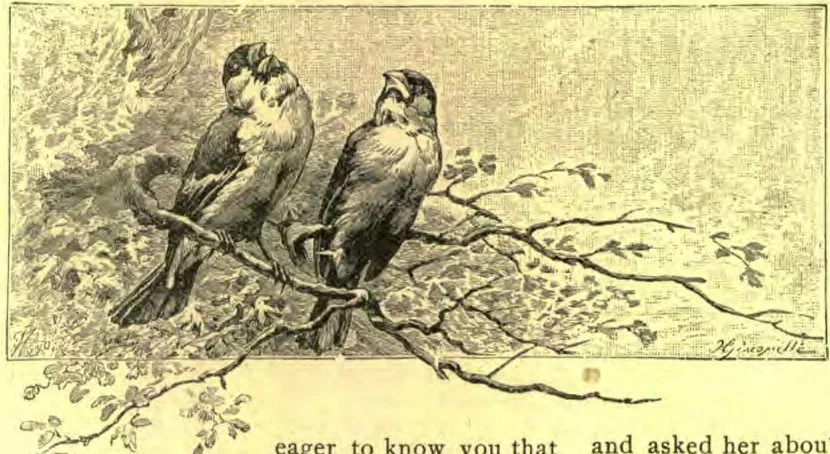
LAST summer when we were in Georgia, a mocking-bird came every morning to the rose-hedge of our garden, and sang for us the most beautiful song in the world, clear, tuneful, and thrillingly sweet,—a fitting accompaniment to that land of bloom and sunshine. His mate came also, and grew so fearless after a few days that she ate the crumbs we placed on the window-ledge for her.
One day Burt found their nest in an old apple-tree in the edge of the orchard, with four little brown-and-white birds, ready to fly. He took two of them, thinking to have their wonderful music in his Northern home.
“I’ll keep them in a cage on the piazza, where they can get the sun and air; and if the old mother-bird finds them, she’ll see they’re all right. Anyway, there’s two left,” he added, to ease his conscience.
But mammy shook her head solemnly. “Hit ain’t no use trying to keep ’em, chile,” she declared, seriously. “If you’s gwine off right now, ’t would be different. Der ole mammy-bird, she fine ’em, d’rectly. She ain’t gwine let you take ’em off. When she fine out she can’t git ’em outen the cage, she’ll pizen ’em, fer to git ’em outen misery.”
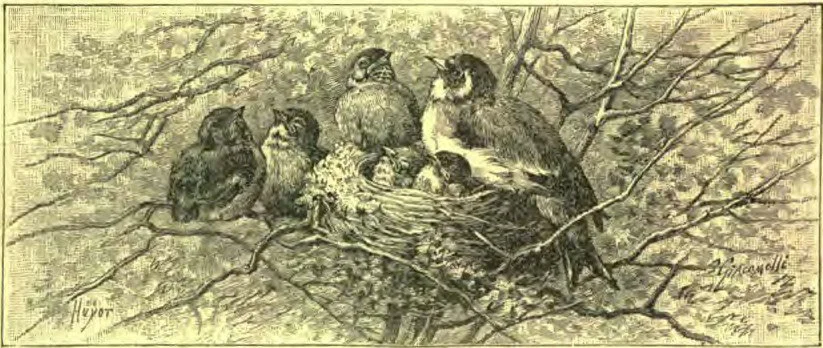
We put that queer story down to mammy’s unbounded faith in the traditions and superstitions of her race, and paid no heed to her prophecy. Burt fed the birdlings with dainty morsels and grubs, which they seemed to relish greatly; on the whole, they did not appear aware of their captivity, but the mother-bird hovered about the cage all day, refusing the feast which we laid in the accustomed place. She uttered plaintive, chirping little cries, which grieved every one of us deeply. She seemed to have forsaken her other children: perhaps the father-bird had taken them in charge.
On the morning of the third day I went out on the piazza, just as the mother-bird flew up from the orchard, and alighted on the little brass rim at the edge of the cage. She thrust a few wilted, pale-green weeds between the bars, and waited to see the little prisoners swallow them greedily; then she flew away to her nest.
“Feeding them, wasn’t she!” Burt exclaimed, coming up just then with a handful of bugs and worms that he had gathered from the rose-hedge. “I wish I knew what the stuff was; it must have been something birds particularly like, or she wouldn’t have brought it.”
At noon the birdlings rejected the grubs Burt offered them, and he put them away for their evening meal, believing that he had overfed them that morning. But that night we found the little feathered balls lying limp and lifeless at the bottom of the cage.
“I done tole you,” said mammy, taking out the dead birds very tenderly. “I’se seed it a many a time. De ole mammy jes’ kills ’em, fer to git ’em outen misery.”
It was indeed true. The mother-bird had reasoned out the problem with rare intelligence; and finding herself unable to rescue her young, had chosen for them death rather than captivity.
MRS. O. PETERSON.
MAKING FRIENDS WITH BIRDS.
ANY one can “learn about” birds by sitting in his library and reading about them, or by going to illustrated lectures, and this is a desirable thing to do; but to get acquainted with them requires personal relations,—seeing and hearing and feeling them in their own haunts. If I can assist any one to this acquaintance by a general introduction, I shall be much pleased; but I warn him that he will not succeed unless he behaves courteously.
You would resent the rudeness of a person so eager to know you that he burst your door, and came into your parlor with a leap and a shout. So do the birds. You should go very quietly to their place of residence, and respect their timidity and desire for privacy. Remember that every bird looks upon you as an enemy until you have won its confidence; and you can never gain this unless you keep very quiet, avoiding noise and hasty movements.
Do this, and you will soon find that the birds’ little flutter of alarm has passed, and that they are almost as curious about you as you are in regard to them; a little later they will forget your presence, and go about their affairs.
Having secured their confidence to this extent, you can draw sufficiently near to see their size, shape, and markings, and so learn their names in the books. When I first began to study birds, I had no books, nor any friend who knew as much of the matter as I did. I had to fix peculiarities in my memory, and make my own names. Nowadays, a half-dozen small and convenient works, as well as larger, more costly ones, are at the command of every student who can spend a dollar and a half. Having a suitable book to help in naming the birds you find, you will need a good telescope or opera-glass to aid you in seeing the birds well.
MAY and JUNE are the best months for study. The resident species have then been reinforced by hosts of migrants from their winter home in the South, and all are in their newest and brightest dress, and in the most active and interesting period of their lives; for now they are busy with nest-building and egg-hatching, and soon will be full of happy domestic cares. This is their time for singing, and one of the first and most interesting things to do is to connect the song and the singer so thoroughly that you will make no mistake in recognizing the voices of the groves and meadows.
Birds are early risers. Find out which one is the first to begin his song, almost as soon as dawn appears, and in what order others awake. There is such an order. This is the best time for observing them, for several reasons. The air is cool; the light good; and the birds are hungry, and so busy in feeding that you not only have the best opportunity to learn what they eat, and how they find or capture it, but they are less timid than later in the day. Their songs, too, are never so joyous and frequently repeated as in the early morning hours.
Don’t try to do too much at once. Be content to keep one bird under observation until you get well acquainted with him. Find a comfortable seat in some retired garden, beneath an orchard-tree or beside a thicket; open your book and opera-glass; then keep quiet, and wait for whatever comes. You will not have long to wait, and you will get a nearer view, and see more of the bird and its behavior, than if you tried to follow it. If it goes away, never mind; it is likely to come back again, and the less you attract its attention, the more it will exhibit its natural manners to your eager eyes.—Well-Spring.
THE MYSTERIOUS SINGER.
The Carter house stood in a large garden. The garden was full of trees, and the trees were full of birds.
One day Carrie said, “Do hear that bobolink!”
“I hear a robin,” said Fannie.
“And I hear a bluebird,” said Ruth.
“And I’m sure it’s a thrush,” said Will.
“Oh, no! It’s an oriole,” said Harry.
“I can’t tell what it is,” said Mary, “but it’s a sweet singer. Let’s ask Aunt Lucy.”
“I think it’s a catbird,” said Aunt Lucy when the children ran to her chair on the porch, and asked her about the mysterious bird in the garden.
“A catbird!” cried all the children, in one breath.
“We will go out and find the bird,” said auntie. “There he is, on the highest branch of that tree. He’s after cherries.”
“Isn’t he pretty! How slender he is! But I didn’t know a catbird could sing,” said Mary.
“Climb up and pick some cherries, Harry,” said Aunt Lucy, “and see what the pretty fellow will do.”
Harry climbed the tree, and down came the sweet singer, scolding and crying out just like a cat.
“It is a catbird!” they all said, and then Aunt Lucy told them about the catbird. She told them that the catbird can imitate the songs of other birds. Sometimes he sings a song that is made up of the notes of other birds, and finishes it with a sweet, clear whistle of his own. He is a shy bird, and loves a leafy thicket, where he can be heard but not easily seen.
“He is welcome to my share of the cherries, if he will only keep on singing like that,” said Ruth, clapping her hands.
— Little Men and Women.
A BIRD'S NEST.
By Florence Percy
Over my shaded doorway,
Two little brown-winged birds
Have chosen to fashion their dwelling,
And utter their loving words;
All day they are going and coming,
On errands frequent and fleet,
And warbling, over and over,
“Sweetest, sweet, sweet, O sweet!”
Their necks are changeful and shining,
Their eyes are like living gems;
And all day long they are busy
Gathering straws and stems,
Lint and feathers and grasses,
And half forgetting to eat,
Yet never failing to warble,
“Sweetest, sweet, sweet, O sweet!”
What if the sky is clouded?
What if the rain comes down?
They are all dressed to meet it,
In waterproof suits of brown.
They never mope nor languish,
Nor murmur at storm or heat,
But say, whatever the weather,
“Sweetest, sweet, sweet, O sweet!”
TIME: First year of Christ's ministry. PLACE: Supposed to be Hill of Hattin. PERSONS: Jesus, the twelve, multitudes.
QUESTIONS.
After spending a whole night in prayer, what did the Saviour do early in the morning? Luke 6:13. Why did he ordain twelve disciples? Mark 3:14, 15. Give their names in their order. Matt. 10:2-4. Where did the Saviour then go? Luke 6:17. Give the substance of the first part of the sermon on the mount. Under what figure does Christ show the relation which should exist between his followers and the world? Matt. 5:13-16. What did he say regarding his attitude to the law? What with reference to its permanency and importance? Vs. 18, 19. What is the real meaning of the commandments mentioned in the sermon? What did he say about retaliation? Vs. 38-42. What about love for one's enemies? In what spirit should we give our alms? Where should we pray? Where should we lay up our treasure? Why? Vs. 19-21. What instruction is given with reference to judging? Matt. 7:1-5. What blessed promise is given to all who need help? Vs. 7-11. What will be the character of those who enter the kingdom of heaven? V. 21. To what are two classes of hearers likened? Vs. 24-29.
NOTES.
1. After the ordination of the twelve, Christ preached the sermon that set forth the spiritual principles of his kingdom. What temple could have been so fitting as the blue dome of the sky? What pulpit more in keeping with his utterances, that were high above the thoughts of man, than the mountain? No sectarianism, no tradition of man, can compass the vast principle of love he expounded. All men, among all nations, stand answered by, and satisfied with, the religion of the sermon on the mount.
2. The sermon on the mount, though given especially to the disciples, was spoken in the hearing of the multitude. . . . The narrow beach did not afford even standing-room within reach of his voice for all who desired to hear him, and Jesus led the way back to the mountain-side—“The Desire of Ages,” page 298.
3. True character is not shaped from without, and put on; it radiates from within. If we wish to direct others in the path of righteousness, the principles of righteousness must be enshrined in our own hearts. . . . The consistent life, the holy conversation, the answering integrity, the attire, the benevolent spirit, the godly example,—these are the mediums through which light is conveyed to the world.—Id., page 307.
4. The Pharisees, who came with the multitudes from motives of selfishness and hate, were determined to see nothing in Christ's delineation of right character, because they were waiting for an opportunity to accuse him. He had said nothing of the law, and yet he had depicted character that met every claim of the commandments. He read their criticism, and declared the impregnable position of the law, and the immutable character of its precepts.
5. A jealous regard for what is termed theological truth often accompanies a hatred of genuine truth, as made manifest in life. The darkest chapters of history are burdened with the record of crimes committed by bigoted religionists. . . . “They [the Jews] thought themselves the greatest religionists of the world, but their so-called orthodoxy led them to crucify the Lord of glory. The same danger still exists.”—Id., page 309.
6. In addition to proclaiming that not a jot nor a tittle should pass from the law, Jesus quoted from the commandments, and showed that the law dealt with the very thoughts and intents of the heart. “The law is spiritual.” While the law calls for a literal obedience, it also demands that the inner being should be in harmony with its commands. Those who waited to catch the Saviour in some fault saw themselves as transgressors of the law for which they pretended to have such zeal. It is safe to watch ourselves; but when we have a zeal to square up others, we are in danger.
7. In this sermon, Christ speaks of God's willingness to give the Holy Spirit, by which every need will be supplied, and illustrates it by a forcible parable. He warns of false professors, and gives a test by which they may be known. Those who do the will of God are his own. He closed his sermon by the story of the two men who built their houses,—the one on the sand, the other upon the rock. Those who hear his sayings and heed not, build upon the sand, and the tempest will sweep away their false characters; those who hear and heed, build upon the eternal Rock, and will abide forever.
TIME: Between two and five o’clock, Friday morning, April 7, A. D. 30. PLACE: Palace of the high priest. PERSONS: Jesus, Annas, Caiaphas, John, Peter, servants, officers.
QUESTIONS.
Where do we see Jesus in this lesson? Explain why he had two trials. By what Jews in high position was he first questioned? Tell of the Jewish court by which he was formally tried. What became of the disciples when Jesus was arrested? How did one escape temptation to deny his Lord? Tell of the palace to which Jesus was led. V. 15. How did Peter gain admittance? What question did this lead to? How did Peter reply? With what company did Peter linger? How was he questioned later? Had he now courage to confess his interest in Jesus? What brought him to a realization of his guilt? About what did the high priest question Jesus? What did he say about his doctrines? For what purpose had he ever spoken in secret? What witnesses of his teachings were at hand? What indignity did one do Jesus? How did Jesus receive this? Before whom was Jesus now tried?
NOTES.
1. “Betrayed into the hands of Roman soldiers and Jewish officers by Judas, Jesus was bound, and led to the palace of the high priest. . . . The Sanhedrin, the supreme ecclesiastical court of the Jews, was permitted to try religious cases; hence Jesus was first tried before this body of seventy Jewish priests, scribes, and elders. . . . There was an informal trial before Annas, who soon sent Jesus, with his accusers, to another apartment of the same palace, where Caiaphas, the acting high priest, questioned him, while waiting for the members of the Sanhedrin to assemble.”
2. “Under the Roman rule, the Sanhedrin could not execute the sentence of death. They could only examine a prisoner, and pass judgment, to be ratified by the Roman authorities. It was necessary to bring against Christ charges that would be regarded as criminal by the Romans. An accusation must also be found which would condemn him in the eyes of the Jews. . . . Joseph of Arimathea and Nicodemus were not now to be summoned. . . . If Jesus could be proved a blasphemer, he would be condemned by the Jews; convicted of sedition, it would secure his condemnation by the Romans.”
3. Christ’s open manner and heroic bearing in the face of death, were like the flashing of a heavenly light in the darkness of that cringing, cowardly, cruel counsel. They were willing to reap the benefit of injustice, and gain by foul means what it was impossible to obtain by a fair procedure.
4. “Ask them that heard me.” To have followed this suggestion would have been to defeat their own murderous designs. What could have been said of him, save that in every word he had glorified God, and fulfilled the Scripture? This would never do. Annas was silenced.
5. “Answerest thou the high priest so?” The anger that caused the officer to smite Jesus with this righteous-sounding rebuke was no justifiable indignation. It was the wrath of the dragon, that could scarcely be restrained until the form of trial could be carried out. This same spirit is made manifest wherever an ecclesiastical dignitary is silenced by truth. The answer of truth is accounted as insulting to one who upholds some revered tradition that contradicts the word of God. How are such blows registered among the witnessing angels?
6. “While the degrading oaths were fresh upon Peter’s lips, and the shrill crowing of the cock was in his ears, the Saviour turned from the frowning judges, and looked full upon his poor disciple. At the same time Peter’s eyes were drawn to his Master. In that gentle countenance he read deep pity and sorrow, but there was no anger there. The sight of that pale, suffering face, those quivering lips, that look of compassion and forgiveness, pierced his heart like an arrow, . . . unable to endure the scene, he rushed heart-broken from the hall.”
7. The related passages in the other Gospels furnish us with the links between this lesson and the one to follow. Caiaphas secured his end by forcing Christ, under oath, to declare himself the Son of God. With pretended horror the high priest rent his robe, but in so doing violated the law of priesthood. The priestly garments were never to be rent, as they symbolized the spotless, unblemished character of Him who clothes his priesthood in the seamless garments of salvation.
NOTES AND COMMENTS
On account of the steps being taken by the czar to Russianize Finland, large numbers of Finns are leaving their native land, and coming to the United States, where there are already about two hundred and fifty thousand of their countrymen. Not long ago, four hundred of them came on one ship to Hull, England, on their way to this country.
THERE will soon be coined from the United States mint fifty thousand silver dollars,—the amount subscribed by this country to the monument to Lafayette, to be erected in Paris. On one side of the coin it is intended to have the faces of Lafayette and Washington, with, perhaps, those of Lincoln and Grant; and on the other, the French general’s prayer for the United States, consisting of about forty words.
Affairs in the Philippines.—Little or no progress has been made in the work of restoring peace in these troubled islands. Two or three times United States soldiers have been captured, and they are still held as prisoners by the Filipinos. If the present advance of General Otis fails, it is said that the President will at once issue a call for the thirty-five thousand volunteers for which provision was made by Congress last winter.
A Trust of Trusts.—There seems to be no limit to the combinations of corporations this year. All have been surprised at the great number of trusts organized since January 1. Now comes from Pittsburg, Pa., the report of an effort to unite the three great trusts called the American Steel Company, the American Tin Plate Company, and the American Steel Hoop Company into a single stock corporation. One of the promoters says the deal will include several other iron, steel, wire, and chain companies. The capitalization of this vast combine will be $500,000,000.
Scarcity of College Presidents.—A remarkable fact, worthy the attention of colleges and universities, and of much interest to young people, is the marked scarcity of available men for college presidents. There is a great number of recruits for the various other professions; and the number of men who think they are qualified to fill the position of head in our higher institutions of learning is also always large. However, the fact that Yale University has for months been looking for a capable president, and the University of Cincinnati, with a salary of $5,000, is also looking for one, shows that the country needs more men who combine scholarly attainments with a successful business training.
An Interesting Publication.—This Office has received a sample copy of the Bounding Billow, a little paper printed on Admiral Dewey’s flag-ship “Olympia.” It is dated “Manila, P. I., November–December, 1898,” and is “published in the interests of American men-o’-warsmen.” It is sent with the compliments of W. W. Weaver, who says, “This is a sample of Filipino type-sticking, no proof submitted.” The typographical work is excellent. The editor says: “This issue is printed on captured paper; and even though the war is over, we still derive benefit from the downfall of the ‘Dons.’” Of course the war with Spain is referred to, as the war between the United States and the Filipinos had not then begun.
Magazine Made in a Prison.—April 26 the first number of the Star of Hope made its appearance from the Sing Sing (N. Y.) State prison. It is to appear semi-monthly, and is written, printed, and published by the inmates of the prison. To avoid embarrassing the contributors by presenting their names to the outside world, the articles are all signed with the cell-numbers of the convicts. No. 1500 is the editor. He congratulates himself, in his salutatory, on freedom from “the remorseless pangs of unstable subscription lists or delinquent subscribers.” As the paper has no subscription price, he says, “The prospects are fair for a full complement of subscribers, and our treasury will not become depleted by large fees to its contributors.” In a note the warden explains that the work on this paper will in some measure take the place of the physical labor which has so foolishly been restricted by recent legislation.
THE QUARTER-ACRE GARDEN.
By Arthur F. Hughes
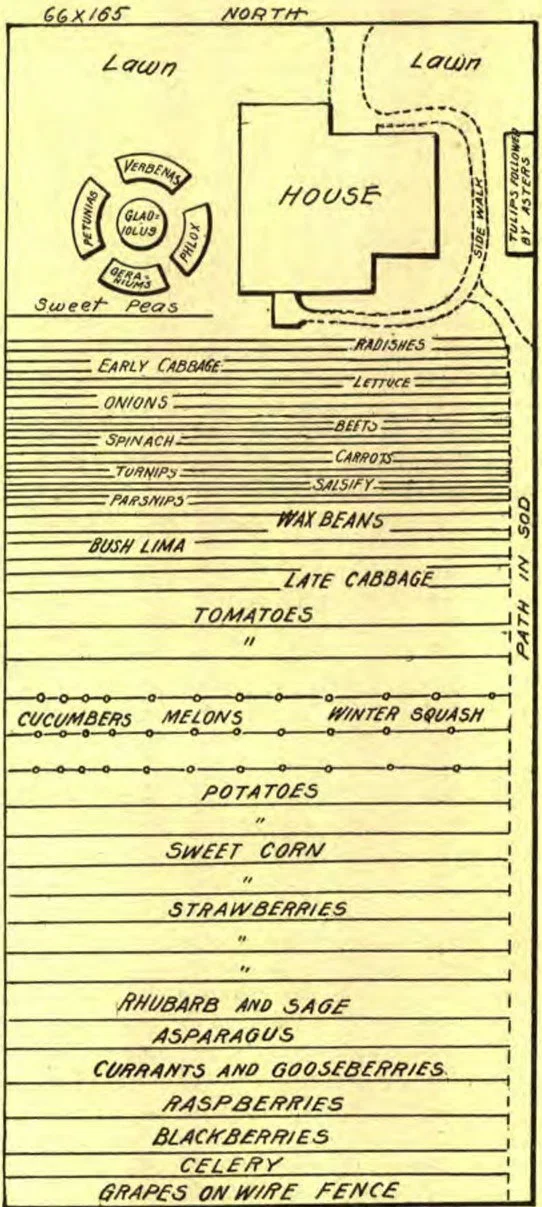
In previous articles we have spoken of the small, temporary garden and the permanent acre-garden. The accompanying diagram shows what can be done for the Master on a quarter of an acre. But whatever the size of your garden, let me insist upon the rotation of crops. Early sweet corn may be followed by late potatoes, cabbage, or string-beans. Early peas may be followed by melons, squashes, or field beans. After strawberries are picked, spinach, lettuce, or late radishes may be planted between the rows. Besides giving an increase of crops, this method of planting will keep the garden free from weeds, and will not exhaust the soil half as much as if they were allowed to grow.
“The amount of ‘green stuff’ that can be grown on a single acre, well tilled, in one summer, is simply incredible,—wagon-loads upon wagon-loads; and there need not be a single meal, from early spring until winter, that is not made more cheerful, more palatable, more wholesome, and altogether more enjoyable, by the presence of some good dishes from the garden, to say nothing about canned tomatoes, sweet corn, berries, crisp stalks of celery, etc., during the winter months. Think,—sixty meals with big plates of strawberries, and sixty more with raspberries and blackberries! Think of the wholesome dishes of asparagus, of the young onions and radishes, the green peas, beans, tomatoes, squashes, melons, etc.” All this can be accomplished in one season.
There will be no trouble in disposing of all you raise; for city people are always glad to get fresh vegetables from the garden. What better method of teaching the principles of health reform could be devised than selling clean, fresh, crisp vegetables, to say nothing of placing in tempting array the large berries and grapes? We are told that we should not teach people to discard certain articles of diet unless we have something better to give them.
Let me again insist upon never using fresh stable manure, unless you can keep the ground well watered. Five loads of decomposed manure is not too much for a garden of this size. Wood ashes are excellent for fertilizing all kinds of soil. If you have been in the habit of throwing ashes in the road, or making a heap somewhere, do so no more, but scatter them over your garden. Market-gardeners living near New York City pay from twenty-five to thirty cents a bushel for wood ashes. Slaked lime and plaster are excellent for some kinds of soil. The manure from the hen-house is also an excellent fertilizer. Like stable manure, it is best when well decomposed. If not fully rotted, mix thoroughly, in small quantities, with soil.
Will it pay to buy commercial fertilizers?—Yes; but let me give a word of caution: There are fertilizers advertised particularly for onions, or beets, or turnips, etc., etc. These special fertilizers are sold at high prices. A fertilizer that will raise onions will also raise beets. The best all-round commercial fertilizers are ground bone-dust, nitrate of soda, and salt. If nitrate of soda and coarse salt are sprinkled over the ground, twenty-five pounds of the former and fifty pounds of the latter, for each quarter-acre, or city lot about four by eight rods, just as the early vegetables begin to peep through the ground, they will grow like mushrooms. This fertilizer should be applied during or just before rain, so it will be dissolved and carried into the ground. It may also be used after the garden is well up; but the sooner, the better, after roots have formed so that it will be used by the plants. A smaller quantity may be sprinkled on every two weeks.
FOURTH'S
As to the quarter-acre garden, but little need be said as to its location; for the necessities of the situation will often require it to be placed back of the house. The arrangement of the beds may be followed as indicated in the accompanying diagram, or it may be changed to suit the taste of the gardener. To plant radishes, lettuce, etc., in long rows, rather than in small beds, will assist in the cultivation with the wheel-hoe; and if the small and more frequently needed vegetables are planted near the house, much tramping of the soil will be avoided.
To set out cabbage and tomato plants, have the soil mellow and in good condition. Be sure to use a rope or strong cord to keep the rows straight. Crooked rows show careless and slovenly work. They are not like some little sins, that can be covered from mortal eyes as soon as they are committed, but are a constant witness the whole season. Never set out plants of any kind until afternoon, unless it is cloudy, or there is an approaching rain, in which case make all haste possible. Always press the soil firmly about the roots of plants, with the fingers. If the soil is dry, leave a small pit by the side of the plant. Into this pit pour about a pint of water; after the water has disappeared, fill up the trench with soil. This should be repeated once each day in dry weather, until the plants have a good start.
Muskmelons do well in any rich soil. It must be mellow and in good condition, and plenty of good fertilizer will not be amiss. Three or four shovelfuls of well-decomposed manure should be mixed with the soil at each hill. With a hoe make hills five feet apart, scatter ten or more seeds in each, cover with an inch and a half of soil, and firm with the back of the hoe.
Watermelons require the same care as do muskmelons, except that the hills should be made from six to eight feet apart, according to the variety planted.
Squashes will do well under the same care. Summer varieties may be planted four feet apart, but the later winter varieties should be planted eight feet apart in the rows.
The same treatment will give an excellent crop of cucumbers. They should be planted four feet apart. ARTHUR F. HUGHES.
THE ROLLING PLANT.
The Kansas valley is the home of a queer plant. It grows in the form of a ball, its stem being extremely small in proportion to the size of the entire plant, which varies from a foot to four feet and a half in diameter. While growing, it is firmly fixed to its stem, which, in its turn, is rooted in the ground; but as soon as the plant has arrived at maturity, the stem shrivels up, and then a gust of wind is quite powerful enough to set the ball rolling across the prairie. It rolls, leaps, bounds, sometimes even jumping over bushes, impelled by the force of the wind. When the winds are high, it is impossible to imagine anything stronger than the sight of these light, elastic balls, which appear to pursue one another, rapidly skimming the surface of the soil.
It is related that two hunters, overtaken by a violent storm of wind and dust, descried some curious objects bounding toward them, which they at first thought to be wild animals; on coming nearer, however, they were found to be none other than the rolling plants of Kansas, borne before the wind.—Selected.
HOT WATER.
Hot water taken freely half an hour before bedtime is helpful in constipation.
Headache almost always yields to the simultaneous application of hot water to the feet and the back of the neck.
A towel folded, dipped in hot water, wrung out, and applied to the stomach, acts like magic in cases of colic.
Nothing so promptly cuts short congestion of the lungs, sore throat, or rheumatism, as hot water, when applied promptly and thoroughly.
A towel folded several times, dipped in hot water, and quickly wrung out and applied over the toothache or neuralgia, will generally afford prompt relief.
Many diseases would be washed out of the system by the free use of pure, soft water, taken into the stomach, or absorbed through the skin.—Selected.
WHAT IS A “COLD”?
By F. M. Rossiter
THE majority of the difficulties of the nose and throat have their origin in “colds.” The question of “taking cold” is one of great importance, because of its prominence in the production of disease in these organs. A cold, whether it be in the head, in the throat, or “on the lungs,” is a congestion of the mucous membrane of those parts, due to a sudden chilling of the skin, either in whole or in part; and because of the exhaustion of the nerve-centers, the skin fails to react, the equilibrium of the circulation is broken, and the part in which there is the least resistance suffers. This is usually some part of the mucous membrane. The most intimate relation exists between the skin on the outside, and the skin on the inside, of the body, or the mucous membrane. The slightest change of temperature affects the skin. In health there is an equilibrium in the circulation in all those parts; but in exhaustion, this equilibrium is broken, and disease follows. Colds are indicators, on the dial of health, of a lowered vitality.—F. M. Rossiter, M. D., in Good Health.
Stopping Sneezing and Coughing by Pressure
Both sneezing and coughing can be arrested by pressing firmly on the upper lip or in front of the ear.
Training Children to Eat Slowly and Chew Thoroughly
CHILDREN should be trained to eat slowly, and chew their food thoroughly, no matter how hungry or anxious to finish the meal and do something else. A scant meal, well masticated, will be of far more value to the body than more food hastily eaten.
Letter from Mrs. F. E. Braucht Describing Samoa Mission
NEXT week the INSTRUCTOR will give extracts from another interesting letter from Mrs. F. E. Braucht, of Apia, Samoa, telling some of the experiences of our missionaries there during the recent troubles on the islands.
Distributing Clean Periodical Copies to Orphans and Hospitals
Brother C. V. S. Boettger, 218 Bank St., Christian Help Mission, Ottawa, Ontario, has an excellent opportunity to distribute clean copies of the Instructor and the Little Friend to orphans and children in hospitals. Where two copies of the paper are taken in the same family, as is often the case, or where the papers are laid away after reading, it would be well to remember that they would cheer many a lonely hour if put into the proper hands.