Getalongableness: The Essential of Working Together
“Getalongableness”
THAT is almost long enough for a German word. That word, however, was coined by an American business man, and named by him as an essential of business success.
We call it team play in athletics, in contrast with the individual grand-stand each-for-himself play, which is sure to lose a game. A young woman of whom I know can sing very creditably by herself, but in spite of much training she cannot sing even respectably with others. She not only gets off the key, but she gets other people off.
Getting together, working together, and getting along together are just as essential in business or church work as in music or baseball. Some very bright and skilful people make failures of their careers because they simply are unable to work with others without friction. “Getalongableness” can be learned and cultivated. Corners can be worn off. Squeaky hinges can be oiled. Young people can adjust themselves to places and people.
The fact remains that a good many young people fail because they do not adapt themselves. They fail from lack, not of ability, but of adaptability. Rigidity of character is good, but it is not incompatible with being “all things to all men.” A man may have a backbone and still be a good mixer. The vertebral column is composed of a good many small bones, so that you can bend your back without breaking it. The secret of “getalongableness” is, at bottom, unselfishness. Courtesy, kindness, graciousness,—these ought to be the fruits of Christian character, and will make one companionable, friendly, and so more efficient.—The Wellspring.
Umbrella Sam
I’LL tell you how he came to be called that.
At school he was always trying to shield some one in some way.
“Take care there!” he would say, “next thing your ball will go through the window, and then you’ll be punished.” It was said on the school ground that Sam would lie awake all night studying how to keep a fellow from getting a whipping.
I don’t know that that was true, but I do know that he walked two blocks out of his way just to prevent little Kittie Gray from being scared almost to death by Butcher Adams’s fierce dog.
“Ho!” Sam declared, “I’d just as lief go this way every night.”
“He’s keeping the storm off Jimmy,” said a boy one day, pointing to where Sam stood with his arms around the trembling little fellow, while big bully Smouse stood over them shaking his fists and threatening.
“He makes a pretty good umbrella,” said the teacher. “I should feel proud if I could do as good service.”
And from that day he was called “Umbrella Sam.” — Herald of Life.
Pin Money
WHEN pins were first introduced into England, less than four hundred years ago, they were so expensive that only wealthy people could afford them, and those who could were as proud of the fact as people are to-day over the possession of automobiles.
Then, as now, the statute books contained some very peculiar laws. Among them was a regulation permitting manufacturers to sell their pins only on January 1 and 2. So, when the good wife went forth on these dates to get her pins, she bought them with what she called her “pin money.” To have “pin money” in those days was an indication of social position, and we can imagine the people liked to exploit the fact. The expression has been preserved with somewhat the same significance. To have “pin money” is to have money that does not have to be spent for necessities.
It may be interesting to know that about fifteen hundred tons of iron and brass are used in the manufacture of pins in the United States yearly.—The People’s Home Journal.
Is It True?
By W. S. Hyatt
Not a missionary visit made, nor a paper or a tract given; not a missionary letter written, nor a Bible reading held; not one hungry person fed, nor a naked one clothed; not a sick person assisted, nor a treatment given; not a child brought to Sabbath school, nor a soul to Jesus! Is it true? From the oft-repeated assertion, “I have nothing to report,” we are forced to conclude that it must be so, but it does not seem possible. Surely it is too terrible to be true. Such a message as we have, and nothing done for Jesus! Is it true?
“O brother, be faithful! and soon thou shalt hear
Thy Saviour pronounce the glad word,
Well done, faithful servant, thy title is clear,
To enter the joy of thy Lord.”
1. How does Jesus say the Son of man will come? What will he then do? Matt. 25:31. Note 1.
2. Who will be gathered before him? Verse 32, first part. Note 2.
3. What will he do to the nations? Verse 32, last part.
4. Where will he set the sheep and the goats? Verse 33.
5. What will the King say to those on his right hand? Verse 34.
6. What reasons does he give for calling them to their inheritance? Verse 35. Note 3.
7. What three additional reasons does he give? Verse 36.
8. What will the righteous answer? Verse 37.
9. What further questions will the righteous ask? Verses 38, 39.
10. What wonderful answer will the King give? Verse 40.
11. What will the King say to those on his left hand? Verse 41.
12. What reasons will he give for this command? Verses 42, 43.
13. How will they answer the King? Verse 44.
14. What remarkable answer will the King give them? Verse 45.
15. Where will these wicked then go? Verse 46, first part.
16. Where will the righteous go? Verse 46, last part. Note 4.
Notes
1. When Jesus comes the second time, the event is to be so glorious that heaven will be emptied of all its inhabitants to form his escort of honor. Our finite imagination can gain but a faint conception of what the glory of that event will be. Jesus is to bring “all the holy angels with him.” In Rev. 5:11 we are given some idea of what their number is, for it says “the number of them was ten thousand times ten thousand, and thousands of thousands;” or as the original gives it, more vividly, “myriads of myriads and thousands of thousands.” A myriad in Greek is the definite number 10,000, so that this text really says “ten thousands of ten thousands and thousands of thousands.” The smallest total number this could make would be 404,000,000, but the actual number of angels is beyond enumeration. Well may we conclude that “all the holy angels” who will escort the coming King on his glorious return, will be, as the translator of Hebrews puts it, “innumerable hosts of angels.” Heb. 12:22, R. V.
2. The angels do not come with Jesus as an escort of honor alone. In Matt. 24:31 it is said that “they shall gather together his elect from the four winds, from one end of heaven to the other.” What a grand and glorious gathering that will be!
3. It is important to notice that the service on which the King will base his commendation or condemnation, is service that is within the reach of every one, even of the least. The words “these my brethren” may seem to indicate that this service is to be given to Christ’s followers only, but we should not interpret them narrowly. While there is a special bond of love between Christ and his followers, and a special promise to any who give them as much as a “cup of cold water” (Matt. 10:42), yet Christ will recognize the spirit of unselfish service that ministers to any one in distress, even when the service is performed by one who is not apparently a follower of Christ.
“Even among the heathen are those who have cherished the spirit of kindness; before the words of life had fallen upon their ears, they have befriended the missionaries, even ministering to them at the peril of their own lives. Among the heathen are those who worship God ignorantly, those to whom the light is never brought by human instrumentality, yet they will not perish. Though ignorant of the written law of God, they have heard his voice speaking to them in nature, and have done the things that the law required. Their works are evidence that the Holy Spirit has touched their hearts, and they are recognized as the children of God.”—“The Desire of Ages,” p. 638.
4. The word “everlasting” in verses 41 and 46, and the word “eternal” in verse 46, are the same word in the original. It must be understood in each case as everlasting in effect. The fire will be everlasting in effect by consuming the wicked, as Malachi 4 says it shall “burn them up,” and “they shall be ashes under the soles of your feet.” Verses 1, 3. The punishment thus inflicted will be everlasting in effect—there will be no recovery from this destruction. Life can be everlasting in effect only by never being cut off. In short, there are only two results—everlasting death and everlasting life. The means and process of producing death need not be confused with the result—death.
Why Not?
WHY should not every Sabbath school have a correspondence class,— a class composed of several persons upon whom is placed the responsibility of keeping up a correspondence with every young person who leaves the town to go out to take up new work in a new place, and of those persons corresponded with? The influence of such a class would be far-reaching. Without doubt many young people who might otherwise drift from the church would be kept in the right path. The following letter from a Sunday school worker suggests the possibilities for good of such an effort:—
“You remember when Marion B— left for that fine Washington position? Well, I wrote her, and she joined our correspondence class. I have a letter from her every week, and I write to her each week, and tell her all the home news as it comes to me. I suggested to her that amid so much that was novel and worth while there, it would be something of a temptation to her to neglect the things that she has been taught to consider of first importance, and she would need to keep in close touch with the church and school, and with those of us who have always known and loved her.
“She has done all this, and in her last letter she said, ‘I am remembering all the advice that you and others gave me, and I want you to know that it has been followed, although it has not always been easy. The notes from the New Year’s sermon that you sent me have done good work; I read them to my roommate, who is inclined to be rather too fond of good times; and yet, at heart, she is good. We agreed that we would not use our Sundays for sight-seeing and good times, but for worship and writing home, etc.; that we would, so far as we knew, keep that day holy. I got up courage enough to ask her to go to Sunday school with me, and she agreed, and now she has got so far interested that we have our morning reading and prayers together. Though I act as a substitute teacher here in Washington, I still “belong” to you, and need just what you are giving me through this blessed correspondence department. Oh, but I am glad we have it, it is so worth while!’
“In eight months’ time we have kept in touch with eleven of our young people who have left home for work; and five of the eleven, besides being cared for, have passed on the spirit of our work to others, and the influence of the written words is spreading and bearing fruit.”
The Road to Heaven
By Nancy Byrd Turner
YESTERDAY
Has slipped away;
God has got tomorrow.
Take today and do your part,
As your part is given.
That's the way to gladness, heart;
That's the road to heaven!
—Nancy Byrd Turner, in the Ladies' Home Journal.
“What are We Without God?”
“O TEACHER, what are we without God?” This is the question a native African woman recently put to Brother H. M. Sparrow as he was making a missionary tour, establishing outschools in the country near Shangani.
The uncivilized savage world shows the result of not having even an intellectual knowledge of God, while the crime, sin, and disease of civilized peoples show the result of not having a personal knowledge of him. He that is without God is without hope, without an anchor to hold the soul in the storm of temptation, and without chart or compass for sailing life's seas.
He that is without God is without a knowledge of the beginning or the end of things. He gropes through life in blindness.
He that is without God is without love. He has never seen the beauty of love as revealed in the cross of Christ.
As the world's night closes down upon the unsaved multitudes, there comes from every corner of the earth the cry, “O Christian, what are we without God? Come quickly and give us that knowledge for the lack of which we perish.” And we who have a knowledge of God, but who are without the power of his life, allow the petty calls, bickerings, and wishes of our selfish hearts to drown out the great Macedonian appeal from the perishing millions. Yea, what are we without God?
Be Careful How You Build
It is not enough for a man to build a ship so that it looks beautiful as it stands on the stocks. What though a man build his vessel so trim and graceful that all admire it, if when she comes to be launched, she is not fit for the sea, if she cannot stand stormy weather, if she is a slow sailer and a poor carrier, if she is liable to founder on the voyage? A ship, however comely she may be, is not good for anything unless she can battle with the deep. That is the place to test her. All her fine lines, her grace and beauty are of no account if she fails there. It makes no difference how splendidly you build, so far as this world is concerned, your life is a failure unless you build so that you can go out into the great future on the eternal sea of life.—Beecher, in Young People’s Weekly.
Contraband Opium and Hemp Burned at Los Angeles
A TWENTY-FIVE-THOUSAND-DOLLAR fire was ignited by inspectors for the State Board of Pharmacy at the Plaza in Los Angeles, California, the flames being fed by the contraband taken during police raids upon the city’s opium dens. Among the confiscated goods were fifty opium pipes, one ton of marihuana or Indian hemp, valued at $16,000, and cans of opium to the value of $7,000.
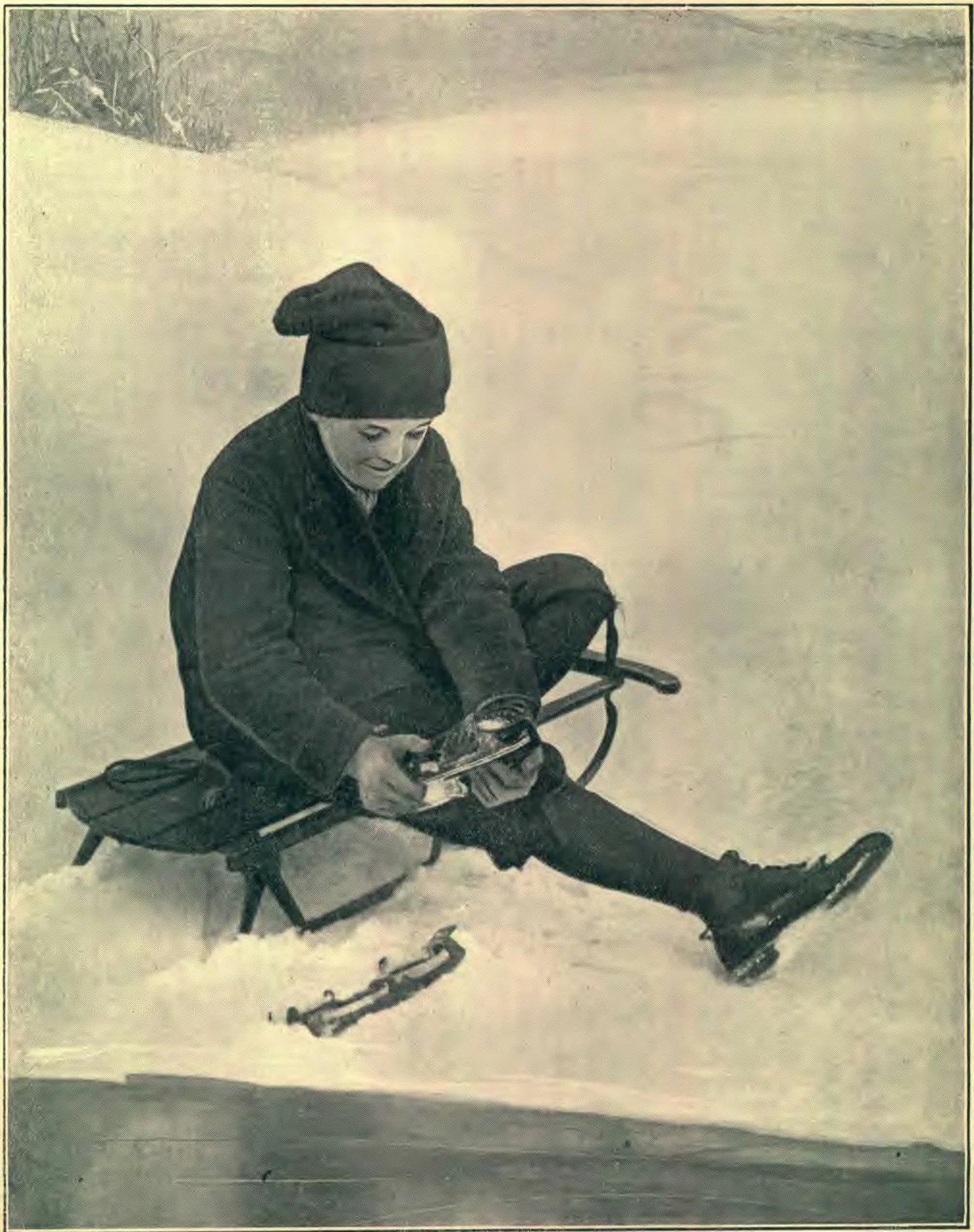
THE BEST SPORT OF ALL.
THE EARLY MORNING OFTEN FOUND JESUS IN SOME SECLUDED PLACE, MEDITATING, SEARCHING THE SCRIPTURES, OR IN PRAYER.