Your ShelfYour Projects

Signs of the Times, Vol. 31, No. 7.

THE MISSION OF CHRIST
Earlier text: Question Corner

EVOLUTION AND GEOLOGY

XI. SOME GEOLOGICAL DEFINITIONS.

HAVING now seen that Evolution has its stronghold in Geology, that, in fact, Geology furnishes ninety-nine per cent. of its supposed foundation, we must next undertake an investigation of this much misunderstood branch of science. And to prepare my non-scientific readers to understand the discussions which will follow in these papers, I must here explain some of the more common terms and expressions.
So brief a treatment of such an extensive subject must necessarily be somewhat obscure and incomplete. But I shall do the best I can to avoid these defects, and hope that those of my readers not already familiar with the science will preserve this article for future reference, so as better to understand the discussions which will follow.
Geology* is the science of the rocks. And the term "rock" is used in this science "to denote any naturally-formed mass of mineral matter, whether it be hard or soft, compact or loose. Hence, blown sand, mud, clay, gravel, and peat are, in the geological sense, 'rocks' quite as much as granite, sandstone, or limestone."

Classes of Rocks.

Rocks are broadly divided into two classes, igneous, or fire-formed, and aqueous, or water-formed rocks. Regarding the former class we shall have little to say, as they are only incidentally connected with the line of thought upon which we are working. They include, however, not only the trap, basalt, etc., of true volcanic origin, but also the slates, quartzites, gneisses, schists, and granites, which are sometimes called metamorphic or changed rocks, because produced, in some cases at least, from ordinary water-formed rocks by the action of a much more moderate degree of heat.
Aqueous rocks are also called sedimentary, because produced from a sediment deposited in water. They are also said to be stratified, because formed in successive strata or layers, one on top of another. Ordinary gravel, sand, and mud belong to this class; and these, when consolidated or hardened, become respectively conglomerate, sandstone, and shale. And they are said to be fossiliferous, when they contain fossils or remains of vegetables and animals embedded in their substance.
In regard to the age of a series of layers found in their natural condition, "those at the bottom must obviously be the oldest, because they must have been deposited before those lying above them. . . . In all such cases, the beds at the bottom are the oldest, and those at the top the newest. This arrangement of one bed or stratum above another, in the order in which they were laid down, is called the order of superposition."

As to the Time.

And yet, as it is almost solely in regard to time that the geologists make their blunders, i. e., in false notions and reasonings regarding the time or relative age of these various successive layers, we must right here be on our guard. When we find one bed or stratum lying above another, the lower one is of course the older of the two; but whether laid down ten minutes earlier or ten million years earlier, how are we to determine?—The common way is by the fossils they contain, as will be explained later; but as this method is based on a series of pure, unfounded assumptions, its results should have no weight whatever for us who want facts, not theories. Hence we are compelled to say that there is absolutely no way of telling how much longer the lower layer was deposited before the next succeeding, tho, if the two are conformable to one another in bedding, and the bottom one shows no evidence of erosion upon its surface before the other was deposited, the strong presumption is that no great time elapsed between the laying down of the two layers.
Another point to be noted here is that regarding the consolidation or hardening of strata. It not infrequently happens that the upper bed or beds may be much harder than those below them. This would not prove that the upper one was much the older of the lot; but would rather show that some strata harden or consolidate much more quickly than others. Indeed some substances, such as limestone, become hard or set almost immediately on being precipitated from water, and a mixture of fine sand and iron filings will, if exposed to the weather, quickly become a hard mass, not readily distinguishable from some of the "oldest" deposits on the globe. Hence the degree of solidification in a given series of beds is of very little use in determining their relative age.

The Earth's Crust.

Regarding the term "the earth's crust" Prof. A. Geikie says:
This name came into use when people supposed the inside of the planet to be an intensely-hot liquid mass, with a cool and comparatively thin crust outside. A great deal of dispute has arisen as to whether the main mass of the inside of the earth is liquid or solid; but those who dispute, whatever their views may be, agree to use this phrase, "the earth's crust," as meaning that part of the earth which men can observe, from the top of the highest mountain to as far below the deepest mine as they can reasonably infer what the rocks must be.
To this conventional definition we will all readily agree; tho, as we are informed by one of the highest-class scientific journals in the world, that "modern analysis tends to the conclusion that our globe is solid throughout" (Nature, Feb. 28, 1901, page 414), we may decline to admit that it is now, or has ever been in the past, a "pulsating crust," rising and falling ad libitum.
But one of the most marvelous, and, indeed, most perplexing, facts about the rocks remains yet to be noted. In almost every section of country we find examples,—perhaps extending over miles of the surface,—of strata, not lying in the horizontal position in which they were deposited, but squeezed, fractured, and crumpled up in such an astonishing manner that they may be standing on their edges or even completely overturned. I do not wish to convey the impression that ALL the cases of this nature, described in the text-books, are really of this character. As we shall find hereafter, some supposed examples of this nature are of such enormous magnitude, and rest on such doubtful evidence that it is not necessary to so understand them. But on a small scale we have numerous examples of this folding and crumpling of strata.
For a few important definitions pertaining to this subject, such as fault, dip, strike, outcrop, anticline, and syncline, I beg to refer the reader either to text-books on the subject, or to some good dictionary, such as the "Standard," where such terms will be found explained with more minuteness than I can employ here, perhaps also by means of illustrations, without which a mere verbal description is of little use.

A Faulty Treatment.

Regarding the way in which the strata are generally treated, in order to assign each to its proper "age" in the long-drawn-out past that the geologists have taught us to believe in, I give the following from Sir A. Geikie:
According to the law of superposition the undermost stratified rocks are the oldest. We can reach but a little way down into the earth. The deepest mines or borings descend but a very few thousand feet below the surface. If, therefore, these rocks still lay flat as they were deposited, we should be able to make ourselves acquainted only with those near the surface. But in consequence of the way in which the rocks have been bent, broken, and upheaved, we see, not only the topmost parts of the series, but even some of the oldest masses. Instead of lying flat, the rocks are very commonly found to slope into the earth more or less steeply, and we can walk over their upturned edges, like the backs of so many rows of books. So far, therefore, from the bottom rocks being still buried under the thousands of feet of solid rock, beneath which they once lay, they are often found rising into the summits of lofty mountain ranges. The geologist, consequently, does not need to sink deep bores and pits to find out the order of the rocks under his feet. By making careful sections from what can be observed at the surface, he can usually determine that order with certainty, and, when he has done so, he knows which are the oldest parts of his chronicle, and which are the newest.—"Primer on Geology," pages 137, 138.
We may admit this last statement, in a kind of general way, for any particular and limited locality; but when the geologists, in their usual fashion, begin to compare the rocks in distant localities, and to affirm that the rocks in one country occurred chronologically, say, IN BETWEEN, two other sets of beds in some other country, where no trace of such rocks is to be found at all, we demur; for the evidence is wholly founded on assumptions and fanciful guesses, as we shall hereafter see.

Geological Formations.

But it is in this very way that the "formations," or sets of rocks, are pieced together from strata found here and there, and all together assigned to some imaginary "age" or period in "the dark backward and abysm of time." This idea is the hardest for the young student to grasp of any in the whole range of Geology; but, as no progress whatever can be made until this pons asinorum is crossed, it will be necessary to elucidate it as best we can. To do this, I quote from James Geikie:
The term "formation" is used very laxly by geologists. Sometimes it signifies a group of strata of inconsiderable or merely local importance, and occasionally the word is applied to a single stratum. Those writers, however, who are more careful in matters of terminology, restrict the term "formation" to those great groups of strata which are characterized by the presence of fossils having a facies [general aspect] so peculiar to themselves, that it not only serves to mark off the strata from overlying and underlying deposits, but to distinguish them wherever they occur throughout the globe. . . . By a "formation," then, it will be understood that we mean all the deposits . . . which accumulated over the surface of our globe . . . at a time when the world was characterized by the presence of some particular and peculiar fauna and flora.—"Historical Geology," pages 12, 13.
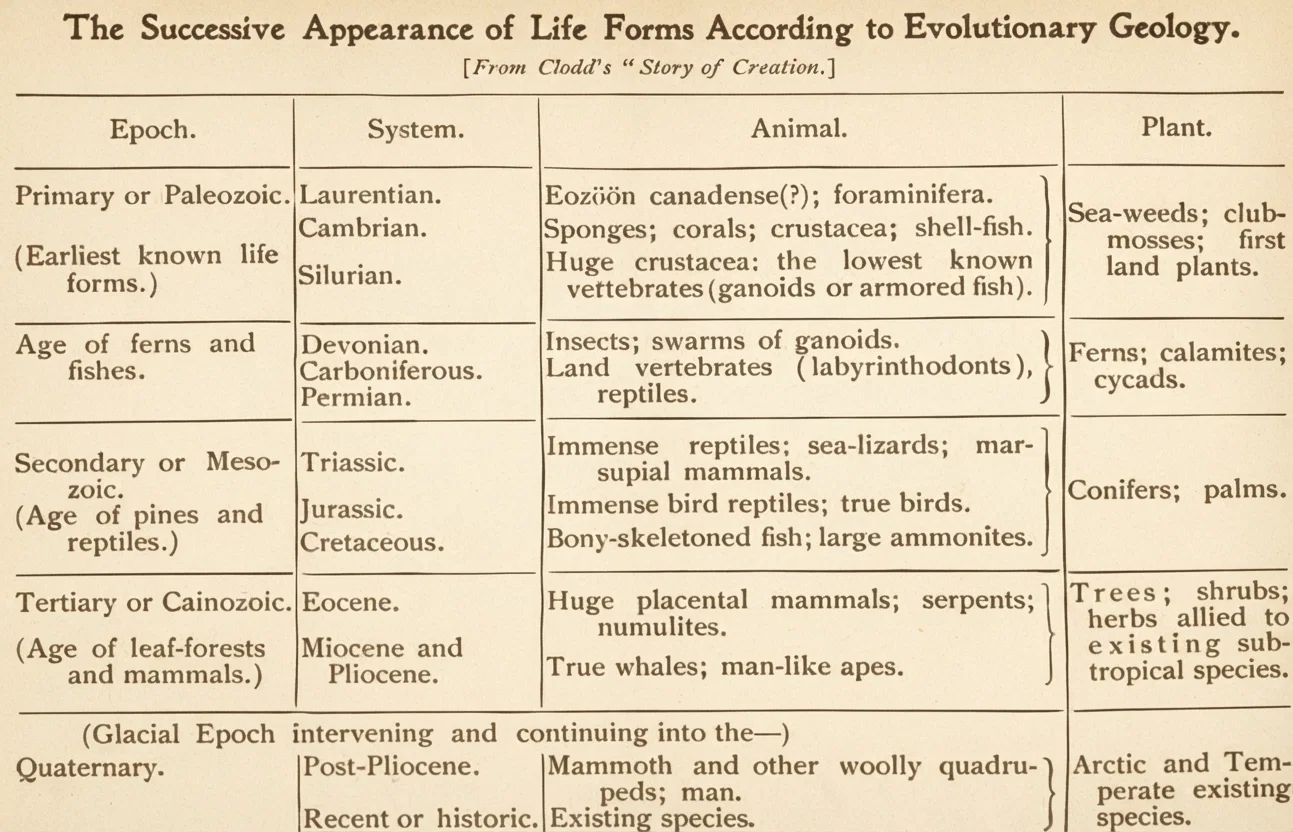
It will thus be seen that the "formations," or sets of rocks, are not found together in any one place in such relation that, by the law of superposition or stratigraphical evidence, one can be said to be older than another. Nor is a single "formation," perhaps, completely found together in any one place, but the rocks from perhaps half a dozen different countries are classed together to make the "formation" or "group" complete. But each of these groups or formations is assumed to represent a period of time; the various rocks over the globe having similar groups of fossils are classed together into one of these sets or formations, and are supposed to have been laid down contemporaneously, and then, according to the prearranged scheme of life,—succession from the low to the high,—these various groups are fitted into their appropriate places in the great hypothetical ladder of life; and the geologist will assure you that we have in this arrangement a correct history of our globe.
But, thank God, we have something surer than such crude guesswork.
["The Assumptions of Uniformity" is the title of the next article.]

PRAYER AND HOME RELIGION.

BY MRS. E. G. WHITE.
PRAYER is the life of the soul, the foundation of spiritual growth. In your home, before your family, and before your workmen, you should testify to this truth.
It is just as convenient, just as essential, for us to pray three times a day as it was for Daniel. And when you are privileged to meet with your brethren in the church, tell them of the necessity of keeping open the channel of communication between God and the soul. Tell them that if they will find heart and voice to pray, God will find answers to their prayers. Tell them not to neglect their religious duties. Exhort the brethren to pray. We must seek if we would find, we must ask if we would receive, we must knock if we would have the door opened unto us. If there are only a few assembled, there are enough to claim the precious promises of God. The Father, the Son, and the holy angels will be present with you to behold your faith, your steadfast principle, and there you will have of the outpouring of God's Holy Spirit. God has rich blessings in store for those who will bring not only all the tithes into His storehouse, but also time and strength of bone and brain and muscle into His service. Those who will do this, will walk in the light, and will triumph in God.
Let each professed follower of Christ carry out the principles of practical godliness in his own house. Religion in the home is the best proof of genuine piety. It is not the stranger, the visitor, the minister, that can best judge of your Christian devotion; it is your children, your servants, the workmen who toil in your fields, who can best tell whether or not you love God and keep His commandments. If your household, your workmen, are not better for your Christianity, then the truth has not wrought its designed work upon your soul. Let not your workmen say: "This man for whom we work has a queer sort of religion. There are no morning or evening prayers in his house. We begin and end the day with drudgery, and we have so much to do on the Sabbath that we can scarcely get time for secret prayer."
Carry your Christianity into your family. Let a bright, steady light be burning. Let impressions be left upon minds of the truth of your God, and the value of His service, that will be as far-reaching as eternity. O, how much need there is of prayer, of tears, of faith! You should pray for the ministers, for those who are weak in faith. You should let your prayers follow the laborers as sharp sickles in the great harvest-field. You should wrestle with God as did Jacob. We may have pentecostal seasons even now, if the people will pray fervently, and believe in the promises of God. And when prayer and faith abound among God's people, the world will see a steady light shining forth from them.
We should study the experience of past life, study it just as we study the proof-sheets of an article, to find the errors and to note them on the margin of the page. We should do this daily, and note our faults so that we may avoid them in the future. Do not forget to examine yourselves whether you are in the faith. Prove your own selves, for unless Christ is in you, you are reprobates. Reform every unchristlike action, seeking the Spirit of your divine Master. Take your hearts, by nature cold as an iron wedge, and let melting mercy fall upon them, that they may be subdued by the grace of God, and impressed by the Spirit with the image of your divine Lord.

RELINQUISHMENT.

BY M. ELISABETH BURNS-HOWELL.
“‘Tis time to put the toys away,” I said to baby dear, When she had ended all her play, And shades of night drew near. She did not cry, Nor question, “Why?” Nor ask that we might “wait a while,” But brought each treasure with a smile.
O, simple, happy, childhood heart! The blessings we might gain, Could we but learn thy sinless art; How much of bitter pain, How much of grief, Would find relief, Did we but sweetly drink the cup, When self must yield her idols up!

THE OIL OF GLADNESS.

BY H. A. ST. JOHN.
JESUS was anointed with the oil of gladness above His fellows. The oil of gladness is undoubtedly synonymous with the Holy Spirit. The Lord gave not His Spirit by measure unto His beloved Son.
The reason assigned by the apostle for the anointing of Christ above His fellows with the oil of gladness, was because he “loved righteousness and hated iniquity.” Jesus hated all kinds of iniquity. He lived from infancy to manhood in a world, a country, a city, where iniquity of every kind abounded, and yet Jesus was never tainted by it even in the smallest degree. Nothing caused the Lord Jesus greater suffering than to behold, or to be tempted with, iniquity. Undoubtedly the measure of our anointing with the oil of gladness will be the same rule. Do we hate iniquity in all its manifestations? and do we ardently love righteousness?
In these last days the love of many waxes cold because iniquity abounds. But the abounding of iniquity in the world can not curtail, or cut off from us, the anointing with the oil of gladness unless we are in some way and to some degree tainted with that iniquity. It behooves us diligently to examine ourselves in the light of the Spirit-illuminated Word, that we discover these iniquitous taints, and have them all washed away in the fountain opened for sin and uncleanness, and accessible to all. Like David, we should earnestly pray the Lord to wash us thoroughly from all iniquity, and cleanse us from all sin. Following, a clean heart will come a right spirit, and the joys of salvation, and our tongues will sing of God’s righteousness, sinners will be taught His way and be converted to God.
The crying need of the world to-day is a church of Christ whose members are anointed with the oil of gladness above their fellows; so manifestly above their fellows in Christian character and joy, that the world will be constrained to say, “They have been with Jesus, and learned of Him.” Then hungering and dying souls everywhere will come to the brightness of their rising, and the very earth will be lighted with the glory of God, as revealed in and through His church and children.
May this glorious anticipation soon change to realization. Then as God’s last message is proclaimed to the world and the consummation comes, may we be ready for that glad day and share in that glorious salvation.

THE SABBATH

THE OLD AND NEW COVENANTS.

THE term New Covenant receives this designation in contradistinction to the term Old Covenant, and both are derived from the special mission of Israel as a people separated from other nations, and from the special unfolding of the principles of the everlasting covenant and the Gospel through that people.
A few weeks before the law was spoken from Sinai, the Lord commanded Moses as follows: "Thus shalt thou say to the house of Jacob, and tell the children of Israel: . . . Now therefore, if ye will obey My voice indeed, and keep My covenant, then ye shall be a peculiar treasure unto Me above all people; for all the earth is Mine; and ye shall be unto Me a kingdom of priests, and an holy nation." Ex. 19:3-6. The covenant itself—that is, the subject matter concerning which promises were made—was the law spoken from Sinai. Thus: "The Lord spake unto you out of the midst of the fire; . . . and He declared unto you His covenant, which He commanded you to perform, even Ten Commandments; and He wrote them upon two tables of stone." Deut. 4:12, 13. And the people said, as one man, "All that the Lord hath spoken we will do." Ex. 19:8.
But the record in the eighth chapter of Hebrews is that they broke that covenant, they continued not in it. And because they broke it, the Lord spoke of a new covenant that He would make. This New Covenant was to be established on better promises than the old. What were the promises of the old? -We have just read them. Who made them? -God and the people. There are His promises, and there are theirs. The record is that God found fault with them. The history shows that they found fault with God also. Who made the promises that could be bettered? -Surely not God, for His promises were based on His everlasting covenant founded in the revelation of His own character. His promises meant every good thing for the people and for the earth. They embraced salvation, redemption, sanctification, wisdom, the character of God manifested in His people, consecrated service for them,-all promises of the everlasting covenant. Their promises were with reference to this covenant-His law.
Then the only promises that could be bettered must have been the promises made by the people. How could these promises have been bettered? The answer is revealed in the statement of the

Conditions of the New Covenant.

"For this is the covenant that I will make with the house of Israel after those days, saith the Lord: I will put My laws into their mind, and write them in their hearts; and I will be to them a God, and they shall be to Me a people; and they shall not teach every man his neighbor, and every man his brother, saying, Know the Lord; for all shall know Me, from the least to the greatest. For I will be merciful to their unrighteousness, and their sins and their iniquities will I remember no more." See Hebrews 8.
The answer is very plain, then, why there might be better promises. Read their history by the side of the New Covenant. They wandered from God; they held to a form of religion, but the law was not in their minds nor in their hearts; they claimed to be the people of God, when in truth they were not, for He desired them to worship Him who would worship Him in spirit and in truth; they claimed to know God, but their knowledge of Him was that of the head, not of the heart; they professed to be the keepers of a knowledge of the true God, and they were that too literally-they failed to spread the truth, because it did not live in them.
It was not God's fault that they did no better. It was their own stubbornness and pride and evil hearts that constituted the fault. If they had stood in the proper relation to the Lord, their promises would have rested in his ability to enable them to keep them. They would have seen that they could not prevail against the enemy in their own strength. They would have trusted in the power of their Redeemer. But their whole history shows murmurings, complainings, and unbelief. They entered not into soul-rest, and some of them did not even enter into the rest of the land of Canaan.

The Covenant Relation

at that time embraced Israel as a nation. Nevertheless it had to take them in first as individuals. And if they had discerned clearly the force of this fact, all of the conditions of the covenant would have been met in their lives. They would have been an holy nation. Their experience, however, is not vastly different from the experience of men and women in other ages. They knew well enough what their personal attitude should be toward God. We know what our attitude should be toward Him. But they were careless and indifferent. Are we as careful as we should be? They were proud of the national features of the covenant. There are plenty of people to-day who quiet the voice of conscience and put off a positive reformation in their lives while boasting the possession of great light. They rest upon a name, but are dead.
Over and over again was it demonstrated to Israel that personal and national salvation depended upon the indwelling presence of their Saviour. Moses realized it, and cried, "If Thy Presence go not with me, carry us not up hence." The everlasting Gospel was being preached to them, with its fundamental truth of salvation by virtue of the overcoming merits of another, and not by virtue of inherent merit in one's own self. Their experiences are recorded for every after age. Isn't it about time the world-the church, at all events-should have learned the lesson?

Faith An Essential Element.

It appears clearly, therefore, that the poor promises of the Old Covenant were the promises made by the people, based upon their own human strength, which is always weakness, rather than upon the power of God working in and through them. It is safe to make promises of what we will do, but only in the name and help of our God and His Christ. And the fulfilment, the keeping of those promises, rests upon the absolute surrender of every-thing into the hands of our great Leader. Because so few really do this is the reason why so few abide in the New Covenant relation to God. It requires faith to do it, and faith is an essential element of the New Covenant. It was lacking in the promises of the people in the Old Covenant-except faith in what they could see and understand, and that is not faith. There was no quiet soul-rest under the old promises. There is none yet, for there are still many of the poor, old covenant promises made. There were a few, very few, at that time who qualified their promises by adding to them the essential thing-the power of God. His character was revealed in some of them, and they entered at once into soul-rest. They entered into the everlasting-the new-covenant, and they entered into Canaan.

The Ten-Commandment Covenant.

Some have stated that the Ten-Commandment covenant was limited to Israel as a nation, basing this inference upon the following statement made by Moses to the people: "The Lord made not this covenant with our fathers, but with us, even us, who are all of us here alive this day." A proper conception of the true meaning of the Ten-Commandment law will show that the inference is erroneous. The force and application of Moses' statement will be seen by a perusal of the prologue of the Ten Commandments as spoken by the Lord Himself. The prologue reads: "I am the Lord thy God, which have brought thee out of the land of Egypt, out of the house of bondage."
It is quite true that upon this fact of deliverance from Egypt the covenant then spoken was made with the children of Israel. But what did the deliverance signify? -It signified the only possibility of their having an opportunity to enter into or receive the benefits of the everlasting covenant made with Abraham, Isaac, and Jacob, or any of the fathers. What is deliverance? -Salvation, redemption, recreation. Who was their Deliverer? -Christ, the Creator. And so we come back at once to the everlasting or new covenant and its promises. The immediate basis for establishing the covenant with them differed, of course, from that of their fathers, for the fact of their deliverance from Egypt was a fact then in history for the first time. But the principles underlying the deliverance and the covenant were old.
There were, however, some features of the covenant with Israel which appertained peculiarly to that people. And yet not to Israel because they were Israelites rather than Jebusites or Ammonites, but because the features belonged to that dispensation, and embraced Israel because it was through that people that the Lord was bringing in the promised Seed-the Redeemer. With Israel's deliverance from Egypt, a special work of education and revelation was introduced in the unfolding of the plan of redemption. The everlasting covenant was re-established with them; special statutes and judgments regulating their social relations and national conduct were given through Moses; and the scheme of typical sacrifices and offerings introduced when man fell, and, transmitted through the faithful, was enlarged, centralized, and embodied in the sanctuary and its elaborate services. All of these features were involved in the promises for and by Israel in the compact made with them at that time. And as a whole they are sometimes referred to as the old covenant.

What Passed Away at the Cross?

Some of these features passed away, but not all. The system of sacrifices and offerings, and all laws and ordinances regulating that system passed away, because all sacrifices were typical, pointing forward to the antitypical offering-Christ. At His death, these "commandments contained in ordinances," together with all rites and ceremonies pertaining to the sacrificial system, no matter how imposed, were nailed to His cross. They ceased. The statutes and judgments regulating social and national life aside from the typical system, as obligatory upon individuals, also ceased by limitation when the Jewish nation rejected Christ, and the Lord no longer recognized them as the chosen nation.
But that feature of the covenant which revealed God's character, which is called "His covenant," did not pass away, and could not pass away any more than God and His Christ can pass away, as we have noted in other studies. That was God's part of the compact, not only with Israel, but with Abraham, and with Noah, and with Adam, and with every soul under the everlasting, or new, covenant.

God’s Promises to Israel.

What more beautiful, more enduring, more blessed, than the Lord's promises concerning this very covenant, spoken to Israel when they entered into the compact to keep it. If they would hear, and obey, and keep it, "then ye shall be a peculiar treasure, . . . a kingdom of priests, and an holy nation." Are the promised blessings a new revelation, or new in principle to the new or everlasting covenant? -O no! Listen to Isaiah: "Ye shall be named the priests of the Lord; men shall call you the ministers of our God." Listen to Peter, writing in the time when the New Covenant had been established by the accomplishment of Christ's mission in the flesh, when Israel meant the seed of Abraham in Christ, where there was neither Jew nor Greek, but a new man, a new creation: "But ye are a chosen generation, a royal priesthood, an holy nation, a peculiar people." For what purpose? -"That ye should show forth the virtues of Him who hath called you out of darkness into His marvelous light."
This was indeed the mission to which Israel of old were called when the Lord took them by the hand to lead them forth from Egyptian darkness into the light of liberty, and into the promised land. The Gospel was preached to them in order that they might enter into rest and lead others in. They failed because of unbelief. And yet their promises at that time to do what the Lord commanded them to do, and to be what He called them to be, constituted their part of what is called the Old Covenant. But they broke the covenant; they failed to enter into rest; and therefore there still remains a rest-a keeping of a Sabbath in the New Covenant-for some to enter into, and under the same promises, too, on God's part. Let us believe, and enter in.

How They Became Convinced

[Believing it would be of interest to our readers, the editor of the SIGNS OF THE TIMES has asked Sabbath-keeping ministers and evangelical workers to tell in a few words the scripture or scriptures, the truths and principles, which constrained them to accept the unpopular truth of the seventh-day Sabbath. These testimonies must not exceed 500 words. Let us hear from all.]

CLXXXIX.

I WAS brought up by my good Presbyterian mother to read the Bible and observe God’s Ten Commandments as she understood them. When about ten years of age I was led to wonder why, when the Lord said, "The seventh day is the Sabbath," Christian people kept the first day. My mind was relieved, however, when my mother said that the day had been changed, and I found the same statement in the Presbyterian Catechism.
I was converted and united with the Presbyterian Church at the age of sixteen. About that time I found a book intended to prove that Sunday is the true Sabbath. Eagerly I seized upon it, expecting to find the reason for the change, but I was disappointed, as the desired "Thus saith the Lord," in support of first-day observance was not there.
That same summer a brother was canvassing for books in a town about twenty-five miles from where I lived. Only one person would listen to his conversation, and this woman purchased "Thoughts on Daniel and the Revelation." She also accepted the "Third Angel’s Message." I am not aware that any one else there purchased books. This lady lent her book to my sister, and from the list of tracts contained therein we selected four, and obtained them from the Review and Herald office. So truthful and consistent were these leaflets that we ordered one dollar’s worth more from the same list.
Further reading brought me into a quandary; for if I continued to investigate I surely would be convinced. Gladly I would have dropped the subject, but how could I? I knew I would be just as guilty if I refused to look for the light, as if I refused to obey after I had seen the truth. So I proceeded to investigate.
During the day these thoughts oppressed me. At night I mentioned my convictions to my mother. She disagreed with me, preferring that I remain in the Presbyterian Church. That night my violent agitation and trembling, caused by the apprehension of the opposition sure to follow if I should be governed by my convictions, attracted the attention of my mother, whose bed I shared. But I was too fearful to explain, in reply to her kind inquiries. However, unexpectedly at this time, the merciful Father smoothed the way for me, and I accepted the Sabbath and the Third Angel’s Message in its fulness.
With a deep sense of gratitude I would acknowledge the loving-kindness of our Father, who called after me in childhood, and in youth enabled me to read my way out into present truth. I thank Him for sustaining grace to keep me, tho so much alone for nearly seven years before I had the pleasure of meeting any one of like faith, and for courage and strength, when the tent came, to step out amid opposition. And I still trust Him to bring me safely home.
C. C.

CXC.

WHEN I was about fifteen years old, living near Evans, Colo., I asked my father, who was a Methodist preacher, why we kept Sunday instead of Saturday, when the Bible says, "The seventh day is the Sabbath." He said that the Sabbath was changed from the seventh to the first day in honor of the resurrection of Christ. Altho he did not tell me who changed it, I rested satisfied with his answer about twelve years, or until January, 1897. At that time my brother, T. J. Landrum, came down from Fort Morgan, and told us that the first day of the week is not the Sabbath, but purely and only a man-made institution, and that the seventh day is the Sabbath of the Lord, commanded by Him, in the fourth commandment, to be remembered and kept holy.
He also showed us that the Bible distinguishes between the two days by always calling the first day, "The first day" and the Sabbath "The Sabbath." Matt. 28:1; Mark 16:1, 2; Luke 23:56; 24:1; John 20:1. By these scriptures and others I saw the truth.
A little later came Elder M. A. Altman, preaching the truth as it is in God’s Word. Several persons at Merino believed and accepted the Sabbath for a time, tho none of us kept it properly until a year later, when Mrs. Landrum and I read a letter of exhortation written by T. J. Landrum to our mother, in which he quoted the scripture, "And that servant, which knew his Lord’s will, and prepared not himself, neither did according to His will, shall be beaten with many stripes." Luke 12:47. Then the Lord gave us grace and courage to step out on His promises; and since that time the truth about the Sabbath, and other Biblical doctrines not before understood, have grown brighter and dearer to us day by day; for which we thank God.
JEROME H. LANDRUM.

GUARD THE CHILD.

If I pierce the young leaf of the shoot of a plant with the finest needle, the prick forms a knot which grows with the leaf, becomes harder and harder, and prevents it from obtaining its perfectly complete form. Something similar takes place after wounds which touch the tender germ of the human soul and injure the heart-leaves of its being. Therefore you must keep holy the being of the child; protect it from every rough and rude impression, from every touch of the vulgar. A gesture, a look, a sound is often sufficient to inflict such wounds. The child’s soul is more tender than the finest or tenderest plant. —Selected.

NOT FORSAKEN.

O, NOT forsaken! God gives better things Than thou hast asked in thy forlornest hour. Love's promises shall be fulfilled in power. Not death, but life; not silence, but the strings Of angel harps; no deep, cold sea, but springs Of living water; no dim, wearied sight, Nor time, nor tear-mist, but the joy of light; Not sleep, but rest that happy service brings.
And no forgotten name thy lot shall be, But God's remembrance. Thou canst never drift Beyond His love. Would I could reach thee where The shadows droop so heavily, and lift The cold night from thy life—and if I care For one unknown, ah, how much more doth He! —Frances Ridley Havergal.

COURTING FAILURE.

SELF-GRATULATION means loss of equilibrium, and that means a fall. No man can safely take pride in his moral achievements, for no man ever made any moral achievements in his own strength. Many a man can look back over a long record of miracles whereby God kept him true and clean and upright; but God alone was responsible. When such a man begins to feel that he is getting beyond the ordinary temptations of mankind, then the most ordinary temptation of mankind is getting its clutches deep into him. No truer word of warning sounds through the ages than the homely, oft-repeated old cry: “Let him that thinketh he standeth take heed lest he fall.” Conscious insecurity is man’s greatest strength, if it drives him back upon Omnipotence.—Sunday-School Times.

The Gospel’s Power

THE piety of those who believe in Christ is the world’s measurement of the power of the Gospel.—Mrs. E. G. White.

ONE OF INDIA'S MANY CURSES.

A BENGALI press correspondent thus speaks of the awful curse of child marriage in Calcutta, mostly in the higher castes:
Taking Bengal, I find that there are about 4,000 baby girls in the province, under one year, who have already been “married,” and over 600 baby girls out of this number, under one year, who have become widows! You will have some idea of the aggregate number of girl-widows, growing in proportion as the age limits rise, if you carry the age up to twelve. And when you consider that the custom prevails mostly among the higher classes, you will realize the enormous proportion, to total women population, of girl-wives and girl-widows. Multiply this figure by the number of provinces in India, and you get a rough idea of the extent of this crying evil of the Kali-yuga and the number of its victims. Imagine babes and sucklings in a state of what William Hunter described as “perpetual penitential widowhood!” How many of the girls of five and seven and upward, to say nothing of these babes of twelve months, must have been “married” to men old enough to be their fathers and grandfathers, with the moral certainty of becoming widows long before reaching their teens. Nowhere are the words “marriage” and “religion” so badly abused as in India.
Continue reading: MY BURDEN