Your ShelfYour Projects

Review and Herald, Vol. 86, No. 11.

The Fruit of His Love
Earlier text: Note and Comment

West Africa

T. M. FRENCH
“The kingdom of heaven is like unto leaven, which a woman took, and hid in three measures of meal, till the whole was leavened.” How fitly this parable represents the growth of God’s kingdom in these closing days of earth’s history. God is doing a great work in the earth, yet how silently, how stealthily, it is going forward! The truth that has been presented to the people is as leaven in their hearts. Hearts are yielding to the subduing influence of the Holy Spirit.
In our work here in Sierra Leone the past quarter, we have seen the working of these principles set forth in this parable of the Saviour. Sabbath, January 2, we held our quarterly meeting. Although several of our brethren belonging to the West Indian regiment of soldiers had returned home, still we had the largest attendance that we have ever had upon such an occasion in this field. It was indeed encouraging to see such a nice, intelligent, earnest company assemble to commemorate the great atoning sacrifice of our Saviour, and his return to reward his saints. While Elder D. C. Babcock conducted the services, God came very near, and hearts were encouraged and more closely united in this great advent movement.
Sunday morning a baptismal service was held at the church, where nine souls were buried with their Lord in baptism—six from Freetown, and three from Waterloo. It is a marvel to note the change in the lives of these individuals. They are indeed as brands plucked from the burning. Without coming in contact with the people, one can hardly imagine the darkness that prevails in this country. The moral condition is something deplorable. Immorality has invaded the home and corrupted society. It stalks openly through the land; it enters the homes of the so-called respectable; it finds its way into the very pulpits of the popular churches; and only those who are made new creatures in Christ Jesus escape it. But we have witnessed the marvelous work of the third angel’s message in making pure, happy homes out of houses of adultery.
Paganism—devil worship—in its most glaring form is sweeping back Christianity to the very border of the country, and is even gaining ground in Freetown and other enlightened cities along the coast. In this last baptism the third angel’s message has claimed the first two from the ranks of heathenism in this field—men who bear the marks on their bodies of initiation into the great Pori and Lokho societies. These, and other heathen societies, practise fetish (Spiritualism) in its worst forms; and they have in their grasp the majority of the vast population of the country. Before the young boy and girl have scarcely come to the years of accountability, they are initiated into these societies, and are brought within the grasp of these fearful influences. Heathenism is not, as many suppose, merely ignorance and superstition on the part of the people. It is true they are ignorant of God—many of them willingly ignorant. But they have a tangible foundation for their belief. You can not convince them that there is nothing to their manifestations, when by means of their medicine-men they recover lost articles, cause the sickness, and even the death in many instances, of their enemies, etc. It must be met, ‘Not by might, nor by power, but by my Spirit, saith the Lord of hosts.’ Where the truth is rejected, and the Spirit of God is grieved, heathenism has actually fastened itself upon the pastors of so-called Christian churches.
What has surprised us in this quarter’s growth is that while our time was so taken up in the erection of our school building, the Lord has given us such a harvest of souls. These individuals have accepted the truth through past efforts and our Sunday night meetings.
I can not refrain from giving you a very material evidence of the spirit of loyalty to this cause manifested by our brethren and sisters. At the business meeting of the Freetown church, the treasurer reported $227.43 received in tithes, and $79.71 Sabbath-school offerings, making a total of $307.14 received during the year. Besides this about thirty dollars has been pledged and paid on annual offerings. The people have also given freely to special donations. When we consider that this church is less than two years old, and that the laborers receive very small wages, this report shows a remarkable spirit of liberality. Ordinary laborers receive ninepence, or eighteen cents, a day for their work, while first-class mechanics, carpenters, etc., receive less than a dollar a day.
The health of the workers is good, for which we thank our Heavenly Father. Of course we have a light attack of the African fever now and then, but it has not hindered our work. We can not expect to escape all the inconveniences of such a field as this, but we remember that ‘if we suffer, we shall also reign with him.’
We trust that as we enter upon a new year, we may have the prayers, sympathy, and support of our dear brethren and sisters in the home land. There must be a mighty move toward the millions who are in midnight darkness ere our Saviour comes. Let us throw our whole lives, our all, into this cause; then when we have brought our few loaves and small fishes, the Lord will greatly bless the sacrifice by quickly finishing the work.
Freetown, Sierra Leone.

In Eastern Prussia

GUY DAIL
The territory of the Prussian Conference contains the two provinces of East and West Prussia. It has about three million seven hundred thousand inhabitants. This is one of the agricultural districts of Prussia. We have a large number of rural churches here. For years this district has been noted for the loyalty of its people to the crown. We found them also loyal to the message, and liberal in their support of the truth.
The sixth annual meeting of the Prussian field was held in the small city of Loetzen (population about ten thousand), January 13-17. About two hundred twenty-five brethren and sisters were present. One hundred strangers, some of whom were among the leading citizens of the place, came to the evening lectures, where the Lord greatly blessed the labors of Elders H. F. Schuberth, J. Erzberger, E. Enseleit, and H. Behr. One interesting talk was given on health principles by Dr. E. Meyer.
Brethren A. Rockel and F. L. Ott were ordained to the gospel ministry. Six were baptized; the ice, which was about a foot and a half thick, had to be cut to make way for the baptismal service. Three new companies were received.
There are about forty churches and companies in this conference; and during the year 1908 there were one hundred nine members received, bringing up the conference membership from seven hundred thirty-nine to eight hundred nine. Seventy-eight delegates represented thirty-six of the churches and companies. The tithe was 23,691 marks, or 4,956 marks more than in 1907. So judicious was this field in its expenditures, that, after it had voted one thousand marks for Galicia, and had paid its twelve workers for 1908, it still had a surplus of fifteen hundred marks for the year. Its book sales were also very encouraging. During the last five years it has doubled its sales; and the past year, when compared with 1907, shows a growth; for in 1908 the sales were 26,487 marks, against 22,828 the previous year. Toward the new school building in Friedensau, four hundred seventeen marks were given in cash and pledges. (A mark is a little less than twenty-five cents.)
This conference also gave its president, Brother Enseleit, to take charge of the work in Galicia. In his place Brother E. Bahr, of the West German Conference, was chosen president.
One of the interesting features of this meeting was the question box, in which were received various questions concerning organization, the duties of church officers, discipline, etc. Brother Schuberth had charge of the answering of these questions, and was able to give much valuable instruction to the delegates and to the brethren and sisters present.
The members and the workers begin the new year with better courage than before. That there are difficulties before them, they all know. They also have learned that the Lord is greater than the difficulties, and that his Spirit is going out before his messengers. May the coming year see more brought into the truth than has any year in the past. Let us work and pray to that end.
Hamburg.

The Indians of Guiana

T. J. KENNEDY
“And this gospel of the kingdom shall be preached in all the world for a witness unto all nations; and then shall the end come.” This scripture, including, as it does, every race of men on the face of the whole earth, takes in the aboriginal Indians of Guiana. To-day, scattered throughout the seventy thousand square miles of territory in British Guiana, there are twenty thousand or more of the aboriginal population of this part of South America, who know little or nothing of a Saviour who died to save them. And although some efforts have been made by other denominations to reach these benighted people, the great majority still remain in gross darkness and superstition. The only hope is the third angel’s message, which must be carried to them sooner or later. But at present very little is being done in that direction. Higher up in the interior of the colony the number of individuals forming the different groups can hardly be determined, for they live, widely scattered, in a country otherwise uninhabited, and only partially explored.
The following will give some idea of the number of different languages in which the message must be given: Akawai, Amaripas, Arawak, Arecuna, Atorai, Caribs, Macusi, Maopityans, Wapiana, Warrau, Woyowai, Zurumutas, and several others on the borders of the Brazilian and Venezuelan territories.
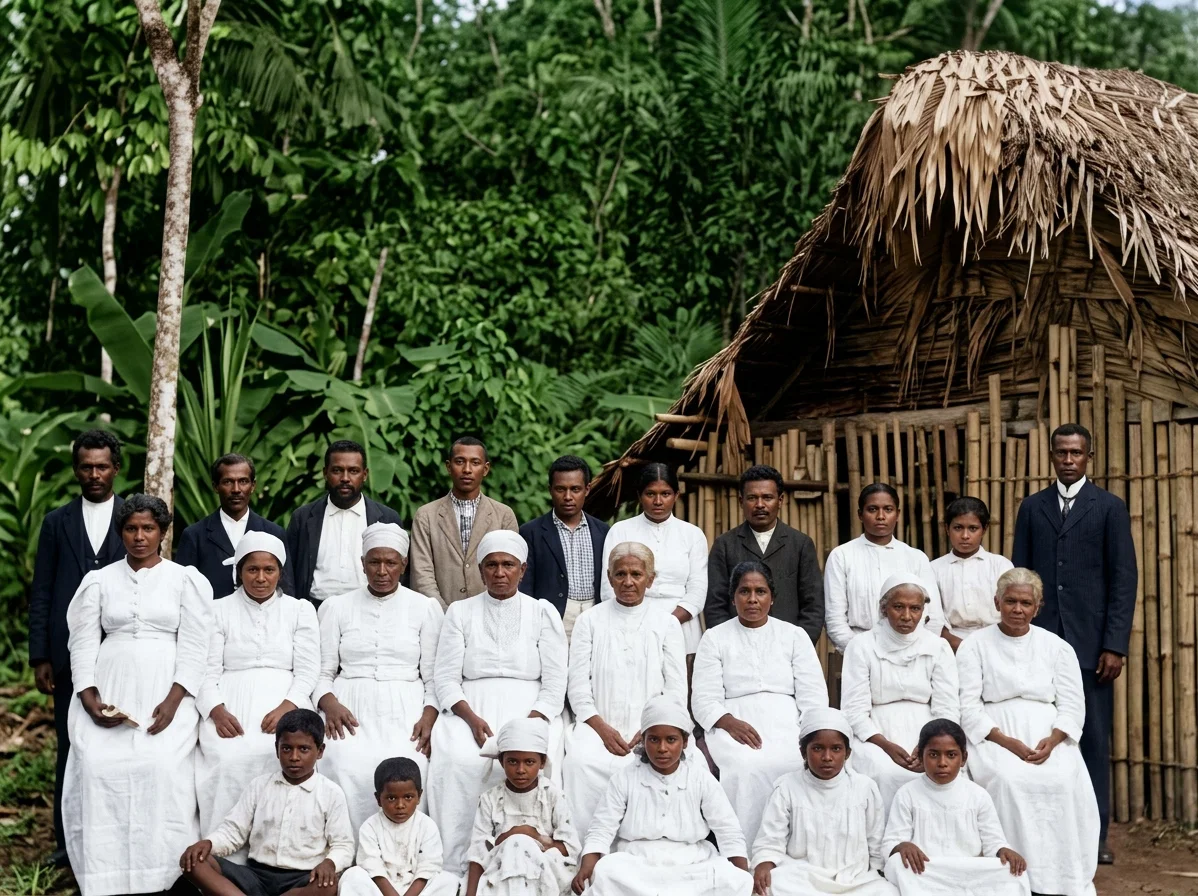
A COMPANY OF INDIAN BELIEVERS
At present we have only one church building, at Tappacooma Creek, Essequibo, with a membership of thirty-nine, and one or two small companies along the frontier of the colony. It would seem almost a problem how the message would ever be carried to them, had we not the assurance that God himself is going to “finish the work, and cut it short in righteousness: because a short work will the Lord make upon the earth.” Rom. 9:28. And also in Isa. 11:11, 12, we read: “And it shall come to pass in that day, that the Lord shall set his hand again the second time to recover the remnant of his people, which shall be left, from Assyria, and from Egypt, and from Pathros, and from Cush, and from Elam, and from Shinar, and from Hamath, and from the islands of the sea. And he shall set up an ensign for the nations, and shall assemble the outcasts of Israel, and gather together the dispersed of Judah from the four corners of the earth.” Much remains yet to be done for the people of this needy field. And while the Macedonian cry is being heard from many places, may God’s people everywhere remember the Indians of Guiana by responding to the call of the hour. “Say not ye, There are yet four months, and then cometh harvest? behold, I say unto you, Lift up your eyes, and look on the fields; for they are white already to harvest.”
Aurora, British Guiana.

A Plea for the Philippines

R. A. CALDWELL
Through the kind liberality of the General Conference, a good supply of the Signs of the Times has been forwarded to us regularly, for wise distribution. Although we believe that when the literature is accompanied by personal influence, an interest is more often aroused, still, because the field is so extensive, and, because of a lack of workers, many of the islands are inaccessible to us as yet, we have thought it advisable to use the printed page to give a knowledge of present truth, to some extent, to the many teachers in these provinces.
The book work has received some attention, and several hundred copies of "Patriarchs and Prophets," in Spanish, have been disposed of.
But the Spanish readers numbering only about half a million in the Philippines, this reaches comparatively few. By means of our literature, the message may be given to the public with the least expense; still we must spend considerable means to prepare suitable literature that the masses can read. The Tagalog dialect should receive first attention. These people are recognized as leaders in every event of great moment. They number about two million. Then the three million Visayans should be provided for; of course this dialect is divided into several branches. But the most difficult of all will be to begin the work among the other millions, with about twoscore variations in the language; and the isolated condition of many of these tribes presents new difficulties.
Are we following the injunction to "arise, shine"? Where is the evidence in these dark, unentered islands? Friends, let us present to you the glorious opportunity of enabling us to make a small beginning in this respect. To hasten the coming of our great King is our privilege. Means given to help defray the cost of preparing or circulating literature will be wisely expended.
Manila.

A Sober Judgment

“A CERTAIN sober judgment ought to mark Christians. They should be like the needle in the mariner's compass, not like the pendulum which within its limited range is always going from one extreme to another.”

Works Before Words

God asks of thee work as well as words; and, more, he asks of thee works first, and words after. And better it is for to praise him truly by works without words, than falsely by words without works.—Rev. Chas. Kingsley, D. D.

The South Caribbean Conference

It is impossible for those living in the lands of passenger-trains and electric cars to fully understand what it means to try to hold a conference in these island fields, where the almost continuous quarantine restrictions and the ever-increasing perils of the sea make traveling a most uncertain and unpleasant experience.
Owing to the inability of our union conference president to meet his appointments, on account of quarantine restrictions, the date for holding our conference was changed five or six times. At last it was thought to be definitely fixed for January 1-6, and accordingly, my wife and I took deck passage from Grenada to Trinidad, where the meeting was to be held. Located between a pigpen and a duck coop, on a slippery iron deck, with the sky as our only shelter, we had a rather more pleasant passage than usual, as we were favored with good weather, only three or four showers falling during the journey, from which our umbrellas protected us fairly well.
On reaching Trinidad we learned that our president, Elder J. B. Beckner, and the union conference president, Elder U. Bender, were unable to leave British Guiana, where they had gone to attend conference, owing to the quarantine restrictions, resulting from an outbreak of yellow fever. Under the circumstances, holding the conference was out of the question; so we held a service each evening during the week, while waiting for a boat to take us home. These services were well attended by the people of the city and the Port of Spain church; and the members of the other churches of the conference who had come, seemed to derive benefit and enjoyment from them.
We reached home on the morning of January 7, after an unusually pleasant deck passage, having had an awning over us; and the same afternoon we received a cablegram to return to Trinidad, Elder Beckner having succeeded in reaching there. So on the twelfth we left home again, and had almost an exact repetition of our previous trip,—pigs, fowls, and all.
Elder Bender was unable to reach Trinidad, which we all regretted very much, but we held the conference January 13, 14. I have not the data for making an exact report, but there were delegates present from eight of the nine churches of the conference, and two new churches were admitted.
Despite our meager force, reduced almost to the vanishing point by the death of Brethren L. J. Briggs and R. L. Price during the year, and the removal of Elders D. E. and S. A. Wellman with their families, the field reports of the few workers revealed encouraging progress.
Openings abound, and calls come from all directions, for most of which we can do nothing but pray. There are twenty-five places in Trinidad, a dozen in Grenada and Carriacou and Tobago, where tent-meetings or other public efforts could be held any time, with every indication of success. But we can not man one tent! Think of this, brethren in the stronger conferences, and share with us, if possible, some of your able workers.
Elder Beckner was re-elected president. The force this year consists of two ordained ministers, two licentiates, and four missionary licentiates.
We reached home January 17, and were called to St. Patrick's the next day to conduct the funeral of Brother Cornwall, and did not return for three days. In our absence, Elder Bender, whom we had been trying for so long to see, spent half a day in our home, as he chanced to pass this way, en route to Panama and Jamaica. Our failure to meet him was a great disappointment to us and to him; but such is life in the West Indies.
We shall soon be leaving this part of the field at the request of the union conference and Mission Board, to open up the work in the unentered Bahamas. Who feels a burden to recruit the depleted forces in this hard, needy, but interesting and fruitful field? Some one must come, and that right early. Who shall it be? "Pray ye therefore the Lord of the harvest, that he will send forth laborers into his harvest," and as you pray, say, "Here am I; send me."
W. A. SWEANY.

Orange River Colony

KOLO, BASUTOLAND.—God is blessing our work, and we are not sorry we came. On the way here, we had the opportunity of presenting the truth to a man and his wife, and both accepted everything we gave them, and to-day they are faithful in Sabbath-keeping and in paying tithe.
We are to have a baptismal service in about two weeks. One candidate is ready, and we hope to have several more.
We are studying the Sesuto language, which is quite difficult, as every missionary coming here can testify. In one year from the time we came, we hope to be able to converse with the natives. And in two years I think I shall not need any one to interpret for me. We believe God will help us, but are also of the belief that God works most when man works hardest. We wish to work here until Jesus comes. And work for him is so sweet! The true soldiers of the cross will be weary and worn with the battle, and will be glad to lay down their armor at the Lord’s command, and enter into life everlasting. We are not discouraged. The blackest clouds always have silver linings. There is no such thing as defeat. Wherever the banner of the cross is raised, songs of victory will be sung.
The work is onward here. We have some reading-matter ("Steps to Christ" and several tracts) translated into the Sesuto, and are planning to have more translated soon. The next book to be translated will be one especially adapted to the native. Our plan for future work is to scatter the printed pages in Basutoland, and then follow this up with more personal work. M. E. EMMERSON.

The Upper Parana Annual Meeting

THIS meeting was held in Posadas, November 20-28. We left Buenos Aires, Argentina, on the steamer “Corumba,” and arrived in Posadas after a voyage of six days. For the first few days the scenery may be called quite monotonous, but as we near the tropics, it becomes very interesting. After passing the city of Corrientes, where we change to a smaller boat, the “Dorado,” we enter the Upper Parana River. Sometimes we are steaming along through a narrow channel, on either side of which there is a luxuriant tropical vegetation of bamboo, palm, and other trees, and again we are steaming out into what seems like a large inland sea. The passengers relieve the monotony by shooting at the large alligators which have crawled out on the bank to sun themselves, or now and again at a group of monkeys which go springing off through the thick branches of the trees. Something of the great size of this stream may be learned when we state that at Posadas, fifteen hundred miles from Buenos Aires, the river is nearly two miles in width. At Corrientes the Parana receives the waters of the Paraguay River, which is navigable for hundreds of miles farther north.
The meeting had been appointed for Villa Encarnacion, Paraguay. The tent ordered for this field was still in the custom-house, and it was impossible to get it out in time for the meeting. As there was no hall to be rented in Villa Encarnacion, it was decided to hold the meeting in Posadas, Argentina, just across the river. Here we have a church of about sixty members. This was quite providential, as during the meeting Paraguay was in a state of siege, and there was no communication between the two ports. This would greatly have hindered the meeting, as most of the brethren live on the Argentina side of the river. The workers present were Elders J. W. Westphal (president of the South American Union Conference), Luis Ernst (superintendent of the mission), Victor E. Thomann, and Ignacio Kalbermatten, the writer, and Mrs. Fulton. The brethren showed great interest in the meetings, donating liberally to the different funds, and in every way making the visiting brethren as comfortable as possible. The last Sabbath seven persons were baptized in the clear waters of the river. The brethren here are poor in this world's goods. They have had many things to learn, and many to unlearn. When we consider that only five years ago the truth was yet unknown here, and that now we have a congregation of sixty members, many of whom are bright, intelligent people, it is a cause of great rejoicing. During the last year they have bought a nice organ for their meeting-room, and have donated liberally toward the new tent, and the sanitarium in Entre Rios. Several hundred dollars is still due on the tent. The work is onward in the Upper Paraná field. ARTURO FULTON.

Canvassing in Arizona

THIS has been a wonderful day's work for me. The Lord hath wrought, all thanks to his exalted name. To-day the Master granted me over ninety-three dollars in orders for books, helps, etc., besides eleven dollars for “Christ's Object Lessons,” making a little over one hundred four dollars in orders to-day. I see an interest manifested in some of these good books—“Patriarchs and Prophets” and “Christ's Object Lessons”—that leads me to hope that some of these dear souls will yet belong to the hundred and forty-four thousand. May God grant it. There are those who seem all ready to grasp these priceless volumes of heaven-sent truths as soon as they are presented to them. Surely some are the Lord's jewels, whom he will remember in that great day. Remember me and the seeds of truth sown, in your prayers.
WALTER HARPER.

The Work in Alaska

A few Sabbaths ago I was called upon to conduct a funeral service. Up in the mountains a young man had died suddenly of heart failure, and his friends brought the remains to town, and sent for me, saying they wanted a Christian burial. The young man was a Lutheran. I walked to the cemetery, and came back just as the sun was setting. I felt thankful to be able to read, sing, and pray before a large audience of people who would not go to a meeting, and would hear God's Word in no other way. I read the whole of the fifteenth chapter of First Corinthians.
Sometimes it gets very cold here in the winter, when the day is mostly dark, and the few short hours of sunlight hardly penetrate the frost. When it is not too cold, it snows almost constantly. We can look for anywhere from six inches to four feet in a single storm. Down it comes, so silently, not a sound for weeks.
Before the deep snow comes, the snow does not pack. It shakes off from one's clothes as so much flour. It is dry, and the roads have to be broken. They are hard just where traveled; but if the horse gets off the road an inch, down he goes. The horses here are trained, and they know they can not get out, so they wait patiently till they are unhitched and dug out; then they seem as glad as the people are to get back on the trail.
This is the kind of road I have traveled over on foot. I had to watch every step I took for fear I would slide off the trail into deep snow. If this had happened, no one would have found me until spring. I have put out thousands of papers in this country under just such conditions.
The summers here are beautiful. The days are long, and the sun shines almost day and night. The grass and flowers and wild fruits grow in abundance. Potatoes, cabbages, carrots, and other vegetables are easily raised, but are sold at an exorbitant price, there being so few who care to do anything but mine. Potatoes are never less than sevenpence halfpenny a pound, and before spring they sell for two shillings a pound.
ELLA I. MALLORY.

Missionary Volunteer Convention in Western Washington
According to appointment made by Prof. M. E. Kern, our Missionary Volunteer convention was held in the North Seattle church, February 12-15. Delegates and visitors from different parts of the conference assembled on the opening day until our committee on entertainment was taxed to the limit. Out of our eighteen Missionary Volunteer societies, twelve were well represented; and both old and young from many of the churches where societies have not been organized were also present. The meetings were well attended throughout the convention. All the conference laborers except two were present, and most of them came prepared to take part in the program. As a result of their co-operation and the excellent instruction given by Elders M. E. Kern and O. K. Butler, the truth was exalted, and all present were greatly blessed.
On Sabbath, Elder Kern spoke of the sacredness of home ties, and of the golden opportunity of parents to win the love and confidence of their children during the early days of childhood. During the morning and afternoon sessions of the convention, the different lines of Missionary Volunteer work were taken up. Papers that had been carefully prepared were read, and the subjects discussed.
Much emphasis was given to the importance of all our young people forming the habit of reading good books. The evenings were given to consecration and revival services, and we greatly rejoiced to see a number of the young people take their stand with the people of God, and others renew their consecration. About twenty took a definite stand for the truth, and many others who had been following their Lord afar off caught a glimpse of the glorious privileges and possibilities of the Missionary Volunteer who has decided to “wholly follow the Lord.”
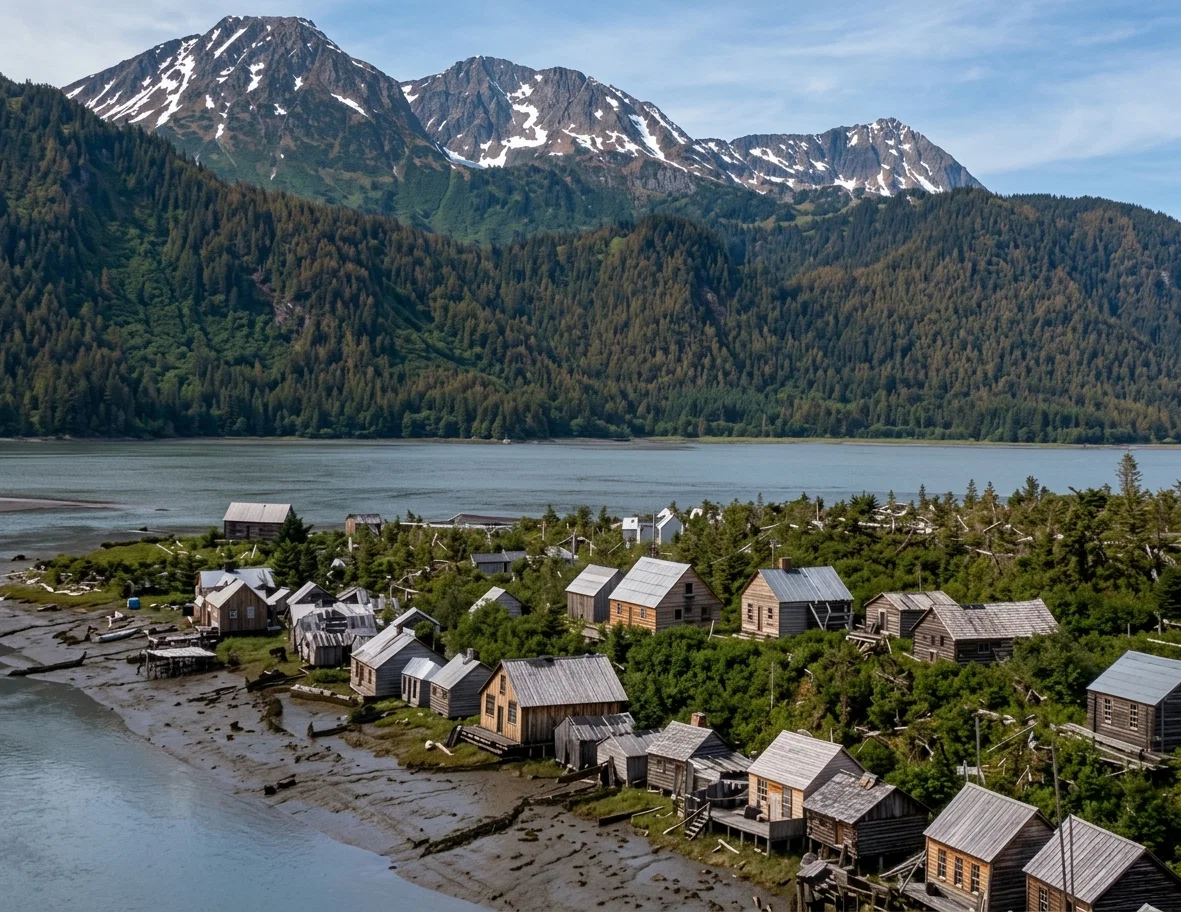
AN ALASKAN VILLAGE
AN ALASKAN VILLAGE
At the close of the convention, Elder S. W. Nellis conducted a praise service, affording all opportunity to speak. Praise and gratitude were offered to God for the blessings received at the convention. The conference committee decided that the conference Missionary Volunteer secretary should be released from conference office work, that more time might be given to the Sabbath-school and young people's work in the field.
We feel to praise God for his blessings bestowed on this first convention of Missionary Volunteers in the Western Washington Conference, and we are confident of ultimate victory in this warfare; for we know whom we have believed.
S. Lea Hoover, Missionary Volunteer Sec.

Chile

SINCE writing my last note, I have visited the churches of Santiago, Valparaiso, and San Felipe. There are a goodly number of young people in our churches here who might be trained for service. We expect to have four times the number in our school this year to prepare themselves for the work. In Santiago several started out selling Señales, and one young brother left his trade to sell our books; and the Lord is blessing him. At our colporteur meetings these workers were the ones who had the best testimonies to give. I expect to have a few agents here in Valparaiso soon.
Valparaiso has about two hundred thousand inhabitants; being the principal port of Chile, many nationalities are represented here. The English language is spoken by thousands. Colporteurs from the States would have excellent opportunities at this port to work among the English-speaking people while learning the language.
If two young men from the States would locate here, thousands of books could be sold in the English and German languages while they were learning Spanish. They would have an advantage far above what Brother Bishop and myself had in 1894. At that time the work was not started in Chile; now there is an organized church here in Valparaiso, with a growing congregation. Elder E. Balada and family are located here, and offer their home to any one coming to begin work.
As in other fields, the doors are wide open for colporteur work. A few days past, while out on a trip to see a young brother who does some canvassing, I sold books in Los Andes, San Felipe, and Limache. At Limache especially the people seemed to be hungry for books containing the truth. Many followed me up with money in hand to buy a tract, “El Juicio,” The Judgment.
Sunday laws are being enforced here in the large cities. So a quick work must be done. At Lantaro, a town in the south, I received permission to enter the barracks of the soldiers to sell the Señales and books. They crowded around me so thickly I stood upon a bench from which I could sell my books and papers. The sales were better than I expected, and I soon had to secure another lot of books.
Any one interested in coming to canvass can write to our secretary, Carlos Krieghoff, or the writer, Casilla 43, Correo 3, Santiago, Chile, South America.
THOS. H. DAVIS.

Bolivia

THERE are about one dozen persons who are deeply interested in the truth in this country, but so far none have taken a decided stand for it. The people are very slow to move, and it takes much patient labor to bring them fully to the side of truth. In these dark countries we need a larger proportion of workers than we do in more enlightened lands. As it is, there is only one laborer—myself—in this country. Several have written me about coming to labor here, but as yet none have come. The field is large and needy, and I pray the Lord to put it into the hearts of some to come to help give the light of the precious gospel to these benighted people. Any desiring to correspond with me may address me at Takoma Park, Washington, D. C., care General Conference. I am planning to attend that meeting. Pray for the work in this field; and pray that God may raise up workers who will be willing to come here.
Ed. W. Thomann.
Continue reading: The Shanghai Meeting