The Youth’s Instructor, Vol. 63, No. 44.

Russian “Follow the Leader”

The Youth’s Instructor

Nov 2, 1915

Review and Herald Publishing Assn. · Takoma Park Station, Washington, D. C. · Nov 2, 1915

Russian “Follow the Leader”

RUSSIAN boys and girls have a form of “follow the leader” that is well adapted to the fall and winter months in northern latitudes. Since it requires fast running, it offers a good way to get warm on a cold day.
Any number of players can take part. A circle large enough to contain all the players without crowding is drawn in the middle of the playground. That is the goal. The choice of a leader is made by “counting out.” The boy who is chosen starts the game by running about in the circle, and tagging one after another of his comrades. Each one falls in behind the leader, at the same time tagging another player, who also falls into line and tags another. This is continued until every one is in line. The leader then starts away, followed by the rest of the players, running in Indian file. The run continues at the discretion of the leader, who finally halts at a point some distance from the starting place, and calls out, “To the goal!” At this signal, the players break from the line and run, leader and all, helter-skelter, pell-mell, back to the circle. The player who reaches it first has the privilege of leading the next run.—Youth’s Companion.

How to Remember the Nines

EXAMINE any one of the statements of equality in the multiplication table of nine, up to and including nine times ten. Select, for example, 9 × 7 = 63, or 9 × 2 = 18.
Observe that in each case the first digit in the product is one less than the number by which nine is multiplied; and the second digit in the product is such that when added to the first digit, the sum of the two is nine.
You may make practical use of this peculiarity of nine and its multiples by applying it in the following way:—
If nine is to be multiplied by eight, for example, think at once of seven (which is one less than eight, the multiplier); then think of two, which must be added to seven to make nine, and you have seventy-two, the product of nine and eight.
Or, if nine is to be multiplied by five, think of four, which is one less than five; then think of five, which must be added to four to make nine, and you have forty-five, the product of nine and five.
By using this method, the nines, usually among the hardest of the tables to fix in the memory, may, in a short time, be fairly classed with the fives and tens and elevens, which are said to “remember themselves.”— Selected.

A Christian’s Alphabet

A — Adopted into the household of faith.
B — Born from above.
C — Chosen of God in love.
D — Dead to the world.
E — Elected by grace.
F — Forgiven of God.
G — Glorified in heaven.
H — Holy in Christ.
I — Immortality of life.
J — Justified by faith.
K — King under Christ.
L — Living in the light.
M — Merciful, obtaining mercy.
N — New creature in Christ.
O — Obedient servant.
P — Patient in suffering.
Q — Quickened from the dead.
R — Redeemed by the precious blood of Christ.
S — Saved by grace.
T — Transformed into his likeness.
U — Unspotted from the world.
V — Vigilant for the truth.
W — Workman that need not be ashamed.
X — ’Xample of God’s grace.
Y — Yielding unto God.
Z — Zealous in good works.
— United Presbyterian.

Auf Wiedersehen

O BIRD with lifted wing, For sunny Southland yearning, Speed on! erstwhile the spring Will plead thy swift returning.
Speed on! thy tender breast Awakes to new emotion Which sends thee on thy quest Anear the tropic ocean.
So stay for no farewell;— Farewell’s akin to sorrow;— Adieu I’d fain not tell, But bide me till the morrow,
When April’s message keen Shall counsel thy remaking, Amidst the orchard green, The nest thou’rt now forsaking;
When love’s sweet charm shall bring Thee home on pinions burning,— O bird with lifted wing, For sunny Southland yearning!
— Thos. J. Taylor.

Book Recommendation: The Glory of the Commonplace

If you want a book of short, apt illustrations, “The Glory of the Commonplace,” by J. R. Miller, author of “Week-Day Religion,” “Making the Most of Life,” and kindred works, write to the Review and Herald Publishing Association. This book will give the minister, the Sabbath school teacher, and the Missionary Volunteer leader opportune help. Price, $1, postpaid.

Chicago Saloons Ordered Closed on Sundays

THE State of Illinois requires all saloons to be closed from Saturday night at twelve to Sunday night at twelve. Chicago hitherto has been a law unto itself, preferring to keep open saloon; but the present mayor claims that the city can make no law nullifying State laws; therefore he has ordered the 7,152 saloons of the city to obey the Illinois Sunday-closing statute. The penalty for violation of the law is a fine not exceeding two hundred dollars.

An Autumn Day

LIKE a jewel golden-rimmed; Like a chalice nectar-brimmed; Like a strain of music low, Lost in some sweet long ago; Like a fairy story old By the lips of children told; Like a rune of ancient bard; Like a missal glory-starred— Comes upon her winsome way This enchanting autumn day.
O’er the hills the sunlight sleeps; Through the vales the shadow creeps; On the river’s stately tides Rich the silent splendor glides; Where the bowery orchards be, Perfumed breezes wander free; Where the purple clusters shine Through the network of the vine, Fragrant odors fill the air; Beauty shineth everywhere; While upon her joyous way Comes this lovely autumn day.
By the road’s neglected banks Rise the sumac’s serried ranks; Ragged hedge of thorn and brier Sudden flames with living fire; From the hard, unlovely sod Springs the glancing goldenrod; Light the level sunbeams sift Through the violet aster drift; All her spears in proud array, Comes the bannered autumn day.
Lifts the forest’s lofty line, Sceptered oak and solemn pine; Shifting rainbow tints illume All the depths of fronded gloom; Through the vistaed aisles unroll Sweeping robe and trailing stole— Where, superbly on her way, Comes the royal autumn day.
Heart of mine, be glad and gay; Wear thy festival array; Sing thy song for gathered fruit; Why shouldst thou alone be mute, When the winds from sea to sea Ring in chords of jubilee? After waiting, after prayer, After pain and toil and care, After expectation long— Lo! the bright fulfillments throng; Gleam the apples through the leaves; Thickly stand the golden sheaves; Earth is all in splendor dressed; Queenly fair, she sits at rest; While the deep delicious day Dreams’ its happy life away.
— Margaret E. Sangster.

I. C. COLCORD

Promptness

I. C. COLCORD

Be on Time.
How anxiously did Napoleon wait that fateful day at the Battle of Waterloo for Marshal Grouchy to come with reenforcements! But he came late. Blücher came in time to whip his men onto the field of battle to help Wellington. Napoleon ordered right, and had the man to whom he had trusted his awful orders not blundered, hesitated, been late, the whole history of Europe might have been changed since 1815.
Be on Time.
Promptness is the act of being there when your name is called, to answer “Here.” There is more truth than poetry in the song “When the Roll Is Called up Yonder.” Punctuality is one of the seven school virtues.
Be on Time.
“The train was late” is a frequent explanation after a terrible accident. Multitudes have met an untimely death because some one was “late at the switch.” Time tells its moments with even, regular strokes; and never has a stroke been tolled out of tune or out of time. The position, the appointment, the order, the friend, the opportunity, will not wait for the man who does not respond on the dot.
Be on Time.
Blücher was one of the promptest men that ever lived. He was called “Marshal Forward.” John Q. Adams was never behindhand. Daniel Webster was never late at a recitation in school or at college. In court, in Congress, in society, he was equally punctual. Sir Walter Scott was a very punctual man. This was the secret of his wonderful achievements. He made it a rule to answer all letters the day they were received. He rose at five. Bryant rose at five; Bancroft at dawn; Washington, Clay, Jefferson, Calhoun, and Lincoln were early risers.
Be on Time.
Be on time at your place of duty—at each and every engagement throughout each day. In fact, the path to greatness starts by being on time each morning at your breakfast table. Success is the child of two very plain parents—punctuality and accuracy.
Be on Time.
School time is habit-forming time, and tardiness is a school evil that does much mischief. To loiter makes the shirk, and to dally the indolent. “Youth is the sowing time. It determines the character of the harvest for this life and the life to come.” May all our church-school boys and girls earnestly resolve to—Be on Time.

Young French Bakers

Daniau, the only baker in the village of Exodum, department of Deux Sevres, being called to the colors, the village was without bread. Then Madeline Daniau, the baker’s daughter, a slight miss of fourteen, lighted the bakery furnace, and with the help of her brother of ten, tried to make bread. After several failures, she succeeded to the satisfaction of the villagers and surrounding farm people, and has been working now for many months from four o’clock in the morning until late in the day, baking bread for the population.
President Poincare has written letters to both children. He commends the girl upon her good humor, courage, and industry, and confers upon her the cross of Lorraine. He calls the boy his “young friend,” and assures him he will grow up to be a valiant soldier.

Report From Rio de Janeiro

HERE is a short report of our work in Rio de Janeiro, Brazil, a little glimpse as seen by one of our young missionaries, Miss Blanche Davis, who went there about two years ago. Miss Davis writes:—
“Rio de Janeiro is a city that fulfills all your dreams, all your most exalted ideals, as far as beauty is concerned. There lies the harbor, a broad, placid sea. No wave stirs the quiet peace and calm. Here and there loom imposing giant mountains from the unknown depths below. Islands they are of emerald hue in a setting of soft turquoise. Majestic ships come and go, while many lie at anchor far and near. With all this beauty, with all to call their hearts to their Creator, should you not think that this people would respond readily to the message that we are presenting to them here? You say, Yes; but no, the people are satisfied, pleasure-loving, living for the moment only, without thought or worry of anything that may come in the future.”
“If you had been here a few months ago, you would have seen our little tent pitched not far from a great Catholic church. Farther back are the sunlit mountains, ever tinted in varying shades. Go with me to the meeting some evening. The sun has gone down, and as we descend the hill, we see the light shining through the canvas of the tent. We enter. Many people are there—some well-dressed and some not. All seem to enjoy the music, as they join in the singing with pleasure. They listen attentively to all the speaker has to say, and then when all is over, leave for their respective homes.”
“You note one young woman especially. She is well-dressed, always near the front, with a great crown of black braids wound round about her head. Her soft dark eyes are fixed upon the speaker. She listens to every word. Night after night you see her here, and wonder perhaps what her real motive is in coming. You can readily see that she is young—twenty, perhaps, or a little more. She is well-to-do, for her clothes indicate this fact. She is intelligent, for her face plainly shows this. We are all interested in her, but she says very little, simply comes to every meeting. There is also a fine-looking young man with his wife and mother, near the middle of the tent. They, too, come regularly. They expressed a desire to have Bible readings, so we go once a week to their home and give them readings. One more woman you would be interested in—a German lady who comes often. She, too, wishes Bible readings. We give these to her, one every week.”
“The tent effort was closed in this particular place, and moved one station nearer the city. Here we are now holding meetings. The tent is always crowded, and Sunday nights many cannot even get in, but are obliged to return home. We know not yet the outcome of these meetings.”
“The young woman with the black braids became so interested that she continued to write Brother E. C. Ehlers in regard to the truths she was not clear about. He answered all her questions so satisfactorily that she expressed a desire to be baptized. During our last baptismal service by the seaside, she and four others were baptized. She is a dear, sweet girl, and we know that she is sincere, although she has much to contend with at home, as her people are all Catholics. The German woman keeps the Sabbath, pays her tithe regularly, and we still are giving her Bible readings. We think now she is ready to be baptized. The young man, with his wife and mother, keeps the Sabbath. No doubt they, too, will soon be baptized. These are not many, but yet we feel happy over these few.”
Miss Davis has written before of the difficulty of learning the Portuguese language. Humorously she says:—
“I am getting along in the language a little better now, and hope in a few years to be able to understand some of the words. I am very thankful I know the English language, and I hope that I shall never forget it, for learning a language correctly is not so easy as it appears from a distance.” M. E. KERN.

Among the Hupeh Outstations

LAST September Mr. Cottrell and I moved into the province of Hupeh, and we felt very glad to accept the invitation of our native brethren and sisters to visit them at the several outstations scattered throughout the province. Accordingly, the early morning of November 27 found us, with Brother Li Wei Ching, off by the northbound train for Yingshang, four hours' ride by rail, and another four hours' by chair, from Hankow.
A little company of twenty-five or thirty are holding services in a rented compound, located three miles out of the city in a small market town. Work was begun in this place only a few months ago, but is being carried on quite successfully by a colporteur and his wife, who is one of our mission Bible women. There seemed to be a good interest, and a few were prepared for baptism, which was held on Sunday.
We next went to Siao Gan, an outstation located on the railroad. The commodious compound there affords ample room for chapel, living quarters for our workers, and a church school.
Chang Djang Pu is another forty-five li, by boat and chair, from Siao Gan. Old Brother Djang and his good wife received us most cordially, and did everything in their power to make our stay with them pleasant. An excellent Christian atmosphere permeates our work in Chang Djang Pu, and we feel sure the Lord is with the believers there. The children of the church school are taught Bible verses and the ten commandments, with the result that even little tots of three and four years surprised us by the way in which they could repeat them; also the baby lips are trained to sing “Jesus Loves Me,” as one of their first accomplishments.
Lo Dien is located ninety li beyond Chang Djang Pu. It was bitterly cold making this trip by chair, consequently many times we had to walk to keep warm. But our brethren and sisters appreciated the visit all the more from the fact that we were willing to leave our comfortable home and travel under such circumstances to help them what we could.
Lo Dien is simply a market place, located in rather a wild portion of north central Hupeh. It was in this country that “White Wolf” and his soldiers were prowling about and terrifying the people last year. Some of his soldiers visited Lo Dien, but did not loot, as in other places. Wildcats, wolves, and other wild animals are said to be plentiful, and we saw their skins hung up for sale on market day. As I was the first foreign woman to visit this town, I had plenty of escorts whenever I went out on the street, and the chapel was always filled with visitors, scarcely giving us time to eat. Although no baptisms were held at this place, we felt that we left the people encouraged, and we hope for a good work to be developed among this simple-hearted people.
We returned to Hankow for a few days, and then went down the Yang-tze-kiang by steamer for about one hundred and twenty miles. Leaving the river at Chi Chuen, we journeyed by sedan chair all of one day, to reach the little mountain home of one of our church members, where we remained overnight. His home was but a windowless mud hut, where all the chickens and animals lived in the house with the family; but they were hospitable folk, and as they showed us to our room after the evening service on Christmas Eve, we thought of the first Christmas night, and considered we were doubtless more comfortable than our Lord had been.
The next morning our host, hostess, and their children accompanied us over the mountains on the remainder of our journey, to the next mission outstation, about thirteen miles distant, the women and children traveling by wheelbarrow. I have never before on Christmas Day been surrounded by so much luxuriant holly as we saw growing along the roadside on that trip.
Djang Hsuen Djeng, a last year's student at the Shanghai training school, is now in charge of the little company at this place. On Sabbath six were baptized.
Thus, in some, at least, of Hupeh's scattered towns and villages, the truth is gaining a foothold, and exerting an influence which, with God's blessing, is bound to widen and widen until all the honest have been sought out and a people prepared to meet God.—Myrtie B. Cottrell, in Asiatic Division Mission News, March, 1915.

Faithfulness

SEVERAL years ago a young man of Jamaican origin, but reared in Spanish Central America, came to Guatemala and began learning the machinist’s trade in the railroad shops, at a wage of fifty cents a day.
At the time he was a wild boy, but later was converted, and became steady and earnest. He then made rapid progress in his work, until he was earning three and a half dollars a day, and was quite a help to us in the work. Several times he was rudely insulted, and once he was beaten in the face by one of the rough white men in the shop, but with the Lord’s help he bore the insult bravely and without dishonor.
When all seemed to be going well with him and he was just about to ask for a leave of absence to go to Honduras to take to himself a wife, he was suddenly discharged by the foreman, who disliked him. Thinking, however, that he would get his place back again without any trouble, he made the trip and returned with his wife, only to be told upon his arrival that he was not needed.
Seeing no prospect for work, he went back to a port in Honduras where his mother lives, hoping to be able to get work in the railroad shops there.
As times were hard and work limited, some other Adventists living there had begun to work on the Sabbath, but our young brother bore a good testimony for the Lord, both to them and to his mother, who well knows her duty but fails to perform it.
The boss at the shops offered him a good place at three dollars a day, and he was urged to accept it; but as they would not give him his Sabbaths free, he steadfastly refused to accept the work, though his mother blamed him for such a course, and thought him very foolish in view of his great need of employment.
After staying with his mother for several weeks in the vain hope that the railroad man would agree to give him his Sabbaths off, or that he might find other employment there, he was finally offered a small school to teach at a very limited salary, in one of the Bay Islands. This he was glad to accept, and he is teaching there now.
Though his wages are small, he has proved that the Lord always opens up some way for those who are true to him, even though it may not be the way they would have chosen, nor so productive of the riches of this world. Our brother also has the satisfaction of having borne a good testimony for the Lord and his truth among others who were not so faithful, though older in the knowledge of the truth.
J. B. STUYVESANT.

Word From Persia

MR. ELISHA KHAMIS, a minister in Persia, in writing last July of conditions in that afflicted land, said:—
“With a full heart I am now having this first opportunity to write to you about the conditions and hardships which we have endured for the last twelve months in this country in the midst of war. It is very hard for me to describe what I have seen, for we have had to undergo the most terrible massacre from the hands of the Turks and Kurd Mohammedans.
“Last August we heard that the European war had broken out, and, a month after, the Turks made war in this country with the Russians, for three months. The Turks were repulsed, but, alas! on December 8 the Russian troops were recalled to the Russian frontier, and about twelve thousand persons from this country went with them for protection. . . . The rest of our nation remained in the country. It was only four hours after the Russians left when we were surrounded by the cruel Turks and Kurds. Immediately they began destroying villages by fire, and killing every male, taking women and girls away for themselves. Many cruel acts have been done in this country which are not likely to be written in the history of the world. From sixteen to eighteen thousand people were massacred in different ways; some were shot, and afterwards hacked into pieces with an ax; others had their skins taken from their bodies with a knife, while still alive; twice my brother Joshua and I have been taken to be killed, but the Lord saved us, through the influence of a Kurdish chief who was friendly with us from old.
“Two thousand women and girls have been taken away by the Kurds, and the rest of our people—we were about 25,000—escaped into the houses of the American, French, and Canadian missionaries in the town of Orosmiah.
“For six months the refugees were fed with a little dry bread once a day. Only now have we been made free again by the victorious Russians, who came to our aid and have utterly conquered the Turkish possessions in these countries. Once again all the refugees have gone back to the villages and are starting a new life. . . .
“My own relatives who have been butchered by the cruel Mohammedans are, six first cousins, one having been a missionary for thirty-eight years; my only sister, Jerusha; and my dear little son, Josh, three years old, who was frightened by the Kurds and died immediately. Eight women and girls have been taken away. The remainder of my relatives, orphans and widows, are forty-eight, all staying with us in the ruins of Charbosh. Our miserable condition is indescribable—no food, clothing, or houses. Everything is devastation and ruins. May God help us! The aid must reach us soon, else we all may perish.”

What Says the Bible?

THE “Bible Opposed to Peace” is the title of an article that recently appeared in the Golden Age, a Baptist publication of Atlanta, Georgia. When so many learned men are looking for peace, and crying, Peace, peace, it is satisfying, though surprising, to read words like the following:—
“In Matthew 24 Christ’s disciples questioned him as to the end, his second coming, and the manifestations thereof. And he made them answer, and in so doing stated specifically that the time of his return would be preceded by a tribulation so terrible that, were those days not shortened, no flesh would be saved. A dire conflict would rage, the like of which mankind had never witnessed. But the earth knows somewhat about trouble. What happened to the Jews when Titus desolated and razed Jerusalem? Or in more modern times, what did The Reign of Terror for the French people? Certainly if these upheavals are to be outdone, universal peace will never obtain or is foredoomed to egregious failure. For it is written, ‘One jot or one tittle shall in no wise pass from the law, till all be fulfilled.’ Matt. 5:18.
“Isa. 26:12 says, ‘Lord, thou wilt ordain peace for us.’ Haggai 2:9 says, ‘And in this place [Jerusalem] will I give peace, saith the Lord of hosts.’
“But before he proclaims peace, he visits destruction upon a sinning world. In the twenty-sixth chapter of Isaiah, quoted above, he will ‘give peace,’ yet in the same chapter we are told he will first come and spend his ‘indignation’ on the inhabitants of the earth, and, such will be the number slain, that they shall not even be buried; or, as Isaiah 34 declares, during this ‘indignation,’ ‘mountains shall be melted with their blood;’ whereas, in verse eight we discover the time to be the ‘day of the Lord’s vengeance,’ also that of recompense or redemption. See Isa. 63:4. For confirmation refer to Jer. 25:33: ‘And the slain of the Lord shall be at that day from one end of the earth even to the other end of the earth;’ then to Isa. 13:9: ‘Behold, the day of the Lord cometh, cruel both with wrath and fierce anger, to lay the land desolate: and he shall destroy the sinners thereof out of it;’ once again, to Jer. 30:5: ‘We have heard a voice of trembling, of fear, and not of peace.’ In the light of these declarations, what folly it is to persist in efforts for universal peace!
“The Bible itself anticipates the present abortive efforts for peace, and tells us repeatedly that they are in vain. See Jer. 8, 11, 15: ‘They have healed the hurt of the daughter of my people slightly, saying, Peace, peace; when there is no peace.’ ‘We looked for peace, but no good came; and for a time of health, and behold trouble!’ Or yet again, from Isa. 33:7, ‘The ambassadors of peace shall weep bitterly.’ And we naturally conclude that they are ‘weeping bitterly’ because they fail to get that for which they are struggling. It is absolutely amazing that people cannot see, when the very thing given them by Paul as a chief marker, takes place right under their eyes. Yet they are blind. He wrote (1 Thess. 5:3), ‘When they shall say, Peace and safety; then sudden destruction cometh upon them.’ And when this war broke on the world, the Peace Congress was in session on Lake Constance. The very man they chose, Kaiser William, for the Nobel peace prize, is now the object of their execrations. All this should show how little is to be hoped of man’s endeavors, and how little competent he is to regulate the affairs of earth.”

Questions and Answers

  1. WHAT shepherd was murdered by his brother?—Abel.
  2. What physician wrote two books of the Bible?—Luke.
  3. What fisherman tried to walk on the water?—Peter.
  4. What mighty hunter built Nineveh?—Nimrod.
  5. What tentmaker preached the first gospel sermon in Europe?—The apostle Paul.
  6. What famous Syrian captain was a leper?—Naaman.
  7. What silversmith stirred up a riot against Paul?—Demetrius.
  8. What herdsman was one of the minor prophets?—Amos.
  9. What farmer was the first murderer?—Cain.
  10. What proconsul of Cyprus asked Barnabas and Saul to preach to him?—Sergius Paulus.
  11. What fisherman was the first apostle to die a martyr’s death?—James, the brother of John.
  12. With what tanner did Peter lodge in Joppa?—Simon.
  13. What servant of a prophet was stricken with leprosy because of his sin?—Gehazi.
  14. What saleswoman was the first Christian convert in Europe?—Lydia.
  15. What shepherdess stole the images from her father’s house?—Rachel.
  16. What great soldier was commander in chief of Saul’s army?—Abner.
  17. What wealthy farmer was the great-grandfather of David the king?—Boaz.
  18. What amanuensis, or copyist, took down Jeremiah’s prophecies?—Baruch.
  19. What cunning hunter sold his birthright for a mess of pottage?—Esau.—Belle M. Brain.
(To be concluded)

The Story of the Rebellion Against the Government of King Jehovah

The Great War — No. 12

The Story of the Rebellion Against the Government of King Jehovah

The Center of the Truth Attacked
CARLYLE B. HAYNES
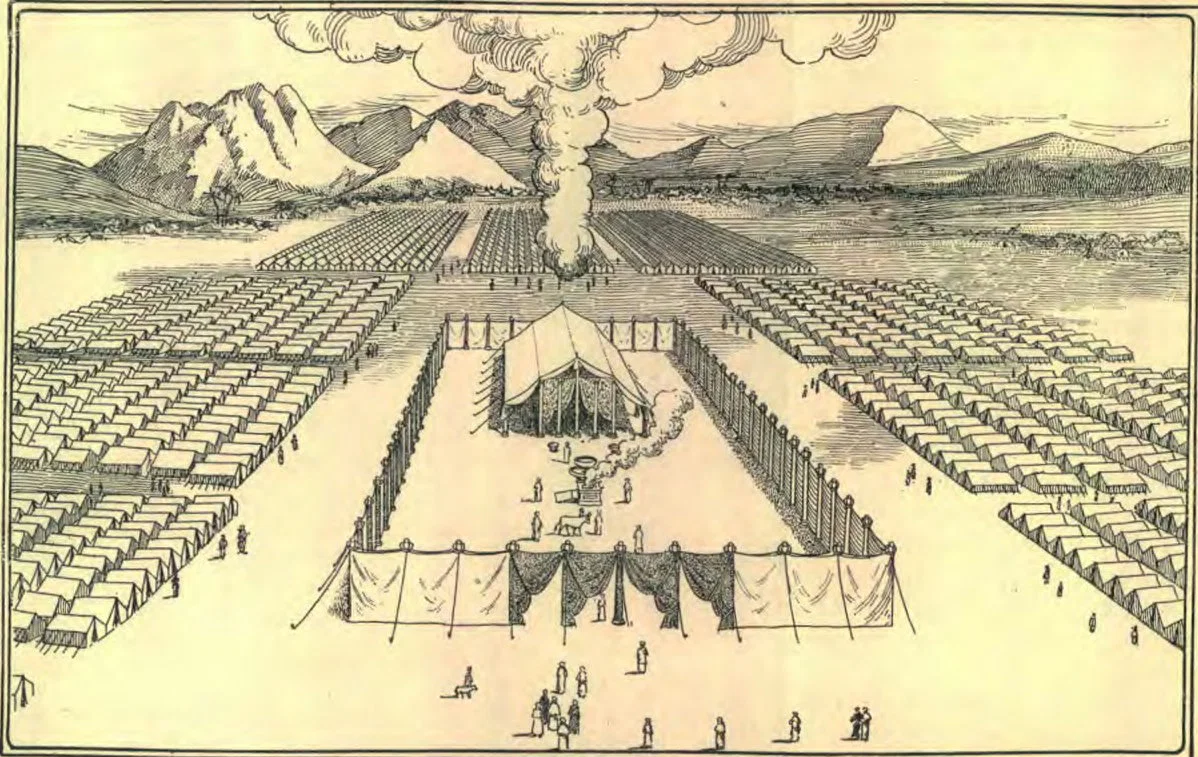
DIAGRAM OF TABERNACLE AND ENCAMPMENT
IN the great conflict between Christ and Satan on this earth, Satan has always directed his attacks against the very center of the truth of God. He has evidently given the revealed truth of the Bible much study, and knows just where to strike in order to corrupt the allegiance of the people of God.
Before the people of Israel were brought out of Egypt, the truth of God was preserved only in the hearts of those who were loyal to him. There was no written Bible in which the principles of the truth were taught; nor was there any place on earth where a teaching priesthood instructed the people in the truths of revealed religion. Altars to the true God were erected anywhere by his worshipers, and his truth was handed down from father to son.
And it was for this reason—that if the servants of God could be destroyed, then the truth of God would also be destroyed from the earth—that Satan worked so persistently, as shown in the last article, to slay every follower of God, and to blot the name of his people from the earth.
When the service of the sanctuary was instituted by the direction of God in the wilderness, Satan had another object for his hatred and for his attacks. And his hatred for the sanctuary was great, because in its services and ceremonies and in the furniture which it contained the entire truth of the gospel was revealed.

The Sanctuary

The sanctuary was the dwelling place of God (Ex. 25:8), and was a replica of the temple of heaven in which God dwells (verse 40). It was pitched always in the center of the encampment in the wilderness, three tribes of the Israelites pitching to the north of it, three to the south, three to the east, and three to the west.
The court of the sanctuary was oblong in shape, about one hundred and fifty feet in length and seventy-five feet wide. It was made with hangings of fine-twined linen, which were hung upon eighty pillars of brass set in sockets of brass, the hangings being attached with hooks of silver. Ex. 27:9-17.
The gate of the court was made of “needlework, of blue, and purple, and scarlet, and fine-twined linen: and twenty cubits [thirty feet] was the length, and the height in the breadth was five cubits [seven and a half feet].” Ex. 38:18. This gate always faced the east. Ex. 27:13-15.
Within the court there were but two articles of furniture. These were the brazen altar of burnt offering and the brazen laver. Upon the altar all the sacrifices of the children of Israel were offered, and the great brazen laver was used by the priests to purify themselves for their ministry in the tabernacle.

The Tabernacle

The tabernacle itself was erected in the court, on the west side, facing toward the east. The tabernacle was composed of two rooms, the holy place and the most holy place. The hangings of the door of the holy place were composed of the same materials as the gate of the court. Ex. 36:37, 38. In the holy place were three articles of furniture—the table of showbread on the right as one went in, the seven golden candlesticks on the left, and the altar of burnt incense directly in front of the veil which separated the holy place from the most holy place. All these articles were made of gold, or were overlaid with gold.
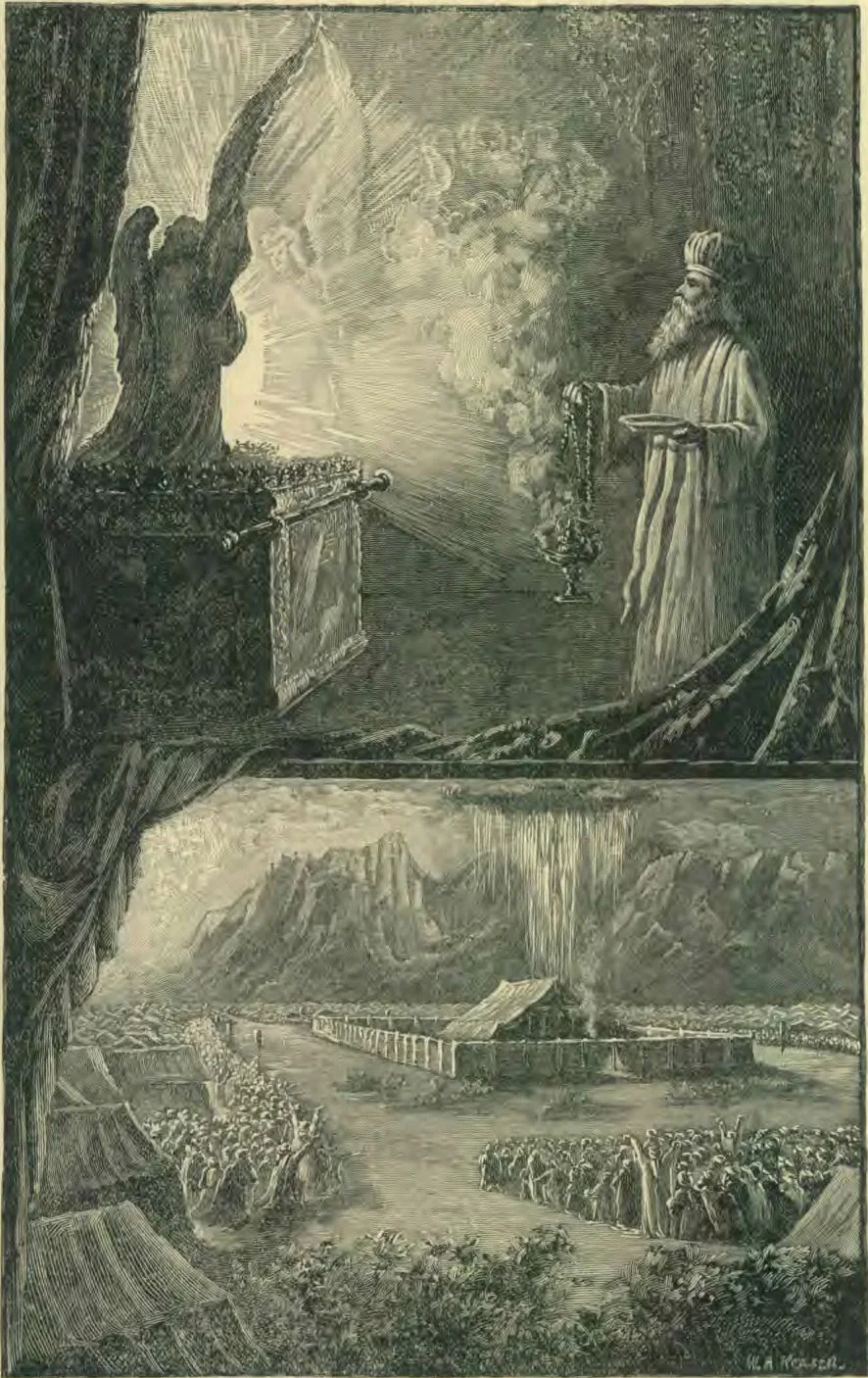
The veil separating the holy place from the most holy place was made of the same materials as the door and the gate (Ex. 26:31, 32), and was embroidered with gold thread with the figures of angels. It was hung on pillars of acacia wood which were overlaid with gold. In the most holy place was but one article of furniture, the ark of the covenant. This was a hollow, oblong chest, overlaid with gold. Its cover was made of a solid piece of wrought gold, and was called the mercy seat. On each end of the mercy seat was the figure of an angel, and these angels were wrought from the same piece of gold as was the mercy seat itself. These angels stood with their wings outstretched over the mercy seat, and their faces were downward as if in adoration and worship.
In the ark of the covenant was the law of God, written on two tables of stone, as it had been given by God to Moses on Mt. Sinai.
The sides of the tabernacle were made of boards overlaid with gold and mortised into one another, making the tabernacle appear as if made of solid gold. The covering of the tabernacle was made of four curtains laid one on top of the other. The inner curtain was of fine-twined linen embroidered in thread of gold with the figures of cherubim. On top of that was laid a curtain of goats’ hair. This was covered with a curtain of rams’ skins dyed red, and above all was a covering of badgers’ skins. Ex. 26:1-14.

The Fullness of the Truth Revealed

In the furniture, the services, the hangings, the sacrifices, the ceremonies, and the priesthood of this tabernacle, all the truths of the gospel which have since been revealed in a fuller way were taught in type. No wonder, then, that Satan would attempt to destroy this tabernacle and the temple into which it later developed. As long as the tabernacle existed, it was a great witness to the true God.
In the Shekinah which appeared over the mercy seat the true God was revealed, and there he met with his people and gave them instruction. In the fourth commandment of the decalogue under the mercy seat his name as creator of the heavens and the earth was revealed. In the ten commandments which the ark contained was revealed the very foundation of the government of King Jehovah. The adoration and worship of all the heavenly universe was shown in the worship of the two angels on the ends of the mercy seat, and thus his lordship over all creation was shown. The duty of prayer and communion with God was shown in the altar of incense. The fact that Jehovah is the light of the world was shown by the ever-burning candlestick. That he provides all his creatures with food, and that he is the bread of life, was shown by the table of showbread containing twelve loaves. The guidance of the Holy Spirit was shown in the pillar of cloud and of fire which always hovered over the tabernacle and which led the people through the wilderness. The need of a Saviour from sin was shown by the sacrifice of the lamb every morning and evening. The fact that there was to be a vicarious sacrifice and a blood sacrifice for sin, was shown by the sin offering. The doctrine of a final reckoning and judgment for sin was shown in the yearly day of atonement. The teaching of a final extinction of sin and sinners was shown by the burning of the body of the sin offering which represented sin. The forgiveness of sins was taught by the transfer of the lamb’s innocence for the sinner’s guilt and condemnation. And, in short, every truth of the gospel will be found revealed in the sanctuary and its services. This must have been what David had in mind when he said, “Thy way, O God, is in the sanctuary.” Ps. 77:13.
The sanctuary, therefore, being so necessary for the preservation of the truth of God on earth, may be expected to be the great object of Satan’s hatred, and the one thing above all others which he will attempt to destroy. The next article will show how the great adversary attempted its destruction.
HIGH PRIEST MINISTERING IN THE MOST HOLY PLACE
Continue reading: God’s Forgiveness; Its Fullness and Its Privileges