God’s Forgiveness; Its Fullness and Its Privileges
By John N. Quinn
JOHN N. QUINN
Fishermen of Feversham made sport of James the Second, king of England, as in disguise he was leaving that port to take refuge in France. The king made prolonged visits to a Trappist monastery, subjecting himself to bodily mortification and penance, yet he never attained to the spirit of forgiveness.
When an attempt was being made by his adherents to recover for him the throne of England, and he was about to start for the coast to set sail, he forwarded a declaration to be circulated among the English people, promising to overlook the nation’s past desertion of him, but he singled out for special exception the fishermen who had made sport of him. On the death of his daughter Mary, the queen of William III, who succeeded to the throne of England, but whose right James disputed, he sent a message to Louis, king of France, requesting him not to pay respect to the dead by letting his court go into mourning.
Bishop Ryle said: “A spiteful Christian is a scandal to his profession. He is praying against himself every time he repeats the Lord’s Prayer. Is he not saying, as it were, ‘Father, do not forgive my trespasses at all’?”
The limit of human forgiveness was seven times. Jesus made it seventy times seven, four hundred and ninety—over twenty times an hour. Who needs to confess defeat twenty times an hour, twenty-four hours a day? Allowing eight hours for sleep, then we have more than thirty confessions an hour to make. Christ meant not mathematical limitations of forgiveness, but rather that God’s mercy is unlimited, unbounded.
God is ready to forgive, and no matter how many times we have sinned, no matter how frequent have been our defeats, if they have been twenty times an hour, twenty-four hours a day, when we confess, God forgives, and forgives freely.
There can be no measure to the forgiveness of God. Sin is finite; righteousness is infinite. Sin can never superabound God’s forgiveness. David pardoned Absalom, but did not grant him full restoration to favor. 2 Sam. 14:24. God forgives, and he also grants to the one pardoned restoration to the fullness of divine favor and blessing. He translates out of the kingdom of darkness into the kingdom of his dear Son; he lifts the penitent out of the “horrible pit,” and makes him to sit “with princes, even with the princes of his people.” God forgives and forgets; he does not bring to mind past offenses; he casts them behind his back; and as far as the east is from the west, so far are the transgressions of the believer in Christ removed from him. “Into the depths of the sea” are our sins cast; “as a thick cloud” they are dispelled by the Sun of Righteousness that has risen upon us. With unveiled faces we behold God’s glory in the face of Jesus, whose life of godlikeness reached its climax in the cry of a broken heart, “Father, forgive them; for they know not what they do.”
Forgiveness excludes punishment. The parent who speaks the word of forgiveness to the child who has confessed wrong, does not inflict punishment. God regards not his pardoned ones as “children of wrath, even as others;” they are delivered from “the wrath to come.” God beholds in them, not the vileness of the sinner, but instead, the perfection of his Son, in whom they believe. “Thou [Christ] art . . . fair: . . . there is no spot in thee.” Cant. 4:7.
He who crossed the threshold of the city of refuge, that instant passed from death to life; he could turn and look the avenger fearlessly in the face; and on the death of the officiating high priest, he could leave the city, free from condemnation.
The prisoner in the prisoner’s box, who has been justified by the judge of the court, can with quiet confidence leave the place of bondage and go forth to freedom. No law can hold him; the word of the judge has declared him just. There is no lake of fire for the one whom God pardons, justifies, frees. The seven last plagues are for the children of wrath, and not for the children of God. Why, then, be downcast? Look up to the throne of grace; look out to the Sacrifice of the cross. A look inward on the part of Satan, brought sin into existence; a look outward brings salvation. A look inward, and Lucifer became conscious of his beauty and ability, of his wisdom and his position of honor. He fell. A look outward to Christ, and self-sufficiency, self-importance, self-righteousness perish. With a penitent heart, sin is confessed. God forgives fully and freely, restoring to the pardoned child his position in the heavenly family, of which the Lord Jesus is the head. “The head of every man is Christ.” When he comes, then the believer in every sense, physically, mentally, morally, spiritually, will be like Christ.
In the Meadow
By Sarah E. Sprague
A BUTTERFLY with spangles gay,
Met a bumblebee one day
Where the sunshine warmly lay
Turning clover into hay.
“Hark!” said lovely Shining Wings,
“Hear how loud that blackbird sings!
Don't you think the summer brings
Just the brightest, sweetest things?
“See the color of the sky;
See the clouds that sail so high;
See the milkweed floating by,”
Said the dainty butterfly.
“Smell the clover blossoms there,
Scenting all the summer air;
Nothing half so sweet or fair
As this meadow, anywhere!”
Bumble jerked his little head;
Then he rather crossly said:
“Well, I like the clover red,
Not for perfume but for bread.
“All the world knows that a bee
Much too busy is to see
Beauty merely. All that he
Cares for is utility.”
Shining Wings then made reply:
“Though I'm but a butterfly,
Beauty's faithful lover I,
And without it fain to die.
“Life itself is naught, poor bee,
If 'tis but utility;
Sure I am 'twas meant that we
Should the beauty also see;
“Else there were no summer sky,
Nor the clouds to sail on high;
Else no milkweed floating by,
Nor spangles for the butterfly.”
Angry Bumble flew away,
Leaving Shining Wings to stay
Where the sunshine warmly lay,
Turning clover into hay.
—Sarah E. Sprague.
The Corpies
By L. J. Bryant
THE Corpies are the tiny men
Who live inside of us, and when
We eat or drink they take our food
And build it into bones and blood,
And muscles, too, so we'll be strong
And well and happy all day long.
A Corpie, as you plainly see,
Don't look a bit like you or me.
He has a body, small and round,
Like red corpuscles, which are found
In blood—and then, perched right above,
A heart-shaped head—the sign of love.
That shows it's love that makes them do
Their work for us, our whole lives through.
Our body is a place, you see,
Just like a great big factory,
With many rooms, with walls and floors,
Partitions, windows, halls, and doors;
With tiny cells, and closets, too,
With pipes and wires a-running through;
With special bins to store away
The things we eat from day to day;
And laboratories, where they test
To see that everything's the best.
There're wonderful machines to treat
And separate the food we eat;
So every Corpie, quick, can choose
Exactly what he needs to use.
There're busy workshops everywhere,
All fitted up with greatest care,
With batteries of little cells
To work the small electric bells;
And telephones and telegraph,
All operated by a staff
Of expert Corpies, who can think
In quicker time than you can wink.
Because the Corpies always keep
At work, they need no place to sleep;
But there's a special bathroom, where
They wash themselves with pure, fresh air.
And, judging from the Corpies' looks,
You'd not suppose they cared for books;
Yet everything we hear or read
Or learn, is sent with lightning speed
Up to the Corpies in our mind,
Who keep it there, where they can find
It quick and tell us right away
Just what we want to think or say.
One thing has not been mentioned yet,
Which surely we must not forget,
And that's the furnace, quite complete,
Which burns up waste and gives us heat.
Our bones make up the factory frame
All joined together, just the same
As beams are joined in buildings high,
Which tower nearly to the sky.
Our muscles make the walls, but far
More wonderful than stone walls are.
Our walls will bend and never break,
They twist and turn, and even make
The factory walk and run around,
And all without the slightest sound.
There're lots of funny things, you see,
About this wondrous factory:
It's never finished, strange to say;
It grows a little every day;
The walls which stretch and twist around
You'd think would tumble to the ground;
But no; they stay where they belong—
The stretching makes them big and strong;
Although, when children run and play,
The walls would really wear away
But for the Corpies' constant care,
Which keeps them all in good repair.
It must be plain to every one,
With something always to be done
No Corpie ever tries to shirk,
But each one has his special work.
Some Corpies muscles make, alone;
Some spend their time in building bone;
Some make our teeth and some our hair,
Some make our skin, so soft and fair,
While others, working day and night,
Clear up our blood and keep it right.
There's scarce a kind of work that you
Can think of Corpies cannot do.
For all the walls they have to build,
There're carpenters and masons skilled.
There're laborers and overseers,
And architects and engineers;
There're firemen to tend the fires,
Electric men to run the wires;
And some the manager appoints
To lay the pipes and fix the joints.
There're specialists on brain and nerves,
And sculptors skilled in graceful curves;
And artists, too, as I have said,
To paint our cheeks a rosy red.
The chemists know what they're about,
For all day long they're figuring out
Just how to mix the milk and meat,
And all the other things we eat,
In right proportions, so they'll serve
To build good muscle, bone, and nerve.
And should we get a cut or bruise,
There's not a moment's time to lose;
A Corpie watchman makes a clot,
Then rushes doctors to the spot,
And maybe surgeons and a nurse,
To keep the break from getting worse—
As firemen rush across the town
To keep a house from burning down.
Of course the Corpies always know
Just what we need to make us grow.
They said: “We wish folks wouldn't eat
A thing that isn't pure and sweet;
For we require not only food
That's wholesome, nourishing, and good,
But which supplies the things we use
To build them up; and we refuse
To work up stuff that will destroy
Digestion, and of course annoy
And bother us, and make them ill—
We'll not be satisfied until
We make the people understand
The kind of food that we demand.”
You know the Corpies' greatest joys
Are making healthy girls and boys,
And grown folks, too; and when they've done
So much for each and every one
Of us, I think we ought to plan
To help the Corpies all we can.
—L. J. Bryant, in Ladies' Home Journal.
Contentment
By Spenser
FOR not that which men covet most is best,
Nor that thing worst which men do most refuse,
But fittest is that all contented rest
With that they hold; each hath his fortune in his breast.
— Spenser.
A Tramp to Mt. St. Helena
By Max Hill
MAX HILL
WITH blankets over our shoulders, burlap-covered square cans for canteens, and the needful “eats,” five of us set out for Mt. St. Helena: five boys—all boys, for it was vacation, and “teacher” was “one of the boys,” not the “brisk wielder of the birch and rod.” For months the mountain that stands but twenty miles from us had invited persistently, almost defiantly, and when summer came, the invitation was accepted.
California can be hot at times, and that was one of the hottest days of the season; at least, so a talkative rancher on the way cheerfully told us, and we accepted his word without argument. But there was no hurry, and we took all the time we wanted; stopped in the shade and poured water on one another to cool off, took off our shoes to rest our feet in cool streams, and occasionally did a little botanizing.
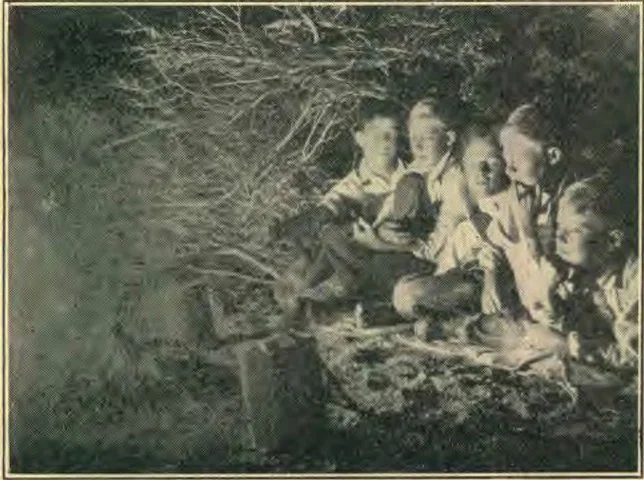
A CAMP FIRE FOR DREAMS
By the middle of the afternoon, we came to the tollhouse, at the top of the saddle that runs out from the peak, within two miles of the summit. There in the shade of tanbark oaks and firs, by a splendid cold spring, we waited until the sun was almost ready to go behind the mountain. And then for the last climb. Over the rocks, through stretches of loose bowlders and broken stone, winding about through chaparrals, or dense thickets, of chamisal and manzanita, ever gaining a broader view, we climbed upward, till just as the sun was sinking behind the farthest coast range by the Pacific, we reached the top. With a happy shout, Alfred, the youngest, climbed to the top of a cairn of rocks at the summit, followed by all the rest, to gaze after the sinking sun.
On three sides the mountain is very steep, with little sign of soil—just cliffs and broken rocks. It was a hazy sunset, but a number of cities and towns lie scattered about through the valleys, sending up the smoke of their homes and industries. On clear days the ocean can be seen on the west.
An interesting marble tablet claimed our attention. It is a restoration of a tablet in honor of early pioneers, among them the Donner Lake Party and the leaders of the Bear Flag Battalion. The legend is on a metal plate, one part in Russian, another with the translation in English, and a third with the statement that the monument was restored in June, 1912, the one-hundredth anniversary of the founding of Ft. Ross, and giving the names of the principal families famous in the early days of California.
But nature called for food. Searching out a sheltered open place among the thickets of scrubby manzanita, we soon had a great camp fire blazing. Night coming on, it turned cold, and the fire was welcome. There we made our big can of coffee and spread our blankets before the cheerful blaze. All sorts of good things came from the five packs, but we were so hungry that Adolph declared there would be nothing left for the next day.
What is there more cheerful than a rousing camp fire? Eat and talk and drowse and rest! Stretch out at length before the glowing coals and leaping flames, and see visions in the fire! Lie on your back and gaze beyond into the starry blue, and see visions there! Go out beyond the glare of the fire and look over the valleys about and see the twinkling lights of a dozen towns, and away to the south the intermittent flashes from the lighthouse on the shore. Beyond that light lies the mighty Pacific, and beyond the Pacific lies—O, it’s easy to dream by a camp fire on a mountain top!
Camp fire stories! That marble monument up near the summit had its stories to tell of the Russians who came in 1812 and built a fort and traded with the Indians, remaining until 1841. The river on which they made their fort is still called the Russian River.
The tragedy of the Donner Lake Party is one of the events of the early days. Eighty persons were in the company that attempted to cross the Sierras in 1846. Winter coming on suddenly, the party was caught in the mountains. Their cattle were lost in the snowstorm, and they were forced to eat their horses. Twenty-two attempted to force their way through, but only seven succeeded in reaching Sutter’s Fort, near where Sacramento is now. Captain Sutter sent some friendly Indians to their aid with supplies. These supplies were soon eaten, and then the desperate travelers ate the Indians, too. Only a few of the large party survived the terrible winter and the famine.
California, you must know, has had many flags. About 1843, the Mexican flag floated over its few forts and scattered posts and missions. In that year John C. Fremont was sent out by the United States government to explore the West, reaching California in 1845, and Sutter’s Fort in 1846. No one knew just why he came,—Uncle Sam does not always explain all he does,—but there was a great stir throughout the State, with rumors of war and conquest. Some Americans captured a number of Mexican horses, an act that did not please the Mexican authorities. Then12the Americans took the town of Sonoma, and surprising General Vallejo, took him prisoner. The new party adopted a flag—made of white cotton with a great red bear of berry stain—and the “bear flag revolt” was on, and soon over, for the spoils of the Mexican War included California. Right or wrong, California the Golden became a part of the United States; and the Bear Flag Battalion doubtless did its share in acquiring it.
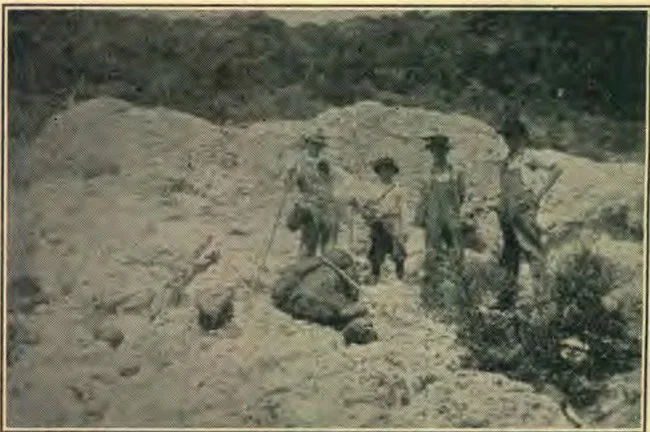
VIEWING MUD CRATER
Bedtime came, and Willie and Oscar and Adolph each rolled up in his blanket. Alfred and the biggest boy found the jolliest little soft place near the fire, and rolled up in their blankets—before long they were both rolled in the same blankets! The fire died away, though for hours the wind kept the embers glowing. All was still and peaceful, until a little whiff of wind rattled a paper near Willie. Mountain lions! flashed through his sleepy head, and with a cry of “Wough!” half of fright and half of defiance, he sat up in his blanket. The shout and the movement brought Adolph up, too, just in time to receive full in his face a handful of sand that Willie hurled at the “mountain lion.” And then everybody was awake.
Finding only a paper rattling in the wind, the boys settled down to sleep again. Half an hour later we were all awakened again; this time by Adolph. He began with a quiet chuckle, but ended with a whole-hearted laugh. “What is it now?” some one asked him. “O, Willie went ‘Wough!’” he replied, bursting again into a laugh, in which we all joined. What do you think of that? Wake up in the night to laugh at a joke! But that’s Adolph. His first greeting on waking in the morning was, “Wough, Willie!”
Of course the thing to do on a mountain top is to see the sun rise. And to be strictly truthful, one must own that the ground bed does get uncomfortably hard by that time of day; and so we went up to see the sun rise, ostensibly, but the boy cropped out as usual. Three steep mountain sides and a pile of loose rock suggest something to a boy. For half an hour those boys rolled rocks down the mountain. How they worked! And what a sensation it is to start a huge rock over the precipitous side of a mountain and listen and watch as it goes crashing and leaping down! Once I was up there with a sober college professor, and he did it, too. I do not know whether that was a sign of the boy in him, or just nature—boy nature, I suppose, that some of us never get out of our systems.
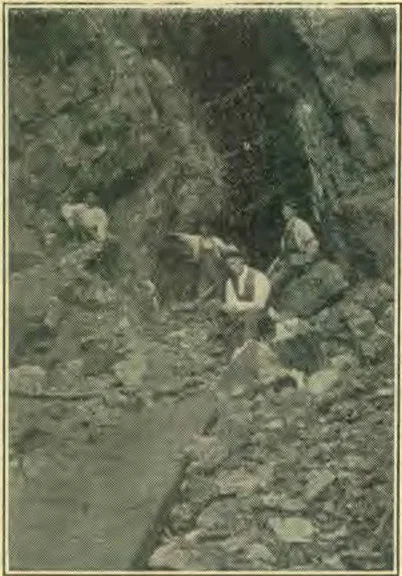
Breakfast over,—there were remnants enough, and we knew the kindly landlady at the tollhouse had boys of her own,—the tramp down the mountain began. Sometimes we ran, in sheer joy of living. In the trail we found the tracks of deer, but of course five boys make too much noise ever to hope to get sight of a deer. Leaving the trail half a mile above the tollhouse, we followed the ridge of outcropping rock to the entrance of the old Silverado Mine. It is a narrow vein in the harder formation, and leads quickly down. It has not been worked for many years, though there is much silver there still.
Just across the gulch from the mine is a tablet to the memory of Robert Louis Stevenson. Where the tablet is his little cabin stood, and there he wrote “The Silverado Squatters.” Good place for dreams again! See the poor man, fighting for life, but cheerful and hopeful, with his bride making a home of a cabin of the tiniest dimensions, high on the mountain side, among the sympathetic and kindly silver miners. A woman’s club erected the tablet only a few years ago.
But boys do not dream long—except Willie, and then it is of mountain lions, not sick poets and brides. And the landlady did help out our commissary department; the wife of a Silverado squatter is a kindly soul. Just as we came to the spring above the house, Alfred discovered a rattlesnake. We missed the deer, but found a rattlesnake, not a very common neighbor in these parts, but occasionally met. This one had ten rattles and a “button”—boys always add the button.
Just down from Mt. St. Helena is the old tree-grown crater of an extinct volcano; Mud Crater it is called. It is nearly half a mile across, and the formation is very interesting. The stones have the appearance of dried mud. To climb down the rough sides is an experience we would not have missed. At the tollhouse they told us to follow the “ducks” on the rocks to find the crater. Arriving there, we decided we could find our way out by climbing down through the cañon that appeared to lead through a cleft of the cliffs at the outer edge of the valley; and being boys, we made it without trouble, the absence of a path only adding zest to the climb down through the cañon.
Once outside the “Palisades,” as the great cliff is called, the valley lay before us, and the walk homeward.
Making for the nearest town, Calistoga, we struck through the woods, down the valley of a mountain stream, coming at length to the vineyards and orchards of the foothills, and then to the fields and lowlands about the town. There was not a watermelon in that whole town! But on the homeward way we crossed Napa Creek. Everybody knows the almost supernatural affinity there is between boys and a swimming hole. How cool and restful that swim was, the last event of a jolly tramp! No, not the last—it has not ended yet; for when we are together on our tramps nearer home, we talk over again and again the delights of that trip; and the memory is very real, and very pleasant.
SILVERADO MINE
St. Helena, California.
Presuming on Friendship
“I WONDER where Jack can be?” Tom Jordan addressed his friend who had accompanied him to Jack’s room.
“Let’s sit down and wait until he returns,” the friend suggested. “He’ll probably be back in a few minutes.”
“Oh, I just wanted to borrow his violin for a few hours,” Tom explained, “and it won’t be worth while to wait for that! He and I are such good friends, you know, that I don’t mind helping myself to what I want, even if he is absent.”
“But perhaps he will want it himself,” suggested Tom’s friend.13
“I’ll fix that all right,” confidently affirmed the other; “I’ll just leave a note on his study table, and when he knows I have it, it will be all right.”
Ten minutes later, Jack returned to his room. When he read the note Tom left on the table, a look of pained disappointment passed over his face. “If Tom would only be a little more considerate,” he remarked, “I would appreciate it. I wanted to practice this afternoon; then my lesson would be out of the way, so I could spend the evening at Professor Todd’s, as he has invited me, too.”
One meets a situation like this once in a while; that is, one will presume on his friendship with another, and ask for things or do things which may often discommode the other, and dismiss it all in the name of friendship. One wonders if there is not a bit of selfishness hidden underneath that splendid word. And that makes the imposition all the more blameworthy.
It will ever remain true that one of the purposes of friendship is mutual helpfulness. One has a right to expect that. But it is quite a different thing to presume on that friendship, and possibly thus impose on the other.
One of the fine marks of friendship is the ability to interpret the feelings and probable decisions of an absent friend. But at its best, friendship is a sensitive thing, and needs delicate consideration to maintain its stability. It requires a big sense of justice and discrimination to be able correctly to interpret the thoughts of an absent friend. This very fact, accorded by one friend to another, affords a chance for imposition. Be careful of it.
When you are in need of assistance or influence, and have friends who can render the very thing you need, be sure of their willingness to do it, before you presume on it. If you proceed on the presumption that it will be freely granted merely for the asking, you may place your friends in an embarrassing situation.
Make all the friends you can, be a friend to all you can; but remember that a friend is not a tool, such as a hammer or a saw, to be used merely to serve you. Let the highest ethical ideals obtain here, and you will never have cause to regret that friendship, neither will you ever find that it will fail you in any legitimate need.—The Boys’ World.
Had You Thought of It?
By Mrs. D. A. Fitch
GIRLS, do you know that by your conduct, wherever you are, observers know whether or not you are obeying the fifth commandment? If you are of a kind and gentle nature, you are honoring your parents; but if of an opposite character, then they are being dishonored by you.
Many young people think that to keep this commandment means simply to do the thing that father or mother requires, but much more is implied. Every action of the life should be so thoroughly in accordance with right and truth that the beholder will be led to say, “That girl has been well trained in her home.”
It matters little what is the age of the person, the commandment that he honor his parents is still obligatory. I am in my seventieth year, and whether I wish it so or not. I am either honoring or dishonoring my parents, who have been many years in the grave. By the very words I am now writing, you are led to decide whether they taught me right or wrong principles.
You may think I am contradicting the foregoing when I say that a child may honor his parents when refusing to obey them. I will explain. A drunkard commands his child to drink a glass of whisky. In refusing does not the child show that some one (probably the mother) has taught him what is right and what is wrong? and does not the child do greater honor to his father by disobeying than he would by heeding his command to drink?
A gentleman was expressing his mind in accordance with the foregoing thoughts, when his wife said, “How can that be? My parents are very much opposed to my being a Seventh-day Adventist, and yet I am one.” He replied, “In being one you are honoring them, for you show that they taught their children to do what they consider is right.”
When violation of principle is not involved, a child is in duty bound implicitly to obey every requirement of his parents. Should unforeseen conditions arise which are not known to the parents, the child should not follow his own inclinations unless they are in harmony with the usually conceded wishes of the parents. The thoughtful question should be, What would father and mother advise me to do?
Mrs. D. A. FITCH.
Missionary Volunteer Reading Courses
Senior No. 9 — Lesson 6: Review of “Things as They Are”
1. WHAT do you consider the greatest obstacle to missionary work in India? Why?
2. What trials must the young Christian in India meet of which you know nothing?
3. Why does the author compare caste to electricity? And why an old native of India to a banyan tree?
4. How is Pantheism related to the religions of India? Why does Hinduism appeal to so many?
5. Why are there so many widows in India?
6. Why does India need educated missionaries? Why does the author plead for simplicity in missionary work?
7. What does the author consider the best plan for securing success in missionary work? How only can we pray effectually for India?14
8. How does the book answer the three general objections to missionary work?
9. Give what you consider the author’s three strongest reasons for calling for reenforcements for India. Mention a way in which the book has helped you.
10. Have you the second book in the course? Will you start reading it at once?
Junior No. 8 — Lesson 6: Review of “Livingstone the Pathfinder”
1. WHEN and where was Livingstone born? How did he use his evenings when a boy?
2. To what country did he desire to go as a missionary? Why? Why did he not go? What kind of missionary did he want to be?
3. What did Livingstone learn on his voyage to Africa that was of great help to him in his work there?
4. In what journey of Livingstone are you most interested? Why?
5. Mention three great discoveries Livingstone made, and four narrow escapes he had.
6. What book did Livingstone always carry with him? How many times did he read it while stopping at Manyema? What seems to have been his favorite Bible text?
7. How did the slave trade make Livingstone’s work harder? Why was he so anxious to have it stopped?
8. Why did Stanley go to Africa to find Livingstone? What did he say of Livingstone after he had lived with him about four months?
9. Where did Livingstone die? What do you think he was doing when death came? Where was he buried? How was his body taken to the coast?
10. Give your favorite quotation from Livingstone. Mention three lessons we may learn from his life.
Faith, Love, and the Dark World's Light
By J. G. Whittier
FAITH shares the future’s promise; love’s
Self-offering is a triumph won;
And each good thought or action moves
The dark world nearer to the sun.
— J. G. Whittier.
Missionary Volunteer Society Programs for Week Ending November 13
REVIEW Morning Watch texts. Have a short paper on “Jeremiah.”
One-minute reports from leaders of working bands.
Bible Study: “The Change of the Sabbath.” See Gazette.
Mission Study: “The Central China Field.” See “Notes on the Mission Studies,” in Gazette; and “An Outline of Mission Fields,” pages 130, 131. Use your map.
Reading: Seniors: “Among the Hupeh Outstations.” See this INSTRUCTOR. Juniors: “A Seeker for Truth.” See Gazette.