The Youth’s Instructor, Vol. 48, No. 29.

IN A SCULPTOR'S STUDIO

The Youth’s Instructor

Jul 19, 1900

Review and Herald Publishing Company · Battle Creek, Mich. · Jul 19, 1900

IN A SCULPTOR'S STUDIO
SHOULD you ever find your way into the studio of a sculptor, and have the privilege of looking about you there, some things will be revealed to you that you never dreamed of; and if you stay long enough, you will know the secret of how many great statues are begun.
Here and there about the studio you will notice large boxes of common clay. This substance is used in making the models from which the larger figures are wrought out later on. Clay was the first material used in this work; but wax, though more expensive, is now coming into common use among sculptors. The clay has to be kept well wet, so that it may be easily worked, and to keep it from drying and crumbling.
The sculptor, or modeler, first makes, of wood, wire, and iron, a rough frame, or armature, which shall correspond in some degree to the greater bones of the body, human or beast, whichever it is the intention to represent. The skeleton must be of great strength, and the wires connecting the different parts must be so affixed that the limbs can be moved into any desired position. Then the clay, or wax, is stuck and pounded on in large lumps, until the body of the figure is about the size that the modeler intends to work upon. Afterward comes the delicate task of modeling the curves and outlines, which must correspond as exactly as possible with photographs, as well as with the many peculiarities of expression, habit, pose, etc., of the person or object represented. This requires great care, and in the doing of it the genius of the sculptor is revealed. When the model is finished in every detail, it generally stands from one to two feet in height; and if accepted by the committees who have the direction of the work from beginning to close, it will thereafter be the basis of all the sculptor's work on that particular figure.
Now the work of the mechanic begins. The small model is made all over again, but on a gigantic scale throughout, making the measurements of height and girth conform to those required. The sculptor usually provides himself with an assistant who is handy with a blacksmith's anvil and carpenter's tools, and who is also an expert caster, and in some cases a modeler. Great joists now come into play, and there is built a heavy iron armature for the body and limbs of the figure—armature which must be of such strength as to bear many tons' weight in the building of heroic statues. The sculptor directs the whole of this rough, heavy labor, as well as the finer work that is to come later on. This calls for the finest judgment and foresight in the adjustment of the various parts that must balance so well the whole. Then comes the application of the clay,—clay, not wax, now, in any case. Day by day the labor goes on, the mass increasing in bulk as the work strengthens and develops. As the model takes shape, the care and anxiety of the sculptor continue, and inspiration burns within him as he pictures the possibilities of outline and beauty that will soon expand beneath his fingers.
Each handful of clay is applied with intelligent accuracy, and the whole mass is moistened at short intervals, to prevent its drying up and breaking; for clay is about as absorbent as sand. In spite of every precaution, accidents are likely to happen that necessitate doing the great work all over. Thomas Ball's equestrian statue of General Washington, which stands in Boston's Public Garden, and William Ordway Partridge's statue of General Grant, in Brooklyn, are two notable instances in point. The gigantic clay models of both these statues were nearly completed; and though in careful hands, at an unfortunate moment large portions of the mass fell away from their frames with a crash, thus undoing in an instant the toil of many months. If the sculptor or his workmen happen to be near the figure at such a time, serious accidents to human life are threatened. But if all goes well, the statue soon becomes almost human in expression, as well as herculean in proportion.
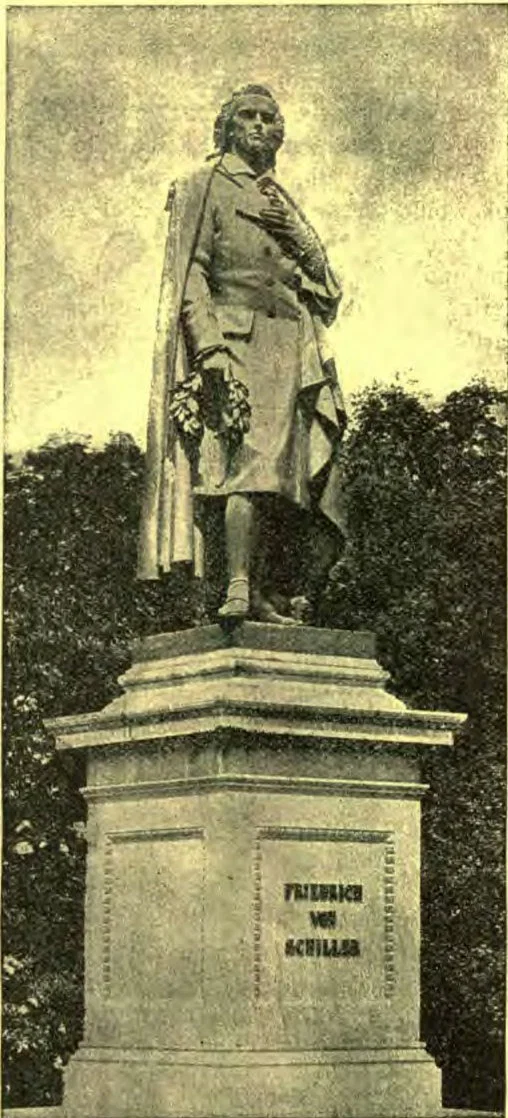
STATUE IN BRONZE OF SCHILLER
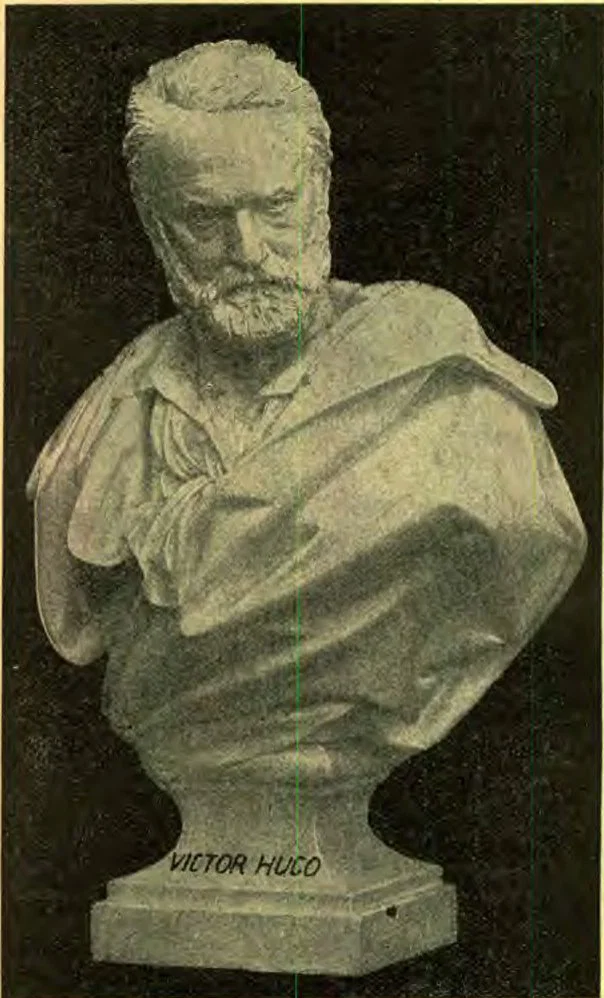
MARBLE BUST OF VICTOR HUGO
The work in clay finished, there follows the difficult task of casting, or taking an impression, or mold, of the whole model, in plaster. Of course the entire figure could not be molded at once. The work is done by portions; and the process is called the thread, or piece-mold process, of casting. The part to be cast first is selected, and a piece of common strong pack-thread is laid along the surface of the clay. The liquid plaster is then poured over both clay and thread, with the ends of the thread protruding. As soon as the plaster has dried a little, the thread is lifted away by both ends, thus dividing the plaster, and rendering it less likely to be broken than if it were one large piece. The operation is repeated until the entire figure has been molded.
This finishes the task of the sculptor, but it does not by any means complete his triumph. From his workshop the molds are packed with the greatest care and attention, the eye and the voice of the sculptor overseeing and directing the smallest details. The cast is then shipped to some bronze foundry, where the founders have made ready their furnaces for the final work of casting in bronze. Into the plaster molds, now hardened to the solidity of rock, is run the liquid bronze, which takes the shape that grew in the brain of the sculptor months before. The plaster is pounded and cut away; the various parts are brought together, and bolted, so as to withstand the storms and changes of years; and the statue, completed, is ready to be placed upon its pedestal, and unveiled before the world.
FRANK WALCOTT HUTT.

GOLD

Gold is the only metal of a yellow color, and, when pure, is the most malleable of all. One grain may be beaten into leaves that cover a space of fifty-six square inches, and are only one two-hundred-and-eighty-two-thousandth of an inch thick. Gold is extremely ductile. A single grain may be drawn into a wire five hundred feet in length; and an ounce of gold, covering a silver wire, can be extended more than thirteen hundred miles. Gold is the least volatile of metals. Gasto Claveus kept an ounce of pure gold constantly melted, in a state of fusion, for two months, without the slightest loss in weight. If alloyed, however, the gold rises with the fumes of the alloy, and loss results. If electricity is passed through gold beaten into leaves, or fine wire, the metal will be dissipated.
Gold is found chiefly in the metallic state, occasionally in combination with other metals. It occurs sometimes as a crystal, but oftener in irregular forms, which, when large, are termed “nuggets.” If found in pieces weighing less than one-fourth to one-half ounce, the whole is called “gold dust.” With the exception of the larger specimens, gold is usually found in bean-shaped pieces, or in some flattened form, the smallest particles being scales, which sink very slowly in a rapid current. These form the “float gold” of miners.
Russia has the largest gold deposits of any country of the Old World. On the Atlantic slopes of North America, gold is most common on the Chaudière River, near Quebec, and in Nova Scotia. On the Pacific Coast gold is found in all the region from Mexico to Alaska. In Africa the chief gold-bearing regions are on the West Coast; and Australia has a large area of gold deposits on her east and south coasts.
Deposits of gold are of two classes,—“veins” and “placers.” In the placer, or alluvial, deposits the metal is generally found in a water-worn condition, and the richest deposits are on the bed-rock. In earlier days these alluvial deposits were washed out in pans,—circular dishes about thirteen or fourteen inches in diameter, made of sheet-iron, with sloping sides. In these the miners placed the pay dirt, and by shaking it over a stream of water, finally secured the gold it might contain. The “cradle” and the “tom”—larger and improved methods of washing—are now used; and where water is plentiful, as in California, the “sluice” is employed. In auriferous soils, jets of water are used by the so-called hydraulic system, the jets playing upon the bank, and carrying the dirt into sluices, where the gold is separated.
When gold is found in rock, the stones are first reduced to powder in a crushing-mill, and afterward the gold is extracted by using mercury.
In regard to the refining process used for gold, Mr. D. I. Byers, one of the principal traveling representatives of gold-metal refiners, made the following statement to a reporter on one of the large city dailies:—
“Probably as little is known about the business in which I am engaged as almost anything you could mention, and still it is intensely interesting. Very few persons know anything about the details connected with the refiners’ business. In the first place the sweepings from the floors of all jewelry establishments are carefully saved, and the water which the employees use to wash their hands is drained into barrels. Every so often the sweepings and water are sent to the refiners. The water is allowed to settle, the residue is put with the sweepings, and then the whole mass is subjected to intense heat, which reduces it to ashes. The ashes are crushed as fine as flour, and then smelted, when the metals are recovered by a chemical process. Thousands and thousands of dollars are saved each year from the refuse around jewelry shops.
“A big business in refining comes from worn-out jewelry, which is generally taken in exchange for new goods. The pure metals are all separated, and then sent to the manufactory to be turned into new goods. Jewelry is turned over and over, and worn again and again in different forms, hundreds of times. The total loss of gold amounts to very little. It is no extravagant statement to say that some of the finest jewelry worn in Cleveland to-day may have been worn in some form two thousand years ago. Perhaps some Cleveland person is wearing some of the same gold jewelry worn by Cleopatra.
“Many are the forms of handling gold. First, there is the pure metallic state; then there is ‘flour gold,’ as fine as dust. Gold is beaten into leaves so light that it can be blown about like a feather. Then again it is spun into a wire almost as fine as a spider’s web. It is also made into a liquid, which is largely used by photographers for toning purposes.
“The help about a refiner’s establishment must of necessity be of the very best. It is not only skill that is required, but the slightest bit of carelessness is not tolerated. A careless man, for instance, might turn away a half-barrel of apparently worthless water, which would mean a loss of hundreds of dollars.”
W. S. CHAPMAN.

MARY'S OFFERING

II

The commendation of Christ after the condemnation of the disciples was of inexpressible value to Mary. Christ could appreciate the gift as the expression of Mary's love, and her heart was filled with peace and happiness.
The disciples did not take in the many lessons given in the Scriptures in regard to the faith that works by love and purifies the soul; and the work of Mary was just the lesson they needed to show them that to be more demonstrative in their appreciation of their Lord, would be wholly acceptable to him. He had been everything to them. They did not realize that soon they would be deprived of his presence, that soon they could offer him no token of their appreciation of his love. The loveliness of Christ, separated from the heavenly courts, living a life of humanity, was never understood nor appreciated by the disciples as it should have been. He was often grieved because they did not give him that which he should have received from them. He knew that if they were under the influence of the heavenly angels that accompanied him, they, too, would be inspired with zeal and true devotion, and with entire consecration to the mind and will of God. They would regard no offering of sufficient value to declare the heart's spiritual affection. Their after-knowledge helped them to realize how many things they might have done for Jesus, expressive of the love and gratitude of their hearts, while they were near him, enjoying his counsel. When Jesus was no longer with them, and they felt as sheep without a shepherd, there were many things they began to understand. They saw how they might have offered him attentions and shown him favor on many occasions. Oh, if they could have taken it all back—this censuring, this presenting the poor as more worthy of the gift than Christ! They felt his reproof keenly as they took from the cross the bruised body of their Lord.
The same lack is evident in our world to-day. But few appreciate all that Christ is to them. If they did, the great and beautiful love of Mary would be expressed—the anointing would be freely bestowed. The expensive ointment would not be called a waste.
Jesus approved of Mary's gift as a testimonial of her love for her Master, who was constantly working in behalf of others, doing good to the poor, and speaking words of comfort to the oppressed. Those who have caught the inspiration of the love that will exist in every heart in the family of the redeemed host, will enter into the joy of their Lord. The spirit of peace and heavenly joy will fill the hearts of those who can appreciate the heavenly Gift. Christ, the world's Redeemer, fills their hearts with love. By faith they are made one with Christ, and their hearts are drawn out to him. They live in Christ, and Christ in them. Nothing is too costly to give him. No self-denial, no self-sacrifice, is too great to be made for his sake.
The words spoken in indignation, “To what purpose is this waste?” brought vividly to the mind of Christ the greatest sacrifice ever made,—the one that could not be surpassed,—the gift of himself to be the propitiation for the sins of a lost world. His entire life had been one of self-denial and self-sacrifice. Declaring his mission in Galilee, he said: “The Spirit of the Lord is upon me, because he hath anointed me to preach the gospel to the poor; he hath sent me to heal the broken-hearted, to preach deliverance to the captives, and recovering of sight to the blind, to set at liberty them that are bruised, to preach the acceptable year of the Lord.” The Lord would be so bountiful to his human family that it could be said of him that he could do no more. In the gift of Jesus to the world, he gave all heaven. His love is without a parallel. It did not stop short of anything. And having given us his only begotten Son, will he not with him also freely give us all things?
If left to be judged from a human point of view, such a sacrifice was a wanton waste; and well might the question be asked, Why does the Lord show such waste, such extravagance, in the multitude of his gifts? Well may the heavenly host look with amazement upon the human family, who cling to their rags of self-righteousness, and refuse to be clothed with the robe of Christ's righteousness,—refuse to be uplifted and enriched with the boundless love expressed in Christ. Well may they exclaim, Why is this great waste?
The supposed prodigality of Mary is an illustration of the method of God in the plan of salvation; grace and nature, related to each other, manifest the ennobling fullness of the source from which they flow. To human reason the whole plan of salvation is a waste of mercy. Self-denial and whole-hearted sacrifice meet us everywhere. But they are provided to accomplish the restoration of the moral image of God in man. The atonement for a lost world was to be full, abundant, and complete. Christ's offering was exceedingly abundant, reaching every soul that God had created. It could not be restricted nor measured so as not to exceed the number who would accept the great gift. All men are not saved; yet the plan of salvation is not a waste because it does not accomplish all that its liberality has provided for. There must be enough and to spare.
In the breaking of the alabaster box, in that the ointment filled the whole room with its fragrance, we have a representation of the sacrifice of Christ, which was to fill the whole world with the fragrance of infinite love. This action of Mary is never to lose its fragrance. This, which the disciples called waste, is repeating itself a thousand times to the susceptible hearts of others, telling ever the story of the abundant love of God for a fallen race.
MRS. E. G. WHITE.

LITTLE AND MUCH

It matters little where I was born, Or if my parents were rich or poor; Whether they shrank at the cold world's scorn, Or walked in the pride of wealth secure; But whether I live an honest man, And hold my integrity firm in my clutch, I tell you, brother, plain as I am, It matters much!
It matters little how long I stay In a world of sorrow and sin and care; Whether in youth I am called away, Or live till my bones and pate are bare; But whether I do the best I can To soften the weight of adversity's touch On the faded cheek of my fellow man, It matters much!
It matters little where be my grave, On mountain or plain or in the sea, By purling brook or 'neath stormy wave, It matters little or naught to me; But whether the angel Death comes down, And marks my brow with his loving touch, As one that shall wear the victor's crown, It matters much!
— Author Unknown.

When All Treasures Are Tried, Truth Is Best

WHEN all treasures are tried, truth is the best.— William Langland.

Gratitude for Life, Health, and Reason

WE can be thankful to a friend for a few acres or a little money; and yet for the freedom and command of the whole earth, and for the great benefits of our being, our life, health, and reason, we often look upon ourselves as under no obligation.—Seneca.

REVEAL THYSELF TO ME

Father, reveal thyself to me. As lovely as thou art; Let light from thee now drive away All darkness from my heart. I long to know that only thou, Where'er I go, dost guide; Since thou hast promised thou wilt be Forever by my side. Teach me to know thy loving voice, And how and where and when It speaks to me, lest I should trust In feeble words of men. And lest I should in blindness doubt The words that come from thee, Father! my heartfelt prayer is this: Reveal thyself to me.
L. H. CHRISTIAN.

SOME TROPICAL PRODUCTIONS

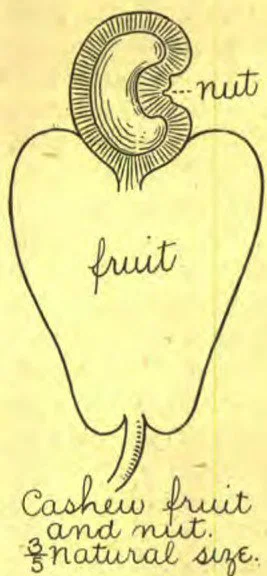
WHEN spring is giving us its parting days, the air is often filled with a savory odor that comes from groups around the common open cooking fires of our island homes. As one passes these fires, he smells burning oil, and sees a great smudge, ending in a sudden fierce blaze. When this burns down, as it soon does, there will be a rapid poking among the embers, and a pulling out of blackened, kidney-shaped nuts, which are cracked, and the white kernels taken out, and eagerly eaten. These are the cashew nuts, which grow at the lower end of the fruit, instead of inside it, as you can see by the illustration. The fruit smells like strawberries, is pear-shaped, spongy, and tough, and its juice, which is somewhat acid, is the only portion used. The skin of the fruit is smooth and glossy, mottled with red and yellow.
The nut has an outer and an inner covering, and between the two is a thick black oil, which oozes out when the nut is roasting. It is this that burns, and gives off such an odor. This oil will blister the skin, and indeed it is sometimes used in the treatment of corns, warts, and sores. The nut meat tastes not unlike almonds. Before it is fully matured, the kernel is filled with a sweet, milky juice.
The tree itself is a sprangly affair, having medium-sized, egg-shaped, reversed leaves growing near the end of the branches. The flowers grow in clusters on the end of the branch, and are small and inconspicuous. The bark produces a milky juice, which is sometimes used for marking linen. The wood is red and rather hard.
The star-apple is another fruit peculiar to the tropics. It is about the size of an apple, quite round, with a smooth green or purple skin. Usually it has ten parts, though each part is not always supplied with a seed. In shape and size the seeds are like a butter-bean,—black, with a white eye. The pulp is purplish-white, very sweet, with a sticky, milky juice, which sends a woe upon the man with a mustache, as it will not wash off, but must wear off. The trees are tall and graceful, with long, slender branches. The pretty, pointed leaves are dark-green above, and of a beautiful, glossy, golden or copper color beneath. Some very young leaves are silver-lined instead. You can easily imagine that one of these trees on a sunny slope presents a beautiful sight when fanned by the breeze.
Driving along, one often sees tall, sturdy, pear-like trees hanging full of fruit that grows straight out from the trunk or limb, and often as large as a gallon pail. The fruit is green in color, and is rough outside, like an osage orange. The flesh of the fruit is white and sweet, the seeds are large and black, and the kernel is often eaten roasted or boiled. This is the “jack-fruit.”
A fruit similar in appearance and size is the “sour-sop,” which, however, grows in the ordinary way; it is sour, and is full of melon-like, brown seeds. This fruit is covered with soft, thorn-like projections. The juice is often used to make a drink similar to lemonade.
The “sweet-sop” and the “custard apple” are two sweet fruits, the flesh of which is soft and custard-like. The seeds, of which there are many, are small. The fruit of both is about the size of a large orange.
The finest of all tropical fruits, in the opinion of many, is the naseberry. This is round, or egg-shaped, ranging in size from an egg to an apple, and having a thin, rough, brown skin. The flesh is somewhat pinkish, and the few seeds are quite similar in size and shape to those of the star-apple. When well matured and thoroughly ripened, the fruit has a delicious flavor, and is very sweet and rich.
I must not leave from my list, which might be made of almost indefinite length, the tamarind and the genisaro, or guango, as it is commonly called. Both fruits are leguminous in character, as are many of the trees here.
The tamarind is a large tree, pinnate-leaved, with fine leaflets. When hanging full of pods, it is very beautiful. The pods are golden-brown, thin, and brittle-shelled, the seeds covered thickly with a very sour brown pulp. This is used to make a beverage, and is sometimes packed in sugar, and sold for this use. A sauce is also made from it. The wood is very tough. The schoolboy dreads a tamarind switch; and criminals are sometimes sentenced to be flogged with tamarind rods.
Genisaro pods are long and black, the seeds covered with a sweet pulp. Horses and cattle feed upon them, the trees being often planted in pastures for both food and shade. The leaves are similar to those of the tamarind, though not so small. The leaves of this tree go to sleep at night. This makes it look, in the early evening, as if it were dying.
The divi-divi is another leguminous tree, which in appearance resembles the tamarind, though it is not so tall, and is more spreading. The leaves are smaller, and slightly sensitive to the touch. The pods are small, brown, and curled up almost like a snail’s shell. The tree is cultivated for tanning purposes.
ANNA AGEE HALL.

Live Nobly in These Noble Times

“LIVE nobly in these noble times! It matters little whether your field of activity be great or small.”

DEVONSHIRE POPPIES

Here, one peers lonely through a gate— Pink-coated huntsman gone astray; There, turbaned courtiers of state Are blurred in carnival array! As scarlet acrobats they run To vault the hedgerow's mystery,— Leaping fantastic in the sun, A blaze of nature's jugglery. Like Highland troopers others pass, With kilt of flame and tunic green; Their bonnets blowing in the grass, Their piper's skirl a lark unseen. Will-o'-the-wisp of summer noons, They flit mid haymakers at rest; And up the path of harvest moons, Are lost o'er sunset's gleaming crest!
— Youth's Companion.

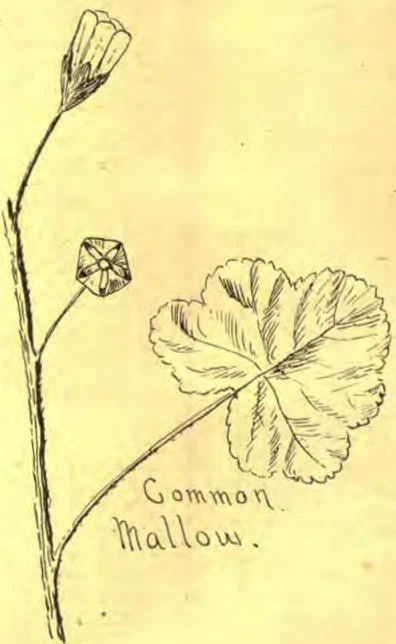
17—MALLOW

THIS is such a common weed, underfoot almost everywhere, that it seems unnecessary to give more than a partial, rough sketch of a leaf, flower, and seed-case.
This plant is what is called in botanical terms “procumbent;” the stem lies upon the ground, and so the plant, with its characteristic leaves, hugs the soil quite closely.
There is another species, with an erect stem, which is called High Mallow. The Marsh Mallow belongs to this same order. It has thick roots, which abound in mucilage, from which was formerly made the confectionery called by the same name as the plant. It was somewhat expensive. Later this confection has been made with gelatin, or some other similar substance, as a base, and consequently it is not so expensive, delicious, nor healthful.
The flower of the Common Mallow is whitish, veined with lavender. The seed-pods are very peculiar, and will help you in identifying the plant. The drawing shows the appearance of one of these.
The leaves are heart-shaped, crenated, and crimpled, and lie quite close to the ground.
L. A. REED.
Continue reading: THE STEREOSCOPE