It is a common error to suppose that the two pictures that make a stereoscopic slide are duplicates, and that their enhanced beauty, when seen in the instrument, is caused by the slight magnifying power of the lenses.
I once attempted to make a stereoscopic slide by mounting, side by side, two prints from the same negative. The pictures combined beautifully in the stereoscope; and though I could see that they were in some way inferior to my other slides, it was some time before I knew that they were not stereoscopic.
The principle upon which the stereoscope is constructed may be illustrated by a few simple experiments.
Look out of the window, and with one eye closed notice the relative positions of the sash and some object outside. Then without moving the head, close the open eye, and open the other. You will observe that the relative positions of the objects have changed considerably. The reason is that the objects are seen from two different points. When both eyes are open, a different image is formed on the retina of each eye, and these images are combined in the brain to form a third.
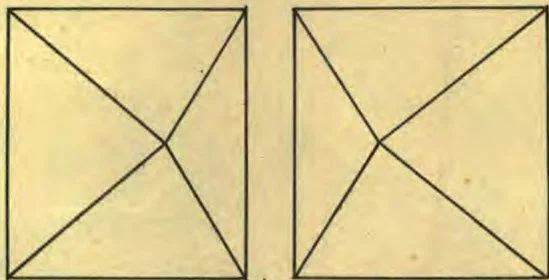
Diagram Illustrating the Principle of the Stereoscope
This principle holds true in stereoscopic photography. Two pictures are taken from different points of view. By the aid of the stereoscope an image of each is formed on the retina of the corresponding eye; and when the brain combines these to form a third, which is unlike either, we have the true “stereoscopic effect.” The drawing will help make this plain.
You may not be able to tell what this drawing represents. But separate the two figures by holding a piece of cardboard or paper between them so that each eye will see but one, and they will gradually melt into one figure. If you are successful with this experiment, you will not need to be told that you are looking down on a pyramid. If the figures will not combine, there is strong probability that you need glasses.
Stereoscopic photographs are usually taken with a camera having twin lenses and a partition. It is really a double camera, with which two exposures are made simultaneously. Such an instrument is necessary if the picture includes moving objects; but many beautiful views may be secured with an ordinary camera and one lens.
The size of the camera used will make no particular difference. If it is larger than four by five inches, it will be well, for the sake of economy, to provide kits, and use smaller plates. If it is smaller than three by three inches, the prints will be smaller than the usual size, but that will not matter if they are mounted the proper distance apart.
Two negatives will be required; and they must be taken from points about three inches apart, measured at right angles with the direction of the object photographed.
The most simple way to accomplish this is to set up your tripod, and make one exposure, in the ordinary manner. Then move each tripod leg about three inches to one side. If the object is near, it may be necessary to loosen the tripod screw, and slightly rotate the camera, in order to include in the second negative the same field that the first had.
If you take many stereographs, it will be advisable to fix a short board on your tripod head, so arranged that the camera may be moved the necessary distance without moving the tripod. There are several methods of accomplishing this, so simple that they need not be described: I will leave you to study out one.
Strong contrast does not give a pleasing effect in the stereoscope; so if your subject is “contrasty,” it is well to overtime the negatives.
The developing, printing, and toning are carried on in the usual manner; but when it comes to mounting, you must be careful not to transpose the pictures, or you will have a “suedoscopic,” instead of a stereoscopic, slide.
If the prints are made on paper a little larger than required, they may be matched more accurately when they are trimmed than if paper of the exact size is used.
Trim the bottom first. Then place the prints in the position they should occupy on the mount, and bring them together until some object in one is two and three-fourths inches from the same object in the other. The prints will overlap in the middle, and they may be trimmed simultaneously by making one cut with the trimming-knife straight down through both. The outside and top may then be trimmed to any size preferred. The usual size of a stereoscopic slide is three by six inches; that would make each print three by three inches. J. EDGAR ROSS.
AN ORIOLE’S VENGEANCE
A LADY who was one day watching a pair of redstarts as they worked in a tree, was startled by a violent commotion that arose in the shrubbery near by. Catbirds screamed, wrens scolded, and the robins shouted, “Quick! quick!” with all their might. A squirrel was dragging a baby catbird by the leg from its nest, and all the birds had come to help make a fuss about it, including a Baltimore oriole. The screaming and the swish of wings as the birds darted about made the little squirrel abandon its prey, and then the commotion subsided as quickly as it had risen. All the birds but the oriole went about their business elsewhere. The oriole had not said a word so far, and, beyond countenancing the hubbub by his presence, had had no part in it. The squirrel, having dropped the baby catbird, cocked itself upon a limb, and began to chatter in a defiant way, while the oriole sat not far away, looking at it, but doing nothing else. In a few moments the squirrel left its seat, and ran out on the limb on which it had been sitting, until it had to use care to keep its hold. Then came the oriole’s opportunity. Flashing across the space, he struck the squirrel in one eye with his sharp, pointed beak, and then, turning instantly, struck the other eye in like manner. Quivering with pain, the squirrel let go the limb, and dropped to the ground, where it rolled and struggled about, apparently in the throes of death. The oriole flew away to his favorite elm, where he sang in his most brilliant fashion. The lady put the squirrel out of its misery, and then saw that the oriole had destroyed both eyes.—Boston Journal.
OUR SUMMER SCHOOL
By Emma C. Dowd
MOUNTAINS strong, serene, and steadfast:
Ocean mirroring the sky;
Lilies giving grace and sweetness,
Just their world to beautify;
Singing brooks that never loiter
On their way to swell the seas;
Pines with fingers pointing heavenward;
Warbling birds, and thrifty bees;
Ferns content to deck, unnoted,
Some half-hidden woodland pool,—
All are teachers, blessed teachers,
In our restful Summer School.
—Emma C. Dowd.
Copper by Electrolysis
The old method of obtaining deposits of copper by electric decomposition of its solutions has been steadily gaining ground, and it is estimated that the pure copper produced in this way now amounts to five hundred tons daily. An early difficulty was the slowness of the process, a weak current being necessary to insure a smooth and adhering deposit. Various devices have made it practicable to work with more powerful currents, and in a given period several times as much copper may be deposited as was obtained from a similar bath ten years ago. One means of overcoming the tendency of the rapidly made deposit to become granular was the continuous passing of an agate burnisher over its surface. An oiled sheepskin was then used as a burnisher.
AN ADVENTURE
By Elizabeth Rosser
AS KATIE TOLD IT
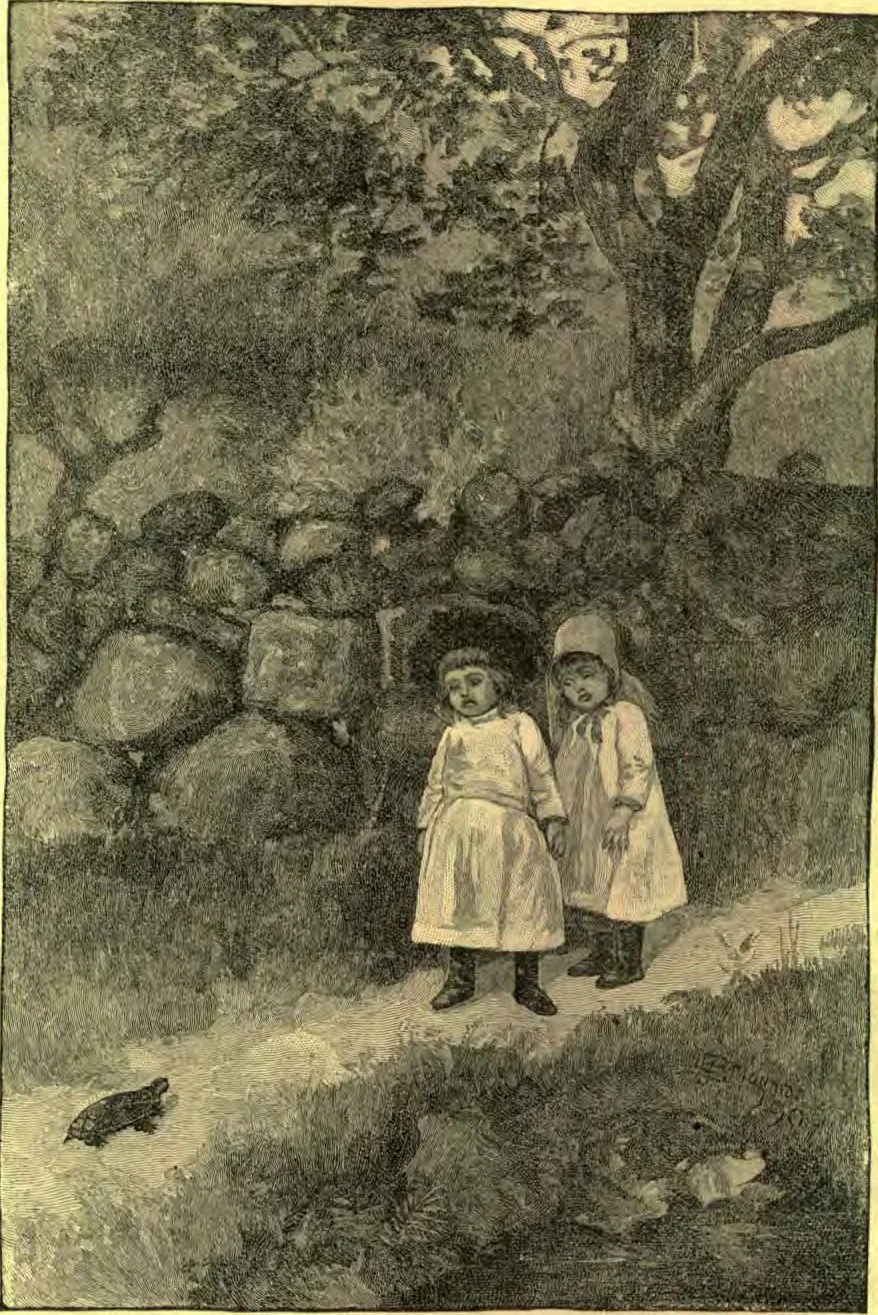
ACROSS the field to Grandma's house, that's where we were going,
To see the lambs and chickens there, and watch the men a-mowing.
We crossed the narrow foot-bridge high, both walking, oh! so careful—
I had to hold Dorinda's hand, she was so very fearful.
We went across the stony-patch, and through the berry-thicket,
And crawled right through the meadow-fence, beneath the broken picket.
But oh! before we reached the gate a fearful monster met us—
We turned and ran right home again, for fear that he would get us!
AS THE TURTLE TOLD IT
I have a fearsome tale to tell; 'tis almost past believing;
I hesitate to speak of it, lest you think me deceiving.
The rest of life I'm going to live here in this bog contented—
To think of ever leaving it, I must have been demented.
But listen to the chance that fell a too ambitious turtle:
I left the bog, I climbed the bank, and passed beneath the myrtle,—
A long and toilsome journey. Then two fearful monsters met me—
I turned and hurried home again, for fear that they would get me!
ELIZABETH ROSSER.
Water Turned into Wine
By Edith E. Adams
When you have heard of the wonderful miracle that Jesus did at the marriage feast in Cana, have you not sometimes wished that you could have sat at that table, and tasted “the good wine” that he provided near the close of the feast?
Yet you have often sat at your own table, and without a thought of him, have tasted water that has been changed into wine by his power! Are you surprised to hear that you have done this, and wondering how it can be? Let us see.
Every miracle that Jesus did was, like the wonderful works of God when he led his people through the wilderness, to teach us his ways—to open our eyes to see what he is doing for us all the time.
When he opened the eyes of the blind man, it was to show that he is “the Light of the world,” the One who gives light and sight to all the people in the world.
When he called Lazarus from the tomb, he was showing that he is the Resurrection, because he is the Life, the One in whom we all “live, and move, and have our being.”
When he fed the five thousand with the multiplied bread, he was teaching that all the bread in the world comes from him, whose power multiplies the grain, and gives the yearly harvest.
When the water gushed from the dry rock in the wilderness, God was teaching that all the water in the world flows from him, “the Fountain of living waters.”
And as Jesus looked upon the water that he had given, and changed it by the power of his glance into rich, sweet wine, like the fresh juice of the grape, he was teaching that it is his presence that makes the earth bring forth and bud, and the light of his countenance that makes that mysterious change in the water that the plant draws from the soil, changing it into “the new wine” that “is found in the cluster.”
For you know that it is the influence of the sunlight that makes this change. By its power the juices of the fruit are sweetened and enriched, and changed into life-giving food. And this light is a gleam from the glory of his face who is “the Light of the world.”
“A FEARFUL MONSTER MET US”
To-day, as at the wedding feast, Jesus looks upon the water stored in the little vessels he has provided for it,—the beautiful fruits hanging on the trees and bushes,—and in the light of his countenance the water blushes into wine. So in the growth and ripening of the fruits year by year, we can see a repetition of the miracle at Cana,—the changing of water into wine.
As you taste the sweet fruits that Jesus is thus providing for you continually, and are refreshed and strengthened by their juice, think of the Fountain of living waters, and the Light of the world, and this wine will seem to you just as wonderful and as sacred as that which he provided for the wedding feast.
In his account of this miracle John says, “This beginning of miracles did Jesus in Cana of Galilee, and manifested forth his glory.” In doing this he was showing the people his glory. But he is, as we have seen, doing the same thing for us all the time; so he is always in this way showing forth his glory. “Do you wish to see the glory of the Lord? Then learn to see him always and everywhere, by his very presence, from the fullness of his own life, providing for the needs of all that he has made. Then you will know that where he is (and he fills heaven and earth) there can be no want, no lack; for in him all fullness dwells.
“For that thy name is near thy wondrous works declare.” “And they that know thy name shall put their trust in thee.”
EDITH E. ADAMS.
A MOTHER’S LOVE
By Bessie Stern
We have a fine, high-bred bay mare, that we call Beauty. Last Thursday night her little colt, which looked just like her, was kicked by another horse; and though we thought it would soon be better, it grew worse and worse, and night before last it was too weak to stand up. This seemed to distress Beauty. She would smell of it, and then walk toward us, and back to the colt, and wait for us to help it up. Yesterday morning it had the lockjaw, and died.
Beauty would walk a little way from it, and then come back and lick it and caress it again, and in many ways try to show her great love for it. We could not get her to leave it.
This morning we buried the dear little colt; and when Beauty saw we were going to take it away, she made so much noise that papa let her loose, and she followed just behind it all the way. When they put it in the ground, she reached down to touch it again with her nose; and when papa began covering it with earth, she raised her head, and almost screamed, and ran to the pasture to call the other horses, and then raced back as fast as she could. In every way she could she tried to make us to know she could not have her baby covered up there. She stood and mourned for a while, then walked round and round the grave, and then started to get the other horses. We let them out; and she came to the grave, and pawed, and tried to tell them to help her. When they went into the barn, she would walk in where they were, then out to the grave, then back again.
Does not this show that dumb animals love their babies, and grieve about them as much, in their way, as human beings do in theirs, when something hurts them?
BESSIE STERN.
Aged fourteen years.
A SPELLING-BEE
“I’m going to have a spelling-bee to-night,” said Uncle John, “and I’ll give a pair of skates to the boy who can best spell ‘man.’”
The children turned, and stared into one another’s eyes.
“Best spell ‘man,’ Uncle John! Why, there’s only one way!” they cried.
JULY STUDY OF THE FIELD
PART IV: “IN THE LAND OF HONDURAS:” “HOW CAN WE BEST HELP PUERTO RICO?”
(July 22-28)
1. The Republic of Honduras is a little larger than the State of Ohio. Its inhabitants number four hundred and thirty-one thousand. Nearly half of the country is inhabited by isolated Indian tribes, whose habits and customs are but little known. The people of this republic are a mixture of Spanish and Indian blood. The prevailing religion is the Roman Catholic. The villagers are hospitable and free from care. They have few wants, and supply these with as little labor as necessary. Their methods of agriculture are primitive. Wooden plows are used in the better-cultivated districts, but the instruments most commonly found are the machete, the hoe, and an instrument resembling a small spade. The men in charge of the various departments of state welcome to Honduras those who will illustrate advanced farming methods. Farmers and gardeners with capital could enter this field; and while teaching the people to cultivate the soil, could also teach them the higher art of cultivating the soul for the heavenly inheritance.
2. Resources of Puerto Rico.—At present very little in the way of plant products is exported from Puerto Rico, outside of coffee, sugar, and tobacco. All other crops have been considered unworthy the serious attention of planters, their cultivation being generally left to the desultory efforts of the most ignorant of the population. As the soil and climatic conditions are exceedingly diverse, it is probable that a wide range of products could be secured, at least for local consumption. Oranges, limes, and other citrus fruits, European grapes, and other semitropical fruits and vegetables, can be produced in the drier parts of the island; while from the moister parts, vanilla, cocoa, mangoes, and other more strictly tropical plants can be cultivated. Over thirteen million dollars’ worth of coffee has been exported in a single season from Puerto Rico, in spite of the fact that the methods of cultivation are of the most primitive character. For men of capital and experience in the industries of tropical countries, there are good openings in Puerto Rico.
3. Homes of the Poor.—One small room, or perhaps two, in the basement or the street floor of the city houses, with no window but a small aperture at front and rear, no furniture except of the most meager, and the barest necessities to keep life going, constitute the home. In the suburbs it is one room, or a small hovel of palm-leaves and grasses, with the inmates crowded in as you never saw them in any other place.
4. Education.—The few schoolhouses now found in Puerto Rico did not exist when the Americans entered that island, the teachers taking the children into their private houses. The school system, with a few slight exceptions, consisted practically of but one grade. The pupils had no school-books. The teacher would have an arithmetic, a grammar, a geography, and perhaps two or three reading-books, which he would pass around the class; but the teaching in other studies would be conducted by having the pupils copy the questions and answers, and then commit them to memory. That was the sum and substance of the teaching—committing everything to memory. Not more than fifteen per cent of the population are able to read and write. These people are desperately in need of education, both religious and intellectual. We have some responsibility in giving this to them. They are not naturally inferior. Their educated men, both white and colored, excel in intelligence and courtesy.
5. A Picture of the Puerto Rican Coffee-Pickers.—“Ragged, tattered pickers, large and small, father, mother, and a brood of partially clothed children, make one of the most picturesque sights in this island of loveliness. In the early morning they trudge out from their little thatched-roof huts, with homemade baskets slung on bands from their shoulders, or balanced carelessly on their heads, straggling along the trails and roads, the little elfin children chasing one another in glee as they go to work. Later, from the depths of every thicket comes the chant of singing voices; and the chorus is feminine, the woman of poverty, somehow, knowing how to be happier than the man. The little children gather all the low berries that may be reached by their tiny hands, while the grown-ups bend down the tall bushes, and rapidly strip the fruit into their baskets. At dusk, from every side burdened figures struggle up the steep hillsides to the winding trails, or ease themselves down, step by step, from the heights above. The men and women are carrying the berries now, sometimes laden down with a large basket on the head, and smaller picking-baskets swung around the body; while the sleepy, tired tots stumble along with all the brightness of life gone out, for that day, from their worn-out little souls. It is no uncommon sight to see a mother carrying a sleeping child in addition to her other load.”
6. Some of the Beauties of Puerto Rico.—Puerto Rico has great advantages in climate and scenery to attract visitors. It stands out in the Atlantic so far that it catches the full benefit of the steady trade winds. These give an equable climate. The temperature in winter every day reaches about eighty degrees, and ninety-two degrees is the extreme limit of summer heat. The island is one of the most beautiful in the world. It is about two thirds the size of Connecticut, and nearly the same shape, three times as long as it is wide. The mountains rise from the coast, leaving no sandy barrens and almost no stretches of marsh. The lower swales and valleys afford rich fields for pasture or for sugar-cane. On the knolls are orchards of cocoanuts; about the houses and huts are groves of bananas; on the hills to their summits grows the coffee, protected by231the shade of small trees. There is grass everywhere, densely matted and low, or, where cultivated, growing half high enough to cover the large cattle. The absolutely clear sky, without smoke or haze or dust, the constant verdure, the tropical vegetation, and the beautiful mountain scenery, make Puerto Rico a most attractive spot.
7. Work for All.—“By the efforts of children and youth many souls will be won to the truth.” “The Lord has his eye upon every one of his people. He has plans concerning each.” “Did the professed believers in the truth live the truth, they would to-day all be missionaries. Some would be working in the islands of the sea, some in the different countries of the world. Some would be serving Christ as home missionaries.” “All who are ordained unto the life of Christ are ordained to work for the salvation of their fellow men. He who loves God supremely, and his neighbor as himself, can not rest content with doing nothing.”—Mrs. E. G. White.
Uncle John's Riddle and the Pond Skating Quarrel
“There are all sorts of ways,” replied Uncle John. “I leave you to think of it a while.”
And he buttoned up his coat, and went away.
“What does he mean?” asked Bob.
“I think it’s a joke,” said Harry, thoughtfully; “and when Uncle John asks me, I’m going to say, ‘Why, m-a-n, of course.’”
“It’s a conundrum, I know,” said Joe; and settled down to think.
Time went slowly to the puzzled boys, for all their fun that day. It seemed as if that after-supper time would never come; but it came at last, and Uncle John came, too, with a shiny skate-runner peeping out of his great-coat pocket.
Uncle John did not delay. He sat down, and looked straight into Harry’s eyes. “Been a good boy to-day, Hal?”
“Yes—no,” said Harry, flushing. “I did something Aunt Margaret told me not to do, because Ned Barnes dared me to. I can’t bear a boy to dare me. What’s that to do with spelling ‘man’?” he added, half to himself.
But Uncle John turned to Bob, “Had a good day, my boy?”
“Have n’t had fun enough,” answered Bob, stoutly. “It’s all Joe’s fault, too. We boys wanted the pond to ourselves for one day; and we made up our minds that when the girls came, we’d clear them off. But Joe—”
“I think this is Joe’s to tell,” interrupted Uncle John. “How was it, boy?”
“Why,” said Joe, “I thought the girls had as much right on the pond as the boys. So I spoke to one or two of the bigger boys, and they thought so, too; and we stopped it all. I thought it was mean to treat girls that way. Don’t you?”
There came a flash from Uncle John’s pocket. The next minute the skates were on Joe’s knee.
“The spelling-match is over,” said Uncle John, “and Joe has won the prize.”
Three bewildered faces mutely questioned him.
“Boys,” he answered, gravely, “we’ve been spelling ‘man,’ not in letters, but in acts. I told you there were different ways, and we’ve proved it here to-night. Think over it, boys, and see.”—Selected.
THE LITTLE BROWN WREN
There's a little brown wren that has built in our
tree.
And she's scarcely as big as a big bumblebee.
She has hollowed a house in the heart of a limb,
And made the walls tidy and made the floor trim
With the down of the crow's-foot, with tow, and with
straw,
The coziest dwelling that ever you saw.
This little brown wren has the brightest of eyes,
And a foot of a very diminutive size.
Her tail is as trig as the sail of a ship;
She's demure, though she walks with a hop and a
skip;
And her voice—but a flute were more fit than a pen
To tell of the voice of the little brown wren.
One morning Sir Sparrow came sauntering by,
And cast on the wren's house an envious eye;
With a strut of bravado and toss of his head,
"I'll put in my claim here," the bold fellow said.
So straightway he mounted on impudent wing,
And entered the door without pausing to ring.
An instant—and swiftly that feathery knight,
All tousled and tumbled, in terror took flight;
While there by the door on her favorite perch,
As neat as a lady just starting for church,
With this song on her lips, "He will not call again,
Unless he is asked," sat the little brown wren.
— Harper's Young People.
I NEVER KNEW
By Anna Temple
I NEVER knew how very far from home
My wandering feet had strayed,
Until I saw
The wounds my Shepherd bore—
Wounds which his thorny search for me had made.
I never knew within that sheltered home
How good it was to be,
Till, tired out
With wandering and doubt,
Back to his fold my Shepherd carried me.
NOTICE that verses 15-17, which formed a part of the last lesson, are repeated in this, to preserve the connection of events. Look up on the map all the places mentioned in the lesson. Note that Tarsus, where Paul went from Jerusalem (Acts 9:30), was Paul's native city. Acts 21:39.
In your study of this lesson, continue the plan of careful, prayerful study of every part of the text. “There is but little benefit derived from a hasty reading of the Scriptures. One may read the whole Bible through, and yet fail to see its beauty, or comprehend its deep and hidden meaning. One passage studied until its significance is clear to the mind, and its relation to the plan of salvation is evident, is of more value than the perusal of many chapters with no definite purpose in view, and no positive instruction gained.”—“Steps to Christ.”
QUESTIONS
1. Who had called Paul? Gal. 1:15. How does God call men? Rev. 22:17. How many does Jesus say he will draw unto himself? John 12:32. Do all yield to this drawing? Heb. 10:39.
2. Whom did God reveal in Paul? With whom did Paul not confer? Gal. 1:16. With whom did he confer? Vs. 11, 12; note 1.
3. What did Paul do after his conversion? Acts 9:20-22. Where did he then go? Gal. 1:17. How long did he remain there? V. 18. To what place did he return? V. 17.
4. After his return to Damascus, what danger threatened him? Acts 9:23, 24. How did he escape? V. 25. Where did he then go? V. 26; Gal. 1:18.
5. Whom did Paul go to see at Jerusalem? How long did Paul stay with Peter? V. 18.
6. How many of the apostles did Paul see at this time? V. 19.
7. What solemn declaration does he make as to the truthfulness of his statements? V. 20; note 2.
8. How was Paul received by his brethren at Jerusalem? Acts 9:26. Who took his part at this time? V. 27. What did Paul do while in Jerusalem? With what results? V. 29. Where did he go next? V. 30; Gal. 1:21.
9. To what extent was Paul known to the churches in Judea? V. 22. What report did they hear of him? V. 23.
10. What did they do because of this good report? V. 24; note 3.
NOTES
1. Paul did not seek counsel of men at his conversion, neither did he follow his own ideas and wishes. Jesus had spoken to him, calling him to do a great work; and he submitted himself to the Lord's instruction.
2. In stating these facts about himself, Paul makes it plain that he had received the gospel from the Lord, not from men. He claims to be an apostle because the Lord had called him, instructed him, and sent him to preach to the Gentiles. He did visit Jerusalem; but his stay there was short, and he saw but two of the apostles at that time.
3. The brethren in Judea had been persecuted by Paul before his conversion. But when they heard of his conversion, they did not distrust him, and question his sincerity; instead, they glorified God in him.
TEACHING WE DO WITHOUT A TEXT-BOOK
TWENTY years ago a discouraged young doctor in one of our large cities was visited by his old father, who came up from a rural district to look after his boy.
“Well, son,” he said, “how are you getting along?”
“I’m not getting along at all,” was the disheartened answer. “I’m not doing a thing.”
The old man’s countenance fell, but he spoke of courage and patience and perseverance. Later in the day he went with his son to a free dispensary, where the young doctor had an unsalaried position, and where he spent an hour or more every day.
The father sat by, a silent but intensely interested spectator, while twenty-five poor unfortunates received help. The doctor forgot his visitor, while he bent his skilled energies to his task; but hardly had the door closed on the last patient when the old man burst forth: “I thought you told me you were not doing anything!” he thundered. “Not doing anything! Why, if I had helped twenty-five persons in a month as much as you have in one morning, I would thank God that my life counted for something.”
“There isn’t any money in it, though,” explained the son, somewhat abashed by his father’s vehemence.
“Money!” the old man shouted, still scornfully. “Money! What is money in comparison with being of use to your fellow men? Never mind about money; you go right along at this work every day. I’ll go back to the farm, and gladly earn money enough to support you as long as I live,—yes, and sleep sound every night with the thought that I have helped you to help your fellow men.”
“That speech,” I said to a friend of mine,—one who has spent many years as a conspicuously successful teacher,—“went into the bones of the young doctor’s life, and strengthened him for a life of unselfish usefulness.”
“Ah,” said the professor, “that one speech was worth years of text-book teaching! And yet it was made without an instant’s preparation.”
“Far from it,” I answered, quickly. “It had taken sixty years of noble living, struggling against sin and self, pressing forward in paths of righteousness, bearing the cross, following hard after the Perfect Man, to prepare that old Christian to make that speech. Then the moment came, and he was ready to teach the glorious lesson.”
For this teaching without text-books, fellow teachers, life’s normal school holds daily, hourly lessons.—S. S. Times.
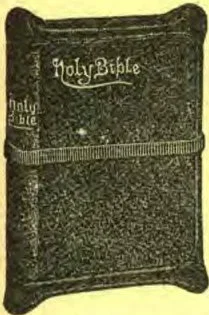
Self-Pronouncing S. S. Teachers’ Reference Bible.
CONTAINS the celebrated *Teachers’ Helps,* comprising nearly 400 pages. Also a complete series of fifteen new maps.
Description. — Imperial Seal Binding, Tuck Edges, known as “Divinity Circuit,” Rounded Corners, Full Red under Gilt Edges.
We offer this Bible, post-paid, for only SIX NEW YEARLY SUBSCRIPTIONS at 75 cents; or TWELVE NEW SIX MONTHS’ SUBSCRIPTIONS at 40 cents.
We will also send it, post-paid, with the INSTRUCTOR one year for $2.25. For 20 cents extra we will stamp your name in gold upon the cover.
To Reach BATTLE CREEK
FROM
CHICAGO, BUFFALO, DETROIT, OR TOLEDO,
Purchase Tickets Reading over the MICHIGAN CENTRAL
“The Niagara Falls Route.”
A First-class Line for First-class Travel between Chicago and New York and Boston. Elegantly equipped through trains pass Battle Creek in each direction daily.
R. N. R. WHEELER,
Ticket Agent, Battle Creek.
O. W. RUGGLES,
Gen’l P. and T. Agt., Chicago, Ill.
TAKE THE Canadian Pacific Railway
for . . . CHATHAM, OTTAWA, MONTREAL, LONDON, GALT, QUEBEC, WOODSTOCK, TORONTO, BOSTON, PORTLAND, and All points in New England, the Maritime Provinces, Great Britain, and the Continent.
Illustrated literature, time-tables, and full particulars, upon application to—
J. FRANCIS LEE, GEN. AGENT,
Passenger Dep't. 228 SOUTH CLARK ST., CHICAGO
Branch Offices: 76 Ottawa St., Grand Rapids, Mich.; Room D, Chamber of Commerce, Cincinnati, Ohio; 315 Chestnut St., St. Louis, Mo.