Ned Fry sat in his cottage, moody and dejected. He had been drunk the night before, and in a quarrel at the village inn had been knocked down violently, and had broken his arm. After enduring some hours of pain, it had been set and bound up in a sling.
Ned was a carpenter by trade, and need never have lacked work. Just now he had a job at the Uplands Farm. But he was thinking that he would now be unable to resume work for some weeks, and that his wife and little boy were dependent on his earnings.
The prospect was not cheerful, particularly as he knew that it was through no one's fault but his own that he was in such a sad plight. He had been married just four years. The happy young wife he had brought home had grown sad-looking, and avoided talking to her neighbors more than was necessary. They said she was fretting after the little girl she had buried a year ago.
But there had been times lately when Mary Fry had said to herself that she could not wish her little one had lived to grow up and know the poverty and suffering that seemed inevitable since her husband had taken to drink. Ned's head was aching, and his arm was very painful. The rain was pattering on the little casement, and a dull, smoky fire gave very little warmth. His wife was preparing a meager dinner, and his little boy was playing on the floor. Just then a tap was heard at the door, and the next minute a lady came in.
Mary Fry dusted a chair for her, and answered her questions about the man's broken arm as shortly as she could. The visitor was well known to them both. She was the wife9of Fry's employer at Uplands Farm, and often visited the villagers when she happened to have time.
“I am very sorry about your accident,” she said to Fry, “but I am afraid it was your own fault. It will be a lesson to you, I hope, to think more of your wife and child. You see how they must suffer for your neglect.”
Fry listened with a scowl on his face, and answered nothing. And soon the visitor, seeing his mood, took her departure.
“There's your good folks!” snarled Ned to his wife. “Preach, preach, and show the way to be good, and let everybody else know they're bad. No religion for me, or religious folks either.”
A week went by, and then a sadder trouble came to the Fry's. The little boy fell ill with scarlet fever, a dangerous type of which had appeared in the village. As the fever ran its course, and he knew that the child's life was in danger, Ned Fry became nearly distracted. His little boy was the idol of his heart.
The poor mother, weakened by anxiety and watching, took ill, too, and before her little boy had come to the worst, she too lay in ceaseless delirium.
Ned Fry did not know where to turn or what to do. The neighbors one and all kept away from the infected dwelling, and there were no hands but Ned's to minister to mother and child. Crippled as he was, and ignorant of what to do, it seemed that things could scarcely be worse for them all. But just then another visitor came.
Ned opened the door, and saw standing there a young lady who had lately come to live in the village. “We've got the fever here,” said he. “I know,” she answered. “That is why I came to see if I could do anything for you. I have heard that you have no one to help you, and that you cannot even use your arm. May I come in?”
She spoke quietly and courteously. “You'd better not, ma'am,” said Ned, softened from his moroseness. “Why should you?” “I want to help you,” the lady replied. “Please let me. I am a good nurse, and I live alone. I came to this village just to do what I can for you all.”
And saying this she passed in. “And it's my belief that from the day she came they began to get better,” said Ned Fry, many weeks later, to his fellow-workmen. “She knew what to do for them, and her gentle ways and touches took the fever out of them. Sometimes she sat up with them o'nights when I was too dead beat to hold my eyes open, and when the worst was over, she would come with her flowers and cool drinks to make a sort of heaven for them. Ah, and never a word did she preach! No talk about goin' to church, and giving up public house, and doin' your duty. But I'll tell you what it is, mates, she didn't need to talk it; she lived her religion. Says I, ‘Why did you come here when you'd no call to do it, and stood a chance of catching the fever, too?’ For I couldn't make it out. But she says, quite simple like:— ‘You were in trouble, and I knew I could help you.’ “And then, somehow, I minded all the words in the Bible about Jesus Christ and the heavy laden, and I says to myself, ‘There's something in religion after all,’ and I actually took my Bible and read it when I sat there by myself. And now there's work to be done, and an honest life to be lived, by God's help.”
And it was the beginning of a new life. Hard work, steady endeavor, and prayer for strength, brought with them the blessings they never fail to bring. And Ned's religion was his life.
Dear friends, unless your faith and your life speak equally to declare you followers of Christ, your religion is of little worth.—Friendly Greetings.
THE PHARISEE AND THE PUBLICAN.
By E. Hilliard
BY E. HILLIARD.
They both went up to the temple for the same purpose,—to pray. One went up to tell God, in the hearing of the people, how good he was; the other, to confess to God that he was a sinner. The Pharisee thanked God that he was not as other men are, extortioners, unjust, adulterers, or even as this publican. He was exactly what he thought he was not. He was certainly an unjust man, although he thanked God that he was not such. He was not justified of God, because he was not willing to call himself unjust, or a sinner. While he thanked God that he was not like the publican, he was far worse. He might have been an extortioner, or adulterer, or guilty of every sin that he thought he had not committed, but had he repented as the publican did he would have been accounted just before God. The publican called himself just what he was,—a sinner, an unjust man,—and he was immediately made just, or righteous.
The apostle Paul, in speaking of Christ, says: “Whom God hath set forth to be a propitiation through faith in his blood, to declare his righteousness for the remission of sins that are past, through the forbearance of God; . . . that he [Christ] might be just, and the justifier of him which believeth in Jesus.” Rom. 3:25, 26. If a just man should call an unjust man just, he would be a liar, and the character of both would then be unjust. But when Christ calls an unjust man just, he is so; for the Father accepts him through the imputed righteousness of Christ, which is declared for the remission of sins which are past.
But even Christ cannot call a sinner just, and declare him to be righteous, unless he is a penitent sinner. He knows the sincerity of the heart, and will justify none but the humble confessor. The publican was justified because in deep humility he confessed his sins. He was doubtless just as wicked as the Pharisee regarded him. The Pharisee was in a worse condition because he had no realizing sense of his own sinfulness, but a keen sense of the sinfulness of others.
The thief on the cross was justified, and was a righteous man but a few hours. There will be men in heaven who were once extortioners, thieves, murderers, and adulterers, but who repented like the publican, and were justified through the precious blood of Jesus, while others who committed lesser sins, and did not repent, but prided themselves on their good record, like the Pharisee, will be left outside. Jesus said to the self-righteous rabbis, “The publicans and the harlots go into the kingdom of God before you.” This is because of the impenitence and unbelief of the rabbis and the penitence and belief of the publicans and harlots.
Wonderful, indeed, is the plan of salvation that imputes to the humble, penitent, believing soul the spotless righteousness of the crucified and risen Redeemer! Hear his gracious words as he stoops from his high position and condescends to reason with the scarlet-stained sinner: “Come now, and let us reason together, saith the Lord; though your sins be as scarlet, they shall be as white as snow; though they be red like crimson, they shall be as wool.” Reader, are you still in your sins? Do you desire to be forgiven? If so, that voice comes sounding down the ages to you, and Jesus desires to reason with you. He wants you to believe that he is ready to pardon you, when you repent, confess, and believe. Come and be washed in his blood and clothed in his righteousness. Then your crimson sins will be cast into the depths of the sea, where they will be forever buried in oblivion.
Brainerd, Minn.
STRAWS POINT THE DIRECTION.
THERE is a town not more than a thousand miles from Orlando that recently had nine applicants for the position of postmaster. Eight of these were Protestants and one was a Roman Catholic and a saloon keeper. The Protestants were highly recommended, one, by one of our United States senators. When the facts seemed to indicate that the saloon keeper and Catholic was about to receive the nomination, a prominent pastor of the city wrote to President Cleveland, told him that the Catholic was a saloon keeper and one that was not received in society at all, and requested that no attention be paid to his application. Notwithstanding all this the Catholic was appointed, and, more than that, received a copy of the letter sent to the President by the prominent pastor.
Everybody is now wondering how these things came about as they did, but are at a loss to understand the secret of it.
Little do they know that there is a “power behind the throne” that says to one, “Go, and he goeth; and to another, Come, and he cometh.” Straws point us to the direction the wind is blowing; so do all these significant facts show us how, gradually but surely, Rome is manipulating everything to answer her own selfish purposes.—Florida Bulletin.
The Greatest Miracle: A Personal Conversion
By Vinat
The greatest miracle that I know of is that of my conversion. I was dead, and I live; I was blind, and I see; I was a slave, and I am free; I was an enemy of God, and I love him. Prayer, the Bible, the society of Christians—these were to me a source of profound ennui; whilst now it is the pleasures of the world that are a weariness to me, and piety is the source of all my joy. Behold the miracle! and if God has been able to work that one, there are none of which he is not capable.—Vinat.
Faith, Not Feeling, Carries Us Through
“It is faith, not feeling, leaning, not resolving, that carries us through.”
A MOTHER'S GOOD-BY.
Sit down by the side of your mother, my boy;
You have only a moment, I know,
But you will stay till I give you my parting advice;
It is all that I have to bestow.
You leave us to seek for employment, my boy;
By the world you have yet to be tried;
But in all the temptations and struggles you meet,
May your heart in the Saviour confide.
You will find in your satchel a Bible, my boy;
It is the Book of all others the best;
It will teach you to live, it will help you to die,
And lead to the gates of the blest.
I gave you to God in your cradle, my boy;
I have taught you the best that I knew,
And as long as his mercy permits me to live,
I will never cease praying for you.
Your father is coming to bid you good-by.
O, how sad and how lone we will be!
But when far from the scenes of your childhood
and youth,
You will remember your father and me.
I want you to heed every word I have said,
For it comes from a heart filled with love,
And, my boy, if we never behold you on earth,
Will you promise to meet us above?
Hold fast to the right, hold fast to the right,
Wherever your footsteps may roam.
O, forsake not the way of salvation, my boy,
That you learned from your mother at home!
—Selected.
A CHOLERA PREVENTIVE.
By John Harvey Kellogg
WHEN the cholera comes into a city, it is only a part of the people who get sick and die. It is those who have bad stomachs who have cholera. Now we need not have cholera, because the Lord has given us the most powerful kind of disinfectant in the stomach. This disinfectant is the gastric juice. It has been shown by actual experiments that cholera germs will live but a few minutes in healthy gastric juice. But if the gastric juice is unhealthy, cholera germs will go down through the stomach into the bowels; and it is in the bowels that the germs do their mischief. If a man loads his stomach with unwholesome things, which overpower the digestive ability of the stomach, this disinfecting process cannot take place; and germs pass down into the bowels, and do all sorts of mischief there. Pure blood also has the power, not only to kill germs, but germs of the most deadly character. Repeated experiments have shown this. The Lord uses natural means to accomplish most of his work. Natural means are God’s means. In saying this, I do not set nature up against God. It is God’s regular way of working. God has given man the ability to defend himself against germs, if he is only well and healthy. A man who goes on eating things that he should not eat, thus getting his stomach out of order, cannot defend himself against germs, because the stomach’s protective power is destroyed; and so, when some dangerous poisons come along, the sentinels and guards of the system are asleep.
Now this is one way the Lord wants to protect us against plagues. I think he will use supernatural means, but he will use natural means first. If a man has been living unhygienically all along, and says, “Now the last plagues are coming, and I am going to reform right off,” he will find that he can’t “reform right off.” You can’t reform in a minute.—Dr. J. H. Kellogg.
THROUGH THE BLACK CANYON.
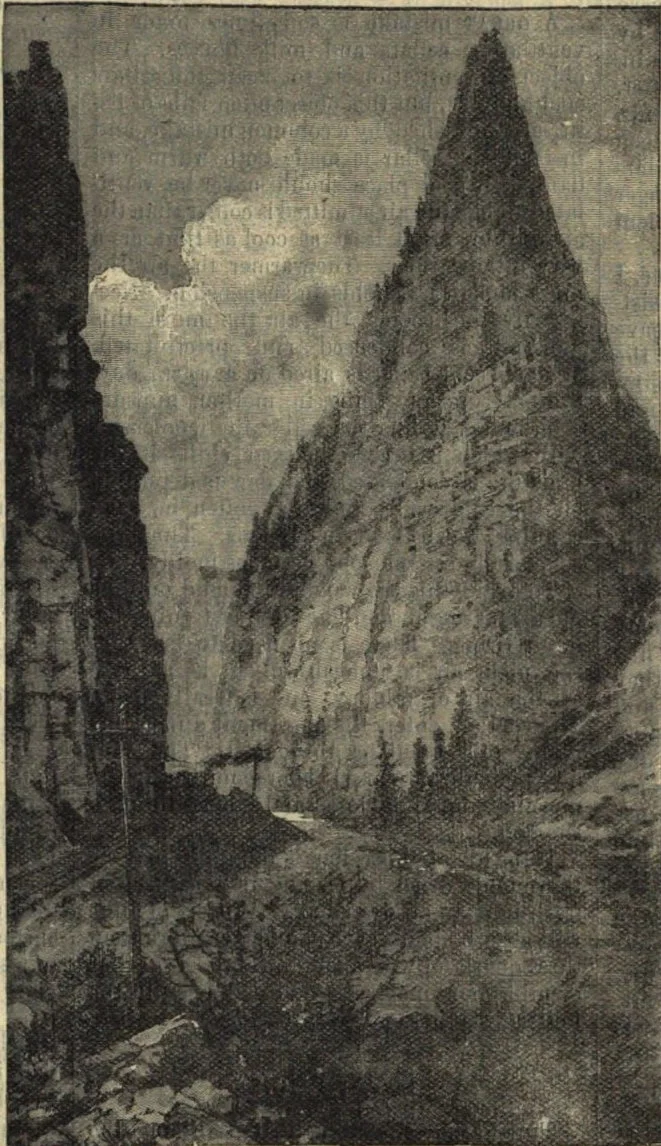
CURRECANTI NEEDLE, IN BLACK CANYON, COLORADO.
THAT it should have been called “black” is a surprise to every one who makes a trip through this canyon, for the river is quite wide, and while the walls of stone are sometimes of great height, they are not somber, but of great beauty, varying in color; so, instead of entering a dark chasm, as the name would indicate, we come into a most beautiful amphitheater. At Sapinero, a small station twenty-six miles west of Gunnison, an observation car was attached to the train. This car was open at the top as well as on both sides, thus affording a fine view, for while Colorado is a large state, a good deal of it is “set up on end,” and the traveler often obtains the finest views by “looking upward.”
The hot July sun beat down upon our unprotected heads, while the rapid motion of the train created a stiff breeze, that wrested from our grasp the umbrellas we vainly endeavored to hold aloft. Cinders from two locomotives filled our optic organs to overflowing. Happily for the ladies, they had provided themselves with veils that protected them from further difficulties, but the gentlemen, not having veils among their baggage, winked and blinked in the sunlight, and held onto their hats with both hands. By the time the train had reached the canyon we were in readiness to view the scene.
The porter of the car in which we were traveling gave us the benefit of his travels through the canyon, and called our attention to the principal objects of interest as we came to them. On the side of the wall of stone that rose up beside the track he pointed out with a cane the outlines of a human face, that was so plainly depicted that we saw it when the train was moving quite rapidly. The high walls of granite rear their heads to a height of 2,000 feet above the Gunnison River, that flows at the bottom of the canyon. The railroad clings to the base of the wall on one side; then, when some impassable barrier rises in its path, it crosses on a substantial bridge to the other side of the river. The most notable object in this canyon, which is about twenty miles long, is the Currecanti Needle, of which our illustration gives a good view. The “Needle” rises high above its surroundings, and so graceful are its proportions that it appears as though it might have been hewn out of stone by some master workman.
An exclamation of delight arose from the lips of all as a turn in the road revealed to our eyes the Chipeta Falls, white as snow, gleaming and sparkling in the sunlight, falling from a height of 2,000 feet into the river below. Our eyes lingered as long as was possible on this beautiful scene of falling water.—Our Young Folks.
SIAM AND THE LAOS.
By W. C. Dodd
BY REV. W. C. DODD.
There are two distinct peoples in Siam, the Siamese proper, in the southern part of the kingdom, and the Laos. Only a portion of the Laos people are tributary to Siam and live in the northern half of the kingdom. They are a people, not a nation, and are living under four separate governments. Siam has the southern portion of them; France recently acquired the eastern, China has the suzerainty of those in the north, and a few are tributary to England on the west. Siam’s portion is the largest, and hence the whole Laos people may properly be included in the missionary outlook for Siam.
Although the Siamese have been derived from the Laos, yet centuries of different latitude, different food, and especially maritime contact with the outside world, have resulted in differentiating them from their inland Laos brethren. This difference is shown in the modification of the spoken language in distinct written languages, in differences of custom, costume, and worship, and especially in a striking difference in physical and moral vigor in favor of the Laos. There are, therefore, marked differences in all the factors which enter into the present missionary outlook in these two portions of the kingdom. We shall note three such factors.
Centuries ago Siam was known as especially friendly to foreigners. Not a great commercial people, but almost wholly agricultural, both Laos and Siamese originally were simple-hearted, peaceful, polite, comparatively pure, receptive, and impressionable. In Lower Siam, at present, contact with the worst elements of our occidental civilization has deprived a large portion of the populace of that primitive simplicity, especially in seaport and river towns. Rum and other debauching elements have come in with steamboats, steam cars, electric cars, telegraphs, and postal system. Yet a large part of the inland population of Lower Siam is still primitive, hence simple and receptive. And this is true of almost all the five million Laos people. God has made and kept the majority of the Siamese and almost all the Laos people free from the influence of immoral foreigners; all are free from caste; there is no seclusion of women except among the royal families; there are no strong nationalities, and hence no pride which despises foreigners11or is restive under foreign teaching and direction; polygamy prevails only among certain classes in Lower Siam, and there is almost none among the Laos people.
With few exceptions the kings, governors, and their subordinates have not only offered no open or secret opposition to the work of the missionaries, but they have been positively friendly, and in many cases have aided by grants of money, land, and influence. The few who have offered decided opposition have been providentially removed. Grants of land and of money for educational and medical purposes are still occasionally obtained in Lower Siam. Among the Laos the government favor is still more marked. For the last fifteen years there has been a government proclamation of absolute religious tolerance in Siam. And, with the possible exception of the Laos, who are under the French, the same favor to missionaries is found among all the Laos officials outside as well as inside of the kingdom of Siam. In every station and prospective station of the North Laos Mission, ground has been leased to the mission to hold, “so long as used for the purposes of healing [by foreign medicine], and of teaching the Christian religion.” And this by a government in which Buddhism is the state religion. The finger of God is here.
The Siamese and the Laos people have this in common, namely, that, unlike most countries of Eastern Asia, their nominal religion is Southern Buddhism unmixed with Hinduism, Confucianism, or any other of the ethnic religions. And Buddhism, by its failure to satisfy the head with its puerile and fantastic stories, and also because of its thousands of self-conflicting teachings, and by its failure to satisfy the heart, with its lifeless pantheism or its agnosticism and its meaningless ritual in an unknown tongue (the Pali), has paved the way for a religion that can satisfy both head and heart.
The Siamese and the Laos people differ in this, that the weak moral nature of the former contents itself with the empty forms. Buddhism retains a strong hold and has a strong outward following in Lower Siam, while it has only a nominal following among the warmer moral natures of the Laos people. So, to its failure to satisfy the Laos head and heart, must be added, as a second negative sort of preparation for Christianity, its failure to keep its own votaries from demon worship. Although it denounces demonolatry in terms as strong as any in our own Bible, yet its hold is too weak to keep these children of nature from seeking the supposedly personal and vital as objects of worship, and more especially of propitiation. Once admitted, demon worship leads to accusations of witchcraft; and these have driven hundreds of Laos people to take refuge from these accusations in the Christ who can cast out evil spirits. —Missionary Review.
A MOTHER'S PRAYERS.
Who can pray like a thoroughly Christian mother? Such a mother will continue to pray for her bad boy long after the father has given him up as hopeless. Many years ago there was a mother in Somerville, N. J., whose son, a young man, had begun to lead a dissolute life.
One evening she begged him not to spend that evening away from her, but he declared that he would. He said, “Mother, I'm not going to be tied to your apron strings; I am going to go.” The mother replied, “Please try to remember every moment to-night that, until you come back, I am going to be on my knees asking God to save you.”
The son, with a rude gesture and muttered oath, rushed from her presence and spent the night in a shameful carousal. It was four o'clock in the morning when he got home. He had managed to keep his mother out of his mind during his revelry.
As he got to the house, he saw a light shining through the shutters. Turning the blinds down and looking in, he saw his mother on her knees, and heard her pray, “God, save my wandering boy.” Going to his room, he threw himself on his bed, but he could not sleep. After awhile he arose, then he knelt down, and it seemed to him as though Christ's power proceeded from the room where his wrestling mother was pleading with God, and it led him to cry out, “God, be merciful to me a sinner!” And that very morning he was converted.
The news of his conversion soon spread in the neighborhood, and in three weeks from that time more than two hundred young people had been converted. Could that young man doubt that God hears and answers prayer? And what blessed encouragement this is to praying Christian mothers. Hard praying leads to the conversion of hard sons.—Christian Advocate.
WASHING FLANNELS.
“All shrunk up and absolutely good for nothing,” said the mother of a family as she looked over the stock of summer flannels, bought with the utmost care and at a great expense. “And the worst of it all is that, say what I will, I cannot get my flannels washed carefully. One of my laundresses is an enthusiast on cold water; another has always regulated her work by the thermometer, and the third declares it makes no difference whether the water is hot or cold, they will shrink anyhow, and I do not think that there is any wonder that they do, considering the way they handle them.
“These women, good, careful souls every one of them, put the flannels onto the washboard and literally maul them and grind them in their efforts to make them clean, all of which is as unnecessary as it is ruinous. Sometimes in despair I do them myself and the consequences are that they do not shrink. I use suds, pretty strong, and with a very little sal soda in it, and just as hot as I, by any possibility, can handle the flannels in. If it is nearly boiling, so much the better. I put the flannels in the tub, pour on the suds, cover them up and let them stand for fifteen minutes, then take them up by belts or collars as gingerly as possible with my very finger tips, let the water drain from them, dip them again, and repeat the draining process.
“If there are any particular dirty spots, I have soap dissolved in water to a pasty consistency and put a bit of it on the spots and leave them a few minutes longer. I do not rub the soap in, neither do I rub the flannels. I simply rinse them up and down in the water, and this not more than is necessary to clean them. When I think they will do, I lay them where they will drain until the water is nearly out, then prepare fresh hot suds and put them through in the same way. Under no circumstances would I wring them or press them any more than is necessary. They are hung out dripping, and, if it is cold weather, they may freeze all they choose. I have had my fine French flannels brought in so stiff that they would almost stand up against the wall, and I have some of them now that are worn to rags that are as soft and pliable as the day they were made up. Before the garments are fully dry they may be ironed. Never use partly cool irons and rub them again and again, for this is worse than the wringing and squeezing process, but take an iron as hot as may be without any danger of scorching, and manage so carefully that once passing over the fabric will smooth it. In this way flannels will last to a good old age and preserve their original quality intact.”—N. Y. Ledger.
COOLING AND DRYING THE CELLAR.
A great mistake is sometimes made in ventilating cellars and milk houses. The object of ventilation is to keep the cellars cool and dry, but this object often fails of being accomplished, by a common mistake, and instead the cellar is made both warm and damp. A cool place should never be ventilated unless the air admitted is cooler than the air within, or at least as cool as that, or a very little warmer. The warmer the air the more moisture it holds in suspension. Necessarily the cooler the air the more this moisture is condensed and precipitated. When a cool cellar is aired on a warm day, the entering air, being in motion, appears cool, but as it fills the cellar the cooler air with which it becomes mixed chills it, the moisture is condensed, and dew is deposited on the cold walls, and may often be seen running down them in streams. Then the cellar is damp and soon becomes moldy.
To avoid this the windows should only be opened at night, and late—the last thing before retiring. There is no need to fear that the night air is unhealthful—it is as pure as the air of midday, and is really drier. The cool air enters the apartment during the night and circulates through it. The windows should be closed before sunrise in the morning, and kept closed and shaded through the day.
If the air of the cellar is damp, it may be thoroughly dried by placing in it a peck of fresh lime in an open box. A peck of lime will absorb about seven pounds, or more than three quarts, of water, and in this way a cellar or milk room may soon be dried, even in the hottest weather.—Medical Classics.
TOBACCO
THE French Government, recognizing the deteriorating influence of tobacco upon the young, has prohibited its use by students in the public schools. The Swiss Government will not tolerate that tobacco be sold to juniors. Boys found smoking in the streets are now promptly arrested and punished. Punishment is also meted out to those who sell them tobacco. Dr. Bremer, of St. Vincent's Institute for the Insane, at St. Louis, has called attention to the fact that tobacco smoking by the young produces mental and moral deterioration, while in older persons it produces brain disease and insanity.—Catholic Mirror.
The Art of Expressing Good Thoughts
By G. W. Rine
The next best thing to having something to say, is the ability to say it impressively, happily. The most fitting honor one can confer upon a good thought is to give it adequate verbal expression. Many a golden conception has, doubtless, been lost to the world because of its author's inability to clothe it happily in words.—G. W. Rine.
“ARISE AND SHINE.”
By Balfour
Go, MESSENGER of peace and love, To people plunged in shades of night; Like angels sent from fields above Be thine to shed celestial light.
Go to the hungry, food impart; To paths of peace the wanderer guide; And lead the thirsty, panting heart Where streams of living water glide.
O faint not in the day of toil; When harvest waits the reaper's hand, Go gather in the glorious spoil, And joyous in his presence stand.
Thy love a rich reward shall find From Him who sits enthroned on high; For they who turn the erring mind Shall shine like stars above the sky.
—Balfour.
THE ONLY ACCEPTABLE GIFT.
A missionary was preaching to the Maori tribe of Zealanders. He had been telling them of the sufferings of Christ—how he had poured forth his soul unto death for them; and as he concluded, the hills rang to the thrilling question: “Is it nothing to you, all you who pass by? Behold and see if there be any sorrow like unto his sorrow.” Then stood forth a plumed and painted chief, the scarred warrior of many fights, and as his lips quivered with emotion, he spoke:—
“And did the Son of the Highest suffer this for us men? Then the chief would like to offer him some poor return for his great love. Would the Son of God like to accept the chief’s hunting dog? Swift of foot and keen of scent, the tribe has not such another, and he has been to the chief as a friend.”
But the missionary told him that the Son of God had no need of such gifts. Thinking he had mistaken the gift, he resumed: “Yet perhaps he would accept my well-tried rifle, unerring of aim; the chief cannot replace it.” Again the missionary shook his head.
For a moment the chief paused; then, as a new thought struck him, suddenly despoiling himself of his striped blanket, he cried with childlike earnestness: “Perhaps he who had not where to lay his head will yet accept the chieftain’s blanket. The poor chief will be cold without it, yet it is offered joyfully.”
Touched by love’s persistency, the missionary tried to explain to him the real nature of the Son of God, that it was not men’s gifts, but men’s hearts, that he yearned for. For a moment a cloud of grief darkened the rough features of the old chief; then, as the true nature of the Son of God slowly dawned upon him, casting aside his blanket and rifle, he clasped his hands, and, looking up into the blue sky, his face beaming with joy, he exclaimed, “Perhaps the Son of the Blessed One will accept the poor old chief himself.” — Union Gospel News.
WORK OF BIBLE WOMEN IN MADURA, INDIA.
Miss Swift, of Madura, writing in the Missionary Herald of the school for Bible women, and of the work which the pupils are doing, says: “All of these students are actively engaged in a variety of work, home-to-house visitation, prayer meetings for women, Sunday school work, evangelistic work on special feast days among the large crowds that assemble at stated places, street preaching on any occasion that serves, etc. Almost every visit to the house of a pupil is made the occasion of a direct address to the gathered company, so that all these women are in a special sense evangelists.
“I feel that I cannot speak too highly of the faithfulness and efficiency of most of them, or too glowingly of the immense field for usefulness opening before them. Five years ago it would not have been possible for these women to have mingled with the crowds on festival days and speak to them of Christ and his salvation, but now hundreds of men and women give a respectful hearing to their message, and not infrequently will ask to hear more. I say hundreds without the least fear of exaggeration. There is nothing at home to compare with the extent of the opportunities before these women every day, and, so far as I know, nothing to compare with it in any other country.
“The work is being done in the simplest and most unassuming way by humble women, but the growing appreciation of their work is shown by the fact that for many months I have rarely heard a sermon or a prayer, or a report in ordinary services or special meetings, that did not contain some allusion to the work of the Bible women, and native pastors and catechists, as well as our brother missionaries, join in kind and appreciative words.
“We look forward to an advance in interesting the churches in securing a Bible woman of their own. Three women in Madura are being supported by the churches, and we have money on hand for a fourth and a small beginning for a fifth. A woman in Pasumalai works in connection with the church there, and I have recently heard from several native pastors that they hope their churches will be able to do something toward the support of a woman. Indeed, I feel sure that every church would be glad to have such assistance, but the question of support seems a difficult one. Not a few Hindu women are sending me monthly contributions, while they themselves do not dare to come openly to visit me.”
“But how to get these women into church relations or how to teach them the simplest forms of Christian worship when they have never seen a Christian gathering is a perplexing problem. With the idea of breaking down the exclusiveness which keeps one Hindu from joining with another in a religious service, I am trying to establish cottage meetings in heathen houses where we have one or more pupils who we think are believers; then to get other women in the neighborhood to come in and join will be the next step; then to have such an order of service as shall oblige these women to take part in the exercises themselves instead of sitting by while the Bible women talk and read and pray and sing. Could we get a few, three or four or more, together for simple Christian worship in this way, the step from this into the church will be far less formidable than it now appears to be.”
REJECTING A CROWN FOR CHRIST.
U. Bor. Sing, the heir of the rajah of Cherra, India, was converted by the Welsh missionaries. He was warned that in joining the Christians he would probably forfeit his right to be king of Cherra after the death of Rham Sing, who then ruled. The chiefs of the tribes met and unanimously decided that Bor. Sing was entitled to succeed him, but that his Christian profession stood in the way. Messenger after messenger was sent, urging him to recant. He was invited to the native council, and told that if he would put aside his religious profession they would all acknowledge him as king. His answer was: “Put aside my Christian profession! I can put aside my headdress or my cloak; but as for the covenant I have made with my God, I cannot for any consideration put that aside.” Another was therefore appointed king in his stead. Since then he has been impoverished by litigation about landed property.—The Wesleyan.
Three Hundred Ninety Women Serve American Missionary Association
The American Missionary Association reports that during the past year 390 women have been busy in its field of missions. It adds that these women have come from our well-known colleges, Wellesley, Mt. Holyoke, Smith, Oberlin, Olivet, Tabor, and from the best normal schools. They have come from homes of refinement and culture, from attractive social and literary circles, and from the very heart of our churches. Some, regardless of any honors that they might win elsewhere, have made this their lifework. In their chosen field of labor they sit beside their Chinese pupils, and make their way through Chinatown to the homes of Chinese women; they live in the humblest quarters on the Indian reservations, or as members of an Indian household in the large boarding schools; they go into exile in the southern mountains, and face there the illiteracy, the feuds, and the terrors of shotguns and whisky. These 390 missionary women have been connected with 109 of the schools and churches of the American Missionary Association. Very diligently have they published the tidings, and everywhere with good results. Noble women are these, whose heavenly crown will attest God’s thought about them through everlasting ages. Women who seek to enter such a sphere of usefulness will find no disputants to challenge their right of way.
Mormon Elders Claim Samoan Converts Are Zealous
Returned Mormon elders are declaring that the Samoan islanders will soon become zealous Latter-day Saints. These elders declare that the Samoans are much impressed with Mormonism, and that 500 Christians have joined the new faith. It will be interesting to learn whether the elders introduced polygamy as an inducement to the islanders, as this was the bait which they threw out to the guileless Hawaiians.—S. F. Chronicle.