The Most Solemn Divine Judgment Ever Pronounced—The “Beast” and His “Image”—“Come Out of Her, My People”—Patience and Commandment Keeping Distinguishing Signs
By A. R. BELL
This seventh article by A. R. Bell, on some of the interesting prophecies of Revelation, continues the study of the fourteenth chapter of this prophecy. This is the third article on chapter fourteen. The two previous articles presented that portion of the prophecy that announces the hour of God’s Judgment, and that tells of the great apostasy that produces the religious despotism against which the warning, as shown in the article this week, is sent.
His article next week will be a study of chapter fifteen of Revelation, and will depict the triumphant deliverance of those who stand with God through this great crisis of the world’s history.
“AND the third angel followed them, saying with a loud voice, If any man worship the beast and his image, and receive his mark in his forehead, or in his hand, the same shall drink of the wine of the wrath of God, which is poured out without mixture into the cup of His indignation.” Rev. 14: 9, 10.
GREATEST JUDGMENT EVER PRONOUNCED
Here is a judgment pronounced, the most awful in the experience of the human race. The time foretold is that beyond which the impudence of man cannot pass. Every overture of mercy will have been spurned. A race will have done despite to the Spirit of grace. In an age and generation of education and enlightenment without a parallel, in a time when never were there so many Bibles, nor such a flood of light shining from heaven upon the pages of Holy Writ, men again, “professing themselves to be wise”—and that, mark you, in the things of God—will have become “fools,” and “changed the truth of God for a lie,” and will be found worshiping and serving a creature in the place of their Creator.
Men are worshiping the beast, and they are worshiping the image of the beast, and are receiving the mark of the beast.
The papacy received the Sunday institution from paganism; and she sets herself forth as having authority to change the law of God, and to command men under sin to obey her.
PAPACY RISING TO POWER
She is surging to power and world supremacy, and to such an extent that it seems, from the prophecy, that every influence of earth has been harnessed to compel men to yield obedience to her commands.
To meet this issue, the third angel’s message is sent, the most startling ever given to lips to speak, or to ears to hear. Each effort is world-wide in its scope. One is to “every nation, and kindred, and tongue, and people” (verse 6), in a last supreme effort to save men. Of the other we read, “All that dwell upon the earth shall worship him.” Rev. 13: 8. The worship consists in receiving the mark, or in other words, yielding to the demands, of the beast, and of the image of the beast, in the matter of Sunday observance.
HEALING OF DEADLY PAPAL WOUND
In the Old World will come about the healing of the “deadly wound,” as recorded in Rev. 13: 3; and in the New World the image of the beast will be made; life will be given to it; it will speak; and when it speaks, its voice will be heard demanding obedience under penalty of death; for “as many as would not worship the image of the beast should be killed.” Verse 15.
In proof of the foregoing, we look over to poor, war-stricken Europe, and we see the strenuous efforts put forth by the papacy, to the end that Pope Benedict shall be regarded as the only one to whom all the belligerents and noncombatants can look for settlement of the trouble. The sending of a representative from the court of St. James to the papal court,—a thing not done by England for centuries,—and the fact that other nations who have not been represented at the Vatican are seriously considering following England’s example, are straws showing which way the wind is blowing. All signs point to the great European cataclysm of war as the road over which Rome will ride again to world supremacy.
FEDERATED PROTESTANTISM MAKES AN IMAGE
Here in America, a Protestantism that has ceased to protest, is surging to the front, seeking power. There is such a mingling of the church with the world, and such a growth of the church in numbers, as is causing the church to become popular and very powerful. Religion seems to be touching everything. Church membership is sought as the path toward success in the business world; and men are seeking office in the political world on the strength of their religious connections, and are selling themselves to the church in return for her votes.
Forms of religion are on the increase everywhere, and everything is pointing to the day that the church fondly hopes for, when she shall have power to command the state. That hope is expressed as follows by one of the self-styled “God’s spokesmen” to the state in regard to “Sunday laws well enforced by men in local authority”:
“A mighty combination of the churches of the United States could win from Congress, the state legislatures, and municipal councils, all legislation essential to this splendid result.”
Here is a picture of the church intrenched in power, the state simply the tool in her hands to do her bidding—the enforcement of the mark of the beast.
Verse 16 shows that the point of obedience—the matter of worship—will be in receiving the mark of the beast. The image of the beast, in forcing obedience in Sunday observance, and in thus being worshiped, is itself, with all its worshipers, through the very thing done, an acknowledgment of Rome’s authority and power. The image of the beast, from the standpoint of its very formation, thus becomes an act of worship.
A MESSAGE SENT TO HEAL
Let us look for a moment at the message. It is the third message. Two have gone before it. At the conclusion of the 2,300-day prophecy of Dan. 8: 14, the first message, proclaiming the hour of God’s Judgment come, sounded everywhere. But that message, which would have healed a falling church, and would have caused her to be robed again in her beautiful garments of righteousness, prepared to meet her Lord, was rejected, and the whole machinery of her organization was set in operation against it.
Then followed the second message, declaring, “Babylon is fallen.” In her falling, she could have been helped; but now she is declared fallen. The message is not only the stating of a fact, but it is the testimony of Heaven to the fact.
The message under consideration in this study follows the second message; and as the second message is the testimony of Heaven to the fact of the fall of professed Protestantism, this third message is the revelation from heaven of the depth of her fall.
THE UNION THAT MAKES THE IMAGE
In her union with the state, she is to become “an image of the beast,” and she is to enforce “the mark of the beast.” She proves herself in this to be a worshiper of the beast, and stands forth in the prophecy as a power set to compel men to obey her in her apostasy, even to the last extreme.
The message of the third angel, therefore, while it is the warning of Heaven against the worship of the beast and his image, and against the receiving of his mark, is, besides this, the testimony of Heaven in regard to the extent of the fall of professed Protestantism in her apostasy.
“Babylon is fallen.” Her fall is complete. She has fallen. And she has fallen back into the lap of Rome. She has turned from the word of the living God, and is following after the traditions of men. She gives obedience to the commandments of men, and is living in transgressions of the commandments of God. Like Israel of old, she has put the word of God away from her, and judged herself unworthy of everlasting life.
“COME OUT OF HER, MY PEOPLE”
But while, as an institution, the daughters, like the mother, are fallen, the God of heaven still pleads. The heart of the Infinite One is wrung with anguish, and the cry is heard, “Come out of her, My people, that ye be not partakers of her sins, and that ye receive not of her plagues.” Rev. 18: 4.
As it was in the days of the apostles, “even so . . . at this present time”—in these last days, when God’s unmixed wrath is about to be poured out upon an apostasy that has turned a world away from God—“there is a remnant according to the election of grace.” Rom. 11: 5. There was a remnant saved from the wreck and ruin of apostasy into which Israel cast herself when she rejected the Lord of glory, and turned her back upon the Prince of peace; and there will be a remnant saved from the wreck and ruin into which Rome and an unfaithful Protestantism have sunk the world in these last days. They will get the victory over the beast and his image, and over his mark. See Rev. 15: 2.
PATIENCE AND COMMANDMENT KEEPING
The view given in the prophecy is that the message of the Judgment has done its work for them. They have yielded to the molding and fashioning of Heaven, and the obedience of faith is seen in their lives. They have turned from the rubbish of tradition to the word of the living God, and from the commandments of men to the commandments of God. The Sabbath of the fourth commandment—the seventh day of the week—has become the sign or seal between them and God, and the finger of Jehovah points them out as the trophies of the grace of Christ, saying: “Here is the patience of the saints: here are they that keep the commandments of God, and the faith of Jesus.” Rev. 14: 12.
They have stood the test of the Judgment, and they have not flinched in the trial of their faith before the powers of earth. In patience they have waited their Lord’s return. Now their patience and faith are to be rewarded.
SPECIAL BLESSING PRONOUNCED
Verse 13 inseparably connects “the dead who die in the Lord from henceforth” with the messages and the movement. It would10seem that this scripture can only have reference to those who have identified themselves with the message and the movement, but to whom is given “rest from their labors.” Their works follow them. Being dead, yet they speak, and their lives and work are an inspiration to those who follow after them.
A SPECIAL RESURRECTION
The prophecy of Dan. 12: 2 reveals a company who are raised from their graves when Michael stands up—when Christ receives His kingdom from His Father in heaven, and begins to reign. See also Dan. 7: 13, 14. Part of this company are raised to “everlasting life,” part to “shame and everlasting contempt.”
This must be a resurrection separate and distinct from the resurrection of the righteous and the resurrection of the wicked; for in the one, only the righteous come forth, and in the other, the wicked, and that not until a thousand years afterward. See 1 Thess. 4: 16, 17; and Rev. 20: 5, 6.
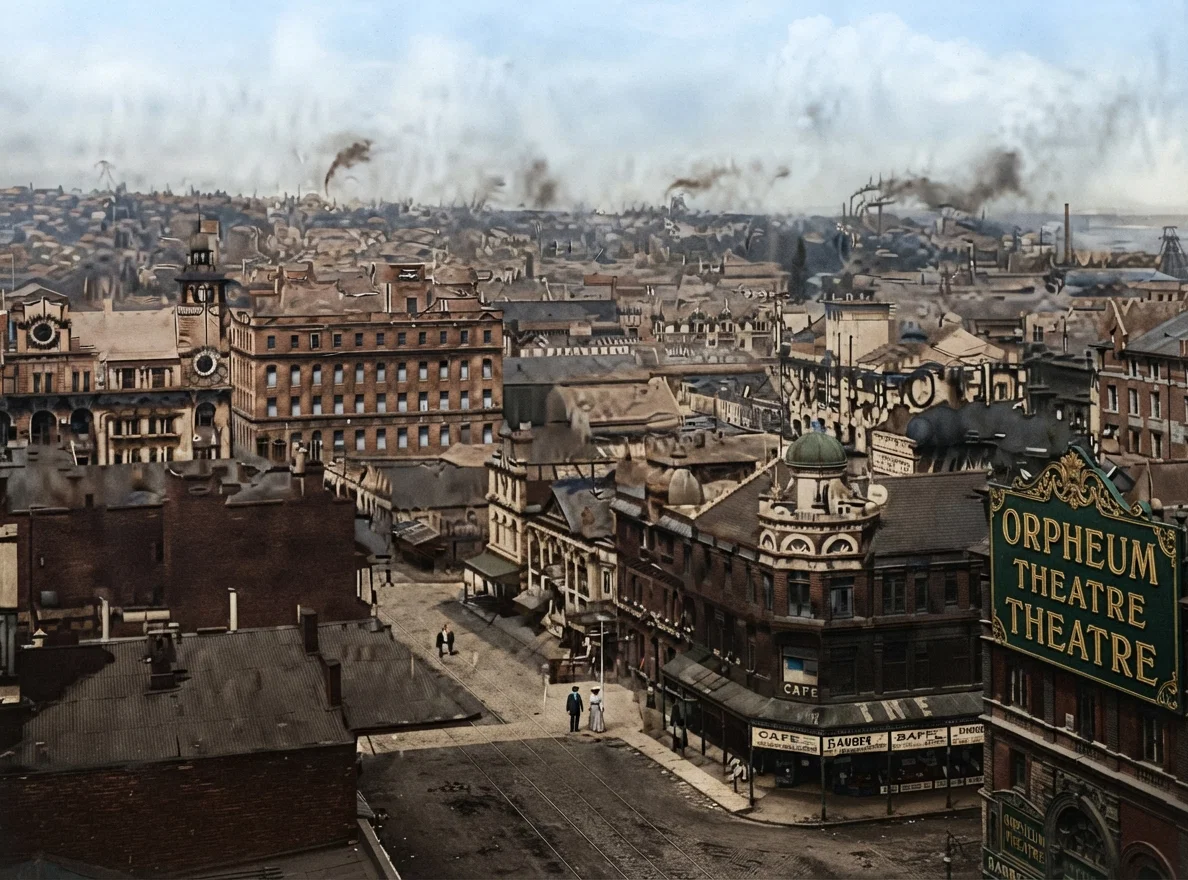
View in Johannesburg, the mining city of the Transvaal
In Rev. 1: 7 it is told us that when Jesus comes in glory, “they also which pierced Him” shall see Him. It was told Caiaphas the high priest, who was the leading spirit of the movement that had for its object the death of the Son of God, “Hereafter shall ye see the Son of man sitting on the right hand of power, and coming in the clouds of heaven.” Matt. 26: 64. And then we read of those who “crucify . . . the Son of God afresh” (Heb. 6: 6), and further, of those who have “trodden underfoot the Son of God” (Heb. 10: 29). It would seem that men who, down through the centuries, have been guilty, as above noted, of the blood of the Christ of God, are in a class by themselves, and that they will in shame be permitted to behold Him whom they pierced, seated in majesty, upon the throne of His glory.
The other special class who at the same time are raised to “everlasting life,” evidently fit the prophetic mold of Rev. 14: 13, being privileged, because of their faithfulness in the proclamation of the solemn message ordained of Heaven to prepare men for the Judgment and for the coming of the Lord, to come forth from their beds of dust, to share with those who followed them the glory that shall be theirs at the revelation of Jesus Christ.
The next event brought to the prophet’s attention is the Lord’s coming, and the reaping of the harvest of the earth. Verses 14-16.
The end of the world is then reached. See Matt. 13: 39. And what a day! The Judgment is then finished, and the unmixed wrath of God is poured out upon a world from which the Spirit of God has been withdrawn. In that day, right which has been upon the scaffold all down through the centuries, will occupy the throne, and wrong will come to its end “with terrific events.”
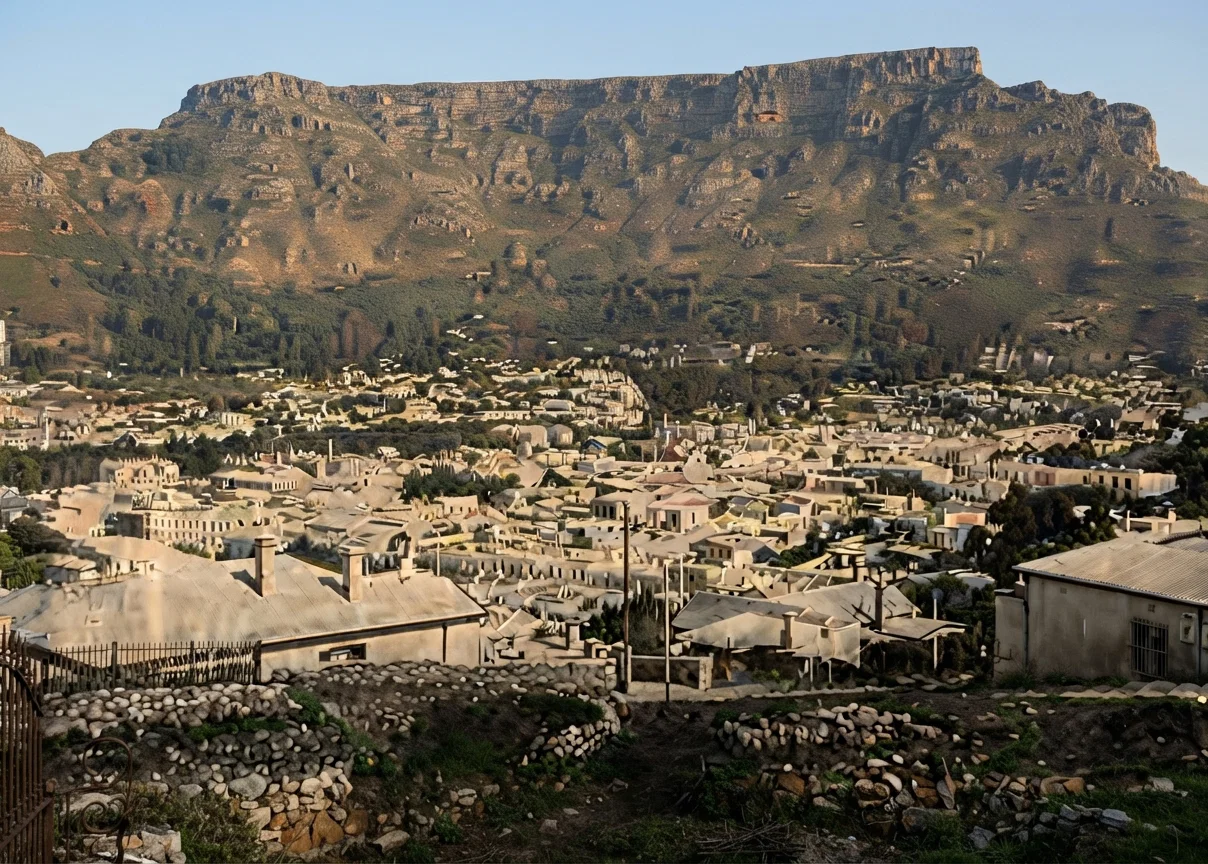
A suburb of Cape Town, Table Mountain in the background
The Exchange in the Atonement
By John Norton Loughborough
By J. N. LOUGHBOROUGH
DID the offering of Christ upon the cross pay the debt of all mankind, so that none will be called upon to suffer for their own personal transgressions of God's law?
Of that offering we read, "Whom God hath set forth to be a propitiation through faith in His blood, to declare His righteousness for the remission of sins that are past, through the forbearance of God." Rom. 3:25.
Webster defines "propitiation" as "an atoning sacrifice." Christ's death upon the cross was an atoning sacrifice for all who, in God's appointed way, avail themselves of its benefits.
GAVE HIMSELF FOR OUR SINS
Paul's manner of presenting this theme was, "Christ . . . gave Himself for our sins, that He might deliver us from this present evil world." Gal. 1:3, 4. Paul does not say that Christ gave Himself and thus delivered us, but that He "gave Himself that He might deliver us."
The beloved John stated it thus: "If we confess our sins, He is faithful and just to forgive us our sins, and to cleanse us from all unrighteousness." 1 John 1:9. To the Corinthians Paul said, "Christ died for our sins according to the Scriptures." 1 Cor. 15:3.
In Christ's explanation of His being offered, He "opened . . . the Scriptures" to the two on their way to Emmaus. The Scriptures He used were Moses, the prophets, and the Psalms. In Moses' writings was the offering of blood, which was a "figure," "example," and "shadow" of the work Christ would perform for repentant sinners. Heb. 8:5. In Moses' writings, we learn that before the offering could avail, there must be confession of sins, with the hands on the head of the animal that was to be slain, and his blood offered.
"SAVED BY HIS LIFE"
Of those conforming to God's plan of reconciliation, the apostle said: "For if, when we were enemies, we were reconciled to God by the death of His Son, much more, being reconciled, we shall be saved by His life. And not only so, but we also joy in God through our Lord Jesus Christ, by whom we have now received the atonement." Rom. 5:10, 11. Having had such experience, we are said to be "in Christ." "If any man be in Christ, he is a new creature ["new creation," R. V.]: old things are passed away; behold, all things are become new." 2 Cor. 5:17. As expressed by another:
"In Christ we are as if we had suffered the penalty we have incurred. In Christ we are as if we had obeyed, and rendered perfect obedience to the law, which we cannot obey without Christ imparts to us His merits and His righteousness."
Again: "Faith can present Christ's perfect obedience instead of the sinner's transgression and defection. The only way he can attain to righteousness is through faith. By faith he can bring to God the merits of Christ, and the Lord places the obedience of His Son to the sinner's account. Christ's righteousness is accepted in place of man's failure, and God receives, pardons, and justifies the penitent, believing soul, and loves him as He loves His own Son. This is how faith is counted for righteousness; and the pardoned soul goes on from grace to grace, from light to greater light."
"God so loved the world, that He gave His only-begotten Son, that whosoever believeth in Him should not perish, but have everlasting life." John 3:16. To the unbelieving the Saviour said, "Ye will not come to Me, that ye might have life." John 5:40. May we each so yield ourselves to God as to receive in full the atonement provided for our acceptance!
A Mason's Emblem
By J. H. Hartog
AFTER engaging a new salesman recently, I started to introduce him to the other salesmen. As I presented him to the first one, expressing the hope that they would get along harmoniously, he replied, "I'm sure we will, for I know he's all right." "Why, do you know him?" I asked. "Never met him," he answered, with a knowing smile; and raising his coat lapel, which carried the Masonic emblem, he added, "But I know he's all right."
The thought flashed through my mind, that I have often experienced a similar fellow feeling when meeting a person who had accepted the Sabbath truth, and in spite of sacrifice, had decided to obey God's law. I too had "never met him," but knew he was "all right," for we both carried the same emblem, though inwardly—the emblem which God calls the sign between Him and His people, as defined in Ex. 31: 17 and elsewhere in the Scriptures.
J. H. HARTOG.
Selfishness
By John Owen
SELFISHNESS is the making a man's self his own center, the beginning and end of all he doeth.—John Owen.
OVERRULING POWER IN SOUTH AFRICA
By Editor
When the Portuguese Held Sway There—Why Were They Set Aside?—People of the Book—The Country and Missionary Activities There
This is the second of some twelve articles by Elder Spicer descriptive of what he saw and heard during his recent trip to South Africa. Next week he will tell of the aboriginal tribes.—Editor.
IT is interesting to watch the hand of Providence in this world's ever shifting scenes and history. We can see an overruling Providence in the course of events that has given the missionary movement a strong base of operation in the dominion of South Africa.
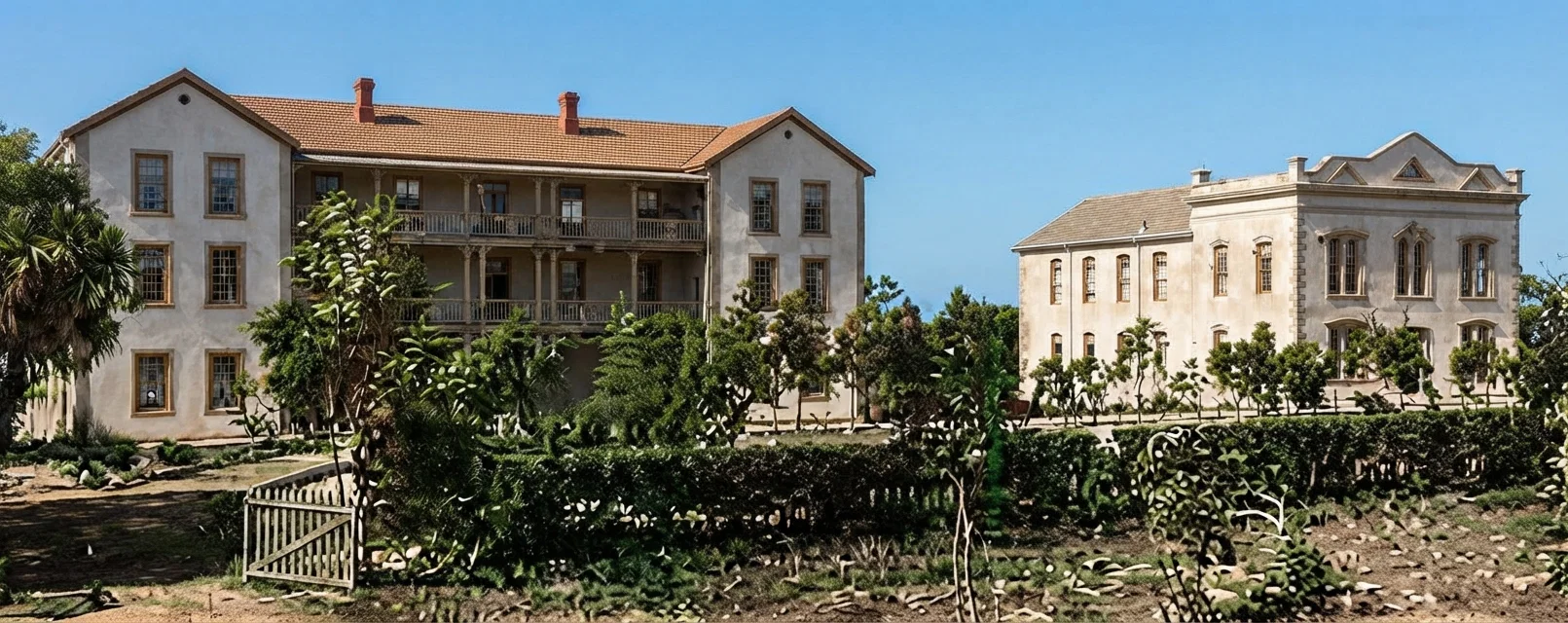
UNION COLLEGE, CLAREMONT, CAPE TOWN, SOUTH AFRICA
FAILED THROUGH NEGLECTING THE BOOK
The Portuguese were the discoverers. While we recognize the debt of civilization to this enterprising people, it is nevertheless a fact that the Portuguese — and particularly the Portuguese of the old time — were not themselves possessed of the open Bible, and could never have done the work that Providence evidently was to make sure of being done in the most favored part of Africa for European colonization.
WHY THIS VITAL OVERSIGHT?
In his book "The Opening Up of Africa," Sir H. H. Johnston remarks upon the singular fact that while "for three quarters of the sixteenth century Portugal had it all her own way in Africa," she never established herself in the one region that was really the choice of all. He says:
"In the subsequent development of a Portuguese empire over Africa, a fatal blunder was made. The Portuguese neglected to occupy the Cape of Good Hope, or any other stronghold on the southern extremity of West Africa. . . . To any power that aspired, as did the Portuguese, to occupy and rule East Africa and India from the west of Europe and by means of the cape route, it was an oversight difficult to understand that prevented their garrisoning the necessary places of call . . . at the southern extremity of Africa."-Page 166.
But thus it came to pass; and into this region, so necessary as a base for missionary extension among the tribes of the interior, there came the Dutch and the English, with the word of God, and the freer institutions of Protestant lands.
Colonial South Africa had its Pilgrim Fathers, as well as our New England colonies. In the days of persecution in France, following the revocation of the edict of Nantes, in 1685, thousands of the best culture of France fled to England and to Holland. Holland had fought its battle for freedom and religious liberty against all the power of Spain and the Spanish Inquisition. From among these Huguenot refugees in the Netherlands, several hundreds took ship for South Africa, joining with the Dutch colonists in making the new state below the equator.
"Then came men, our Pilgrim Fathers, noblest blood of sunny France—
Broad-browed men of free-born spirit, lighted with the eagle glance;
Spoiled, by bigot priest and despot, of the broad lands of their line,
Rich yet in the glorious freedom that dares know itself divine.
Hither came they—welcomed hither by the gallant northern race
Whom they well might own for brethren, breast to breast in close embrace,
Those stanch darers of the waters who first broke the giant force
That would rule man's free convictions as the rider guides his horse;
Struggling, and despairing never, till at length they gained the war;
Spain, the hope of priest-led tyrants; Holland, freedom's polar star."
Thus the foundations were laid by a people of the Open Book, and the liberal institutions of the British dominion have fostered the spirit that makes for liberty and progress and enlightenment.
BAKED HER BIBLE TO HIDE IT
One of our aged members, descended from one of the Huguenot families, told me how her great-great-grandmother managed to get her treasured Bible out of France in the days of her flight. Even when Protestants were allowed to cross the border, their luggage was searched for Bibles, which were seized and burned. Our sister's worthy ancestor wrapped her Bible in a mass of dough, and baked the dough into a generous sized loaf of bread. Thus with the "staff of life" concealing the "bread of life" indeed, she made her way out to liberty, and carried her treasure to the new world of Africa.12
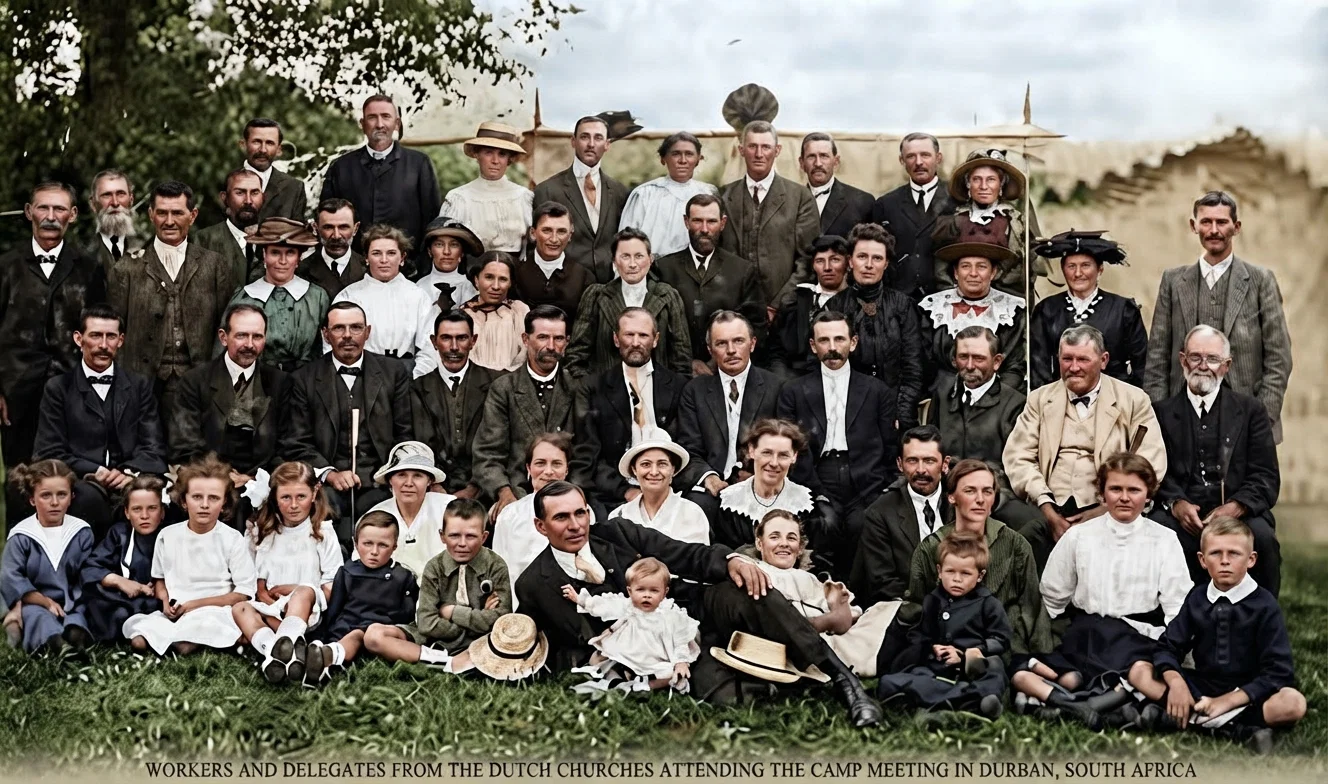
WORKERS AND DELEGATES FROM THE DUTCH CHURCHES ATTENDING THE CAMP MEETING IN DURBAN, SOUTH AFRICA
I had many times good evidence that our fellow believers in Africa are lovers of the Book. One pleasing experience I must tell. I was traveling alone northward through the Orange Free State. In the early gray of morning, we in the train were rolling out of our rugs and settling down for the day's run over the veldt, dotted here and there with sheep and cattle ranches.
SIGNALED THE BIBLE READER
I noticed in the car a passenger who had come aboard during the night. The first thing, after rolling up his rugs, he opened a bag, and took from it a Bible, which he sat reading, while all about, men smoked and talked.
"I wonder," I said to myself, "if that man who opens his Bible the first thing in the morning, no matter where he may be, is a Seventh-day Adventist."
"But no," I thought; "there are multitudes of people in South Africa besides ourselves, who love God's book."
After all, I determined to signal the Bible reader. So I took out of my bag a copy of our South African paper, the Sentinel, published in Cape Town. Holding it up, I began to read. At once the stranger sprang up and came to me.
"Do you know the people who publish that paper?" he asked.
"Yes; I am one of them."
"So am I," he said; and I found I was talking with one of our Dutch evangelists, Brother Baren de Beer.
And we ought to be a people of the Book—we who stand for the last step in the Reformation, and are preaching the return to the New Testament standard of "the commandments of God, and the faith of Jesus."
A PHRASE BURDENED WITH POWER
It is really wonderful, the power there is in this phrase of inspiration that is used in the Revelation to describe the remnant church just before the second coming of Christ. We hear of it in all lands; and in South Africa it bears its witness also.
One lady, attending a camp meeting in the Cape Province, heard sermons, but went away with no particular impression. One phrase, however, kept with her. She had heard it at the meeting.
"Those words," she said, "'the commandments of God, and the faith of Jesus,' kept ringing like a voice in my ears, until I surrendered to keep the commandments of God, and the faith of Jesus."
Again on this visit, I met a lady, bearing one of the old Huguenot family names, who told me that she had rather decided against this way.
Illness, however, brought her to one of our sanitariums. Here she heard again of these truths. "I am too ill," she said to herself, "to think about it; God Himself will have to teach me the right way."
She was too ill to read, and no one discussed religious things with her.
WORDS THAT SPOKE TO HER HEART
"But these words kept speaking to my heart," she said,—"'the commandments of God, and the faith of Jesus'; and they brought me into this light and truth, which have been the greatest blessing and joy of my life."
Yes, the words of God are living words, and the Holy Spirit is speaking to hearts and minds in all the earth.
THE CALL THAT TOOK US TO AFRICA
We Seventh-day Adventists were called to South Africa thirty years ago. Two men in the region of the diamond fields had been led independently to inquire after the truth concerning the Sabbath, knowing nothing of any people keeping the seventh day of the fourth commandment. Providence had the agent ready just at that moment to direct their attention to this advent movement growing up in America and Europe. The agent was an old miner, who himself had first heard of this message in the early days of California. This miner carried the truth in his heart and life to Australia, and then to the new diamond fields of the Kimberley district.
Thus two Dutch brethren,—Messrs. E. van Druten and P. J. D. Wessels, whom I found rejoicing in the truth,—learned of Seventh-day Adventists, and sent the invitation to our General Conference, in 1886, which led to the sending of Elders C. L. Boyd and D. A. Robinson and associates to open our evangelistic work in South Africa.
Our first church building in Africa was erected in Beaconsfield, near Kimberley; and I was glad, as I visited it, to find that notwithstanding the shifts and changes that time brings in a new country, there is still a company of believers worshiping here, one or two being charter members.
It was at Cape Town, however, that most of the early evangelistic work was done by our pioneer laborers. There are several churches now in and about the city. The educational center for our work is Claremont, a beautiful suburb around the eastern base of Table Mountain. The Union College here has sent numbers of our youth into the missionary and evangelistic fields. Further on is the Plumstead Sanitarium, the headquarters for our health and temperance work, and a training school for nurses.
CHARACTER OF THE COUNTRY
What kind of country is it around this cape region?—Well, it is much like one of the grape-growing valleys of California, a beautiful countryside, now grown up with suburban villas, with here and there some genuine specimens of the real old Dutch colonial type. Simon van der Stel, one of Riebeek's early successors in the governorship, started the grape industry around this part—now the famous Constantia vineyards. He was really the most progressive of the early governors in pushing back the wilderness, developing the resources of the soil, and making a beautiful home country for the European settler.
"Not as the rest, for greed of spoil,
He ruled by Table Bay;
In new-built barn and seeded soil
His little kingdom lay.
Cornfield and garden, oak and vine,
He loved and tended well.
'Who plants a tree is a friend of mine,'
Quoth Simon van der Stel."
Between the mountain ranges, which begin a little way to the northward of the cape, is fine, well watered farming and fruit country. In northern Cape Province, and then on up through the Orange Free State and the Transvaal, is the rolling veldt, or prairie, the land of the sheep and cattle farmer, and of the great mealie or Indian corn industry. The province of Natal is part veldt, and part hilly country, where subtropical fruits of all kinds abound.
FOUND OUR PEOPLE EVERYWHERE
Through all the states, I found Seventh-day Adventist churches here and there, little companies, from Johannesburg, the mining center and metropolis of South Africa, to the cape, where first I met our South African colonial people. The work is carried on in the Dutch and English languages. The union conference issues two general religious journals, the Sentinel, in English, and the Wachter (Watchman), in Dutch, the latter paper being a translation of the former.
The war situation led many to ask what these things mean that are coming on the earth, and the spirit of inquiry abroad had enabled our brethren to give some special numbers of their paper a circulation as high as thirty thousand and even more. By post, these papers are sent to addresses of farmers scattered in the remote country districts, in regions that it is difficult for the living evangelist to visit. So up and down colonial South Africa I found the message spreading. W. A. S.
A WORD TO OUR READERS
By Editor
We send no papers from this office to individuals without pay in advance. When persons receive copies without ordering them, they are sent by other parties, and we can give no information in regard to them. Persons thus receiving copies of the SIGNS are not indebted to the office, and will not be called upon to pay for them. Please read the papers you may receive, and hand them to your friends to read.
DATE OF EXPIRATION
The SIGNS wrapper bears date of last issue due on your subscription. Unless renewed in advance, paper stops with expiration date.
If herewith is an order blank, you will know you have overlooked sending renewal. You will not wish to miss a single issue. Back numbers often cannot be furnished.
SCRIPTURE QUOTATIONS
Our authority for the doctrines we teach is the Bible. Quotations are usually from the King James Version or the American Standard Revised.
Two or more copies to one person, six months,
each $0.60.
Two or more copies to separate addresses, six
months, each $0.65.
Weekly and monthly SIGNS one year, $2.25.
JAMES COCHRAN, Circulation Manager.
A Form of Godliness
By J. E. F.
By means of a galvanic battery, a corpse can be made to move its fingers, and there can be nothing more uncanny. Of certain ones the Scripture says, "Thou hast a name that thou livest, and art dead." Many who have unconverted hearts, profess the name of Christ; many who are "dead in trespasses and sin," pass for those who are alive. They have "a form of godliness," but deny "the power thereof." J. E. F.