Signs of the Times, Vol. 34, No. 25.

God's "Righteousness Is Like the Great Mountains."

Signs of the Times

Jun 17, 1908

Pacific Press Publishing Company · Mountain View, California · Jun 17, 1908

God's "Righteousness Is Like the Great Mountains."

With Our Inquirers

"If ye will inquire, inquire ye."
This Inquirers' Department is conducted for the purpose of helping those who are studying the Bible. The answers are oftentimes only suggestive. They are never to be considered infallible, only as they agree with the infallible word. The writer who may answer them does not consider that his opinion is infallible. He will simply give the best that he has, and plead with the inquirer to search the word. Such questions only will be answered which, in the opinion of the editors, seem to minister to the good of the readers and to the mission of the paper. We can not answer repeatedly in the same volume questions upon the same scripture. The name and address must accompany question, not for publication, but as an evidence of good faith, and that answer may be made by letter if deemed advisable. No letters are answered which do not contain the name of the writer. It is well always to enclose stamp for reply.

2532.—Galatians 4.

Please explain Galatians 4.

S. S. T.
Our inquirer has asked a large question. It is almost impossible to explain such a chapter as that in this department. In brief, however, the first part of the chapter opens before us the gift of God's Son, who became flesh and died in our behalf in order that we might be sons of God. Verses 8 to 11 are a reproof to the Galatians for turning from God, and turning back to idolatry, to them that are not gods, and therefore, the apostle has fears because of this. In verses 12 to 20 he pleads with them to become as he was, and warns them against those who desired to profit by their apostasy. Verses 21 to 31 are a parable illustrating the point under discussion all the way thru the epistle: Self-justification on the one hand; trusting the righteousness of Christ alone on the other.
Abraham had two sons, one by the handmaid, and one by the freewoman. The son born of the handmaid was as was his mother—in bondage. The son of the freewoman was free. The son of the bondwoman is a type of those who would be justified by the law, who would earn their own justification. Abraham thought that thru the bondwoman he would obtain the heir, the seed promised of God, a thing which the Lord was endeavoring to teach him could only come thru the righteousness by faith. Isaac was the child of promise, thru no planning or device of his father, but wholly thru the power of the One who promised. God would teach us by this that our only hope of justification or salvation rests not in ourselves, nor in any work that we ourselves may do, but wholly in the promises of God by Jesus Christ. That does not mean that God's children will not be obedient, but we will not be obedient in order to earn life and salvation, but will be obedient because we have life and salvation thru Him. The one is the obedience of the law,—self-righteousness; the other is the obedience of faith.

2533.—Eating of Flesh Meats.

Is it not wrong to kill or to eat flesh meats? Did Jesus eat fish? If it was wrong to eat flesh meat, why did Jesus eat fish, if he did; and what did He wish to teach us by so doing?

Whether it is wrong to eat flesh meats or not must be decided by the individual conscience. The original bill of fare did not include flesh meats. Genesis 1. The manna which the Lord gave the children of Israel when they came up out of Egypt did not include flesh meats. Exodus 16. And yet some of the good among God's children, throuut all the ages, have used flesh meats. The one thing which we should consider in the food that we eat is, Will it glorify God? The rule is found in 1 Cor. 10:31, "Whether therefore ye eat, or drink, or whatsoever ye do, do all to the glory of God." There are diets which are worse than flesh meats. Sometimes one might be placed as was Noah after the flood, where about the only food to be gotten at all was flesh meats. It is said of Elijah in a time of sore famine, that the ravens brought him bread and flesh every morning, and bread and flesh every evening. Our Lord probably ate fish. There seems to be no question about it at the time. Doubtless it was the best food that He had to eat, and He ate it believing that it would glorify God. As diseases multiply, as modes of unnatural living increase, as artificial life comes to predominate, animals which furnish flesh foods will become more and more diseased, as science shows that they are becoming at the present time. The eating of much flesh food tends to corruption of body; to sluggishness of spiritual nature, to demand for stimulation. It ought to be the Christian's duty to live in such a way that the natural man would become more spiritual, more responsive to the voice of the Spirit of God, less inclined to yield to the lusts of appetite. He should seek a food not filled with the corruptions which contaminate most of the flesh foods. It is for that very reason that thousands upon thousands have been led to adopt a vegetarian diet, and they have found in that all that is necessary. Yet, there may be times that the very best food that one can get to eat is flesh food. We should not seek to condemn our brethren in Christ who may or may not eat it. Read Romans 14. We should seek, as to ourselves, however, to glorify God in all that we do.

2534.—When Did the Lord Come Down on Sinai?

Did the Lord come down on Mount Sinai on the fifth day of the third month, Sunday, Egyptian calendar; or did the Hebrews ever celebrate the Passover, Pentecost, unleavened bread, or the feast of the wave-sheaf, and first-fruits during the forty years they were in the wilderness? Or was Pentecost known to the children of Israel on the fifth day of the third month after going out of Egypt?

E. R.
All this endeavor to prove by some hocus-pocus that Sunday is the true seventh day, and that the change was made at the Exodus, and at the Crucifixion, is unworthy of consideration by any candid, Christian scholar. Only those who have a case to maintain, and are determined to maintain it at any hazard, are the ones who take any such position as that. That their position is hardly worthy of consideration is shown in the fact that the vast numbers of Christian scholars give no credence to it whatever. This, of itself, ought to brand it as a false theory. The special advocate of that claim at the present time is a one Mr. Gamble. If our inquirer desires to know the fallacy of his views, let him send to the Pacific Press and obtain a little tract entitled "The True Seventh Day," A. G. L. 78. It will cost but two cents.

2535.—The Observance of the Sabbath.

Should one keep the Sabbath on Saturday if all the people where he lives keep Sunday? Is Sunday the first day of the week?

N. M.
The world finds itself with a week, a septenary circle of days. In all the world, as reckoned by civilized nations, that week begins with Sunday and closes with the day commonly called Saturday. Sunday is the first day, Saturday the seventh day. This has been so just as far back as authentic and accurate history carries us. It was so in the time of our Saviour. The Roman first day was the day dedicated to the sun. In the northern part of Europe it was the day dedicated to the sun among the German nations, Sunday, from which our word "Sunday" comes. This day came just after the Jewish seventh day. That the Jewish seventh day was the true seventh day is shown by Luke 23:56, where it is declared that the holy women kept the Sabbath day "according to the commandment," and the next day, we are told, was the first day of the week. The Sabbath commandment is recorded in Ex. 20:8-11. That enjoins the keeping of the seventh day. The holy women, therefore, kept the seventh day as the Sabbath, and this seventh day of Ex. 20:8-11 is the same seventh day that was ordained in the beginning, enjoined for the same reasons as are there stated. Gen. 2:2, 3. Therefore, if we should grant the claim that the day may have been lost at sometime in the past, it was not lost to the Lord, and He showed by a threefold weekly miracle for forty years just what day the true seventh day was. See Exodus 16. And when Jesus died upon the cross, Inspiration again fixes the true seventh day. Therefore, the first day must be the day following that seventh day; and that first day, according to all nations, corresponds with our Sunday.
Now as to the question, "Should one observe that day if others do not?" Really, has numbers anything to do with it at all? Supposing all around us on every side worshiped idols, should we not worship idols, too, rather than make ourselves singular? Supposing all around us were covetous, should we be covetous, too? Suppose that all on every side took the name of the Lord in vain, should we take it in vain? Really, if we are worshipers of the true God, ought we not all the more to be faithful to Him tho others should depart from Him? We need all the more to be faithful in doing just what He tells us is our duty, rather than to follow the customs of the world. They may be blind, but if we know our duty, their blindness will not excuse us. "We ought to obey God rather than man" is a principle which ought to mold the children of the Lord in all ages.

2536.—Carriage Riding on the Sabbath.

Is it right to go buggy riding on the Sabbath after the services in the church?

H. C. P.
Yes, and no. It is utterly impossible to answer such questions as this. They pertain wholly to the purpose and conscience of the individual; to the relationship between himself and his Maker. The whole morality of the question lies in the purpose. What is the object in going riding? Is it for our own pleasure, or, is it to the glory of God? These are the questions which ought to decide the worth or character of our conduct. God Himself has given us a commentary on the Sabbath. It is found in Isa. 58:13. "If thou turn away thy foot from the Sabbath, from doing thy pleasure on My holy day; and call the Sabbath a delight, the holy of the Lord, honorable; and shalt honor Him, not doing thine own ways, nor finding thine own pleasure, nor speaking thine own words; then shalt thou delight thyself in the Lord." We can understand how people could ride on the Sabbath and find rest and strength in God in so doing; they could make that ride a mission of mercy and blessing to others, or they can make it a mere matter of selfish pleasure. In the one case they would be justified of the Lord; in the other, the act would be the same as any other selfish act of carnal pleasure.

2537.—The Destroying Angel.

Who is the destroying angel of Exodus 12? in other words, was that angel Lucifer?

C. B. R.
The Scriptures do not tell us what the name of this angel was, but it seems very clear indeed that it was one of the angels of Jehovah. We are expressly told in verse 23, "For Jehovah will pass thru to smite the Egyptians; and when He seeth the blood upon the lintel, and on the two sideposts, Jehovah will pass over the door, and will not suffer the destroyer to come in unto your houses to smite you." Of course God did this thru His agencies, the angels. If this had been the destruction of holy people, we might have conceived that the destroyer was Satan, but these destroyed were souls who had identified themselves with sin, and God was punishing sin then. If the Egyptians had not identified themselves with sin, they would not have been destroyed. But they chose sin rather than God and therefore were destroyed with the sin. They elected to stand on the side of all the years of Egypt's oppression of Israel. Back of all this, of course, Satan was responsible for the destruction in inducing them to sin. But in the punishment one of God's angels was commissioned to pass thru Egypt, evidently as in a later time one was commissioned to pass thru the army of the Assyrians. See 2 Kings 13:35.
2538.—W. G. W.—We know of no scripture whatever that forbids cousins marrying. The degrees which are prohibited are indicated in both Leviticus 18 and 20.

"One Thing Thou Lackest."

By Mrs. E. G. White.
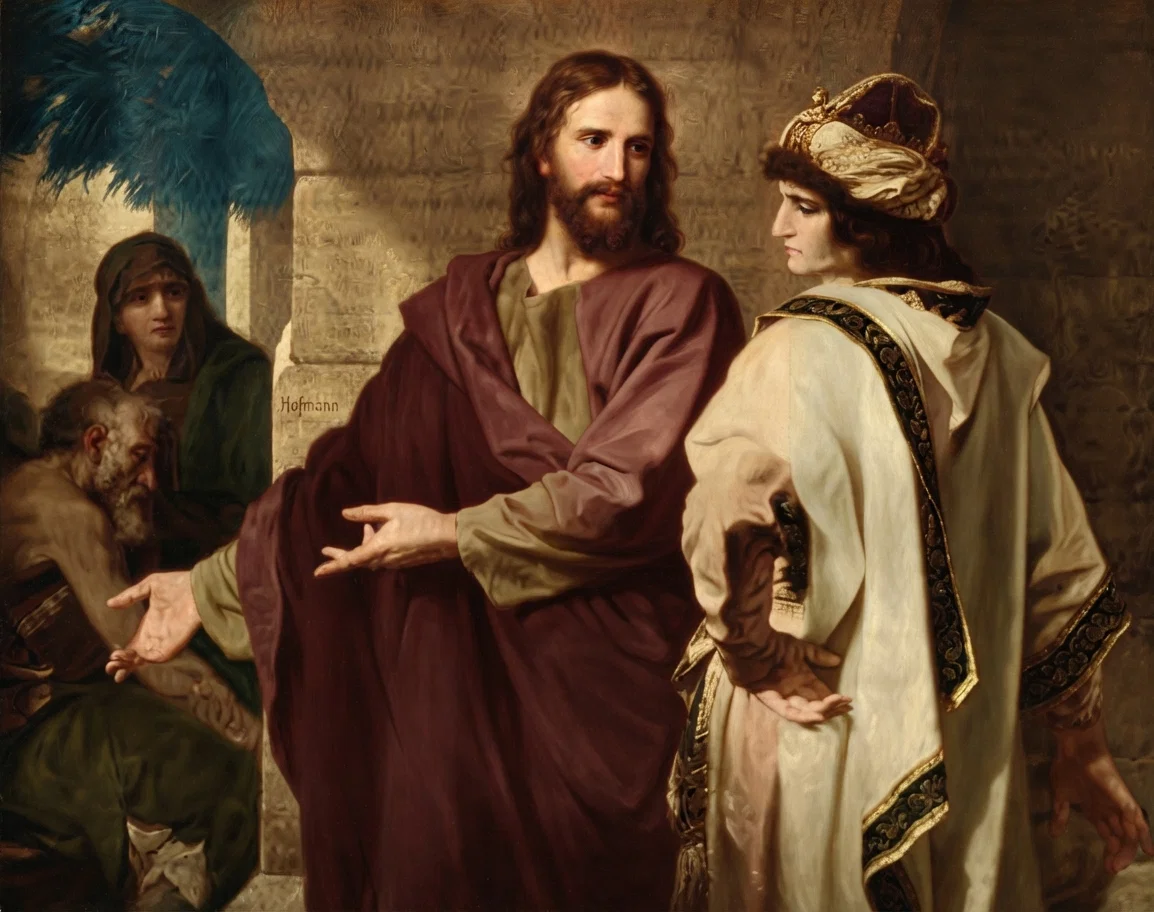
Christ and the Rich Young Ruler.
AND when He was gone forth into the way, there came one running, and kneeling to Him, and asked Him, Good Master, what shall I do that I may inherit eternal life? The young man who asked this question was a ruler. He had great possessions, and occupied a position of responsibility. He saw the love that Christ manifested toward the children brought to Him; he saw how tenderly He received them, and took them up in His arms, and his heart kindled with love for the Saviour. He felt a desire to be His disciple. He was so deeply moved that, as Christ was going on His way, he ran after Him, and kneeling at His feet, asked with sincerity and earnestness the question so important to his soul, and the soul of every human being, "Good Master, what shall I do that I may inherit eternal life?"
"Why callest thou Me good?" said Jesus, "there is none good but one, that is God." Jesus desired to test the ruler's sincerity, and to draw from him the way in which he regarded Him as good. Had he realized that the One to whom he was speaking was the Son of God? What was the true sentiment of his heart?
This ruler had a high estimate of his own righteousness. He did not really suppose that he was defective in anything, yet he was not altogether satisfied. He felt the want of something he did not possess. Could not Jesus bless him as He blessed the little children, and satisfy his soul-want?
In reply to this question Jesus told him that obedience to the commandments of God was necessary if he would obtain eternal life; and He quoted several of the commandments which show man's duty to his fellow men. The ruler's answer was positive: "All these things have I kept from my youth up. What lack I yet?"
Christ looked into the face of the young man, as if reading his life and searching his character. He loved him, and He hungered to give him that peace and grace and joy which would materially change his character. "One thing thou lackest," He said, "go thy way, sell whatsoever thou hast, andgive to the poor, and thou shalt have treasure in heaven; and come, take up the cross, and follow Me."
Christ was drawn to this young man. He knew him to be sincere in his assertion, "All these things have I kept from my youth." The Redeemer longed to create in him that discernment which would enable him to see the necessity of heart devotion and Christian goodness. He longed to see in him a humble and contrite heart, conscious of the supreme love to be given to God, and hiding its lack in the perfection of Christ.
Jesus saw in this ruler just the help He needed if the young man would become a colaborer with Him in the work of salvation. If he would place himself under Christ's guidance, he would be a power for good. In a marked degree the ruler would have represented Christ; for he possessed qualifications, which, if he were united with the Saviour, would enable him to become a divine force among men. Christ, seeing into his character, loved him. Love for Christ was awakening in the ruler's heart; for love begets love. Jesus longed to see him a coworker with Him. He longed to make him like Himself, a mirror in which the likeness of God would be reflected. He longed to develop the excellence of his character, and sanctify it to the Master's use. If the ruler had then given himself to Christ, he would have grown in the atmosphere of His presence. If he had made this choice, how different would have been his future!
"One thing thou lackest," Jesus said. "If thou wilt be perfect, go and sell that thou hast, and give to the poor, and thou shalt have treasure in heaven, and come and follow Me." Christ read the ruler's heart. Only one thing He lacked, but that was a vital principle. He needed the love of God in the soul. This lack, unless supplied, would prove fatal to him; his whole nature would become corrupted. By indulgence, selfishness would strengthen. That he might receive the love of God, his supreme love of self must be surrendered.
The ruler was quick to discern all that Christ's words involved, and he became sad. If he had realized the value of the offered gift, quickly would he have enrolled himself as one of Christ's followers. He was a member of the honored council of the Jews, and Satan was tempting him with flattering prospects of the future. He wanted the heavenly treasure, but he also wanted to have the temporal advantages his riches would bring him. He was sorry that such conditions existed; he desired eternal life; but he was not willing to make the sacrifice. The cost of eternal life seemed too great, and he went away sorrowful; "for he had great possessions."
His claim that he had kept the law of God was a deception. He showed that riches were his idol. He could not keep the commandments of God while the world was first in his affections. He loved the gifts of God more than he loved the Giver. Christ had offered the young man fellowship with Himself. "Follow Me," He said. But the Saviour was not so much to him as his own name among men or his possessions. To give up his earthly treasure, that was seen, for the heavenly treasure, that was unseen, was too great a risk. He refused the offer of eternal life, and went away, and ever after the world was to receive his worship.
Thousands are passing thru this ordeal, weighing Christ against the world; and many choose the world. Like the young ruler, they turn from the Saviour, saying in their hearts, I will not have this Man as my leader.
Christ's dealing with the young man is presented as an object-lesson. God has given us the rule of conduct which every one of His servants must follow. It is obedience to His law, not merely a legal obedience, but an obedience which enters into the life, and is exemplified in the character. God has set His own standard of character for all who would become subjects of His kingdom. Only those who will become coworkers with Christ, only those who will say, "Lord, all I have and all I am is Thine," will be acknowledged as sons and daughters of God. All should consider what it means to desire heaven and yet to turn away because of the conditions laid down. Think of what it means to say "No" to Christ. The ruler said, "No, I can not give you all." Do we say the same? The Saviour offers to share with us the work God has given us to do. He offers to use the means God has given us to carry forward His work in the world. Only in this way can He save us.
When Christ's followers give back to the Lord His own, they are accumulating treasure which will be given to them when they shall hear the words, "Well done, good and faithful servant; . . . enter thou into the joy of thy Lord." "Who for the joy that was set before Him endured the cross, despising the shame, and is set down at the right hand of the throne of God." The joy of seeing souls redeemed, souls eternally saved, is the reward of all that put their feet in the footprints of Him who said, "Follow Me."

Christ the Word Made Flesh

"And the Word became flesh, and dwelt among us." John 1:14.
HOW wonderfully brief is this summing up of the great story of the incarnation!—"the Word became flesh, and dwelt among us." And yet in these few words the truth is all told.
It is not for us to inquire how the Word could be made flesh; God says it was, and that is sufficient. It is a great "mystery" which neither the power of reasoning nor the weight of intellect can ever unravel, but, nevertheless, it is that which is understood and known in experience by every child of faith.
But look, first, at the great fact. The Son of God whose goings forth had been from the days of eternity (Micah 5:2, margin), who dwelt in glory ineffable before the foundation of the world, whose presence caused ten thousands of angels to rejoice, whose power was infinite, and whose greatness filled the universe, suddenly became a babe. Somewhere, somewhen, in some way, He was transformed; He ceased to be in heaven, and began a course upon earth. This is the fact, the mystery of godliness.
The Scriptures have much to say regarding this tremendously important fact; for had it not been that the Word of God became flesh and dwelt among men, man would have perished in his sins and earth would have been a blighted wilderness.
And what is the record? To the Philippians the apostle wrote, "Have this mind in you, which was also in Christ Jesus: who, existing in the form of God, counted not the being on an equality with God a thing to be grasped, but emptied Himself, taking the form of a servant, being made in the likeness of men." Phil. 2:5-7. In other words, Christ Jesus was not content to remain on an equality with His Father, so long as man, sinful and fallen, was doomed to die. The great fulness of His love and pity and unselfishness longed to break into and destroy the terrible vacuum which sin had made in man's heart and home.
In Heaven's councils it was therefore settled that the Creator should take the creature's place. Fully and absolutely He would step down from His exaltation and, assuming all man's weaknesses and sins, He would become the brother of humanity. "Since then the children are sharers in flesh and blood, He also Himself in like manner partook of the same." "It behooved Him in all things to be made like unto His brethren." Heb. 2:14, 17.
"Like unto His brethren" was simply to be like unto sinners, for all His brethren had sinned. Rom. 3:23. He was therefore "made to be sin on our behalf." 2 Cor. 5:21. Like all men born in sin and subject to the laws of heredity, so He was "born of a woman, born under the law." Gal. 4:4. He was one of David's descendants "according to the flesh." Rom. 1:3.
In all this, however, there is no hint of an "immaculate conception," but on the other hand there is the direct statement that His was "sinful flesh." Rom. 8:3. The fact that our Lord stooped so low that He descended into the very pit of human vileness, that He voluntarily took into and upon Himself all that man because of sin is forced to bear, is that which gives man courage to hope and power to grasp that which God has provided. Had Jesus Christ been preserved from all hereditary taints, His life of perfect righteousness would have beenso far removed from human kind that there could have been no connection between.
The work of our Redeemer was beautifully set forth in the law given to Israel. The word "redeemer" comes from the Hebrew word which is also translated "kinsman." See Ruth 3:9, margin. A redeemer had always to be a kinsman, and not only a kinsman, but a near kinsman. Verse 12. It was required that he belong to the family whose inheritance he would preserve and whose name he would perpetuate. Thus when Jesus became the Redeemer of mankind, He took man's nature in all its sinfulness; He became a near kinsman, a Brother of the lowest degree, of whom it was written, "The Lord hath laid on Him the iniquity of us all." Isa. 53:6.
That the Lord Jesus Christ became the Brother of sinners was one of the great truths which strengthened and upheld the leader of the Reformation. Luther wrote, "Thou, Lord Jesus Christ, art my righteousness, and I am Thy sin. Thou hast taken what was mine, and hast given me what was Thine. What Thou wast not Thou didst become, in order that I might become what I was not." And another has said, "Into the world where Satan claimed dominion God permitted His Son to come, a helpless babe subject to the weakness of humanity. He permitted Him to meet life's peril in common with every human soul, to fight the battle as every child of humanity must fight it, at the risk of failure and eternal loss."
"The Word became flesh." "God was manifest in the flesh." 1 Tim. 3:16. When God manifested Himself in and thru the sinful flesh borne by His only-begotten Son, it was only that He might thus open the way to reveal Himself in sinful flesh whenever and wherever flesh would submit itself to His control. The Word of God which became flesh in the babe of Bethlehem seeks now to become flesh in you and in me.
The Word made flesh was the Son of God made to be a Son of Man, and as Son of Man living only to reveal God the Father. By taking man's nature and compelling that nature to submit to divine dictation, He set man an example and furnished him power. "By His humanity, Christ touched humanity; by His divinity He lays hold upon the throne of God. As the Son of Man He gave us an example of obedience; as the Son of God He gives us power to obey." In Christ, the Word made flesh, man finds the Link which connects him with heaven.
From the foundation of the world God has looked upon humanity only thru His Son. "God has adopted human nature in the person of His Son," and given His only-begotten Son "to become one of the human family, forever to retain His human nature." And so fully does God carry out His plan thru the Word made flesh that "in Christ we become more closely united to God than if we had never fallen."
When the Word became flesh, then was flesh—humanity—lifted up. When Divinity took its place in humanity, it was to the end that humanity might forever dwell with Divinity. And this is now assured. Christ—the Word—was made flesh, therefore believers shall share in the divine; He was treated as men deserve; therefore man shall be treated as He deserves; He bore man's sin, therefore man shall have His righteousness; He did suffer man's death, therefore man shall enjoy His life.

"Private Judgment."

OUR Catholic friends tell us that the Protestant doctrine of "private judgment" is a heresy; that it has no counterpart in any department of human thought and activity.
They will say that the social organism is so complex and the division of labor has made of the human family such an army of specialists that no one man has the time or means to sound all knowledge. Hence every man must submit to authority on every subject except his own. On the subject of footwear he must submit to the shoemaker; on clothing, to the tailor; on law, to the jurist; on medicine, to the doctor, etc. And so also must he do in theology and religion. They say, "When I have a matter pertaining to law, I would not study law for myself, but simply pay my lawyer, and the thing is done without any trouble on my part. When I am sick, I go to a man who devotes his life to nothing else but the science of healing; I pay him and rest my case in his proficient hands. In religion I do the same thing. I have not the time to spend in studying theology. I pay specialists who do that for me, the same as I do in everything else.
"And this is just the reason the Catholic church is such a solid body, while the Protestants are disintegrating more and more. Protestants, leaving to every man his choice as to what he should believe in religion, follow an irrational course—a course which can not be tolerated in other spheres of human endeavor. And since religion is one of the deepest subjects that can engage the mind of man, and since so deep a subject is left to the whims of private judgment, Babylonian confusion in Protestant ranks naturally follows."
So will argue our Catholic friends. And their theory seems fair on the face of it. But studied more carefully, taken even from their own premises, it can be seen that the argument is illusive and can be turned into a boomerang.
In the first place, our Catholic friends exercise private judgment in everything except religion. Altho they are not experts in shoemaking, in tailoring, in law, in medicine, etc., yet they will pass judgment as to the quality of goods and workmanship, and they will purchase where their judgment dictates. When in need of an attorney, they will go to one of the best reputation. Is there any one sick in the house?—the best physician is secured. And, altho my Catholic friend has never studied medicine, he will exercise his private judgment in getting the best doctor.
If Roman Catholics are free to select the best in every walk of life, why not in religion? We have one Pattern, one Standard—even Jesus Christ. The very humblest man can know which of all the religions comes the nearest to the great Pattern; and is he not free to exercise his private judgment in its selection, even as he is in everything else in the world?
It is true that the Protestant world is in chaos and the Catholic Church in apparent cosmos. But the unity, so-called, in the Catholic Church is forced at the expense of the greatest prerogative vouchsafed to man—spiritual liberty. And it is infinitely better to have no unity in the church with the freedom of the Spirit than to have it with such spiritual paralysis as we behold in the church of Rome.
The spiritual process in the Protestant ranks is advancement to greater and still greater light. Those churches which follow light at any cost leave the others in the same crystallized condition that the Roman Church is in. Should all churches follow light with the same advancing step, we would have the most wonderful unity and the most wonderful spiritual power that this old world has ever seen.
FELIX BLACHOWSKI.

His Mighty Love.

These words can be sung as duet for soprano and alto to that beautiful melody, "O Morning Land" in Gospel Hymns (Moody and Sankey).
IN holy vision long ago The prophet saw the Saviour's wo, When Christ the Lord for you and me Was nailed to the accursed tree; When on His brow He wore the crown Of many a sorrow, many a thorn, To banish all of sin and night, And bring in everlasting right; When on His heart He bore the race, And died for all at Calvary's place, That we might ever with Him be Exalted in eternity; O mighty love! O mighty love!
Before the prophet's eyes there rose The vision of the Saviour's woes,— The path of grief His feet have trod, Thou the beloved Son of God. And one with man in pitying love The majesty of heaven above, "Cut off," He saw the Saviour die "The law of God to magnify." To save a lost and rebel race He came to die at Calvary's place; He shed His blood to make atone That we with Him might have a throne. O mighty love! O mighty love!
Shall we unmoved behold His pain? For us shall Christ have died in vain? Shall we refuse to let His light Drive from our hearts sin's weary night? O by the cross of death He bore, And by the crown of thorns He wore, O, by the love that led Him down From heaven's light and love and crown, Let us the Saviour magnify, And daily unto self-love die, And at His pierced feet bow low To love the Christ who loved us so! O mighty love! O mighty love! FRANCES E. BOLTON.

The Enduring Word of God

THE word of God is solid; it will stand a thousand readings; and the man who has gone over it the most frequently and the most carefully is the surest of finding new wonders there.—James Hamilton.

Submission to Scripture

OTHER books we may read and criticize. To the Scriptures we must bow the entire soul, with all its faculties.—E. N. Kirk.
Continue reading: Underlying Principles of Law