The Youth’s Instructor, Vol. 35, No. 12.

NEW ZEALAND FLAX

The Youth’s Instructor

Mar 23, 1887

S. D. A. Publishing Association · Battle Creek, Mich. · Mar 23, 1887

NEW ZEALAND FLAX.
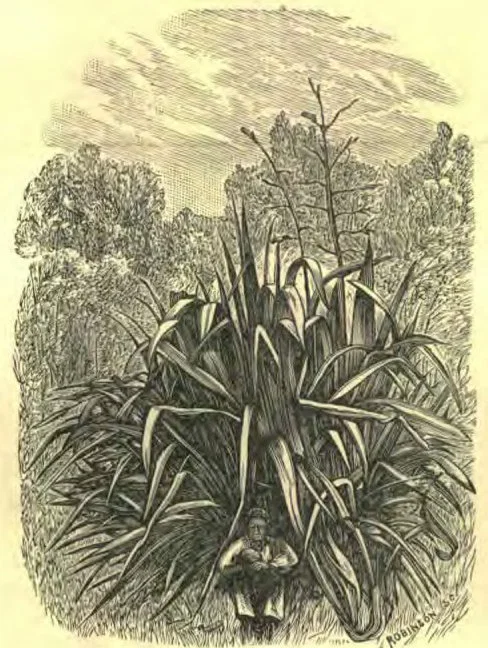
THIS week the artist has furnished us a picture of the Maori flax, which grows in low marshy land near the salt water, and attains a height of from ten to fifteen feet. The New Zealand flax is a natural product of the Colony, and it is the most valuable of all the plants which grow in that country. Its botanical name, Phormium Tenax, comes from two Greek words, phormos, meaning a basket, and tenax, meaning strong. It is sometimes called the lily flax.
The leaf varies in size from three to fourteen feet in length, and from one-half an inch to five inches in breadth. The plants grow in clusters; each shoot has five leaves, and there are on an average about ten of these shoots in one bunch. The leaves are perennial, hard, and sword-shaped. The flower stalk shoots up three or four feet above the leaves, and bears a profusion of yellow or sometimes red flowers, which are followed by triangular seed vessels filled with flat, thin, shining black seeds. It is said that in rich soil the flower stalk rises to the height of twenty feet. The plant becomes fully developed in three years, when it first flowers.
The plant is a native of the Norfolk Islands. It has also been carried to India and other countries, and it is said that it will grow on the Pacific Coast of the United States. It grows best in rich, moist, well-drained ground, and reaches great size on the banks of running streams.
When the leaves are full-grown, the natives gather them green, and separate the fibers. Four and a half tons of leaves yield about one ton of fiber. A full-grown plant will produce on an average about thirty-six leaves, and it takes about six leaves to yield an ounce of fiber. At this estimate, an acre of ground planted three feet apart, would yield about sixteen hundred weight of fiber; when cultivated, the yield is about two and one half tons per acre.
In some districts of New Zealand, flax forms the principal resource of the people, being exported in large quantities. Many men are employed in cutting and carting the raw material to the mills, where it goes through an operation of stripping, washing, and bleaching. This is done by men and boys who receive pay for their services at a certain rate per load. Those who prepare the flax for ropes receive wages at from $2.25 to $3.00 per week for boys, and from $3.50 to $4.50 per week for men, and these laborers furnish their own board and lodging. The preparation of the fiber and packing it for export is generally done by contract, and the ordinary price paid when the material is baled up and sent off, is $6.00 per ton.
The condition of the flax industry at present is not very satisfactory, for the English have discouraged the use of this flax in making their ropes, since it interfered with their home manufacture. But some mills have turned out a fiber which produces a very superior quality of rope. Oftentimes vessels are moored to the wharf by these ropes; and it is said that in a severe storm which occurred a few years since, all the vessels fastened to the wharf broke from their moorings except those secured by ropes made of this flax. New Zealand flax was generally supposed to be the strongest fiber in the world; but recent experiments with testing machines show that while it is double the strength of ordinary hemp, it is not so strong as silk. The table given is as follows: Silk bears a strain of 34 pounds; New Zealand flax, 23 pounds; European hemp, 16 pounds; European flax, 11 pounds.
A very excellent paper may be made from this fiber. Those who are too poor to make their whares, or houses, of the sort described in the INSTRUCTOR a few weeks since, cover them with this flax. They do not prepare the flax in the least, but simply dry it and place it upon their houses. It also furnishes the walls of their whares; and when it is crowded together, even the air cannot penetrate it. The fiber is also used for clothing. It is slit up into fine shreds, and so woven together as to form a mat, and is made into long robes which are hung over the shoulder, covering a large portion of the body. These are very expensive. It is also used in the manufacture of baskets; and you often see the Maori children carrying their books to school in some not so very different from those used by some of the INSTRUCTOR family. The pulp of the stalk is used for food; so it can well be said that the flax furnishes them food, clothing, and a covering for their houses, besides rope and numerous other things. It is therefore a very useful plant among the Maoris, and the English people who live on the island. As will be seen by the picture, the phormium tenax, or flax plant of New Zealand, is very unlike the flax of this country. It is not so plentiful upon the island as it was formerly, but is still sufficient to supply the present demand.
S. N. HASKELL.

THE BIBLE IN THE WALL.

THE Italian sun was sending its warm beams down every hill-side, swelling the young buds of the orange trees into fragrant, snowy blossoms, luring the vine tendrils higher and higher on the trellises, and giving the dark old olives a soft, silvery hue.
On the outskirts of a little town which lay half-hidden among the orange groves and olive yards, a lady was walking. As she came near the principal entrance to the town, she saw a man busily engaged in building a wall. A pleasant smile and a “Buon giorno” never fails to call forth a response from the light-hearted peasants of the sunny South. In a few moments the lady was in lively conversation with the stone-mason, and his dark eyes were gleaming with friendliness to the “Signora Inglese.” But suddenly you might have noticed a great change in his manner; he looked suspiciously, and even angrily at her. Why this change?
Out of a little bag which she carried at her side the lady had taken an Italian Bible, and this she had offered to the man, explaining to him that it was the word of God, and that he would find in it a message to his own soul. He refused the gift, boasting that he would have nothing to do with the book. But the lady was not to be easily daunted in her good work. She had gone forth in faith to distribute God’s word among the priest-ruled people, and she earnestly tried to persuade this man to accept the volume she offered. After a little while he seemed to give way, and even allowed her to write his name on the fly-leaf of the book; but there was a cunning look in his eye as she did it, and a sinister smile on his lips as he bade her “Addio.”
As soon as the lady had turned away, the man resumed his work. But what is he going to do? He removes two or three stones from the wall, places the Bible within the hollow space, and then proceeds exultingly to build up around it. He has outwitted the heretic English lady, the hateful book is safely buried, and he will have a fine tale to tell the priest.
A few years later this same little town where the stone-mason and the lady met was visited by a great calamity. One memorable night, the sleeping inhabitants were suddenly awakened by the crash of falling houses. It was the shock of an earthquake. Shrieks and groans from the injured and dying, and screams of the terrified women and children, mingled with the noise of falling masonry. More than half the town was destroyed, and the scene of devastation was pitiful indeed.
When the terror had somewhat subsided, and the poor people who had fled in dismay from the desolate town were beginning to return to their homes, inspectors were sent to examine the walls which remained standing, to prevent further disaster.
As one of these men was tapping a wall with his hammer, he noticed that in one spot it sounded hollow.
“Perhaps there is a treasure hidden here,” he said to himself; and he at once set to work to discover it. In a few minutes he had removed the stones. Yes, just as he had guessed, there was a hollow place, and buried within it was—a little book. A disappointment, truly, but still he had found something, and there must surely be some interesting history connected with it to be hidden in such a way.
So curiosity led him to carry home the book and to read it, and the reading of God’s word was the means of his conversion. Then, indeed, he knew that he had found a treasure buried in the wall. Longing to do something to lead others to his new-found Saviour, this man became a Bible colporter, and went from place to place selling copies of the Scriptures.
One day, as he trudged along laden with his pack of books, he saw a group of workmen standing by the wayside. He came up to them with a greeting, and began to undo his pack and to show them his books. Two or three of the men were induced to purchase a Testament, but one stoutly refused even to accept one as a gift.
“I’ll have nothing to do with the book,” he said. “I had one once, and I put it in a place where not even the devil himself could find it.”
A sudden thought struck the colporter. He drew a Bible from his breast, and opening it at the fly-leaf, asked the man if that was his name written there. The astonished stone-mason at once recognized the Bible which he had so carefully built up in the wall. He dared no longer fight against the God of the Bible, and he humbly begged the colporter to let him have his book again. With earnest prayer for the man, and not without some regret at parting from his treasure, the colporter handed it to its former owner.
With feelings of reverence and awe, the stone-mason carried the book to his home—this wonderful book which God had found and sent to him.
Day by day, in all the time he could spare from his work, he read and pondered it. Day by day the Spirit of God brought home its truths to his heart. He read and believed that “the blood of Jesus Christ cleanseth from all sin,” and coming in humble trust to the Saviour, he proved the faithfulness of the promise: “He that heareth my word, and believeth on him that sent me, hath everlasting life.”—Selected.

THE RIGHT ROAD.

I HAVE lost the road to happiness;— Does any one know it, pray? I was dwelling there when the morn was fair, But somehow I wandered away.
I saw rare treasures in scenes of pleasures, And ran to pursue them, when lo! I had lost the path to happiness: And I knew not whither to go.
I have lost the way to happiness;— O, who will lead me back? Turn off from the highway of selfishness To the right—up duty's track!
Keep straight along, and you can't go wrong; For as sure as you live, I say, The fair, lost fields of happiness Can only be found that way.
—Ella Wheeler Wilcox, in Good Cheer.

The Value of Earnest Character

An old author has very wisely remarked that if men were only half as earnest in becoming what they would wish others to believe them to be, the world would be much better than it is.

Yellowstone Geyser Region.

Since you have read the interesting article, “The Geysers of the Yellowstone,” in the INSTRUCTOR of October 6, 1886, we suspect you know just where they are. If any do not, it might be well now to find on your maps the Territory of Wyoming, in which these remarkable geysers lie; for there is much to be told of this wonderland, which makes it important that you should be able to locate it.
Speaking of this tract of country, one writer has said that “in the north-western corner of Wyoming Territory, in the same latitude as New York, the grand Rocky Mountain system culminates in a knot of peaks and ranges inclosing the most remarkable lake basin in the world. From this point radiate the chief mountain ranges, and three of the largest rivers of the continent—the Missouri, the Columbia, and the Colorado.”
After bounding this division of territory by several prominent mountain ranges, one of which a few years ago had never been crossed by a white man, the writer continues:—
“Set like a gem in the center of this snow-rimmed crown of the continent, is the loveliest body of fresh water on the globe, its dark-blue surface at an elevation greater than that of the highest clouds that fleck the azure sky of a summer’s day, over the tops of the loftiest mountains of the East. Its waters teem with trout, and the primeval forests that cover the surrounding country are crowded with game. But these are the least of its attractions. It is the wildness and grandeur of the inclosing mountain scenery, and still more the curious, beautiful, wonderful and stupendous natural phenomena which characterize the region that have raised it to sudden fame.”
It is a fact worthy of note here that it is less than twenty years since the public received their first knowledge of the marvels that really existed in the Yellowstone Geyser region. Unsuccessful attempts had previously been made to explore it; for after the upper Missouri valley began to be thronged with gold-seekers, rumors came that in the unknown Yellowstone country, diamonds, rubies, sapphires, emeralds, and other gems, as large as walnuts, were gathered by thousands from the stony branches of the petrified sage brush. No doubt these visionary stories originated in something that had been communicated by the Indians.
In 1859, Col. Reynolds made an attempt to enter the basin, which resulted in his passing around it only. Ten years afterward another party entered, but no report was made of their discoveries. In 1870, an expedition “composed of some of the leading officials and citizens of Montana, accompanied by a small escort of U. S. cavalry under Lieutenant G. C. Doane,” made an extensive research of that tract of country, reporting that they had “seen the greatest wonders on the continent; and were convinced that there was not on the globe another region where, within the same limits, nature had crowded so much of grandeur and majesty with so much of novelty and wonder.”
Other explorations immediately followed, and have been continued, until reports of them furnish many pages of the most grand, sublime, and thrilling descriptions imaginable.
Among those who traversed this region, “making a systematic survey,” was the United States geologist, Dr. F. V. Hayden. As soon as he reported officially the results of his investigations, steps were taken to have a portion of this wonderland set apart for the benefit of the public at large. A bill to this effect was introduced into the Senate in December, 1871, and approved by Congress March 1, 1872. It provided that “a tract of land fifty-five by sixty-five miles, about the sources of the Yellowstone and Missouri Rivers, be set apart as a great noted pleasure-ground for the benefit and enjoyment of the people.” It is called the Yellowstone National Park.
“Within the limits of our great National Park, is the grand geyser region of Firehole River. Here, in a valley a dozen miles long and two or three wide, is an exhibition of boiling and spouting springs on a scale so stupendous that if all the corresponding phenomena of all the rest of the world could be brought into an equal area, the display would seem as nothing in comparison.” “Two miles further down the stream is the Upper Geyser Basin, an open, rolling valley, two miles wide and three long, the mountains on either side rising 1,500 feet above the valley, with steep, heavily timbered ledges of dark rock.”
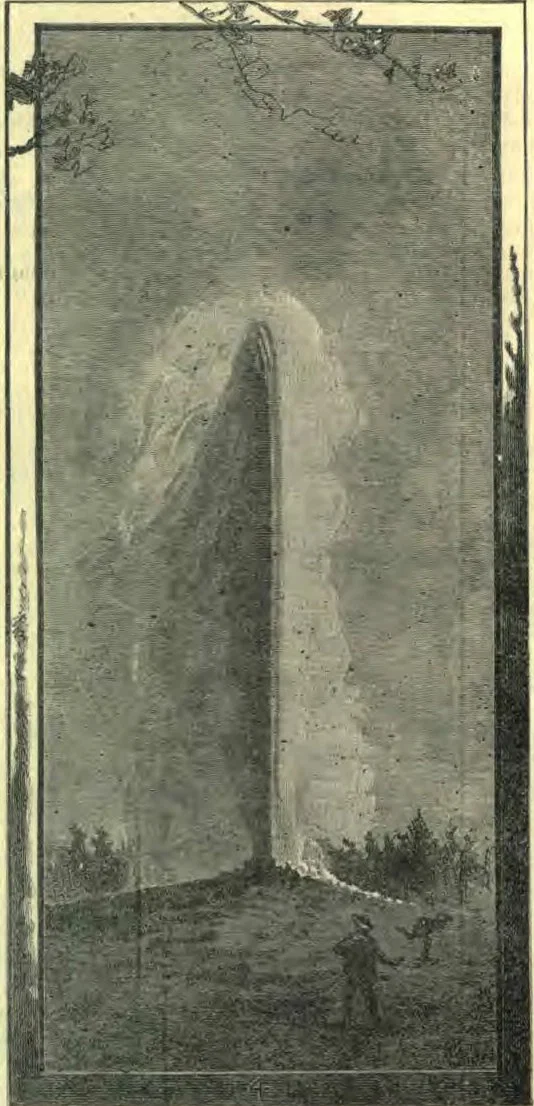
This is rightly named the Grand Geyser Region. At the head of this valley, on a mound thirty feet above the level of the surrounding country, a very interesting geyser seems to stand as guard. It has been named Old Faithful. In its description, you will readily detect the characteristic that suggested its name. We wish we had space for what explorers testify of this wonderfully formed mound from whence is discharged such marvels of varied beauty, but we can only give a description of the geyser’s appearance in times of spouting and resting.
The opening through which Old Faithful discharges water is said to be an irregular oval, three feet by seven in diameter. He has such an interesting way of entertaining visitors, that we will close the article with an extract from a description given of it by an eyewitness:—
“You hear Old Faithful splashing in the night, and, if you have kept your reckoning, can actually tell the hour, he is so regular in his action. Never was a geyser better named; for once every sixty minutes he asserts himself. You may walk up to his mouth and look down his throat, but you will see nothing but a passage full of water; you may drop in a handkerchief, only to see it become saturated and sink from view. If it is near the hour of eruption, your wisest way is to walk a few rods away and sit down under the bushes; not that there is any particular danger in delay, for even had Old Faithful begun operations, there would be time to run out of reach. But it is so pretty to watch him at a safe distance, and then it is only from a distance that one gets any idea of the height of the geyser column. With watch in hand you listen for the preliminary rumble—he does not vary ten minutes either way. There it is! a kind of choking sound in his throat, and a moaning as of intestinal disturbances, which is followed by a splutter and slopping over that is like a useless attempt.
“For a moment you lose confidence; you begin to fear that this eruption will prove a failure. His reputation is at stake, and he knows it; for after half a dozen discharges, abortive compared with what he has done and can do, he is off with a column of water that curls outward on every side in a magnificent capital and veils itself in clouds of whirling vapor. Higher and higher it climbs, as if he were endeavoring to outdo himself, until at last its topmost wave seems actually to catch an azure beauty from the sky, and to leave part of its diamond dust aloft, there to be absorbed by the sunshine. In five minutes he is satisfied; he has exhausted his enthusiasm and his resources at the same moment, and he quietly, but majestically, and with great dignity, subsides with an audible sigh. He steams vigorously for a little while, and pants as from sheer fatigue, but shortly he is as quiet as if he had never done anything out of the common, and he does it so easily and so naturally that it is hard to believe that he has.
“Just before the eruption, the water in Old Faithful’s throat stood at a temperature of 200 degrees Fahrenheit. Now it is down to 170 degrees Fahrenheit. That little freshet yonder is the surplus, the overflow from this small mouth, now hastening to the river in the head of the valley. Here is the handkerchief you dropped into the geyser before the eruption. It has been thrown thirty feet from the lips of the crater; had the wind been blowing, it might have lodged fifty or a hundred feet further yet away; it looks like a tangled skein; but for the knot you thoughtfully tied in it, perhaps there would not have been threads enough of it left together to warrant identification. Notwithstanding the regularity with which Old Faithful attends to his duties, he is seldom twice the same in appearance. The slightest wind sweeps the descending water to a considerable distance and spreads it in many a graceful and beautiful pattern, sometimes resembling a colossal ostrich plume of the most dazzling whiteness. The real feather is not lighter or more susceptible to the influence of the winds.” M. J. C.

A USELESS STONE.

In the far-away land of Syria there are imposing ruins which belong to the ancient temples of Baalbec. A mile distant from these is the quarry from which the materials were drawn, and here the tourist beholds a stone of immense size. It is seventy feet long, fourteen feet high, and thirteen feet wide, and is supposed to weigh fifteen hundred tons. Perhaps it is the largest stone ever quarried for a building, but for some unknown reason it was never used. Much work was spent to cut it from the rock and to chisel its rough sides smooth, and it might have adorned a splendid temple, but there it lies useless.
That stone reminds one of the kind of person that we sometimes meet with in our journey through life. He has had much money spent upon him in the way of education, and he has the polish which culture and good society give, and we expect him to fill a prominent place. But his life is a disappointment, for it is a useless one.
What is the reason?
Perhaps he chooses a pursuit for which he is unfitted. He tries hard, but failure awaits him, and then he gives way to utter discouragement when he should turn to some other pursuit. Many men can excel in one line of work, and but few in several. The orator cannot make money like the merchant, and the merchant cannot thrill an audience and move them at will by the power of speech like the orator. The first step toward a useful life is to find out the thing one can do the best, and it may take many years to find that out.
Then there must be energy, which is to a man what steam is to the engine—the driving power. There must be perseverance, too, which is like the long track on which the engine keeps running steadily for hours until the end of the journey is reached. Last of all and greatest of all, there should be a trust in God and a daily prayer that he would help us to be useful, so that when we die we may leave the world better than we found it.—Classmate.

True Politeness Is Everywhere the Same

Ceremonies are different in every country; but true politeness is everywhere the same.—Goldsmith.

THEN AND NOW.

Fifty years ago the tinder-box was as indispensable as was, and is, the tea-kettle that still sings on the hob in the kitchen. As an old acquaintance it is worth describing. It was more or less coarsely ornamented, and of various forms. Ordinarily it was an oblong wooden box, some six or eight inches long, and three or four in width, and was divided into two parts by a partition. In one of these was fitted a loose lid with a central knob, to drop in as a “damper” on the tinder; and in the other were kept the flint, steel, and bunches of brimstone matches. The “tinder” was scorched or half-burned linen rags. The flint and steel being struck together emitted sparks, and then, as soon as a spark had fallen upon and ignited the tinder, the brimstone end of a “match” was applied to it and lit. The matches were thin slips of deal, five or six inches long, and perhaps a quarter of an inch wide, cut to a point at each end, and dipped in melted brimstone, they were hawked about the country by itinerant venders. The fumes of the sulphur emitted a scent by no means pleasant to the olfactory nerves; in fact, the stench was strong enough to find its way from the kitchen to the attic of a lofty mansion. From the match thus ignited a candle was lit, of mutton fat usually, or “molds” where greater cost could be afforded. There were never candles on the table without the snuffer-tray and snuffers. It is almost as necessary to describe the snuffers as the tinder-box, for they are nearly as much of the past.
In those days lighting by gas was a novelty that was making its way into public favor slowly, and against a furious storm of opposition, although in the unsafe, miserably lit streets of London tottered at night feeble old creatures with staves and lanterns, who were by a fiction styled “watchmen,” but whom the public knew best as “Charlies.” They came mostly from the workhouse, and their shelter between sunset and sunrise was a narrow, rickety sentry box, to overturn which, with its aged and decrepit occupant, was a favorite sport of all the “bloods” in town. Lamp-lighting was a profession; but the streets were so “dark with light,” that on the opposite side, if the streets were at all broad, you could not tell whether it was a man or woman who was passing. Familiar to me in my youth were the old oil lamps, those makers of darkness visible in our thoroughfares, which the now sovereign king, gas, has displaced. It is strange, but true, that one of the most bitter opponents to the introduction of gas was Sir Walter Scott, who denounced the “pestilential innovation” in a public speech. But the northern wizard speedily recognized the magic of the new light-giver, and, changing with the times, took a prominent part in the formation of a gas company, causing Abbotsford to be lit with the “dangerous and deleterious air.”—S. C. Hall.

LESSON 10.—GOD ANSWERS PRAYER THROUGH THE MINISTRY OF THE ANGELS.

1. How does Moses say the Lord answered the prayers of the Israelites when they cried unto him? Num. 20:16.
2. What did Hezekiah and Isaiah the prophet once do when in great distress? 2 Chron. 32:20.
3. How did the Lord answer them? Verse 21.
4. When Peter was about to be killed, what did the church do? Acts 12:5.
5. What is the promise concerning such prayer? Jas. 5:16.
6. What was the result in this case? Acts 12:7.
7. Who sent this angel? Verse 11.
8. When Paul and his company were in great peril (Acts 27:20), how did God comfort him? Verse 23.
9. How did Daniel seek God for light and help? Dan. 9:3.
10. Do many seek God like that now?
11. Who came to Daniel? Verse 21.
12. Why did he come? Verse 23, first part.
13. What did Daniel do on another occasion? Dan. 10:2, 3.
14. Did God hear his prayer? Verse 12.
15. Who was sent to answer him? Verse 12.
16. What do all these cases show as to the means by which God answers the prayers of his people?
17. Give as many more cases as you can upon this point.
18. Where is God's throne?
19. Where is Jesus, our high priest? Heb. 8:1.
20. What did John see before the throne in heaven? Rev. 8:3, first part.
21. What did the angel offer before God? Verses 3, 4.
22. Then who offers our prayers before God in heaven?

DIRECTORY OF THE STATE SECRETARIES.

A few weeks ago there appeared in the Instructor a list of the State secretaries and their addresses. It was according to the latest information we had at the time of going to press. Several of these addresses have since been changed, and we give below a revised list, according to our latest knowledge. If any mistakes occur in it, we would be glad to learn of them.
CANADA.—Emma Dingman, So. Bolton, P. Q.
CALIFORNIA.—Jessie F. Waggoner, 1465 Castro St., Oakland, Cal.
COLORADO.—Mrs. Cora M. Jones, Longmont.
DAKOTA.—Isa L. Ransom, Mitchell.
ENGLAND.—Mrs. J. H. Durland, Hawthorne Road, Kettering.
INDIANA.—Allie Lewis, 32 Cherry St., Indianapolis, Ind.
ILLINOIS.—Mrs. A. B. Tait, Kankakee.
IOWA.—Mrs. J. S. Hart, State Center.
KANSAS.—Mrs. Josephine Gibbs, Ottawa.
KENTUCKY.—Anna L. Coombs, Glasgow.
MICHIGAN.—Vesta D. Miller, Battle Creek.
MISSOURI.—Vita Morrow, Salisbury.
MAINE.—Mrs. A. K. Hersum, Box 360, Richmond.
MINNESOTA.—E. S. Babcock, Eagle Lake.
NEW YORK.—Mrs. Mary W. Keim, 52 Crouse Building, Syracuse.
NORTH PACIFIC.—Carrie L. Brooks, East Portland, Oregon.
NEW ENGLAND.—Mrs. E. D. Robinson, So. Lancaster, Mass.
NEBRASKA.—W. D. Chapman, Red Cloud.
NORWAY.—Cecelie Dahl, Akersgaden 74, Christiania, Norway.
OHIO.—Nellie L. Beebe, Box 1131, Mt. Vernon.
PENNSYLVANIA.—Mrs. F. C. Oviatt, Wellsville, N. Y.
SWITZERLAND.—Esther H. Whitney, 46 Weiherweg, Basel.
TEXAS.—Mrs. Lee Gregory, Denton.
VERMONT.—Mrs. F. S. Porter, North Fayston.
VIRGINIA.—Amy A. Neff, Battle Creek, Mich.
WISCONSIN.—Nellie C. Taylor, Nielsville.
UPPER COLUMBIA.—Mrs. M. A. Kerr, Milton, Oregon.

Honoring the Lord's Work in Sunday-School Service

Says the biographer of an eminent Sunday-school worker: “He was the stronger for his own work through not neglecting the Lord’s work. In truth, all that he did he looked on as the Lord’s work; and because he honored the Lord in its doing, the Lord honored him in its results; and the Lord made all that he did to prosper in his hand.”

THE FOUR T'S.

There are four T's so apt to run, 'Tis best to set a watch upon:—
Our Thoughts— Oft when alone they take them wings, And light upon forbidden things.
Our Temper— Who in the family guards it best Soon has control o'er all the rest.
Our Tongues— Know when to speak, yet be content When silence is most eloquent.
Our Time— Once lost, ne'er found; who yet can say He's overtaken yesterday?
—Golden Days.

THE BULRUSH CATERPILLAR.

One who has recently spent some months in New Zealand exhibited to the publishers of the St. Nicholas a specimen of a very curious plant, which they describe in the March number of their magazine as follows:—
“Among the most curious productions of New Zealand is the singular plant (called by the natives Awheto), the Sphæria Robertsii, or bulrush caterpillar. If nature ever takes revenges, one might imagine this to be a case of retaliation. Caterpillars live upon plants, devouring not only leaves, but bark, fruit, pith, root, and seeds; in short, every form of vegetable life is drawn upon by these voracious robbers. And here comes a little seed that seems to say, ‘Turn about is fair play,’ and lodges on the wrinkled neck of the caterpillar, just at the time when he, satisfied with his thefts in the vegetable kingdom, goes out of sight, to change into a chrysalis, and sleep his way into a new dress and a new life. A vain hope. The seed has the situation. It sends forth its tiny green stem, draws its life from the helpless caterpillar, and not only sends up its little shoot with the bulrush-stem capped with a tiny cat-tail, but fills with its root the entire body of its victim, changing it into a white, pith-like vegetable substance. This, however, preserves the exact shape of the caterpillar. It is nut-like in substance, and is eaten by the natives with great relish.”
“There are other cases of this vegetable retaliation, but none so curious as this of the bulrush caterpillar. The larva of the May beetle is attacked by a fungus which grows out of the sides of its head; but while this growth destroys the life of the larva, it does not change the larva into a vegetable substance.”
“A near relation of the murdered caterpillar is the larva of the New Zealand swift moth, upon whose tapering head sometimes appears a similar growth, which feeds upon the life-blood of the caterpillar, until it dies from exhaustion.”
“A very curious sight must be one of these heavily-burdened crawlers moving along with the banner that announces its doom solemnly floating above it. For, when the young caterpillar bears this growth upon its head, it heralds the slow but certain death of the overloaded insect.”

THE STONE IMAGES OF EASTER ISLAND.

A STRANGE memento of an unknown race is the gigantic stone image from Easter Island, now on the way to the Smithsonian Institution, at Washington. This lonely isle of the Pacific is of volcanic origin, and is but eleven miles long and six broad, and, from its solitary situation, is seldom visited. The natives, but few in number, are of the Polynesian race, and were originally exceedingly hostile to the few whites who visited them. But within the past twenty-five years they have embraced Christianity under the influence of French missionaries. The island is owned by a Tahiti firm, who utilize its fertile valleys for cattle-raising. The remarkable features which distinguish it from other solitary islands are the huge stone statues to the number of several hundreds, which lie scattered about. They were chiseled with rude skill from the lava in the craters of extinct volcanoes and transported to all parts of the island, where they were set up; but most of them have since been overthrown by earthquake shocks. Some of these statues are forty feet in height, and some still remain unfinished in their quarries. Nothing is known of their origin. The present inhabitants possess neither the skill nor the tools for the work, and have no appliances for transporting such immense masses of stone. Their traditions furnish no information, as they merely ascribe a supernatural origin. The statues are all grotesque effigies of human beings, and while they are low in the scale of art, they are evidently the work of a race centuries in advance of the present inhabitants. A theory has been advanced that Easter Island is the remnant of a submerged continent, and that the statues were made by a people who worshiped them as idols. But this is only theory, without a particle of evidence to sustain it. The statue for the Smithsonian institution is now on board the United States steamer Mohican, which was at last accounts at Valparaiso. It weighs between twelve and fifteen tons, and it was with great difficulty that it was placed on board the vessel, as the island has no good harbors; and although the image had to be transported overland about eight miles, there was not a tree to furnish the material. The Mohican finally obtained a few logs at Samoa, with which the work was accomplished. This is the second monster curio which has been taken away from Easter Island—a German vessel having secured one about two years ago. When it finds a permanent place here, our puzzled ethnologists may possibly be able to clear away the mystery of its origin by a careful study of its design and workmanship.—Interior.

THE LENGTHENING DAYS.

On the 21st of December, 1886, the sun touched the Tropic of Capricorn, his extreme limit of southern declination, and turned his face toward our northern clime. The epoch is called the winter solstice, for at that time the astronomical winter begins.
It receives the name of solstice from two Latin words, which mean the sun stands still, because for about four days before and four days after the epoch the sun seems to stand still, the days being of a uniform length—nine hours and four minutes in the latitude of Boston. A change then takes place. A precious minute of sunlight is added to the day; the sun is coming towards us.
The day's increase goes on, minute by minute, until it becomes plainly perceptible. At the end of January the days have increased fifty-three minutes; at the end of February, two hours and seven minutes. The increase will continue until the sun reaches the Tropic of Cancer on the 21st of June, at the time of the summer solstice, when the day has reached its greatest length, fifteen hours and sixteen minutes. The sun will then turn his face southward, and the process will be reversed, the days growing shorter instead of longer.
Any intelligent observer may easily watch the seasons as they come and go, and comprehend the laws that regulate their course. If the points of the horizon, where the sun rises and sets at the winter's solstice, are noted, it will be seen that they are moving farther north.
If the position of the sun at noon-day, or its meridian altitude, be noted, it will be seen that he is every day a little higher in the heavens. This change in the sunset and sunrise points, and in the sun's meridian altitude, is the tangible proof that the sun is moving northward.
The revolution of the earth around the sun, with her axis inclined to the plane of her orbit, is the real cause of the apparent movement of the sun north and south, and the constant change of his meridian latitudes, thus giving us the seasons. The revolution of the earth on her axis makes the sun appear to rise and set, and gives us day and night.—Companion.

A BOY'S PROMISE.

THE school was out, and down the street A noisy crowd came thronging; The hue of health, and gladness sweet, To every face belonging. Among them strode a little lad, Who listened to another, And mildly said, half grave, half sad, "I can't—I promised mother."
A shout went up, a ringing shout, Of boisterous derision; But not one moment left in doubt That manly, brave decision. "Go where you please; do what you will," He calmly told the other; "But I shall keep my word, boys, still— I can't, I promised mother!"
Ah! who could doubt the future course Of one who thus had spoken? Thro' manhood's struggle, gain and loss, Could faith like this be broken? God's blessing on that steadfast will, Unyielding to another, That bears all jeers and laughter still, Because he promised mother!] —George Cooper.
Continue reading: THE PROPHET ELIJAH