[The following is from a speech by Hon. Thomas C. McRae, of Arkansas, in the House of Representatives, April 2, 1896. The special point under consideration was an appropriation for Howard University, a private and Congregational institution. This appropriation came in as an amendment to the appropriation bill for civil expenses of the government. The speech, especially that part quoted from Judge Jeremiah Black, is worthy of a place among some of the famous documents drawn by Jefferson, Madison, and Johnson.]
I regret very much that some gentlemen have seen fit in the discussion of this question to erroneously charge the southern states with unfair treatment of the colored people in the matter of educational facilities. I do not intend to be led into a discussion of that matter at this time, but I do want to say that I heartily join the gentleman from Texas [Mr. Sayers] in denying these misrepresentations of our tax-ridden people. The negroes have been fairly treated in the state of Arkansas, and I believe they have been in the other southern states; but if they have not been, it is no reason why we should make this appropriation of $32,000 to a private denominational colored university located in this district, when we all know that they have the same opportunities to attend public free schools as the whites have.
To my mind there is no theory consistent with our institutions upon which this appropriation from the general revenues of the government, collected by taxation from all the people, can be justified. That the colored people need education in the south can not be denied; but it does not follow that Congress should take the money from the people of the states, black and white, and give it to a private university located in this city. I make no war on the Howard University. There is evidently a necessity for it, or it would not exist. I have nothing but words of praise and encouragement for its promoters and supporters, but I insist that Congress should not aid any educational institution except those which offer to the youth of our country an opportunity for a common school education free of cost. If we have the power to aid the cause of education, we should help the public and normal schools in the states and territories and not subsidize private universities, however deserving and philanthropic they may be. One of the great mistakes of the past in this and other countries8has been that the aid to colleges and universities has been out of proportion to that extended to the public schools. The result has been that knowledge, that great agent, so powerful and dignifying to human nature, has been and is confined to a few master spirits, who, constituting the repositories of moral and mental power, have given laws, literature, and religion to the world and shaped the destinies of mankind.
For just experience tells in every soil
That those who think must govern those who toil;
And all that freedom's highest aims can reach,
Is but to lay proportioned loads on each.
In the most remarkable period in the history of learning, when all that was beautiful and grand in conception, all that was sublime and powerful in thought or chaste in imagery, we find ignorance is the basis for human usurpation. This has always been and always will be the case. The mind is the ruling and controlling power of the intelligent few, to whose patient labor and systematic study the world is indebted for the thousand improvements and successful discoveries which are the pride and ornament of the nineteenth century.
I shall not take up the time of the committee to prove that the university in question is sectarian, for the amendment admits this by providing that no part of the money “shall be paid to any teacher or professor of theology or religion, or to any chaplain in said university.” If you aid any department, you help the entire institution.
Mr. Chairman, I do not wish to be understood as opposing church schools and colleges, nor should I underestimate their great benefit to the cause of education and civilization. I affiliate with a Protestant denomination which believes in and advocates the highest education for its ministers, and its institutions of learning stand in the front rank of sectarian schools. It maintains an institution for the education of colored ministers in the state of Alabama, but, sir, it does this by private and voluntary contributions, and it will deserve to die when it asks Congress to aid it. The various churches in the south are doing as much for the cause of higher education as any other agency. I take pride and pleasure in saying that all of the religious denominations in the state which I in part represent are bending all their energies to arouse the aspirations of the people and to bring them to a realization of the dangers that threaten our institutions by the great mass of ignorance that surrounds them. They are lighting up the minds of the people with the torch of knowledge. In their own hopeful, faithful way and under their own independent control they are accomplishing what was not dreamed of thirty years ago. They have had many hardships and disappointments to encounter, but they have never thought of asking aid of the government. May God speed them in the great work they have assumed!
As a believer in the Christian religion, and not opposed to sectarian education, and for the good of the churches themselves, I stand here to warn them as well as my countrymen of the danger of government aid to any school, college, or university under church or private control. I say this in the interest of that pure Christianity which I believe exists in the hearts and homes of the great body of the people of this country, as well as for the regard I have for that charter of our liberties which provides that no religious test shall be prescribed. Let us keep the state and church forever separate and independent of each other. No church that has a proper regard for the holy work committed to its care would accept aid from a state or the government.
Mr. Chairman, I think this a fit occasion to refer to some of the utterances of that great lawyer, that statesman, jurist, and champion of the Christian religion, the late lamented Judge Black, of Pennsylvania, upon the question of religious liberty. I shall now ask the attention of the House to some of the thoughts suggested by him, because the principles are stated more forcibly and more strongly than I can possibly hope to state them. I wish I could burn the great truths he has so eloquently expressed in the minds and hearts of the members of this House and the people of our great country.
“We habitually use certain words and phrases, imported from the other side of the water, which are calculated to mislead us. One of these is the word ‘toleration’ as applied to matters of faith. It implies that we derive whatever religious freedom we have from the concessions of the government; that the king in a monarchy, and a majority of the people in a republic, permit those who differ from them to live unmolested. This notion is wholly untrue. It is not a political privilege, but a natural and indefeasible right, which human government may protect but can not either give or withhold. If we are permitted to enjoy it, our thanks are due, not to any popular majority, but to Him who gave us being.”
“Deus nobis hæc otia fecit. [God grants this repose.]”
“Again, we hear it continually said by the wisest men among us that Christianity is part of our common law. No one has ever attempted to explain how this is to be understood. The law and the Gospel are, in fact, wholly dissimilar in nature and essence, in origin, operation, and object; as different as the purity of the one must necessarily be from the coarse and vulgar machinery of the other; so different that they never can be mingled together without corrupting both. Christianity, they tell us, is a part of our law; that is, we have adopted the rules of the divine Lawgiver to regulate our civil conduct; but, finding them very defective, we have made certain valuable additions. The Connecticut settlers resolved that they would live according to the laws of God until they had time to make better. So we profess to have taken a system formed in the councils of Omniscience, which came from the hands of its Author round and perfect like a star, filled with all forms of moral beauty, and radiant with miracles of light, and we boast that we have adopted this system with such amendments as our superior wisdom has found it necessary to make. The proposition is blasphemous, and every Christian man should frown upon it.”
(To be continued.)*
A DANGER SIGNAL; WHAT WILL THE END BE?
By H. F. Phelps
Demands for religious legislation have been very urgent for some years. When these were seen to be futile, there followed threats of political boycott. But now demands are being made as to the religious standing of officials and political aspirants. Governor McKinley, altho he is acknowledged as being “a staunch Methodist and an active worker in the Methodist Church,” is denounced as “a shouting Methodist on Sunday and a political wire-pulling demagog the rest of the week,” because he gave a position of trust to a Roman Catholic, which these religio-political politicians thought should have been given to a Protestant. And these are also demanding that Mr. Reed shall publicly avow his religious proclivities, and so offer himself to the highest bidder; as tho religion were a thing for barter, a thing of the head and not of the heart.
But the latest in this line is that which occurred in this city, St. Paul, Minn., a short time since, according to a morning paper. A meeting was held in the interests of better Sunday observance, led by Mrs. W. W. Nicholas, state president of the W. C. T. U. Representatives were present from several denominations, the Street Mission, Christian Endeavor Mission School, the Epworth League, the Total Abstinence Society, the W. C. T. U. Unions,9with several ministers, some of whom advocated “a strictly Puritan sabbath.”
The first full week in April is set apart in the interests of this line of work, and Mrs. Nicholas had consulted with Archbishop Ireland, who said that he did not consider there could be a more fitting subject chosen for Easter Sunday than that of the Lord’s day. This, certainly, is a very reasonable conclusion, since Easter and Sunday are both institutions of the Catholic Church.
It seems that Senator Nelson, from this state, has been receiving protests from some of his constituents against the passage of certain bills now pending in Congress, involving religious legislation. And Mr. Nelson, as the servant and representative of his constituency, has presented these protests in Congress; against which act these representatives of latter-day reformers take exceptions. The report says:—
“A protest was made by all present against the action of Senator Nelson, March 2, when he presented petitions at Washington, of citizens of Minnesota against Sunday observance legislation. It was decided to appoint a committee to write to Senator Nelson, asking him to state more clearly his views, the union giving him the benefit of the doubt.”
It is one of the rights of the American citizen to petition or protest for or against any measure presented in our legislative halls; and it is the duty, and often the pleasure, of these representatives to receive and present such. But these religious zealots would protest against this right of protest. Then why are they exercising this right in protesting? But it may be wondered if there would have arisen any protest from this same source if the protests presented by Mr. Nelson had been petitions from their side.
But do not these people know, can they not see, that all these demands that the public officials and political aspirants shall define themselves upon religious matters, is a violation to the National Constitution, which says, “No religious test shall ever be required as a qualification to any office or position of trust under the United States”? Do they not know that they are requiring a religious test? This is evident; for if they are found upon the side of these would-be reformers, they will give their votes; but if otherwise, it is a political boycott that will follow. And do not these people know that such a course is only opening the way for even the most contemptible, time-serving politician to declare himself religiously, and enter the churches? And are they ready and willing to extend the right hand of fellowship to such as these? And will not such a course continued, persistent to the end, fulfill the word concerning mystic Babylon, that she “has become the cage of every unclean and hateful bird”? Then is not the cry now in place, “Come out of her, my people”? It is encouraging to know that all of our representatives are not time-serving politicians, but that some have the martyr spirit, and would rather die than yield the principles of religious liberty under such class legislation as is constantly being urged forward. H. F. PHELPS.
The Travail of Humanity and Christ's Soul
By Berry
THE review of the travail of humanity, which is the travail of Christ’s soul, ought surely to add to the solemnity and significance of life.—Berry.
Feeding Christ's Sheep: Spiritual, Not Worldly Fare
“WHEN Christ told Peter to ‘feed my sheep,’ he did not mean for Peter to fill them up with ice-cream and cake at ten cents apiece.”
UNHOLY METHODS.
By Editor
There is nothing that shows more clearly the deterioration in religion, the sapping of spiritual life, than the methods and means used by the churches to raise money for church purposes, among which are not a very high class of theatricals, various enterprises involving the principles of gambling, grab-bags, fishing ponds, various “teas,” etc., etc. Among the latest which has come to our notice is a “Poverty Social.” We will not mention the town or state; for it will do no good to those not knowing, and those who are acquainted with the circumstances will recognize the thing if we do not tell them. We have not space for the entire circular. It was “for the benefit of the M. E. Sabbath school.” The invitation and rules are thus printed, verbatim et literatim:—
Cum in your rags. Cum in your tags, otherwise you will be fined the usual sum.
Five cents will let you in if you have no box.
Be ye fat or be ye thin, all are welcome.
Now consider yourselves ax't fur a gud time.
RULS AND REGULASHUNS.
1. All must wear close suitable fur the soci'l.
2. Eny lady what cums must ware a kaliker gown, and aprun or sumthing ekally apropriate.
3. No gent with biled shirt an dood kollar will be aloud to enter unless he pays a fin of 5 cents.
Then follows a list of the articles the wearing of which results in a fine of from one to five cents, and closes with:—
Evry ladi what kums pleas bring substantil Grub Fer Two in a Box.
Poor spelling is not wit. “Poverty socils” are not Christian. It is right enough to appeal to men for money, but let it come freely, and let them feel that they are giving to God and humanity, instead of selfishly buying fun, in which the church will not condemn them, and in which it can not save them.
“And fair and festival—frolics untold—
Were held in the place of prayer.”
The word of God declared of those living in the last days, “having a form of godliness, but denying the power thereof,” that they were “lovers of pleasures more than lovers of God,” and enjoined, “From such turn away.” See 2 Tim. 3:1-5.
THE CODE OF HEALTH.
By John Harvey Kellogg
BY J. H. KELLOGG, M.D.
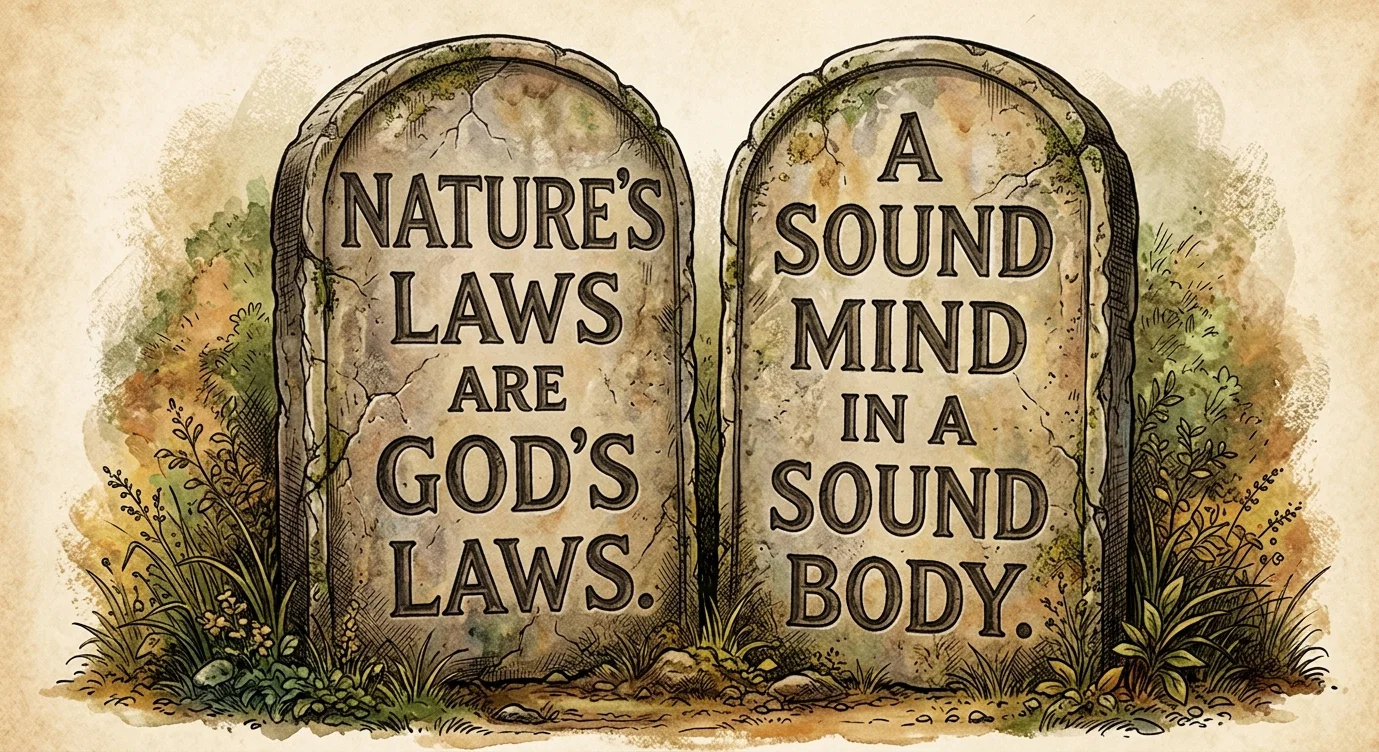
The essence of morality is right-doing, or the practical recognition of the obligation to law. Man is a part of the great universe, and is as much under the domain of law as the planets, rocks, trees, and other natural objects, or as the pebble, which, when thrown in the air, falls to the ground in obedience to the law of gravitation. In addition to the general laws which relate to all natural objects, and to which man is subject in common with all other objects, man is governed by various special laws which relate to his physical, mental, and moral welfare. Morality is generally looked upon as relating solely to those relations which are directly embraced in the injunctions of the Ten Commandments; but the view which regards man as a natural object, governed only by natural laws, and which defines right-doing as being simply obedience to law, gives to the term “morality” an immensely broader scope, and makes it include all those laws and principles by which his entire being is governed.
This notion of morality is confessedly a modern one, or rather a revival of a primitive idea which was hidden so deep in the mental and moral darkness of the middle ages that it has only in modern times begun to reach the light. “But,” says a young man who recognizes the importance of holding fast to the principles of morality, as related to other matters, “is it anybody’s business what I eat or drink or wear, or how I use my body? Do not I belong to myself? and haven’t I a right to do as I please with myself?” Let us see how much truth there is in the claim that individual rights include the right to treat the body in a manner not consistent with its interests,—to abuse the stomach for the purpose of affording the palate a questionable gratification; to whip and goad the brain and nerves by stimulants to do more work than is possible for them to do without injury; to recklessly violate any or all of the laws of health.
Here is a man who has vast possessions,—houses, barns, well-filled granaries, collections of rare and curious natural objects, galleries filled with beautiful works of art, safes filled with paying stocks and government securities,—all sorts of wealth. Suppose this man takes it into his head to destroy his wealth. Hold on there, says the Law, and its strong hand is laid upon him as soon as his purpose is discovered. A man who recklessly destroys his property is regarded as either a criminal or a lunatic, and, in either case, unfit to be at large. The state recognizes the fact that the man’s property is not wholly his own, or at least that others have interests in it. What he does not require for his own use, belongs to his children or other surviving relatives, or, in case he dies without a will and without heirs, to the state.
The state recognizes the right of a child to inherit from his father his due share of the property which the latter may have acquired. Ought not intelligent men and women to recognize the fact that the child has an even greater right to inherit from its parents a constitution unimpaired by vicious or injurious habits, or neglect of the requirements of physical law?
That quaint philosopher, Dr. Oliver Wendell Holmes, remarks that each one of us is an omnibus, in which ride all our ancestors. What right has any man by reckless habits of life to compel each of his children to carry about in his “omnibus” the results of the selfish gratification of depraved tastes and morbid appetites?
Another consideration, which certainly is worthy of thought, is the fact that the brain which does our thinking is a part of the body; and whatever seriously affects the physical health, whatever lowers nerve or vital tone, directly affects, in a harmful way, the mind. The man whose vital tone is lowered by sedentary occupation, by dissipation, by any means which overtaxes or exhausts the nervous system, is in a condition of lowered nerve tone, which means lowered brain tone, lowered mental tone, and lowered moral tone.
Thus it appears that health has a very important relation to morality, using the word in its common and narrow sense, and that no man who desires to live a pure and upright life can afford to run the risk of lessening his moral tone and his power of resistance to evil by impairment of his physical and mental vigor.
THE CODE OF HEALTH.
The laws which relate to individual health may be concisely summed up as follows:—
Breathe only pure air.
Drink only pure water.
Eat only pure food.
Take sufficient muscular exercise.
Preserve proper attitudes.
Discipline the mind by proper mental exercise.
Take proper rest and recreation and sufficient sleep.
Restrain the passions and govern the emotions.
Give attention to personal cleanliness.
Be temperate in all things.
To the man who will carefully and conscientiously observe all of those laws which relate10to his physical health, nature vouchsafes, barring accidents, a long, comfortable life, free from a great share of the ills which come upon a large portion of mankind. A great share of the sicknesses, and even a large proportion of deaths, are unquestionably due to the violation of some of the plainest principles of health morality, and are wholly preventable. An eminent English sanitarian once remarked, “When a man dies of typhoid fever, somebody ought to be hanged.” Somebody is clearly responsible for the annual slaughter, for not less than one-third of all the sickness, and pretty nearly as large a proportion of the deaths. Let us each, with soberness and consideration, ask the reaching question, “Is it I?”
A CONTRAST.
By W. N. G.
THAT Supreme Courts are not infallible is frequently demonstrated, and that their decisions are often the result of individual bias rather than of logical construction of law is also capable of demonstration. Last week we noted the decision of the California Court that the Barbers' Sunday law of this state is unconstitutional and unjust, because it is class legislation. There was but one dissenting voice. This week we note that the Supreme Court of the state of New York confirms the Barbers' Sunday law of that state, ruling that it is not class legislation. In that case two of the judges filed dissenting opinions. A press despatch says that “Judge Vann holds that the law does not deprive any one of liberty or property within the meaning of the Constitution.” It requires considerable stretch of imagination, or bias of opinion, to see equality in forbidding men of one trade to pursue a quiet vocation when those of other trades may labor at pleasure. It is equally a restriction of one's liberty when he is denied the privilege of working at any given calling which persons of another city in the same state may freely engage in during the forbidden hours. But such is the character of all barber laws establishing religious days or other religious institutions or ceremonies. W. N. G.
HOME-MADE SUNSHINE.
By Mary D. Brine
BY MARY D. BRINE.
What care I—as the days go by—
Whether gloomy or bright the sky?
What care I what the weather may be,
Cold or warm—’tis the same to me.
For my dear home skies—they are always blue;
And my dear home weather (the glad days thro’)
Is “beautiful summer” from morn till night,
And my feet walk ever in love’s true light.
And why? Well, here is my baby sweet,
Following me ’round on his restless feet,
Smiling on me thro’ his soft blue eyes,
And gladdening and brightening my indoor skies.
And baby’s father, with fond, true heart
(To baby and me, home’s better part)—
His face is sunshine, and we rejoice
In the music heard in his loving voice.
So why should we heed—as the days go by—
The gloom or the light of the weather and sky
Of the outside world, when we’re busy all day
Manufacturing sunshine which fades not away?
With smiles, with kisses, with peace and with joy—
Father and mother, and baby-boy—
We are living each day in the sunshine we make—
And God keep us and guide us for love’s dear sake!
—Harper’s Bazaar.
ETIQUET FOR CHILDREN.
By Mrs. J. M. Colby
BY MRS. J. M. COLBY.
It seems to me that too many mothers neglect this important element in the training of their children. In fact, do young folks at any time have the manners that distinguished those of two generations ago? There has been a sad decadence of manners generally within the last forty years, and, unfortunately, children have been affected by it more visibly than others. Gone is the old-time courtesy which children showed to their elders, especially to the aged. I remember when boys were taught to raise their hats to teachers and the girls to courtesy. In reply to all questions it was the rule rather than the exception to answer, “Yes, sir,” or “No, sir,” to a gentleman, and “Yes, ma’am,” and “No, ma’am,” to a lady. The change is to be regretted.
And yet we can not blame the children. The fault lies with their parents, principally their mothers. We can not expect all little children, indeed, to be Little Lord Fauntleroys or Eva St. Clairs, but they can be taught to be thoughtful of others, unselfish, respectful, and courteous. Especially should they know how to behave politely in the dining-room. If there is one thing more than another that shows our bringing up, to use a common expression, it is our manners at table and the way we eat. Yet how often is one’s whole meal made unpleasant by some unruly or misbehaved child. Mothers can not be oblivious to the misdemeanors of their children in this respect. Possibly, however, they may not realize that the responsibility of their behavior or misbehavior rests upon them; but it is as necessary to teach them good manners as that they must not eat too much.
In the first place, are not children petted too much and allowed too many privileges in these days? In many homes the children are the real managers. They monopolize the conversation, and continually interrupt older ones while talking. This is all wrong. Such a mode, or, rather, lack of training, fosters their selfishness and vanity, and renders them real nuisances of fault-finding and discourtesy.
Only the other day I was greatly shocked while visiting at a friend’s house by the ill manners of her little boy, who was not quite ten years old. Before we were all fairly seated at the table, he leaned forward upon the table, knife and fork in hand, and exclaimed, “I want some of the plum pudding, but I won’t have any cake.” “You must wait, Carl,” said the father. Afterwards he was helped three times to the plum pudding, so several of the older ones had a much smaller amount in consequence. I imagined that his mother might feel ashamed of his want of breeding, but the little fellow afterwards remarked to me confidentially, “Mama always says that I may have the lion’s share of anything.” A faultless toilet, quietness of demeanor, and a willingness to wait for others, the use of the fork instead of the knife, the absence of faultfinding, the proper use of the napkin, eating and drinking without making any uncouth noise, these are all to be equally observed as a part of table etiquet, and the youngest boy or girl can easily practise them. Nor should they forget the “please” and “thank you,” that have so much to do toward making children attractive.—The Housekeeper.
THE BOBOLINK.
Leaning idly over a fence a few days since we noticed a little six-year-old “lord of creation” amusing himself in the grass by watching the frolicsome flight of birds which were playing around him. At length a beautiful bobolink perched himself upon a drooping bough of an apple tree, which extended within a few yards of the place where the urchin sat, and maintained his position, apparently unconscious of the close proximity of one whom birds usually consider a dangerous neighbor.
The boy seemed astonished at his impudence, and, after regarding him steadily for a minute or two, obeying the instinct of his baser part, he picked up a stone lying at his feet, and was preparing to throw it, steadying himself carefully for a good aim.
WILSON'S
The little arm was reached backward without alarming the bird, and Bob was within an ace of danger, when lo, his throat swelled, and forth came nature’s plea: “A link—a link—a-l-i-n-k—Bob-o-link—Bob-o-link—a-no-weet—a-no-weet,”—“I know it—I know——a link—a link, a link—don’t throw it—throw it!—throw it!” And he didn’t. Slowly the little arm subsided to its natural position, and the despised stone dropped. The minstrel charmed the murderer. We heard the songster through, and watched his unharmed flight, as did the boy, with a sorrowful countenance.
Anxious to hear an expression of the little fellow’s feeling, we approached him and inquired:—
“Why didn’t you stone him, my boy? You might have killed him and carried him home.”
The poor little fellow looked up doubtingly, as tho he suspected our meaning, and with an expression half shame and half sorrow, he replied:—
“Couldn’t; ’cos he sung so.”
The angels who sang at the creation whispered to the child’s heart. The bird was saved, and God was glorified by the deed. Dear little boys, don’t stone the birds.—Clinton Courant.
Faith in God Through Faith in Man
By Bright
Look full into thy spirit's self,
The world of mystery scan.
What if thy way to faith in God
Should lie through faith in man!
—Bright.
CLING CLOSE TO THE ROCK, JOHNNY.
A LONG train of cars, fourteen or fifteen, was passing over the Alleghany Mountains, on the way eastward. They were crowded with passengers. As the iron horse snorted and rushed on, the passengers felt they had begun to descend, and needed no power but the invisible force of gravitation to send them down with terrible swiftness. Just as the passengers began to realize their situation, they came to a short curve cut out of the solid rock—a wall of rock lying on each side. Suddenly a steam whistle screamed as if in agony: “Put on the brakes! put on the brakes!” Up pressed the brakes, but with no apparent slackening of the cars. Every window flew open, and every head that could be was thrust out to see what the danger was, and every one rose up in his place, fearing destruction. What was the trouble?
Just as the engine began to turn into the curve, the engineer saw a little girl and baby brother playing on the track. In a moment the cars would be on them. The shriek of the whistle startled the little girl, and every eye looking over could see them. Close to the rail, in the upright rock, was a little niche, out of which a piece of rock had been blasted. In an instant the baby was thrust into this niche, and, as the cars came thundering by, the passengers, holding their breath, heard the clear voice of the little sister on the other side of the cars ring out, “Cling close to the rock, Johnny! cling close to the rock!”
And the little creature snuggled in and put his head as close to the corner of the rock as possible, while the heavy cars whirred past him. And many were the moist eyes that gazed, and many a silent thanksgiving went up to heaven.
In a few hours the cars stopped at a station, where an old man and his son got off. He had come so far to part with his child, who was going to an eastern city to live, while the aged father was to turn back to his home. All the dangers that would harass the son seemed to crowd into the heart of the father as he stood holding the hand of his boy, just now to part with him. He choked, and the tears filled his eyes, and all he could say was, “Cling close to the Rock, my son!” He wrung the hand of his child, and the passengers saw him standing alone, doubtless praying that his inexperienced son might “cling to the Rock Christ Jesus.”—Sunday School Visitor.
Baby Learns Quickly.
A COMPETENT nurse says most children’s naughtiness is taught by mother or nurse. “Baby does not cheerfully kiss you. See, mama cry if baby will not kiss her. Boo-hoo! and mama makes believe to cry in her hands till baby pulls her fingers away from the deceiving eyes, and mama laughs and does not always remember when she stops boo-hooing to exact the kiss. Of course by a mere animal process of reasoning baby learns to cry for what it wants. Has it not had the ‘line upon line’?”
“When baby makes a misstep and down he goes, avoid the Scylla and Charybdis of nursery shipwreck. Neither make a great fuss over the bump, and weaken his self-control by too much sympathy, nor do that other miserable thing, strike the offending object of collision, saying: ‘Naughty old table. Whip the table for hitting little boy’s head.’ This is often the first lesson in combativeness, and the baby who hits back the passive chair that is said to have hit him, becomes equally active in slapping children or other folk who morally or physically oppose.”—Chicago Interior.
Lightening Burdens by Helping Others
“It will make your own burdens lighter to lift those of others.”