THOUSANDS of Cook’s tourists have been personally conducted around the world since a famous temperance lecture in London seventy-five years ago; but most of them do not know how much they owe to that obscure lecturer, and to Thomas Cook’s enthusiastic devotion to the cause.
Cook was by trade a printer, but by profession a prohibitionist. He worked assiduously to cultivate his principles in all his friends, and to this end got up a little party of Englishmen to attend the lecture in London. His was the first excursion train that ever pulled out of a station.
Today you cannot turn a corner in the remotest spot on the globe without running across a Cook’s office. He is a world banker. He is Egypt’s mail carrier. He is the ticket agent of the world. Railroads and steamship companies and hotels owe him a monument as high as the Bunker Hill shaft, says the Philadelphia Ledger.
It was sixty-one years ago when Thomas Cook conducted his first party of tourists to a foreign land. They were Englishmen who wanted to see the sights of Paris. Sixteen years later a crowd of American Masons acquired a hankering to taste the joys of the audacious French capital. It was Cook who bought the tickets, looked after the luggage, and engaged accommodations; who told palpitating ladies what they ought to wear, and instructed American business men in the rudiments of polite European behavior.— Every Week.
Woodchucks at College
THE long sleep of our hibernating friends never ceases to puzzle us. In an attempt to add to the general knowledge on the subject, a colony of woodchucks has been installed at Cornell University. Mr. E. T. Brewster gives the following account of this new addition to the college force:—
“They are not, to be sure, quite students. Rather are they teachers, since their mission is to prove to science how they manage their winter sleep. Instead, therefore, of attending classes, they are packed in straw and put out on the campus in the cold, stored in shallow pits underground like so many sacks of potatoes kept over winter. Then, from time to time, some of them are unwrapped, their weights and temperature noted, and samples taken of their blood. Sometimes, also, they are brought into a warm room and allowed to wake up, to show how they are getting on.
“Our ‘ground hog,’ in his unschooled state, sleeps from four to six months, rousing occasionally on warm days, and then dozing off again when the thermometer drops. But his sleep is not at all like the nightly slumber of such creatures as ourselves.
“To begin with, his lungs work so imperfectly that the amount of carbon dioxid in the blood rises to nearly twice the waking amount. It is this, apparently, that makes him sluggish and stupid, like a human being in bad air.
“In addition, the body temperature, which during waking times holds always close to 98°, as in ourselves and all warm-blooded animals, drops in the hibernating woodchuck to 43°.
“A human being, that is to say, suffering from a severe chill, sometimes cools down four or five degrees. If he goes lower, he commonly dies. But the woodchuck is built to cool off more than fifty degrees without harm.
“In short, our ‘little brother to the bear’ is two sorts of animal. Six months or more of the year he is warm-blooded, as any fur-clad thing. The rest of the time he is half-and-half cold-blooded, like a fish or a frog.
“Such really cold-blooded animals not only stand being ice-cold, but they even freeze up solid, so that their bodies can be broken, like icicles. And yet, they thaw out as lively as ever. The woodchuck cannot, of course, do this. But he does cool his blood five sixths on the way down toward freezing, without, it seems, so much as feeling chilly.”
The Teleferica
THE teleferica is something new, though it works much the same as the common basket bundle carrier in our department stores. It is an Italian cableway used to transport guns, food, and ammunition to the soldiers upon Italy’s mountain tops.
There are 125 miles of cableways scattered along the 400-mile battle front, with a total carrying capacity of 3,600 tons. Three-quarter-inch steel cables are strung over rivers, plateaus, and low peaks. Then the car is mounted.
“The ability of the teleferica to do hard work taxes the imagination. The carrying capacity of its units along the 400-mile front equals the combined efforts of six army divisions of 240,000 men, or 120,000 mules. Formerly, to bring up a single 149-millimeter gun a distance of 20 kilometers from a certain locality required two months of time and many gangs of men working. Twenty days of this time was lost waiting for snow avalanches to fall.
“On one occasion the lives of forty men were lost when the cannon fell into a crevasse, and the cannon was recovered only after the most strenuous efforts.
“Most of this hard work is now being done by the cableway. Food and ammunition also find their way to the mouths, respectively, of the men and the guns via the sprightly teleferica.”
It Pays to be Kind
By C. C. Webster
I ONCE knew a man whom I shall call Mr. Harper. He was a farmer and lived near the railroad about forty miles east of Cleveland, Ohio. He believed in being kind to everybody and everything. One evening a tramp came to his home and begged for a place to sleep. Mr. Harper took the poor man in, and after giving him his supper, showed him to a comfortable bed.
In the morning, after the stranger had eaten his breakfast, he told Mr. Harper that this was the first time for many a day that he had been treated like a man, and he felt like a man again, and wanted to pay for his accommodations, but all he had of any value was a recipe. This he gave to Mr. Harper, saying, “This may do you some good, but it never will me.”
The recipe proved to be a solution to keep oil from soaking through wooden barrels or casks, and was sold to the Standard Oil Company for a half million dollars’ worth of shares of stock. Mr. Harper spent much time and money trying to find the one who gave him the valuable recipe, but failed in this attempt. He then built a small house near the railroad and furnished it for unfortunate men without homes.
Mr. Harper died some years ago, but he is remembered as a kind-hearted man, and the Bible says, “He that hath pity upon the poor lendeth unto the Lord.”
Let us remember that it pays to be kind, because we shall surely have to give an account to God for all we do; and God expects us to be kind.
C. C. WEBSTER.
Surgical Operations Now Common and Well Understood
SURGICAL operations are now so common, so well understood by all, that they no longer form an inspiring topic of conversation. No, not even your own operation.
Discouragement
IN a fable it is told that Satan one night held a sale and offered his tools to any one who would pay the price. These were all spread out for sale, some labeled hatred, envy, malice, jealousy, sickness, despair, crime,—a motley array. Apart from the others lay a harmless-looking wedge-shaped implement marked “discouragement.” It was much worn and was much higher priced than the others, showing that it was held in higher esteem by its owner. When asked the reason for this, Satan replied, “I can use this one more easily and more effectively than any of the others because so few persons know that it belongs to me. With this I can open doors that I cannot budge with the others, and once inside I can use whichever of the others suits me best.”
The Chicago Examiner, in an editorial on “Courage,” related the following story bearing on this same point:—
“In the street of Life, walking in the darkness of the shadow, Satan was out hunting with his dogs, the little imps of human weakness.
“A man came walking through Life Street.
“Satan said to a little devil, ‘Go get him for me.’
“Quickly the imp crossed the street, silently and lightly hopped to the man’s shoulder. Close in his ear he whispered:—
“‘You are discouraged.’
“‘No,’ said the man, ‘I am not discouraged.’
“‘You are discouraged.’
“The man replied this time, ‘I do not think I am.’
“Louder and more decidedly the little imp said again: ‘I tell you you are discouraged.’
“The man dropped his head and replied: ‘Well, I suppose I am.’
“The imp hopped back to Satan and said proudly: ‘I have got him; he is discouraged.’
“Another man passed. Again Satan said, ‘Get him for me.’
(Concluded on page fifteen)10
Discouragement
(Concluded from page nine)
“The proud little demon of discouragement repeated his tactics.
“The first time that he said, ‘You are discouraged,’ the man replied emphatically, ‘No.’
“The second time the man replied, ‘I tell you I am not discouraged.’
“The third time he said: ‘I am not discouraged. You lie.’
“The man walked down the street, his head up, going toward the light.
“The imp of discouragement returned to his master crestfallen.
“‘I couldn’t get him: Three times I told him he was discouraged. The third time he called me a liar, and that discouraged me.’” C. J. TOLF.
A Perpetual Calendar
By J. Gertrude Hutton
A PERPETUAL calendar is a very convenient thing to have on one's desk, and a fine gift to make for father, mother, or a friend. I am sure many a missionary, too, would like one, especially those who are so far away that the new calendars do not reach them easily and promptly. Any boy or girl can make these calendars with little trouble by following directions.
First, decide on the size of the month card you are going to use. For illustration, let us say that the month space is 3⅛ x 2¼ inches. Select the calendar for seven months, taking one month whose 1st is Sunday, one whose 1st is Monday, one whose 1st is Tuesday, and so on, till you have a card with each of the days of the week as the first of the month. Cut off the name of the month, and on three plain white papers, each 2½ x 3½ inches, paste the names of the months, putting half of them on one side, and half on the other; half right side up, and half bottom side up, like this:—
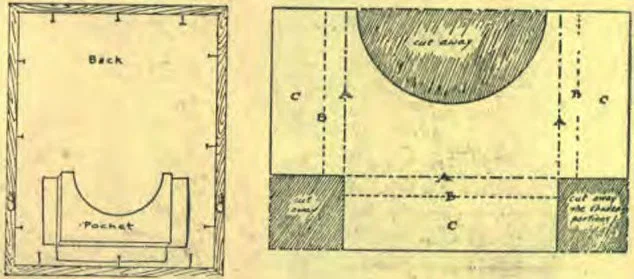
Next secure a small oblong picture frame; the size should be 5 x 6½ inches; it may be a little larger. You may make the frame from molding which you can buy at any picture store, or you may buy it already made for a few cents. Remove the back, and cover the cardboard that is next to the glass with whatever material you like best. Mine is a lovely blue, narrow-striped, moiré wall paper. If you like silk or some other fabric, you may use that. Near the bottom of this cardboard, cut a space 2½ x 3 inches; this should be done before the covering is pasted in place, so that you can bring the edges of the covering through the opening and paste on the back, to give a neat finish. For the upper part of the card, select your favorite picture and paste in place. You can buy for a cent a reproduction of the finest paintings, or you may wish to use a photograph, a part of a postal, a snapshot, or even a magazine print. Over the opening on the back of the card paste a small paper pocket. (See Fig. 1.) This is to contain the month cards, and back of these go the month names. The month cards, being shorter, allow the month name to show above them. Fasten the card in place in the frame by small brads; the month and month-name cards, of course, are left loose in the pocket, to permit ready changing.
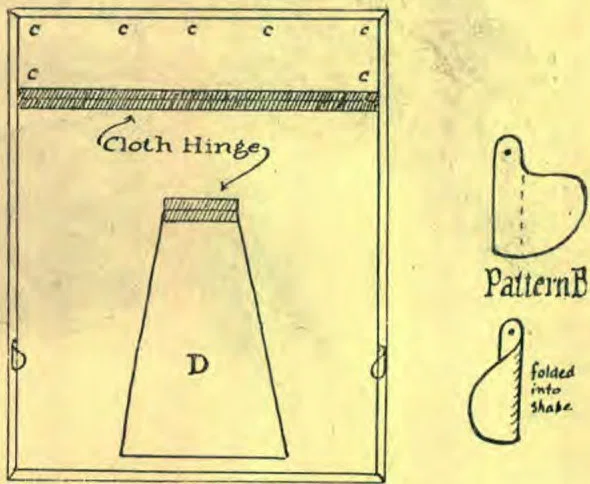
Use two pieces of heavy cardboard for the back which joined together will exactly cover the back of the frame. Hinge it at the top, as in Fig. 2, by pasting a strip of cloth over the seam, and cover both pieces neatly with paper or thin cloth. Fasten this with small brads to the frame at the top, c, c; and make two little holders out of a bit of tin cut from a biscuit box by pattern B; these are to be fastened to the frame at the back near the bottom, by a single small brad or tack, after you have bent the holders over at the dotted line. (See Fig. 2.) They will swing over the edge of the hinged cardboard back, and hold it in place after the date cards are put in. A support made of cardboard, like D, may be fastened to the back to keep the calendar upright on the desk. — J. Gertrude Hutton, in Everyland.
DRAWING FOR A PERPETUAL CALENDAR
Something to Say “Thank You” For
By Kay Cleaver Strahan
MOTHER called him “Pal,” because Charles Orcutt Wilsen, Jr., seemed like too big a name for such a very little fellow. For that matter, Mrs. Charles Orcutt Wilsen, Sr., seemed like too big a name for such a very little woman as mother was, though that was not the reason the people who lived up over her head in the big brick apartment house called her “Wilsen.”
It was a part of the job to be called “Wilsen,” and she was called it very often, because when anything at all went wrong upstairs, from a leak in a faucet to the failure of an elevator, the people went to their house telephones and told Wilsen about it. She had to be polite—always—and pleasant—always—but not too cheerful; she had to weather storms of abuse about mistakes that were none of her making, apologizing for the janitor, justifying the manager, because she was only the complaint woman. For being only the complaint woman she was given, rent free, two cubby-holish rooms partitioned off from the dark, airless, trunk-filled basement, and for salary she received not quite barely enough. All of which, written so, sounds dreary. But it wasn’t. Because Mrs. Wilsen was not like that. Every day she told herself, very often she told Pal, that she was a fortunate woman.
“WHAT DID YOU WANT THE FRESH AIR FOR, DEAR?”
You see, two years before, when her husband died, she had sat in one of the smallest rooms upstairs and looked with large frightened blue eyes into a future which it had seemed to her she could not face: a future without Pal. The long anxiety had stolen away too soon the part of her called youth; her friends lived far off, she had no money, she had nothing—nothing, that is, but Pal.
When the manager found that she could not pay the rent due him for the past month, he offered her the job, and the cubby-holish rooms, and the salary which was not quite barely enough. He had paid others twice the amount for the same work, but he knew that he did not have to pay Mrs. Wilsen, widow, so much. Other incumbents had held their positions for varying lengths of time, the shortest length being half an hour. And each of them had handed the job back to the manager with varying remarks.
At the time this story begins Mrs. Wilsen had owned the job, or, rather, it had owned her, for two years, and she had never thought of returning it to the manager. Then the manager proved himself an Indian giver: he threatened to take away the job he had given her. It was a certain day in November when the water had been turned off for an hour while the plumber was repairing a leak. She had answered thirty calls about it, during the one hour, and was standing, waiting to answer another, when the manager stumbled into her dark hall.
“Wilsen,” he said, “the tenants are complaining about the service you give them. They say your answers over the phone are inaudible, and that half the time instead of speaking up to them you stand and cough into the telephone.”
Mrs. Wilsen was sorry. She did have a slight cold, but it would soon be better.
“Well, you’ll have to do better,” he said, “or I’ll have to make a change.” Then, perhaps because she was so little and thin and white, “I’d be sorry to, but it is my business to keep the tenants satisfied. I have to answer to the owner, you know.”11
Mrs. Wilsen knew, and then, timidly, she pointed to the telephone, high up on the wall, so high up, indeed, that by standing on her very tiptoes she could not quite reach its black rubber mouthpiece. “If we—if you could have that lowered a bit?” she suggested. “So that I could sit down to speak into it?”
“You are not,” said the manager, “expected nor intended to carry on long conversations. A brief, courteous reply—that is all, and surely not worth sitting down for.”
“I know,” she answered again, “but often I do have to talk to them for a long time. I can’t hang up the receiver while they are talking to me. Besides, I answer it so many times a day and”—it was her first complaint—“I do get—tired.”
“Well,” said the manager cheerfully, “I’m afraid you’ll have to make the best of it.”
The trouble was that she had been making the best of it for too long a time. One can’t make the best of very bad things forever. But Wilsen kept on trying to. She tried to speak more loudly and clearly into the telephone, and she tried to stop coughing as she answered it. But the cough persisted and finally forced her to understand its meaning. She was frightened. Pal’s daddy’s cough had been much like that in the beginning. Pal was so little a person to be left quite alone in the big world.
She knew that it was useless to send for a doctor, because she knew what the doctor’s prescription would be. That night she did the first seemingly selfish thing she had ever done. She moved Pal’s little bed away from the window, the window that looked out on the sidewalk, and put her own couch bed in its place. And, as she lay there, with wide-awake eyes, she tried to formulate some plans for Pal. But she could not. She could only listen to the tide of footfalls above her head: first a steady surge of them, diminishing as early nighttime changed into late nighttime, to occasional stealthy or hurried steps; ceasing for perhaps an hour of blessed quiet, and then, as morning came, rising again.
The bell of her alarm clock shrilled out its summons to another day. She was tired, more tired than she had been the evening before. She had a confused idea that she had worked hard all night long, listening. But, because there was nothing else to do, she crawled out of bed and began again to make the best of things. Perhaps, after all, she lied to herself, it was simply some bronchial trouble.
For three long working days, and for three long listening nights after that, she kept on making the best of it. The fourth day happened to be Thanksgiving. It would not be true to say that Mrs. Wilsen was thankful, because in the morning when her alarm clock rang she found that her body would not obey her; she found that, for a few hours at least, she would have to stay quietly in bed. Oh, how tired she was! How comfortable the bed did feel!
She had Pal answer the first complaint. He dragged a chair into the hall, as she directed, and stood on his tiptoes, and told the cross voice from upstairs that mother was just a little ill that morning, and asked it to tell him the trouble so that he might tell mother.
“The newspaper hasn’t been brought up,” Pal called to her.
“Tell them we will send it up immediately,” she instructed, and he answered into the telephone: “We will send it up im—im—”
“At once, dear,” she prompted.
“At once, dear,” he told the voice, and climbed down from the chair.
“I’m afraid,” he reported to mother, “they were cross about it.”
“Go and tell the janitor, pet,” she said, “to distribute the papers right away.”
When Pal came back from telling the janitor, he found the manager in mother’s room, talking to her, and her eyes were shiny wet.
“But on a holiday,” the manager was saying, “when all the men are at home! Naturally they object to having a child answer their calls. You’ll have to make an effort for today, at least.”
“I have made an effort,” mother answered.
“Well,” said the manager, “I am sure I don’t know what we are going to do. The janitor will have his hands full, and my wife and I have an engagement for the day.”
“Perhaps,” began mother, “a little later I may—” Then, noticing Pal standing bashfully just inside the door: “Run up on the sidewalk and play for a while, little man. Right on, now, as mother says.”
Pal knew that he must mind mother. But he hated dreadfully to leave her alone with a man who was making her cry. He hesitated an instant, and then he advanced and stood before the manager. “I’ve got to go,” he said threateningly, “but you mustn’t bother my mother. She’s ill. You mustn’t make her cry, ’n—’n—you’d better get right out of here now.” Sometimes, in moments of excitement, he lapsed into baby talk.
“Pal!” gasped mother. “Oh, shamey! So rude to Mr. Kliner! Run right upstairs now, as I told you.”
Pal went. He was frightened because of the rudeness. But the manager laughed. “A nice little chap,” he said. And then, quite unexpectedly, he added: “I’ll tell you what; I’ll phone for my doctor. He can likely give you something that’ll set you up.”
“Only—I—” stammered Mrs. Wilsen.
“Never mind about the bill,” interrupted Mr. Kliner, to his own surprise, as he went away.
In a few minutes Pal came back with a question in each of his blue eyes.
“What is it, Pal?” asked mother.
“Up there, a man,” Pal explained. “He said to me, ‘I hope your heart is overflowing with gratitude today, my child.’ What does that mean, mother?”
“Such talk to a baby!” scoffed mother inwardly, and then: “Today is Thanksgiving Day, dear. That means a day which people pick out from other days to say thank you to God for giving them nice things. The gentleman meant that he hoped you were saying thank you for all the nice things God has given you.”
“For what should I say thank you to God for giving me?” Pal questioned.
“Mother could tell you ever so many things, but it would be better if you could find them for your own self. We’ll play it. It’s a game. You go upstairs now and take a nice walk around the block. Don’t cross the street, keep right on the sidewalk, all the way around, and walk slowly. And then you come back and see whether you can’t tell mother something you have found that you can say thank you to God for.”
On his walk, Pal met a most interesting little girl, with red hair and a candy turkey; so he stopped for a while to play. When he finally came home again, he saw a stranger man sitting by mother’s bed, talking to her. But when Pal heard his voice, he could tell12that he was not bothering mother. It was a kind voice, sorry-sounding, and Pal stood quietly in the doorway so as not to interrupt.
“Little woman,” said the stranger man, “I always tell my patients the truth. There is not much question but that you have tuberculosis. But we have caught it early, and there is no reason on earth why you can’t be cured, absolutely cured. This climate is one of the best, so you can stay right here. But you must, of course, leave these rooms at once. There is not enough fresh air in here for a well person. Fresh air, plenty of it, is the first requirement.”
“But, Doctor,” began mother, “I can’t leave here—”
“Tut-tut-tut,” interrupted the doctor, “there is no such word as can’t. Of course you can. Plenty of fresh air—”
Right then mother saw Pal standing in the doorway. “Sh-h-h!” she warned the doctor. “Come here, dear,” she called to Pal. “This is my little son, Doctor. Pet, this is Dr. Ranamacher.”
Pal shook hands with the doctor, and in answer to his, “What is your name, son?” replied, “Charles Orcutt Wilsen, Jr. Not five yet, but I can read words and print letters.”
“Splendid,” said the doctor.
“Little braggart,” smiled mother. “You had best go now and walk around the block, say two times more, and see how many things you can find—what mother told you to find, remember?”
“I didn’t find anything this other time,” objected Pal, “but only a candy turkey, and it wasn’t mine.”
“Deary me!” deplored mother. “All the extra reason then why you should go on another hunt. Run along, pet,” she added, in the voice which always meant, “Mind mother.” Slowly Pal climbed the steps that led out of the dark basement up to the sunshiny sidewalk. He had heard that big tuberculosis word before, and his baby mind knew far more of its meaning than it should have known. It was an illness, a bad illness, that had taken daddy away. It could not take mother away, Pal felt sure of that, because little boys’ mothers just had to be, they couldn’t be taken away. But, unless they could get fresh air, mother would stay ill, and illnesses hurt people.
He came to the door of a garage and paused for a moment to peer in at the shining cars, standing there in lines. The object of his walk occurred to him; he was to find something to say thank you to God for. If he had one of those automobiles, now, to play with, that would be a big something. But he didn’t have it, and mother had told him never to stand in that doorway, so he walked on and stopped at the window, hoping he could see the cars from there. He shaded his eyes with his hands and pressed his pug nose tight against the glass. Then he saw IT. The sign, the almost unbelievable sign, staring at him in big black letters—
FREE AIR
Sitting just inside the door of the garage was a man wearing overalls, nice and dirty and comfortable-looking. Several times he had smiled a jolly, dirty-faced smile at Pal; so the boy was not at all afraid of him.
“Please,” he said, going over in front of the overalls man, “please, is your free air fresh?”
“Guaranteed absolutely fresh,” answered the man with a wide smile.
“Then,” said Pal, “if you please, will you give me some of it?”
“Well—now—about how much did you want?” inquired the man speculatively.
“As much,” Pal answered, “as you can pos-si-bly spare.”
“But you ain’t got nothing to carry it in,” quibbled the man.
“I—I’ll get something,” Pal assured him earnestly, eagerly. “So please wait and please don’t give it all away. I’ll come right back,” and he was off as fast as he could run.
The doctor was still talking to mother when Pal reached home; so he did not stop to explain. He paused just long enough to poke his head in at the door and call jubilantly, “I’ve found it, mother, something great big to say thank you for!”
In another part of the basement was a row of clean new garbage cans, kept there to replace the old cans when they had worn out. Pal selected one of these. It was exactly as high as his chin, and the space between the handles, on the sides of it, was nearly as far around as his arms could reach. But, some way, he managed to tug it up the steps, and then he pushed it and pulled it to the door of the garage.
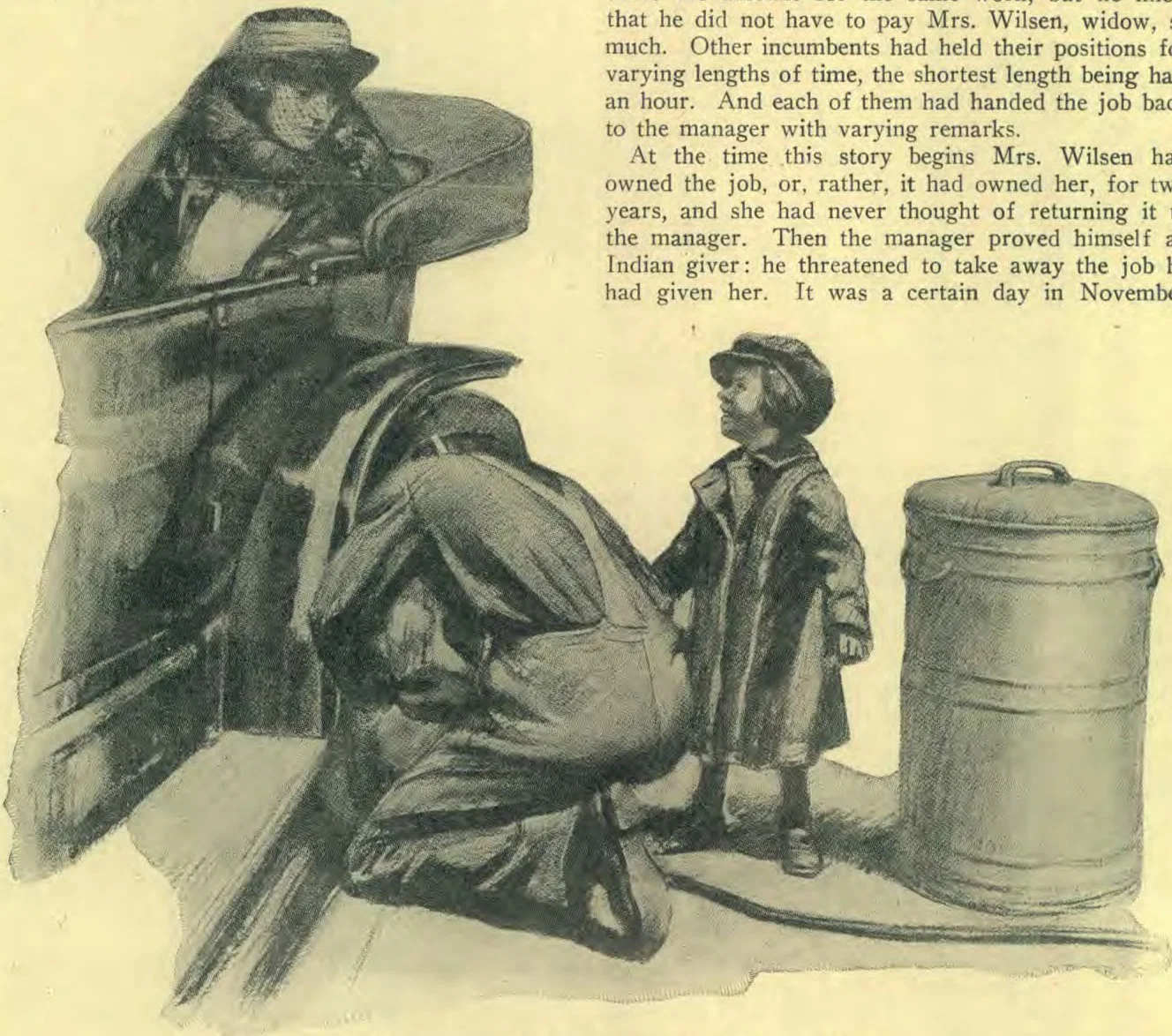
A big automobile was standing in front of the garage. In fact, it looked as if it were tied there by a long tube fastened to one of its wheels and going down into the sidewalk. The overalls man was talking to some people in the car, but when Pal came up pulling his can, the overalls man said, “Oh, ho, where is that big can going with that little boy?”
Pal smiled. He thought the man meant a joke and knew it was polite to smile at jokes.
“This little boy,” the man continued, with a wink at the people in the car, “has brought this can to get some free air. He was particular, though,” with another wink, “to make sure it was fresh before he decided to take it.”
“But,” explained Pal, feeling very uncomfortable, “it just had to be fresh.”
The lady in the car leaned out and smiled at Pal. He thought she was a very pretty lady, even though her hair was white.
“What,” she questioned interestedly, “did you want the fresh air for, dear?”
“For mother,” Pal answered.
“Oh,” said the lady, “has mother a car?”
“No,” said Pal, “she has tuberculosis.”
It seemed to Pal that the gentleman in the car said a naughty word, but he wasn’t sure of that. Nobody else said anything. The pretty lady was busy with her muff. The overalls man stooped down to look at the tubing.
Pal had an uncomfortable feeling that he had said something all wrong, so he tried to explain. “That’s why she has to have fresh air,” he said, “’count of that. But only we haven’t any, not down in our rooms. Reason of they are in a basement.”
Again there was the longest, deadest sort of a silence. But the pretty lady was looking at the gentleman in the car. That was all she did, just look, but after a time the gentleman answered as if she had spoken to him: “Of course, my dear! Of course!”
Then the lady turned and leaned out of the car again. Her eyes were shining as brightly as mother’s eyes could shine, sometimes. She smiled at Pal, but she spoke to the overalls man, who was still busy examining the tubing. “Fill the little fellow’s can for him,” she said, “fill it full of your best fresh air and then put it up here in the car, please. Because we are going with him to take it to his mother. Because,13and something about her voice reminded Pal of mother’s voice at nighttime, right after prayer time, “we are afraid that, possibly, this can may not hold quite enough, and, in that case, we are going to tell her that we have ever so much fresh air to spare, up at our home in the mountains, and we are going to persuade her to come up there and use some of it.”—Kay Cleaver Strahan, in American Magazine.
Missionary Volunteer Society Programs for Week Ending December 30
The programs for the Missionary Volunteer Societies, Senior and Junior, for this date, with notes, illustrations, and other helpful material, will be found in the Church Officers’ Gazette for December.
Is It Worth Continuing?
By Meade MacGuire
(Texts for December 24 to 31)
THIS brings us to the last week of 1916. Are you weary and inclined to relax and drift with the current? Are you content to remain about as you are? Or are you steadily pressing onward and upward?
Have you ever been in an athletic field or park where tens of thousands of people, packed in a great amphitheater, witnessed some thrilling contest? It may have been some popular game or a contest of mechanical skill, or a race. Without the onlooking thousands what interest would there be in the race?
Now Paul has given us a graphic picture of the Christian race. After recording in the eleventh chapter of Hebrews the triumph of the mighty heroes of faith in past generations, he says: “And, therefore, we having with us such an encompassing cloud of witnesses, throwing off all weight, and seductive sin, let us run persistently through our prescribed course; looking forward to Jesus, the leader and trainer of our faith, who, striving for the reward prepared for him, endured the cross, despising its shame, and sits on the right of the throne of God.”
These heroes of the past are represented as a mighty host surrounding the race course, silently witnessing to the contestants that through the grace of God every one may press on and win the race. An even more intense picture is drawn in Phil. 3:7-16:—
“But what might have been a gain to me, that I considered a loss for Christ. Nay, further; I also consider them all to be a loss, compared to the possession of the knowledge of Christ Jesus my Lord: by which I lost everything, and consider it to be refuse if I can gain Christ, and may be found in him, not possessing my ritualistic righteousness, but that through the faith of Christ, the righteousness from God by the faith; so as to know him, and the power of his resurrection, and the association with his sufferings, being assimilated to his death—so that in any way I may attain to the resurrection that is from the dead. Not that I have now attained it, or am now perfected: but I ran so that I might carry it off; and I was also laid hold of by Christ. Brothers, I do not consider myself to have won it; but one thing, forgetting the past, and straining to those in front, I rush along the track for the prize of the supreme call of God in Christ Jesus. As many of us therefore who are perfect, let us have this before us; and if you put anything else before you, may God reveal this to you. Beyond what we have attained to—let us go straight to that.”—Fenton’s “New Testament in Modern English.” How tame and careless our course seems in the light of this stirring language.
While many have an ambition to accomplish something for the Lord, and have visions of really great achievement in his work, it is hard for them to realize that the road to true greatness is such a humble one; that great deeds are the outgrowths of secret connection with Christ. How easily we deceive ourselves when looking at some great character by ascribing his greatness to his own poor human efforts. Yet a glimpse at the inner life of these great men and women never fails to reveal the secret of their success. It is said of the late W. E. Gladstone, the greatest of English statesmen, that in his devotion to religion he resembled, more than any other man in public life, some medieval saint. As regularly as the sun rose, in fair weather or foul, it was his custom to make his early morning visit to the little stone chapel a mile distant from his home. “It was a spectacle for men and angels to see the greatest living man of earth spending the best hour of the morning in prayer and meditation before the throne of God.” If that man, with such great burdens and responsibilities, could afford to observe the Morning Watch so faithfully, do you not think it will be wise for you to take the habit over into 1917? The glorious reward about which we are studying this week will be given to those who “by patient continuance in well-doing seek for glory and honor and immortality.”
Paul, looking back at the close of his life, said, “I have finished the course.” He ran faithfully to the end. There never was a time when temptations were so numerous, so fascinating, so overwhelming, as now. Therefore, there never was a time when it was so perilous to neglect the Christian armor and relax our vigilance. We are nearing the end of the race; the prize is almost in sight; the mansions are waiting; the reward is eternal. Let us make 1917 the most spiritual and so the most successful year of our lives.
Meditations.—The most precious and the most profitable hours of my life have been those I have spent in closest communion with my Saviour. Shall I not plan definitely for the coming year to gain a more intimate acquaintance with Jesus, even though I may have to neglect other things?
Special Prayer.—Our prayer this week is for the United States and Canada. One hardly knows which needs it more—Canada with its sorrow and distress on account of desolate homes, absent fathers, sons, and brothers, many of whom will not return; or the United States rolling in wealth and prosperity and forgetting God, thinking only of pleasure and gain and worldly honor. Let us pray that the mighty convicting Spirit may search out the honest in heart in both countries and bring them to Christ.