“We are ready for a parable, auntie,” said Edith. “Yes, auntie, a parable,” echoed every voice, as the children gathered around Aunt Ruth’s chair. When the little tongues were all quiet, Aunt Ruth began:—
“I am thinking of a giant who lives in a cave with ivory gates and folding doors. He is a great worker; for the cave is a grist-mill, and the ivory gates are grinders as well. The giant’s work is to stir and mix the grist, while it is being ground, with a solvent fluid obtained from six springs in the mill. A great variety of grist is brought into this mill, to be stirred and mixed and ground together. As each grist is finished, the giant pushes it back to a chute at the back of the mill, and sends it down to a workshop below, where it is churned and dissolved. If the giant is pleased with the flavor of the grist sent in, he works away with hearty good will; but if anything comes in that he does not like, he turns it promptly outdoors.”
“This giant is a troublesome servant to his master; for whenever he is idle, he is sure to be talking about everything, and often gets his master into serious trouble by his foolish wagging. But his master is entirely responsible for this; for the giant is one of several servants by which the master expresses his thoughts, and he only obeys his master’s will. Sometimes when the master gets angry, the giant lashes himself into a perfect fury in his den; but when, by the grace of God, a new spirit of love and peace has changed the heart and soul of the master, the giant is gentle and obedient.”
“Get your Bibles, and see if I have exaggerated the spiritual reality. Walter, turn to James, third chapter, and read the sixth verse.”
“‘And the tongue is a fire, a world of iniquity: so is the tongue among our members, that it defileth the whole body, and setteth on fire the course of nature; and it is set on fire of hell.’”
“Edith, read the eighth verse.”
“‘But the tongue can no man tame; it is an unruly evil, full of deadly poison.’ O Aunt Ruth! how terrible!” cried Edith.
“Yes,” said Aunt Ruth, “the untamed tongue is a terrible thing; but if we pray David’s prayer, ‘Create in me a clean heart, O God; and renew a right spirit within me,’ the tongue will utter only words of love, joy, and peace. David made another beautiful prayer, too. You will find it in Ps. 141:3.”
RUTH GARDENER.
THE GOSPEL OF THE SPRING.
The Equinox.
WHAT does this word “equinox” mean? perhaps you ask. You may have heard it talked about lately, as we have just passed what is called the “vernal,” or spring, “equinox.”
It is made up of two Latin words meaning “equal nights.” About the 21st of March the days and nights all over the world are just equal, each about twelve hours long, and this is called the time of “equal nights,” or the “equinox.”
But after this the days and nights get more and more unequal. The part of the earth that we live on, the north, passes more and more into the sunlight, and the days get longer. The south passes away from the sun, and the days get shorter and shorter; until, when it is midsummer with us, the longest day, it is midwinter in the south, with the shortest day.
Then we pass again to the time of “equal nights.” About the 23d of September is the “autumnal equinox,” when the days and nights are of the same length all over the world again. But after this the south passes into the sunlight, and we pass away from it. Midsummer in the south, their longest day, is our midwinter, the time of short days and long nights.
Now let us think for a little while what it is that makes these changes,—that governs the length of the day all over the world, and makes the four seasons,—spring, summer, autumn, and winter.
You will remember that when God said, “Let there be lights in the firmament,” he said also, “Let them be for signs, and for seasons, and for days, and years.” And you know that the year is the exact time which it takes the earth to make its journey round the sun.
But this alone does not make the seasons; for if the earth were to travel round the sun in a perfectly upright position, there would be no change whatever. The days and nights would be always and everywhere just the same length, and some parts of the earth would have nothing but winter, while in other parts there would be continual summer.
The temperature in the part of the earth that we live on would always be what it is about the time of “equal nights,” the end of March and of September. There would never be heat enough to bring any of the fruits of the earth to perfection; so much of the plant and animal life of the world would be impossible.
To what, then, does the earth owe its changing seasons, which bring in their turn “cold and heat, summer and winter, seed-time and harvest”?—It is to what is called “the inclination of the earth’s axis,” about which you have probably learned something in your geography lessons.
Instead of being perfectly upright, the earth inclines, or leans, always toward the north. The north pole, the uppermost part of the earth, points always to the north star. Because of this, the north pole is sometimes turned toward the sun, and sometimes away from it; and this has an effect upon the whole earth, and brings the change of seasons all over the globe.
Stick a knitting-needle through a ball of wool, or a pencil through a ball of string, and draw this round in a circle, with the upper point of the needle turned all the time toward one particular object; and you will see that every part of the ball will be a part of the time turned toward the center of the circle, and part of the time away from it.
Do you see, then, to what we owe the life and fruitfulness of the earth?—It is to this secret drawing influence, this attraction from that part of the heavens that we call “the north,” that turns the earth always toward it. It is this same drawing power from the north that makes the needle of the compass point always in that direction.
God’s word teaches us that “the north,” “the uttermost north,” is the dwelling-place of God, “the secret place of the Most High,” from which he governs the whole universe. So it is from God himself that this sweet influence comes, attracting and drawing the earth, making it incline to himself. “He hangeth the earth upon nothing,” and by his Spirit he guides and holds it in just the position in which it will get the greatest benefit from the life-giving rays of the sun. How wonderful is his wisdom!
Not our earth only, but all the great worlds that God has made, he is upholding and drawing to himself, and guiding in just the way that will bring them the greatest good.
This same sweet influence which attracts the earth toward God, is drawing every one, even every little child, who lives upon it, to him. As you feel this sweet influence moving upon your heart, drawing you to turn to God, to love him, and to give yourself to him, do not resist his gentle pleading and grieve his loving Spirit. Let him turn you fully toward himself, and guide you in all your ways, to bring the greatest blessing and happiness to you, and to make you a blessing to all around you.—Present Truth.
Sweet Thoughts Versus Candy: A Verse for Children
“VERY soon the candy slips.
In between your open lips;
Let sweet thoughts into your mind,
Just such ready entrance find.”
BIRDS' NESTS
By May Riley Smith
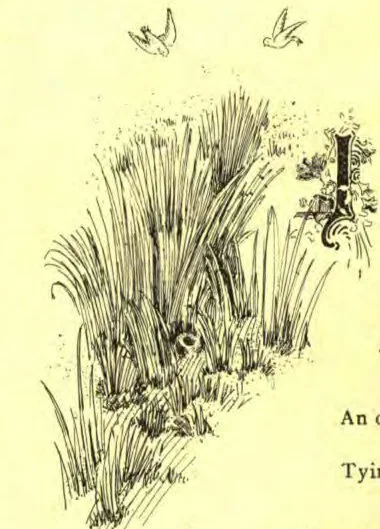
I KNOW where meadow grasses rank and high
A cradle cover,
Because two bobolinks with tell-tale cry
Above them hover.
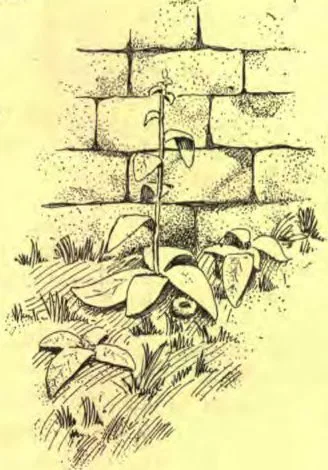
Some mullein leaves beside my garden wall
Grow unmolested;
And under their pale velvet parasol
A sparrow nested.
An oriole toiled on from day to day—
The cunning weaver!—
Tying her hammock to that leafy spray
Above the river.
No wingless thief can climb that tree's frail stair,
Nor guest unbidden
Can reach the swinging, airy chamber where
Her eggs are hidden.
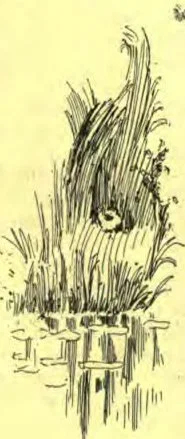
A marsh-wren's cunning hermitage I see
As my boat passes,
Moored to the green stems of the fleur-de-lis
By water-grasses.
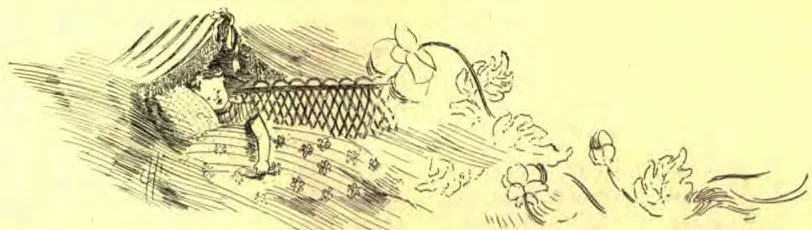
And stay! I know another pretty nest
Of woven willow,
With dainty lace and bits of ribbon drest,
And a wee pillow.
And just one bird, with moist and downy head,
Herein reposes.
He has no wings—his shoulders grow, instead,
Dimples and roses.
You have a nest and little wingless bird
At your house, may be!
Of course you know without another word
I mean—a baby!
— May Riley Smith, in Wide Awake.
NOTES AND COMMENTS
The Treasure of Salt Lake.— One sixth of the contents of Salt Lake is, according to analysis, salt and sulphate of soda. Some one has figured out that there is in the lake 250,905,600,000 cubic feet of these substances,—over eight billion tons of salt and nearly nine million tons of sulphate of soda. Hundreds of thousands of tons of salt, he says, are made by natural evaporation along the shores of the lake; “and at one place near Salt Lake City a windy night never fails to pile up many tons of soda, eliminated by the movement of the waves.”
A Novel Factory.— A spider-web factory is said to be in successful operation near Paris, France, where large numbers of spiders are reared for their webs. “They are arranged in groups of twelve above a reel, and as the webs are spun, they are wound upon the reel. From thirty to forty yards are thus wound up before the spiders are released. The webs are then taken off, washed, and dried, after which they are twisted into threads of eight webs each.” These threads are then woven into cords, which are both lighter and stronger than silk.
Submarine Cables.— There are fifteen hundred submarine cables in the world, over which six million messages are sent every year. The total length of these lines is about seventeen hundred miles. Eighteen lines cross the Atlantic Ocean; but the Pacific has never been crossed, for the reason that no one nation has ever owned or controlled a chain of landing-places across it, and lengths of cable over three thousand miles long are impracticable. The United States is now in a condition to lay such a cable, as it has landing-places at Hawaii, Wake Island, Guam, and the Philippines.
Our Representatives at The Hague.— The men chosen to represent the United States at the Peace Conference to be held at The Hague, the capital of the Netherlands, about May 18, are Andrew D. White, ambassador to Berlin; Stanford Newell, United States minister to Holland; Seth Low, president of Columbia University; Captain Wm. Crozier, officer of the ordnance department of the army; Captain A. T. Mahan, retired officer of the navy; and Wm. Holls, a well-known lawyer of New York. The conference will probably be presided over by M. de Staal, head of the Russian delegation and present Russian ambassador to London.
The Peace Conference.— This conference is held at the invitation of the czar, the autocratic ruler of an empire with an area of over eight million six hundred thousand square miles, and a population of nearly three hundred million. Its avowed object is to bring about a world peace; and with this end in view, it will consider: (1) How to check the increase of the world’s armies and navies; (2) “More humane methods in waging war;” and (3) “The avoidance of war through established and uniform processes of mediation and arbitration.” While all the great nations sound the cry of “Peace! peace!” its echoes reaching to the remotest corners of the earth, each is looking well to it that its army and navy increase in proportion to those of its neighbors. The United States alone has forty-eight war-ships building. All these things point unmistakably to the fact that we are nearing the time when “sudden destruction” will put an end to all the schemes of men to bring about, by their own word, what can be accomplished only by the Spirit of God dwelling in the hearts of men.
TIME: April 7, A. D. 31. PLACE: Judgment hall. PERSONS: Roman governor, representatives of the Jewish council, the multitude.
QUESTIONS.
From what place and to what place was Jesus now led? V. 28. Explain the religious scruples of the Jews. V. 28. What did Pilate now demand of the accusers? V. 30. What was their reply? V. 30. Did this daunt Pilate? What did he offer to let them do? V. 31. Had Jesus foreknown how all would go? V. 32. What was next done? V. 33. What unseen trial was now in progress? How did this result? What question did Pilate ask? V. 33. What must Jesus be told before he could reply? V. 34. Why? What did Pilate next say? V. 35. What did Jesus say of his kingdom? V. 36. Explain this. If he had been a political king, what would have resulted? V. 36. Why did Pilate repeat his question? V. 37. What did Jesus say further? V. 37. Explain this. What did Pilate think of Jesus’ kingdom? V. 38. What did he declare? V. 38. What did he propose? V. 39. With what success? V. 40. What was this cowardly man at length forced to do?
NOTES.
1. The Jewish council had determined the death of Jesus; but as they had no power to carry out their desire, they brought him to the Roman governor, who before this had not scrupled to put innocent persons to death. They hoped he would take their word, and grant their request without investigation.
2. “Christ’s appearance made a favorable impression upon Pilate. . . . He had heard of Jesus and his works. . . . He resolved to demand of the Jews their charge against the prisoner.”
3. The murderous priests and rulers would not enter the hall of Pilate, as contact with the Gentiles would bring them ceremonial defilement, and unfit them for participation in the Passover feast. Scrupulous of outside forms, their hearts were the courts of corruption.
4. “Pilate saw through their purpose. He did not believe that the prisoner had plotted against the government. . . . Pilate was convinced that a deep plot had been laid to destroy an innocent man who stood in the way of the Jewish dignitaries.”
5. Christ is “the Light that lighteth every man.” Pilate’s darkened soul was illuminated. The answers given by Jesus flashed conviction upon him, showed him Christ’s godlike glory, and the character of the kingdom he had come to set up in the hearts of men. The hardened Roman governor had no fault to find with the King or the kingdom, either from the view-point of religion or politics. But to release Christ would involve his personal interests. Jesus was from Galilee, over which Herod was tetrarch. He sent him to Herod, to shift responsibility from himself.
6. The divine patience manifested by Jesus gave evidence of his heavenly origin and connection. But conviction of his true character was thrust aside by those who hated truth, who chose self instead of Jesus. Both Herod and Pilate showed the same weakness. While acknowledging the accused as blameless, they treated him as guilty to conciliate his enemies, and shifted one upon the other the responsibility of his condemnation.
7. “If at the first Pilate had stood firm, refusing to condemn a man whom he had found guiltless, he would have broken the fatal chain that was to bind him in remorse and guilt as long as he lived . . . Christ would have been put to death; but the guilt would not have rested upon Pilate.”
8. “One stain upon his human life, one failure of his humanity to endure the terrible test, and the Lamb of God would have been an imperfect offering, and the redemption of man a failure. . . . His abasement was the pledge of his exaltation. The blood-drops of agony that from his wounded temples flowed down his face and beard were the pledge of his anointing with the ‘oil of gladness’ as our great High Priest.”
9. “His blood be on us.” In less than fifty years their city was overthrown and destroyed. More than a million people perished in the siege. Thousands died by famine, thousands by disease, thousands by the sword; and their blood ran down the streets like water. . . . Thousands were crucified, suffering the same punishment they had inflicted on the Messiah.—Barnes.
10. Tiberius recalled Pilate, but died before Pilate could appear at his court; and then, neglected by everybody, scorned by those who knew him best, Pilate, who had no conscience,—now he had no Tiberius,—killed himself. . . . “Was there always the memory of one face, of one prisoner, of one execution? Did he remember the day he tried to wash off his guilt with water? tried to save his life, and lost?”—Johnson.
THE CENTURION'S SERVANT HEALED; THE WIDOW'S SON RAISED
THE SABBATH-SCHOOL LESSON.—NO. 9.
(May 29, 1899.)
THE CENTURION'S SERVANT HEALED; THE WIDOW'S SON RAISED.
TIME: A. D. 31. PLACES: Capernaum and Nain. PERSONS: Jesus, Jews, centurion, widow of Nain, son, mourners, John's disciples, multitude.
QUESTIONS.
Who met Christ as he came down from the mountain? Luke 7: 1-3. What request did they make of him? What had the centurion done that in the eyes of these elders entitled him to special consideration? Vs. 4, 5. Before reaching the centurion's house, whom did Christ and the company with him meet? Luke 7: 6. What word did they bring? Vs. 6-8. What did the Saviour say, on perceiving the man's faith? V. 9. How was it rewarded? V. 10. Where was Jesus going with a large company on the day following? V. 11. Whom did they meet? V. 12. Repeat the Saviour's comforting words to the mother. V. 13. What mighty act did he then perform? V. 14. How were the people moved at the sight? V. 16. How far did the rumor go of this wonderful work? Vs. 17, 18. What word did John send to Christ? What was the Saviour doing at the time when the message came? V. 21. What answer did he give the messengers? Vs. 22, 23. What noble tribute did Jesus pay the Baptist? Vs. 24-30. What rebuke did Christ administer to the people of his day? Vs. 31-35. What prayer did the Saviour offer? Matt. 11: 25, 26. What gracious invitation was then offered to all? Vs. 28-30.
NOTES.
1. How grateful to the Saviour was the manifestation of faith! From his own people, he had met prejudice and unbelief; but those who were regarded by the Jews as dogs and outcasts had responded to his word, and believed in his mission and divinity. Three notable instances of faith are recorded,—the centurion's, the Syrophenician woman's, and that of the Greeks, who came desiring to see Jesus when his own nation were ready to crucify him.
2. The centurion gave evidence of response to the divine Spirit in that he manifested a tender regard for his servant. “All that was spiritual within him responded to the Saviour's words. He felt unworthy to come into the presence of Jesus, and he appealed to the Jewish elders to make request for the healing of his servant.”
3. The Jewish elders who came to Christ in behalf of the centurion, pointed to his good work for the Jews as an evidence of his worthiness of favor. He showed a better appreciation of the Master's character, and a better understanding of his own, declaring himself unworthy. “We have nothing to recommend us to God; but the plea that we may urge now and ever is our utterly helpless condition, which makes his redeeming power a necessity. Renouncing all self-dependence, we may look to the cross of Calvary, and say,—
“In my hand no price I bring,
Simply to thy cross I cling.”
4. The city of Nain—“the fair, the beautiful”—was twenty miles from Capernaum, and opposite Shunem, where Elisha raised the Shunamite woman's son from the dead. Christ probably went on foot, followed by the people.
5. “Weep not.” Christ's heart was ever touched with pity for suffering humanity. At the grave of Lazarus he wept in sympathy for sorrow, before he called forth the dead. He comforted the widow with words of consolation before his deed of love restored her son to her arms. “Fear not,” he said before he quieted the storm. “Let not your hearts be troubled,” comes to our hearts to-day, just before he will bring all trouble to an end.
6. The people rejoiced, and glorified God, sure that he had visited his people. Perhaps they recalled the miracle of Elisha, as the funeral train returned to Nain in triumph. The rumor spread far and near, through Judea and round about.
7. While Christ was delivering captives, healing the sick, opening the eyes of the blind, raising the dead, healing the broken in heart, preaching to the poor, John, his forerunner, lay in Herod's prison, apparently forgotten, and perplexed. A misconception of Christ's mission made John wonder why he did not take David's throne, and deliver those who were bound. The report of his disciples as to Christ's work threw a new light upon the prophecies, and John was not “offended” in him.
8. There were thousands who did not, or could not, receive, as John did, the evidence of Christ's kingly character and power. They saw the works that John only heard of, and demanded that Christ take a throne of temporal power, or they would not believe. The woes he pronounced resulted from their unbelief in rejecting the Fountain of blessing. Jesus thanked God for the humble and trusting who would believe, and who saw that which was hidden from those who deemed themselves wise.
Insects and Remedies.
By Arthur F. Hughes
One of the results of the curse is the insect pests with which we have to contend; but, like the weeds and thistles, they can be destroyed. We should ever bear in mind that it is only through the blessing of the Lord that we hope for success, and we can come to him with a greater assurance after we have faithfully employed all the means he has placed within our reach to accomplish the desired end.
The striped cucumber-beetle is well known, and will not need much description. It makes its appearance just as the cucumbers begin to peep through the ground. If the only damage done by this insect was above the ground, we could control its ravages much more easily; but it lays its eggs on the roots, and in a few days, white grubs are hatched, which feed on the tender roots, often resulting in the destruction of the vine. If the vine is pulled up, we can see that the roots have been badly gnawed or eaten entirely off. This beetle works on squashes and melons, but its ravages can be checked if the rigorous methods given below are followed:—
Remedies.—Air-slaked lime, mixed with a little carbolic acid, wood ashes, or tobacco dust, will keep these beetles away, provided the plants are well dusted before the beetle has made its appearance, and the treatment is continued for three or four weeks, or until the last beetle has disappeared. If we have only a few vines, the best way to protect them is to make frames about eighteen by eighteen inches, and six inches deep. Cover these with mosquito-netting, and set them over the hills before the first beetle has made its appearance.
Cutworms, which are the caterpillars of our night-flying moths, are the worst enemies the gardener has to contend with. During the day they hide in the soil, coming out at night. Often a gardener has gone to bed at night, priding himself on his fine cabbage and tomato plants, only to see them all cut down in the morning.
Remedies.—Dig where the cutworm has been working, find and kill it, and thus prevent its eating more the following night. A better method is to encircle the plants with heavy wrapping-paper, pasteboard, or with tin cans that have been unsoldered.
Culture of the Watermelon.—After the vines have grown about one foot long, thin them out, leaving three or four of the best. Do not allow the soil to become baked or hard around the hills, but keep it mellow. After the vines have run about four or five feet, cut off the tips, to throw the strength of the vines into the lateral branches, upon which the melons are produced. If you wish to have extra large melons, cut off all but one or two when they are about three inches in diameter. This should not be done sooner, as you can not tell which are the best formed. Continue the cultivation until the melons begin to ripen. The same care will give excellent crops of cucumbers, squashes, and muskmelons.
How to water plants during the hot summer days is to many a perplexing question. If you have only a few hills, get tin cans, make a large hole in the bottom of each one, and set these cans in the hills. You can fill them with water with less injury to the vines than would result from sprinkling. The water will go directly to the roots, and will not be evaporated by the sun. The same method may be used with tomatoes and other special crops. I have tried this plan, and the returns were twice more than in sprinkling.
In the permanent acre-garden, it was recommended that one put a row of tomatoes along the north fence. Tomatoes will do well in almost any location, provided the soil is rich; but if you wish to have early tomatoes, plant them on the south side of a building, or any place where they will be protected from cold winds. If you have a garden with a tight board fence, throw the soil up against the fence to keep out the cool winds. The sun shining here and the reflection of its rays from the fence will make a regular hot-house, and you will have tomatoes ten days earlier than if the plants were set out in the open field.
A word of caution in regard to the use of salt: It has no special value as a fertilizer, and will kill the plants if too much is applied. It may be used to mix with nitrate of soda, but should be scattered sparingly, and even then not allowed to remain on the foliage of very young plants. Arthur F. Hughes.
NOTICE!
By Editor
WE can not furnish complete files of the YOUTH'S INSTRUCTOR from Jan. 1, 1899, as some of the numbers are missing.
OUR PREMIUM BIBLE.
By Editor
If your subscription is about to expire, you may secure the beautiful INSTRUCTOR Bible by sending us your renewal, with $2.25.
The Bible is also offered to any INSTRUCTOR subscriber who will send in six new yearly subscriptions, at seventy-five cents, or twelve new six-months’ subscriptions, at forty cents.
A GENEROUS GIFT.
“AN OLD SUBSCRIBER,” who does not sign her name, enclosing money for the INSTRUCTOR and Bible, writes as follows:—
“Not long ago I found a woman so poor that she could not buy a Bible suitable for her needs, and was unable to subscribe for our literature; therefore I send $2.50, that she may have the Self-pronouncing Teachers’ Reference Bible, and may enjoy the pleasure of reading the YOUTH’S INSTRUCTOR during the coming year. I am a subscriber, and know the value of our young people’s paper.”
Are there not others who will heed the injunction, “Go, and do thou likewise”?
ENCOURAGING WORDS.
From a recent communication from a lady residing in Syra, Greece, we make the following extracts:—
“I have found a subscriber here for one year, and forward the money to the publishing company. The subscriber is a Greek doctor, who reads the paper with a Greek school inspector. These two men have taken English lessons from me for the last two months. I recommended the INSTRUCTOR to them, and they are much pleased with it, especially the doctor, who greatly enjoyed the article on ‘The Show-windows of the Soul.’ I hope others may be interested to take the INSTRUCTOR.”
A gentleman sends us three subscriptions to the INSTRUCTOR, from Alexandria, Egypt, accompanied with kindly words of appreciation for the paper; while one of our missionaries in China forwards an order for three subscriptions, with the Bible to accompany each.
A friend in Arizona writes: “I received the Bible a week ago, and am well pleased with it.” Another writes that she wishes to canvass, and secure seven of the INSTRUCTOR Bibles.
To Reach BATTLE CREEK
FROM CHICAGO, BUFFALO, DETROIT, OR TOLEDO.
Purchase Tickets Reading over the MICHIGAN CENTRAL
“The Niagara Falls Route.”
A First-class Line for First-class Travel between Chicago and New York and Boston. Elegantly equipped through trains pass Battle Creek in each direction daily.
R. N. R. WHEELER,
Ticket Agent, Battle Creek.
O. W. RUGGLES,
Gen'l P. and T. Agt., Chicago, Ill.
Grand Trunk Railway System
Time Card in Effect February 5, 1899.
C. & G. T. DIVISION.
WEST-BOUND FROM BATTLE CREEK.
LEAVE.
No. 11, Mail and Express, to Chicago — 12.00 M.
No. 1, Chicago Express, to Chicago — 9.00 A. M.
No. 3, Lehigh Valley Express, to Chicago — 3.40 P. M.
No. 5, Pacific Express, to Chicago, with sleeper — 12.55 A. M.
No. 75, Mixed, to South Bend — 7.30 A. M.
Nos. 11 and 75, daily, except Sunday. Nos. 1, 3, and 5, daily.
EAST-BOUND FROM BATTLE CREEK.
No. 10, Mail and Express, to Pt. Huron, East, and Detroit — 3.45 P. M.
No. 4, Lehigh Express, to Pt. Huron and East — 8.27 P. M.
No. 6, Atlantic Express, to Pt. Huron, East, and Detroit — 2.05 A. M.
No. 8, Lehigh Exp. to Saginaw, Bay City, Pt. Huron, and East — 6.50 A. M.
No. 74, Mixed, to Durand (Stops at Nichols) — 7.35 A. M.
Nos. 10 and 74, daily, except Sunday. Nos. 4, 6, and 8, daily.
E. H. HUGHES,
A. G. P. & T. Agt. Chicago, Ill.
A. S. PARKER,
Ticket Agent, Battle Creek.
TAKE THE Canadian Pacific Railway
for . . . CHATHAM, OTTAWA, MONTREAL, LONDON, GALT, QUEBEC, WOODSTOCK, TORONTO, BOSTON, PORTLAND, and
All points in New England, the Maritime Provinces, Great Britain, and the Continent.
Illustrated literature, time-tables, and full particulars, upon application to—
J. FRANCIS LEE, GEN. AGENT,
Passenger Dept. 228 SOUTH CLARK ST., CHICAGO.
Branch Offices: 76 Ottawa St., Grand Rapids, Mich. Room D, Chamber of Commerce, Cincinnati, Ohio. 315 Chestnut St., St. Louis, Mo.