A FEW more words about correspondence study before the opening of the Correspondence School, Monday, October 4. So many expressions of appreciation and of encouragement regarding this new enterprise have come to our desk, that we are moved to more determined effort to make it a decided success. Our office correspondence is so heavy that we can not say through that means all that ought to be said before correspondence study is actually entered upon. A little heart-to-heart talk with our prospective students might not be out of place at this juncture.
Down deep in your soul you have cherished for years a longing to become something better than you are, to do something better than you are doing, and to do the thing you are doing, better than you are doing it. This is good; no nobler desire could burn within you. “Be not simply good; be good for something.” “Thousands pass through life as if they had no definite object for which to live, no standard to reach. Such will obtain a reward proportionate to their works.” If you have ever belonged to this class, you have left their ranks by determining to take up correspondence study, by forming a definite purpose and by entering upon a definite work to accomplish it.
There are a few well-defined principles which you should look squarely in the face before laying hold of the plow, in order that you may “plow in hope.” “No man, having put his hand to the plow, and looking back, is fit for the kingdom of God.” The wise man says, “The sluggard will not plow by reason of the cold [“winter,” margin].” He puts his hand to the plow doubtless with the best of intentions. The delightful days of autumn cheer his spirits. He revels in bright visions of a bountiful harvest. All the earth and the things therein seem to move parallel to his purpose. But the season advances, winter settles down, his face stings from the chill winds, his hands grow stiff on the plow handles, his feet clog with adhesive earth, his visions vanish, and he vanishes from the field with them. What is the sequel? “Therefore shall he beg in harvest, and have nothing.”
This is not a fanciful picture. It forecasts an experience awaiting him who “sitteth not down first, and counteth the cost.” This is principle number one: Count the cost. The longer life continues, the more clearly we see that the really desirable thing costs effort to obtain it. “There is no excellence without great labor.” This is why the Saviour so often urges us to “seek,” to “strive,” to “dig.” This is why Paul says, “I follow after,” “I press toward the mark.” This is why we are told in “Christ’s Object Lessons:” “Remember that you will never reach a higher standard than you yourself set. Then set your mark high.” This is principle number two: Set your mark high.19
The reason for this need of energetic action is that there are always lions in the street to success. No hunter ever goes on a chase without equipping himself beforehand with suitable trappings. It is well for us also to get a “good ready” before we enter the race. The correspondence student works alone. He is without the stimulus of associates who are pursuing the same study, and without the encouragement of daily personal contact with Christian teachers. There will come times when his interest will lag, when the way will seem hard. He will be strongly tempted to think that this correspondence study is not what it was represented to be. Some byway or “retreat” will look more attractive. He will be inclined to say, “Well, I haven’t the time anyway. I can’t study with so many interruptions. I think next year I’ll have more time and better conditions for study. Perhaps, too, I can go to college then. I’ll drop it for now.” And, like the sluggard plowman, he vanishes from the field of knowledge and power to beg along the highway of possibilities the rest of his days. But—
There Is a Remedy
for these human ills. Nature and revelation unite to provide it. When you feel a wane of interest creeping over you, work the harder. There is nothing like hard work to kill a lagging spirit. There is nothing like thoroughly acquainting one’s self with a good subject to develop a real interest in it. Know it, and you’ll like it; this is principle number three. But do not hold yourself to the task too long at one sitting. Hard work will hurt nobody as long as he enjoys it and keeps sweet-tempered about it; but the laws of nature say, Take a change—principle number four. Refresh yourself. Go briskly on an errand you want to do. Take a run in the open air. Do a little intensive physical work. Then go back to your task, and you will find its whole complexion has changed while you were gone.
If time seems scarce, stop studying for one day, take a note-book, and while you go about your other duties in the usual way, jot down the minutes, the quarter- and half-hours, you might have employed in your study if you had at hand a book or a lesson sheet, or something copied from them for the purpose. Make a note of the time also that you observe some one else about you let run to waste. Before retiring at night, foot up your columns, and note the results. With this revelation, try your lesson again the next day. But before beginning it, read pages 342-344 in “Christ’s Object Lessons.” Picture to yourself how many people you have observed sitting in a street-car or a train looking idly out of the window, gazing vacantly about the car, or that you have seen standing “doless” at the waiting station. Think how many people you have heard blame others for taking their precious time by being late at an appointment or by delaying dinner. Ask God to help you not to be as other men are in these respects, and then seize upon your task anew. Let this be principle number five: “Only let the moments be treasured”—be a minuteman.
On the general principles of self-denial and perseverance, note the expressions Paul uses in rehearsing his Christian experience: “If by any means I might attain.” “I count all things but loss for the excellency of the knowledge [I am seeking].” “I have suffered the loss of all things, and do count them but dung, that I may win.” “I can do all things through Christ which strengtheneth me.” Reflect that “opportunity is the command of God.” “Then note these striking words from ‘Christ’s Object Lessons:’”
“As the will of man co-operates with the will of God, it becomes omnipotent. Whatever is to be done at his command, may be accomplished in his strength. All his biddings are enablings.”
And these: “Remember that you will never reach a higher standard than you yourself set. Then set your mark high, and step by step, even though it be by painful effort, by self-denial and sacrifice, ascend the whole length of the ladder of progress. Let nothing hinder you. Fate has not woven its meshes about any human being so firmly that he need remain helpless and in uncertainty. Opposing circumstances should create a firm determination to overcome them. The breaking down of one barrier will give greater ability and courage to go forward. Press with determination in the right direction, and circumstances will be your helpers, not your hindrances.”
The spirit of these words suggests principle number six—Make circumstances your helpers; and principle number seven—Press toward the mark you yourself have set. Only one more principle need be mentioned now: Make your teacher your confidant. Tell him all your troubles. Ask him all the questions you need to for a clear understanding of the subject you are studying. The teacher in correspondence study esteems it his duty and his pleasure to help you in every time of need. Copy out of this article the eight principles that have been mentioned, write them neatly on a card, and keep them in sight while you study.
Special Mention
Correspondence School announcements and registration blanks have now been sent out to all parts of the country. It is our purpose to keep a supply in the hands of all Missionary Volunteer and educational secretaries of the union and local conferences. To save time, requests may be sent to them. All registration blanks, when filled out, should be sent direct to the Correspondence School. October 4 is now drawing very near. Will all who can register as charter members of the school, please send in their application blanks properly filled out, as soon as possible, in order that all the details of classification may be attended to before the opening day? The school will be continuously open for the admission of students, but the more who can begin at the opening, the better for all concerned. Remember that first correspondence lesson we had August 5 on promptness—the second P in your watchword for success.
W. E. HOWELL.
Kentucky
By C. F. McVAGH
One of the best camp-meetings I ever attended was that at Louisville, August 19-29. In connection with it was held the second annual session of the Kentucky Conference. The meeting was small, but considering the size of the conference, the attendance of Sabbath-keepers was good, about twenty of whom testified that this was their first Seventh-day Adventist camp-meeting. The new family tents, neatly pitched in a good part of the city, made a pleasing appearance; and from the first, the power and blessing of God were manifest in all the meetings. Revival and consecration services, in which nearly all present took part, were held on both Sabbaths of the meeting. The people of Kentucky are of good courage, and the work is onward.
Aside from the regular conference laborers, there were present, for a whole or part of the time, Elder J. W. Christian, Dr. W. A. George, Professor Van-Kirk, Brethren A. F. Harrison and R. Hook, Jr., and the writer. Elder A. O. Burrill was re-elected president, Mrs. Clara Russell secretary and treasurer, Miss Dollie Callender Sabbath-school secretary, and C. F. Dart field secretary. Elder E. G. Hayes is following up the work in Louisville. C. F. McVAGH.
Christian Education
By Frederick Griggs
Conducted by the Department of Education of the General Conference
FREDERICK GRIGGS - - - - Secretary
Sunday Laws in Vermont
THE press of the State is busy just now discussing the Sunday law and what amusements or work are proper for Sunday. The first trace of a Sunday law in all the history of the world, Scriptural or secular, is one made by the pagan emperor, Constantine, March 7, A. D. 321. Constantine was one of the most bloody and depraved men who ever occupied the imperial Roman throne, and was a sun-worshiper. Consequently his famous law speaks of the day as the “venerable day of the sun.” It was a rather loose affair, and permitted almost any kind of work and amusement, so long as one complied with the ceremonies prescribed by the church trust which he was then organizing. This law was copied into English law from the Romans, was brought to America by the colonists, and is the original of all modern Sunday laws. A study of this father of our present law would be edifying to modern reformers.—Green Mountain Press, Burlington, Vt., Aug. 24, 1909.
Field Notes
Field Notes
BROTHER JOHN T. JONES reports that two persons are ready for baptism at Plymouth, Pa.
Sixty-Five Desire Baptism
SIXTY-FIVE persons signified their desire for baptism at a revival service at Nevada, Iowa.
Thirty-Four Accept the Third Angel’s Message
THE work in West Philadelphia has resulted in thirty-four accepting the third angel’s message.
Sixteen Decide to Obey the Truth
FROM Elder I. M. Martin, of Asheville, N. C., comes the word that sixteen persons have decided to obey the truth.
Profitable Camp-Meeting at New Hope
ELDER W. M. CUBLEY reports a very profitable camp-meeting at New Hope, Tex. Eight have taken their stand for the right.
Seven Baptized at Funkstown
August 1 seven were baptized in the Antietam Creek at Funkstown, by Elder John F. Jones, the result of a tent-meeting conducted by Elder L. E. Sufficool at Hagerstown, Md. Others are also keeping the Sabbath.
Baptisms Follow Eau Claire Meetings
A TEN-DAYS' series of meetings was held at Eau Claire, Wis., after the dedication of the church there, at the close of which eleven candidates were baptized. A number of these were children that had been attending church-school.
Saving Property and Human Beings
BEN LINDSEY, the boys’ judge of Denver, Colo., tells, among other stories, how a gang of seven boys were accused of stealing five bicycles. Immediately, of course, the whole machinery of the law was in operation to save the bicycles.
The leader of the gang was caught, and because he refused to tell anything, the police gave him the third degree, beat him, and strapped him to a bed. The other boys were not found at once, but their records were looked up, and it was found that every one of them had been in jail.
Lindsey went in to see the boy, who was strapped to the bed. The first thing the boy said to him was: “You can’t make me snitch on the gang.”
“That’s right,” said Lindsey, “I’m glad you won’t.”
With his insight into human nature, the judge saw that the finest quality in the boy was his sense of loyalty. Instead of trying to destroy this one good quality, he tried to strengthen it. By this means he gained the boy’s confidence. He told the judge all about himself, and brought the other boys in, one at a time, to tell about themselves. This is called “snitching on the square.” Incidentally the bicycles were recovered.
Some of the police officials, however, thought the judge was entirely wrong. His business was to protect property and get back the bicycles. “Which would you rather do,” asked Lindsey, “save five bicycles, or save seven boys?” That was a staggerer. “You have sent all these boys to jail at least once,” continued the judge, “and you haven’t saved them; so your plan is a failure. Neither did you save the bicycles, for the boys took them after they had been in jail. I think it is more important to save the boys than the bicycles, and if I save the boys, the bicycles will be saved anyhow.”
Because of Judge Lindsey, six of the boys are to-day upright and successful citizens. Only one of them was a back-slider.
Judge Lindsey put his healing touch upon the sore spot of nearly all our law administration. The judges are sitting up nights trying to save property, and never give a moment to trying to save human beings.
The highest court in New York has decided that a law forbidding women to work nights in factories is unconstitutional. If they did not work all night, certain property might be produced less cheaply than it is now. Many of these overworked factory women are mothers. Because of their long and painful labor, their boys and girls are, of necessity, neglected. Neglect is the father of crime. The high court saves a little property, and makes more criminals to give the other courts an occupation.
Suppose our learned judges devote themselves to trying to protect and rescue human beings? Can any one imagine but that the number of criminals would be less, that crime would be less frequent, and that in the long run the learned judges would be surprised to find that in protecting human beings first, they had really given a greater protection to property than they did when they made property their first and only consideration?
Down in New Zealand they have been doing this for some little time, and one curious result is that the people can go away for weeks at a time, and do not even have to lock their front doors.—Selected.
The Unanswerable Argument for Christianity
“A LIVING, loving Christian, true of tongue, honest of heart, pure of conduct, and yet lovable in daily life, is the most unanswerable argument for Christianity.”
Religious Liberty Notes
Strangely enough, a new Catholic weekly, named America, made its appearance in the world of journalism at about the same time as the Protestant Magazine. Its aim is to interpret current history from the Catholic view-point.21
The Missouri Conference sent a thousand copies of the July Signs Monthly to as many editors in the State, each containing a slip calling attention to the article containing Mrs. J. S. Wightman's address before the Missouri Legislature.
A Sunday-closing campaign was recently on in Burlington, Vt. Several small dealers, principally Jews, were arrested, and each was fined two dollars and costs for keeping open shop. They all paid but one, who took an appeal. The mayor appeared to be the prime mover in the campaign, but other interests evidently were back of him.
The “blue-laws” of Maryland have been revived in Montgomery County, the proprietor of Glen Echo Park, near Washington, having received notice from the county sheriff that the gates of the park must be closed on Sunday. The proprietor is inclined to yield to the demand, it is said, inasmuch as he “paid five hundred dollars into the coffers of Glen Echo last year for keeping his place open on Sunday.”
Learning that the aldermen of Marion, N. C., had passed a law forbidding the sale of soda-water, ice-cream, and candy on Sunday, the young women residents of the place, on August 21, rushed to the office of the mayor, and there “made a demonstration to prevent him from approving the ordinance,” protesting that the drug stores were the “social clubs on Sunday.” “Being too cautious to admit that he had signed the law,” it is said that the mayor “leaped into his buggy and went fishing, intending not to return until after Sunday.”
Rev. Dr. Pierce, of this city, President Taft’s pastor, said some strong things on a recent Sunday against trying to make people Christians by law. “The plan of forcing people to go to church by closing other places won’t work,” he said. “Man must have the sense of goodness in his soul and heart. He must recognize the authority of God’s Word on earth. . . . Compulsory church going would only tend to make hypocrites of men, who would delude themselves with the idea that they were doing their duty to God and their fellow men, when in fact they would only be pretenders.” The President was in the congregation.
“Religion by law” did not get much encouragement from a recent sermon by Rev. Dr. Jefferson, pastor Broadway Tabernacle, New York, the largest Congregational church in America, if not in the world. At the great Moody Summer School at Northfield, Mass., a few days ago, referring to the modern effort to secure all moral and spiritual advance by the law process rather than by the slower but surer and more Biblical methods of the gospel, he said: “We, too, have tried this, but have failed. We have more murders and more murderers than old Europe; we lead the world in divorces and lawbreaking. What use are all our laws? They are impotent. Law can not settle one of our problems to-day.” His text was, “They saw no man, save Jesus only” (Matt. 17:8), and his conclusion was, “We must see Jesus only.”
Encouraging News
By E. R. P.
A RECENT letter from Brother H. H. Hall, of the Pacific Press Publishing Association, states that the actual sale of books in their territory (comprising five union conferences) during the first seven months of this year, shows an increase of thirty-one per cent over the corresponding period for 1908.
Brother C. H. Jones, manager of the Pacific Press, recently sent us the following interesting memoranda of work in hand in two of their departments:—
In the Type-room
Home and Health, Spanish
Bible Lessons, No. 2
Bible Lessons, No. 3
Bible Nature Studies
The Spirit World (pamphlet)
True Education Reader, No. 4
True Education Reader, No. 6
In the Pressroom
10,000 The Great Controversy, English
3,000 The Great Controversy, Swedish
3,000 The Desire of Ages
5,000 Home and Health, Spanish
5,000 Ministry of Healing
5,000 Practical Guide to Health
5,000 Bible Lessons, No. 2
5,000 Bible Lessons, No. 3
10,000 New Testament Primer, Spanish
10,000 The Gospel Primer, Spanish
3,000 Christ Our Saviour, Dutch
5,000 The Spirit World (pamphlet)
3,000 Christian Science (pamphlet)
36,000 Spanish Tracts
100,000 English Tracts
48,000 Sabbath-School Quarterlies
All this is in addition to the regular work on the Signs of the Times weekly, the Signs Monthly, and Our Little Friend. It should also be borne in mind that all work in the type-room must go through the foundry, and all work in the pressroom, through the bindery.
The Review and Herald Publishing Association are also very busy manufacturing supplies of our various publications, as will appear from the following interesting note just received from Brother S. N. Curtiss, the manager:—
“We have binding orders in our bindery this morning (September 8) for nearly 70,000 copies of our various books. Of these over 12,000 are large subscription books, like ‘The Great Controversy,’ ‘Daniel and the Revelation,’ and ‘Practical Guide to Health.’ Over 11,000 are small subscription books, such as ‘The Coming King;’ nearly 25,000 are ‘helps,’ such as ‘Best Stories,’ ‘His Glorious Appearing,’ etc. About 18,000 are trade books, including ‘Christ in Song,’ ‘Testimonies for the Church,’ etc.”
“We have just completed the printing of 10,000 copies of ‘The Great Controversy,’ 5,000 of ‘Daniel and the Revelation,’ 20,000 of ‘Christ in Song’ (the third edition of the enlarged books), and have on our presses a 5,000 edition of ‘Patriarchs and Prophets.’ Also the art work and composition on the Missions number of the REVIEW are going forward rapidly.”
At an early date we hope to publish information regarding the publications in process of manufacture in our other publishing houses. Doesn’t it look good to see our printing plants engaged exclusively in the production of Seventh-day Adventist literature instead of devoting their energies to commercial work?
E. R. P.
Our Union Conference Papers
By E. R. P.
A Model Number
OUR union conference papers are becoming a powerful factor in their local fields. Through these little journals our laborers in all departments can report interesting items and plans of work, which, for lack of space, can no longer find room in our church paper, the REVIEW AND HERALD.
As we look over these local papers, which come to our desk, we notice a wide difference in them. Some are filled with abstract subjects, which in their proper place would do very well, while others are brimful of interesting reports, which tempt one to read every number almost with the interest of a personal letter. To this last class belongs the Northern Union Reaper of Aug. 24, made up as follows:—
1. “The Secret,” a poem on the power of prayer to give a fresh, new life daily.
2. “Our Duty to the Missionary Work,” by Mrs. E. G. White.
3. “Closing up the Summer’s Work,” by W. L. Manful, the general canvassing agent.
4. “The Iowa Conference”—five brief encouraging reports from field laborers, and ten news items.
5. “South Dakota ‘Conference’”—an announcement, a brief report from the field, a quarterly report of home missionary work, and eleven news items.
6. “North Dakota Conference”—four reports from field laborers, and nine news items.
7. “Minnesota Conference”—three reports from field laborers, and seven news items.
8. An itemized summary of the book work for one week in the union conference.
9. A brief description of the September number of the Watchman Monthly, and the September number of the Signs of the Times Monthly, statistics concerning the circulation of Liberty, a note concerning the undertaking to place the REVIEW AND HERALD in every Sabbath-keeping family in Minnesota, and several pointed paragraphs.
Several other union conference papers come to hand which are of similar character, dealing, as they do, with living, progressive issues in their respective territories. To the writer’s mind, there is a wide difference between the value of such a paper as the one outlined above and another conference paper which we have before us. It begins with an abstract, argumentative article on “The Sleep of the Dead,” and closes with an obituary,—a rather lifeless affair. From the first page to the last no reference whatever is made to the progress of any department of the Lord’s work.
We enjoy the living papers which deal with living things, and the same is doubtless true of most readers.
Will not our conference presidents, ministers, canvassers, Bible workers, colporteurs, physicians, and other workers help the editors of these local papers to make them just what they should be? This can be done chiefly through sending them brief, live reports of the progress of the cause in its various departments. E. R. P.
The Home Missionary and Publishing Work
Conducted by the Publishing Department of the General Conference
E. R. PALMER - - - - Secretary
N. Z. TOWN - - - Assistant Secretary
A. J. S. BOURDEAU - - - Missionary Secretary
Off to Spain and South America
By E. R. P.
WEDNESDAY, September 8, Brother N. Z. Town sailed from New York on the “Teutonic,” bound for Southampton, England. That is the first stage of his long journey to Spain, Brazil, Argentina, Chile, Peru, Bolivia, and Panama, where he is to labor during the next six to eight months in the interests of the Spanish publishing work.
Our interest and our prayers will follow Brother Town in his long voyage. We shall hope to hear from him often, and report the success of his work. He will join the workers in these fields in holding conventions, and in organizing their field work. We trust that under the blessing of God a great era of successful work is dawning upon these Spanish fields, which for centuries have been groping in ignorance and superstition beneath the dark, overshadowing cloud of Roman Catholicism. E. R. P.
Christian Liberty
By K. C. Russell; W. A. Colcord
Reports, Notes, and Comments Pertaining to the Current History of the Rights of Conscience
Conducted by the Religious Liberty Bureau
K. C. RUSSELL - - - - Secretary
W. A. COLCORD - - - Corresponding Secretary
A Mayor Arrested for Refusing to Enforce Sunday Laws
By W. A. C.
THE Sunday-closing crusade in Atlantic City, N. J., reached a sensational climax on September 4, when the mayor, Mr. Franklin P. Story, was arrested on the charge of “misdemeanor in office for alleged failure to enforce the Sunday-closing laws.” Two weeks before, the mayor had refused to receive an order from State Attorney-General Wilson, placed in the hands of one of the local “reformers,” demanding that he give immediate attention to forty-eight alleged violations of the Sunday laws. His excuse for this was that the order was “not served legally.” The order for his arrest was likewise sworn to by an agent of the local reform organization, and served by the secretary of the New Jersey State Law and Order League. The mayor gave five thousand dollar bail for his appearance later before Magistrate Hughes, but up to date no further attempt has been made to prosecute him. In the meantime, however, the reformers have kept up their crusade. W. A. C.
Current Mention
— The bubonic plague has appeared in Ecuador, thirty-nine cases having developed during the month of August, eight of which were fatal.
— The Allan line steamer from Boston for Glasgow went aground at Mistaken Point, near Cape Race, on September 6, in a dense fog. Her sixty-three passengers and crew of ninety men were safely transferred to the shore in small boats.
— The captain and crew of the French schooner “Qualite,” engaged in recruiting laborers in the New Hebrides Islands, were massacred by natives of the island of Mallicollo recently, when the vessel was driven ashore by a storm. A British war-ship is investigating the occurrence.
— Lieut.-Gen. H. C. Corbin, a veteran of the Civil War, and an active officer in the war with Spain, died at New York City on September 8, following a surgical operation. General Corbin had been in the military service of the United States continually for the past forty-seven years.
— Reports from Mexico City, dated September 10, state that another terrible flood has visited the Jamiltepec district in the state of Oaxaca. Sugar plantations and mills have been destroyed, and many domestic animals and scores of farm laborers have lost their lives. It is said that 100,000 persons will suffer from this flood.
— It is now believed by the Mexican authorities that the total casualties in northern Mexico from the recent floods is not less than 3,000. Floods in southeastern Mexico have also done great damage to property, and caused the loss of many lives. The loss to the Mexican railroads alone from these floods will amount to $2,000,000.
— The government has lost its case against the Barber Lumber Company, which had been accused of fraud in connection with the entry of 40,000 acres of timber land in Idaho. This tract of land is valued at $1,000,000. All the cases of the government in this connection have failed thus far, including the prosecution of Senator Borah.
— A dressmaking establishment in Boston, operated almost entirely by electricity, has an electric cutter capable of cutting 250 thicknesses of cloth at once, a button-sewing machine capable of sewing on 3,000 buttons a day, a buttonhole machine making 400 buttonholes an hour, sleeve sewers, tucking machines, and waist and skirt machines making from 1,800 to 3,500 stitches a minute.
— Mr. E. H. Harriman, one of the greatest factors in the American railroad world, died at his home, Arden, N. Y., September 9, after a lingering illness. Mr. Harriman controlled the following railroads: Union Pacific; Southern Pacific; Southern Pacific of Mexico; the San P., L. A., and St. L.; the St. Joe and Grand Island; the Illinois Central; and the Central of Georgia; and held an interest in the following: Baltimore and Ohio; Delaware and Hudson; Erie; New York Central; the Atchison; the Chicago and Northwestern; and the St. Paul. His personal wealth is estimated at from $50,000,000 to $100,000,000.
— Work is actually in progress on the construction of another mountain railroad across the Andes, this one to connect La Paz, Bolivia, and Aricas, Chile. This road will reach an altitude of 13,000 feet above sea-level.
— The reports from the cotton-gins of the country up to the first of September show the amount of cotton ginned in the United States to be 377,552 bales. Reports for last year show that 402,229 bales were ginned during the same period. The general crop reports of the Department of Agriculture indicate that the crop conditions are about the same as last year, some of the products averaging higher than last year, and others not quite as high.
— Prof. W. W. Campbell, director of Lick Observatory, has just returned with an astronomical expedition from Mount Whitney, and brings the report that water vapor has been discovered on Mars. He says: “We are now in a position to issue the strongest statement that has ever been given out as to the existence of water vapor on Mars.” This, he states, proves that the conditions on Mars are favorable to the existence of life. It does not, however, actually prove that life exists there.
— Lord Northcliffe, owner of the London Times, in a speech at Winnipeg, Manitoba, on September 7, declared that war between Germany and Great Britain was certain to come within a few years, and named the year 1912 as the probable date. He stated that the Krupp Gun Works had recently increased the number of their employees to 100,000, who were being worked day and night and on Sundays, preparing munitions of war, while all Germany’s ship-building yards were busy turning out fast cruisers and battle-ships. He further stated that this threatened war could be averted only by thorough preparation on the part of England. England will therefore do all she can to meet preparation with preparation. Thus the merciless competition will go on while the people groan under the burden of taxation made necessary by this competition.
— Six days after the publication to the world of the exploit of Dr. Cook in reaching the north pole, an announcement came down from the northern shores of Labrador that Commander Robert E. Peary was on his way back to civilization from a north polar exploration trip, claiming also to be the first man to reach the pole. He also sent down a despatch casting discredit upon the claim of Dr. Cook. Commander Peary’s story of his trip, telegraphed from Labrador, was published under copyright in the public press of September 9, 10, 11. Commander Peary’s effort to discredit the claims of Dr. Cook has aroused a heated controversy, which will not be settled for months, if it is ever settled. The opinion is quite general that both men have reached the goal of arctic explorers. In Denmark great honors have been conferred upon Dr. Cook both by scientists and by royalty, and except by a portion of the British press he is generally acknowledged to be the first man to stand at ninety degrees north latitude. Both explorers are now en route for New York, and will arrive there at about the same date, when it is expected that the exploration data of both men will be laid before competent judges.
Obey God Rather Than Men
“We ought to obey God rather than men.” “Render therefore unto Cæsar the things which are Cæsar’s; and unto God the things that are God’s.”
NOTICES AND APPOINTMENTS
Camp-Meetings for 1909
CANADIAN UNION CONFERENCE
Maritime, Hopewell Cape ........ Sept. 9-19
CENTRAL UNION CONFERENCE
West. Colorado, Grand Junction ... Sept. 16-26
Indiana, Linton ................. Sept. 9-19
LAKE UNION CONFERENCE
Wisconsin, Milwaukee ..... Sept. 23 to Oct. 4
SOUTHEASTERN UNION CONFERENCE
Florida, Orlando ............ Oct. 21-31
Southern Training School Opening
By M. B. Van Kirk
THE fall term of the Southern Training School opens Sept. 29, 1909. The courses have been arranged with the idea of giving to the young people of this territory the training they will need to do efficient work in the giving of the message.
An examination of the catalogue will show that the several lines of the work have been carefully studied, and the subjects offered cover an excellent course.
The school is raising money now to further equip the building and laboratories so that the work may be made more efficient.
It is hoped that all young people, as far as possible, who expect to attend this school the coming year will plan to be on hand at the opening. The enrolment will begin on the morning of September 29, and the organization of the school be effected so that class work will commence Friday, October 1.
The catalogues are now ready, and will be sent upon request to any address. Correspondence solicited. M. B. VAN KIRK, Principal.
A Perplexing Problem
By Editor
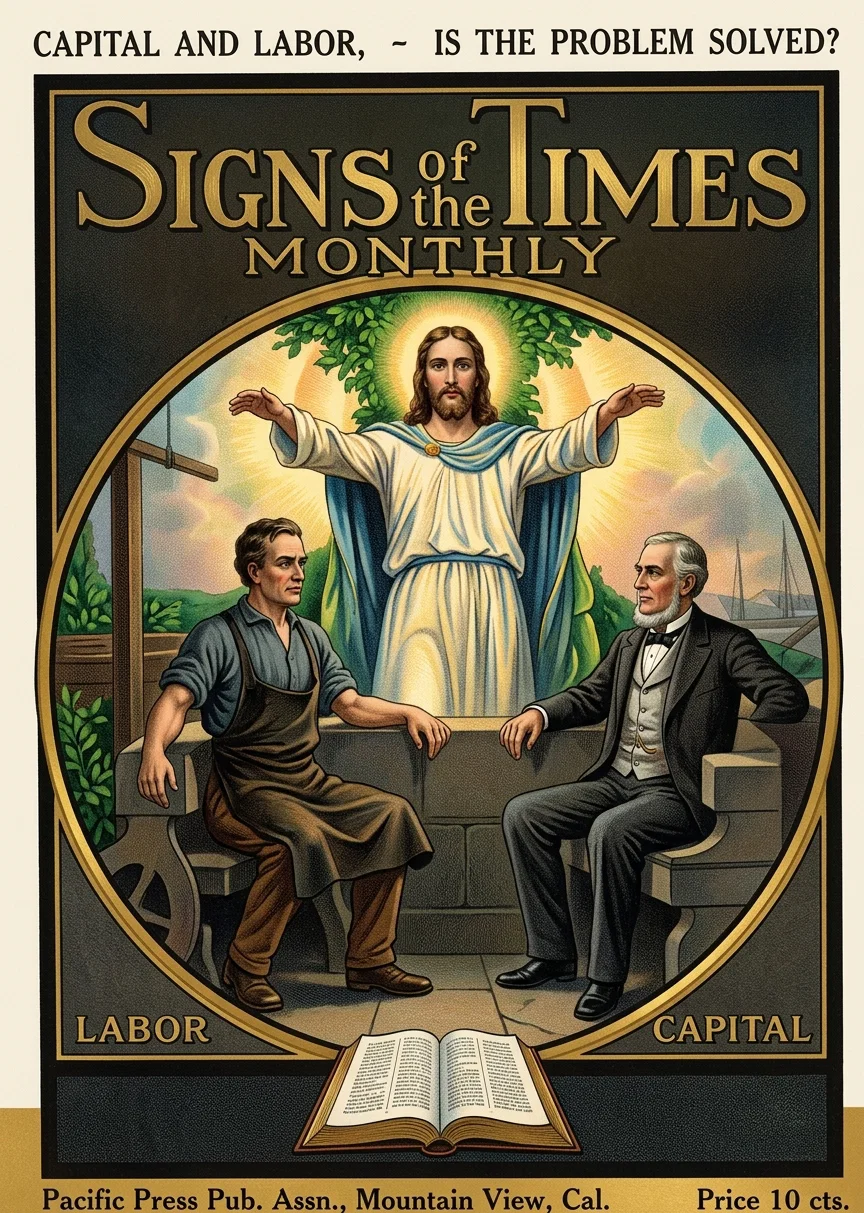
ONE of the most perplexing problems that this country, or any other country, for that matter, has had to deal with is that of capital and labor, and the relation they should sustain to each other. Millions of dollars and thousands of lives have been sacrificed in trying to solve the problem.
This question will be fully discussed in the Signs of the Times Monthly for October.
Articles have been secured from prominent writers, representing the different sides of this controversy, thus making it an intensely interesting number, and one that will appeal to all classes. The subject will be taken up in the following order:—
“From the Manufacturer’s Standpoint.” An article by John Kirby, Jr., president of the National Association of Manufacturers, will present the subject from the manufacturer’s standpoint.
“From the Standpoint of Organized Labor.” Selected statements from the recent utterances of Mr. John Mitchell, the great labor leader, will present the subject from the viewpoint of organized labor.
“From the Socialistic Standpoint.” A special article on “Capitalism and Socialism,” by Eugene V. Debbs, will present the matter from the Socialistic standpoint.
“From the Prophetic and Christian Standpoint.” This view of the problem will be handled by the editor, who has given years of study to the question, and who will present to the reader the only true solution of this most perplexing problem.
General Articles
Other leading features of the magazine will be an article on “The Sabbath Institution,” by Elder H. W. Cottrell, president of the Pacific Union Conference.
“Struggles for Religious Liberty in the Western World” is the subject of a very timely article on Religious Liberty, by Elder J. O. Corliss, member of the Religious Liberty Bureau.
Dr. D. H. Kress, of the Washington [D. C.] Sanitarium, writes upon the much-thought-of theme, “What Constitutes Divine Healing.”
Mrs. E. G. White has an article on the great divine mission, “Go Ye Into All the World.”
Elder Clarence Santee, president of the Southwestern Union Conference, writes on the subject, “The Nations and Prophecy.”
Elder Wm. A. Westworth, president of the Southeastern Union Conference, has a very helpful article, “The How of the New Birth.”
“The Jubilee of Calvin in Geneva” is the title under which Jean Vuilleumier tells of the celebration of the birth of Calvin, and of the founding of Calvin’s Academy in Geneva. Preparations for this event have been in progress for the last four years.
The cover for this number is a three-color half-tone, the original drawing made by Mr. Charles Mente, our New York artist, and it represents in striking figures the only true solution of the capital and labor problem. It is a beautiful conception, and tells the story at a glance.
The October number of the Signs of the Times Monthly magazine will be one of the most interesting, attractive, and important yet published, and is sure to sell readily. Orders should be sent in early.
Agents wanted in every city and town.
Prices
5 to 25 copies, 5 cents a copy; 25 to 500 copies, 4 cents a copy; 500 to 1,000 copies, 3½ cents a copy; 1,000 copies or more, 3 cents a copy.
Address your tract society, or Signs of the Times, Mountain View, Cal.
FACSIMILE OF COVER PAGE. ORIGINAL PRINTED AS A THREE-COLOR HALF-TONE