The Youth’s Instructor, Vol. 43, No. 41.

THE GOSPEL IN JAPAN

The Youth’s Instructor

Oct 10, 1895

S. D. A. Publishing Association · Battle Creek, Mich. · Oct 10, 1895

THE GOSPEL IN JAPAN.
PROBABLY the first missionary to Japan was Francis Xavier, a Roman Catholic priest who went there in the sixteenth century, and began teaching the doctrines of his church. Some of the rulers and leading men of the empire embraced his creed, as did also a large number of the common people. When the sect became powerful, the usual means employed at that time for gaining adherents to the Catholic Church were resorted to, and under the persuasive influences of drawn swords, torture, flames, and the like, converts to the new faith were made by the wholesale.
But when the Jesuits began intriguing to annex Japan to Spain, the jealousy of the government was aroused, and the Catholics became the subjects of the bitterest hatred and persecution. The same schemes which they had employed to introduce their religion into Japan were now resorted to in order to exterminate it. Most horrible scenes of cruelty were daily enacted. In one day thirty thousand Catholics were massacred. They were crucified, burned, tossed into the sea, and butchered, until the government supposed that the dreaded sect was exterminated. The ports of the country were then closed against foreigners, and for nearly three hundred years Japan was the most exclusive nation on earth. It was death for a foreigner to land upon her shores, and death for a native to leave Japan. Public-notice boards were put up all over the empire pronouncing capital punishment upon any one who did homage to the Christian’s God, and if any one was found who did so, he was killed.
But in 1854 Commodore Perry went to Japan, and after peaceful negotiations, succeeded in getting the country open to foreigners. The Japanese nation awoke from its long Rip Van Winkle sleep, and resolved to adopt Western civilization. Soon great steamships bearing men and implements for introducing all modern appliances and conveniences of civilization, were plowing through Japanese waters.
In a little while the shriek of the railway engine was heard by the astonished natives. Telegraphic messages were flashing along the wires that well-nigh girt the island. Good schools, modeled after ours in America, were established all over the empire. With such marvelous celerity did Japan advance, that she was an astonishment to all the world. But in spite of such material progress, even in 1868 a governmental edict was issued saying that “the wicked sect called ‘Christian’ is strictly prohibited.”
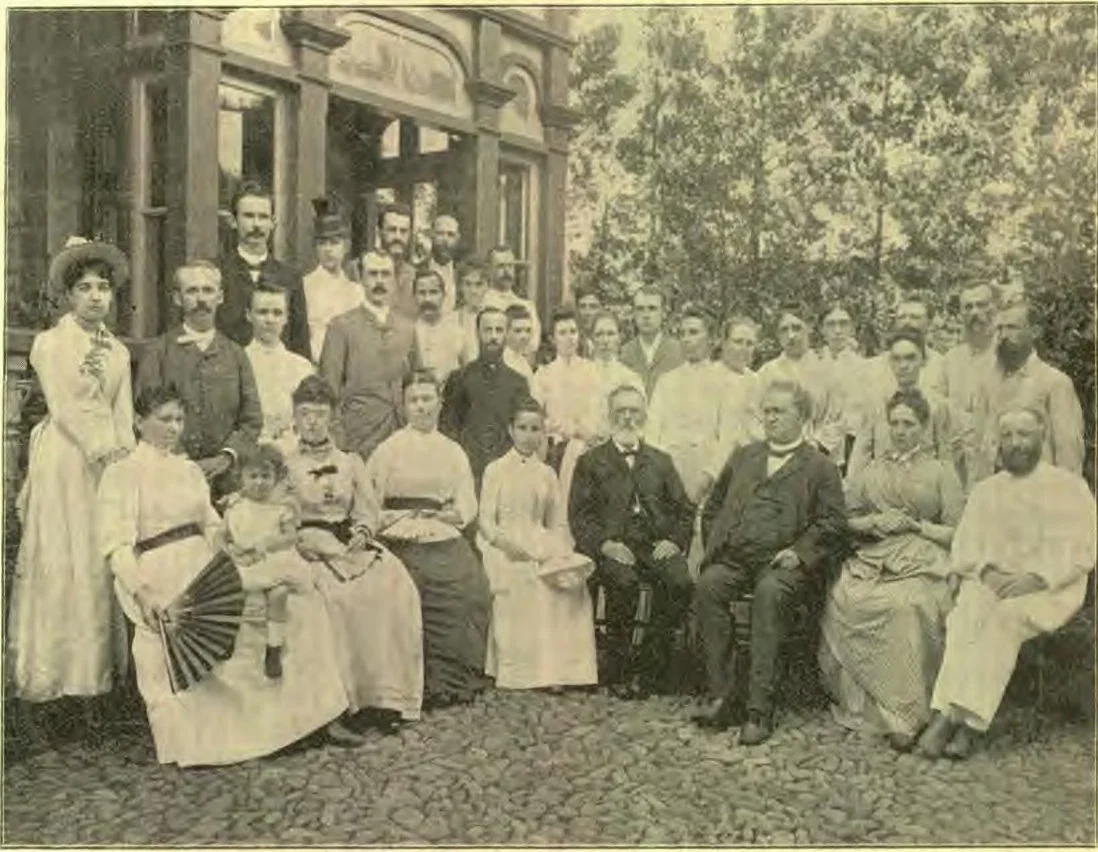
A GROUP OF MISSIONARIES.
In the face of this, God’s messengers went there with the gospel; but they found it very difficult to reach the people, so great was the terror in reference to Christianity. The majority of the people supposed that Protestantism and Catholicism were identical. A missionary who was there at the time says: “We were regarded as persons who had come to seduce the masses of the people from their loyalty to the ‘god country’ (Japan) and corrupt their morals generally.” It was impossible to rent a place in which to preach, and very difficult to procure a language teacher. Humanly speaking, a missionary going to Japan, as late as twenty-one years ago, took his life into his own hands; for a Christian was looked upon as no better than a thief or a murderer.
But though the Bible was proscribed, infidel literature was widely circulated, and many of the influential men of the empire became followers of such men as Huxley, Spencer, and Ingersoll. But despite these great and seemingly insurmountable obstacles, the gospel is triumphing in Japan. The edict against Christianity has been virtually repealed, and religious liberty practically prevails in Japan. From ten Christians and no churches in 1871, there are now about thirty thousand Christians and several hundred churches and preaching places.
One great obstacle to the cause of Christ in Japan is the number of denominations represented there, all claiming to follow the Bible, and yet all interpreting it differently. This is very confusing to the Japanese, who often reject it altogether in their perplexity over the numerous creeds presented to them for acceptance. O that all men would permit the Bible to be its own interpreter, and let it mean what it says! What a glorious thing it would be for the advancement of mission-work the world over!
Another obstacle to Christianity in Japan has been the doctrine held by the Shintoists, and generally believed by the people, that the emperor is descended from the gods, and must be venerated as such. Now the Christians deny this; hence they were looked upon with suspicion, and were accused of being disloyal to their country. But the conduct of the Christians during the late war has forever set at rest the question of their patriotism.
Whether as soldiers upon the battle-field, sharing in the perils and privations of war, or as civilians toiling at home for the absent ones, they have proved themselves loyal to their country. Thus even war, despite its horrors, may be an instrument in God’s hands for advancing his cause.
Seeing the good work that the Christians were doing in ministering to the sick and wounded, chaplains were permitted to accompany the army. The government also granted permission to the agent of the Bible societies to distribute Bibles among the soldiers. The opportunity was gladly seized. At the opening of the war it was almost impossible for a Christian soldier to conceal a Bible about his person. Now it is seldom that any soldier will not accept some portion of the Scriptures.
The prospects for the spread of Christianity in Japan are brighter than ever before. Truly the field is white for the harvest. It is time that we, as a people, were turning our attention to Japan, and making our plans for sending out laborers there, who will preach the gospel of the coming kingdom. Let us pray to God, who is moving so mightily in the Island Empire, that he will speedily send forth laborers into this harvest. Then let us show our faith by our works, and each contribute to this cause as the Lord has prospered.
MRS. J. A. BRUNSON.

HUMANITY THE LOST PEARL.

The kingdom of heaven is represented as being like unto a merchantman “seeking goodly pearls; who, when he had found one pearl of great price, went and sold all that he had, and bought it.”
This parable has a double significance, and applies not only to man seeking the kingdom of heaven, but to Christ seeking his lost inheritance. Through transgression, man lost his holy innocence, and mortgaged himself to Satan. Christ, the only begotten Son of God, pledged himself for the redemption of man, and paid the price of his ransom on the cross of Calvary. He left the worlds unfallen, the society of holy angels in the universe of heaven; for he could not be satisfied while humanity was alienated from him. The heavenly merchantman lays aside his royal robe and crown. Though the Prince and Commander of all heaven, he takes upon him the garb of humanity, and comes to a world that is marred and seared with the curse, to seek for the one lost pearl, to seek for man fallen through disobedience. For our sake he became poor, that we through his poverty might be made rich.
Satan is exercising his power over the human race. He accused God and Christ, misrepresenting the Father, and deceiving men in regard to the Prince of the hosts of heaven. More and more he was obscuring the knowledge of the only true God, taking possession of the minds of men, and afflicting their bodies. The messengers that God sent were refused, beaten, and killed. Christ came to the world to meet the wily foe, and to dispute his claim of sovereignty over the earth. He came to the world as a man, veiling his majesty and glory, clothing his divinity with humanity, in order that he might not extinguish the sinful race, but stand where man stood, to endure the temptations under which Adam failed. He became the substitute and surety for the fallen world, and submitted to every test that could be brought to bear upon his loyalty to God. He had only the advantages in the battle which are the privilege of fallen man. He was tempted in all points like as we are, but he met Satan with the weapon of God’s word, saying, “It is written.”
The warfare between the Prince of light and the prince of darkness was carried on under far more discouraging circumstances than was the battle between Adam and Satan. Christ’s life was a continual battle until he was offered up on Calvary’s cross. But in spite of Satan’s temptation, in spite of the trials and humiliations that came upon the Son of God, he carried out the divine mission of which the prophet Isaiah had written ages before. In the synagogue at Nazareth he read the words of the prophet, saying, “The Spirit of the Lord God is upon me; because the Lord hath anointed me to preach good tidings unto the meek; he hath sent me to bind up the broken hearted, to proclaim liberty to the captives, and the opening of the prison to them that are bound [in unbelief and hopeless despair by the power of Satan]; to proclaim the acceptable year of the Lord, and the day of vengeance of our God; to comfort all that mourn; to appoint unto them that mourn in Zion, to give unto them beauty for ashes, the oil of joy for mourning, the garment of praise for the spirit of heaviness; that they might be called trees of righteousness, the planting of the Lord, that he might be glorified.”
This is the work that Christ, the merchantman, who comes to rescue his goodly pearls, is to do. He finds his pearl buried in rubbish. Selfishness incrusts the human heart, and it is bound by the tyranny of Satan. But he lifts the soul out of its darkness, to show forth the praises of Him who hath called us out of darkness into his marvelous light. We are brought into covenant relationship with God, and receive pardon and find peace. Jesus finds the pearl of lost humanity, and resets it in his own diadem. The same thought is brought out in the parable where the faithful shepherd leaves the ninety and nine, and goes forth to find the one lost sheep. Christ comes to save perishing souls. He did not come to labor exclusively for one favored nation, but to pour out his blessings upon a lost world. He came to demolish every wall of partition, to throw open every apartment of his temple. No true worshiper need meet any obstruction in approaching the God of the temple. He said, “I am the light of the world.” He would inspire the most sinful, the most debased with hope. He says, “Him that cometh to me I will in no wise cast out.” When a soul finds the Saviour, the Saviour rejoices as a merchantman that has found his goodly pearl. By his grace he will work upon the soul until it will be like a jewel polished for the heavenly kingdom. “For God so loved the world, that he gave his only begotten Son, that whosoever believeth in him should not perish, but have everlasting life.”
MRS. E. G. WHITE.
  • (To be concluded.)*

JOHN THREE SIXTEEN.

One bitter winter’s night a little Irish boy stood in the streets of Dublin, homeless and friendless. Wicked men were making him their tool, and he was even then waiting to help in a crime.
In the darkness a hand was laid on his shoulder. The face he could not see; but a kind voice said: “Boy, what are you doing here? The hour is late. Go home and go to bed.”
Shivering, he answered, “I have no home and no bed.”
“Poor fellow! Would you go to a home if I sent you?”
“Indeed I would.”
“Well, then, go to such a street and number, ring at the gates, and give them the pass.”
“The pass? What’s that, sir?”
“The word that will let you in. Remember, the pass is John 3 : 16. Don’t forget, or you can’t get within—John 3 : 16. That’s something that will do you good.”
The boy ran to the place. Timidly he rang the bell at the great iron gates. A gruff porter opened. “Who’s there?”
“Please, sir, I’m John Three Sixteen.” His voice trembled with cold and fear.
“All right,” said the porter; “you’ve got the pass.”
Presently he found himself in a warm bed, the best he had ever known. Before going to sleep, he thought: “That’s a lucky name. I’ll stick to it.” In the morning he had a warm breakfast before being sent away.
Crossing a crowded street, he was run over, picked up unconscious, and taken to the hospital. Soon fever and delirium set in. In ringing tones he said, over and over: “John Three Sixteen! It was to do me good, and so it has!”
The words were heard all over the ward. Testaments were pulled out to find what he meant. So it came about that one and another read the words: “For God so loved the world, that he gave his only begotten Son, that whosoever believeth in him should not perish, but have everlasting life.” The Holy Spirit used the words, and souls were saved then and there.
After a while the lad’s senses returned. A voice from the next bed said: “Well, John Three Sixteen, how are you to-day?”
“How do you know my name?”
“I know,” the voice went on; “you got it from the blessed Bible.”
“Bible? What’s that?”
The poor little waif drank in the answer, and said: “That’s beautiful; it’s all about love, and not a home for a night, but a home for always.”
He believed the precious truth. Friends were raised up. He received an education, and grew up to a career of great usefulness.—Our Young People.

THE RESTITUTION.

My thoughts often linger upon sweet memories of the past, when in the morning of life so many loved ones were about me, ever ready to cheer and encourage, when the way seemed rough to my inexperienced feet. Yes, I recall so many dear forms and faces, whose companionship helped to make my young life happy; but long since they crossed the chilling tide, and one by one entered the “dark valley,” leaving me with aching heart and tearful eyes, to mourn their absence.
They have passed from earth away, Closed forever life's short day, Closed their eyes in slumber deep, Closed the record angels keep.
Precious friends, the true and just, Rest together in the dust; But when Gabriel's trump shall sound, They shall wake from sleep profound.
Then arise and sweetly sing, “Where, O death, where is thy sting? From thy scepter we are free! Grave, where is thy victory?”
Thank the Lord, the dark grave will soon open, no more forever to close over its victims; ’t will soon give back its treasures, for He, the “resurrection and the life,” is coming, and “there shall be no more death.” How sweet to contemplate that bright morning, and the glad reunion that will take place, when we shall behold our exalted Redeemer, who once, on the cruel cross, gave his life for a lost world.
Yes; he is coming, and will bring again to our embrace those precious ones from “the land of the enemy.” Children will then be restored to the arms of their fond parents; brothers and sisters long parted will meet; husbands and wives, no longer separated, once more will embrace each other, never to part. O what a meeting that will be, when the Deliverer comes, and the final consummation is completed!
O how sweet, how sure, how comforting is the gospel hope! and how full of consolation! In a little while our sorrows will turn to everlasting joys.
MRS. M. S. AVERY.

ANXIOUS FOR WAR.

Mr. Chauncey Depew has lately returned to his home in this country after a somewhat protracted European tour. He has been interviewed by the representatives of the press, and has spoken his mind quite freely in regard to affairs in Europe. Perhaps the most significant remark which he has made is in regard to the attitude of Germany toward France. Mr. Depew says:—
“I was in Germany on the twenty-fifth anniversary of the victory of Sedan. The celebration reminded me of the rejoicing with us over the surrender of Appomattox. Palaces and cottages, stores and houses, were alike covered with flags and bunting, obscuring the streets. Processions, music, illuminations, and every form of popular joy was universal. The enthusiasm was wild and contagious. It developed a deep-seated national and almost passionate desire for war with France now and on any pretext, to settle forever the possession of Alsace-Lorraine, and so to cripple the French that they would no longer be a menace to the peace of Germany, so that her military establishments might be reduced.”
It has generally been thought that the desire for war was all on the side of the French; that France was the firebrand that is always threatening the peace of Europe; but if Mr. Depew is correct, Germany is more anxious for war than is France. It is now known, by Bismarck’s own confession, that he prevented certain despatches from reaching the French government in 1870, because he feared that if they were received, France would not fight, and he wanted to fight then, when he knew that Germany was prepared and France was not. This fact, with Mr. Depew’s statement of the present feeling in Germany, will remove some of the responsibility of that war from France to Germany.
Germany is tired of her immense military establishment, and a general disarmament would be a very desirable thing for the empire; but the treatment of France by Germany has made the armament necessary. The demands upon France were so extortionate, and the treatment of the French-speaking people of Alsace-Lorraine so cruel, even forbidding the singing of French songs and the use of the French language in the schools, that the national spirit of France was deeply wounded, and a desire to get even with Germany never is lost sight of.
Germany was alarmed, and increased her armament. Still, not feeling secure, she made friends with Austria, and formed an alliance with her. Fearing that France might contract an alliance with Italy, overtures were made to the latter country, and the Triple Alliance was formed. And even now Germany fears that she may lose Alsace-Lorraine back to France! We hope for peace; but Germany will not be likely again to find France so unprepared for war as she was in 1870.

A UNITED ITALY.

SEPTEMBER 20 was a day of great rejoicing in Italy, and in all other places where the Italian language is spoken. On that day, twenty-five years ago, the Italian army, under its king, Victor Emmanuel, entered the city of Rome against the decided protest and armed resistance of the papal troops, and Italian unity was then complete. Italy was a nation, and its capital was Rome.
Before that time, for centuries, Italy was nothing but a geographical expression. It meant the Italian peninsula; it did not mean the nation, for there was no Italian nation. The country was divided into a number of petty kingdoms and duchies, with the papal states ruled by the priest-king, the pope, in the center.
None of these kingdoms, except the papal states, could be said to be independent; many of them were direct dependencies of Austria, and were farmed out to poor scions of the nobility to furnish them a support. It was the policy of the popes to oppose the formation of a strong government of any kind in Italy; for in such a case there might be a clash with the papal authority. Really the papacy held the balance of power in Italy, and nothing was done by the nations in that country without first considering what effect it would have upon the papal see.
If any one had predicted in 1840 that by 1870 Italy would be one united kingdom, with Rome the capital, and that the temporal power of the popes would be destroyed, he would have been considered a fit subject for a lunatic asylum; but by a series of remarkable events, scarce paralleled in history,—by battle and by diplomacy, aided by a kind Providence,—the thing was done, and Victor Emmanuel, duke of Savoy and king of Sardinia, became the king of a united Italy. The names of the principal persons who brought about this stupendous change are Victor Emmanuel, Cavour, his prime minister, Mazzini, and Garibaldi. The last two were agitators, revolutionists, who stirred up the people; the first two, by skilful diplomacy, reaped the fruits of the sowing of Garibaldi and Mazzini.
To describe the various steps taken to bring about Italian unity would take too much space to be told here; but a few facts may be briefly stated.
By the help of France, in a war in 1859, Austria was defeated, and Lombardy ceded to Italy. Several of the petty duchies,—Modena, Parma, Tuscany, etc.,—joined themselves to Sardinia. Garibaldi, with a thousand men, swept through Naples, and took the whole country for Victor Emmanuel. The alliance of Italy with Prussia in the war between Prussia and Austria, in 1866, gave Venetia to Italy. Finally the Franco-Prussian war, in 1870, humbled France, and the French army being withdrawn from Rome, the city was entered. Three times had Garibaldi endeavored to take Rome, but failed. Twice he was prevented by the king of Italy, on account of the treaty with France, by which the king of Italy was pledged to support the papal independence, and once he was prevented by the French troops.
A few months ago, by vote of the Italian parliament, September 20, the anniversary of the entrance of Rome was made a national holiday. There was a great celebration in Rome. The statue of Garibaldi was unveiled near the place where the Italian army entered the city. Many of his companions in arms were there,—the famous “red shirts,”—and they received from King Humbert evidences of his distinguished regard.
It is not very gratifying to some Catholics to see this celebration of the overthrow of the temporal power of the pope; but the Italian Catholics have very generally supported the measure. In this country many Catholic prelates are trying to evoke sympathy for the pope. He is represented as a prisoner, when he is as free to go where he pleases, and when he pleases, as is any other man. The papacy has lost a vast amount of the power it once possessed, but it has lost nothing which it had a right to keep. The temporal power of the papacy is gone, and we cherish the hope that it is gone forever.

THE RETURN OF PEARY.

THE Peary relief expedition, which was despatched to find and succor Lieutenant Peary on the northern coast of Greenland, has returned, having met the explorer on his way south. While the expedition to find the explorer was therefore a success, the expedition of Lieutenant Peary appears to have accomplished very little. No higher latitude than the one reached on his previous voyage was attained, and with the exception of the discovery of two rare meteoric stones, the expedition was barren of results.
As is usual in expeditions of this kind, there was much suffering, and the members of the exploring party were in a state of great distress when relieved; but no lives were lost. After the relief reached them, several trips along the coast of Greenland were made. One of the places visited was Littleton Island, where the ship of Captain Kane was frozen in so long, and from which he was obliged to escape by sledge and boats. North of this island clear water was discovered as far as the eye could see, but neither the original explorers nor those who went to their relief were prepared to make a longer voyage. All have now reached St. John's, Newfoundland, in safety, but the secrets of the frosty north have not yet been given up to man.

NOTES ON THE FAR EAST.

For some time no news of importance has been transmitted from the East. The appearance of the cholera in China and Japan has been the only event that has appeared worthy of notice. At the same time, preparations are slowly going forward for events that may startle the world. The Russian government, following up its shrewd movement in lending China an immense amount of money, is about to establish a bank in Peking. This is exceedingly displeasing to English capitalists, who have hitherto managed all the financial ventures of John Chinaman.
China is accumulating her millions to pay Japan the indemnity agreed upon by the treaty. There have been rumors that the Japanese have dismantled the fortifications of Port Arthur. If this is true, it was doubtless done for fear that China would deliver it up to Russia. The latter country is fully determined to gain a foothold on the eastern coast of China, and a warm port either in China or Corea as the terminus of one branch of her great Siberian railway.
The Japanese government is buying ships of war, and should England and Japan agree that Russia has no right to Chinese ports and a portion of the Eastern trade, there may be another clash of arms in the Far East, of much greater magnitude than the last one. England will be very reluctant to lose the control of the Chinese trade by which her merchants have become rich. She has put several ships of war up the Chinese rivers, and demands the degradation of the viceroy of Szechuen. It is very likely that the British government feels that China needs to be impressed anew with the magnitude of British power. M. E. K.

THE POOR IN SPIRIT.

“Blessed are the poor in spirit: for theirs is the kingdom of heaven.” Matt. 5:3. These are the first words of Christ’s memorable sermon on the mount. His teaching was very different from that of the scribes and the Pharisees. Their teaching largely consisted of subtle reasonings about the meaning of the Scriptures, what disastrous results would happen if one letter was mistaken for another, and hundreds of minute directions for the performance of the most trivial duties. With these dry husks of fine-spun theories and fanciful interpretations, they were trying to relieve the spiritual hunger of a people longing for the bread of life.
Jesus was a teacher after a new order. Non-essentials formed no part of his teaching. He did not open to his hearers long vistas of speculation, nor burden them with a round of ritual service. He revealed to them the Father. He was God manifest in the flesh, the living ideal of the perfect man,—just what the Father desired all his children to be. To understand the relations which we sustain to the Father is of the first importance. The design of Christ, of the gospel, is to lift man up. “As many as received him, to them gave he power to become the sons of God, even to them that believe on his name.” But none can be lifted up until they feel the need of the divine uplifting,—until they realize that they have fallen, and must be raised by some power greater than their own.
To realize our true condition is the first step toward the divine life and heaven. In the first insight of self in contrast with God, there is a glimpse of the riches of God’s character and our own poverty,—happy beginning of a better life! “Blessed [happy] are the poor in spirit.” We see the holiness of God and our own unrighteousness in sharp contrast,—his beneficence and love, our selfishness and hatred; his purity, our vileness; his abundance of mercy and truth, the absence in us of these same precious qualities. A glimpse into the treasure-house of our God,—his character and his attributes,—and O, what poverty is seen to be in us! A child grown up in squalid surroundings, by some means looks into a happier home of wealth and refinement; and after that his own home is so mean, his life so wretched! He has seen a better life, and now senses his own poverty. The same is true of us when we see the Father, as manifested in Jesus, and compare his life, so pure, so perfect, with our own.
“Poor in spirit!” yet blessed, happy, for our hearts are turned to a better, holier life! The kingdom of heaven is ours. This was the attitude of the penitent publican. He was poor in spirit. There was in his prayer no justification of self, no recounting of righteous acts which he had done. He confessed his poverty of righteousness; not to prove that he was deserving, but as an evidence of his need. “God be merciful to me a sinner,” was his only plea. Was not the kingdom of heaven surely his? He “went down to his house justified”; and justification through faith means “peace with God, through our Lord Jesus Christ.” What follows justification?—“Moreover, whom he did predestinate, them he also called: and whom he called, them he also justified: and whom he justified, them he also glorified. What shall we then say to these things? If God be for us, who can be against us? He that spared not his own Son, but delivered him up for us all, how shall he not with him also freely give us all things?” Rom. 8:30–32. “All things” will be given to the poor in spirit who are justified by faith. Truly, “theirs is the kingdom of heaven.” “Blessed are the poor in spirit.” Take that step, and do not retrace it. To deny this experience is self-righteousness. The poverty of self and the wealth of Jesus is the first lesson to be learned, and that knowledge must be retained, as a present experience, unto the end of the Christian journey. We may be rich, but the riches are in Jesus Christ, not in us.
Then is it not blessed? because if we have nothing, Jesus possesses all things, and he holds them in trust for us. All the treasures of wisdom, knowledge, and righteousness are in him, and if we are in him, all that he has is ours. Read it over again, and see the blessedness there is in it: “Blessed are the poor in spirit: for theirs is the kingdom of heaven.”

“THOU GOD SEEST ME.”

These were the words of Hagar, when, wandering in the wilderness, she suddenly found herself addressed by the angel of the Lord. Gen. 16:13. She also seemed to sense the fact that she, in her flight and wanderings, was not placing her dependence on God, for she said: “Have I also here looked after him that seeth me?” She was not looking after God, was not expecting anything of him; but he was looking after her, and told her what to do.
Here is a lesson for every one of us. God watches over us, marks our conduct, and though by us unseen, angels are near us to guide us in the right way.
Jacob learned this lesson while on his way to Haran. With a stone for a pillow, in a lonely and unfrequented place, he lay down to rest; but God was there, and by a dream of a ladder from earth to heaven, upon which the angels of God were ascending and descending, God revealed to Jacob that there was a constant communication between heaven and earth, and that God had a care for him, even in that lonely place. “And Jacob awaked out of his sleep, and he said, Surely the Lord is in this place; and I knew it not.” But that place was nothing different from any other place. We live in the presence of God; we can as truly say, wherever we are, “God is in this place,” as Jacob could say it then. This should deter us from sin, and should also be a comfort to us; for the knowledge that God is always with us, should give to us a sense of security.
Not only is God near us, but he knows the heart of every person; that is, he can see the mind, the purposes, of every person, and know the character as well as,—yes, far better than,—we know people and distinguish them from each other by their outward appearance. The best of men may be deceived by the appearance of people; we may even deceive ourselves; but the Lord knows all. He is not deceived or mistaken in the least.
It is recorded in 1 Samuel 16 how the Lord sent the prophet Samuel to anoint a king over Israel from among the sons of Jesse. The prophet went on his errand to the house of Jesse, and the sons of Jesse were made to pass before him. The name of the son of Jesse who was to be anointed was not revealed to Samuel, and he seems to have thought that he would be able to discern which one of the sons of Jesse was to be the king, by his personal appearance. Saul, who at that time was king of Israel, was of commanding appearance, “higher than any of the people, from his shoulders and upward.” Perhaps this fact had some weight in the mind of Samuel, and led him to make a mistake; for when Eliab, the eldest of Jesse’s sons, stood before Samuel, the prophet exclaimed, “Surely, the Lord’s anointed is before him.” But the Lord said to Samuel, “Look not on his countenance, or on the height of his stature; because I have refused him: for the Lord seeth not as man seeth; for man looketh on the outward appearance, but the Lord looketh on the heart.”
The Lord wanted a man whose heart was right for king over Israel; and passing by seven of Jesse’s sons, the youngest of all,—the lad David,—was called from the field where he was tending the sheep, and anointed to be the king of Israel. Who can read the songs of David, where his heart is revealed to our inspection, and not feel certain that God knew David’s heart, even when he was a boy?
The Lord has said, “Keep thy heart with all diligence; for out of it are the issues of life.” Whatever we do springs from the heart; the words, the deeds, issue from the heart as water flows from a fountain.
Do we say and do things displeasing to God; words that grieve and wound others; deeds not of love, but of hate? Then the heart is not right. But there is a remedy; “the blood of Jesus Christ cleanseth from all sin.” Hearts may be purified by obeying the truth. The heart may be a throne upon which Jesus will sit, a chamber in which he will dwell. Where he is, there is purity; for his presence drives sin away. If our hearts are fully given to him, he will purify them, so that when he sees us, no sin will be seen.

IMPROVING OPPORTUNITY.

How many persons have to mourn all their lives because the time of youth allotted to every one to prepare for usefulness is frittered away, and no solid, useful learning is obtained! Hard study in later years may partially atone for youthful neglect, but it can never fully do it. The aged always affirm that they remember their earliest impressions best; others fade, but the knowledge gained in youth is retained as long as life remains. If one has an earnest desire for education, in some way it will be obtained. While schools and colleges are useful, and should be patronized if possible, a studious mind may gain much information outside of them, but not outside of study. All observation and seeking to know the causes and reason of things is study. The thoughtful, studious observer never ceases to study; he is always adding to his stock of information. There are persons who are graduated from school and go through college, and then never know anything aside from the books which they studied. Remove them from the groove in which they have traveled, and they are lost at once. They are like an engine flanged to the track, rather than like a bird which goes where he pleases. We should always aim to use our knowledge instead of allowing it to use us. This will make ready persons, who will never be at a loss to know what to do in every circumstance in life.
What they have learned furnishes the store-house of the mind, of which they hold the key, and help themselves to what they need.
M. E. K.

LESSON 4.—A THEOCRACY — TRUE AND FALSE.

(October 26, 1895.)
1. What is a theocracy? (See note .)
2. Who, then, must be ruler, or king, in a true theocracy?—God.
3. God being the king, whose law must govern in such a government?—God’s law.
4. What is the nature of God and his law? John 4:24; Rom. 7:14.
5. What kind of service is acceptable to God? Isa. 1:19.
6. What two things must, therefore, exist in a true theocracy? (See note .)
7. What proposition did the Lord make to Israel? Ex. 19:3–6.
8. What reply did Israel make? Verses 7, 8.
9. Who, then, was their king? Judges 8:23; 1 Sam. 12:12, last clause.
10. How much did the conditions of this compact include? (See note .)
11. In what ways did the Lord reveal his will to his people? (See note .)
12. What did Israel thus become?—A true theocracy.
13. What did the people in their backslidden state desire? 1 Sam. 8:5, 6.
14. How did the Lord regard it? 1 Sam. 8:7; 12:16–19.
15. How did the Lord still show his love for his erring people? Verses 20–24.
16. That Israel might have righteous rulers, how were they to be appointed? Deut. 17:14–17.
17. By what was the king to be directed? Verses 18, 20.
18. As Israel departed still farther from God, and the cup of their iniquity became full, what was the result to the kingdom? Eze. 21:25–27. (See note .)
19. Will the kingdom of God exist again in this world before Christ comes? Verse 27; John 18:36, 37.
20. When will Christ take the throne of his kingdom? Matt. 25:31.
21. What is said of Christ’s eternal reign? Luke 1:32, 33; Dan. 7:14.

A FALSE THEOCRACY.

22. What is that government which claims to rule in place of God?—A false theocracy.
23. What does the prophetic word say of such a power? 2 Thess. 3:3, 4; Rev. 13:5–8.
24. Whence must all such power and authority come? Rev. 13:2; 12:9.
25. What will become of all false theocracies? Ps. 2:8, 9; Dan. 2:44.
26. Who will then reign as king forever? Jer. 23:5, 6; Zech. 14:9.

NOTES.

Continue reading: SABBATH-SCHOOL HINTS