The Youth’s Instructor, Vol. 43, No. 41.

THE GOSPEL IN JAPAN
Earlier text: THE GOSPEL IN JAPAN

SABBATH-SCHOOL HINTS.

Prayer is communion with God.
Prayer is a great help in studying the lesson.
Commit to memory the principal passages of Scripture referred to in the lesson.
The Saviour did not say, “Search the helps”; but he did say, “Search the Scriptures.”
Use your lesson-sheet freely the first six days in the week, and you will have no need to refer to it during the recitation on the Sabbath.
After studying the lesson several times, lay aside all books, and try to reproduce the subject-matter of the lesson on paper.
Do not strive with your teacher or other members of your class in regard to points that are not clear. Time and prayer will reveal the truth more quickly than contention.
Always show due respect to your teacher, although you may see many defects. Remember that human nature is full of defects, and that a critical spirit is evidence of a very serious defect in yourself.
How to Study the Lesson.—Every lesson has some special points that form the framework for all the lesson contains. In order for the student to become thoroughly acquainted with the subject, it would be well to make an outline of the lesson, and study it topically before making any effort to answer the questions.
The lesson of this week might be divided as follows: (1) The nature of a theocracy; (2) Distinction between a false and a true theocracy; (3) Christ’s future reign. Group the Scriptural references of the lesson under each division; then carefully turn to the texts, and study them until the thought is fully fixed in the mind. Then read the notes connected with the lesson carefully, comparing them with the texts to see whether the thought is clearly presented to your mind. After making a careful topical study, ask yourself the questions, and thus test yourself on your knowledge of the subject.
Application of Truths.—It is not enough that you are sufficiently acquainted with the lesson to be able to answer all the questions the teacher may ask. You need to make a careful study of the truths taught, and apply them to your own heart. Ask yourself the question, “Am I any better fitted for the responsibilities of life by learning this lesson?” If you cannot see that you are, it will be well to make another study of the lesson, with this thought in mind. Go over it again and again, until you see that your soul has been fed.
Heart Service.—One prominent feature of this lesson is that under all circumstances God requires heart service. Read the Old-Testament history of God’s dealings with men, and note how prominently this thought is brought out. Read the Bible until you are familiar with many of the characters spoken of in the Bible that illustrate this principle. Then let the truths of the lesson appeal to your own heart in the question, “Do I always serve God from the heart?” If you are led to see that you do not, go to him until you know that all you do is done to the glory of God.
J. H. D.

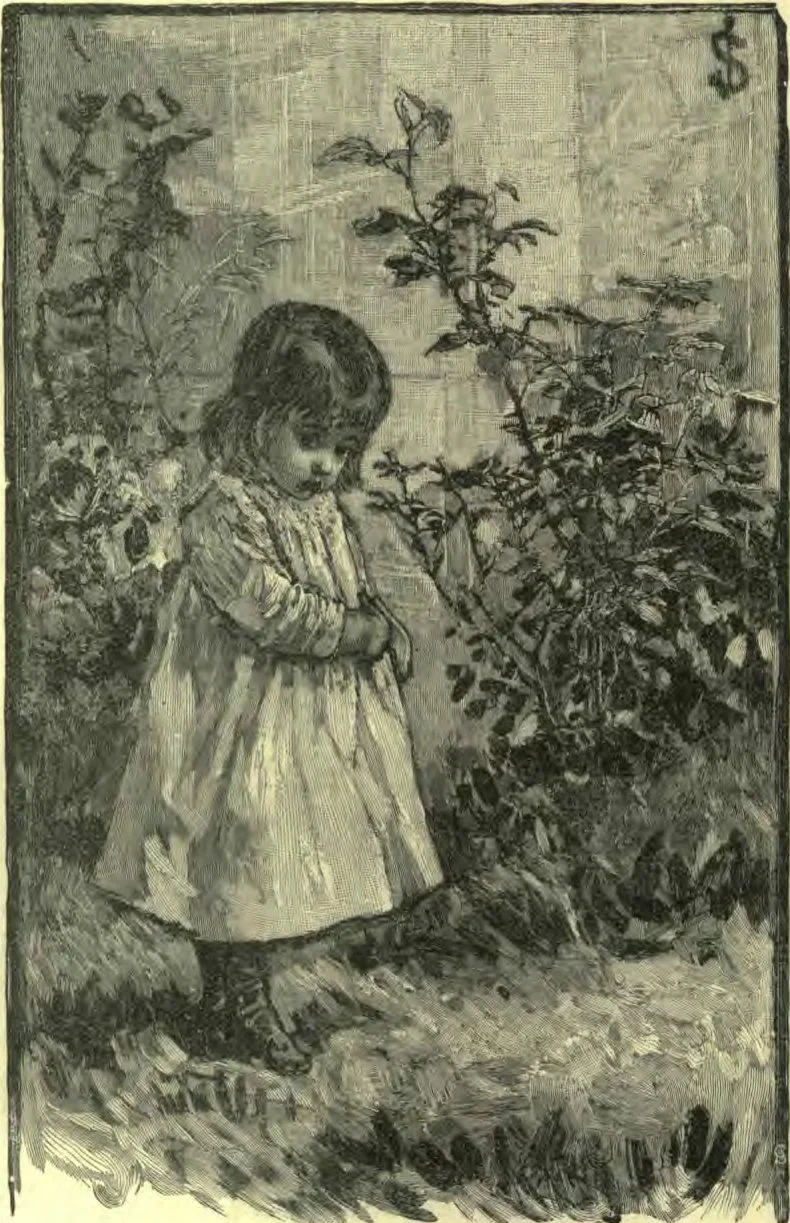
WEARING WEEDS.

“My mama said—she did, John Jones! I’d laugh, if I were you!— She said my Auntie Claire wore weeds, And looked so awful blue, Because my bestest cousin of all,— My little cousin Clyde,— He took the measles once, he did, And afterward he died!”
“THAT IS WHY I'VE FOUND THESE WEEDS!”
“And now my dolly, Sary Jones, She was took awful ill, And though I gave her medicine,— One dreadful big black pill,— It did n’t do a bit of good! And she died—she did, so there!— And that is why I’ve found these weeds To wear, like Auntie Claire!”
MYRTA B. CASTLE.

WHICH WAS THE BEST?

Beth and Carrie and Jean sat in a row on the yellow settee in the little country depot.
Suddenly there was a flutter of excitement amongst all three.
“Here comes Mrs. Cobb and a strange lady!” exclaimed Beth, in a whisper.
“An’ she’ll introduce us!” gasped Carrie.
“What did you say to do?” she asked, hurriedly.
“Katherine said,” whispered Jean, solemnly, “the very latest was, to say Miss Brown, or Miss Green, or Miss White, and bow a little, and smile a little! That’s what she told Gertrude Means this morning. An’ Katherine learnt that at Uncle Frank’s in New York,” Jean added, very impressively.
“But s’posin’ her name’s something else,” said Carrie, quickly.
Jean looked mystified.
“I guess that was ‘for example,’ as Miss Frazier says. I guess—you’re to say her name, whatever it is,” answered Jean, doubtfully.
Mrs. Cobb entered the open door, and the three little girls sat flushed and expectant.
Mrs. Cobb smiled, and the three little girls smiled in return, and Jean nudged Beth, for she felt sure the triumphant moment was approaching.
“Isn’t this a lovely day, children?” said Mrs. Cobb, smiling again. “My friend, Mrs. James, has been enjoying this beautiful country air with me to-day. She comes from New York City, where there are no green fields and pine woods like ours!”
Carrie looked at Jean, but Jean never moved, for the time hadn’t come; but her eyes were bright with excitement, for here was an unseen triumph.
From New York! Oh, if Mrs. Cobb would only introduce them, and Jean could show Mrs. James that she knew the very latest!
“I want to introduce you to three of my little friends, Anna,” said Mrs. Cobb, as Mrs. James left the ticket window.
Jean could hardly breathe, she was so excited, and Beth and Carrie moved uneasily in their seats.
“This is my dear friend Mrs. James,” said Mrs. Cobb.
“And this is Jean Fowler—”
Jean rose, bowed a little, smiled a little, and murmured “Mrs. James” very low, and sat down.
Mrs. Cobb’s mouth twitched at the corners, and her eyes twinkled as she paused and watched this impressive scene.
“And this is Beth Graves,” she continued.
Beth rose also, and then hesitated; but she drew a long breath and repeated hurriedly, “Mrs. James,” and then she sat down.
“And this is Carrie Danforth.”
And Carrie rose. Her bright, happy face was wreathed with smiles as she put out her hand and said quickly:—
“I’m de-lighted to see you, Mrs. Green.”
Mrs. James took the brown little hand in her soft white one as she answered:—
“And I am delighted to see you, dear.”
Carrie took her seat again, unconscious of the disgusted faces of her playmates and the amused ones of the ladies.
“You called her Mrs. Green,” whispered Jean, “an’ you were the only one that didn’t say it right! I should think once in a while you’d get things straight!” she added, loftily.
Poor Carrie’s face grew rosier, and two bright tear-drops gathered in her eyes.
“Why, what is the matter?” asked Mrs. Cobb, as she discovered her.
“I’ll never be polite, never!” sobbed Carrie.
“I said Mrs. Green instead of—instead of—”
“And that was every bit as nice,” declared Mrs. James; “for you said you were glad to see me, and that was very pleasant, for I knew you meant it.
“Remember, dear,” she added, “that true politeness comes from the heart, but that is a lesson you will never have to learn as long as you continue to be the same kind-hearted little girl you are now.”
Carrie did remember, and Beth and Jean did, too; and they all agree that Mrs. James’s true politeness is much better than Katherine’s “latest” from New York.—Margaret V. Dane, in Youth’s Companion.

“TOO MUCH WORK.”

“I wish I had a kite like John Clark’s,” said Harry.
“Why don’t you make one this afternoon?” suggested his sister Sue.
“Too much work; I can’t afford to;” and he stretched himself upon the grass, and fell asleep.
After tea they all gathered around the lamp. “Now for our arithmetic lesson,” said Sue, as she brought out books and slates; “here is a long example in partial payments, Harry, for us to work out.”
“I’m not going to do it,” he answered; “it’s too much work. I understand the principle, and if you get the correct answer, I shall just copy your figures, and carry them into the class.”
“I don’t think that will be right,” said brave little Sue; “it seems like cheating.”
“Oh pshaw! well, cipher aloud, and I will stop you if I notice any mistakes;” and he leaned back lazily in his chair.
“Seven times eight are fifty-six, and three are fifty-nine,” murmured Sue; “set down the nine and carry the five”—and just then some one knocked.
“I can’t stop a minute,” said Mr. Mayhew, the druggist, briskly; “I just stepped in to say that if Harry will take hold and study Latin this term, next summer I will give him a place in my store.”
“Oh how splendid!” cried Sue, after he had gone; “of course you’ll do it, Harry.”
“Not I,” he replied; “it’s too much trouble to learn those declensions and conjugations; it makes me tired just to think of it;” and he leaned back still farther in his chair.
. . . . . . . . .
An old man is leaning on the gate of the almshouse, and wondering how his schoolmates all happened to be successful men, while he was almost always poor and out of employment. And no one likes to tell him that it is all owing to three little words, “Too much work!”—Exchange.

HANG ON.

The hired man, who was coming home with a load of wood, placed Master Tommy on top of the load. Just before reaching the farm, the team went briskly down a steep hill. When Tommy entered the house, his mother said, “Tommy, my dear, were you not frightened when the horses were trotting so quickly down Crow Hill?”
“Yes, mother, a little,” replied Tom, honestly; “but I asked the Lord to help me, and hung on like a beaver!”—Selected.

The Universities of the Middle Ages.

2.—Growth and Privileges.

The universities of Paris and Bologna became the models after which later foundations were patterned. Some of these later institutions were created by kings and popes, and built up as exact copies of one or the other of the original foundations; while others grew up after the manner of their predecessors. Among these latter was Cambridge. Some time about the twelfth century, four Norman monks came from the Continent, and settled themselves upon the banks of the Cam. There, seeking to benefit mankind, they began to teach. We still have the program of daily studies in this school. At daybreak Brother Odo taught grammar; at six o’clock Brother Terric lectured upon the logic of Aristotle; at nine o’clock Brother William lectured upon the rhetoric of Cicero and Quintilian; and on holidays Brother Gislebert expounded the Scripture; while on Sundays the monks took turns in preaching. The hall in which these humble beginnings of a great university were made was an empty granary.
Very different was the origin of the University of Salamanca. It was founded by King Alfonso the Wise, and built of the best materials of Christian and Mohammedan culture. Its rector sat, on state occasions, beside the king; and the power of the university, not only within its own boundaries, but in the kingdom at large, was almost regal. It was the support of Salamanca that brought Columbus the patronage of Isabella; and, at a later day, when Galileo was languishing in prison, his doctrines were championed at this stronghold of Arabian astronomy.
Peculiar privileges were enjoyed by universities during the middle ages, almost from the first. This was due in part to the half-sacred character which learning wore in the minds of the people; partly to the violence of the times and the chaotic state of the law, which made necessary the concession of special rights and prerogatives to institutions not able to fight for themselves; and partly to precedents established upon special occasions or in special emergencies.
The students, as well as the institutions of which they were the members, were thought worthy of the special protection of the law, as persons who had, for the advancement of knowledge, renounced for a time or for life the common enjoyments and rights of young men. Among the earliest of these privileges were those for the purpose of guarding the students’ term of residence from outside interruptions. In 1158, at the time of granting the charter to the University of Bologna, Frederick Barbarossa decreed that any student who had action for debt or offense against any person, could sue him before the magistrates of Bologna, and summon him thither. This was followed by another decree, the complement of the first, requiring any plaintiff wishing to bring action against a student to cite him before his professors or the bishop of the city at the defendant’s choice. In the same list falls the later grant of exemption from military duty.
Another group of privileges was that which gave rise in time to the university court. One of the cardinal principles of the charter of liberties of most universities removed the student from the jurisdiction of the civil to that of the ecclesiastical court. The ecclesiastical court specially charged with such cases gradually came to be part of the university,—either its faculty, or a court established for the sole purpose of dispensing justice in the university. This court had its own police,—the beadles of the university,—and administered the law of the university, as well as the civil code. In Paris the separation of the university from the city went so far that not even domestics of students were amenable to civil courts; and so satisfactory was university justice that many citizens became formal servants to students, in order to place themselves under the jurisdiction of the university.
Not only was a student’s privilege of continuous residence at the university insured against all that might molest, but his resources also were carefully guarded. Neither the goods nor the revenues of students could upon any pretext be attached. No taxes could be levied upon him for the support either of the state or of the city. “Students are to be considered citizens,” decreed the court of Padua, “in what concerns the advantage but not in what concerns the burdens of citizens.”
Among the privileges held by the universities as organized bodies was the right of cessatio,—the right to go out upon a “strike.” The origin of this peculiar usage was at Paris. On some charge of teaching heresy several professors had been excommunicated by the bishop of Paris. Their colleagues refused to cast them out of their chairs; and as a result, the university came to a full stop. The sentence was not removed, and the professors and masters began to remove to other countries, until Paris was almost deserted by her university. This touched the pride of the French monarch, and, in coöperation with the pope, he coerced the bishop into removing the excommunication. After a break of two years, the schools of Paris once more opened their doors. But the lesson was not forgotten, and the cessatio was called into use with more and more frequency, to curb the will and oppose the tyranny of monarchs. At the last the custom was grossly abused, and was finally abolished.
But aside from these weighty legal matters, there were other privileges of a more curious sort, by which the path of the student was made less severe. Various trades and professions were considered bound to make peculiar recognition of the honorable character of the student community. Every band of players coming to Turin, for example, was bound to send eight tickets free to the “syndic” of the university. At Orleans, three representatives from each of the four “nations” of students were entitled to free seats in the theater. In the latter place, also, every baker, wine-merchant, or dealer in provisions was obliged by custom to make gifts to the students, at Christmas, of brandy, preserves, cake, and other like things supposed to add to the cheer of the festival.
German students, for some reason, were shown unusual favors at all the universities. They were allowed to carry arms, against the general regulations, because the bearing of arms was considered necessary to the dignity of a German gentleman of rank. This distinction of nationality, marked by favors of one kind or another toward the representatives of various nations and races, was scrupulously kept up, and led to much disturbance of the peace, which broke the quiet of a round of existence otherwise monotonous, though not always dull.
C. B. Morrill.

THE RE-DISCOVERY OF A LOST ART.

S. R. Dawson, of Des Moines, Iowa, the discoverer of the lost arts of hardening copper and making “Damascus” steel, brought to the Inter Ocean office recently some samples of cutlery made from the new metals, as they might be termed. A large dagger made from the hardened copper would have delighted the soul of a Spanish señorita or an Italian brigand. It looked like highly polished gold, and had an edge keener and smoother than a steel razor.
Metallurgists say that the discoveries of Mr. Dawson entitle him to rank with the greatest inventors of the world. He is a man about forty-eight years of age, tall and slender in physique, of modest and pleasing demeanor. He is a lineal descendant of Ralph Hogge, who cast the first iron cannon made in England. It is rather remarkable that his ancestors, on both his father’s and his mother’s side, have been workers in iron and steel.
“Were your discoveries in copper and steel the result of accident, or research?”
“Partly accident, but primarily the reward of the labor of years,” replied Mr. Dawson. “It had been the dream of my life from boyhood to discover the art of hardening copper as practised by the Romans and Greeks before the Christian era, and of making the wonderful steel of the Syrians. Analysis of prehistoric bronze shows only the elements of copper and tin; but when they are compounded in the proportions indicated, an entirely different metal is produced. It is so with my hardened copper. Chemists can find in it only copper and tin. The truth is that it contains two other elements. What are they?—That is my secret. From this hardened copper can be made any kind of cutlery, from the finest surgical instruments to a jack-knife. No deleterious oxid forms on it when subjected to any tests. It has about the hardness of ordinary tool bar steel not tempered. It hardens under pressure, and any steel drill made will break if forced against it. In the mechanical arts it fills a place where all other metals are found wanting.
“The object of my visit to Chicago is to look over the advantages for erecting a plant here, in comparison with points in Pennsylvania, Ohio, and Indiana. Our company is established as the Damascus Steel Company, of Des Moines, but we have not yet decided where the plant will be located.”—Inter Ocean.

FOR LAND AND WATER.

Near Copenhagen are two lakes divided by a strip of land. The Danes, wishing a continuous passage from the beginning of one to the end of the other, decided not to cut a canal between, but to build a steamboat that would climb over the land—of course by means of a railway. They have done it. The boat glides through the water like any boat till it nears the land. Then piles guide it till wheels in the boat fit into rails on the land, when—over it goes, with its seventy passengers! After describing this novel boat, the Scientific American says: “This reminds us of the celebrated Orukter Amphibolos, invented by Oliver Evans, of New York, in 1803, which traversed land and water. It was a boat provided with four wheels for land service, and a propelling wheel at the stern for the water. It was driven by steam and operated with success. It would rattle along over the ground until a stream to be crossed was reached, then plunge into the water, paddle across, then wheel up the bank, and away it would go!”

Illustrated Articles on Japan and the Mission Fund

WE begin to publish this week a series of illustrated articles upon Japan. It is hoped that by this means a renewed interest will be awakened among all our readers for the spread of the truth in the island empire of the East, and that our Japanese mission fund will be greatly increased thereby. The picture in this paper was taken in Japan, and is of a group of Protestant missionaries of various churches, who had gathered for a council. The author of the articles is the lady standing at the end of the picture, and her husband, Elder Brunson, is the tall gentleman a short distance from her left.

ENTERTAINING ROYALTY UNAWARES.

Several years ago two strangers, well-dressed young men, entered a church in a small town, and seated themselves in an empty pew. Presently an elderly woman, the owner of the pew, came to the door, and motioned to them to come out until she should pass to the farther end. They were offended at her discourteous manner, and marched angrily out of the church, refusing to listen to any invitation to remain.
A few years afterward, the queen of Holland, being an invalid, visited the city of Heidelberg, in Germany, for medical treatment. While there, she went each Sunday to a modest little church, occupying the back seat in order to escape notice.
One day a scholarly-looking man, plainly dressed, came into the church, and took a seat near the pulpit. A few minutes later a haughty German lady swept up to the pew, and, seeing a stranger in it, ordered him, by an imperious gesture, to leave it.
The stranger quickly obeyed, and going into one of the seats reserved for the poor, joined devoutly in the services. After they were over, the lady’s friends gathered around her, and demanded whether she knew who it was that she had treated so rudely. “No; some pushing stranger,” she replied. “It was King Oscar of Sweden,” was the answer. “He is here visiting the queen.”
Her mortification may be imagined.
A correspondent, who was an eye-witness of both these scenes, sends the story to us, and asks, “Which played the more manly part, the two vain young men, or King Oscar?”
The answer is obvious.— Exchange.

COMFORT ONE ANOTHER.

Comfort one another; For the way is growing dreary, The feet are often weary, And the heart is very sad. There is a heavy burden-bearing, When it seems that none are caring, And we half forget that ever we were glad.
Comfort one another With the hand-clasp close and tender, With the sweetness love can render, And looks of friendly eyes. Do not wait with grace unspoken, While life's daily bread is broken, Gentle speech is oft like manna from the skies.
Comfort one another; There are words of music ringing Down the ages, sweet as singing Of the happy choirs above; Ransomed saint and mighty angel Lift the grand, deep-voiced evangel, Where forever they are praising the eternal love.
— Selected.

HIRED-MAN TIME.

To adopt the language of the school-boy composition, it may be said that there are “several kinds of time.” The two more usually spoken of are standard and actual time, but the New York Evening World gives a third,—“hired-man” time,—which, it seems, is ahead of either of the others.
An oldish couple, who had come in by the Erie road, were crossing on a Pavonia ferryboat one day, when the wife asked her husband about the time of day. It was about two o’clock by the right time, but he looked at his big silver watch, and replied that it was three.
“But they said we’d get here about two,” she protested.
“Train might have been late.”
“It wasn’t quite two by the clock in the depot.”
He took out his bull’s-eye again for another look, held it up to his ear to see if it was going, and then suddenly exclaimed:—
“Oh, pshaw! I’m an hour ahead! I’ve had her set for the hired man to get up by, and forgot to turn her back!”—Selected.

GREATER THAN A SOLDIER.

A CURIOUS piece of history has been discovered in the archives of the War Department at Washington. This is a letter from Charles Pinckney Sumner to the secretary of war, asking for a place in the military school at West Point for his eldest son, Charles Sumner. Charles was at that time fifteen years of age. It would seem from his father's description of him that he was then proficient in Greek and Latin, though not particularly advanced in arithmetic and algebra; he was well acquainted with history, and knew the history and characters of many of the heroes of ancient times. As the boy Charles had little to recommend him besides his father,— no influential friends,— the request was not granted. Young Sumner never become a West Pointer, never entered the army; but he lived to do his country a service which the achievements of the greatest generals cannot excel. He became a United States senator from Massachusetts, and for years stood in the forefront of the battle for freedom. The history of those days cannot be written without frequent mention of this champion of human rights. He formed public opinion, and that is often a greater feat than it is to command an army.

LESSONS TO SWEARERS.

THE eccentric George Francis Train, while traveling in a parlor car, was annoyed by the many oaths with which several men interlarded their conversation. Determined to rebuke them, he joined in the talk, exclaiming again and again:—
“Shovel, tongs, and poker!”
“Mr. Train,” said one of the men at last, wearied with the recurring exclamation, “why do you use that nonsensical phrase?”
“That is my way of swearing,” answered Train; “and it is no more nonsensical, and far less blasphemous, than your oaths. I’ll quit if you will.”
There was no more swearing during the journey. The Christian describes another lesson, given to a swearing student:—
“A late distinguished president of one of our Western colleges was one day walking near the college, with his slow and noiseless step, when a youth, not observing his approach, while engaged in cutting wood, began to swear profanely in his vexation.
“The doctor stepped up and said: ‘Give me the ax,’ and then quietly chopped the stick of wood. Returning the ax to the young man, he said in his peculiar manner: ‘You see now the wood can be cut without swearing.’” — Dallas News.

THE MOON'S POWER.

FALLACIES about the moon are numerous, such as that the full moon clears away the clouds; that you should sow beans or cut down trees only in the wane of the moon; that it is a bad sign if she changes on Saturday or Sunday; that two full moons in a month will cause a flood; that to see the old moon in the arms of the new brings on rain; and many others, of which a catalogue alone would take up a good deal of space. M. Flammarion says that “the moon’s influence on the weather is negligible. The heat reaching us from the moon would affect our temperature by only twelve millionths of a degree; and the atmospheric tides caused by the moon would affect the barometric pressure only a few hundredths of an inch—a quantity far less than the changes which are always taking place from other causes.” On the whole, we are disposed to agree with the rhyme,—
“The moon and the weather May change together; But change of the moon Does not change the weather.”
Even the halo round the moon has been discredited; for Mr. Lowe found that it was as often followed by fine weather as by rain, and Messrs. Marriott and Abercromby found that the lunar halo immediately preceded rain in thirty-four cases out of sixty-one. We always have a lingering hope that some future meteorologist will disentangle the overlapping influences, and arrive some day at a definite proof that our satellite, after all, has something to do with our weather.—Nature.

A SMALL EARTH.

FOUR leading French scientists—Villard, Cotard, Seyrig, and Tissandier—have succeeded in making a wonderful model of the earth. It is a huge sphere forty-two feet in diameter, and has painted upon its outside all the details of the earth’s geography. At Paris, where this pigmy world is exhibited, an iron and glass dome has been erected over the globe. The building is eight-sided, and is well provided with elevators and stairways, which make it an easy task for the visitor to examine “all parts of the world.” The globe weighs eighteen tons, but is so nicely balanced that it can easily be rotated by a small hand-wheel. The entire surface area is five hundred and twenty-five feet, which is sufficient to exhibit all the mountains, rivers, islands, and cities, even to the principal thoroughfares of the latter.—Baltimore Herald.

RECEIPTS FOR JAPAN MISSION.

Previously acknowledged, $390.04
G. H. Wood and daughters, 4.00
Total, $394.04

You have reached the end of this edition.

The Youth’s Instructor · Oct 10, 1895