The whole subject of sanitary science may be comprehended in one word—cleanliness. Its meaning is “freedom from dirt, filth, or extraneous matter.”
The subject of cleanliness is one of the simplest and most intelligible of all the sciences. Its essentials are plenty of pure water, an abundance of fresh air and sunshine, together with attention and carefulness.
Poverty is no just excuse for uncleanliness. The poorest clothes may be kept clean, and the house, though ever so poor and meagerly furnished, may be kept cleanly and wholesome. More depends upon the character and habits of the people who occupy a house than upon the house itself. The story is told of an Irish landlord who removed his tenants from their mud huts into the beautiful dwellings he had erected for them. When he afterward visited his estate, his disappointment knew no bounds. The new houses were as dirty and untidy as the mud huts had been. The pig was still under the bed, and the hens on top of it. The beautiful concrete floors were as dirty as the mud ones had been. The windows were broken, and the yard had grown up full of weeds. The trouble was he had gone about his reformation in the wrong way. Reform, to be effectual, should begin in the individual. He should first have taught the people the beauty of cleanliness and comfort. Building new houses, making sewers, keeping public streets clean, etc., on the part of the state or municipal authorities, is not enough to insure health and cleanliness in a community.
If dirt and the seeds of disease are allowed to accumulate about each separate home, all these things will avail but little. There must be active co-operation on the part of the people themselves. Each family and each individual must take a personal interest and exercise care in this matter. Otherwise little permanent results can be obtained.
Dirt is demoralizing and degrading. It is associated with drunkenness, wickedness, and crime. It is the dirty parts of the cities that are the dangerous parts. Just in proportion as people are orderly and cleanly, they are respectable.
Cleanliness promotes industry, comfort, thrift, health, patience, modesty, morality, and life, while uncleanliness tends to indolence, carelessness, poverty, indecency, disease, degradation, and death.
Cleanliness is one of the distinguishing features between civilization and barbarity. A nation progresses in civilization according to the habits of order and cleanliness practised by the people. One of the first steps toward civilizing a degraded man is to place him in a clean, healthy home, and teach him cleanly habits. This is generally one of the first things missionaries have to do when entering upon their work among the poor and degraded in our large cities and in heathen lands.
Habits of cleanliness in the daily life and surroundings are essential to good health, without which we can not attain to our brightest hopes and highest ambitions.
It is to a lack of knowledge of cleanliness and attention given to the little, common, yet most important things of daily life that thousands perish every year. A large per cent of the mortality of young children is due to uncleanliness as well as to improper diet. Such diseases as diphtheria, typhoid fever, bubonic plague, and others, which carry off their victims by the thousands and tens of thousands, originate from preventable causes. They come as a consequence of a violation of the laws of cleanliness.
About three years ago the bubonic plague broke out in several of the large cities of Australia. The doctors who spoke and wrote on it termed it a strictly “filth disease,” and the remedy prescribed for its removal was to “clean up.” Accordingly large gangs of men were employed at great expense to the government to wash, cleanse, and sewer the dirty parts of the cities. Whole sections, in some instances, were burned down in order to clear out the rubbish and destroy plague-infected buildings. Disinfectants were used freely, and were furnished for use in the whole city, free of charge. Great fear took hold of the people, as no one knew but he would be the next to show symptoms of the dread disease, and be carried away to the pest house. Among other preventives recommended was a warm bath daily.
It was known that rats carried the disease. Accordingly a reward was offered for every rat caught, and large numbers of men were employed for the sole purpose of killing these rodents. The rats thus caught were taken charge of by the health officers, and were cremated. People almost feared to buy a bag of potatoes lest a rat infected with bubonic plague had been on them. The steamers arriving from other ports were kept at a distance from the wharves, and large tin funnels were placed on the hawsers, or cables, which held the boats in place, to prevent the rats getting from the shore on to the boats. It cost many thousands of dollars to clean up the cities and wipe out the plague.
Cleanliness of the body as well as of surroundings is essential to health. The surface of the body is provided with tiny openings called pores, which act as sewers to carry away the waste matter from the system. There are about two millions of these over the entire body. Unless obstructed, they are at work constantly. In order to feel bright and active, frequent bathing is necessary.
(To be concluded)
The Simple Life
By Priscilla Leonard
TIMES have changed, doubtless, and we can not expect to preserve the simplicity of our grandmothers. But the courage of simplicity is sadly needed among American women. Every detail of household life is becoming more and more complex. Many a husband and father is overworked year after year, till the strenuous life finishes him a decade earlier than necessary, because his household requires too much furniture, too many clothes, too many outings, too many entertainments, too many servants, too much keeping up with the rising standard of luxurious living. It requires a high courage for any woman to set a simple standard, and hold to it; but her family will rise up and call her blessed in the end, if she has the courage of her conviction that simplicity is the keynote of true living.
When we sit down and think about it, how few are the essentials of life, after all! Shelter, warmth, clothing, cleanliness, plain food, education, religion, family ties, friendship—there is little more to be added to complete the list. These are practically within any one's reach, without exhausting effort. Strenuousity begins when we add brownstone, steam heat, laundries, entrees, university courses, pews in expensive churches, and relatives and friends who spend largely and expect us to do the same. Caught in this luxurious whirl, we lose the realities for the appearances of life. Many a home which might have been happy if it had been contentedly simple, becomes a mere abode of contention, debt, and pretense, from which all possibility of happiness has faded forever. It requires bravery to wear one dress for three seasons when all one's neighbors have three dresses in13one season.
It requires a calm courage to do without new curtains and centerpieces when our friends regard them as necessaries of existence. It demands firm mental balance to read standard books instead of the last novels, and to let the flood of magazines and newspapers sweep by without wading in neck-deep in company with every one else. The woman who rushes from kitchen to club, from sewing-machine to charity-meeting, with haste and without rest, is called an "all-round" person in approving tones. "She neglects nothing," is the formula of praise from all her friends who toil after her, inspired by her strenuous example.
The woman who simplifies kitchen and sewing, who restricts clubs and charities to the point where she really gains strength and gives strength from and to them, and who aims for true social intercourse and not empty social dissipation, is regarded as "so eccentric," if she is a person of position and means, or "so queer," if she possesses neither. The average woman has not the courage to take this stand. It involves not being "like other people;" and we all know the horrors of that phrase to the average mind.—Priscilla Leonard.
A Father's Love
Much is said and written in glorification of mother love. Father love is less in evidence, but one little girl's opinion of it appears in the following story:—
A young rector was in charge of a large church in the West End of London, whose wife died, leaving a motherless child. The people hoped that some aunt, sister, or niece would come to look after the child, but none such appeared.
Gradually it came to be known in the parish that their scholarly and eloquent rector was as much at home amid the mysteries of the nursery, the warming of a child's mug of milk, the washing of baby's face, etc., as he was familiar with the mazes of theology and the changing phases of Biblical questions.
Four years slipped by, and one Easter Sunday, when the church was adorned with wreaths and lilies of sweet perfume, the child was placed, as usual, in the corner of a front pew, and the service went on until the sermon began.
This was on the mother of Christ—her agony of heart at the cross, her wonder at the news of the resurrection, and from this he turned to tell of the sadness and misery of those who “feel the mother want in this world.”
The face of his motherless child inspired unusual earnestness as he pictured that wonderful mother love.
In conclusion he said: “Think what a child's life is without a mother's love. Who can tend, who cherish, who can love—who—but a mother?”
And in the depth of his feeling the rector's strong voice halted, as if for an answer.
In the hush of the great congregation a little voice spoke out very sweetly from that front pew:—
“A faver [father] would do just ev’y bit as well, papa, dear!”
The rector closed the service somewhat abruptly as he gave the benediction.
The little child ran into the vestry, and the rector clasped her to his heart, as the little one, in a half-frightened tone, asked: “You aren’t angry wif me, are you, papa dear? I forgot ev’ybody was a lis’ning!”—Selected.
What the Housewife Wants to Know
By Katherine Kay
Old stockings cut down the seam make excellent cloths for polishing furniture and floors, as well as soft iron-holders.
When grease is spilled on the kitchen table or floor, pour cold water on it at once to prevent its soaking into the wood. It will quickly harden, and can be lifted with a knife.
To remove soot from a carpet, sprinkle plenty of fine salt over it, and sweep along the grain of the carpet. Repeat until every trace of the soot is removed.
In making down pillows go over the wrong side of the case with an iron rubbed well with beeswax each time it is applied to the cloth, to prevent the down's working through the cloth.
Flat irons should be washed every week, and always kept in a clean, dry place. Few housekeepers use sufficient wax in ironing. Do not allow your irons to become red hot, as they will never again retain the heat.
When winds blow, and there is frost in the air, put handkerchiefs, collars, cuffs, and all small articles in the wash to dry in a pillow case. The fabric is spared whipping by the wind; they will freeze dry, and be quickly gathered for ironing.
Buy a strip of asbestos cloth at the hardware store, and use small squares of it to interline your iron-holders. Keep a good-sized piece fastened to your ironing-board to save the sheet.
Do not try to sweep an invalid's room, but wring a clean cloth out of cold water to which a few drops of ammonia have been added, and carefully wipe the carpet, matting, or floor, turning and rinsing the cloth, and changing the water frequently.
Cheese-cloth makes good dusters, and window or box draperies that are no longer fresh and attractive should be cut into squares and neatly hemmed for the purpose. There should be a sufficient number on hand that they may be washed as regularly as the face towels, as they last longer and give more satisfactory service with frequent washings.
Teach the boys as well as the girls the proper way to put the bedclothes to air over two chairs in the morning, and also occasionally give the boys a lesson in simple cooking by having them help prepare breakfast.—Katherine Kay, in the Pilgrim.
Health’s Decalogue
1. Rise early, retire early, and fill your day with work.
2. Water and bread maintain life; pure air and sunshine are indispensable to health.
3. Frugality and sobriety form the best elixir of longevity.
4. Cleanliness prevents rust; the best-cared-for machines last the longest.
5. Enough sleep repairs waste and strengthens; too much sleep softens and enfeebles.
6. To be sensibly dressed is to give freedom to one’s movements, and enough warmth to be protected from sudden changes of temperature.
7. A clean and cheerful house makes a happy home.
8. The mind is refreshed and invigorated by distractions and amusements, but abuse of them leads to dissipation, and dissipation to vice.
9. Cheerfulness makes love of life, and love of life is half of health. On the contrary, sadness and discouragement hasten old age.
10. Do you gain your living by your intellect? Then do not allow your arms and legs to grow stiff. Do you earn your bread by your pickax? Do not forget to cultivate your mind.—French Medical Review.
The Best Kind of a Missionary Society
By M. E. Kern
THE family is the unit of government and the strength of the nation. So the character of the families in the church determines the character of the church. The church will be a missionary church when the families comprising the church are missionary families. Therefore the best kind of missionary society is the family missionary society. This missionary society is brought to view in “Testimonies for the Church,” Vol. VII, page 11, where, speaking to parents, it says: “Let them [the children] unite with you in opposing the evil by which Satan seeks to destroy the souls and bodies of human beings. Share with them the secret of the cross, the secret that to you means sanctification, redemption, and eternal victory. As you take your children with you into the service of the Lord, what a victory you gain.”
Such a family will be a united family, and united in a glorious cause. What will be the result of such missionary societies?—“If this work were faithfully done, if fathers and mothers would work for the members of their own families, and then for those around them, uplifting Christ by a godly life, thousands of souls would be saved.”
And what will be the result upon the churches?—“When God’s people are truly converted, when they realize the obligation resting upon them to labor for those within their reach, when they leave no means untried to rescue sinners from the power of the enemy, the reproach will be removed from our churches.”—M. E. Kern, in The Central Advance.
Trust Him More
“SINCE thy Father’s arm sustains thee,
Peaceful be;
When a chastening hand restrains thee,
It is he;
Know his love in full completeness,
Feel the measure of thy weakness;
If he wound thy spirit sore,
Trust him more.”
A New and Needy Field
By L. R. CONRADI
L. R. CONRADI
Africa has not been styled the “Dark Continent” without good reason. Millions upon millions are there waiting for the light of the gospel. While something has been done, yet it is very little in comparison to the awful needs of the masses who have yet never heard the “glad tidings. But when it comes to the presentation of present truth, we have scarcely touched this mighty continent with our finger-tips; and yet we owe to these millions of human beings the same duties that we owe to their brethren in the South, or to the natives of any other country. Indeed, the African in his native environment has less opportunity and fewer privileges than do peoples living in more favored lands.
The Dark Continent has wonderfully developed in the last few decades. A short time ago the interior was but a blank upon the maps. It was unexplored and unknown save to a few daring adventurers, who had crossed the land. Cruel rulers oppressed the people, and the European traveler was constantly in danger of losing his life. The terrible slave trade decimated the population.
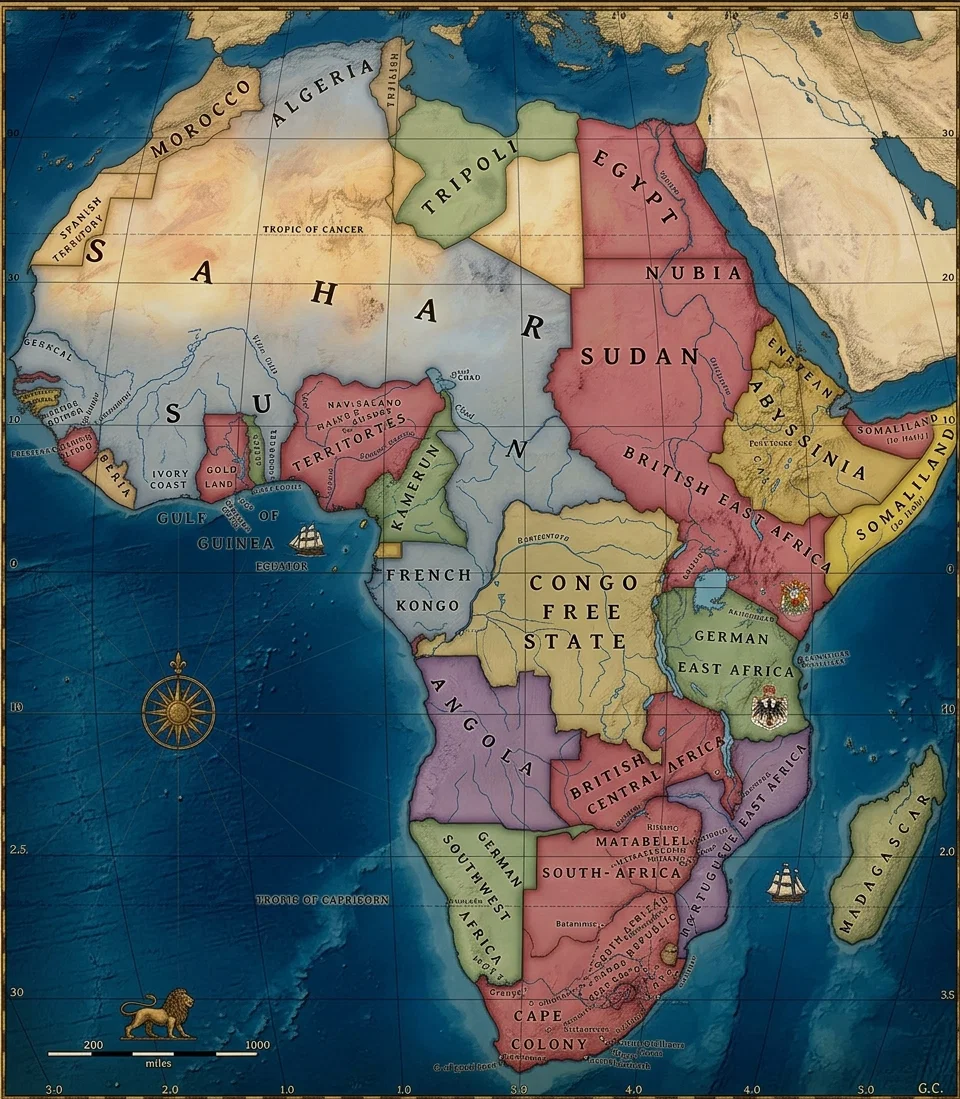
All this has changed. Africa to-day is fast becoming a large European colony, owned by Great Britain, Germany, France, Belgium, Italy, Spain, and Portugal.
The German possessions are the more recently acquired. On the west coast, Germany has Togo, Kamerun, and Southwest Africa; on the eastern coast is German East Africa, the most important of the German colonial possessions, with the largest population (about 6,000,000). While thus far only about fifty miles of railroad has been laid, still the German government has built a number of well-constructed roads, and planted military stations all over the land, so that order and peace are established among the natives, and the slave trade is nearly extinct. The land in general is fertile, and there are a number of mountainous districts quite salubrious for Europeans.
As the work in Germany has steadily advanced until our membership is now about three thousand, our eyes naturally turn to the German colonies. Wherever the subject has been presented to our people, they have felt a desire to help in the great work of enlightening the people who live in heathen Africa. Two thousand dollars has been raised toward meeting the initial expenses in opening up the mission, and the German Union First-day offerings are to be devoted to this field.
We have spent considerable time in investigating the country, and the Hamburg Seventh-day Adventist Association has received the governmental right to acquire and hold mission property in German East Africa,—indeed, the Colonial Department accords to us the same privileges that it grants to other missionary societies,—and we have the colonial governor’s hearty personal invitation to come.
Brother J. Ehlers, a practical gardener of many years’ experience, will be in charge of the mission. He is a man about thirty years of age, and has been a faithful believer in the message for a long time. His previous experiences have been such as to well fit him to undertake the establishment and direction of the mission. He has spent about one year in our Friedensau school. He is accompanied by Brother Enns, a trained nurse from America—a man who, for a number of years, has felt himself called to the work of a medical missionary in Africa. They sailed from Naples, October 23, on the steamer “General,” German East African Line, reaching Dar-es-Salaam, November 12. This port is about twenty-five miles south of the island of Zanzibar.
At this time we can not definitely state just where they will settle, but we expect that they will report soon. They planned to confer first with the colonial governor. We have rather hoped to establish ourselves northwest of Victoria Nyanza, not far from British Uganda. The place could be easily reached by the Uganda road, which crosses from Mombasa to Lake Victoria. Freight can be transported across the lake. As soon as a location has been decided upon, they15will undoubtedly call for means to assist in establishing the mission, and for more workers.
While the German Union has provided so liberally to open up the station, it would seem that our brethren across the waters should be asked to lend us a helping hand. The General Conference voted five thousand dollars toward this enterprise, but as yet this money has not been raised. Of course the Mission Board can not create the funds—it can only receive them. Among the friends of the cause and of missions are there not a number in America who will donate from one dollar to one hundred or more dollars toward the German East African Mission? As we in Germany, with only three thousand members, have already raised three thousand dollars, it seems to me that in a short time the five thousand dollars might be sent to the headquarters of the General Conference in Washington, if those whom God’s Spirit touches will only respond. Brethren, the German Union has two hundred and sixty-five millions of souls to warn of the soon-coming judgment.
Can you not assist us by raising two dollars in the States to our one? We need your co-operation and help, and perhaps the liberality of our American churches in this matter might bring rich showers of blessing to themselves. Would to God that such a wave of giving might visit you that a subscription list in the Review, headed “Five Thousand Dollars for German East Africa,” would quickly be opened, and the list rapidly completed and closed; and above all, brethren, remember in your daily prayers the workers so recently sent out to this new and untried field.
Address your offerings to the Treasurer of the General Conference, 222 North Capitol St., Washington, D. C.
Hamburg, Germany.
New Developments in Missions
By William Ambrose Spicer
W. A. SPICER
Two new moves in the fields abroad are of much significance. The truth had long since taken firm root in other lands. Centers of operation have been established in all continents from which the light would continue to shine out even though cut off from connection with the American field. But it is ours to plant new centers, and aid our brethren abroad in lifting the blazing beacon higher and still higher. We have recently received information that the Australasian Union Conference has taken up energetically a new movement to lay the burden of the work in the Pacific Islands more fully upon the believers in Australasia. Our people there feel the same desire that we do to hasten the evangelization of all the world. They are enthusiastically taking up the missionary forward movement, and aim to do their utmost to sustain and enlarge the missionary campaign in that field, which naturally falls under their care.
DAR-ES-SALAAM
And now comes the word that the German Union Conference, itself a vast and needy mission field, though strong in sturdy growth and conference organization, has launched its own first foreign mission across the seas. It is not their first mission. The German Conferences, with millions of people within their own territory, have all the time carried a burden for the regions just beyond. They have sent out representatives into Austria, Russia, the Balkan States, and Turkey. Thus, in co-operation with the Mission Board, Germany has done splendid work beyond its own borders.
Now we are asked to help our German Union Conference in planting its first over-sea mission station in German East Africa. This enterprise will mean much to the work in Germany as well as to the cause in Africa. The colonial authorities have taken much interest in the matter, and from the new colony the light of truth will shine back to the fatherland. German East Africa is northeast of Nyassaland. Our brethren who are pushing northward from that point toward Uganda will be cheered by this movement.
The vote authorizing a call for this enterprise was cheerfully passed at the Oakland General Conference, and now that the time has come to open the subscription lists, let us cheerfully respond. Two German sisters who have watched for the call have already sent in the first gifts, as will be seen on the last page of this issue.
Among the Women of India
By Georgia Burrus Burgess
GEORGIA BURRUS BURGESS
A short time ago I met an elderly Hindu woman, who was visiting at the house of a relative of hers with whom I was acquainted. Thus came the opportunity of telling her for the first time the “old, old story,” which was so new to her. As she listened, her eyes filled with tears, and she said, “O, I wish I could remain here longer, so that I could learn more! It seems to me there is something in this religion that I have never found before—something that can cleanse my heart.”
One Hindu woman, a widow, whom I had visited but a few times, and whose relatives were trying to get to discontinue studying with me, said to me, “Memsahib, when I hear about your Jesus, my heart seems to melt, and I want to learn more of him. Come as often as you can, and teach me.”
Hari, a Brahman woman, has recently accepted the Saviour, and is rejoicing in him. Her friends and relatives are very much stirred, and she is meeting with much opposition, but she stands firm. A short time ago a mob attacked her home at night, and told her they would give her just so much time to leave the place, as they would have no Christians there. But their threats did not move her. In telling me of these things, she said, “What does it matter if I lose all these? I have found the Saviour, and that is enough.”
A number of years ago a little Hindu girl was attending a mission school in Calcutta. Here she first heard of the Saviour, and learned to love him. One day she went to her teacher, and said, “Memsahib, I love Jesus, and want to be a Christian. Won’t you take me away from my home, and let me live with you, so I can be a Christian?” The teacher explained to her that that would not be pleasing God, but told her if she would pray God in faith, he would open the way for her at the right time.16
Shortly after this the child was married, and of course taken out of school. But she did not forget her early teaching. Within a few years her husband died, and the sad lot of a child widow became hers. Soon after this her father also died, and she was left to the care of an older brother. In this added grief her heart turned again toward the Saviour of whom she had learned in the mission school, and she began to pray that God would open the way for her to become a Christian. She prayed definitely that in some way her brother with whom she was living might be converted; and within a year from the time she began to pray, her brother became a Christian. She, too, was baptized, and after continuing her studies for some time, became a teacher in the London Missionary Society’s Hindu Girls’ School, where she has been working ever since.
About a year ago the attention of this young woman was called to the Sabbath, and she became convinced that it was her duty to keep it. At once the question arose in her mind, How could she go on teaching school on the Sabbath? She felt assured if she refused to teach on that day, she would lose her position. Her anxiety was not so much for herself as for her brother, who had become a helpless invalid, and was entirely dependent upon her. But remembering how God in answer to her prayers had opened the way for her to come out from Hinduism, she believed that he would by some means open the way for her to take this advance step. So going to her pastor, she told him of her conviction, and that she could no longer teach on the Sabbath. Of course he tried to convince her that it was not necessary for her to keep the Sabbath. But, finding it impossible to turn her, at last, rather than lose her from the school where she had taught so faithfully, he arranged to have another take her work on the Sabbath, and she teach only the Bible class. This she has been doing for about three months. So we now have a Sabbath-keeper teaching in the London Missionary Society.
This young lady is very anxious to learn more of the truth and fit herself to carry the message of the Saviour’s soon coming to her shut-in Indian sisters, and we trust that the way may soon open for her to engage in this work.
Missionaries Appointed to Raratonga
Brother G. F. Jones and his wife, who have spent some time in Mangareva and also in work for the Pitcairn Island people, have been requested to locate in Raratonga, and they will take charge of the work during the absence of Brother and Sister Piper.
A Garo Man Learns to Read
A MEDICAL missionary in Tura, Assam, writes of an interesting case, which is one of the encouraging signs to the missionaries who toil alone among the heathen: A young married man came to the office one market morning, and said he wanted to learn to read. There never had been a teacher in his village, but the man bought a little primer, and after asking a few questions, went on. The next week he came back, and read half of the letters, and asked more questions, and went away. He has worked in this way from week to week, and now reads any Garo printed in the English character, almost anything in the Bengali, as well, and has made a start on the English. Although still a heathen in name, the man has been preaching to his villagers; and when the missionary made his first visit to his home, he found many evidences of the working of the Spirit.
Telugu Christians Send Missionary to Natal
The Telugu Christians have sent one very highly esteemed among them as a foreign missionary to Natal, South Africa. This has been done within the last six months, and marks a distinctly new period in the development of the work among the Telugus. The missionary has gone with his family to preach the gospel, and to be a pastor among the natives of India who have gone there as laborers, and are employed on the plantations and estates of Natal. He is sent and supported by the Telugu Christians. This has greatly stimulated among them the missionary spirit, the spirit of prayer, and the grace of giving.
Mission Notes
BROTHER CONRADI writes that our German missionaries en route for German East Africa had reached Aden when he last heard from them.
Boer Prisoners Begin Keeping Sabbath
From Hamilton, Bermuda, Brother J. A. Morrow reports that two of the Boer prisoners with whom they have been holding meetings have begun to observe the Sabbath, and others are interested.
The Work in India Increasing
WRITING of their experiences in India, Brother W. O. James says: “The work in this field is steadily increasing. We find people every day who manifest an interest in the special truths for this time. It is wonderful to see how the Lord goes out before us and prepares the way when we do not see a step ahead.”
Progress of the Work in British Guiana
Brother D. C. Babcock reports the work moving forward in British Guiana, and precious souls accepting the message. They were expecting to have baptism soon, when four will unite with the Georgetown church. Their congregations were so large that the tent could accommodate but about one fourth of its those who came.
Woman’s Condition in Heathen Lands
IN China a man is required to mourn three years for the death of his father, one hundred days for the death of his mother, and not at all for the death of his wife. Indeed, a Chinaman would feel disgraced if he showed any sorrow on account of the death of his wife. This tells its own story of woman's condition in heathen lands.
Missionary Progress in Chang-sha
Dr. Griffith John, writing of the fact that four missionary societies are operating in Chang-sha, the capital of the province of Hunan, says: “It would have been as much as any foreigner’s life was worth to attempt in Chang-sha six years ago. The change is wonderful. I can not think of it without exclaiming with wonder and gratitude, ‘What hath God wrought!’”
The Literature of Missions
The literature of missions has multiplied with a tremendous rapidity lately. Barring fiction, there is no class of books of which so many have been published in the last ten or twelve years. This indicates that there is “a reading public” for this kind of literature; that more people are interested in missions, and that more are eager to become intelligent and well informed on this subject.
Piper Family Leaves Raratonga
On account of failing health, Brother and Sister A. H. Piper have been compelled to withdraw from Raratonga, for a time at least. They will go to Australia, where they will be connected with the work. Writing of their departure, Brother Piper says: “It is with a great deal of regret that we have decided to leave the field, but we feel that we must get away before another hot season begins. We have enjoyed our work with the natives here very much, but ever since arriving three years ago, the climate has prevented us from doing all we wished to do. We hope to complete our church building before our departure. With the trouble we had in securing our land, it has been a long undertaking; but I am glad to say that some of those who opposed our getting the land in the beginning are now helping us to finish the building. The chiefs who at one time persecuted our brethren now let them off from the ordinary work in the village, in order that the work on the church may go on. The school, although the attendance is not very large, is doing nicely. There is an excellent spirit among the native youth attending. One young man, who has shown undoubted signs of a thorough conversion, and whose whole desire is to become a missionary, we are taking with us to Cooranbong, that he may attend the school there.”
English People Near Pua Hear the Truth
Of the English people, near Pua, Chile, Brother H. F. Ketring writes: “I held a meeting with them, and I never had a warmer reception. They listened eagerly as I told them of the blessed hope, and how we must prepare to share in its fruition. And as they took my hand to bid me good-by, they begged me to come back and talk to them again. They had heard of my meetings in the other colony, and asked that I come over and visit them. Thus the people are longing to hear the truth. It did me good when I entered, to see lying on the center table a full morocco ‘Bible Readings,’ a full morocco ‘Great Controversy,’ and also a cloth one. They have been read, too. Thus the faithful canvasser sows the seed, and another reaps. We are pushing forward, and the Lord is giving us the victory.”
A Missionary Needed for Africa
BROTHER A. J. HAYSMER, writing of the return of Brother D. U. Hale and family from the West Coast of Africa, on account of the condition of their health, says he would gladly step into the gap, if it were thought best, still it does not seem wise for him to take his family into that unhealthful climate. We confidently expect that somewhere the Lord has some one in preparation to enter that needy field, and carry forward the work already begun at such sacrifice.
East Michigan
By E. K. Slade
DECEMBER 26 and 27 it was my privilege to meet with the brethren at Rives, in company with Elder Cowell and Brother F. G. Lane. Brethren Lane and Boylan had been laboring at this place for a few weeks in the past, and as a result a few new believers were added to the little company at that place, bringing courage and rejoicing to all. On Sunday we organized a church there with a membership of fourteen, and with a full corps of officers. The Lord's Spirit was very clearly manifested in choosing and setting apart the officers of the church, and it did us good to see the loving, humble spirit shown by all the brethren. A good school is in progress at Rives, which is held in a part of Brother Kienest's house, fitted up for that purpose. We believe that the brethren at Rives are doing a good work, and that others will join their company in the near future. All departments of the work are in good progress in this new church.