WALLSEND.—We have been holding forth the word of life at this place since the latter part of last November. Other workers had preceded us, and a small company of believers were holding fast the precious truth. We realized the need of a place in which to worship, and when we placed the matter before them, all were ready to respond. Although poor, yet each family pledged twenty-five dollars, and also promised to collect from their friends: so we have now a neat little church, seventeen by twenty-six feet, with a very steep roof. It sets on a hill overlooking the lower parts of the city, yet it is quite central.
A church school has been in session the past three years, and very soon a schoolroom must be added to the church. We have sufficient land, nicely fenced in. Building we find is somewhat more expensive here than in the United States.
On Sabbath, March 14, we organized a church of twenty-one members. The next day seven persons were baptized, and will also become members of the church. We praise the Lord for his goodness and mercy in thus working for his children in such times of drought and distress. Our brethren are of good courage in the Lord, and are pressing17on in the work of the Lord. At Hamilton, seven miles distant, the church has taken hold of the book work. One sister has sold fifty copies of “Christ’s Object Lessons,” and others have sold ten or more. All are anxious to see the work make progress. Attention also has been given to our debt on the church; weekly sacrifices are being made, and we are glad to see the interest that is being taken in this matter.
We expect soon to leave this part of the vineyard, for aggressive warfare in new fields in other parts of the State.
W. WOODFORD.
Northern Chile
By A. R. Ogden
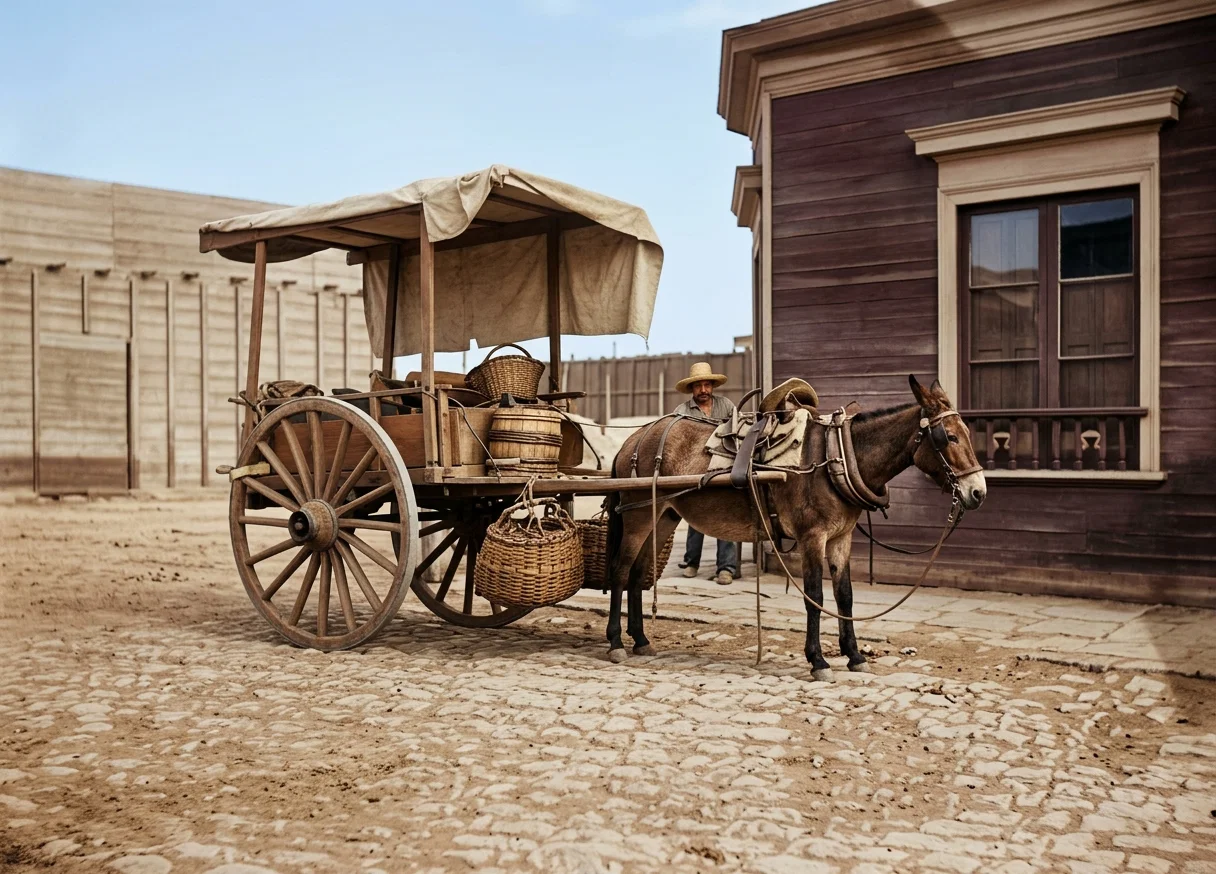
A CHILEAN GARDENER'S CART
Living in northern Chile is very different from living in the southern part. In the south everything grows, and consequently living is very cheap. But here in the north, where it is simply a great, barren desert, it never rains, and consequently nothing grows, and living is much more expensive. Everything that is eaten is brought from other parts; even the water is brought from the interior mountains, a distance of forty or fifty miles. Water carts deliver this water, so it can be bought by the pail or by the barrel, as one likes. There are probably one hundred of these water carts in Iquique, a city of thirty thousand people. These water carriers are18always on the street, anxious for the opportunity of selling a bucketful, or a barrelful. When one buys water in this way, he soon learns to be very economical of the water he uses.
Perhaps you wonder why people live in such parts of the country. It is because of the great amount of saltpeter. There are hundreds of mines, which employ thousands of men, the saltpeter really constituting the wealth of the country. A. R. OGDEN.
West Coast (South America) Mission Field
By A. R. Ogden
IN this field the year 1902 has been a year not so much of harvest as of seed-sowing, although forty-two persons were baptized during that time. We recognize the advantages of circulating our literature, and believe that what has been said of The Signs of the Times as a pioneer missionary paper among English-speaking people, is equally true of our Spanish literature in Spanish fields. So we are endeavoring to make our Spanish Signs of the Times, Señales de los Tiempos, a pioneer for this field of four republics, for which it is published.
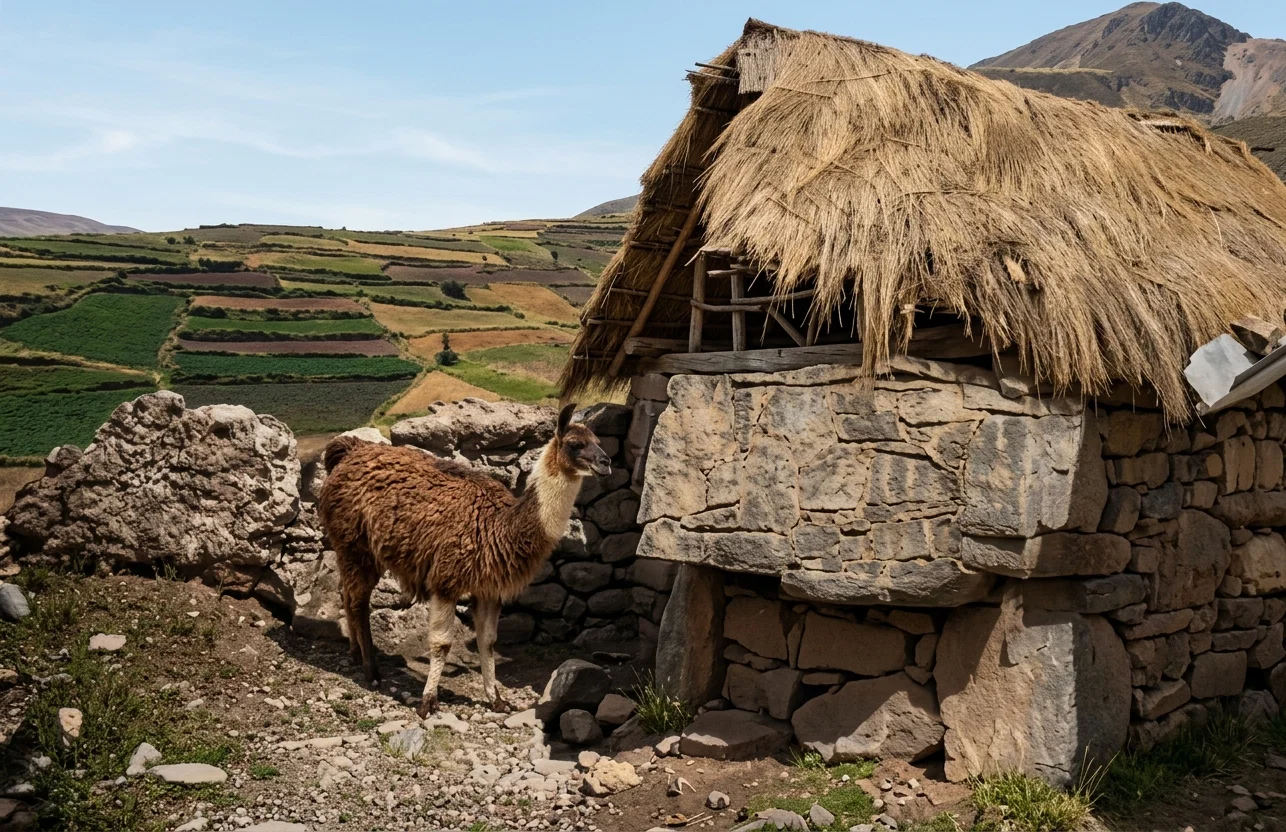
A NATIVE HOME IN PERU
Until the year just past little effort had been made to open up the work in the other three republics, the work being limited almost entirely to Chile.
The first of last September two brethren started for Bolivia, selling tracts, books, and papers. They worked especially in the interests of the paper Señales. During the trip of four months they sold about twenty-three hundred copies of the paper, and took nearly eight hundred paid yearly subscriptions. In one city, La Paz, they secured one hundred and eighty yearly subscriptions, and sold nearly eight hundred copies in less than three weeks' time.
We rejoice in this good work. At our committee meeting in the early part of 1902 it was suggested that we send a man to Bolivia to secure the names of persons to whom we might send the paper free. But how much better that the people themselves should pay for the paper, as they will be much more liable to read it. And besides, the paper work has not been made a burden of debt to the Mission Board. The last year it has been self-supporting, with some gain financially after paying the expenses of printing fifty-seven thousand copies during the year. We are now printing eight thousand monthly, with and hope soon to print ten thousand; so the present year we expect to print and circulate more than one hundred thousand copies. The sowing of this seed will certainly bring some fruit.
At our recent committee meeting, plans were laid to send one or two colporteurs into each of the other republics, — Peru, Bolivia, and Ecuador. Thus we hope to see the work open up in all parts of the field.
Our force of workers is now small, only two ordained ministers in the field. Elder Balada, having a desire to carry the truth to his native land, is going to Spain in a few days. Last year he labored in Peru. Ecuador is the only untouched field, but within a few months we expect to have one or more workers enter that country, and then at least a beginning will have been made all along the coast.
A. R. OGDEN.
Iquique, Chile, Casilla 240.
Prince Edward Island
By Wm. Guthrie
We have now been in this field about eleven months. In all this time we have been constantly at work in the pulpit and with the people.
A number of honest souls are becoming interested in the simple and plain message the Lord is sending to them.
During all this winter we have been placing in the homes of the people tracts and pamphlets, with the hope that the spell that holds them to their old customs may yet be broken, and they made free indeed.
I have distributed reading-matter at the market to the farmers who come with their produce from week to week. One lady who lives in the neighborhood where I tried to hold meetings last fall, but was prevented by the fierceness of the Church of England rector, wanted to know if I intended to come out there again. I told her that I intended to make a visit to that place. She then told me to come to her house, as it was open for a meeting if they would not let us have the hall. This lady is a parishioner of the rector who closed the hall against us.
The last Sunday of April we had our hall here in Charlottetown well filled with interested and attentive listeners. Our real interest at present seems to be the best that we have had since we spoke on the Sabbath question. For this we thank God, and take courage.
We are in great need of a consecrated young man to sell and distribute tracts throughout the island. Who will answer the call, “Go work in my vineyard to-day”?
The long, weary winter is past, and we rejoice at the approach of the beautiful summer season. But as the evenings are so cool, we are building a sectional structure of wood to use instead of the tent. This has kept us very busy for the past two weeks; but we hope to have it completed by May 20. It will seat about one hundred, and will provide rooms for part of the workers, and possibly for all. It will cost about two hundred and sixty dollars when finished.
We are glad to thank our brethren in the States for their kind and timely response to our call for help in this work. Later, when the tabernacle is completed and pitched, we hope to be able to furnish our friends with a picture of the building, and a more extended description of it, together with the names and amounts of donations of those who have answered the call God made in their hearts to help us.
May love, unity, and true fidelity in God's cause lead us to forsake all and follow him. Our hearts go out after this people, and we claim a people for his name from this place.
WM. GUTHRIE.
Charlottetown.
Blessed in Giving
By M. E. Olsen
THE hearts of the brethren and sisters in this country were deeply touched by the generous action of our American brethren in raising ten thousand dollars toward the Caterham Sanitarium, and it was with a hearty good will that they started out to raise the remaining five thousand dollars, or one thousand pounds.
Some of our smallest and poorest companies were enabled in a remarkable manner to do their full share. To raise this sum of money means much more in this country than in America. The writer, together with Brother Nethery, of Wyoming, had the privilege of meeting with the little company at Catford on the day when the sanitarium offerings were taken up. The members of this company are working men. They live in very plain quarters, and work hard to make a living for their families. It was good to hear them relate the various providences that had made it possible for them to give so liberally toward this enterprise. But they were yet to do more. When the collection had been taken, they wished to know how much it amounted to. The money was counted, and it was found that about four pounds would be required to make up the full quota of a pound for each adult member. The Spirit of the Lord came in in a marked manner as one after another gave or pledged an additional gift till the entire sum was reached. We could not but feel that some of these dear brethren were really giving more than they were able, but they acted entirely voluntarily, and their faces beamed with joy. It was a most excellent meeting.
The company at Westbourne Park, numbering twelve, just one less than at Catford (these names, it should perhaps be said, represent simply certain districts or suburbs of the city of London) had what was in some respects a still more remarkable experience. Its members are mostly sisters whose husbands are not in the truth. Some of them are very poor. Nevertheless, when the matter was presented, the leader took his stand at once, and said, in the words of Joshua, "We be able." The members pledged themselves to do their utmost. Strange to say, one sister, who it was expected would have the greatest difficulty, brought in her pound first, her face beaming with joy. Others took in extra washings, or did other work. The children gave all they had, and some earned their offering by selling the Good Health. Friends and neighbors, learning that this little company had a work of so much moment on hand, and were straining every nerve to accomplish it, gave as their hearts prompted them. Finally when the day for the offerings to be handed in had arrived, each brought a gift, not knowing how much others had; but when the gifts were all counted, there was exactly twelve pounds, one pound for each member. Then they began relating their experiences, and how, in some cases, they had in a remarkable manner received just a little more that very morning. Of course it was now very apparent why these additional sums came in; they were needed to make up the twelve pounds which they had faith to believe the Lord would enable them to raise.
The experience has been a most blessed one to the whole company. They have learned in a very practical way to trust in God, and expect with his help to be able to do great things. During the few weeks while they were having this special experience, two persons began to keep the Sabbath, and a work of revival began among the young people and children, which is bearing fruit for the kingdom. Hence it is the unanimous verdict of the members that they have derived more benefit from the effort than the sanitarium itself has.
In the North London church, some of the boys and young men in the office, and some of the students in the school, went without their breakfasts for some time in order to be able to save money to make a gift toward the sanitarium. Others denied themselves in other ways. This was all done so quietly that only incidentally did some of the particulars become known.
Naturally self-denial and self-sacrifice in securing the money to purchase the place, has helped to make the institution sacred in the eyes of those who labor in connection with it. At the organization of the Caterham Sabbath-school two weeks ago, the few helpers who are already on the ground getting things in readiness for the patients, related some of the things that had come to their knowledge with reference to the efforts made by different ones to donate toward the enterprise, and all felt that everything about the place should be used with the greatest care, and earnest efforts should be made to economize in every consistent way, in order that the best possible use might be made of the money given at the cost of loving sacrifice. Thus the institution takes on a sacred character from the very start, and this is as it should be.
No doubt similar sacrifices have been made by those who have given toward this enterprise in America. These dear friends may be sure that their gifts are appreciated, and that no pains will be spared to conduct the work in such a way that it will be a means of winning souls for the Master.
There is great need of sanitariums in this country. The multitudes are grossly ignorant concerning the simplest health laws, and disease is on the increase. Drink is dragging thousands down into drunkards' graves every year. Sad to say, the habit is increasing most rapidly among the women, so that at the present time more women than men are arrested in London for being drunk and disorderly. We earnestly hope that this sanitarium at Caterham is but the beginning of a great work. M. E. OLSEN.
The Mexican Work
By W. L. Black
Arizona
The Mexican Work
WHEN the work was begun a little over three years ago in southern Arizona, we endeavored to labor among the Mexican population also. The Lord first opened the way for us to present the message to them by means of an interpreter. As a result of the work thus started, two strong churches have been raised up, comprising nearly fifty souls, with one Mexican minister, Elder M. Serna, who has been laboring in New Mexico the past seventeen months. After accepting the message, he awakened much interest through correspondence in various parts. In New Mexico there was an urgent call for him to come and give the truth to those with whom he had worked in his previous ministry, while connected with the Methodist denomination. His work has been quite fruitful there, having raised up one church and three other strong companies in various parts. During his absence, my wife and I have done what we could among these people, to elevate them to a higher standard in the message, and, at the same time, to continue our work among the Americans. The Lord has blessed me in the study of the Spanish language, so that now I am able to speak to them in their own tongue.
About one half of the population of Arizona, with the exception of the Indians, are Mexicans, and the other half are Americans. It appears from this19that the work should be promulgated among both nationalities as one, as far as possible at the same time. If an American and a Mexican worker could labor together, then the work among the Mexican people could be elevated to the proper standard, and the whole field be warned at the same time, thus saving time and expense. Greater plans must be laid to meet the needs of this nationality, since eighty millions of these souls are waiting to hear the sound of the third angel’s message.
The interest that is being manifested among them shows that their doors are wide open, and that the Macedonian cry is calling all to service. The testimony of God’s Spirit has told us that now is the time to enter this part of the great harvest field, and that delay shall be no longer.
Since coming to Nogales, we have entered upon the work among this people. Elder Serna returned from New Mexico to assist me for a time, and to visit our other churches. So far we have had public meetings in a hall for three weeks, with fair interest. Some have taken their stand for the truth. Among these is a Mexican minister, Ralph Acosta, who had been preaching for the Methodists up to the time when he accepted the Lord’s Sabbath. He is an intelligent young man, and we believe he will make a good worker. We hope to see others soon decide to walk in the way of God’s commandments.
Elder Serna tells me of two other ministers in New Mexico who have accepted the truth, and are ready to proclaim the message. One has preached twenty-five years, and the other seven. He says that they are good, honest brethren and faithful workers. We trust these brethren will find a place to work among the millions that must hear the message. Elder Serna is well versed in the truth on all points, and if these brethren could be with him through one or two series of meetings, I am persuaded that they would do efficient work for the Master.
As far as literature is concerned, we are very crippled, having but few tracts and small books in this language. We need the message translated and put into pamphlet form, being illustrated and made attractive in every way for the purchaser. Large books and high-priced literature can not readily be sold to such humble and poor people. My heart aches to see them in their dire needs, and especially their need of a living and indwelling Saviour. When we think of the great responsibility that rests upon us as a people, because of the great light that God has given us, and that the blood of souls will be laid to our charge if we do not impart to those who are in darkness the same light that God has given us, it behooves us to be up and doing.
W. L. BLACK.
Porto Rico
By B. E. CONNERLY
MAYAGUEZ.—We are beginning to speak a little Spanish. We enjoy the study of the language very much, only we sometimes wish that the process might be hastened, as at Pentecost. We have decided, while our tongues are yet dumb so far as the language is concerned, to give the message by means of a paper. And as the people do not seem to care for our papers published elsewhere, we have started one of our own. It has created no small interest and stir here, as it is the first Protestant religious paper on the island. We secured the names of over seven hundred teachers, and are sending them sample copies, also a personal letter calling their attention to the department in education. We are very sanguine of the success of the paper, and shall fill it with the message of God for this time. We have had to stand by the printer’s side almost continually, to teach him how to do the work, as it was all new to him; and as we see the paper now, we conclude most assuredly that the Lord has blessed it already.
The workers of other denominations here seem to fear that our presence is an infringement upon their rights, and we can hope for no encouragement or assistance from them. We are glad to launch our paper first, though we expect that it will soon be followed by others from these other sources. The office where our paper is printed is besieged by people wanting to see that new paper on Protestant religion, and many requests have already been made for us to write on this, that, or the other subject, comparing our views with those of the Catholics. Next month we plan to add a health department, and send a copy to all the doctors.
We are having good experiences, and long for the time when a strange language will not bind our tongues from speaking the message for which these people are asking. We are delighted to have some interested ones attend our Sabbath-school. Pray for us when you are asking for workers to go into these needy places. B. E. CONNERLY.
Current Mention
—Paul Du Chaillu, the famous explorer and author, died at St. Petersburg, Russia, April 29.
—Nine men were killed and twenty-one injured by the explosion of a powder mill at Ganister, Pa., April 30.
—A dispatch from Dallas, Tex., states that Texas crops have been damaged by frost to the extent of $10,000,000.
—The Ottoman Bank at Salonika, Turkey, was blown up with dynamite, April 30. Fighting and rioting continue to be reported from Macedonia.
—The Santa Maria volcano in Guatemala is again active, according to recent reports from that country. The amount of damage done is not stated.
—At the rate at which the tide of immigration is now pouring into this country, the population of the United States will be increased by about 1,000,000 during the present year.
—An attempt to secure exemption of church property in New York City from assessments for improvements, was vetoed by Mayor Low, who pointed out that such a step would reverse the uniform practice of the city and the State for a century.
—A dispatch from Simla, India, to the Exchange Telegraph Company, London, says it is officially announced that the bubonic plague in India infects 9 British provinces, 156 districts, 109 big towns, 7 cantonments, and 51 states. The weekly mortality exceeds 30,000.
—The formal dedication of the Louisiana Purchase Exposition took place at St. Louis, April 30, with imposing ceremonies, President Roosevelt, ex-President Cleveland, and a number of State governors being present. The opening of the fair will not take place until next year.
—Recent temperance legislation at Albany having raised the price of a liquor-tax certificate fifty per cent, the number of saloons in Greater New York has been reduced by about 700, but the total receipts of the saloons show a steady increase. Decreasing the number of the saloons has no necessary connection with a decrease in the amount of drinking.
—The question of the desirability of the separation of church and state is being brought to the attention of the people of France. An elaborate scheme providing for such separation has been prepared, says the Paris Temps, and has the signatures of over fifty Radicals and Socialist supporters of the government. There seems to be ground for the hope that the separation will be realized at no distant day.
—A Chicago stock yards strike which occurred not long ago was settled by the appointment of three clergymen as arbitrators. Recently the clerical arbitrators presented their bill for services, asking $1,000 each. Both the packers and their workmen objected to the bill as being exorbitant, and it was decided at a meeting of their representatives that the arbitrators should be paid at the rate of thirty cents an hour, at which rate the bill amounted to $14.50 each.20
—Cholera is again raging in the Philippines, and threatens to spread over the island of Luzon. Since January, there have been in Manila 101 cases of bubonic plague, confined mostly to the natives and the Chinese.
—A Roman Catholic missionary in China, Shan-tung province, reports that a new Chinese sect, similar to the Boxers, has become very formidable in his vicinity, and that a wholesale massacre of foreigners by the fanatics is in prospect.
—A dispatch from Salonica, dated May 4, says that an engagement between Turkish troops and a band of revolutionists is reported to have taken place in the Monastir district of European Turkey. Both sides suffered considerable loss. Ten Turkish officers are said to have been killed.
—More than a score of passengers and members of the crew on the Clyde line steamer “Saginaw” were drowned as the result of a collision between that ship and the steamer “Hamilton” of the Dominion line, which took place off the Virginia coast in a dense fog, on the morning of May 5, about two hundred miles from Norfolk, Va.
—Members of the Chicago Turn Bezirk who obey the laws of the order must not become members of any State militia, pursuant to a recommendation unanimously adopted at the forty-sixth convention recently held in Grand Rapids, Mich. In the State of Illinois there are several thousand members of the order.
—Wm. Pickens, of Little Rock, Ark., the colored orator of Yale, 1904, has received an invitation to become the head of an Afro-American empire to be established in the island of Hayti. The proposition comes from N. L. Musgrove, of Sturgis, Ky., who is agitating a movement tending toward the seizure of the island of Hayti by American negroes.
—The Protestant Alliance of England did not look with favor on King Edward’s recent visit to the pope, and in a telegram to the king’s secretary at Rome declared its “intense regret that our Protestant king intends to visit the pope, who is described in the homilies of our established church as antichrist;” and expressed its earnest “hope that the rumors are absolutely unfounded.”
—President Loubet, of France, will visit Rome soon. The pope, after consulting his cardinals, has decided not to receive the French president, and this decision will be semi-officially communicated to France. The pope’s refusal to receive the president of France certainly will lead to a diplomatic rupture between the Vatican and the French government and the abolition of the concordat.
—The week ending May 4 was unseasonably cool over the greater part of the country, the minimum temperatures of April 30 and May 1 and 2 being the lowest recorded in the last decade of April and the first days of May for the last thirty years at nearly all the weather bureau stations from the central and west gulf coasts to the upper Missouri Valley, and also at a number of stations in the central Mississippi and Ohio Valleys, the lake region, and New England. Nearly all fruits have suffered further damage from frosts and low temperatures, apples apparently having escaped with the least injury.
—Great Britain has officially warned the powers of Europe that any attempt on their part, or on the part of any one of them, to establish a naval base or fortified port on the shores of the Persian Gulf will be resisted to the utmost strength of the army and navy. The warning was given officially by the marquis of Lansdowne, secretary of state for foreign affairs, in a formal statement to the House of Lords. Lord Lansdowne’s attitude in this matter generally meets with approval, although the answers thereto of the other powers interested in the gulf are awaited with some anxiety.
—The English House of Commons by formal resolution has guaranteed the new Transvaal loan of $175,000,000. In explaining the necessity for the loan Colonial Secretary Chamberlain stated that it had been decided to purchase all the existing railways, which would absorb $65,000,000 of the new loan, and $25,000,000 more would be expended as quickly as possible on the development of railways, $12,500,000 would be spent on land settlement, and $10,000,000 on public works. In addition to this loan an additional loan of $150,000,000 will be made by the Transvaal and Orange River colonies, in three installments of $50,000,000 each. This loan will be the colonies’ contribution to the expense of the war, and will not be guaranteed by the British government.
Danish West Indies
By A. Palmquist
CHARLOTTE AMALIE, ST. THOMAS.—When five or six years ago I volunteered my services to the Mission Board as a self-supporting worker, I did it with no uncertain proof of the Lord’s guidance, and with no other purpose than to serve the Lord with all my power, to the end.
The struggle of a self-supporting missionary for an existence in this part of the field is best known to those who have tried. Through all the hardships endured on land and sea—in hunger and prolonged thirst, in soaking wet day and night in open boats, and without shelter—I have never been discouraged, never longed for “home.” I have enjoyed excellent health, except once, when fever fastened on me. Heat and wet have so far not affected my health. My greatest pleasure is in seeing souls turn to God. And were it not that God gives me fruit for my labors, I might doubt my calling and mission. On the United States of America admiral ship I sold $14.50 worth of books last Christmas. As a result of ship mission work in Barbadoes, as well as in this place, souls are rejoicing in the present truth. Nearly half the members of this church were keeping the Sabbath before I left for St. Croix, or before Elder Haysmer came here. On the island of St. Johns at least two or three are keeping the Sabbath. One was formerly a leader in the Moravian church there. This is a result from the seed sown in Tortola. A. PALMQUIST.
O. A. OLSEN
By Ole Andres Olsen
Scotland
GLASGOW.—I am now in Glasgow, attending the first annual meeting of this mission. Elders J. O. Corliss and E. E. Andross are here. I am glad to report that we have had interesting and profitable meetings. The assistance of these brethren has been much appreciated. The outlook for the work in this field is encouraging. Brother Westworth has been conducting meetings in Edinburgh. Although the work starts out slowly, some are interested, and are beginning to decide for the truth. An aggressive campaign is arranged for the coming season, and we look for good results. At the present time, Scotland is taking the lead in the canvassing work; that is, it is selling the largest amount of books of any division in the British Union Conference.
The brethren here are waiting with interest to see what the General Conference will do for them. This is an important field, and the force of laborers is very small,—one ordained minister, two ministerial licentiates, and three Bible workers, for all Scotland.
A year ago Brother Harry Armstrong was just opening the work here. Before that, canvassers for both books and papers had been at work, and much of our literature has been circulated, especially in Glasgow. This has also borne fruit, and a number have accepted the truth, and others are much interested. The canvassing work is now being pushed more than ever, and the general outlook is encouraging.
O. A. OLSEN
Mission Work Among the Kaffir People
DURING the recent conference held in Uitenhage, South Africa, a recommendation was passed with reference to starting a mission for the Kaffir people in the northern part of Cape Colony. There are many thousands of these people in the South African field, many of whom are educated, having their own newspapers, as well as many books in the Kaffir language. As this language is the foundation of the languages of many tribes in South Africa, workers may be trained here for other parts of the great Dark Continent. A man and his wife are called for, to take charge of the mission. A call is also made for another man and his wife at the mission farm, Matabeleland, and for a man and his wife at Gwelo.
Reports Wanted
By Editor
WE are confident that thousands of our tract society workers are being blessed in their efforts to circulate the new tracts, and we earnestly request such to send us reports of their experiences. We will “pass them on” to others for their encouragement; and thus your little service of love may be extended. Have you by this means interested a friend or neighbor in the “good news” that Jesus is soon coming? Have you seen the Lord working through this means for the salvation of souls? Has your own heart been warmed by your labor of love? Tell us about it. Send such reports to E. R. Palmer, 267 West Main St., Battle Creek, Mich.
Circulation of Tracts in the Early Days of the Message
By Washington Morse
Forty-seven years ago the tenth of next June I went to Minnesota with my family. The first day of July I began work at my trade in Faribault. I sent one dollar to the Review for tracts. On receiving them I started out after my day’s work and sold them all the first night. I then sent one dollar for more tracts, which were soon received, and were sold at once. For twenty weeks I continued to send the dollar as often as the mail could go with it and return with the tracts. All these tracts I sold without consuming time in my working hours, and now I could tell of many Sabbath-keepers, some of whom are filling responsible places in church capacity, in Minnesota and Dakota, who date their conversion to the Sabbath truth from reading those tracts. At that date there were only six families besides mine in Minnesota who kept the Sabbath.
Just forty-four years ago Wisconsin and Illinois donated an old tent to us; and Elder William Ingraham, of Wisconsin, and I held three tent meetings, resulting in bringing out sixty-four adult Sabbath-keepers. We had plenty of tracts and pamphlets, which we circulated freely. But I do not think we had one bound book.
In 1860 Elder J. N. Andrews came to Minnesota and held three tent meetings; and seventy-four Sabbath-keepers were added to our number. We used tracts and pamphlets freely.
Just forty-one years ago next May I was present at the first General Conference held in Battle Creek, Mich., and I filled my trunk with tracts and pamphlets, and took them home to Minnesota. Last March I received four hundred copies of the new tracts, and immediately sold nearly all of them. I sent again, and have just received four hundred more. I am very happy in this blessed work. I shall need to double my orders in a short time. Surely God led my dear brethren to write and publish those blessed tracts; it is the best move ever made by Seventh-day Adventists to remove prejudice and spread these glorious truths. O my brethren and sisters, how can you be idle one hour? Take these and other tracts and work with them. Read them, and let your words be well seasoned with grace.
Every day I find some who are in trouble, and I am greatly blessed in having a season of prayer with them. One year ago I sent one dollar to the Review Office for tracts, and they were soon gone. One old gentleman, a superannuated M. E. minister, was urged to buy three of those tracts, but he would not. I reluctantly let him have them without pay. Last week I called on him with the new tracts. His wife took the tracts, and paid for them, saying that they had been much interested in reading a tract given them by some one, and that her husband had taken it to the editor of21the county paper, and he had published the entire tract. She began to read the tract in the paper. I soon stopped her, and said, “I gave you that tract one year ago.” It was the tract entitled “Is Man Immortal?” written by Elder George I. Butler. I meet those who have read the tract in the paper who esteem it very highly. Here is an instance where God overruled to bring this blessed truth before thousands of people. O my brethren and sisters, how quickly the world could be warned if all of his remnant people would consecrate themselves wholly to the Lord. My brethren, get your hearts in order; for the trumpet of the archangel will soon be heard. WASHINGTON MORSE.
Peterboro, Ontario.
Silent Messengers
By Editor
Our Books, Tracts, and Periodicals
E. R. PALMER . . . Editor
Gather Them In
By F. J. van Alstyne
GATHER them in! for there yet is room
At the feast that the King has spread.
O, gather them in!—let his house be
filled,
And the hungry and poor be fed.
Gather them in! for there yet is room;
'Tis a message from God above;
O, gather them into the fold of grace,
And the arms of the Saviour's love!
Out in the highway, out in the byway,
Out in the dark paths of sin,
Go forth, go forth, with a loving heart,
And gather the wand'rers in!
—F. J. van Alstyne.
The Five New Tracts
By Editor
THE new tracts are still going rapidly. At the General Conference many leading workers stated that these tracts are among the best we have ever issued. Whether this is so or not, let us give them the great circulation called for by their merit, and the times in which we live. Read the report from one of the “old hands,” Brother Washington Morse; and as you do so, may the Holy Spirit inspire you to follow his example.