THE credentials of the faithful Christian are recorded in Matt. 5:44: "Love your enemies, bless them that curse you, do good to them that hate you, and pray for them which despitefully use you, and persecute you."
It is natural to love those who treat us kindly, but it is impossible for the unregenerated man to love those who treat him unkindly. Not so with him who has bowed down in tears under his load of guilt, confessed his sins to God, and his trespasses to his fellow men. Such a one freely loves his enemies. He gladly returns blessings for cursings. He bears the credentials of a Christian character, and can be trusted to represent the kingdom of heaven to a world alienated from God and estranged in sin.
GRIEVED BY RETURNING EVIL FOR EVIL
Many, many times our Saviour has been grieved by His professed followers returning evil for evil. This, too, has often been done without one word of confession to follow. How completely deceived such a professor of Christ must be! He bears the credentials of the evil one, hates his enemies, and scatters from Christ.
When our Lord was abused, He had no mind to retaliate. When He was reviled, He "reviled not again; when He suffered, He threatened not"; but committed His case into the hands of His heavenly Father. The more His persecutors oppressed Him, the more He sent forth waves of infinite love to beat back the tide of human hatred. He saw that His enemies stood greatly in need of Heaven's pardon and help.
THE PRINCE OF SUFFERERS
Under no circumstances has any one else suffered such aggravated abuse as did He who said, "Love your enemies." They scourged Him until streams of blood trickled down His nude back. They pulled and pushed Him about until it seemed as if they would tear His limbs from His body. They plucked off His beard (Isa. 50:6), spit upon Him, ridiculed Him, blindfolded Him, and rudely struck Him in the face.
Physically, our Redeemer was poorly prepared to receive such treatment. He was without sleep all of Thursday night, on trial at break of day, and weak from the loss of blood and the need of food. We may wonder how His Father could look upon the abusive scene and not interfere in behalf of the pale-faced Sufferer.
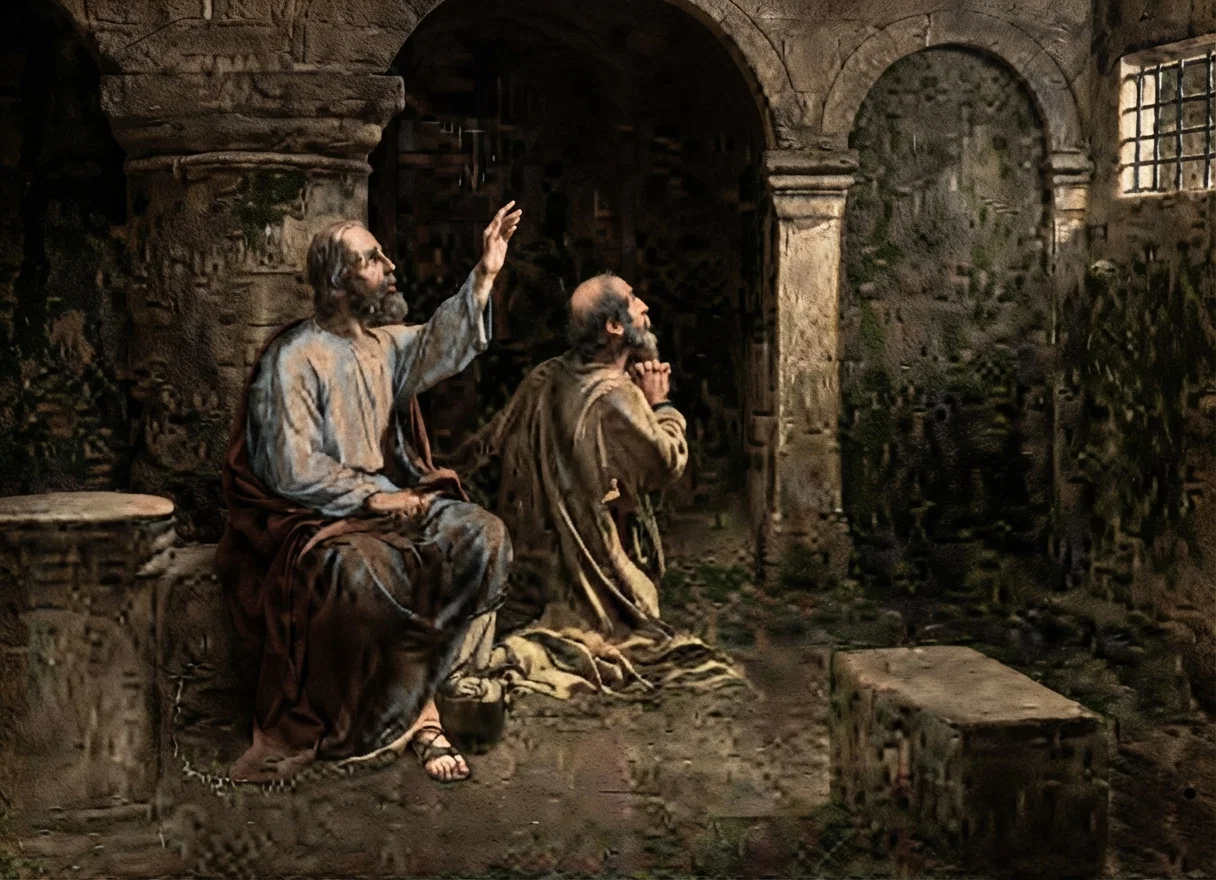
PAUL AND SILAS IN PRISON
LOVE STAYED THE HAND OF JUSTICE
It was the Father's love for us that stayed the hand of justice. It was the yearnings of a Father's heart for His rebellious children that permitted His only-begotten Son to be so roughly handled. In it is a lesson teaching us how to treat our worst enemies. "For even hereunto were ye called: because Christ also suffered for us, leaving us an example, that ye should follow His steps." 1 Peter 2:21.
It is when, like our Saviour, we do well, suffer for it, and take it patiently, that we are acceptable to God. 1 Peter 2:20. Those who meekly bear ill treatment for well-doing testify to the world that they have been transformed into the image of Christ, and that they possess the Christian's credentials of Heaven's immortal principle of divine love.
Levitical Laws and Ceremonies
By Stephen N. Haskell
THE Christian can have no life apart from Christ. John 15: 4, 5. Every detail of his life is directed by the great Master. This was made very clear by the old Levitical rites and ceremonies.
The details of the every-day life of the ancient Israelite were under the direction of God. His food, his dress, his planting and building, his buying and selling, were all regulated by the laws of Moses. To the careless reader, these requirements may seem but a collection of meaningless forms and ceremonies; but to the student of Scripture, who is watching for the steps of his Master, each Levitical law is a reflector, giving him precious rays of light from the Sun of Righteousness.
ALL OF ONE SORT — THE LESSON
We read, "Thou shalt not wear a garment of divers sorts, as of woolen and linen together." Deut. 22: 11. The question is often asked, Why was this requirement given? One of the first things God did for Adam and Eve after they had sinned, was to make clothes for them. Gen. 3: 21.
Garments are a type of Christ's righteousness, with which He clothes every one whose sins are forgiven. Isa. 61: 10. Before man sinned, he was clothed with a garment of light and glory, and God designs that our garments should remind us of the heavenly dress with which He will finally clothe the redeemed. Rev. 3: 5; 19: 8.
God says: "I am the first, and I am the last; and beside Me there is no God." "My glory will I not give to another, neither My praise to graven images." Isa. 44: 6; 42: 8.
A part of our life can not be clothed with the "filthy rags" of our own righteousness (Isa. 64: 6), and the remainder with the pure, spotless robe of Christ's righteousness. We can not serve God in our home and church life, and serve Mammon in our daily business life. The one who continues trying to do it, will never enter the kingdom of heaven. "Ye can not serve God and Mammon."
The Saviour taught the lesson that we can not patch our own filthy robes of self-righteousness with the righteousness of Christ. "No man putteth a piece of a new garment upon an old; if otherwise, then both the new maketh a rent, and the piece that was taken out of the new agreeeth not with the old." Luke 5: 36.
The Israelite who conscientiously refused to mingle woolen and linen in his garments, and saw in it the lesson God designed to teach, would also refrain from sin. His entire dress, made of but one kind of cloth, would constantly remind him of the perfect robe of Christ's righteousness, given to the faithful.
WORKING THE OX AND THE ASS TOGETHER
As the Israelite started out each morning to assume his daily tasks, another command constrained him: "Thou shalt not plow with an ox and an ass together." Deut. 22: 10. The ox was a clean animal; the ass, or donkey, was unclean. Lev. 11: 3, 4. While each was useful, yet they were not to be yoked up together.
The Saviour prayed, not that we should be taken out of the world, but that we might be kept from the evil in the world. John 17: 15. While we may use the world, as the Israelites used the unclean ass, yet we are not to yoke ourselves up with any of the evil of the world. "Be ye not unequally yoked together with unbelievers: for what fellowship hath righteousness with unrighteousness? and what communion hath light with darkness? and what concord hath Christ with Belial? or what part hath he that believeth with an infidel?" 2 Cor. 6: 14, 15.
INCLUDES MARRIAGE AND ALL OTHER RELATIONS
This command includes the marriage relation and every business connection. Ungodly business men often use methods, in conducting their business, that a Christian could not use without compromising his Christian integrity.
The Christian is to bear Christ's yoke, and engage in no business in which Christ can not help him carry the burden of cares and perplexities connected therewith. The Saviour says to all, "Take My yoke upon you, and learn of Me; for I am meek and lowly in heart: and ye shall find rest unto your souls." Matt. 11: 29.
SHALL NOT SOW DIVERS SEEDS TOGETHER
All the precepts of the Old Testament are irradiated with the glory of the Son of God. Especially is this true of the command, "Thou shalt not sow thy vineyard with divers seeds: lest the fruit of thy seed which thou hast sown, and the fruit of thy vineyard, be defiled." Deut. 22: 9.
Horticulturists know the value of this command. Sowing together wheat and oats ruins the oats and injures the wheat. This, like the other Levitical laws, referred to more than the temporal prosperity of the Israelites. It taught them that if they would remain true to God, they must not associate with evil companions. "Be not deceived: evil communications corrupt good manners." 1 Cor. 15: 33.
CORRUPTING GOOD MANNERS
The Revised Version of the New Testament reads, "Evil company doth corrupt good manners." The Twentieth Century New Testament makes it stronger, showing that the contamination of evil association affects more than the outward manners. It says, "Do not be deceived; good character is marred by evil company."
The Syriac New Testament gives us a side-light on what is included in the term "evil company," or "evil communication," as follows: "Be not deceived. Evil stories corrupt well-disposed minds." It matters not how they may be received, whether orally, or through the fashionable novels, or in the columns of the daily paper. The truth remains the same, — well-disposed minds are corrupted by them.
Just as truly as wheat, which furnishes us our daily bread, is injured by being mixed with other seed in the field, so the most spiritually minded may be led astray by associating with evil persons, for "their word will eat as doth a canker." 2 Tim. 2: 17. "Did not Solomon king of Israel sin by these things? yet among many nations was there no king like him, who was beloved of his God, and God made him king over all Israel: nevertheless even him did outlandish women cause to sin." Neh. 13: 26.
"By beholding we become changed," is a law of our being. If we behold with open face the glory of the Lord, we are changed into His image. 2 Cor. 3: 18. If we let our minds dwell upon evil things, we become evil. Like David, we need to pray, "Turn away mine eyes from beholding vanity; and quicken Thou me in Thy way." Ps. 119: 37.
MAKE A BATTLEMENT FOR THE ROOF
To the individual building a house the command was given, "When thou buildest a new house, then thou shalt make a battlement for thy roof, that thou bring not blood upon thine house, if any man fall from thence." Deut. 22: 8. The houses in Palestine generally have flat roofs, and on them men sleep or walk to enjoy the fresh air, converse together, etc. The need of the battlement is quite evident.
But there is also a deep spiritual lesson taught in the command. Every man builds his own character. Paul says, "Ye are God's building," and every building will be tested by the Lord. 1 Cor. 3: 9-17.
It is possible to build a character that will pass the test of the Judgment, and in this world stand as a beacon light in the moral darkness of sin, guiding others safely into the haven of rest. On the other hand, like the housetop without any battlement, we may be the cause of ruin to many souls. In our character building, we need to make straight paths for our feet, "lest that which is lame be turned out of the way." Heb. 12: 13.
CHANGING THE FEATURES OF THE MARBLE STATUE
It is said that the rigid features of a marble statue may be made to vary their expression, so as even to smile, when skilful hands move a bright light before it. In like manner the plain command, "Thou shalt not muzzle the ox when he treadeth out the corn" (Deut. 25: 4), when viewed in the light of the New Testament, contains spiritual lessons for the Christian church.183
DO NOT MUZZLE THE OX THAT WORKS
In writing of the support of the Christian laborer, Paul says: "It is written in the law of Moses, Thou shalt not muzzle the mouth of the ox that treadeth out the corn. Doth God take care for oxen? or saith He it altogether for our sakes? For our sakes, no doubt, this is written." 1 Cor. 9: 9, 10.
Then he proceeds to explain that if we receive spiritual help from the Christian workers, we are in turn under obligation to give them of our "carnal" or temporal things. We have no more right to enjoy the spiritual aid derived from Christian workers without giving financial aid to support the work, than the ancient Israelite had to muzzle the ox that was patiently treading out his grain.
Paul closes his argument by showing that the same system of tithing given by God to sustain His work anciently, is still binding on the Christian church. "Do ye not know that they which minister about holy things live of the things of the temple? and they which wait at the altar are partakers with the altar? Even so hath the Lord ordained that they which preach the gospel should live of the gospel." Verses 13, 14.
MUZZLE THE IDLE OX
"Thou shalt not muzzle the ox when he treadeth out the corn," contains a lesson for the Christian worker as well as for those for whom he labors. The muzzle is not put on the ox "when he treadeth out the corn"; but if the ox stands idly by and does not tread out any grain, then it would be all right to muzzle him. The command is far-reaching, and requires of the laborer in God's cause faithful service, at the same time that it lays upon others the obligation of faithfully supporting the gospel laborers.
Surely the following words of Tyndale apply to this text: "Similitudes have more virtue and power with them than bare words, and lead a man's understanding further into the pith and marrow and spiritual understanding of the thing, than all the words that can be imagined."
BITTERN BY THE WILDERNESS SERPENTS
During the forty years' wandering in the wilderness, the children of Israel passed through varied experiences. Like humanity of the present day, they failed to be thankful for the protecting care of God. They did not see that God had shielded them from the poisonous reptiles that had infested their pathway through the desert. God removed His protecting care, and allowed the fiery serpents to come among the people, "and they bit the people; and much people of Israel died." Num. 21: 5, 6.
The people confessed that they had sinned and spoken against God, and pleaded with Moses to pray for them. God told Moses to make a serpent of brass and set it up on a pole, and every one that would look upon it should live.
Hope sprang up in many hearts, as they lifted the heads of their dear ones and directed their eyes toward the serpent. As soon as the gaze of those who were bitten rested upon it, life and health came back to them.
SO SIMPLE—ONLY TO LOOK
The remedy was so simple—only to look—that some scoffed at it; but in refusing to look, they refused life.
The introduction to the wonderful words of John 3: 16 are, "As Moses lifted up the serpent in the wilderness, even so must the Son of man be lifted up: that whosoever believeth in Him should not perish, but have eternal life." Verses 14, 15.
As the serpent was lifted up on the pole, so Jesus Christ was lifted up on the cross. As the Israelites were to look at the brazen serpent, so sinners must look to Christ for salvation. As God provided no other remedy than this looking for the wounded Israelite, so He has provided no other way of salvation than faith in the blood of His Son. As he who looked at the brazen serpent was cured and did live, so he who believes on the Lord Jesus Christ shall not perish, but shall have eternal life.
FATAL EFFECTS REMOVED IN NO OTHER WAY
The fatal effects of sin can be removed in no other way than by the means God has provided. The old serpent, which is the devil, is wounding men and women on every side by his deadly bite; but Christ has shed His blood upon Calvary's cross, and every one who will look to Christ, believing that His blood will cleanse from all sin, will be free from the poison of the serpent's bite. 1 John 1: 9.
Of the command, "Whether it be cow or ewe, ye shall not kill it and her young both in one day" (Lev. 22: 28), Andrew Bonar gives the following comment: "Some say this was meant simply to discourage cruelty. No doubt it had this effect. But a typical reason lies hid, and is very precious. The Father was to give up His Son; and the Son was to be, as it were, torn from the Father's care by the hands of wicked men. How could this be represented if both the ewe and her young were offered together? This part of the truth must never be obscured, that God so loved the world, that He gave His Son. And the bleatings of the tender lamb in its parent's ears, as it was taken from the fold, filling the air with sadness, represented the bleatings of the Lamb led to the slaughter, who so sadly wailed, Eli, Eli, lama sabachthani? . . . We see thus a picture hung up in every house of Israel of that great truth, God spared not His own Son, but delivered Him up for us all."
Christ in the Sanctuary Types
They Had a Significant Typical Meaning—The Central Figure Was Christ and His Righteousness—We Are to Have His Goodness and Tenderness Without Any Alloy
The Martyrs—Who Are They?
By F. D. Starr
THE term "martyr" occurs three times in our common English version of the Bible, once in the plural form. Following are the instances:
"And when the blood of Thy martyr Stephen was shed, I also was standing by, and consenting unto his death." Acts 22:20.
"Thou holdest fast My name, and hast not denied My faith, even in those days wherein Antipas was My faithful martyr, who was slain among you, where Satan dwelleth." Rev. 2:13.
"I saw the woman drunken with the blood of the saints, and with the blood of the martyrs of Jesus." Rev. 17:6.
But the original word translated "martyr"—martus or martur—occurs much oftener. A good illustration of this is found in Acts 22:15: "For thou shalt be His witness unto all men of what thou hast seen and heard." Here the word "witness" is martus in the original, the identical word found in Rev. 2:13, and there rendered "martyr."
In fact, the same word is used by Paul in Acts 22:20 as in verse 15, though in one case it is translated "witness" and in the other "martyr."
Another instance of this use of the word is found in Acts 26:16: "To make thee a minister and a witness." Here "witness" is derived from the original word for "martyr."
By reference to Greek lexicons, we find that the meaning of this Greek word is witness. The same fact may be learned by searching for the derivation of the word as given in an English lexicon. "To be a martyr, signifies only to witness the truth of Christ." (South, quoted in Webster's dictionary.)
It will be seen that the Revised Version has followed this suggestion, by the use of the term "witness" instead of "martyr." The following are a few of the instances where the original word for "martyr" is found translated "witness": Rom. 1:9; 1 Peter 5:1; Rev. 1:5. Please examine these.
By consulting the Septuagint, the Greek translation of the Old Testament, we find the same use of the term "martyr." "The murderer shall be put to death by the mouth of witnesses: but one witness shall not testify against any person to cause him to die." Num. 35:30. "Even I know, and am a witness, saith the Lord." Jer. 29:23. Other passages might be cited, such as Ruth 4:9, 11; Joshua 22:27, 28, where the word for "martyr" is rendered "witness."
The same original term is also used in speaking of false witnesses. "A false witness that speaketh lies." "A false witness shall not be unpunished." "A false witness shall perish." Prov. 6:19; 19:5; 21:28. The same word is here used as that rendered "martyr" in some New Testament texts.
It is very evident, from these scriptures, that the primitive meaning of the term "martyr" is simply witness. But so many witnesses for the gospel were put to death that the term "martyr" acquired the meaning of one who suffered death for his witnessing for Christ—sealed his testimony with his blood. "They overcame him by the blood of the Lamb, and by the word of their testimony; and they loved not their lives unto the death." Rev. 12:11. The word here translated "testimony" is from this original word for "martyr."
We must all be true martyrs in the original sense of the word, and we may become martyrs in the commonly accepted sense of the term. F. D. STARR.
Wanted
"SINGLE, middle-aged man to tend bar; no drinker or cigarette smoker need apply." This advertisement appeared in a daily paper. If liquor and tobacco are undesirable for a bartender, an occupation requiring perhaps as small an amount of capacity or skill as any, they surely are unsuitable for one engaged in any of the higher vocations of life. Think of using those things which unfit one for even a bartender! This should serve as a hint, at least to the wise youth.—Selected.
Making Mountains of Molehills
“God can make a mole-hill out of a mountain as easily as some men make a mountain of a mole-hill.”
"THIS IS THE LAW AND THE PROPHETS"
By Alonzo T. Jones
"Therefore all things whatsoever ye would that men should do to you, do ye even so to them: for this is the law and the prophets." Matt. 7: 12.
E VERY word of this sublime statement will bear emphasis. "Therefore all things whatsoever ye would that men should do to you, do ye even so to them: for this is the law and the prophets."
This is, indeed, the "law and the prophets." It is the "substance of all relative duty." It is "the Scripture in a nutshell." This is the rule by which our just and merciful Father in heaven would have us treat one another in this desolate world. And if this grand yet simple precept were obeyed by all, much of the sorrow and pain and cruelty now inflicted upon the human family would not be known.
But this was a religion with which the masses to whom Christ was speaking were unacquainted. This was a kind of treatment they had never witnessed. True, the principle had been set forth in the law and by the prophets; but it was not understood, and of course not lived out.
EVEN THE TEACHERS KNEW IT NOT
The great teachers themselves had failed to comprehend the principle, and were trampling it beneath their feet. Christ pointed this out, and told the people that their righteousness must exceed the righteousness of the scribes and Pharisees. Said He, "Do not ye after their works: for they say, and do not." They bound heavy burdens, grievous to be borne, and laid them on men's shoulders; but they themselves would not move them with one of their fingers. They devoured widows' houses. They sought the uppermost rooms at the feasts, the chief seats in the synagogues, and greetings in the markets.
All this was the exaltation of self and a flagrant violation of the law and the prophets, which they daily expounded to the people.
The law inculcates love; and "love worketh no ill to his neighbor." To live the law in reference to our duty to our fellow men, is to treat others, under all circumstances, just as we would have them treat us were we in their place. "Thou shalt love thy neighbor as thyself," is the sum of the last six commandments of the Decalogue.
AS FOUND IN OLD TESTAMENT PRECEPT
This was taught most positively by Moses and the prophets. Said Moses, "Ye shall do no unrighteousness in judgment, in mete-yard, in weight, or in measure. Just balances, just weights, a just ephah, and a just hin, shall ye have." Lev. 19: 35, 36. "Thou shalt neither vex a stranger, nor oppress him. . . . Ye shall not afflict any widow, or fatherless child." Ex. 22: 21, 22. The rich were not to exact usury from the poor. The raiment taken for a pledge was to be restored before the "sun goeth down." The last sheaf was not to be taken from the field, nor the last grape from the vine. "It shall be for the stranger, for the fatherless, and for the widow." Deut. 24: 19-21. "Show mercy and compassions every man to his brother: . . . and let none of you imagine evil against his brother in your heart." Zech. 7: 9, 10.
This and much more is the teaching of the law and the prophets respecting man's duty to his fellow men. Every one is to consider the trying, unfortunate position of his neighbor, and then treat him with the justice, mercy, and compassion that he himself would crave. Accordingly, the apostle says: "Look not every man on his own things, but every man also on the things of others." "Let all bitterness, and wrath, and anger, and clamor, and evil-speaking,
be put away from you, with all malice: and be ye kind one to another, tender-hearted, forgiving one another."
"Love is the fulfilling of the law," and "love seeketh not her own." "Therefore all things whatsoever ye would that men should do to you, do ye even so to them: for this is the law and the prophets."
A. G. D.
SATAN'S REBELLION AND ITS RESULTS
By R. C. P.
In Creating Intelligent Beings, God Took a Risk—If Created Free, There Was the Chance for Sin—Lucifer, the Author of Sin, Once the Highest Created Being
THE universe was born of the love of God. It burst into songs of unrestrained joy in response to the love which gave it birth. When His creative work was finished, and God saw the joy of a universe of newly born beings basking in the delights of His love, He rested from His creative work, and was refreshed. An innumerable company of angels formed the highest order of the subjects of the kingdom of love. Heb. 2:7.
THE RISK OF SIN
In the creation of intelligent beings, God took the risk of the entrance of sin. He must of necessity take that risk if He would create them free. The right of choice in His worship and service involved the risk of sin. That God in creation faced that problem and assumed that risk is evident, since from the beginning He gave the freedom of choice to all, and gave warning against disobedience.185
Great as was that risk, it is shared still by every parent who brings a child into the world to satisfy the longing of parental love. The child may go wrong, but the parent takes the risk, that he may have the joy of fatherhood. So the great fatherly heart of God would rather take the risk of sin than be denied the privilege of rendering loving service to a universe of loving children.
WOULD NOT BE SERVED BY AUTOMATONS
In creating intelligent beings, He must risk disobedience, bringing sin, with all its train of evil, into His kingdom, or by enforced obedience be served by automatons with no more character than machines. In enforced obedience, the act would be His, not theirs; hence they would develop no character. A God of love could but take the risk and leave His children free.
Since righteousness is character, and God will not enforce character, He therefore, strictly speaking, created intelligent beings neither righteous nor unrighteous. He created them innocent as a child before character is developed, with the capacity to form righteous characters through obedience, or unrighteous characters through disobedience.
HE SAW BEYOND THE TEARS AND HEARTACHES
He who saw the end from the beginning, knew that His plan would succeed. Isa. 46:10. Although sin should enter, He saw beyond the tears and heartaches which it would bring for a brief span, and beheld a redeemed host joining the great throng of the millions of unfallen worlds ascribing glory, honor, thanksgiving, and praise to their Creator and Redeemer throughout endless ages. Rev. 5:13.
In taking the risk of sin invading His kingdom of perfect peace and love, God therefore took the risk of sorrow, pain, and death marring for a time His kingdom, and causing the ruin and loss of some of His loving subjects, and deep grief to Himself. Yet, at the last, this seeming defeat of His purpose to establish a kingdom where love should be all-pervading and everlasting would bring a new opportunity to manifest His love; and since nothing can be done against the truth, but for it (2 Cor. 13:8), in the end the love that took the risk of sin in order to create free subjects, will be rewarded.
Eternity will be none too long for loyal subjects of the kingdom of God to praise the God of love who created them free.
WILL WE GRASP THE MARVELOUS MEANING?
"God is love." This expression has become so common that there is danger of passing it without grasping its marvelous meaning. It is the character of God, the foundation of His great creative and redemptive work. In it are infolded all of the unfathomable depths of infinite wisdom, power, holiness, truth, mercy, and justice, which are the attributes of God. It is the mainspring of every act of God, manifested in inexpressible goodness, for the word "God" means good. His all-pervading love, which encircles all created intelligences, from the center to the circumference of His vast universe, stoops to no selfish pleasure, and is too honorable for any unworthy act.
CREATED FOR HIS PLEASURE
When, therefore, it is said, "Thou art worthy, O Lord, to receive glory and honor and power: for Thou hast created all things, and for Thy pleasure they are and were created" (Rev. 4:11), He is worthy to receive glory and honor because, while creating for His own pleasure, He created in love. And love "doth not behave itself unseemly, seeketh not her own." 1 Cor. 13:5. Love seeks the pleasure of others, for no other reward than the pleasure of seeing them happy and receiving returns of love for love dispensed. And "there is no respect of persons with God." Rom. 2:11. Therefore, since "love is of God; and every one that loveth is born of God, and knoweth God. He that loveth not knoweth not God; for God is love." 1 John 4:7, 8.
LUCIFER A COVERING CHERUB
While unsurpassed acclamations of joy arose from every creature in the universe, God stationed created beings in the positions for which each had been prepared to serve the interests of His kingdom best. In the places for which each had been prepared, all would find their highest pleasure.
God set Lucifer next to Christ as a covering cherub. Eze. 28:14. Between two covering cherubs, God sat upon His throne to administer the affairs of His kingdom. Ps. 99:1. Lucifer was therefore honored by receiving the highest position of any created being. For a period, all responded to the love of God, in love fulfilled His holy law, and anthems of harmonious praise poured forth from every part of the habitable universe.
LUCIFER'S REBELLION AND THE ENTRANCE OF SIN
Having been placed second only to Christ, as a covering cherub, Lucifer stood in the immediate presence of God as an attendant to perform His bidding. Lucifer occupied the highest position of which he had been made capable. But as Christ occupied a higher place, there was a test of character in Lucifer's relation with the throne of God. Opening his heart to the suspicion that God had not done the best thing for him in assigning him his position in the universe, his heart became so lifted up in pride that he sought to exalt himself to a higher position by dethroning the Creator.
That this covering cherub was a created being, that he was created perfect, that the spirit of pride which led to his desire for supremacy caused the entrance of sin and the announcement of its penalty, is all plainly told by the prophet Ezekiel, who introduces him under the figure of the king of Tyre.
"Moreover the word of the Lord came unto me, saying, Son of man, take up a lamentation upon the king of Tyrus, and say unto him, Thus saith the Lord God; Thou sealest up the sum, full of wisdom, and perfect in beauty. Thou hast been in Eden the garden of God; every precious stone was thy covering, the sardius, topaz, and the diamond, the beryl, the onyx, and the jasper, the sapphire, the emerald, and the carbuncle, and gold: the workmanship of thy tabrets and of thy pipes was prepared in thee in the day that thou wast created. Thou art the anointed cherub that covereth; and I have set thee so: thou wast upon the holy mountain of God; thou hast walked up and down in the midst of the stones of fire. Thou wast perfect in thy ways from the day that thou wast created, till iniquity was found in thee. By the multitude of thy merchandise they have filled the midst of thee with violence, and thou hast sinned: therefore I will cast thee as profane out of the mountain of God: and I will destroy thee, O covering cherub, from the midst of the stones of fire. Thine heart was lifted up because of thy beauty, thou hast corrupted thy wisdom by reason of thy brightness: I will cast thee to the ground, I will lay thee before kings, that they may behold thee. Thou hast defiled thy sanctuaries by the multitude of thine iniquities, by the iniquity of thy traffic; therefore will I bring forth a fire from the midst of thee, it shall devour thee, and I will bring thee to ashes upon the earth in the sight of all them that behold thee. All they that know thee among the people shall be astonished at thee: thou shalt be a terror, and never shalt thou be any more." Eze. 28:11-19.
A CONSPIRACY TO OVERTHROW GOD'S GOVERNMENT
This revolt against God's method of handling the affairs of His kingdom led to open rebellion against the government of God. Selfishness was Lucifer's first act of secession. The next step was feigned reformation of God's government, followed by a conspiracy to overthrow the government. "How art thou fallen from heaven, O Lucifer, son of the morning! how art thou cut down to the ground, which didst weaken the nations! For thou hast said in thine heart, I will ascend into heaven, I will exalt my throne above the stars of God: I will sit also upon the mount of the congregation, in the sides of the north: I will ascend above the heights of the clouds; I will be like the Most High. Yet thou shalt be brought down to hell, to the sides of the pit." Isa. 14:12-15.
RESULTS OF THE REBELLION
Satan's rebellion brought a spirit of disaffection into the universe. It also brought in a spirit of seeking position for self glory instead of occupying the position of greatest service for others. It introduced sophistry and fraud instead of fair and open presentation of truth. It introduced flattery as an artful influence to lead others to join in a confederacy of evil. Satan thus sought, through misrepresentation, to cast reflections upon the law of God and to impeach God's wisdom and love.
SATAN CAST OUT OF HEAVEN
For these reasons, after all that infinite love could do for Satan's recovery, he was removed from his position as covering cherub, and cast as profane out of the mountain of God. Time was required to unmask the sophistries of Satan sufficiently before the intelligent host of free angelic worshippers that they might reach an intelligent decision as to the relation they should sustain to the controversy that had been forced upon them by Satan's rebellion.
SATAN MUST BE ALLOWED TO SHOW HIMSELF
Although God knew the changed character of Lucifer, as with satanic frenzy he now led all who would join him in rebellion against the government of heaven, He must consider that angels required time to gather from its results evidence of the character of Satan's rebellion. For this reason death, as the penalty of sin, was not inflicted when Satan was cast out of heaven. God deferred the execution of this traitor against His government until his confederacy of evil had borne sufficient fruit to reveal to all subjects of His kingdom the true nature of sin, as contrasted with righteousness, the attribute of a just government by the law of love; until they should see contrasted with a confederacy in opposition to moral law, the character of a God of love as King; until, contrasted with the character of a usurper who would dethrone God and ruin the universe to satisfy an unholy ambition for supremacy, should be seen the character of One who was willing to empty Himself to assist those without hope.
But the day is coming when iniquity will have an end. A just and loving God will be vindicated, and Satan and his rebellious followers will meet the full penalty of sin in death. Beyond this, perfectly united in the kingdom of love, all loyal subjects will render voluntary worship and service throughout unending ages to a God without iniquity, whose work is perfect, and all His ways justice and truth.