The Youth’s Instructor, Vol. 49, No. 12.

SHOW US A SIGN FROM HEAVEN

The Youth’s Instructor

Mar 21, 1901

Review and Herald Publishing Company · Battle Creek, Mich. · Mar 21, 1901

“SHOW US A SIGN FROM HEAVEN”

THE Pharisees also with the Sadducees came, and tempting desired him that he would show them a sign from heaven. He answered and said unto them, When it is evening, ye say, It will be fair weather: for the sky is red. And in the morning, It will be foul weather to-day: for the sky is red and lowering. O ye hypocrites, ye can discern the face of the sky; but can ye not discern the signs of the times?”
The sign they asked was a miracle,—some wonderful token in the heavens to gratify their curiosity. Signs were frequently given by the prophets; and if he were the Messiah, they argued, he would give some evidence to prove it. Those miracles which included only the relief of human necessities, the healing of the woes of mankind, had no particular interest for them; for they looked upon suffering and distress with hard-hearted, unsympathetic indifference. In relieving the oppressed and suffering, Christ cast a reproach upon them, not only for their careless indifference toward the poor, but because they were themselves the direct cause of much of the misery that existed.
Well had the prophet declared of this people: “Hear, O heavens, and give ear, O earth: for the Lord hath spoken, I have nourished and brought up children, and they have rebelled against me. . . . Israel doth not know, my people doth not consider. Ah sinful nation, a people laden with iniquity, a seed of evil-doers, children that are corrupters: they have forsaken the Lord, they have provoked the Holy One of Israel unto anger, they are gone away backward. . . . Every one loveth gifts, and followeth after rewards: they judge not the fatherless, neither doth the cause of the widow come unto them.” “Judgment is turned away backward, and justice standeth afar off: for truth is fallen in the street, and equity can not enter. Yea, truth faileth; and he that departeth from evil maketh himself a prey.”
Christ tried to present before the Pharisees their inconsistency. By certain indications in the heavens they professed themselves wise to foretell the weather. “When it is evening,” he said, “ye say, It will be fair weather: for the sky is red. And in the morning, It will be foul weather to-day: for the sky is red and lowering. O ye hypocrites, ye can discern the face of the sky; but can ye not discern the signs of the times?” If these signs in the heavens are sufficient evidence on which to base your faith, why do you not believe the evidence given of my mission? The works that I do, they testify of me.
The relation of the Jewish nation to God has often been presented as a marriage relation,—God the husband, the nation the wife. Their separation from God by wicked works is called adultery. The Jews had been unfaithful to the covenant that God had made with them. Not only spiritually but literally they were transgressors of the law of God. Christ would work no miracle to satisfy the curiosity of the people. “A wicked and adulterous generation seeketh after a sign,” he said, “and there shall no sign be given unto it, but the sign of the prophet Jonas.”
It was not Christ’s mission to exalt himself as an astrologer. His work was with sinful human beings, whom he came to save from hopeless woe and misery. The angel that foretold his birth declared, “Thou shalt call his name Jesus: for he shall save his people from their sins.” And more than six hundred years before, he himself had declared: “The Spirit of the Lord God is upon me; because the Lord hath anointed me to preach good tidings unto the meek; he hath sent me to bind up the broken-hearted, to proclaim liberty to the captives, and the opening of the prison to them that are bound; to proclaim the acceptable year of the Lord, and the day of vengeance of our God; to comfort all that mourn; to appoint unto them that mourn in Zion, to give unto them beauty for ashes, the oil of joy for mourning, the garment of praise for the spirit of heaviness.” This was his mission.
Even the wicked Herod could perceive the greatness of the works of Christ; but the scribes and Pharisees could not be convinced. The works which they could not explain away they charged to the agency of the devil. The Holy Spirit was sent down to bless this people, but they barred the door of their hearts against his influence. Christ well knew that however strong and uncontrovertible the evidence he might give them, they would not receive it. Therefore he kept steadily at the work which had been planned in the councils of heaven, healing the sick and relieving the oppressed. He knew that in this work he was giving ample proof of his mission to those who were honest in heart. His heart was grieved by their obstinacy and determined resistance of light and truth. “If I had not done among them the works which none other man did,” he said, “they had not had sin: but now have they both seen and hated both me and my Father.”
Christ was God manifest in the flesh; in him dwelt “all the fullness of the Godhead bodily.” All this glory he longed to pour upon the world, but men refused to receive it. They were given evidence upon evidence; but they bound themselves up in their stubborn unbelief and prejudice. Therefore they were without excuse.
We are to learn a lesson from the sin of this people. To-day there are many who have taken their position on the side of unbelief, as if it were a virtue, the sign of a great mind, to doubt. Because the works of God can not be explained by finite minds, Satan brings his sophistry to bear upon them, and entangles them in the meshes of unbelief. If these doubting ones would come into close connection with God, he would make his purposes clear to their understanding.
The position of those who resist light is thus set forth by the apostle Paul: “If our gospel be hid, it is hid to them that are lost: in whom the god of this world hath blinded the eyes of them which believe not, lest the light of the glorious gospel of Christ, who is the image of God, should shine unto them.” The operation of the Spirit is foolishness to the unrenewed heart; but to those who are humble, teachable, honest, childlike, and who desire to know the will of the Father, his word is revealed as the power of God unto salvation.
MRS. E. G. WHITE.

DENIAL

Not only Peter in the judgment-hall, Not only in the centuries gone by, Did coward hearts deny thee, Lord of all! But even in our time, and constantly; For feeble wills, and the mean fear of men. And selfish dread are with us now as then.
To-day we vow allegiance to thy name; ‘To-day our souls, ourselves, we pledge to thee;’ Yet if a storm-wind of reproach or blame Rises and beats upon us suddenly, Faltering and fearful, we deny our Lord, By traitorous silence or by uttered word.
We close our lips when speech would wake a sneer; We turn aside, and shirk the rougher path; We gloss and blink as if we did not hear The scoffing word which calls for righteous wrath. All unrebuked we let the scoffer go, And we deny our Lord and Master so.
Come thou, as once of old thou camest in And “looked on Peter” in the judgment-hall; Let that deep, grieved gaze rebuke our sin, Questioning, recalling, wakening, pardoning all, Till we go out and weep the whole night long, Made strong by sorrow as he was made strong.
—Susan Coolidge.

HIS MOTHER’S BIRTHDAY

It was a frosty morning in January when Paul Ellis unceremoniously entered the home of his friend, John Markham. “Hello, Jack!” he cried, “may I ask what it is you are concealing from view, sir? Been into mischief, probably, after the manner of small boys whose mothers are gone.” This was said by way of pleasantry, for both lads were strapping boys of fifteen or thereabouts.
For answer Jack drew forth a partly finished shelf, on which he was putting much ornamental work.
“Did you do all that with your knife?”
Jack nodded.
“It must have taken a long time. What’s it for, anyway?”
“Well, to-morrow is mother’s birthday, you know, and I’m making it for her. She doesn’t know a thing about it; and now, while she’s gone, I’m putting in the time to good advantage. When I heard you, I thought she had come back, and that’s why I hid it.”
“Do you always do this sort of thing?” asked Paul, as Jack fell to whittling and whistling together.
“What sort of thing? making shelves?” inquired Jack, with a laugh.
“No, I mean giving presents to your mother, and—and—things like that.”
“Why, I always try to make her birthday different from other days. Seems to me I’d feel real sneaking mean not to notice it at all. As little money as mother has, she always manages to have something extra for me when my birthday comes.”
Paul’s face flushed crimson at the unconscious rebuke these words contained for him. Never in his life had he given his mother anything, or taken any notice of her birthday. Indeed, he was not quite sure when the day came, though he thought it was sometime during that same month. Jack’s voice broke in upon his thoughts.
“Some years I can’t give her much, but this time I have something really nice, I think. Come and see it,” and, opening his trunk, he disclosed to view a very pretty little clock. “Cost four dollars and a half,” said he, proudly; “I’ve been saving the money for ever so long. You see the clock we have is about worn out, and mother needs one badly. I’m going to get up after she’s asleep to-night, fasten the shelf to the wall here, and put the clock on it. My! how surprised she’ll be, when she sees it in the morning!” and he gave vent to his feelings in a prolonged whistle. To him it seemed nothing remarkable that a boy should think of his mother, and do things for her; but a new train of thought had been started in Paul’s mind, which was kept up all the way home. His mother had always made the anniversary of his birthday a day to be remembered with pleasure; she was always planning and working for him. He had taken it for granted that that was what mothers were for; but now he began to wonder whether such kindness did not merit some return.
He knew her birthday came soon, and somehow he found this fact connecting itself with the six dollars he had saved toward buying a bicycle. But could he relinquish this long-cherished desire? Then something seemed to rein him up sharply, and to ask him whether he really cared enough for his mother to make any sacrifice for her; and whether, after all, such things as this were not the things that showed the stuff one was made of. Poor mother! there were so many things she needed, too. But it was a severe struggle; and it was not ended until that evening, when, sitting alone by the fire, he brought his hand down upon the table with an emphatic, “I’ll do it!”
“Do what, Paul?” asked his sister, Madge, who was just entering the room. She was two years younger than Paul. Their father had died several years before, and the family had had a hard time financially ever since.
Paul told his sister of his own half-formed plans for their mother.
“Oh, that will be splendid!” she cried. “Why didn’t we ever think of something like that before?”
“I’ve a strong suspicion, sis, that it’s because we’ve been so busy thinking about ourselves that we haven’t had much time for any one else. Madge, do you know what mother needs? I don’t know what to get her.”
Madge thought a moment. “Yes, I believe she needs a new dress most of anything. The best dress she has is getting real shabby. But what can I do? I haven’t any money to amount to anything.”
“Well, mother has been teaching you to cook lately, and you do first-rate. How would it do to get her off somewhere in the forenoon, and you have dinner ready when she comes back?”
“That will do, if we can manage it. I believe I can get Mrs. Jones down on the corner to make a birthday cake. You know she bakes for people sometimes, and she makes good cakes. I think I have enough money for that. I’ll find out in the morning.”
The birthday dawned clear and beautiful. A neighbor, who was in the secret, sent for Mrs. Ellis during the forenoon, and kept her till the dinner hour. When she returned, what was her surprise to see the table laid with a snowy cloth, and a tempting dinner prepared,—a very creditable meal indeed for a girl of thirteen. In the center was a beautiful cake, with Mrs. Ellis’s initials on it. Upon learning what it was for, Mrs. Jones had added several other dainties, which also graced the table. Beside Mrs. Ellis’s plate lay an unopened parcel.
“Why, what does this mean, Madge?” she finally managed to say. “You’ve been getting dinner alone, haven’t you? Such a nice dinner, too!” she added.
“You see, mother, we haven’t forgotten the day,” said Madge, with a smile.
“The day?—why it is my birthday, isn’t it? I had almost forgotten it.”
“No wonder you forget it,” replied Paul, “when every one else always has. But we’re not going to do that any more. Now please open that parcel. I want to see how you like it.”
When Mrs. Ellis saw the soft gray flannel dress-goods within, her eyes brightened. It was exactly what she had wanted.
“But, Paul, dear, how did you get it? Not with your bicycle money?” as the truth suddenly flashed upon her. “O, Paul! what made you?”
“You don’t want me to be a selfish old curmudgeon all the days of my life, do you? I think it is time I spent more thought on my mother.”
Then the poor little woman, overcome by her emotions, sank into a chair and sobbed.
“Why, what’s the matter?” asked both, in dismay. “Don’t you like it?”
“Oh, yes! the dress—and dinner—and cake—are all beautiful. I think,” said she, smiles breaking through the tears, “that I’m crying because I’m so happy. You are such dear children, and it is so good to be remembered.”
Madge threw her arms around her mother, and kissed her, while Paul stood awkwardly by, trying hard to keep the tears from his eyes.
“The truth is, mother, I’m going to be a better son to you than I have been. I guess I’ve just waked up to the fact that I’ve got a mother. But I’m not going to forget it again, see if I do.”
And Paul kept his word. A year afterward he was heard to say that it paid a boy to take thought for his mother—it made him feel “more like a man.” VIOLA E. SMITH.

BEREAN LIBRARY STUDY

Revelation 16: “Thoughts on the Revelation,” Pages 641–656
(March 24–30)
The Seven Last Plagues.—The seven last plagues will be poured out as follows: (1) Upon the earth; (2) upon the sea; (3) upon the rivers and fountains of waters; (4) upon the sun; (5) upon the seat of the beast; (6) upon the great River Euphrates; and (7) into the air. The first four plagues will bring the fulfillment of the first chapter of Joel. The first falls upon the earth, and men are afflicted with sores. Is it not reasonable to suppose that the plague on the earth, will affect the food supply in such a way as to cause sores upon man? The world will reason from cause to effect, and will fail to recognize in this plague the judgment of God. The second and third plagues will be more marked, not so easy to overlook. The fourth plague will be intense heat. No doubt scientific men will seek to give reasons for all the plagues, as Jannes and Jambres withstood Moses while the plagues of God were falling in Egypt. The fifth and sixth plagues will fall more directly upon men and nations. All are felt by mankind. The first four work through the agency of earth, water, and the sun; while these two fall upon the kingdom of the beast, and the Turkish Empire. The air is an agent that transmits very rapidly, and the seventh plague, which is poured into the air, is soon felt in the whole earth. Every mountain and island is moved. The great treasure-house of the Lord will be opened; and the hail, which he has reserved for the time of trouble, will be cast upon the earth. Job 38: 22, 23. The hail will sweep away the refuge of lies. Isa. 28: 17. It will slay the wicked, and utterly demolish their works from the earth. The plagues will not be universal; if they were, the earth would be depopulated before the Saviour’s coming. The first ones especially will not be universal, but will be felt in different parts of the earth at different times.
Spirits of Devils.—They are unclean spirits, coming out of the mouth of the dragon (paganism), the beast (papacy), and the false prophet (apostate Protestantism), to do unclean work in the earth. Coming from the mouth would seem to indicate that they will influence these powers to speak according to the dictates of the unclean spirits. They will also work miracles. This will deceive many; for the common belief is that none but a divine power can work miracles. We need to keep in mind that the devil can perform miracles. The rapidity with which Spiritualism has spread has been wonderful. Within a few years it has sought entrance into almost every home on the earth. It arose in 1848, a few years after the third angel’s message; but it has far surpassed it in the rapidity of its growth.
It Is Done.—Twice these words are pronounced in the hearing of the heavenly host. The first time is by the Saviour, when the number of the redeemed is made up, the last prayers are answered, and the censer is cast into the earth. Then the decree of Rev. 22: 11 is pronounced. The second time the words are spoken is when God pronounced them under the seventh plague. His people have suffered enough; and as he looks upon them, and hears their cry for deliverance, he says, “It is done.” Read the second paragraph in Time of Trouble, also fifth paragraph in God’s People Delivered, in “Great Controversy,” Vol. IV.

WORKING FOR A REWARD

In the days of Malachi the prophet, the true spirit of service had so nearly vanished that it was difficult to secure a person who would even shut the doors of the temple unless there was a financial object in it, or kindle a fire on God's altar unless he was paid so much an hour. See Mal. 1:10. We naturally wonder how a Christian could attempt to work for God on such a selfish basis; and yet we see precisely the same spirit manifested on every hand to-day. It is a far greater opportunity to kindle a fire in human hearts than to kindle one upon an altar made of bricks and stones; and yet there are many workers, who, when offered a grand opportunity to work for souls, will hesitate until the financial inducements have been fully determined. We may be sure that God is saying of such, even as he did of these slothful workers in days of old: “I have no pleasure in you, . . . neither will I accept an offering at your hand.”
DAVID PAULSON, M. D.

STEADY AND STICK

A RUSH is good in its place, lad, But not at the start, I say; For life's a very long race, lad, And never was won that way. It's the stay that tells,—the stay, boy,— And the heart that never says die; A spurt may do, with the goal in view, But steady's the word, say I. Steady's the word that wins, lad, Grit and sturdy grain; It's sticking to it will carry you through it; Roll up your sleeves again!
O, Snap is a very good cur, lad, To frighten the tramps, I trow; But Holdfast sticks like a burr, lad,— Brave Holdfast never lets go. And Clever's a pretty nag, boy, But stumbles and shies, they say; So Steady I count the safer mount To carry you all the way.
The iron bar will smile, lad, At straining muscle and thew, But the patient teeth of the file, lad, I warrant will gnaw it through. A snap may come at the end, boy, And a bout of might and main; But Steady and Stick must do the trick,— Roll up your sleeves again!
—Selected.

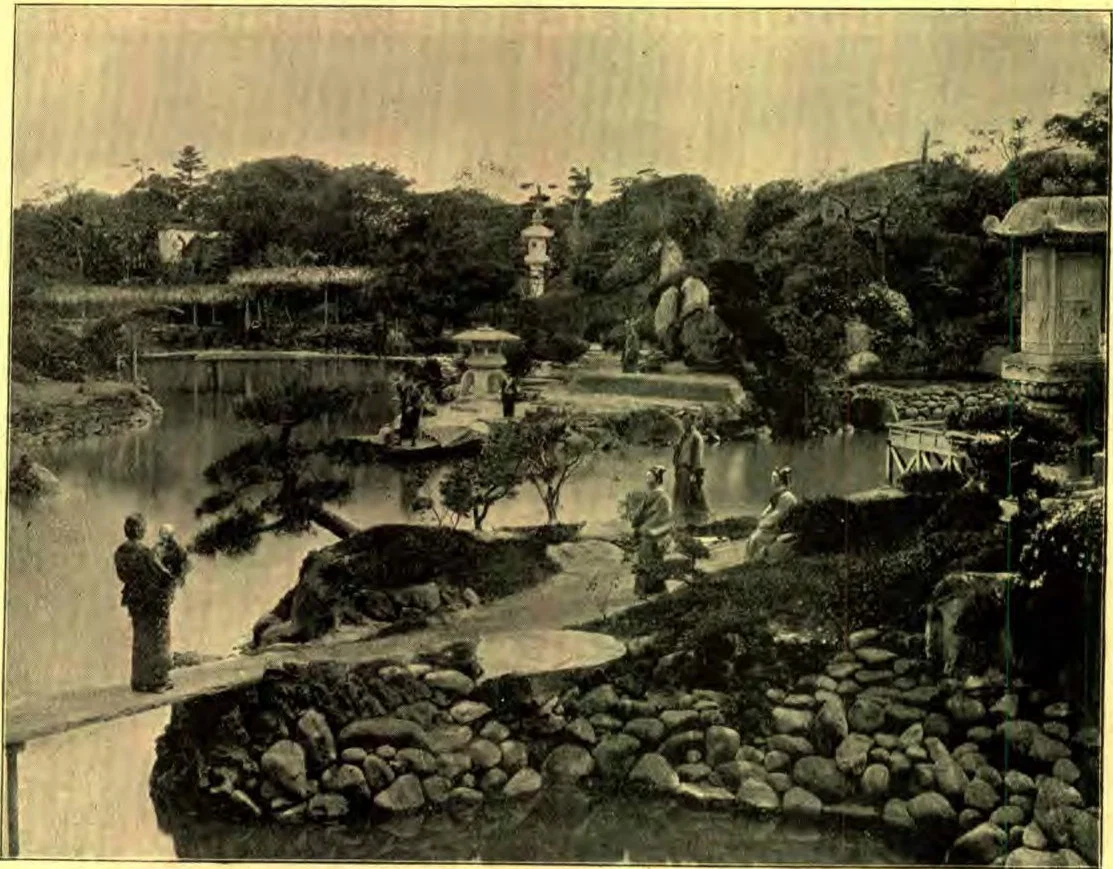
GREAT JAPAN

THAT is what the Japanese call their beautiful little island empire. There are many things to indicate that it deserves the adjective.
Many thousands of islands are in the Japanese group, but only five or six are of much importance. Taking them altogether,—these important ones,—they are not larger than the State of California. But forty-two millions of persons live in them.
There are many interesting things for the children to learn concerning Japan. About fifty years after Columbus discovered America, Jesuit priests brought an imperfect Christianity to Japan, and labored zealously to win the people to believe it. They were very successful. Japanese historians tell us that they had a million converts. But the Dutch and Portuguese traders became jealous of their success, and circulated untrue stories about them, saying they had come hoping to win many Japanese to this new religion. By and by, when all looked favorable, military force would come from the land of the priests, and they would win victories over the Japanese, and rule their country. So the leading statesmen in Japan said: “No; we will not allow this to occur. We will expel all these foreign barbarians, and kill the Japanese Christians if they will not recant: thus we will put this new religion forever away from us.”
A JAPANESE GARDEN
A JAPANESE GARDEN
Then a terrible persecution was begun. Thousands of Christians suffered a dreadful death rather than deny their Saviour. History tells us that they were sewed up in great rice-sacks, heaped in piles, and burned; they were starved to death in cages, in sight of food; they were hung by their hands or feet over precipices, and tortured through lingering agonies till death came to their relief; the picture of their blessed Saviour on the cross was laid before them, and if they refused to trample on it, they were killed; they were crucified, and banished. In spite of all this fierce savagery on the part of their persecutors, some of the Christians escaped. Is it not wonderful to know that in 1868, in southern Japan, there was found a church of three thousand members, who had kept their faith in face of such frightful obstacles?
Could you and I suffer for Jesus as they did? Let us live for Him faithfully day by day, and rest assured that if the time ever comes when we must die for him, we shall have “dying grace” given us. Even as late as 1872, men, women, and children were exiled, and condemned to hard labor in coal-mines, because they would not deny Jesus. Some of them died in exile. And before that, in 1829, seven Japanese were crucified because of their faith in the dear Redeemer.
Many were the seeds that sprang up from this early sowing and persevering watering. And God gave a wonderful increase later.
LAURA DE LANY GARST.

TYING THINGS TOGETHER

MANY a Western farmer boy knows what can be done with a stout cord in a break-down, far away from the repair shop. In India the stout cord serves many uses. A few bamboo sticks tied together with native-made cord suffice for the ox-yoke, and for the cart itself, in fact, excepting the wheels. The rafters of the native house are tied throughout with string. As the wall is of mud, and the door often of matting, very likely not a nail would be found in such a cottage.
The masterpiece of the tying art is the cargo boat. It has a carrying capacity of a ton or two, it may be. The bottom and sides are built of narrow boards, joined edge to edge, and tied with cord. Not a nail, apparently, nor an iron bolt, can be found in all the craft. Even the oar-blades are tied to the bamboo oars. These tied-together boats, plying about the great ocean liners, suggest the contrast between primitive and modern navigation. In these lands one learns how many ways there are of getting on without things that are thought absolutely necessary in the West.
W. A. SPICER.

SUN ON THE NORTH SIDE

I WENT, one cold, windy day last spring, to see a poor young girl, kept at home by a lame hip. The room was on the north side of a bleak house. It was not a pleasant prospect without, nor was there much that was pleasant or cheerful within.
“Poor girl! what a cheerless life she has of it,” I thought, as we went to see how she was situated; “what a pity that her room is on the north side of the house!”
“You never have any sun,” I said; “not a ray comes in at these windows. That I call a misfortune. Sunshine is everything. I love the sun.”
“Oh,” she answered with the sweetest smile I ever saw, “my sun pours in at every window, and even through the cracks.”
I am sure I looked surprised.
“The Sun of Righteousness,” she said, softly—“Jesus. He shines in here, and makes everything bright to me.”
I could not doubt her. She looked happier than any one I had seen for many a day.
Yes; Jesus shining in at the windows can make any spot beautiful, and any home happy.—Selected.

Idle Hours and the Temptations to Evil

LEISURE misused, an idle hour waiting to be employed, idle hands with no occupation, idle and empty minds with nothing to think of,—these are the main temptations to evil. Fill up that empty void, employ those vacant hours, occupy those listless hands, and evil will depart because it has no place to enter in, because it is conquered by good.—Dean Stanley.

NEBUCHADNEZZAR’S DREAM

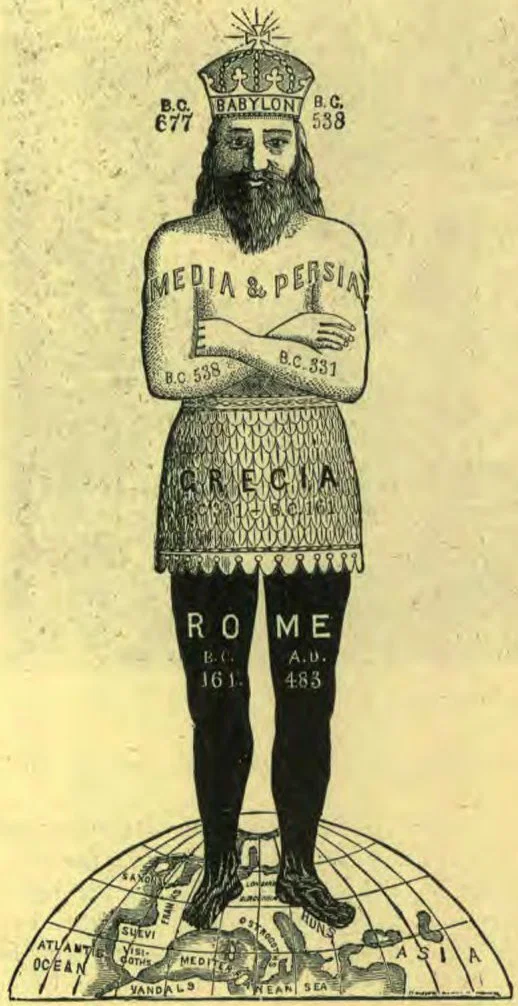
In about the year 607 B. C., Nebuchadnezzar, who was at that time the king of Babylon, had a most remarkable dream, given to him by the Lord, that he, as well as all who should live after his time, might know of some of the events that would happen on this earth, and more especially those things that God had decided should occur in the last days. And “all these things . . . are written for our admonition, upon whom the ends of the world have in reality come, study these Lord is pleased to have us, upon whom the ends of the world have in reality come, study these prophecies, and learn, as did King Nebuchadnezzar, “what shall be in the latter days.” Dan. 2:28.
Let us turn to the second chapter of Daniel, and beginning with the thirty-first verse, read the description of this wonderful image, whose form was terrible, and whose brightness was excellent. It seems that the image’s head was made of fine gold; his breast and arms were of silver; his sides and thighs of brass; his legs of iron; while his feet and toes were part of iron and part of clay. While Nebuchadnezzar, who was an image-worshipper, was looking in admiration at this great image, a stone that was “cut out without hands” smote the image upon its feet, and broke it in pieces, so that the iron, the clay, the brass, the silver, and the gold became as the chaff of the summer’s thrashing-floor: “and the wind carried them away, that no place was found for them; and the stone that smote the image became a great mountain, and filled the whole earth.”
To Nebuchadnezzar it must have been a severe disappointment to see so majestic an image destroyed by a power that was entirely beyond the control of human authority; and then, as if to deepen the impression upon the king’s mind, the Lord caused the whole scene to pass from his memory. This worried the king; and he called in the wise men of his court to recall to his mind, by the supernatural power they professed to have, the dream of the previous night, also to make known the interpretation thereof. This they were unable to do. Finally Daniel was called in; and he, through the wisdom given him of Heaven, told the king the whole matter, and plainly told him that the God of heaven had given Nebuchadnezzar his kingdom, and that after Nebuchadnezzar’s day, the glory of this mighty monarchy would pass into other hands.
Daniel told Nebuchadnezzar that he himself, as the representative of his kingdom, was this head of gold; and that after him would arise another kingdom, inferior to Babylon. Just as the breast and arms of silver succeeded the head of gold in the image, so another and inferior kingdom was to succeed that of Babylon. This we know really occurred. In the year 538 B. C., at the head of the armies of the Medes and Persians, Cyrus entered the city of Babylon, killed its reigning king, and took possession of the throne so lately occupied by Nebuchadnezzar himself. Read this interesting bit of history, as recorded in the fifth chapter of Daniel.
Below the breast and arms of silver in the image, came the sides of brass. So the Lord, through Daniel, told King Nebuchadnezzar that a third kingdom of brass should bear rule over all the earth; this we also know came about just as the Lord here said it would; for in the year 331 B. C. the Grecian armies overran the territory previously occupied by the Medo-Persians, and so became a universal kingdom.
But Grecia was not always to last; for as in the image the brass was succeeded by the legs and feet of iron, so the kingdom of Grecia, which the thighs of brass symbolized, was to be succeeded by another, an iron kingdom. This, as we well know, was none other than Rome. This change in the prophetic scene was accomplished in the year 161 B. C. by what is known as the famous league with the Jews; and soon following this, Rome became mistress of the whole world. The legs of the image, being composed of iron, fitly represented the real character of Rome in its earlier history; while the feet and toes, being part of iron and part of miry clay, showed that in its latter days the Roman kingdom would be partly strong and partly broken. The nations of Europe to-day are only the remains of the broken-up condition of that once iron-heeled monarchy.
For years we have been living in that part of the world’s history represented by the feet of the image. For years the crowned heads of Europe have married and intermarried among themselves, hoping thus to preserve the peace and national lines of that continent; but God has said that though they might mingle themselves with the seed of men, yet shall they not cleave one to another, even as iron is not mixed with miry clay. Verse 43. What care the people of Germany to-day that their emperor is the grandson of England’s late queen? Or what amount of intermarrying between the courts of Russia and England can avert the conflict that seems so sure to come?
How soon that stone, which is none other than the Rock Christ Jesus, shall smite these earthly governments, and cause them to become as the chaff of the summer’s thrashing-floor, we know not; but we do know that the next universal kingdom that will exist upon this earth will be the kingdom of our Lord and Saviour Jesus Christ. “Ask of me,” says God to his Son, “and I shall give thee the heathen for thine inheritance, and the uttermost parts of the earth for thy possession. Thou shalt break them with a rod of iron; thou shalt dash them in pieces like a potter’s vessel.” Ps. 2:8, 9. Soon those nations that are now strong as iron will be broken with a rod of iron, and those that are weak as potter’s clay will be broken as a potter’s vessel.
The stone was cut out without hands; even so shall the wicked be destroyed that night when the Saviour comes; for “in a moment shall they die, and the people shall be troubled at midnight, and pass away; and the mighty shall be taken away without hand.” Job 34:20. “And the kingdom shall not be left to other people, but . . . it shall stand forever.” Dan. 2:44.
The kingdom of Babylon was succeeded by that of Medo-Persia; Medo-Persia was succeeded by Grecia; Grecia was overthrown by Rome; and we now are living in the last days of Rome in its divided and weakened condition. The next great event is the setting up of the last universal kingdom, which will be that of our Lord Jesus Christ. Soon the time will come when the saints will possess the kingdom; for “the saints of the Most High shall take the kingdom, and possess the kingdom forever, even forever and ever.” Dan. 7:18. Praise God’s holy name! Can we not pray from the heart, “Thy kingdom come. Thy will be done in earth, as it is in heaven”?
OTHO C. GODSMARK.
1518 Wright St., Milwaukee, Wis.
(To be continued.)

Doing God's Will: Lines by Elizabeth Barrett Browning

So oft the doing of God's will Our foolish wills undoeth! And yet what idle dream breaks ill Which morning light subdueth? And who would murmur or misdoubt, When God's great sunrise finds him out? — Elizabeth Barrett Browning.

OUR CALLING

“For ye see your calling, brethren, how that not many wise men after the flesh, not many mighty, not many noble, are called: but God hath chosen the foolish things of the world to confound the wise; and God hath chosen the weak things of the world to confound the things which are mighty; and base things of the world, and things which are despised, hath God chosen, yea, and things which are not, to bring to naught things that are: that no flesh should glory in his presence.”
In the very beginning of the history of God’s people, one man was called out of the land of the Chaldees; later, his descendants, an enslaved nation, were led into Canaan: yet with and for that one man, that one nation, what wonders were wrought! and how God’s name and fame were spread abroad in the earth!
Look at Jesus, called from the humblest home to evangelize the world, and dying a malefactor’s death on the cross,—one love set against a hostile heathen nation, and that love scorned. Look at his disciples,—many of them poor, ignorant fishermen,—and mark the result of their preaching, though most of them, like their Master, were slain. Truly the foolish things of the world have confounded the wise; the weak things of the world have confounded the mighty. It was so in apostolic times; it was so in the history of the Waldenses and the Huguenots; it was so in the days of Huss, Wyclif, and Luther. And how the mighty have succumbed before the weak things in the hands of God! How the things that are not—the ashes of Huss, the scattered dust of Wyclif—have brought to naught the things that are! How the burned Bibles have spoken! the martyred children preached! “That no flesh should glory in his presence.”
Wicked popes have gloried in their power to stamp out God’s blessed truth; kings have exulted in their strength to bind and put to death the children of God: yet all their plans have come to naught, all their glorying has been in vain. The Bible lives, and God’s people are still in the earth. And so “ye see your calling, brethren,”—you see what God has done and is doing with weak and feeble instruments. Work away, young men, young women, “strong in the Lord, and in the power of his might;” for you are called with a higher calling than the greatest of earthly warriors.
MRS. S. ROXANA WINCE.

MARCH!

Snowdrops, awake! The night is past! The sweet spring morning is here at last. Take off your night-caps, and tuck them away; Before you is one long, happy day; There is work in the world for each little sprite, And yours is the mission to cheer and delight; Do not linger for foolish fears, Thousands are waiting to see you, dears,— March!
Children, rouse you! Winter is done! Now is the time for work and fun. Get your wheelbarrows, rakes, and hoes, And clear the garden of all its foes; There are bushes to trim, and vines to prune, And a host of things to put in tune; Do not loiter—there’s work to do, And yours is to make things trig and new,— March!
— Emma C. Dowd, in Young People’s Weekly.
Continue reading: A HAIR STORY