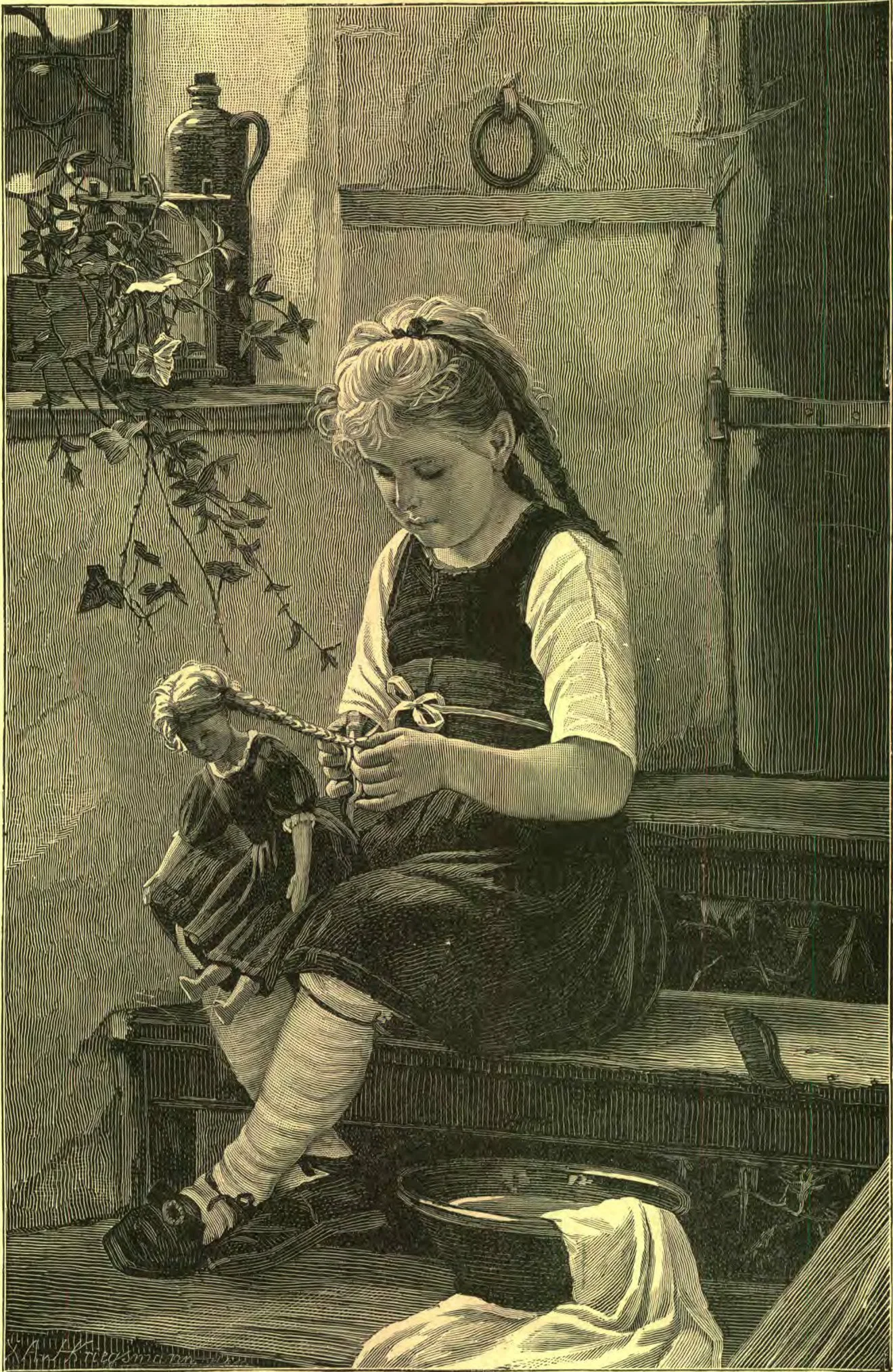
“Now, Dolly, I know it is very tiresome to sit still and have your hair combed. I know just how it feels when the comb comes down against an ugly little tangle; but it helps ever so much when Mama tells a story, so if you’ll be good and not cry, I’ll tell you one. What shall it be about? ‘Hair’? Well, let me see, then. You think you have a hard time to sit still a few minutes while I comb your hair, and braid it smoothly; but do you know it takes some folks hours to have their hair dressed? If you were a Chinese lady, you would have your hair built up to look like a bird, or a butterfly; and it would be so much trouble that it would not be done every day. ‘It would get roughened up on your pillow’? But you would not sleep on a pillow; you would have nothing but a hard block of wood under your neck.”
“If you were a Chinaman, though, your hair would be shaved off, all but a little patch on the crown of your head: that would be allowed to grow long, and you would braid it in a long queue; to make it look still longer, you would braid a lot of black silk in with it. ‘A man with a braid would look funny’? Well, so he does; but, in this country, at least, the Chinaman winds his queue into a knot on the back of his head while he is at work. A hundred years ago the gentlemen of this country wore their hair long, powdered, and curled.”
“THERE! YOUR HAIR IS COMBED AND BRAIDED NICELY”
“The people in Africa have black, woolly hair; they make horns, like cows’ horns, of wet, pliable leather; and when these have dried, they fasten them to their heads, and cover them with their hair, plastering it down with clay and grease. Sometimes they wear only one horn. Some of them comb their hair straight out, until their heads look like big black dandelion-downs.
“But my-oh! there is one tribe in Africa, where the men take years to build up their hair! ‘You couldn’t sit still so long’? Well, neither do they, of course. It is done a little at a time. Strings made of bark are woven into the hair, and drawn up round: when the hair grows through, more string is woven in, and after it is all finished, it looks like a felt helmet; this they ornament with beads and feathers, and I dare say they think it looks very fine.”
“The South American Indian wears bangs. ‘Learned it of North American white women’?—No, indeed, my dear; Indian women wore bangs long before the women of this country did.94
“But we don’t need to go to Africa for queer styles in hairdressing. If you had lived in England a little more than a hundred years ago, and had been a grand lady, you would have had your hair built into a great pile three feet high. Of course you would not have had hair enough of your own, but you would have stuffed it out with tow; then you would have trimmed it with yards and yards of ribbon, strings of beads, feathers, and even little jeweled figures of animals.”
“But there! your hair is combed and braided nicely, and I like it better this way than in any of those fashions I’ve told you of.”
“And that is just what my mama said to me, when she finished telling me this story while she combed my hair this morning.”
AUNT BETTY.
ONE BY ONE
“Pile them straight and evenly, my boy.”
Will’s father came and stood near him as he was piling up some wood.
“But then I shall have to lay every one separately,” said Will, in a complaining voice.
“That is a good way—one by one.”
“One by one! Oh, dear! it takes so long. I like to take a half-dozen at a time. Just think of going all through this great pile, laying the sticks one by one.”
“One by one, little by little, is the way most of the great things are done in this world,” said the father.
“It’s the way I’m laying this walk,” said Robert, Will’s older brother, who was working near by,—“one brick and then another.”
“It’s the way I’m doing this knitting,” said grandmother, with a smile, from her seat on a bench in the shade,—“one stitch, and then another.”
“If I had my way about things, I’d have it different,” said Will. “I’d have things done in one big lump.”
“I don’t think I’d like that,” said Robert. “I like to see things grow under my hand.”
“When we think how many things are made up of one small thing added to another,” said his father, “it gives a great deal of dignity to little things. Look at the leaves on the trees,—how they wave in the soft wind, every new movement giving them a new gleam in the sunshine.”
“I don’t think I’d fancy a tree with just one big leaf on it,” said Robert, “or a lawn with one big blade of grass to it.”
“Water is made up of drops, land of grains of sand or earth, and the sunshine of separate bright rays,” said his father.
“Sure enough; there are plenty of littles,” said Will, who was becoming interested in the discussion.
“But,” the whine coming back to his voice, “there’s so much tug, tug, tug, to it. At school it’s day after day, and day after day. And it’s one figure after another on your slate, one line after another in your lesson.”
“Well,” said Robert, “what would there be for us to do if it wasn’t one thing and then another? Would you like to get through, and then have nothing more to do?”
“No,” said Will. “I really didn’t think of that. No, I don’t think it would suit me to be all through with everything.”
“I think,” said his father, “it is well for us sometimes to remember how few of the great things in the world are done by just one person or through a single great effort. They come of the united force of a dozen or a hundred or thousands of men, and from all these through the adding of one day’s effort to another. So now, having preached my little sermon, we will go to dinner.”
“And after I’ve finished this woodpile, we’ll have our game of ball,” said Will.
“That will be one pitch after another,” said his father.
“One bite and then another,” said Robert, with a smile at his brother, as they were at the table.
“Yes,” said Will, laughing. “I shouldn’t like it all in a lump.”—N. Y. Observer.
“WHAT MUST I DO NOT TO BACKSLIDE?”
By W. S. Sadler
I
ONE of the first things to settle in answer to the question, “What must I do not to backslide?” is that backsliding never comes without a cause. It is a symptom of spiritual disease. It is an indication that we are dying spiritually. The backslider is one who has lost his spiritual health, just as an invalid is one who has experienced a loss of physical health. The physical invalid must be trained out of disease back into health; and this process of training consists in proper eating, drinking, working, sleeping, etc. In like manner the spiritual invalid—the backslider, the soul that has lost its power of resistance against sin—must be trained, by careful and persistent effort, into habits of spiritual health. In either case, it is God who works the miracle of restoration, but in each instance man must co-operate with the divine working. And just as physical health, when once lost, is regained only by removing the causes of disease, so the lost spiritual health is permanently secured only by the removal of the causes of the backsliding.
Let us consider some of the things essential to the regaining and maintaining of spiritual health. We are able to resist the inroads of spiritual disease only by living upon a high moral plane. And it is in the consideration of these things, that we will find an answer to the question: “What must I do not to backslide?”
1. Spiritual Breathing.—The one function which the body is most dependent upon is that of breathing. We can exist physically but a few moments after respiration has stopped. Prayer is the respiration of the soul. In order to maintain good spiritual health, it is necessary for us constantly to breathe spiritually; that is, to “pray without ceasing.” By physical breathing we carry off the poisonous gases of the body, and replace them with the life-giving oxygen from the air. Spiritual breathing, or prayer, carries out of our souls our own plans, our own mind,—these poisons of self,—and in their place brings the life-giving mind that was in Christ, even the will of our Father in heaven. Thus, prayer is a process of constantly changing the one who prays,—putting off the old mind, and putting on the new. “And be not conformed to this world; but be ye transformed by the renewing of your mind, that ye may prove what is that good, and acceptable, and perfect, will of God.” The more we pray, therefore, the more easily we can say, in every experience of life, “Nevertheless not my will, but thine, be done.”
2. Spiritual Eating.—It is written, “Man shall not live by bread alone, but by every word that proceedeth out of the mouth of God.” The same necessity that exists for feeding the body also exists for supplying nourishment to the soul. As the body is fed with bread, so the soul must be fed with the Word. If you would not backslide, if you would maintain your spiritual health at a high degree, be sure that you partake regularly of spiritual food by reading your Bible. Remember, too, that our food must be digested. It is not enough to chew the bread in the mouth, in order to obtain the nourishment it contains; it must be swallowed, digested, and assimilated. This is equally true of spiritual food. It is not enough merely to masticate truth in the mind, but it must be digested in the heart; for it is with the heart that “man believeth unto righteousness.” We can not thrive spiritually without daily spiritual food any more than we can gain physical strength without a daily supply of nourishment for the body. “Wherefore laying aside all malice, and all guile, and hypocrisies, and envies, and all evil speakings, as new-born babes, desire the sincere milk of the word, that ye may grow thereby.”
3. Spiritual Drinking.—As the body must be constantly supplied with water, so likewise must the soul be filled and refreshed with the water of life,—the Spirit of God. “In the last day, that great day of the feast, Jesus stood and cried, saying, If any man thirst, let him come unto me, and drink. . . . But this spake he of the Spirit, which they that believe on him should receive: for the Holy Ghost was not yet given; because that Jesus was not yet glorified.” As the body must have a daily supply of water to cleanse its tissues, so the soul must be filled with the water of life. “And be not drunk with wine, wherein is excess; but be filled with the Spirit.” The thirst of the soul should be quenched, not with worldly amusements and sinful pleasures, but with the refreshing, life-giving ministry of the Holy Spirit. The soul must be well watered with this divine influence, to maintain its healthy activity, and be able to resist the pernicious influence of the enemy’s temptations. Dryness of soul is due to our forsaking the fountain of living water—grieving away the Spirit of God. The language of each heart should be, “I will take the cup of salvation, and call upon the name of the Lord.”
1. What truly unselfish prayer did Moses offer for his people, after the destruction of the golden calf? What did the Lord answer? When he afterward asked to see the glory of God, what did the Lord do to satisfy his longing? In what words did the Lord proclaim his name to Moses?
2. What sin led to the death of Nadab and Abihu? Who were these men? What was their work? Why should the Lord’s servants never touch intoxicating drink?
3. What did the Lord give his people for food while they were in the wilderness? Did this food always satisfy them? Why not?
4. What was the result of their lusting after flesh? What was the cause of their illness?
5. What led Aaron and Miriam to become jealous of Moses? How did the Lord rebuke their sinful course? What does the Bible say of the sin of jealousy?
6. When Moses had led the people to the borders of Canaan, whom did he send into the land? For what purpose? What was the report brought back? What course did the people take as a result?
7. While Israel was in the wilderness, what leading men became dissatisfied with the work of Moses? Why? What became of the rebellion so wickedly begun?
8. Afterward, what miracle did the Lord work to stop the murmuring caused by the rebellion?
9. What was the one sin of Moses while leading the people through the wilderness? Why was this sin so grievous to the Lord?95
10. Because of their constant murmuring, what terrible affliction overtook the Israelites? What remedy was provided? What did each one need to do to get help? Of what was this a type?
11. Who was Balak, and in what way did he try to overthrow Israel?
12. Describe the death of Moses. Who was chosen to take his place? What did the Lord tell this new leader to do in order to have success?
13. Before crossing the Jordan, who was sent into the promised land? What did they learn? Describe what was done in crossing the river.
14. Give two lessons which you have learned from the taking of Jericho.
Easy Steps — In the — Bible Story
By Adelaide Bee Cooper
By Adelaide Bee Cooper, Editor of the Youth’s Instructor
Introduction by Elder S. N. Haskell,
Contains the Bible stories from Creation to the Giving of the Law. It is the first of a series of books for children, to cover the entire Bible narrative. The second Book of the series is now in preparation.
The early Bible stories never lose their beauty, freshness, and charm. They bring new inspiration to those advanced in years, and are read with pleasure and eager delight by youth and children. The principles revealed in the lives of the early Bible characters will, if instilled into the minds of the young, make an indelible impression for good, that neither time nor later associations can erase. Mothers, read them to your children.
WILL BEAR READING MORE THAN ONCE
That best of all Bible books for children—“Easy Steps in the Bible Story”—gains the unqualified approval of the children themselves; and that is the best possible testimony in its favor. They are glad to read it more than once. And the book will bear reading more than once: that is its strength.—Elder A. T. Jones, in Review and Herald, Jan. 8, 1901.
OAKLAND, CAL., Jan. 17, 1901.
REVIEW AND HERALD PUB. CO., BATTLE CREEK, MICH.
Gentlemen: I am pleased with the author’s success in briefly touching the salient points in the long period covered by “Easy Steps in the Bible Story,” and connecting them in such a way as to lead the minds of the little folks along with increasing interest. I hope thousands of children will be provided with this book.
ELDER A. G. DANIELLS.
The book contains 160 pages, table of contents, and list of illustrations. Our artist has prepared 150 beautiful pen-drawings, illustrating the text of the book. It also contains many full-page illustrations. Beautiful cover design. Two styles of binding.
PAPER COVERS, — 25 CENTS
CLOTH, — 50 CENTS
Order of your Tract Society; the
Review and Herald Pub. Co., Battle Creek, Mich.,
*** or the Pacific Press Pub. Co., Oakland, Cal.
“Tame Wild Geese”
By Elmer W. Pruett
SHERBURNE, MINN.
DEAR YOUTH’S INSTRUCTOR: One evening my brother Elwyne and I went over to a hill south of our farm. It was spring, and the grain was just coming up. We saw two large geese on the ground a few rods from us. They had black necks, with a short white stripe under the head from eye to eye. Their backs were about the color of a tame goose, only a little darker; their breasts were almost white, and the under-side of the tail was pure white. The ganders have light-colored spots over their eyes after they are about eighteen months old.
When these geese saw us, they flew to the slough. We lay down to watch them. Then they began to swim toward the west end of the slough; but when we stood up, they swam back to the east end, coming back when we lay down again. When we went home, we were sure there was a nest somewhere in the western end of the slough. We thought it would be fun to have some tame wild geese, but Elwyne could not find the nest. After about a week, father took a pail, and started for the nest. As soon as he reached the water, an apparently black goose flew out to the gander, squawking loudly.
Father came back presently with the pail nearly full of down, and six large white eggs on top of that. Mother put the eggs under Old Wyandotte. In about three weeks, or on May 19, father came to the house, and said, “You may go to the barn and look at ‘my geese,’ if you won’t touch them.” We went, you may be sure. They were so pretty!—four little fluffy, yellow balls, with black bills and feet. We put them into a pen, and gave them some water in a saucedish. Oh, how hard they tried to get wet all over! When they were about a week old, we set a pan of water in the pen for them. They would dive, and then swim round and round under the water. Sometimes they had a little trouble in getting their tails under.
When we let our pets out of the pen, they were very tame,—in fact, I never saw them any other way,—and sometimes they followed us to the neighbors.
When we came home from school, they would talk to us, and we to them. They went to the slough one day, and did not come back at evening, as usual. Just as Elwyne went up-stairs, a loud “squawk” was heard, and there stood my goose on the doorstep. Elwyne came back, and took her to the barn (there were three ganders and only one goose). The ganders were near the barn in the morning, with several tail-feathers gone; for a good many days after that they would not go to the slough. Several times wild geese came and talked to ours, and then flew away. Our geese could not fly, because we clipped their wing-feathers as fast as they grew out.
One day in early April when the geese were nearly two years old, Elwyne and Alberta were at school, but I was at home. About two o’clock in the afternoon we missed the geese. Father set out to track them, as there was a light snow. He followed their wanderings till, in a neighbor’s dooryard, he found some—blood! Oh, how sorry we were! The geese, which had been shot by a neighbor, seemed so human; and then to think that he could possibly suppose they were wild—wild geese standing about two rods from him, and looking at him shoot them! Father thought it would be foolish to waste them; but we could not eat our friends, and neither could he. ELMER W. PRUETT (13 years old).
This is an exceptionally well-written letter, Elmer; and we are sure that all will enjoy reading the story of your pets, and will sympathize with you in their sad end. One of the things which will make the new earth a happier place than this to live in is that, as the Lord has said, “They shall not hurt nor destroy in all my holy mountain.” All the trusting animals will be perfectly safe there.
The Hot Box: Why Worry Impedes Progress
THE other night the train lost two hours in running less than a hundred miles. “We have a hot box,” was the polite conductor’s reply to some impatient passengers, who begged to know the cause of the long delays at stations. The hot-box trouble is not altogether unknown in human life. There are many people who move swiftly enough and with sufficient energy, but who grow feverish, and are thus impeded in their progress. A great many failures in life must be charged to worrying. When a man worries, he is impeded in several ways. For one thing, he loses his head. He can not think clearly. His brain is feverish, and will not act at its best. His mind becomes confused, and his decisions are not to be depended upon. A worried man never does his work as well as he could do it if he were free from worry.—Selected.
Baby’s First Wardrobe
By Mrs. F. M. Kellogg
HYGIENIC PATTERNS
Complete outfit, based on healthful principles—22 NEAT PATTERNS, with full directions for making, showing necessary material, etc., sent, postpaid, for 50 cents. A beautiful booklet on the proper care of infants also included with every order. Send stamps or silver to— MRS. F. M. KELLOGG, 36 Washington Ave., Battle Creek, Mich.
GRAND TRUNK R'Y. SYSTEM.
By W. C. Cunliffe
Taking Effect Dec. 16, 1900.
Trains leave Battle Creek.
WEST-BOUND.
No. 9, Mail and Express, to Chicago. 12.15 P. M.
No. 1, Chicago Express, to Chicago. 8.30 A. M.
No. 3, Lehigh Valley Express, to Chicago. 3.50 P. M.
No. 5, International Express. 2.17 A. M.
No. 75, Mixed, to South Bend. 8.30 A. M.
Nos. 9 and 75, daily, except Sunday.
Nos. 1, 3, and 5, daily.
EAST-BOUND.
No. 8, Mail and Express, East and Detroit. 3.45 P. M.
No. 4, Lehigh Express, East and Canada. 8.22 P. M.
No. 6, Atlantic Express, East and Detroit. 2.10 A. M.
No. 2, Express, East and Detroit. 6.50 A. M.
No. 74, Mixed (starts from Nichols yard). 7.15 A. M.
Nos. 8 and 74, daily, except Sunday.
Nos. 4, 6 and 2, daily.
W. C. CUNLIFFE, Agent,
BATTLE CREEK
Our Trip to Readstown
By Olen R. Godsmark
MILWAUKEE, WIS.
DEAR YOUTH'S INSTRUCTOR: Thinking you would like to hear of our work with the tent last summer, I will write about our meetings held at Readstown. After the camp-meeting at Eau Claire, we went to Readstown, a little village among the hills of southwestern Wisconsin. Our tent company was composed of papa, mama, Brother French, and myself. When the tents came, we put them up, and began meetings with a good interest. Papa and Brother French held meetings each night, while mama gave Bible readings, and held meetings with the children.
This is the first course of lectures I ever heard, and I wish all the INSTRUCTOR readers might have heard them too.
When a storm would come up, the big tent would flop, and sometimes we would have to let it down; when the storm was over, we would run it up again. My work was to help care for the tent in a storm. One time papa left me to tend to the inside of the tent while he tended to the outside; when he came back, I was wet clear through.
Nine began to keep the Sabbath, and we believe others would; but papa was taken very sick with typhoid fever, and we had to close the meetings. OLEN R. GODSMARK (11 years old).
Your letter is excellent, Olen—all the words correctly spelled, and the sentences well punctuated. Attention to these little details now will not only make your letters pleasing to the eye and a delight to your friends as you grow older; but the habit of accuracy and neatness will become a part of your very character, and will enter into whatever you do. We shall be glad to hear from you again.
Letters from Young Contributors: Guidelines for Submissions
By Editor
OUR young contributors will please remember that letters written with pen and ink, and on one side of the sheet, will receive first attention as the department grows; also that no unsigned letter, or one which does not bear the writer's address, can be noticed. One other thing—please spell out your first name, at least. A name, you know, means so much more than an initial! The letters that are coming in show a lively interest in our new departments.
“LIVING UP”
“I HAVE always,” said a dear Christian girl the other day, “from my earliest life, lived up. So when the light of this special truth came to me, I was ready to receive it gladly.” And in this idea of “living up” lies one of the sweetest secrets of Christian experience. The heart that harbors no spirit of unkind criticism, no harsh judgment, lying rumor, or evil suggestion, but whose thoughts dwell with delight upon whatever is pure, lovely, honest, true, and of good report, will be as ready to receive God’s messages, the light that he sends, as a lily is to unfold its white petals in the sunshine.
Every day is a testing day: every hour, every moment, is either drawing the soul up or dragging it down. It is a solemn thought, is it not?—and yet how beautiful when we remember that by surrendering our wills to God’s will, giving our hearts wholly to him, we place ourselves where he can lead us, keep us in the hour of temptation, and cause us to grow up into the perfection of a true Christian character. But while all this is held out to us, and we are invited, yes, urged, to accept it, no one will ever be compelled to surrender himself to God. The responsibility of choice lies always with the individual. “Choose ye this day whom ye will serve.”
A THOUGHT FROM THE LIFE OF DANIEL
Not long after Daniel was carried away from his own country, and brought a captive to the court of the great King Nebuchadnezzar, a time came when he must choose between two courses—he must act in harmony with all his previous teaching and his own conscience, or he must compromise with sin. But the young man took a decided stand. He “purposed in his heart” that he would not defile himself by partaking of food that had been offered to idols. And the Lord honored his decision, and helped him to carry it out.
If Daniel, proud of his own strength and trusting in it, had “made up his mind” that he would not eat of the king’s meat, or drink the wine from his table; and then in an arrogant, haughty way had announced his decision to the chief eunuch, one of two things would have been very likely to happen: either the chief steward, angry at this unheard-of request, this indifference to the royal favor, would have compelled Daniel to follow the course planned for him by the king—or Daniel would have yielded to the pressure brought to bear upon him, and “changed his mind.”
But Daniel’s was not a head religion: his convictions came from a heart that was wholly given to God. And when he spoke to the eunuch, it was with such gentleness and princely courtesy as to win him to grant Daniel’s request—a request that ran directly opposite to all the chief eunuch’s preconceived ideas.
Young Christians of the Daniel stamp—with decided convictions, integrity of purpose, and gentle manners—are needed everywhere to-day; but nowhere, dear young friends, are they needed more than in our own church—perhaps it would be safe to say that nowhere else are they needed so much. The truth we believe is not a popular one; it holds out no inducements of earthly honor, riches, or power to those who accept it: on the contrary, its acceptance means the loss, from the world’s point of view, of much that is desirable in life. And yet, all through this great country of ours—in every hamlet, village, city, and town—and in all the other countries of the world, there are honest persons who long for something different than they have known, and who are simply waiting to hear of a better way in order to walk in it. These are very precious in the sight of the Lord: he wants them to know the truth about his holy Sabbath, and that he is soon coming again. Some one must carry the message; some one must win these souls for his kingdom.
For they must be won. It is not enough that the messengers have the truth, nor is it always sufficient that their purposes be pure and their determination not to yield to error unshaken: they must, by their own manner, their own life, lift up Jesus, and make the truth appear to be, what it is, the most attractive and desirable thing in all the world. When the worker puts himself in this place, he will possess a power that can be used to God’s glory.
Preparation is of course essential; but all the training of all the schools can never make up for, nor take the place of, the winning, kindly manner that comes naturally from a heart where the Spirit of God rules. Courtesy, gentleness, kindness, always attract; and their opposites always repel. That is an important thing to remember in working for souls. You can see, then, how necessary it is for you—and there are many of you—who hope in a few years to go out into the harvest field to do public work for the Master, to begin now the training that shall make you effective instruments in the Lord’s hands then.
“But,” you say, “it is impossible for me, with my uncultured surroundings, to acquire the gentle manner that comes so easily to those who are surrounded all their lives with advantages and opportunities. In my own home, at school, about my daily work, we do not pay much attention to these things. It is hard to be different.”
Yes, it is hard—but never impossible. And the brave spirit that can rise above a forbidding environment, and at the same time draw others with him, is adding an element of strength to the character that will greatly enhance his future usefulness.
In striving for gentleness of manner, the sympathy that shall comfort the burdened heart, the gracious gift of winsomeness, the life of Jesus furnishes the perfect model. During the short time of his earthly ministry, and with the most important work to do that has ever been committed to man, he yet found time for human friendship; he blessed the lowest and the most exalted alike with his companionship; he was never too busy to help the afflicted, too weary to speak the words of life, nor too sorrowful to remember his earthly ties; he had only gentleness for the rough men who buffeted and scourged and mocked him, and with unfailing courtesy and tact he met the “hard questions” with which the learned teachers sought to entangle him. Study that life; and pray that the same Spirit that dwelt in Jesus, and made his life so great a power in winning souls, may dwell in you, his disciple, as you follow on to do his work.
OUR PREMIUM BIBLE AGAIN
HERE is what a sister in California writes concerning her Premium Bible: “We received our Bible, and are more than pleased with it. It is a beautiful book, and especially nice for a present. The one I am now sending for is to be used in that way, and I know the receiver will be delighted with it.”
FOR EVERY DAY OF THE WEEK
SUNDAY:
The eternal stars shine out as soon as it is dark enough.—Carlyle.
MONDAY:
Self-control reaches its highest discipline in the absolute giving away of the whole life to the care and service of God.—Joseph Parker.
TUESDAY:
A holy life has a voice. It speaks when the tongue is silent, and is either a constant attraction or a perpetual reproof.—Hinton.
WEDNESDAY:
In proportion as persons help lift up others, and the more unfortunate the race, and the lower in the scale of civilization, the more do they lift up themselves.—Booker T. Washington.
THURSDAY:
Souls are made sweet, not by taking the acid fluids out, but by putting something in—a great love, a new spirit, the Spirit of Christ. The Spirit of Christ, interpenetrating ours, sweetens, purifies, transforms all.—Drummond.
FRIDAY:
Make us Thy messengers to shed
Within the homes of want and woe
The blessings of thy bounty, spread
So freely on the world below.
Let us go forth with joyful hand
To strengthen, comfort, and relieve;
Then in thy presence may we stand,
And hope thy blessing to receive.
— Woodman.
SABBATH:
“Let patience have her perfect work, that ye may be perfect and entire, wanting nothing.” James 1:4.
Japan: First of Five Articles by Laura De Lany Garst
By Editor
We are pleased to give our readers this week the first of a series of five short articles on Japan, written by Mrs. Laura De Lany Garst, for fourteen years a missionary to the Flowery Kingdom. While these articles are written especially for the younger readers, we are sure they will be read with pleasure by all. But our interest in the subject thus presented should not cease with the reading of the articles. The question for each one is, What can I do for these, my brothers and sisters who do not know Jesus?