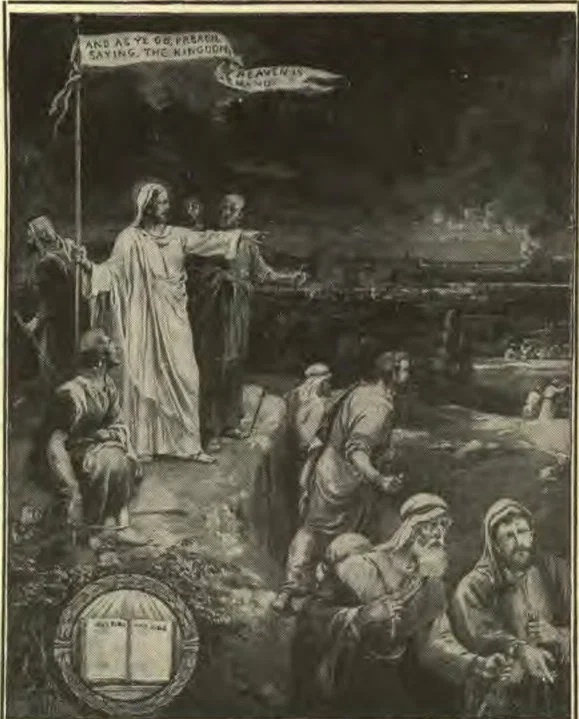
"Go Ye into All the World and Preach the Gospel to Every Creature." Mark 15:16.
BIBLE READINGS SERIES
Twenty-five Special Numbers
Including the Great Missions Double Number
Signs of the Times
The Great Missions Special
Reduced Facsimile of Missions Number Cover Page
24 - - Special Numbers - - 24
November 13, 1907, to April 22, 1908
The present series of twenty-six numbers is giving such general satisfaction that the publishers have decided to issue another series to immediately follow this one. A very prominent feature of these numbers will be a series of illustrated Bible-readings covering all the leading topics of the Gospel message. These readings will occupy two pages of each issue, and will appear in the center opening of the paper, under the general heading of
"HOME BIBLE STUDIES FOR WINTER EVENINGS"
They will be in the form of illustrated studies. The subjects will be taught by questions, quotations from history, notes from authors, and a marshaling of important facts which all ought to know.
There will also be readings on the book of Romans, articles on the miracles, teachings, and life of Christ, and a series of articles on the Ten Commandments.
The regular departments of the paper, such as the "Home Department," "The Outlook," "Missions," etc., will be kept up the same as usual.
In the future, as in the past, the SIGNS will keep abreast of the times, and in the Outlook Department will give particular attention to current events which have a bearing on the fulfilment of prophecy. Send for illustrated booklet.
The Great Missions Special
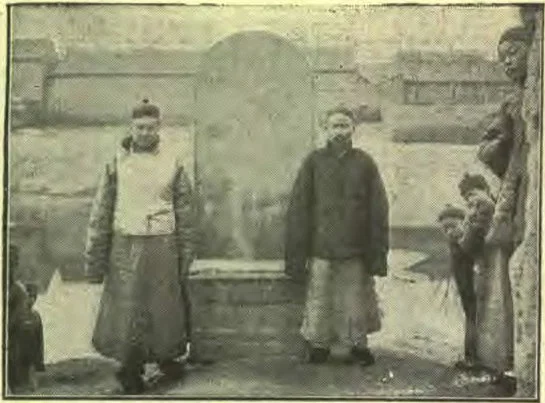
Chinese Jews
October 30 and November 6, 1907
This will be a double number (32 pages) beautifully illustrated, and covering the whole range of missionary work, its rise, progress, and what still remains to be done. The writers for this issue will be men whose hearts are burdened for the salvation of souls, men with hearts fresh and warm from mission fields, and men in those mission fields bearing the burden, seeing the misery, hearing the cry for help, and witnessing the power of the Gospel.
For many months the editors have been gathering from all parts of the world illustrations and material for this special issue, and we feel safe in saying that this will be the best missions number that was ever published by any journal on this earth.
It was first designed that this paper should have been published more than one year ago, but the great calamities which befell the Pacific Coast and the Pacific Press have prevented the consummation of our plans in this respect. Now we are planning again, at the beginning of another wonderful series of Bible-readings and articles containing the great, soul-stirring message, to give to the world the great Missions Number of the Signs of the Times.
A little booklet giving full description of this World's Missions Number will be mailed free on application.
Price for single numbers, also in quantities, is given below.
Subscription Price
Missions Special--Double Number
Single copy, $0.10
25 to 75 to one name and address, each, .07
100 to 400 to one name and address, each, .05
500 and over to one name and address, each, .04
Five or more mailed direct from the SIGNS office to names furnished, per copy, .08
Bible Readings Series--24 Numbers
25 numbers (six months) including the Missions Double Number, to one address, $0.75
Five or more to one address, for six months, each, .50
Five or more (new subscriptions) mailed direct to single names when furnished by one person, six months, each, .50
Single copy, one year, including all special numbers, 1.50
In clubs of five or more to one name and address, one year, each, 1.00
To foreign countries, including Canada, 1.75
Address your State Tract Society, or
SIGNS OF THE TIMES, Mountain View, Cal.
"The Gospel to the World in This Generation" "There Shall Be Delay No Longer"
An Indian Homestead, India
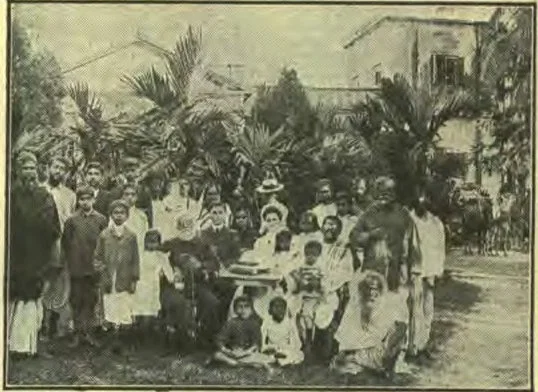
Bengali Sabbath Keepers, Calcutta, India
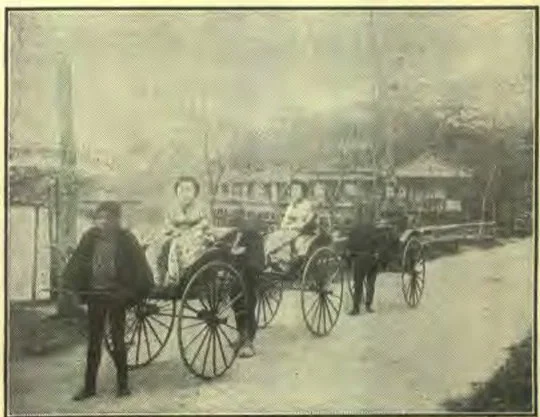
Jinnikishas
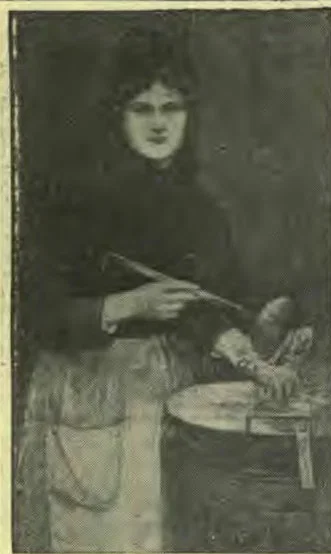
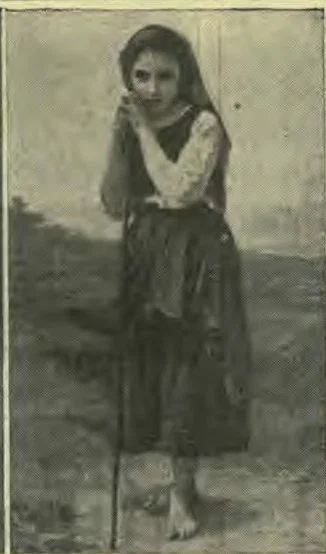
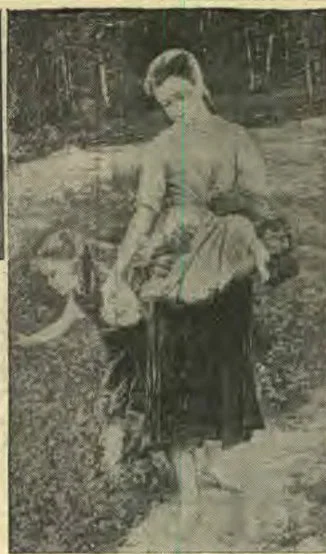
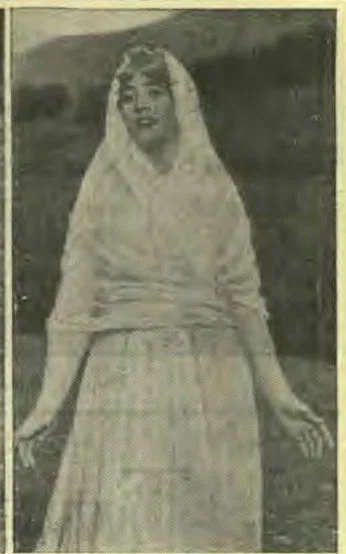
Girls
By Mrs. A. J. S. Bourdeau
By Mrs. A. J. S. Bourdeau
The Dangers That Menace Them.
As our thoughts linger upon the subject of girls, a panorama passes before us,—young girls, old girls; short girls, tall girls; stout girls, thin girls; pale girls, rosy girls: slow girls and spry girls; flaxen-haired, brown-haired, and auburn-haired girls; gray-eyed, blue-eyed, and brown-eyed girls; trim and tidy girls, dull and slovenly girls; sweet girls, sulky girls; plain girls and pretty girls; quiet girls and noisy girls; girls that titter, and girls that chatter; girls that glower so that one fairly imagines a storm must be brewing, so depressing the atmosphere becomes in their presence, and happy girls, whose very looks quicken one with joy and buoyancy.
What danger can assail this large army marching from girlhood to womanhood? There are dangers threatening them, as many and diversified as the girls are, in numbers and characteristics.
The greatest danger menacing the girl—the danger including all others—is that she will not be trained in high ideals of true womanliness. “The child forms its character thru its surroundings.” The environment of the girl should be the actual working out of the ideals the parents desire to instil into her. In other words, the environment of the girl should be—and is—the daily living by the parents of their own teachings.
Unconsciously, then, the daughter will absorb and imbibe ideals of the nobility of womanhood, which will prove her surest safeguard against all perils.
A mother is her daughter's object-lesson. The mother whose manner is coarse, who is untidy in clothes, who is unrefined, can not, by all the teaching in the world, make her daughter dainty in dress, sweet, and thoughtful in manner.
“We have all worked with the refractory vine that would not twine with its fellows. We have gone to it day after day during the growing season, and bent it around its support. We have been so careful not to break the smallest tendril; but daily and persistently we have guided it. At length we were rewarded by seeing it cover, in graceful shape, the frame over which it climbed. Like the delicate, wayward vine, our children need the gentle, daily training. No spasmodic effort will do, but vigilance always.”
Mothers can not begin this training too early. It has been said that “a baby is influenced by the way its mother places it in the crib.” It is related of Mrs. Bottome that when her child wanted to go anywhere with her, she would say: “Do you think you can take care of your mother? Because if you can not, I do not think I shall take you.” It is not astonishing, then, that when this boy became a husband and a father, he still tenderly cared for his mother.
The following is an incident showing how strong early acquired habits may become in little children: “Two little girls were visiting a Southern town during a cotton season. The town was quite a cotton market, and presented an exceedingly untidy appearance; not only were detached samples and other pieces of cotton scattered about the dusty streets, but newspapers and other trash made the town unsightly. In the midst of such a scene these two little girls held up a diminutive paper bag from which they had just extracted the last animal cracker, and with very earnest faces and genuine anxiety in their tones, inquired, ‘O, mama, where shall we put this empty paper bag?’ With some difficulty their mother restrained a smile, and taking them into one of the shops near by she said, to the amazement of the young clerk, ‘Will you kindly put this paper bag in your trash basket? These little girls are not accustomed to throwing paper in the street.’ The clerk told a friend afterward it was the best lesson in neatness he had ever had.”
From her earliest conscious actions, the little girl should be taught to regard her body as “the temple of God.” The golden thread running thru all the mother's training should be to instil in the child a wholesome respect for the body. This instruction regarding the respect due the body makes up a chain, every link of which, in itself, seems almost trivial. Yet it helps to complete a chain which will securely bind the girl to purity. Does the child habitually see the body intemperately abused with food and drink?—One link in this protecting purity chain is gone. Is she taught to keep her body exquisitely dainty?—One link is forged. Does her mother clothe her immodestly as a little girl, “because she looks so cute”?—Another link in the purity chain is broken. Coarse jests, rude familiarity, indecent decollette, immodest dress of any sort—all these, tho seemingly trifles, make for impurity in the girl. Small seeds will grow and bear fruit.
“In a street-car, not long ago, stood a tall, beautiful girl. Beside her was her mother. When the car gave a lurch, the mother put out her hand toward her daughter for support. The passengers were amazed to hear her say: ‘Don't lean on me.' It was not a playful ‘Don't lean on me, mother dear, I shall prove a poor support,' but an irritated, ugly ‘Don't lean on me!' Maybe, when a child, the girl had heard often from her mother's lips the irritated words: ‘Don't lean on me!' ‘Don't bother me!' ‘Go away!'” The seed had borne fruit.
(Concluded Next Week.)
Learning of His Love
By F. E. Y.
WOULD we close our eyes when the day is o'er,
Nor sigh for another sun?
Would we close our ears to the birdie's song,
E'er the song was scarce begun?
Shall we cease to listen to His sweet voice
Who would teach us all His way?
We may see His face, and His matchless grace,
And learn of His love for aye.
F. E. Y.
All Things Work Together for Good.
Our ideas of good and bad, desirable and undesirable, ordinarily pivot on our selfish interests considered from a very limited outlook. In a dry season, when water in the springs and streams is low, and the cattle thirst, and the mills can run only half-time, or less, a heavy rain is welcomed as a good and desirable thing to those whose personal needs are thus supplied.
Yet at that very time the farmer who has the grass lying freshly cut on his best meadows, and the father who is with his wife and children at a distance from his home in an open wagon without an umbrella, consider that first shower anything but good and desirable.
And so it is with well-nigh every experience in life; we can not look at it apart from our personal and selfish interests. Is it not cause for gratitude on the part of all the world, ourselves included, that we can not choose as to God's lesser or greater providences? Our Father knows what is good and desirable for all and each of His children, as they do not. "The Lord reigneth, let the earth rejoice."—Sunday School Times.
The First Time
The following text begins after a marked illustration placeholder. The article proper continues seamlessly into Part 1.
This is the list of Bible lessons or talks outlined by the General Conference Educational Department to be presented during each of the first three school years.
The reading lessons in True Education Reader Series Nos. One, Two, and Three run parallel to these talks—each book covering the entire course.
These readers contain the memory verse designed to accompany each talk; also the story upon which the talk itself is based.
With these readers the parent or teacher will find the task of interesting the child in Bible stories and of teaching him to read an easy one.
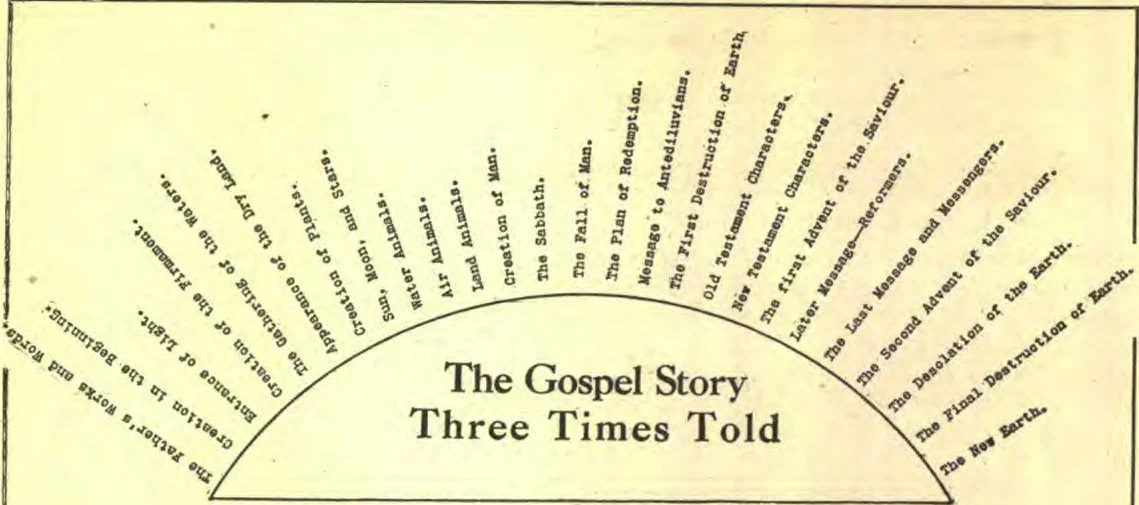
While the special purpose of True Education Readers Nos. One, Two, and Three is to put the child in possession of a complete key to English reading, they also familiarize him with the most important Bible truths. Three times over they tell of God's plan for the earth in the beginning, the successive steps in the work of Creation, something about each of these steps, a sketch of certain selected Bible child biographies, including the life of the perfect Child, Jesus, His work, His sacrifice, the plan of salvation finished, and the new earth.
The First Time
In simple language, by attractive pictures and the best methods of teaching reading, True Education Reader No. 1 fixes upon the child's mind in his first school year an outline of the beautiful Gospel story from Creation to Redemption.
The Second Time
Enriched by many illustrations, enlarged by additional topics, made more interesting by sketches from the lives of insects, birds, and animals, the incidents of the Gospel story are given the second time in True Education Reader No. 2.
The Third Time
True Education Reader No. 3 tells it again, and in connection with it brings in a variety of other matter, such as poems, biographical sketches, Bible selections, our Saviour's parables, simple lessons on physiology, geography, and botany, and adapts it all to the growing intelligence of the child in his third school year for whose use it is intended.
How the Mind Is Prepared for This Thrice-Told Story
The oral Bible lessons which follow the same outline as the readers are given by the teacher or parent before (perhaps one or two weeks) the child comes to the subject in his reading, so when he does come to the lesson in his reading, he recognizes it and reads with greater interest and understanding.
And Then the Story Is Reviewed
The regular text-book for Bible study which is now being prepared for grades or school years four, five, and six, is developed from this same outline. Hence, the child's fourth, fifth, and sixth year's work in Bible will be in the nature of a review of the lessons, the general features of which he has been made familiar with during the preceding three years.
An Illustration
Suppose a child with his parents takes a trip across the continent. Before he reaches each point of special interest, he is told a story concerning it by his parents. When the point is reached he has developed an interest in it and is likely to remember something about it.
The next year the trip is taken again. The same method is followed by the parents. More points are visited and much more is learned about those seen the first time.
The succeeding year he takes the same journey but with various side trips and spends more time at each point. Old memories are revived and strengthened, new facts concerning familiar places are learned, and all is vividly impressed upon his mind by the thrice-told story to which he has listened and the threefold view he has enjoyed.
The Application
This is the kind of trip and the method of instruction enjoyed by the child who learns to read by use of the True Education Reader Series, books One, Two, and Three.
The Harmony of This Plan
So you see the True Education Reader Series harmonizes with the plans and methods adopted by the Educational Department of the General Conference in behalf of our church schools
1. One new yearly subscription and one renewal, or two new yearly subscriptions, sent at one time, $2.50.
2. Two new yearly subscriptions and one renewal, or three new yearly subscriptions, sent at one time, $3.25.
3. Three new yearly subscriptions and one renewal, or four new yearly subscriptions, sent at one time, $4.00.
Sample copies sent on application.
DATE OF EXPIRATION.
The SIGNS wrapper bears date of last issue due on your subscription. Unless renewed in advance, paper stops with expiration date.
If herewith is an order blank, you will know you have overlooked sending renewal. You will not wish to miss a single issue. Back numbers often can not be furnished.
S. S. Supplies.—We still have a good supply of S. S. Record F at 35 cents, for schools of 20 to 90 members; class records at 10 cents; S. S. Quarterlies at five cents each. If you need a Bible, send for our "Select List of Bibles." Address, Pacific Press, Mountain View, Cal.
Helps to Bible Study. A series of Bible-readings, simple and easy, designed as an aid to the personal study of the Scriptures, and adapted to the use of individuals or families; also a valuable assistant for Bible workers. 125 pages. Paper covers, 25 cents; cloth, net, 50 cents.
PACIFIC PRESS, MOUNTAIN VIEW, CAL.
FOR 10 Cts
3 Large Bulbs
Gild'n Sacred Lily
These will make the most beautiful and fragrant pot of flowers for winter. Of rapid growth, hardy and frost-proof, sure to bloom. Flowers in clusters, very large, golden yellow and very sweet. May also be planted in the garden for early spring blooming.
Three big Bulbs. Booklet on Bulbs for Winter Blooming, and Catalog, all postpaid for 10c. 7 Bulbs for 20c.; 15 for 40c.
Free—Illustrated Catalog of Hyacinths, Tulips, Narcissus, Crocus, Lilies and all Hardy or Holland Bulbs, and new winter-flowering plants.
200 (1)st Island Ponyola. 10c
200 (2)nd Holland Club. 10c
JOHN LEWIS CHILDS, 10c
BEAUTIFUL BIBLE MOTTOES.
They are selling everywhere. Three agents ordered 5,000 each. One agent has taken, in less than eight months, 6,783 mottoes. If you send us a good recommendation from the elder of your church we will mail you one dozen on thirty days' time.
Address, Hampton Art Company, Hampton, Iowa.
Beautiful Bible Mottoes
No home complete without them
There is no better time than the present to sell them. They sell readily everywhere, and agents are making good wages. An inspiration to higher living in every home. Nearly 75 styles of mottoes in English, and two each in German, Danish and Swedish. Ten dozen beauties, $7.00. Sell for $25.00. Five dozen, $3.75. Sixteen samples, all different, $1.00. All prepaid. Safe delivery guaranteed. Particulars free.
Address, Home Art Co., Box 114, College View, Neb.
News and Announcements
Our girl readers, and for the matter of that, all others, will enjoy reading Mrs. Bourdeau's excellent article on "Girls, and the Dangers that Menace Them." We regret that our space would not permit the use of the whole article. We trust that its wise counsels will be heeded.
There was another massacre of the Jews in Odessa, September 2. Five were killed, and fifty or more were wounded. When the massacre started the most of the unfortunate victims were kneeling over the graves of their friends and relatives that were slain a year ago. The police made no effort to stop the bloodshed, but apparently were in sympathy with it.
The Sabbath-School Lesson Quarterly for the fourth quarter of this year is now ready, and may be had by addressing any of our tract society offices, in the usual way. The lessons are entitled "A Synopsis of Present Truth," and form a very interesting series. The grand old doctrines of the Bible that set forth the second coming of Christ and the preparation necessary to fit us to stand in that day can not be studied too frequently or too carefully.
Pastor I. H. Evans, Treasurer of the General Conference, made us a brief visit September 4 while passing thru from the Southern California camp-meeting. We were very sorry that he could not have remained with us for a longer time, but pressing matters in the home office made it necessary for him to go on. He expressed himself as highly pleased with the economy and practicability of our new office building, and especially to see it so full of work in preparing the printed pages that tell of the soon coming of Christ and the preparation necessary to meet Him when He comes. The fact that all our facilities are taxed continually in preparing our own publications, and that we have no time for any outside commercial work is always a source of encouragement to our workers as they visit our busy factory.