The Youth’s Instructor, Vol. 37, No. 1.

COASTING

The Youth’s Instructor

Jan 2, 1889

S. D. A. Publishing Association · Battle Creek, Mich. · Jan 2, 1889

COASTING

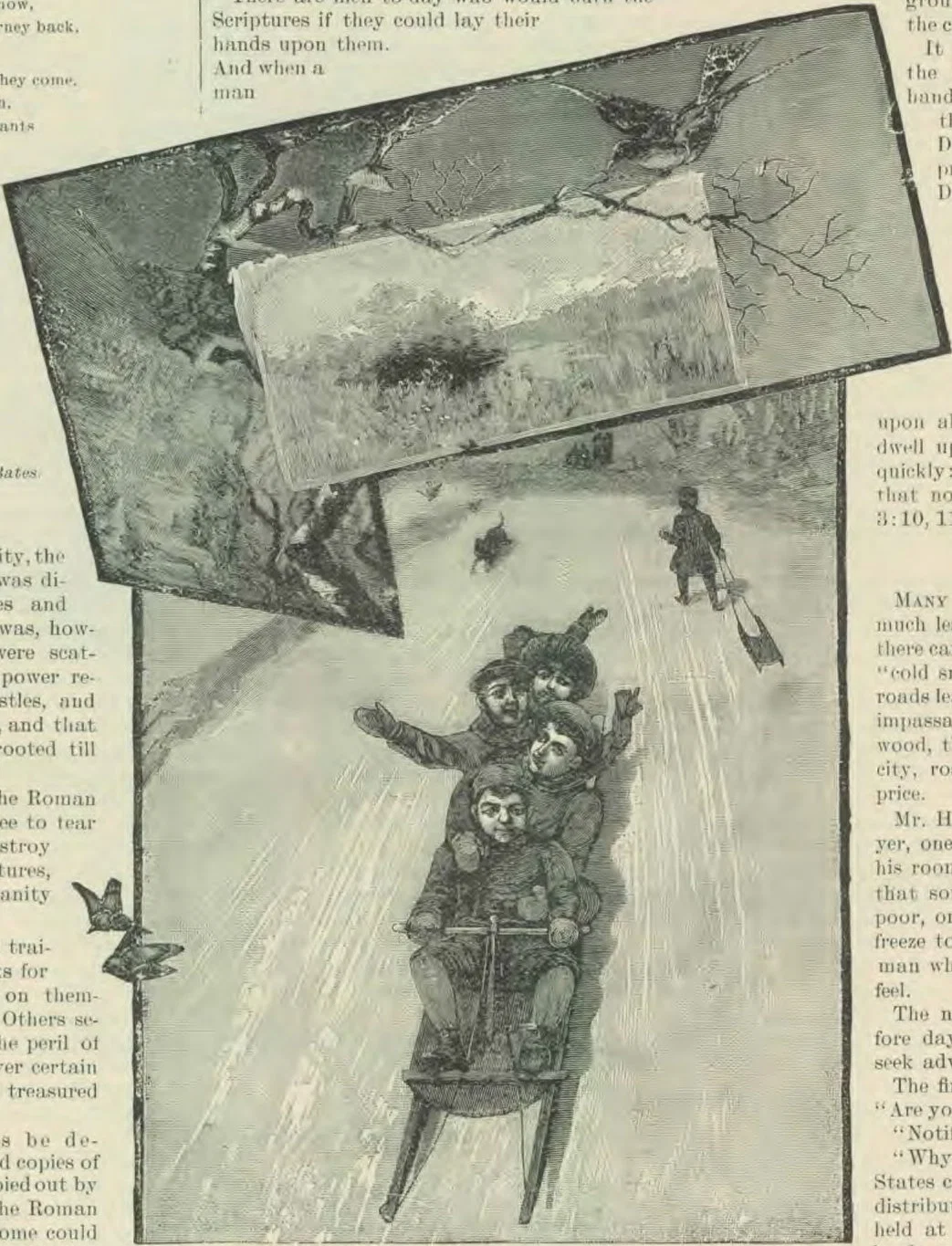
The winter twilight in the sky Pales all its red and gold. And still the children linger there, Ruddy with cold.
Down the long hill the flying sleds Speed black against the snow, Although that means a journey back, Both long and slow.
Like swallows on the wing they come, Swift sweeping to the plain, To crawl more like a line of ants Upward again.
The glistening track is icy smooth: The dark has come too soon; And, lo, just peeping from the east, Behold the moon!
Must they go home? Indeed they must; They hear their father's call, Not willing yet to leave their sport, Nor tired at all.
An hour later the white hill Lies in the chill moonlight, Hushed, lonely, with not anywhere, A child in sight.
—Mrs. Clara Doty Bates.

THE BOY MARTYR.

In the earliest ages of Christianity, the wrath of the heathen world was directed against the apostles and preachers of the gospel. It was, however, found that if preachers were scattered or slain, there was still a power remaining in the Gospels, the Epistles, and the sacred books of the Christians, and that Christianity could never be uprooted till the Scriptures were destroyed.
Accordingly, in the year 303, the Roman Emperor Diocletian issued a decree to tear down the places of worship and destroy the copies of the Sacred Scriptures, hoping thus to blot out Christianity from the earth.
The scheme failed. Some timid traitors delivered up the sacred books for destruction, and thus brought on themselves the censure of the church. Others secreted and preserved them at the peril of their lives, while some handed over certain worthless books, and kept the treasured volumes which they loved.
The Scriptures could not thus be destroyed. Probably sixty thousand copies of them were then in existence, all copied out by hand, and scattered throughout the Roman Empire; and all the power of Rome could not hunt them up and burn them. Besides, these books were copied into other writings, so that to this day two-thirds of the New Testament can be picked out of the writings of one single ancient writer, the learned Origen, who wrote about A. D. 200; or a hundred years after the death of the Apostle John. There are not a dozen sentences in the New Testament that cannot be found quoted in the writings of those Christians who wrote within three hundred years of the time when our Saviour died. So it was impossible, even for a heathen emperor like Diocletian, to root out the Holy Scriptures. A few years later, his successor, Constantine, publicly favored the Christian religion. About A. D. 331 he caused fifty copies of the Scriptures to be beautifully written out by careful penmen, that they might be placed in the churches of Constantinople, his capital, and there read publicly every Lord's Day. So the Scriptures are still preserved, by various means, and we may read them daily.
But this was not the last effort that was made to destroy the sacred word. When wicked priests and governors have ruled, they have often hated God's word, and have labored to destroy it.
There are men to-day who would burn the Scriptures if they could lay their hands upon them.
And when a man is opposed to the Scriptures, it is usually because the Scriptures are opposed to him.
One day when the persecutors were trying to drive the Bible out of Scotland, a party of soldiers who were riding along the road, met a lad carrying a book.
“What book is that?” said they.
“The Bible,” said the little hero, with a fearless glance.
“Throw it into the ditch!” shouted the commander.
“Na,” said the Scotch laddie, “it is God's word.”
“Throw it into the ditch!” repeated the captain; but the lad clasped the book more firmly.
“Then pull your cap over your eyes,” said the cruel officer. “Soldiers, prepare to fire!”
For a moment the soldiers hesitated, but their leader's face was stern.
The lad did not flinch or waver. He knew what was before him, but the Lord was his strength.
“I will not cover my eyes,” said he, firmly. “I will look you in the face, as you must look me in the face at the great judgment day.”
Another moment, and the faithful lad lay on the ground, shot through the heart by the cowardly persecutors.
It was by such heroes as this that the Scriptures were preserved and handed down to us. Do you wonder that Scotchmen love the Bible? Do you wonder that all Christians prize it as a precious treasure? Do you wonder that they want their children to read it, and learn it, and love it? Let us cling to the blessed word, and we shall hear the Master say to us, “Because thou hast kept the word of my patience, I will also keep thee from the hour of temptation, which shall come upon all the world, to try them that dwell upon the earth. Behold, I come quickly; hold that fast which thou hast, that no man take thy crown.” Rev. 3:10, 11.—H. L. H., in Little Christian.

ENERGETIC

MANY years ago, when Detroit was much less of a city than it is at present, there came on a very severe and sudden “cold snap” early in the winter. The roads leading out of the city were almost impassable from recent heavy rains, and wood, then the only fuel burned in the city, rose suddenly and enormously in price.
Mr. H. H. Emmons, a prominent lawyer, one evening, as he was retiring to his room for the night, said to his wife that something must be done for the poor, or many of them would actually freeze to death. Fortunately, he was a man who knew how to act, as well as to feel.
The next morning he breakfasted before daylight, and started out, not to seek advice, but to do what was needed. The first man he met he hailed thus: “Are you around notifying?” “Notifying what?” “Why, the meeting at the United States court-room, to take measures to distribute wood to the poor. It is to be held at nine o’clock. Something must be done at once, or the people will be freezing.” “I hadn’t heard anything about it,” answered the citizen, “but I will gladly do what I can.” “Very good. Suppose you notify those on your street immediately, and send everybody along to the Court-house?”
He set the next man, and the next at the same business, till the city was roused. At nine o’clock the court-room was filled to overflowing. Thousands of dollars were subscribed on the spot; the poor were relieved at once. Within an hour and a half from the time when the first man was asked if he was around notifying, proclamation had been made that the destitute could obtain fuel at a certain wood-yard.
The amount of money raised proved to be twice what was needed, and the remainder was invested for similar use in the future.
One of the pleasantest features of the affair was the fact that nobody, or almost nobody, knew how the meeting came to be called. “A spontaneous gathering” all the newspapers called it, and it was commented upon far and near.
If you want a thing done, set about doing it.— Youth’s Companion.

A CHAPTER ON DOGS.

Of all domestic animals, the horse and dog are accounted the most intelligent. The dog comes a little nearer to our hearts and hearths than the horse does. He follows faithfully, though he receives neither encouragement nor reward. He defends loyally, even to the giving up of life itself, and will die mutely loving to the last.
I am acquainted with a little English terrier that is so sagacious he seems only to lack speech to make him equal to a child in intelligence. I am positive that he reasons from cause to effect. It could not be instinct alone.
He knows all the family by name, and if told to go find such a one, he immediately proceeds to the one mentioned. He knows and watches the words of each one, and concludes just what liberties he may take. Sometimes his master corrects him for some fault. After the lapse of half an hour or so, when the family have forgotten all about the incident, the dog will slowly emerge from under the sofa, or back of some chair, and crawl hesitatingly and abjectly across the floor to his master, and look up in his face with a pathetic questioning in his eyes that speaks as plainly as words for forgiveness and reconciliation.
One kind word changes the whole tableau. The drooping tail and ears become erect, and he leaps into his master's lap, and fawns upon him in his thankfulness to be restored to favor. He shows evidence of reason and memory, in scores of similar instances.
Last spring there was a fire in a manufactory not very far from our house. It broke out about midnight. Two men who slept there and a Newfoundland dog, were the only occupants of the building. All the doors inside were left open to give Rover the run of the place to catch rats.
He seems to have been the one to discover the fire. He ran up to the room of the sleeping men, and tried to arouse them. He caught the bedclothes in his teeth, and pulled them off the first bed; this failing, he applied his teeth to the man's wrists and ankles, until he awoke and ran down stairs, closely followed by the dog.
A door opened on to the street at the foot of the stairs, but the man was so frightened and confused he could not unlock it. Then Rover, comprehending the situation, commenced howling vigorously, which attracted the attention of the crowd in the street, who quickly burst in the door, and man and dog rushed out together.
But Rover remembered the other sleeper, and though the building was by this time filled with dense smoke, he only waited to get a breath of fresh air before dashing in and upstairs for the man who had by this time become unconscious from the suffocating air. He did not stand upon ceremony, but seizing him by the shoulder, swiftly dragged him down and out into the street. The rescue by this brave dog was witnessed by hundreds who gathered at the fire. I am glad to say Rover was unhurt, and is still the recipient of much petting from “a circle of admiring friends.”
There are upwards of forty varieties of the domestic dog. They are to be found in nearly every habitable spot on the globe, and always the affectionate, faithful friend of man.
In sheep-raising countries, shepherds greatly rely on their dogs' strength and skill for the safety of their flocks. In the Arctic regions, where no horse could exist, the dog is almost indispensable to man. The Creator has fitted him to endure intense cold by providing him with a double coat of fur; an outer one three or four inches in length, and an inner woolly one that falls off in summer, and grows again as winter approaches.
The Esquimaux dog spends its life in drawing sledges. Its master hitches eight or ten of them to his load, having an old and experienced dog for a leader, who obeys his master's voice and whip as oxen do in this country. Arctic explorers say the dogs easily travel over the snow sixty miles a day for days in succession.
Though they are so docile and useful, the Esquimaux are very cruel to them, feeding them scantily on the poorest food, and punishing them by torture if from weakness they break down in their work.
There are two kinds of wild dogs. One—the Dhole—which inhabits the western frontier of India, is of a rich dark bay color, and about the size of a greyhound. The other—the Bunsuah—lives in the northern part of India, and resembles the wolf. Like the wolf, both of these tribes hunt in packs, run swiftly, and seek wild animals for their prey. Whether either, or both, of these represent the primitive dog or not, nobody has, as yet, been able to state with authority.
L. E. ORTON.

MISSIONARY MICE.

“Where is Susie?” said father, as he sat down to supper.
“Coming,” answered little Susie, slipping softly into her place, while mother said,—
“I guess Susie has had on her thinking-cup to-day. I don’t know when I have seen her so sober.”
Mother was right. Susie had been thinking the same thing over many times that day. It was much like this:—
“I don’t know how I’ll ever earn any missionary money, and I want to give some that is not given to me. Father and mother are so kind as to pay us for so many things, so we can have money of our own; but there seems to be nothing I can do. John has his potato patch, and Will the currants in the south corner, and Mary washes the dishes. Bennie earns some by driving the cows to and from pasture, and little Kit has to have the paper-rag money, for she is too little to work; and there seems to be nothing left for me to do, since Dr. Lane said it would hurt my back to take care of baby.”
“No butter for supper?” said father.
“No,” answered mother, “a mouse got into the cream jar. I don’t know what to do about the mice, they are so troublesome. They get into everything; they have been into the closet and cut my shawl, besides doing mischief everywhere else!”
“Get a cat,” said John.
“They catch more young chickens than mice,” answered mother.
“Poison them,” suggested Will.
“No,” said father; “I’m afraid to have it around. I will get some traps, if some of you will attend to them.”
“Let me do it,” said Susie. “Father, all the rest have been earning missionary money, and there has been nothing for me to do. Pay me a little for every mouse, and I’ll keep the traps baited.”
“I’ll do it,” said father; “I’ll give you five cents apiece for rats, and three cents for mice, and it will pay me better than it does you.”
“Rat-catcher!” said Bennie, slyly, and when mamma shook her finger, Susie said, “I’ll catch ’em, if I can.”
So the traps were bought, and Susie had her work. The rat-traps she set in the barn and corn-crib, the mouse-traps in pantry, cellar, and closet. Every day she made several trips to see them all, and soon her money began to pour in so that father talked of cutting down the price; but Susie would not let him.
Every few days she washed all the traps with hot soap-suds, so they would be neat and clean; then she broiled scraps of bacon, and toasted bits of cheese, to make tempting bait.
Only six weeks, and she had caught twenty-eight mice and thirty-three rats.
Father paid up. What a time she had making the calculation! Three times twenty-eight—eighty-four cents for mice! Five times thirty-three—one dollar and sixty-five cents for rats! Two dollars and forty-nine cents! What a pile! She had to borrow mother’s pocket-book to take it to Sabbath-school.
Oh, dear, how funny she felt when the teacher read out the names and the amounts given, and told how they all earned their money!
It seemed that everybody opened their eyes when Miss Lee read,—
“Susie Simms, $2.49. Earned in catching mice and rats!”
Oh, what a laugh! And Susie laughed, too, though she felt like crying.
Uncle Jerry could hardly stop laughing, but Susie forgave him; for after Sabbath-school he came and said,—
“Susie, don’t you want to take the contract at my house? The rats are about to take the place, and we have no youngsters to tend the traps; and your Aunt Lucy is so busy, and I am so lame, I believe it would pay me to pay you to clean them out for us.”
“I’ll do it,” said Susie. “I know mother will let me, and I’m going to tell all the boys and girls to make the mice and rats help the missionaries.”—Our Youth.

YOU NEVER CAN TELL.

If you think it is easy your steps to retrace, Before the last pitfall is gained; That a man can stop short of a crushing disgrace, And still find his honor unstained. But sin is so mighty, and conscience so weak, And under so tempting a spell, That though you may long other pleasures to seek, Your weakness you never can tell.
The ocean of evil you never can sound, Its depth you can never discern. But under your feet there is treacherous ground, Far away from the good land you turn. You see not the danger, you fear not the foe, You whisper the soul, “It is well!” And think that you know just how far you can go, But you never, no never, can tell.
You never can tell at what moment you'll slip, Into snares that are cruelly laid By those who are willing another should trip Where they were as foully betrayed. A moment's indulgence may lead you to crimes That merit a prisoner's cell; Then quench the hot fever of passion betimes, For its power you never can tell.
You never can tell what moment you'll hear The signal of death at your gate, Whose touch will arrest your thoughtless career, And bring your repentance too late. Stand firm, then, to-day; the allurements of sin With earnest persistence repel, And strive for a prize that is worthy to win, And whose glory you never can tell.
—Anon.

A BOILING WELL.

In the township of Vernon Center, Blue Earth Co., Minnesota, a most wonderful phenomenon of nature was discovered in digging a well. The well was sunk to the depth of one hundred and fifteen feet, when a vein of water was reached that rose suddenly to the height of sixty-five feet, and is constantly kept in a boiling state. The turmoil of the water does not seem to roil it in the least, and it is cold, pure, and clear.
Tile pipes, eighteen inches in diameter, have been put down, which serve as curbing. With a small mirror, the light of the sun can be reflected upon the surface of the water, and its movements plainly seen.
Its seething condition keeps a crest of foam upon its surface, and it crackles and sputters very much like a pot of boiling potatoes. It emits a strong sulphurous odor, and it is thought that the water contains mineral properties, although it has not so strong a taste as is peculiar to this kind of water. Some are of the opinion that the water is kept in commotion by escaping gas. A heavy rumbling sound is heard, similar to a grist-mill in motion; and sometimes the disturbances of the internal elements are much greater than at others, and can be heard at quite a distance.
Scientists from the city of Minneapolis are expected soon to visit the spot, to examine into this wonderful freak of nature, and, if possible, ascertain the cause of the phenomenon.
As we listened to the heavy rumbling of the boiling water, we thought of the deep hidden agencies of God, which, by a word of command, he can call into action to execute his judgments upon those who disregard his holy law and daily trample his blessings and mercies under foot.
May God help all the children of the INSTRUCTOR family to be dutiful and obedient, so that when the raging elements of God's wrath shall be brought into action, and desolation and destruction shall be witnessed on every hand, they may be preserved. The time is coming when we shall be just as dependent upon the care and mercy of a loving God, as was Noah and his family during the flood, or as was Daniel in the lion's den. The Bible gives us a description of the terrible scenes that will attend the second coming of Christ, and of the condition of the earth just before that event. "And the heaven departed as a scroll when it is rolled together; and every mountain and island were moved out of their places." "Behold, the Lord maketh the earth empty, and maketh it waste, and turneth it upside down, and scattereth abroad the inhabitants thereof." Rev. 6:14; Isa. 24:1. E. HILLIARD.

WHY DID THEY NOT SEND IT BEFORE?

A LITTLE girl in the Micronesian Islands lived in the family of a missionary by whom she was taught. After a long time she learned the way to be saved.
“Missionary,” said she one day, “how long have they had the gospel in America?”
When he told her, she said in a serious, earnest tone, “Then why did they not tell us before? My father is dead, my mother is dead, my sister is dead, and, oh, where have they gone?”
What a sad thought that is, but are we doing all we can to save ourselves from a similar charge by some poor awakened convert? Shall we some day have to answer the question why we did not send the gospel sooner?—Sel.

SOMETHING WRONG.

I KNOW my pillow's light and soft, And smoothed with care at night: But I, a worried little boy, Can get no sleep to-night. I cannot sleep—the night is long; There surely must be something wrong.
My downy bed for which I feel So thankful every night, Is hard, and restlessly I turn, And wish for morning light.
I have not sung my good-night song, Nor said my prayers—for something's wrong. The silver moon looks down on me, Whose light I love so well. But when I look at her, I feel She's something sad to tell. It seems my comforts all are gone, And something whispers I am wrong.
“Ah, little boy! (‘Tis conscience speaks) The lie you told to-day, Still unrepented, brings unrest, And drives your sleep away. Fall now on bended knee, be strong, And tell your Saviour you are wrong.” —Sol.

CHINESE BOYS AND GIRLS.

All over the world live little boys and girls. They are sometimes naughty and sometimes good, sometimes glad and sometimes sorry, sometimes they laugh and sometimes they cry, just as the children in America do. They have warm, human hearts, and like to be loved. We sometimes forget that when we talk about their queer ways.
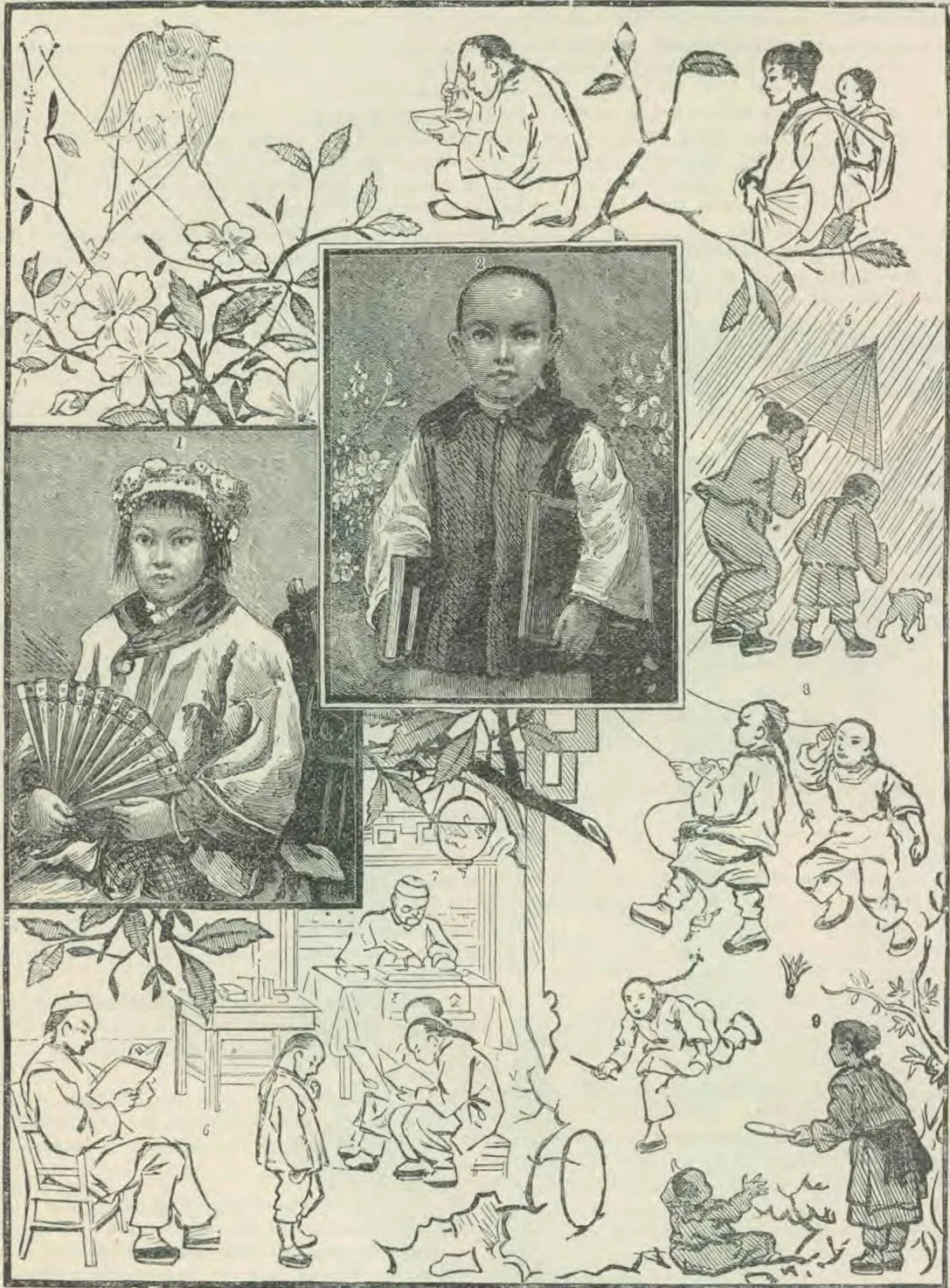
In our picture are a lot of little Chinese boys and girls. In picture No. 1 is a little girl. She looks bright and happy. But I do not believe you would look as contented as she does if you lived in her place. The fact is, Chinese girls do not have a good time. Their parents are not glad to have girls in the family. They think it is of no use, because it is a great expense to bring up a girl, and when she has grown old enough to be useful, she is almost sure to get married, and go away from home. So the people do a very dreadful thing: they drown hundreds of girl babies every year, just to save the trouble of bringing them up.
The little boy in No. 2 is a Chinese student. In the lower left-hand corner, you can see the school-room. He goes to school for the first time when he is six years old.
When you see a printed page of the Chinese language, you must remember that those strange characters are not letters, but that each one is a word. The Chinese have no alphabet. So the first thing a little boy has given him when he goes to school is a book called the Sun tsze king, a Chinese primer. It is an easy book, made up of short sentences of three characters each.
As he grows older, he studies harder books, but all of them have to be learned by heart. And in this way it happens that although he goes to school a great many years, he never learns anything but to repeat the words just as they are in his book. He does not learn to think for himself.
At the top of the picture you can see how the Chinese mothers carry the babies, in a hood fastened to the back.
In picture No. 3 is a boy eating his dinner. He is eating rice soup. He has no spoon with which to dish it up; but he holds the bowl close to his mouth, and with two long, smooth sticks, called chop-sticks, he manages to keep a stream of rice soup going down his throat. I am afraid that if you had no other way than this of eating, you would starve before you could learn to handle the chop-sticks.
Down in the right-hand corner are some Chinese playing games. Once every year the Chinese, old and young, keep a curious festival. They go upon the house-tops or upon the highest ground near the city, and men as well as boys spend the whole day flying kites. Nobody knows how this festival came to be kept in the first place.
This people keep many festivals, one for almost every month in the year. They make a great ado at New Year's. Every body feels bound then to settle up his business, even though he has to sell everything in his store for less than it cost him, before he can do so. They offer many sacrifices to their gods, and have great rejoicing. On the last day of the old year, boys go up and down the streets shouting, “I will sell my idle ways.” I suppose they want to begin the New Year aright.
However many of the commandments the Chinese break, because they do not know the true God, and what he wants us to do, and them as well, there is one that they keep very carefully. That is the fifth one, which says, “Honor thy father and thy mother.” Every morning, when a little Chinese boy gets up, he washes and dresses himself very carefully, and then goes at once to his father and mother to know what they would like him to do that day. All through his life, that is, until his father dies, he is expected to be just as dutiful and just as obedient as when he was a child. When he is married and has a family of his own, he cannot do anything which his father says he must not do. And middle-aged men meekly take floggings if their aged fathers think they ought to have them. Indeed, the old men are often severe, and may cast their sons into prison if they disobey them.
So I suspect the little Chinese boys and girls are more often obedient because they are afraid of the punishments than because they love their parents so much that they want to mind them. God wants us to be obedient because we love to do it, and not because we will be punished if we do not do so. Don't you think this world would be a happy place if all the people were good because they loved to be good?
W. E. L.

Better Budget.

CHARLIE CRAIG writes from Colorado. He says: “I will write a few lines for the Budget, so that my friends who read the INSTRUCTOR may know how I am getting along. I am eleven years old, and study Book No. 2. My mother died in Nebraska a year ago, and then we moved to Colorado. I have two brothers, one older and one younger than myself. My oldest brother is married, and has a little girl a few months old. We are very lonely here. Our nearest neighbor is one mile and a half away, and we are three miles from town. We have no day school to attend. I like to read the INSTRUCTOR. I want to do the Lord’s will, and be prepared to meet my dear mother and you all in God’s kingdom.”
MINNIE MABEL and LILLIE MAY HEATHCOTE send letters from Columbus Co., Cal. Minnie says: “I am eight years old. I go to Sabbath-school and to day school. My mother has given me a hen, and I am going to raise some missionary chickens. I was at the Oakland camp-meeting last year, and got acquainted with some of the Sabbath-keeping children there, and have read letters in the Budget written by some of them since. I am trying to be a good girl. I want to meet all the INSTRUCTOR family in the new earth.”
Lillie says: “I am six years old. I have been to school only one day in my life, but hope to go all next term. We have a family Sabbath-school at our house, and my mamma is my teacher. I have three brothers and two sisters, all older than myself. I have a lamb and two chickens. I give nearly all my money to the London Mission. I spent five cents for gum once, but mamma says little girls ought not to chew gum. She says they won’t chew it in the new earth. I want to meet you all there.”
The next letter is from Lyon Co., Kan., written by ALMIRA L. GALENA. She says: “I love to read the INSTRUCTOR and the letters, so I thought I would write one. My mamma used to read the paper to me before I learned to read. I am now nine years old. We live on the prairie, so far away that we do not go to meeting, but I am learning the lessons in Book No. 2. I have found out that the Lord cares for us. One night last summer our house was struck by lightning in three places. The chimney was torn down about two feet from the side of my bed. There were five of us in the house that night, and the Lord spared the lives of us all. We know the Lord protected us, or we would not have escaped without harm when the house was so badly torn to pieces. I have only been to day school nine months. I lived with my sister that length of time, and went from there to school. I am trying to do all of God’s commandments.”
Continue reading: LESSON 3.—RESISTING THE TRUTH