WHILE the flowers are still fresh on the graves of our honored dead, let us pause and think. We are called a “Christian nation,” and yet this nation quarreled, and in that quarrel a million men were maimed, or lost their health or lives.
What a comment on the “Christianity” of this “Christian nation” to say that the questions of ’61 could not be settled without murdering or maiming a million men, and bringing want and wretchedness or woe and widowhood into a million homes!
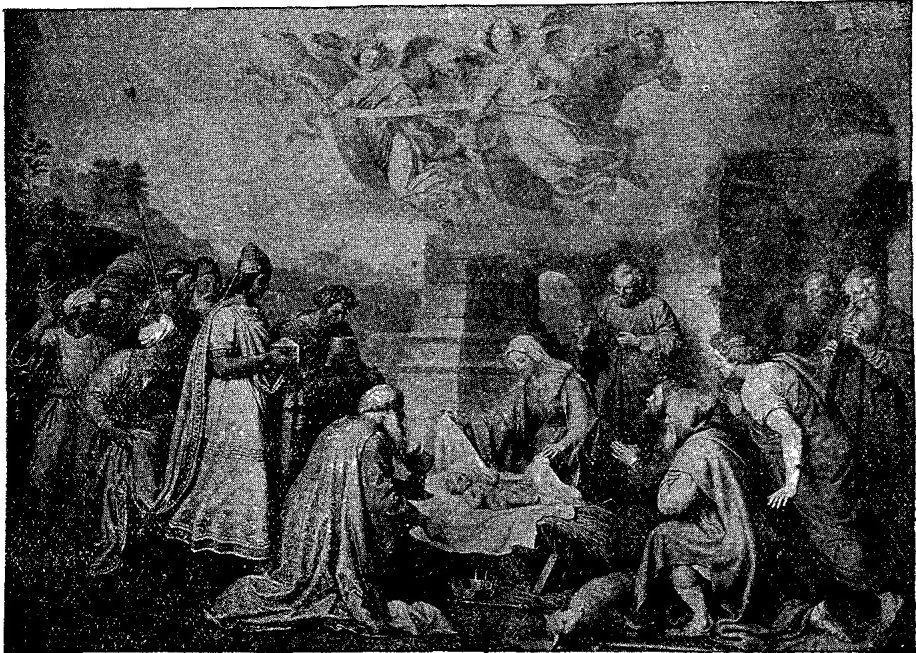
Bethlehem, Judea, Birth of the Prince of Peace. From F. H. Revell Co., by permission.
One would think that a look at the slabs which mark the resting places of the brave husbands, fathers and sons who were buried in that baptism of blood, would cause men to hate the licensed murderer, called War, and shudder at the sight of his marching columns. But no; never has there been such a tendency toward militarism as there is to-day. It is not confined to the element which always selects war by choice as a life occupation, but is all-pervading.
The children of the public school, the children of the private school, and the children of the Sunday school, Protestant and Catholic, are being trained in the arts of war. In New York City alone there is an army of 25,000 school boys. On Grant memorial day a part of this army marched in the great parade carrying their muskets, with flags on which were inscribed the contradictory words “we are for peace.” While one could but wonder at the sight of this military tendency on the part of the public school in a nation whose boast has been that its strength lay in justice and intelligence and not in force of arms, yet that wonder changed to amazement when the bristling bayonets of the church armies passed by. Among them were the Baptist Boys’ Brigade, Episcopal Church Temperance Legion, Hebrew Orphan Asylum Cadets, St. Francis Xavier (Jesuit) Cadets, Our Lady of Sorrows (Catholic) Cadets, etc., etc.
Turning to the “Christian nations” of Europe we find the situation appalling. More than twenty-one millions of trained soldiers stand ready to march into the battle of Armageddon and empty their veins into its crimson flood. Sea and strait, harbor and river, groan beneath a navy numbering more than two thousand ships and carrying more than twenty thousand guns. All of this tremendous armament is maintained by “Christian nations,” not to defend themselves against the heathen, but against each other in their covetous scramble for each other’s territory and for the territory of the heathen. The cost of all this—more than nine hundred million dollars—is wrung from the people by taxation. The poor man’s bread must be divided with the government to make and maintain this murder machinery before he divides it with his children. As a result the masses are growing hungry and restless. The struggle for bread is growing fiercer every hour, and pinching poverty is eclipsing all thoughts of the Prince of Peace.
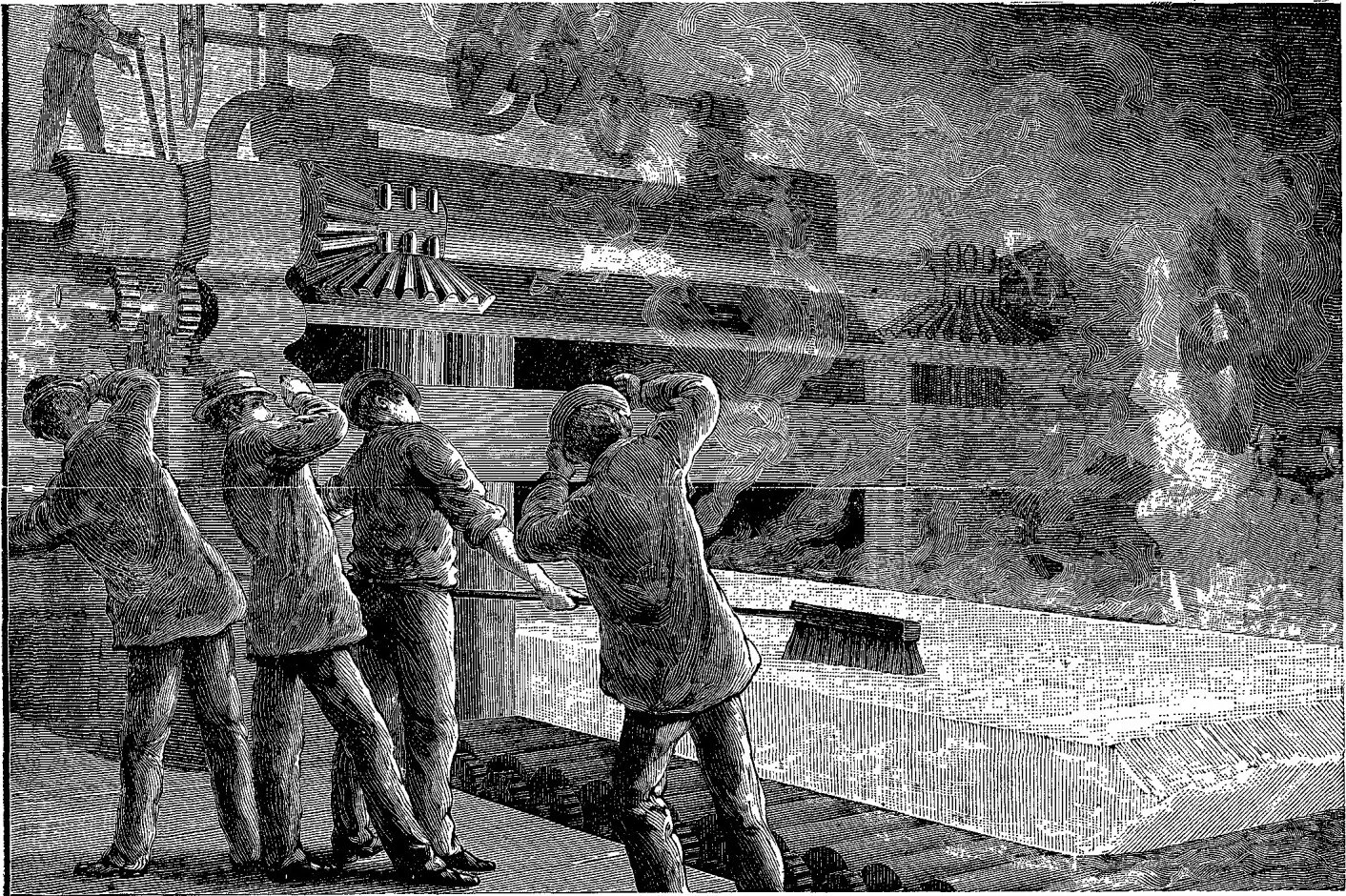
A wierd and touching incident occurred recently illustrating this fact. It was night in the city of Bethlehem, Pa.,—not “Bethlehem,” the birthplace of the Prince of Peace. A stranger was passing along its streets, when suddenly church bells began to ring and whistles to scream. What could it mean? Did it announce some great calamity? Was the city on fire? Oh no. Were the church bells ringing the glad news of the coming of the Prince of Peace or of some great conquest for his kingdom over the passions of men? No, no; the bells of Bethlehem ring out on the silent air no such joyful tidings. They are ringing with hungry tones the announcement that the Bethlehem Iron Co. has just been awarded the contract for forging the armor plate for Russia’s great war ships. Men have long been out of employment345Poverty and suffering have resulted. Now they will have work and bread. No matter though it be to make engines of war which shall pour from their fiery throats shot and shell into the breasts of their fellow-men. Now they can eat and drink. No matter though they do eat and drink the flesh and blood of their fellows,—let the bells of Bethlehem ring.
These are the signs of the times. And with these awful facts staring us in the face, men will tell us that we are in the dawning of the millennium. That though the Prince of Peace has not yet returned, these are the days of peace.
Bethlehem (Pa.) Iron Works, Forging Armor Plate for the Russian Navy. From Scientific American, by permission.
To those who are disposed to regard these things with complacency we recommend a careful reading of the article on the next page from the pen of Hon. Thomas F. Bayard, Ex-secretary of State, and late ambassador to England. “There is no thoughtful man,” says Mr. Bayard, “who is not anxiously questioning in his heart, what does all this preparation portend.” It is only the thoughtless man who is not stirred by these facts. It is only those who fail to discern the signs of the times who cry peace and safety at such a time as this.
Reader, can ye not discern the signs of the times? These are not days of peace, but of plague and poverty and passion, of “distress of nations; men’s hearts failing them for fear and for looking after those things that are coming upon the earth. . . . Then shall they see the Son of man coming in a cloud with power and great glory.”
“But of the times and the seasons, brethren, ye have no need that I write unto you. For yourselves know perfectly that the day of the Lord so cometh as a thief in the night. For when they shall say, Peace and safety, then sudden destruction cometh upon them, as travail upon a woman with child; and they shall not escape. But ye, brethren, are not in darkness, that that day should overtake you as a thief.”
Pessimist! some one will say. Yes, pessimist as regards the world in its mad rush for pleasure, pelf and power; but an optomist as regards God’s power to accomplish his purposes concerning the world. It is his purpose to save such as seek salvation and submit to his will. He could not save more without destroying man’s free will. “Whosoever will let him come.”
Those who have built their hopes on a millennium of peace and righteousness before the return of the Prince of Peace, have built upon the sand. God’s Word furnishes no foundation for such a hope.
“Denying ungodliness and worldly lust, we should live soberly, righteously, and godly, in this present world; looking for that blessed hope, and the glorious appearing of the great God and our Saviour Jesus Christ.” This is the Christian’s hope. To this he looks for the end of strife and war. A. F. B.
Individual Liberty.
By Thomas F. Bayard
By Hon. Thomas F. Bayard, Ex-Secretary of State, and late Ambassador to England.
NEVER since the world was peopled has mankind stood in such anxious expectancy, awaiting the outcome of the immediate future, as in these closing years of the nineteenth century. Men are wistfully striving to peer through the portals of the year 1900—marvelling as the effect and forces of applied science are unfolded to our comprehension, and discovery moves on, each invention leading in another, in stately procession; we, all the while, wrapped in wonder, are straining in hope and fear to catch the coming word, and to comprehend its import.
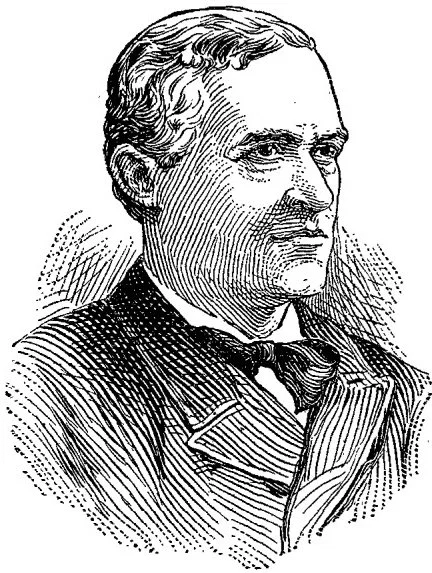
HON. THOMAS F. BAYARD.
Never was speculation so rife, never was the field of human observation so unobstructed and expanded, nor the ascertainment and sifting of facts so facile. Never were opinions more diverse, nor was it ever so obviously important to detect and assert the philosophical principle, in recognition and obedience to which, the lucidus ordo of human government may be preserved and kept in view, and the retrocession of mankind prevented.
At no stage of history was it more important to call to mind the great principle that government is a means, not an end, and is instituted to maintain those general liberties which are essential for human happiness and progress.
GREAT MOVEMENT OF UNREST.
There is a deep movement of unrest in the breasts of men, and the forces of society move in strong and variant currents—the concentrated weight of armed repression and the upheavals of popular discontent are alike plainly discernable.
In some countries consolidation of empire progresses remarkably and impressively—in others disintegration is equally signified. Old dynasties, in sorrowful impotency, are drifting helplessly on the surface of events, or sinking palpably and hopelessly into the sea of time, which threatens soon to ingulf them, and even the memories of their unproductive civilization—the roots of which have dried up and lost the principle of growth.
Other nations appear glowing, sanguine, self-confidence, in lusty vigor and virility, springing forward and upward as though vivified by an elixir vitæ, which expels fear and feebleness, and sends strength and hope tingling through every fibre.
In some nations the hand of autocratic power and unequal privilege appears to tighten upon society, and if now and then it seems to relax its hold, it is only to extend and fasten more securely its grip upon the masses over whom it bears sway.
In others, the progress of the doctrine and spirit of democracy widens the base of power, and calls into political consolidation the great body of the inhabitants, depositing the ultimate power of decision in a majority of the members.
Never were the destructive forces of warfare marshalled in such impressive array as we see them to-day—never before did earth shake under the measured tread of so many men armed and prepared to be armed—never in history were weapons so lethal, missiles so mighty, and explosives so terrific and powerful, or in hands so carefully drilled and instructed in their employment—never were the preparations for war on land and sea comparable in scale and efficiency, to those of the present day.
Contemplating all these terrific forces, there is no thoughtful man who is not anxiously questioning his heart, What does all this preparation portend? What is to be the result to the civilization and progress of the human race of the conflict of such forces, and the changes it may at any moment create?
WEIGHT OF TAXATION GROWING.
But this disposition to an exaggerated and ever-increasing militarism is necessarily accompanied by grievous pecuniary burdens; the weight of taxation is growing fearfully, and as men are withdrawn from productive industries and remunerative pursuits, the great engine of the State, the sovereign power of taxation, is put in motion everywhere and in every shape to gather revenues to support the vast expenditures.
The forces of productive industry were never so great, and the burdens upon their products were never so heavy. Combination and consolidation to resist injustice and competition for success have gradually arrayed capital and labor in opposite camps, in which the power of each is separately and too often aversely organized, and serious conflicts have occurred, and conflicts more serious are impending, which threaten disaster to that tranquility and good order of the State, which are essential not only for its progress, but for the maintenance of the civilization to which the world has attained.
In this threatened conflict and confusion of the forces of society, and seeking the origin of that free government which is essential for happiness and progress, and how it shall be perpetuated, I ask, What is its germ? What is the seed from which human liberty springs? and which must347never be overlooked, but renewed, and replanted and protected as the generations of men pass away and their successors fill their places?
When I contemplate the autocratic power which is exercised in some countries to-day, and behold the organized and associated powers of wealth and numbers welded in such an overwhelming phalanx in others, I ask, Where is the safety and personal freedom of the individual? How is it to be guarded and secured? For the freedom of its individual members is the essential basis of the freedom of the State. The movement of the day, sometimes open, sometimes concealed in the robes of philanthropy and paternalism, but more often discernable in policies purely selfish, is toward State Socialism, as an opposing force to Autocracy. But either is Despotism, and fatal to that individual freedom of man's mind and soul which is the instrumentality by which the world, under the very laws of its origin and progress, has been raised from brutality and barbarism to its present standard of civilization.
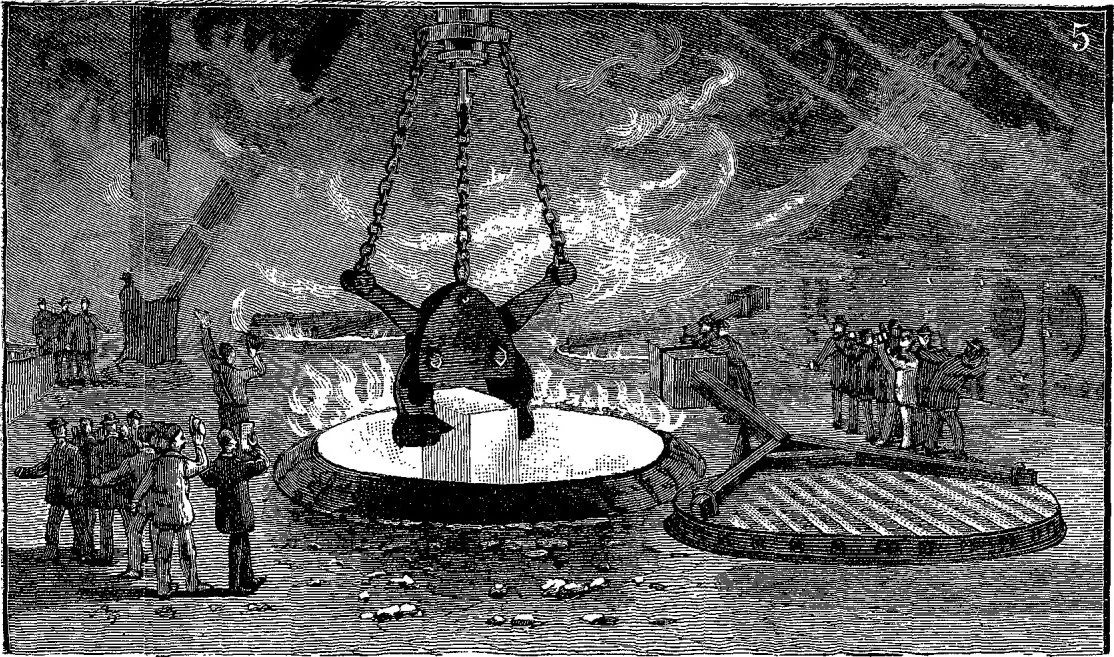
Heating Armor Plate, Bethlehem Iron Works.
From Scientific American, by permission.
These problems of society rise on every side, and the peace and order of the world are seriously menaced.
WHAT BECOMES OF THE INDIVIDUAL.
The centripetal forces seem to move almost irresistibly towards consolidation and centralization, and in the presence of such exaggerated militarism, with its stupendous powers, with the vast plutocratic combinations of incorporated wealth and capital so closely in alliance; with the widespread national and international popular organizations of labor, with their solidified, massed, numerical force, one asks, with just alarm, What is to become of the individual—the freeman, the essential unit of a society that hopes to retain the principle of growth and progress; of adaptation to those advances and improvements which demand the open mind, the complete liberty of human faculties, first for their discovery, and after that for their reception and assimilation? Is there not cause to fear lest between the upper and the nether millstones of the twin despotisms, military absolutism and socialistic tyranny, the freedom of the individual may be ground to death?
News, Notes, and Comment.
I NOTE that the “A. P. A.” is taking an active part in supporting certain public school managers who countenance the reading of the Bible in the establishments under their charge, in spite of the protests of many parents. This matter has frequently led to bitter disputes, and the fate of parties and of statesmen has sometimes hung on its settlement. In Canada the public school and its relations to religion have been discussed with an intensity of feeling fortunately—so far—undeveloped among our people. Nevertheless, every now and then, some very harsh language is indulged in by our disputants, and compromises are, as usual, perfectly satisfactory to nobody. The thing is deplorable; but it is, to some extent inevitable, from the very nature and existence of the public schools.
UNQUESTIONABLY, the undertaking of the work of education by the State involves the surrender of the great doctrine that the function of civil government is police and police alone. Education is a paternal duty; the State that undertakes it in so far assumes the position of a natural parent—it adopts paternalism into its system of administration. Whether this be a good thing to do or not, the public school is so firmly rooted in the affections of the American people that any attempt to dislodge it would be vain, and no shorter cut to unpopularity can easily be found than any serious criticism or questions on the subject. The tendency is rather to enlarge than to curtail the activities of the body politic in this direction, and no matter how heavy the taxes thus become, they are always cheerfully borne. But, like all other forms of activity, for good or for348evil, the work of State education brings with it certain difficulties and perplexities of its own. Always the point is presented—how much of the father's primary duty in the way of education shall the State take upon itself? There is physical punishment, for instance. Conceding its advisability, under any circumstances, shall a public school teacher administer corporal chastisement in person, or merely advise the child's father to do so? There are scores of little matters of personal habit, cleanliness, politeness, etc., etc., which are important parts of a child's education, and respecting which the provinces of parent and teacher are not by any means sharply defined as to their boundaries. Where the relation is merely between two private citizens, how they agree on its establishment, how they modify its incidents, when or why they sever it, concerns no one but themselves. But make the teacher an officer of the State, and you at once convert every detail of his work with every pupil into a thing of public concern, in which the entire community is interested. The greatest embarrassment in this direction grows out of the divergence of religions among the people.
It is perfectly true that religion is a part, and a very important part of a child's education. But it by no means follows that he should receive this particular part at a public school. The parochial school, it is well understood, in advance, discharges this parental function. It operates under the guidance and direction of a priest or preacher, selected by the parents, accepting their faith, professing and inculcating their creed. Those who send their young to such an institution do so with the desire and upon the condition that certain dogmas shall be taught, along with the sciences, the mathematics and the classics. The teaching is uniform, and acceptable to all alike. But the very moment that you invite the members of more than one sect or denomination to send their children to the same school, then uniformity of instruction in religious matters becomes impossible, without doing violence to the religious faith and sentiments of some one.
In this, as in all other departments of the world of thought, there is plenty of conscious, as well as of unconscious cant. People play upon the word “instruction;” they even try to tamper with the sacred name of religion. They say they do not want religious instruction; all they want, forsooth, is prayers and Bible reading. But this is wicked trifling with truth and the essence of reality. Instruction is not necessarily given as such. It is given by example—by action. If a teacher were to read out every morning to his class three or four pages of “Tom” Paine’s “Age of Reason,” without comment, would not his scholars conclude, and rightly conclude, that he accepted the views of that author, and deemed it advisable for them to do the same? If he read it privately, and they detected him in so doing, would they not give to what they secretly perused in the volume all the weight of his personal authority and influence over them?
How does it affect the principle at stake, that either the Bible or the “Age of Reason” is read “without comment”? The Bible is a sacred book. It is partly made up, it is true, of mere historical narration. But it is not read by any but great scholars for its history. It is read and loved by those who choose to read and love it because of what they believe to be its divine inspiration. It is studied because of its assumed authority as an exponent of a religious system, or cult. Those who so treasure it do not desire that it should be read or studied for any other reason, or in any other light, in schools, or anywhere else. Its reading must necessarily be recognized by the scholars as a public proclamation of their teacher that he individually believes in its sacred character, and would have them do so—that he gathers his faith from its pages, and would have them do the same. None of the advocates of the Bible in the public schools would busy themselves in the least about the matter, if they did not build upon this very hope and expectation.
THE character of the Bible, as a sacred book, renders it impossible that it should be used in a school for any other purpose than to commend a certain form or type of religion to the scholars. This being the case, it is obvious that its use in a public school embodies that union of Church and State against which it is the main purpose of these humble paragraphs to protest most earnestly. Few people stop to think how many points of a purely religious nature are necessarily assumed and preached by the mere act of reading the Bible in a school, as it can only be read—in its sacred character. Is there a Deity? Has he made a special “revelation” to man? Have we here the only such revelation ever made, and do these pages contain it all? And so forth, and so on. Concerning all such topics, there be many minds among men: Differences minute and innumerable exist, and all the differences are about religion, and nothing else in the world. To decide any one of them for the young is to teach and preach religion. To decide any one of them by reading the Bible in the public schools is to effectuate pro tanto a union of Church and State.
BUT I hear a great cry over “godless education.” It is a pretty phrase enough. And men are often guided and governed by phrases. I knew a man once who invented a liniment. He called it, let us say, “Socrates’ Grecian Pain-Killer,” and nobody would buy a bottle. Comparatively a small number of his neighbors, you see, had ever heard of Socrates; and not one of them cared anything for the Greeks, at that time, because the enlightened press had not yet told them what magnificent disseminators of the gospel of truth and love those lamb-like349creatures were. There came into contact with this man another, who invented not, but had analyzed and assayed his fellows. The two formed a partnership; the last mentioned at once changed the name of the liniment. He called it, let us say again, “St. Patrick’s Salvation Ointment.” He never even suggested any change in the formula. But, in a few years, those partners were wealthy.
THUS are men swayed by words. And when you talk about “godless education,” you seem to many to make a great point for the Bible in the public schools. But, in fact, the phrase is utterly irrelevant. What is the trouble about a “godless education,” so far as a school is concerned? The school is established to teach things of this world, not of the next. What has “godliness” to do with the Latin grammar? In what different way would a godly man explain the solution of a problem in quadratic equations, from the way in which an ungodly man would elucidate the same subject? What is the distinction between a godly and an ungodly map of the United States?
BUT religion is an important part of education. True, but it is not all of education; nor is it a part with which any but a parochial school has anything to do. The origin of the parochial school is easy enough to trace. It originated in the selfishness and laziness of parents. The parent’s bounden duty to inculcate in the mind of his growing child the truths of religion, the obligation and the joy of a religious life, is shifted on the shoulders of the clerical master of a parochial school. It is a convenient arrangement, and saves a world of trouble to a really conscientious parent. When such a pious person turns his eyes public school-ward, it seems hard to him that he cannot by its means relieve himself of as much responsibility as he can get rid of through the instrumentality of a parochial school, which costs him a good deal more money than the other. If the Bible is read to his boy at school, then he can spend the evening with the newspaper instead of pondering with the little fellow over the Sermon on the Mount, and be easy.
A PROMINENT actor preached in a Western pulpit some days ago, and took occasion to say that if there were no vicious audiences there would be no vicious plays. This is true enough, but it hardly constitutes an excuse for those who produce vicious plays. That men have vices is no justification for those who make a living by pandering to them. While there are many clean and beautiful plays, and many honest, upright men and women, no doubt, upon the stage, it is a fact, unless the philosophers of all the ages are wrong, that the moral atmosphere of the play house is distinctly worse than that of the community at large. Perhaps nobody is to blame for this in particular; it may be that, humanly speaking, it is the unpreventable result of the environment.
THE actor has no home, and no home life for the greater part of the year. He is a wanderer among men. He has no social environment to brace him up on every side. He is forced to keep bad hours, and to live with more or less irregularity. Moreover, there is probably something that tends, at any rate, to weaken the ties of self-respect in his business. To be always “personating”—to live in an artificial world, night after night—to seek applause by the very skill with which you bury yourself from sight, and feign emotions which you do not feel—to cater constantly to the many headed, the thoughtless, the butterflies of society—these things may be considered as drawbacks to the higher life and the ideal moral state of mind.
Sabbath-Keepers Persecuted in Delaware.
By Fred H. Seeney
Cheswold, Del., May 21st, 1897.
EDITOR AMERICAN SENTINEL:—
Brethren Leslie Munce and Robert Williams will spend Sabbath, May 22, behind the cold bars of a prison cell, because they choose to serve God rather than man.
The particulars of the case are as follows:—
Mr. J. Thompson, justice of peace at Cheswold, Del., called Brother Leslie Munce at the hour for trial and said: “Leslie Munce, you are charged with doing work on the 25th day of April, 1897, the sabbath day. What have you got to say?”
Bro. Munce: “Not guilty.”
“Robert Williams, you are charged with a like offense, what do you say?”
Robt. Williams: “Not guilty.”
Mr. John Carney was the first witness for the prosecution.
Justice, to Mr. Carney: “Now, John, tell us what you know about this case. Did you see Leslie Munce doing work on the 25th day of April last, the sabbath day?”
Carney: “Yes, sir; on the 25th day of last April I saw Leslie Munce go along the road with a grubbing hoe on his shoulder going toward the church, and he went to the church and stayed a while and came back and went over in the field and went to digging up sprouts; and this man, Robert Williams, picked them up and carried them to the woods and threw them in the woods. And that, sir, is what I saw him do.”
Justice, to Maud Carter (second witness): “Tell us what you know about this case of Leslie Munce and Robert Williams. Did you see them doing work on the sabbath day?”
Maud Carter: “Yes, sir, I did see Leslie Munce digging up bushes. I was out to Uncle Will Morgan’s and I saw Leslie Munce grubbing up bushes and Robert Williams picking them up and throwing them in the woods. That, sir, is all.”
Justice: “Now, Leslie Munce, what do you say?”350
Leslie Munce: “Squire, will you allow me to ask the witnesses a few questions?”
Justice: “Yes; I forgot that.”
Leslie Munce: “Mr. John Carney, you are the first witness. You say you saw me digging up bushes on the sabbath day.”
Witness: “Yes; I did.”
Munce: “John, can you tell me which day is the Sabbath day?”
Witness (confused): “Well, I did; we take Sunday; it was on the 25th of April.”
Justice: “That won’t do; it is contempt of court. We take the first day for the Sabbath, and it is indorsed by the laws of this State and the United States and the civilized world over, as the Sabbath. So your argument won’t do.”
Munce: “Squire, you say that Sunday is the first day of the week.”
Justice: “Yes.”
Munce: “The Bible says the seventh day is the Sabbath of the Lord thy God.”
Justice: “Stop; we don’t want the Bible; that won’t do; and if you don’t stop I will fine you for contempt of court. The Bible is not what we want, it is the law.”
Munce: “Well, Squire, can’t you allow the evidence of the Bible in this matter?”
Justice: “No; the Bible is not the thing; it is the law we want.”
Munce: “Is not that a Bible you swore the witnesses on?”
Justice: “Yes.”
Munce: “How is it, Squire, you will not take the testimony of these witnesses unless they swear by God’s Word that what they say is truth? If they can be allowed these oaths by God’s word, why not accept my statements concerning the Sabbath by God’s word?”
Justice: “That will do; I don’t want any more. You have got to stop.”
Munce: “All right, Squire; I will ask the other witness a question. Maud, why did you seek to do me a wrong?”
Maud Carter: “I wanted to show you what the law could do with you.”
Justice (to second witness): “That will do, now; I want you to stop where you are and don’t say any more.”
Justice to Leslie Munce: “I fine you $4- and costs, amounting to $2.19, making $6.19. And Robert Williams, you are fined with the same amount, making $12.38 in all.”
Constable to Munce: “Leslie Munce, what are you going to do?”
Munce: “It is for you and the Squire to say what you are going to do.”
Justice: “Are you going to pay the fine?”
Munce: “No; I have done no one any harm, and I cannot pay anything.”
So the constable went and got his horse and wagon, and Brothers Munce and Williams got in on the rear seat with the constable in front, and the people seemed to think they were two as harmless criminals as could have been seen.
So Brothers Munce and Williams spent their Sabbath in Dover Jail. But Brother Munce said he never spent a better Sabbath in his life. The Lord was with him, and he never realized the need of the Saviour as at that time, and everything went as pleasant as could be. The hardened criminals seemed to drink in the Word of God like water as they had never had the Bible read to them in that light. Brother Munce had opportunity to give away some tracts and to talk some in favor of the truth. He was in jail only twenty-four hours. Those hardened criminals made him promise them he would come again and bring them some reading matter and read to them. We can accomplish wonders if we will only be led by the Spirit of God.
So we want to say, as the great Teacher said, “We come to do Thy will, O God, for Thy law is within our hearts.” And the prospect is that if we continue to keep this law of God there will be more of us to go to jail soon.
The spirit of persecution seems to be stalking at large at present. Those who hate us are taking pains to spy out our liberty, and some of the lower class say they will give in all they see at work on Sunday, both men and women. FRED H. SEENEY.
By their action in the case of the Rev. W. H. Cossum, who criticised the acceptance by the Baptist Mission Board of a bequest of $250,000 from a well known millionaire, the Board seem to have put a peculiar interpretation upon the scripture that “charity covereth a multitude of sins.”
TO OUR PATRONS:
By Editor
Write names plainly.
Remit by P. O. Money Order, or Express Order, or by Bank Draft on New York. Personal checks are not desired.
Make all Orders and Drafts payable to Pacific Press Publishing Co., not to the editor or any other individual.
We will receive Postage Stamp in small quantities and any kind of good money. Defaced coins will not be taken. If paper money or coin is sent, register the letter.