THE butchery in the Balkans is filling the English mind with disgust. Contrasted with his late opponents, the Turk seems no longer “unspeakable,” and many are willing to see him once more in possession of the tombs of his ancestors at Adrianople. The great powers from first to last have not shown to advantage. They began by trying to sit on the Balkan allies; but when the prowess of these pugnacious kingdoms showed that they were not going to be sat upon, the powers meekly accepted the rebuff. They took their revenge by bullying the smallest of the allies; and when Servia and Greece, disappointed in Albania, tried to compensate themselves in Macedonia at the cost of Bulgaria, weakened in the common cause, and attacked in the rear by Rumania and Turkey, the powers contented themselves with impotently announcing that they would not consent to see Bulgaria too much humiliated. So far, however, Bulgaria has nothing to thank them for. Even Turkey seems to be able to set the great powers at defiance. Russia would gladly undertake to drive the Turks back to Constantinople, or operate on their flank in Asia Minor; but the rest of the powers are afraid that the benefits of such a course might fall to Russia alone, and will not give their consent. Germany does not intend that any other European power shall get into Asia Minor ahead of her.
While there is a general feeling that Bulgaria has herself largely to thank for the hostility of the Serbs and Greeks, she has naturally received plenty of sympathy in the hard fate that raised up for her, in her time of exhaustion, powerful enemies on every hand. No one expects that the patched-up peace of Bucharest will prove a lasting one. As soon as Bulgaria sees her opportunity to take a full revenge, there is little doubt that she will seize it. Greece and Servia will have to pay for their present triumph over the ally, without whom they could have accomplished nothing. Henceforth a deadly feud will smolder in the Balkans between irreconcilable foes.
There is a deep, underlying significance to the tragedy that is being wrought out in the Near East. In that quarter lies the focal point on which the armed vigilance of Europe is concentrated to-day. Like wild beasts, intently watching one another, ready to spring in fury and growling at every sign of movement on the part of a rival, the eyes of the great powers are fixed upon the neighborhood of Constantinople. How easy to precipitate a conflict there that would engulf civilization! And close to that very quarter lies the region pointed out by the prophets as the scene of earth’s last and greatest struggle.
In Asia Minor
The Right Honorable David Lloyd-George
The return of the Turk to Adrianople has brought back into the situation all the possibilities of world-wide strife that appalled the imagination of Europe at the outbreak of the Balkan war. Mr. Asquith and Sir Edward Grey have warned the Ottoman government that if it is determined to flout the will of Europe, it may reopen important questions that, in Turkey’s interest, had far better be left closed. Every one knows what the menace means. Turkey was to have been left unmolested in Asia Minor; but if she tears up the treaty of London, and will not withdraw from Adrianople, the powers will consider themselves at liberty to deal as they please with her possessions in Asia. Mr. Harold Spender declares that the partition of Asiatic Turkey into European spheres of influence will be the next great development on the chess-board of European politics. If the great powers have been obliged to relinquish to the Balkan States the coveted spoil of Turkey in Europe, they will be all the more ready to seek compensation in Asia. In such a case, it will not be long before the future of the Holy Land will become a practical problem of pressing importance. Then will come to pass the scenes opened up before Daniel and Joel and the revelator. The Plain of Esdraelon will witness once more the gathering of mighty armies, and thither the kings of the earth will lead their forces for that last great struggle which the Scriptures associate with the name of Armageddon.
Sowing and Reaping
And the spirit that is manifested by the powers, great and small, is well calculated to assist the world on its downward path to perdition. Undisguised greed is the ruling principle of statecraft. Might means right. Students of current history are in despair as to the outcome when they see how the nations to-day throw honor and justice to the winds. A desire for territorial enlargement is sufficient warrant for the invasion of a neighboring and unoffending country. Mr. J. L. Garvin, of the “Observer,” one of our most forcible English writers, declares that the cause of peace has been set back for a whole generation by the late war in the Balkans. “Every precedent set in the most cynical epochs of dynastic statecraft has been confirmed and repeated.” He reviews the grievances that have been cherished in Europe for the past forty years, and declares that by the course they have themselves taken in the recent crisis, the various countries concerned have fully justified all the violence and international crime that has been committed against them during that period. Rumania can never again complain of what she has suffered at the hands of Russia and Austria, for she has done to the Bulgarians as those powers did to her. “The Servians have invoked Heaven against Austria. Now they have vindicated Austria by their own proceedings. The Hapsburg empire has at least as much moral right to Bosnia and Herzegovina as the Servians have to the larger part of the Bulgar districts they have seized in Macedonia.” Take the Greeks. “A few weeks ago, every generous sentiment associated with humanity and morals was invoked on behalf of the unemancipated Greeks in Southern Albania and the islands. Meanwhile our Hellenistic friends, without a particle of magnanimity or restraint, and with a complete disregard, toward others, of the elevated principles invoked for their own benefit, have laid hands on all they could.” The Balkan allies, in their treatment of one another, have sown to the wind, and they are likely to reap the whirlwind.
Is It a Civil War in England?
In England, we are still wondering whether or not we are within a few months of civil war. The Home Rule Bill has now passed twice through the House of Commons. It only needs to be passed once more by that assembly, and then it will go into effect, regardless of what the House of Lords may say. Unless the present government is defeated in the interval, home rule in Ireland will become law next spring. The Orangemen of Ulster have sworn a mighty oath that they will not submit to an Irish government; and Sir Edward Carson, their leader, has declared that he is prepared to sacrifice everything, even life itself, in resisting. It is said that the Orangemen have already armed themselves and are drilling assiduously so as to be ready for the fray. Just what it all amounts to, remains to be seen. One side protests fervently that it means rebellion and civil war and appalling bloodshed; the other side does not believe that the business men of Belfast will be willing to take one step that may imperil their commerce. Sir Edward Carson is daring the government to arrest him for his seditious utterances; but so far, they are declining to take him too seriously. The clergy in the north of Ireland are taking a prominent part in working up the Orange agitation.
Welsh Disestablishment
The Welsh Disestablishment Bill is also running its course, notwithstanding great bitterness of feeling on the part of the established church in England. The bill has been again passed by the House of Commons, and in another year, unless the government is overthrown in the meanwhile, this bill will also go into effect.
The Troubled and Troublesome Women
The militant suffragette movement is still pursuing a course of violence and incendiarism11. By special legislation, the government has secured a legal weapon against the hunger strike. When, by reason of their refusal to take food, the imprisoned militants are reduced to the extreme of weakness, they are released from jail for a few days, and after the expiration of this period are again arrested. Of course the hunger strike at once begins again, and after a few days they are again released. The militant party term this the “Cat and Mouse Act,” and use it as another illustration of man’s unfitness to rule over women, without their aid in the making of laws. There is no doubt, however, that the militant leaders are much hampered in their campaign by this act, and it is likely to wear them down in the long run. Meanwhile the orderly agitation for giving votes to women increases greatly in strength. Huge demonstrations have lately been organized; and in response to a deputation, Mr. Asquith has promised that he will not exercise any personal influence whatever against giving votes to women, if the majority of his party should desire this extension of the franchise.
Omens of Labor Troubles
There are signs of renewed trouble in the labor world. The use of the military in South Africa to put down the miners’ strike at Johannesburg has tended to inflame the anger of the Labor Party against Lord Gladstone and the high officials responsible for this step. Strikes continue to break out in various parts of the United Kingdom. One in particular is worthy of notice. The agricultural laborers in this country have been a particularly meek and long-suffering class of people. Scattered as they are in small villages, it has been impossible for them to organize effectively, and a limited education has made them unresponsive to the appeals that have stirred up their fellows in the cities. It was therefore a matter of considerable surprise when the agricultural laborers in the northwest of England struck this summer for higher wages, shorter hours, and recognition of their union. The farmers who employ them are usually a conservative class, and they were unable to regard with appreciation or enlightened sympathy this unexpected development. Some of them walked about their farms with loaded guns, threatening to shoot anybody who dared to trespass on them for the purpose of picketing. After a strike had lasted two or three weeks, to the peril of the hay harvest, the laborers gained most of their points. So the organization of the farm laborers has begun. This will mean that the great army of discontented toilers will more than ever hold the country in its power, whenever it shall think fit to bring about a general strike. When the labor war extends to the land, and growing crops are attacked by strikers as mills and factories now are, it will be a serious development for the general public.
In Religious Circles
The annual conference of the Wesleyan Methodists, just held, attracted unusual public attention, because it witnessed a protest against the appointment of the Rev. G. Jackson to one of the training colleges, on the ground that his public utterances showed him to be one of the modern higher critics. Evidence was produced from his writings to sustain the charge; but the conference took the position that, altho Mr. Jackson had been too free in expressing his disbelief on certain points hitherto regarded as fundamental truths, the Wesleyan Church could not prohibit freedom of thought and expression. So Mr. Jackson becomes a recognized teacher of candidates for the Wesleyan pulpit.
The Imperial Sunday Alliance, a combination of Anglican, Free Church, and Roman Catholic forces, has framed a weekly Rest Day Bill, and got it introduced into the House of Commons. This bill claims to be free from religious bias and to aim merely at obtaining for the working classes one day of rest in every week. But as drawn, it is a stringent Sunday bill. It forbids the employment of labor on Sunday, but allows certain shops to be opened on that day for a limited number of hours. The Jews are dealt with harshly in the bill, being allowed only slight concessions as to opening their shops on Sunday, and these are hampered by restrictions. The bill can not be debated in the present session of Parliament, but has been introduced with the support of representatives of all parties, in the hope that it will receive attention next session, and with a view to working up a public sentiment in its favor. At the present time, the general tendency is in the opposite direction. Sunday is observed more loosely to-day than it has been for a long time.
Proposed Reforms
The present government is still contemplating large measures of reform. The educational system is to be overhauled, and an important land reform campaign is also being agitated. The lot of the rural laborer is to be ameliorated, and he is to be left no longer at the mercy of the employer from whom he now, as a rule, has to rent his little cottage. Mr. Lloyd-George’s Insurance Act is working smoothly and prosperously, but one result of the measure is that there are now more sick people in the country than ever before. It is a temptation to a man who is able to draw sick pay for a few months, to take his complaints more seriously than he was wont to do when every cessation of work meant the complete stoppage of his wage.
W. T. BARTLETT.
Viscount Gladstone, son of the late W. E. Gladstone
England to Protect Catholic Missions
The London correspondent of the Western Watchman (Roman Catholic), in the issue of that journal of July 31 says that the Catholic protectorate of missions, granted to Portugal by Pope Martin V, 1417-1431, and renewed in 1886, has been rejected by Portugal, and will probably be offered to England, “who will gladly accept it.” This, we are told, “will have far-reaching consequences. It may be the means of opening official relations between England and the Vatican, and of sending an English ambassador to Rome, while it will certainly assure to England one day the possession of Goa, Diu, and Daman, the last Portuguese possessions in Hindustan.” But will England do this?
The State Out of Place
By W. F. Martin
At the recent Christian Citizenship Conference in Portland, one of the things that was urged as much as anything else, if not more, was that religion should be taught in the public schools. In addition to advocating it from the rostrum in the Stadium, one entire forenoon sectional conference was devoted to the subject. The principal address at this meeting was given by the superintendent of the National Reform Association. The theme of his discourse was “Religious Instruction in State Educational Institutions.” His opening statement was an index to the entire effort. It was as follows: “To fulfil its mission, the state must be Christian.” Then comes the sequel: “She must impart Christian teaching to her children.”
This is a mistaken idea of the realm and work of the state. It is not the province of the state either to profess or to teach the Christian religion. The government is composed of citizens, some of whom are Christians, some Jews, some Hindus, and a great many profess no religion at all. So long as any of these classes comport themselves in a proper way toward their fellow men, they are entitled to all the advantages of the government. No one can claim any special favors from the government because of his religious belief. So soon as any sect or class should be favored by the government, or granted an advantage by the civil law, over other sects or classes, just so soon would complete religious liberty be destroyed. It would not be fair to the Christian to levy a tax from him to pay for the teaching of Mohammedanism, much less to pay for teaching this false religion to his children. This same principle will apply with equal force when it comes to taxing the Mohammedan to pay for the teaching of the Christian religion to his children.
The state is a civil institution, ordained to deal with civil matters only. God's church is a divine institution, dealing with the individual conscience. The state compels, but the church persuades. Whenever either has invaded the realm of the other, trouble has invariably followed. Religion has been called “the duty which we owe to our Creator, and the manner of discharging it.” No man or even government has a right to dictate how or when this sacred duty shall be performed.
W. F. MARTIN.
The Harm of Fiction Reading
Word comes from one of the large publishing houses in New York City that it is publishing “over a million words of fiction a month.” And it might also be safely added that the publishing of this matter does untold harm and but very little good. Go where you will on the railroads, on the street-cars, in waiting-rooms, and such places, and you will see young men and women, and older men and women, busily poring over some volume or magazine article of fiction. If they resorted to such reading only occasionally, it would not be so bad. But when they spend the major part of their spare time in that way, it is perfectly safe to say that they are not among the ones who are “doing things” in the world. One can not spend his time and energies on fiction and still get and hold that grasp of knowledge that fits one to bear his part strongly in the world’s work.
Funeral of August Bebel
There were twenty thousand Socialists at the funeral of the great German Socialist, August Bebel, at Zurich, Switzerland, August 17. They were representatives of Socialism from nearly all countries in the world.
Pittsburgh’s Annual Fuel Consumption
The Pittsburg district of Pennsylvania is the largest consumer of fuel in the world, using more than 22,000,000 tons annually of coal and coke.
The Transformation of Ngwe Zin
By Robert Bruce Thurber
A Story of Real Life
By Robert Bruce Thurber
NGWE ZIN boarded the train with all the nonchalance of his fifteen Burman years. The people of his race are full of the laugh of life, and he was exceptionally so. Head up, walk a swagger, lips ready to accost any and every one with a pleasantry, he sat down on the narrow board seat of the third-class compartment, and deposited his bundle by his side. With the same air, he lighted a cigaret, and blew smoke out the window, his feet perched on the opposite seat. He looked the personification of self-satisfaction. Nothing mattered.
But this was all on the outside. Ngwe Zin was troubled. The careless demeanor was habitual, but beneath it there slumbered a conscience. He wanted satisfaction, that boon we all want. His mother had been a Buddhist nun, and had lost her mind, and his father was rather indifferent about him. He was going to live with his married sister in Rangun. Perhaps the great city held what he desired.
A Burmese Gentleman
The long train curved snakelike among the far-reaching rice-fields. Ngwe Zin looked out, but did not see. He was thinking of a legend of the great Gautama, which his father had told him that day. In a former existence, Gautama had been a calf, and when his mother drank at the brook, he inadvertently drank from a little way up-stream, and muddied the water which his mother was drinking. For this breach, he was fated forever after to have all water become muddy as soon as he raised it to his lips. Strange truth, this! Ngwe Zin recalled a recent experience in which his susceptible conscience had been overurged to get him to seek the jungle places near Maulmain where the priests lived an ascetic life, and had to be supported in their walk because their food was “vegetation.” He sought the peace they seemed to have, but it was not for him. Perhaps the Good Man would yet lead him in the true way. But just now he was on the point of giving everything up that disciplined, and starting to do just as he pleased. What was the use of trying, anyway? Other people were happy, why shouldn't he be? This endless trying-to-do-right-and-can’t was maddening. The Christians were the best favored, and hadn’t their God helped them to rule almost the whole world? Yet every one said that Burma had become more wicked, and there was more disease, since the Christians came. The puzzle of “things as they are” was too much for him.
A Burmese Girl
As the train rolled on, vague plans for the future became a part of his reverie—vague because he knew so little about the city and its ways. With but a change of clothing and his ticket to Rangun, he must now make his own way in the world; and what place would his scant knowledge of English and his little other education find for him? He was eager and willing, but—Nicotin just then called for another puff, and on suiting the action to the desire, he found that the cigaret had “gone dead.” And his matches were gone, too. How careless! (No, how providential!) He looked around, and saw a man and a boy watching him.
“Is there a match with you?” he asked; and after he said it, he noticed the man had been reading a book, and there was a pleased expression on his face.
“No,” came the answer, as the man put his hand on the book, “I have a Light, but I haven’t a match. I don’t drink smoke.”
“Strange,” thought Ngwe Zin; and he asked aloud, “What book do you read?”
“The Bible.”
“O, a Christian!” and there was a tone of dampened friendliness in his voice. “You are a Christian, and you don’t ‘drink smoke’? How is that? I learned to smoke cigarets at a Christian school. Doesn’t the Christian’s God ‘drink smoke’?” This in a bantering voice.
The man looked displeased, and the boy laughed.
“No, God doesn’t ‘drink smoke;’ and true, enlightened Christians don’t, either. It is a bad habit,—bad for the body, and the mind, and the heart. I know a Christian school where neither the teachers nor the boys ‘drink smoke.’ I wish you could go there.”
Well, here was a new thing in Burma, and Ngwe Zin caught at the idea. He was informed of a school at Meiktila where the boys were taught morals and hand-work as well as the book lessons the other schools taught. Yes, poor boys could have a chance; for the tuition fees were low, and if a boy were diligent he could earn his way. He would emerge from the school with a trade, a character, and a trained mind.
Ngwe Zin questioned in his mind about “coolie work” being in any way desirable, but here was a chance to get “book learning,” and it was not to be scorned. This well-appearing man was a teacher in the school, and was now on his way there. Perhaps it was all untrue; but he was absorbed in it, and the time passed quickly till the train arrived at Pegu. Here the erstwhile fellow travelers parted, and in two hours Ngwe Zin was being jostled by the crowd at the Rangun station.
His sister lived in a poorer section of the noisy city. Burma’s metropolis seethed like a caldron at this season. The intense heat was accentuated by the crowded condition. The choky dust, the filth of the foreign element the rabble among whom he was as nothing, disgusted him in a short time. What chance here without money? Then he opened his heart about that school, and a sympathetic sister heard with interest. It appealed to them. A will was born, and a way was sure to follow. Somehow she got13together ten rupees for him, and half of it was spent for a ticket to Meiktila. God bless her sacrifice! She is dead now, but that was the greatest thing she ever did.
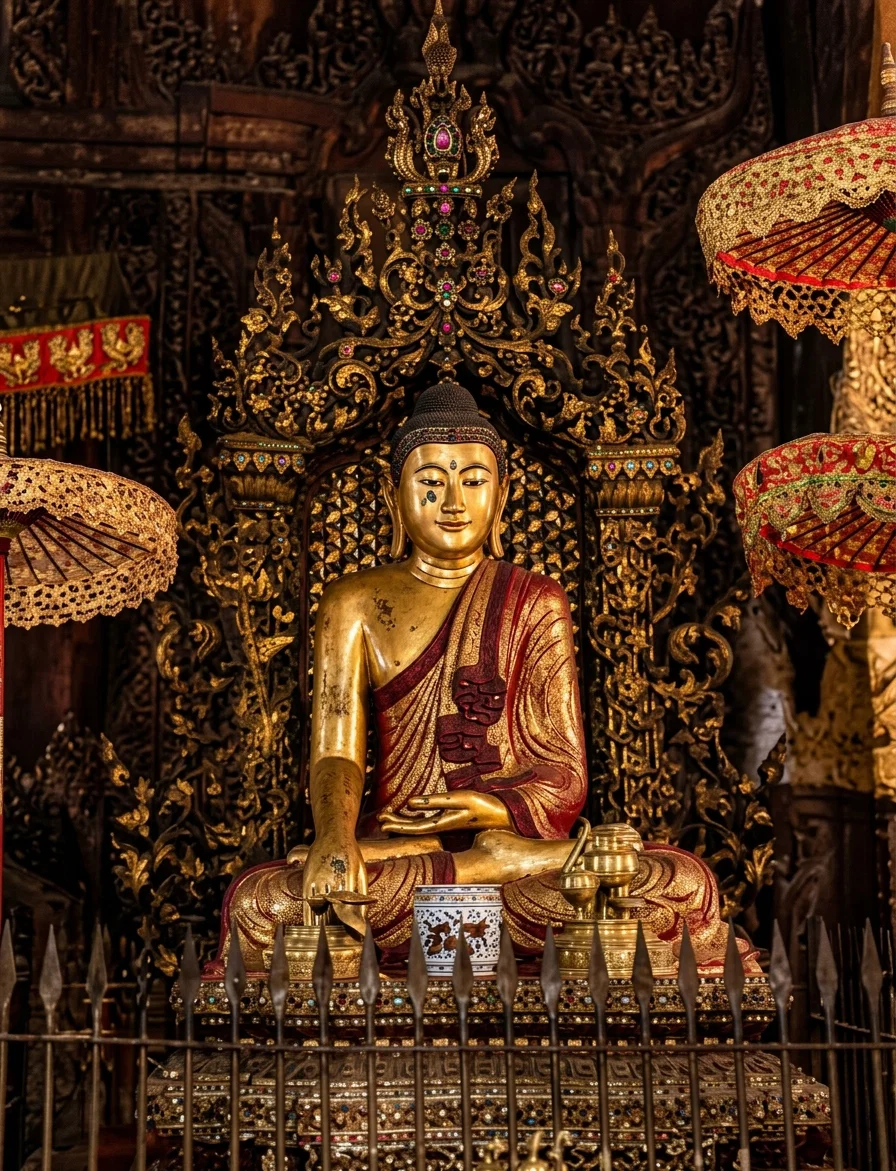
A Burmese Buddha
The boy came without previous notice or arrangement; and the next morning, before daylight, he was landed at the “desired haven,” but hardly knowing “whether he went.” There were no likely persons astir to guide him, so he sat down on a step and waited—waited for some one to come, for he was sure some one would come. At daylight the very boy whom he had seen with the teacher on the train, passed that way. Hailing him and making explanations, the rest was easy. We took him on the recommendation of his efforts to reach us.
At first he was disappointed. His natural love of a big show was not satisfied. There was only a rented building, and no school compound. No trades were taught yet, and there were but few boys. But it offered a better chance for an education than did Rangun or home. Little did he realize that an institution is as great as its principles, and that the most privileged persons in the world are those who do not despise the “day of small things,” but are pioneers in a noble work. The teachers treated him kindly, and took a personal interest in helping him to improve; and soon he was at home, with one exception—the hated Christianity.
He had held the indifference of youth, even to Buddhism, before; but now that he was feeling its hold on him loosen almost before he knew it, he was roused to fight for it with desperation. Ngwe Zin was honest and energetic, and these very traits made him an ardent disciple of the Indian prince, when his cause was assailed. But nothing was said to discountenance his faith in Buddha. The simple truth was told, but it brought forth many a hard-fought argument with the teachers. And this worthy champion of heathenism had the self-confidence to believe that he could reason the best. Perhaps he was right. But there was that Book. He couldn’t fight a book, and yet its contents and spirit were fighting him every day.
Like others who, in spite of their pride, are compelled to acknowledge to themselves that they are gradually losing ground, Ngwe Zin now tried to hide his discomfiture by smoking, and by doing everything else he knew the missionaries didn’t want him to do. Contempt was his last weakhold. His cult sadly needed defending, but he had made poor work at its defense.
Down by the lake, one day, he sat despondently looking at the lap of the wavelets on the pebbly shore. All at once, in that way familiar to Christians who seek God, there flashed into his prejudiced mind a little light. Why, these people had the satisfaction that he had vainly sought! Their religion helped them to live lives of peace in spite of the glaring inconsistencies of it. And after all, isn’t this all that is worth while? Surely the truth alone can beget peace. Why hadn’t he seen it before? Gautama tells us how to do right, but Christ helps us do it. The great gospel truths which had been seeking entrance to his heart, had at last found lodgment. And once entered, they pervaded his whole knowledge, and suffused his entire thought and life. Gautama merits. Jesus saves. This is Christianity. O that he had only known it before! Every one would accept it if they only knew. He must tell them. And right there was born in his soul the saving spirit that was not to pass away. Again nothing mattered, but how different the feeling!
Ngwe Zin is forward, and fights a good battle on either side, when he is sure he is right. He grasped the Bible truths with avidity, and imparted as he learned. At almost one stroke, he stood forth a man in Christ. Rarely are seen changes so complete as his. Enslaving habits were dethroned; the feasts and fasts and foolishness of Gautama-as-he-is-worshiped lost their lure; rice and curry became secondary; and he boldly sought “first the kingdom.” No work was too hard, no place too humble. Like Samuel, he delights to keep in order the house of God. Nothing pleases him better than to lead his schoolmates to Christ. Three years from the time he came to us, he is now preceptor in the school. Rising bravely above objectionable character traits within and strong opposition from without, he stands to-day, just merging into manhood, at the beginning of usefulness for God, a trusted servant, an intelligent student, an energetic worker, a monument to missionary effort.
IN THREE DAYS SAN FRANCISCO Overland Limited. TAKES YOU To Chicago
ACROSS GREAT SALT LAKE AND HIGH SIERRA BY DAYLIGHT
Luxurious High-class Equipment Electric Lighted Throughout
Pullman Drawing-room Stateroom Vestibuled Sleeping-cars Careful and Attentive Dining Service Parlor Observation-car with Library and Cafe Ladies’ Reading-room Gentlemen’s Smoking-room Daily News Bulletins Latest Papers and Magazines
Southern Pacific
ZEROLENE
An oil that maintains its uniform body in all temperatures and under all conditions, is one of the first requirements of the motor.
ZEROLENE
The Standard Oil for Motor Cars
Fulfills this requirement exactly. It does not thin out in the sometimes intense heat of Arizona and Southern California; yet its low cold test keeps it from becoming heavy in the cooler climates of the Pacific Northwest.
ZEROLENE—The Carbon Proof Oil.
Sold by Dealers Everywhere.
Standard Oil Company
(CALIFORNIA)
SAN FRANCISCO
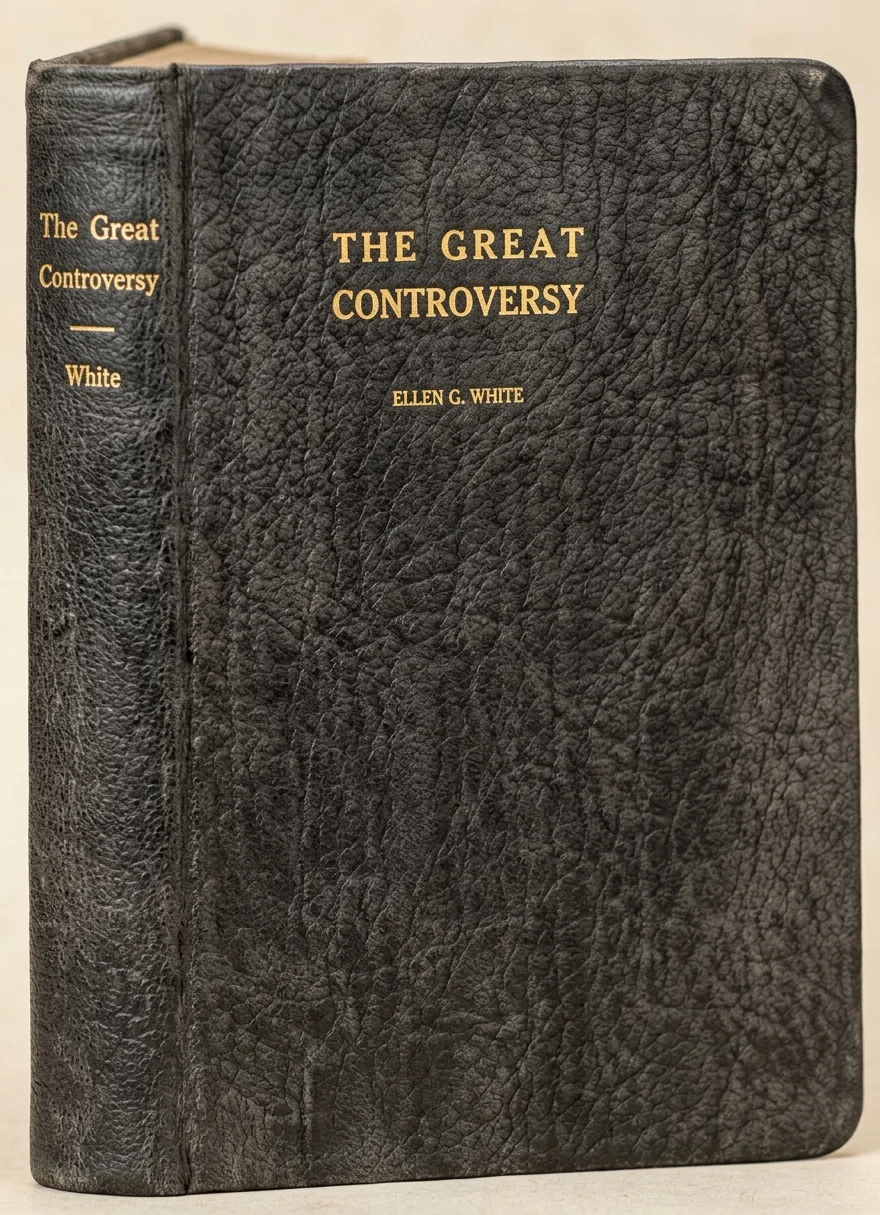
Great Controversy
In Limp Leather
“The Great Controversy between Christ and Satan” has now been added to the “limp leather bound” list. Printed on a fine grade of thin paper. The contents complete are contained in this beautiful, durable book weighing but 22 ounces. It is 8½ by 5½ inches in size, uniform with “The Acts of the Apostles” and “Patriarchs and Prophets” in the same form. In this binding “Controversy” costs only $2.00.
Other works in this form that all should have are
Patriarchs and Prophets . $2.00
The Acts of the Apostles . 2.00
The Desire of Ages . . 2.00
Steps to Christ . . . 1.00