THE memorable battle of Arbela, that resulted in the overthrow of the Persian kingdom, is one of the most remarkable of all history. The Persians under Darius numbered over one million, while the Macedonians under Alexander were only forty-seven thousand. The attack of the Macedonians seemed but madness, the odds were so heavy against them; but Alexander knew his strength, and the secret of this self-confidence lay in the fact that, on the eve of the engagement, there fell into his hands full and complete details of the plans of the approaching attack of Darius, and by this foreknowledge he was enabled so to place his army that the Persian forces were routed, and he gained the victory that made him monarch of the world.
There is no more unequal struggle in all history than that of the man who endeavors to cope with the devil without the help of Jesus Christ. But Christ knows all the wicked plans of the arch-enemy of souls, and these he has revealed to his children. “But ye, brethren, are not in darkness;” for God has been faithful in giving due warning of any judgments that were to come upon the world, that all who would might escape. Noah preached a coming flood for one hundred and twenty years; Lot was warned of the destruction of Sodom; and the Christians knew, years before, of the overthrow of Jerusalem, and so definite was the sign given of that event, that when the time came, every Christian within the walls of that doomed city knew it and escaped.
But merely because we are “the children of light,” — because we know these things theoretically,— that alone will not save us. Lot’s wife knew of the destruction of Sodom, but that did not save her from being turned into a pillar of salt; and the Saviour, in speaking of what would take place in the end of the world, and the danger there would be of even the elect being deceived and turned out of the way, uses these significant words, “Remember Lot’s wife.” What did she do? — Simply “looked back” — that is all, but that meant her destruction. She desired to escape the doom of the city, but while her body was on the plain, her heart was in Sodom. There is in this a lesson of especial importance for those who live in the last days, for “as it was in the days of Lot . . . even thus shall it be in the day when the Son of man is revealed.” Luke 17: 28-30. “Come out from among them,” are the Lord’s words to his children, and “be ye separate.” There can be no compromise. Some of the Lord and a little of Sodom or Babylon will never save us.
So the struggle is a fierce one; but with all the secret plans of Satan laid bare, for “we are not ignorant of his devices,” and with Jesus as our commander and leader, we are ten thousand times more sure of victory, in this conflict, than was Alexander the Great; and he who is faithful to the end, who overcomes, will reap a never-ending life in the kingdom of God.—Present Truth.
Which Side Do You Represent?
By Mrs. S. N. Haskell
MRS. S. N. HASKELL
THE fourth chapter of Isaiah, although the shortest in the book, is a remarkable one. The first verse is introduced by a conjunction, showing that it is closely connected with the closing part of the preceding chapter. The last eleven verses of the third chapter speak of the departure of the daughters of Zion from the simplicity which God designs should characterize his people. All the fashions mentioned in these verses are prevailing fashions in some portions of the earth to-day. The nose jewels are regarded as highly by the Eastern beauty as the ear jewels by her Western sisters. After speaking of the departure of the daughters of Zion from the simplicity that God designs should characterize them, the prophet states that the gates of Zion “lament and mourn, and she being desolate shall sit upon the ground. And in that day seven women shall take hold of one man, saying, We will eat our own bread, and wear our own apparel: only let us be called by thy name.”
A woman in the Bible is taken as a symbol of the church. Jer. 6:2; 2 Cor. 11:2. The number “seven” denotes completeness, therefore seven women would denote a complete church. We must judge of the character of the church by the character of the women, as a corrupt woman is taken to represent an apostate church, and a chaste woman to represent the true church. These women say, “We will eat our own bread, and wear our own apparel: only let us be called by thy name, to take away our reproach.” No true, loyal wife will look to any one besides her husband for her support; therefore, these women, while they take the name of the husband, look to others for their bread and raiment, and cannot represent the true, loyal bride of Christ. All apostate churches of Christendom claim to be married to the one man, Christ Jesus, and are called by his name—“Christians;” but to be called by his name does not make them true and loyal. On the other hand, from the reading of the verse we would understand that the loyal bride of Christ, the true representatives of his church in the earth, would not eat their own bread nor wear their own apparel; or, in other words, when they take the name of Christ, their diet and manner of living would change, also their outward adornment and apparel would change. There would be a marked difference in their diet and apparel after they had taken the name of Christ.
The question might arise, How do we know the will of Christ in these matters? We have the plain statement in his Word; the subject of diet is taught from Genesis to Revelation. One of the first instructions which the Lord gave man was in regard to his diet. Gen. 1:29. In the last chapters of the Bible we find a record that the saints should partake of the tree of life. From beginning to end, the Bible is full of instruction in regard to diet. On the other hand, we have plain instruction in regard to the apparel which the Lord would have his people wear. The Lord, in speaking of women, says: “Whose adorning let it not be that outward adorning of plaiting the hair, and wearing of gold, or of putting on apparel: but let it be the hidden man of the heart, in that which is not corruptible, even the ornament of a meek and quiet spirit, which is in the sight of God of great price.” Here we have the secret revealed. We are told that “after this manner in the old time the holy women also, who trusted in God, adorned themselves;” or in other words, they wore the apparel of their true husband, Christ Jesus. Only those who trust in God are able to do that.
Without a firm trust in God, we cannot wear the apparel the Lord would have us wear. The fashions in the world are constantly changing, but God would have his people ever dress in a plain and becoming manner. Their outward apparel as they go to and fro in the world, should be just as marked as their conversation and course of life. When one who is named a Christian is attired like the world around her, so that as she goes to and fro in the streets, no one would distinguish her from the worldly women with whom she comes in contact, there is something wrong. Such are wearing their own apparel, and not the apparel of the One whose name they have taken.
The apparel of Christ will mark a Christian woman from the women of the world just as distinctly as the character of Christ will mark a true Christian from a worldly person. When we take the name of Christ and wear the uniform of the world, we place ourselves at a disadvantage; in other words, we are clothed in the uniform of the enemy.
In every war the engaging armies have a distinctive uniform. The uniform means a great deal. In our late war one who attempted to serve in the American army with the Spanish uniform would have been banished immediately; so in the great warfare between truth and error. We cannot afford to weaken the side of our great Master by being clad in the uniform of the world, dressing like the world, eating and living like the world. The Lord would have us come up to the standard of his Word, and represent him in every place and at every time. In this fourth chapter of Isaiah the Lord beautifully describes the covering that he will draw over those that will come out from the world entirely. “When the Lord shall have washed away the filth of the daughters of Zion, and shall have purged the blood of Jerusalem from the midst thereof by the spirit of judgment, and by the spirit of burning. And the Lord will create upon every dwelling place of Mount Zion, and upon her assemblies, a cloud and smoke by day, and the shining of a flaming fire by night: for above all the glory shall be a covering.” Isa. 4:4, 5, margin. We cannot afford to be left out when that covering is spread over the people of God. Let us therefore look well to ourselves, and be sure that while we are called by the name of Christ, we do not “eat our own bread, and wear our own apparel.”
Educating a Child
An ancient physician, on being asked the time when a child's education should begin, replied, “Begin twenty years before it is born, by training the mother.” The witty Frenchman said, “The way to civilize a man is to begin by civilizing his grandmother.” But the question arises, whether it might not also be well to begin this system of education by training the father and the grandfather of the child, and then let the child be trained under their faithful care.
A child left to himself brings shame both to his father and to his mother. The way men go to ruin may be stated in a word, “All we like sheep have gone astray; we have turned every one to his own way.” This is enough to ruin any one; for when a man has “his own way,” it is usually the worst way he can have. Children inherit evil passions and dispositions. Born with unregulated impulses, they “go astray as soon as they are born, speaking lies;” and if they are to be useful here or happy hereafter, they need to be trained, brought up, educated, guided, and transformed by the renewing of their minds.
To secure successful training of children13there should be example, instruction, restraint, and prayer. Said the Lord of Abraham, “I know him, that he will command his . . . household after him.” Eli advised his sons; Abraham commanded his: and the merits of the two methods were manifest in the outcome. In Abraham and his seed all the nations of the earth have been blessed, while the sons of Eli made themselves vile, and he restrained them not, until his family was blotted out beneath the curse of God. As parents, we are to train our children in the right way, and one of the surest methods of leading children in the right way is for parents to walk in that way themselves, and lead their families with them.—The Common People.
My Mother
By M. L. Murdock
SHE gave the best years of her life
With joy for me,
And robbed herself, with loving heart,
Unstintingly.
For me with willing hands she toiled
From day to day.
For me she prayed when headstrong youth
Would have its way.
Her gentle arms, my cradle once,
Are weary now;
And Time has set the seal of care
Upon her brow.
And though no other eyes than mine
Their meaning trace,
I read my history in the lines
Of her dear face.
And, ’mid His gems, who showers gifts
As shining sands,
I count her days as pearls that fall
From his kind hands.
— M. L. Murdock, in Christian Register.
Practical Hydrotherapy
By Lillian Eshleman
Lesson XV—Tonic Baths
LILLIAN ESHLEMAN, M. D.
PERFECT health depends upon perfect circulation in a sound organism. It is by means of the blood that nourishment is carried to each cell of the body; by it the tissues are constantly bathed, and the wastes and poisonous products that result from cell activity carried to their special channels for elimination. If the circulation is impeded in any organ or tissue, the blood becomes surcharged with waste products, and is no longer an efficient preserver of vital force. The health of the whole organism suffers from slow and sluggish blood movement.
The skin surface is the keyboard from which impressions are carried that influence the circulation of the blood in all organs of the body. The skin is an index to the health of the individual. A state of inactivity and disease of this organ is present in nearly every chronic malady. There are more than eleven thousand square feet of secreting surface in the perspiratory ducts alone, and their healthful activity is essential to physical well-being. Diseased conditions of the skin are common among civilized races, because of the detrimental influence of clothing and the neglect of the daily bath. It is almost impossible to effect a cure in chronic disorders until the skin has been brought into a healthy condition. A dry, sallow, dingy skin indicates that the person is filled with the poisonous wastes from his own body; a dry, harsh skin bespeaks irritation of the sympathetic nervous system. A pale, anemic skin indicates impoverished blood; a relaxed, putty-like skin, a general loss of tone of the whole vital economy. A warm, pink, soft, pliable skin denotes health. These are but few of the ways in which the skin proclaims the physical ailments of its owner.
By proper applications made to the surface of the body, the sluggish vital processes may be aroused to healthful activity. The short cold bath taken immediately upon rising, before the body is cooled, is the best kind of tonic to improve nerve tone, purify the blood, promote activity of the kidneys, relieve constipation, headache, and lassitude, and “sharpen the appetite.” The bath should be modified to meet the condition of the bather. For one in health the cold plunge bath is most excellent. Before the bath is entered, the body should be well warmed by friction, a short warm bath, or exercise. The head, face, and neck should then be wet in cold water for the purpose of contracting the blood vessels of the brain first. The bath—temperature from 48° to 68°—should be entered suddenly, the whole body except the head being submerged quickly. The plunge is not necessarily long; from two seconds to two minutes is sufficient. The bather should rub himself vigorously while in the bath, and emerging during the first reaction, enfold himself in a dry bath sheet, and continue the rubbing until dry and warm.
The first effect of such a bath is a sudden inrush of blood from the surface to the internal organs, causing momentarily an intense congestion in those parts, which recedes as reaction is established and the skin reddened. The heart and circulation are powerfully influenced; blood pressure is raised; the circulation of the brain is stimulated; the respiratory movements become deep and full, and produce vigorous fluxion of the blood and lymph through the brain, so that the mind, though previously clouded, becomes clear, and all the intellectual functions are facilitated. The sudden contact of cold water with the general surface likewise stimulates the action of the kidneys and the liver, and excites peristalsis; it causes contraction of all the abdominal viscera, and quickens all the vital functions by the profound nervous impressions made.
Such a vigorous cold bath should be avoided by persons suffering from an acute inflammatory condition of the internal organs, or from any disease which has greatly weakened the heart or kidneys. It should also be avoided in conditions of exhaustion from any cause.
For one who is less vigorous or unaccustomed to cold bathing, a systematic course of training should be practiced by until habits of health have supplanted the suppressed and perverted activities of the cells. Lighter tonic baths may be used at first, and made more vigorous as the strength of the patient improves.
Simply dry friction, administered briskly with a flesh brush or coarse towel, is the first step in training a very feeble skin to react. At a later day the coarse towel may be wrung quite dry from cold water, and a part at a time vigorously rubbed and dried; later more and colder water may be left in the towel, and a larger surface covered before drying. A third step may be taken by first entering a warm bath, and following it with a short cool spray, or pour from a dipper or pitcher.
A short hot spray—from 100° to 110°—for one minute, followed by a cold spray—from 80° to 60°—from fifteen seconds to one minute, is also a pleasant morning awakening.
The salt glow is a most efficient tonic measure for those not having special conveniences for bathing. Prepare a hot foot bath, temperature 110°, and moisten two pounds of medium fine salt in a basin or bowl. Spread a sheet upon the floor, and allow the patient to sit on a stool in the center of this, with his feet in the bath. Beginning at the feet, apply the salt with both hands, making rapid friction movements from the foot to the thigh, cover each part as finished; treat the arms likewise, then the chest and back. The salt may be removed by sponging with cool water, or the patient may enter a full bath, or may rub himself while an attendant administers a cool spray or pail pour. The skin will feel hard and almost as smooth as marble after the application, and the healthy glow of the skin betokens its power of inducing circulatory reaction. This is a tonic measure which is admirably suited to the weak as well as the strong. For one who is quite feeble a dash of hot water or a warm shower may be given before the final cold.
My Desire
By Mary A. Newman
Just to help others along the way,
Sending out love-thoughts every day,
Cheering the sad with a trusting song,—
This be my life as I pass along.
Seeing the beautiful, hearing the true,
Thoughts of the good in all that I do;
Living the life that the Master taught,
So with his mind and Spirit fraught;
Letting all questioning turn to faith,
Listening only to what he saith;
Dying to self as I rise to him.
Heaven’s light clearer, as earth’s grows dim;
Taking the gifts his hand bestows,
Caring for nothing because he knows;
So may his sunshine light my way,
Brighter unto the “perfect day.”
“Trusting and resting,” keeping still,
Only desiring to do his will,—
This is the life to which I aspire,
This is the sum of my heart’s desire.
— Mary A. Newman.
On Honest Labor and Fear of Soiled Hands
“THE son of toil will gain the spoil,
While delicacy lingers:
That man's unwise, who'er he be,
Who fears to soil his fingers.”
Break Bad Habits With a Clean Cut
By Gray
BAD habits cannot be left off by degrees. There must be a square, clean cut. Webb, the noted pedestrian, who was remarkable for vigor of both body and mind, drank nothing but water. He was one day recommending his regimen to one of his friends who was fond of wine, and urged him with great earnestness to quit a course of luxury by which his health and intellect would be destroyed. The friend appeared convinced, and told him that he would conform to his counsel, and though he would not change his course of living at once, he would leave off strong drink by degrees. “By degrees!” said Webb, with indignation, “if you should unhappily fall into the fire, would you caution your servants to pull you out by degrees!”—Gray.
The “Fertile Island” and Its Neighbor
By S. A. Wellman
S. A. WELLMAN
St. Kitts, or Liamuiga, “the fertile island,” as it is said to have been called by the native Caribs, is a little spot of tropical vegetation rising out of the Caribbean Sea at 62° 40′ west longitude and 17° 20′ north latitude. Close by, at its eastern end, and separated from it by only two miles of shallow waters, lies another little islet of much the same natural formation and general appearance, Nevis. These two are so closely allied physically and historically, also politically, that in writing of the one it becomes a necessity to include the other.
MONKEY HILL AND THE ST. KITTS MOUNTAINS
St. Kitts is long and narrow; Nevis almost round. Both are volcanic in formation, having at the summits of their cloud-crowned peaks, craters now inactive, but doubtless in former years the exit of the fire-laden atmosphere of the inner earth. The principal mountain in St. Kitts, Mount Misery, is forty-five hundred feet in height, and is but rarely seen, being cloud-capped the greater portion of the year. Nevis Peak, on Nevis, is thirty-five hundred feet in altitude, and it, perhaps more than Mount Misery, is continually enveloped in a cloudy covering. These two peaks are by no means the only ones, although the highest; for the very shores of these islets run up to the foot of hills and mountains, and in many parts the sea waves lash the base of the mountains themselves. Yet, in spite of this, halfway to their summits grow in great profusion and natural beauty fields of sugar cane. It was from this luxuriant tropical verdure that the Carib tribes gave to the island the cognomen “fertile.” And this name applies here perhaps more than to any other tract of land among the West Indian Islands, unless it be Barbados. No other has such fertile fields and beautifully clothed hillsides, and none can compare with it in the combination of its cultivated and natural beauties.
St. Kitts is twenty-three miles long and five wide, running in a northwesterly and southeasterly direction. The main body is oval in shape, but toward the southeast tapers to a narrow isthmus, from half a mile to a mile in width, and finally at its extreme southeast end widening to two miles. Basseterre, the capital, lies on the southern side of the island, and its roadstead, for it has no harbor, properly speaking, is formed by an inlet about two miles in breadth and half a mile long, where the sea runs into the land.
Beyond Basseterre, southeastward, following the narrow neck, among the conical hills thickly studded with bush lies a salt pond two miles in circumference, from which at certain times of the year large quantities of pure salt are gathered. Beyond these low hills which surround it is the Narrows, and beyond the Narrows, Nevis. This island, like St. Kitts, is cultivated far up the slopes of the mountains, which above are heavily wooded. The capital, Charlestown, is on the southwestern side, about twelve miles from Basseterre. Both capitals are sleepy little places of no great size, lying on the shores of their respective islands, boasting of very few houses, properly so called, mostly the shanties of the poor laboring classes. In days past the richer part of the population lived in their manor houses on the plantations. Many of them, old and decaying, may be seen to-day studding the slopes of the mountains. Long ago their owners left these estates in the charge of others, and returned to England. Thus the places that in former years shone in colonial grandeur, are to-day decaying, and are but a shadow of their former selves.
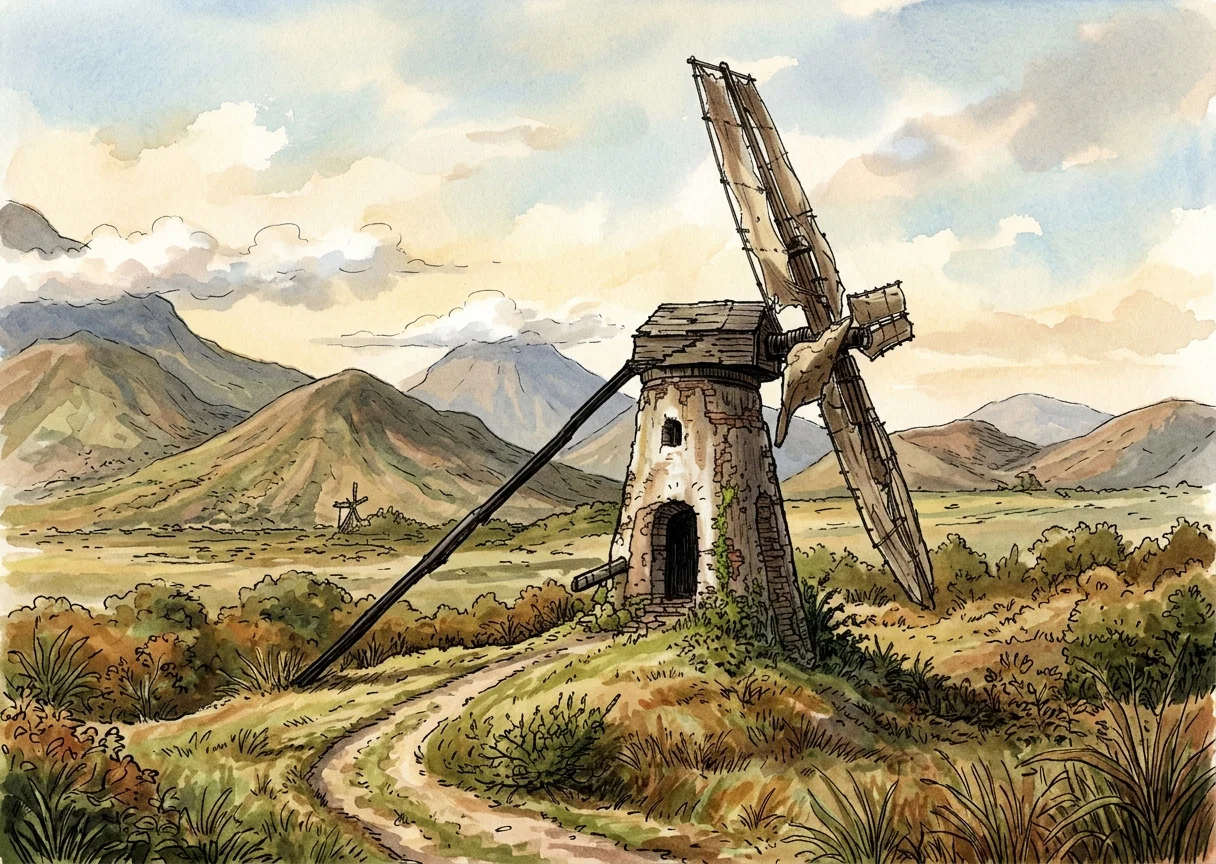
On nearly all these estates can be seen what remains of the old wind cane mills, in all stages of decay; while here and there throughout both islands there is still one of these monuments of the good old times doing faithful service by the aid of Caribbean breezes. Most, however, are but stone towers molding slowly into ruins, the upper woodwork rotted away, and the long arms lying in decay at the foot of the tower. In their places stand to-day on the larger estates the steam mills, with their ungainly sheds, their stone chimneys, or worse, iron ones, breaking the former beauty of this once prosperous land,—the marks of “progress,” but the implements of doom.
AN OLD-TIME CANE MILL
Come with me for a ride around both of our little islands. Starting at Basseterre, we will go northward across St. Kitts, here passing a field of full-grown cane, there a field only just in early days, and again a field where the ground is being prepared. On every side are seen evidences of decay in buildings long out of use, or, perhaps, by their side those of more modern pattern. Passing through the valley between the low hills of this isthmus, we come out upon the north shore, which skirts it closely about one hundred feet above the beach. To the northeast lies the broad Atlantic, and to the north in the dim distance lie the little islets of St. Martin’s and St. Bart’s or St. Bartholomew, whose mountain crests rise in hazy outline above the ocean’s bosom. We pass quickly along the north shore through the little villages of Cayonne, Nickola Town, past cane fields and plantation houses, past hillsides rich in the verdure of the everlasting summer, to the town of Sandy Point, the former English capital of St. Kitts, when she shared the little colony with the French, whose capital was the present town of Basseterre. In this once prosperous village, sleeping in the neglected solitude of the forgotten past, are found many of the old fortifications which in former days did service against the ruthless French, who more than once turned from professed friendship to open murder and rapine. Brimstone Hill, on which is located the grand old fort and citadel of those days, must have been a veritable Gibraltar to them, standing alone as it does, a single, stately eminence rising almost perpendicularly on all sides from the gentle slope which predominates here. On every side one beholds the past revealed, at once interesting and mysterious.
Revision of the Fijian Bible Nearing Completion
For twelve years, work on the revision of the Fijian Bible has been in progress. The New Testament has been completed for some time, and an edition of five thousand five hundred copies was printed, and forwarded to Fiji, and sold out almost immediately. Two hundred copies more were sold in three days. Another edition of ten thousand is now being printed. Only fifty pages of the Old Testament still remain to be revised, and then the entire Scriptures will be completed.
Mengo Church Rebuilt in Brick by Its Members
At Mengo, the capital of Uganda, there is a huge church made of reeds and thatch, capable of accommodating about four thousand people. It is often crowded with worshipers, and has been used for some time. The people built this cathedral themselves. It is now to be replaced by a more permanent brick building. Classes in the school at the mission have been stopped, and all the members are helping to carry the clay for brickmaking, from the teachers in training, down to the little ones six or eight years old. The women are carrying firewood for burning the bricks, and the men, headed by the leading chiefs, have taken their turns in carrying the clay, the chiefs themselves setting a good example by carrying larger loads than most of their men. The seating capacity of the new building will be the same as that of the thatched one.
In Memoriam
By D. E. Lindsey
D. E. LINDSEY
HAVING read the late reports of the death of some of our faithful missionaries, and being especially touched by the appeal of our dear Sister Fischer, of Porto Rico, whose hospitable parents, Brother and Sister J. F. Jones, of Baltimore, Md., cared for my wife and me when we sought to proclaim the message in their mission field, I submit the following beautiful lines (author unknown) found in The New Mirror, New York, Oct. 21, 1843:—
On the Death of a Missionary
“How beautiful it is for man to die
Upon the walls of Zion! to be called,
Like a watch-worn and weary sentinel,
To put his armor off, and rest in hope.
“The sun was setting on Jerusalem,
The deep-blue sky had not a cloud, and light
Was pouring on the dome of Omar’s Mosque,
Like molten silver: Everything was fair;
And beauty hung upon the painted fanes,
Like a grieved spirit, lingering ere he gave
Her wing to air for heaven. The crowds of men
Were in the busy streets, and nothing looked
Like woe or suffering, save one small train
Bearing the dead to burial. It passed by,
And left no trace upon the busy throng.
The sun was just as beautiful; the shout
Of joyous revelry, and the low hum
Of stirring thousands rose as constantly!
Life looked as winning; and the earth, and sky,
And everything, seemed strangely bent to make
A contrast to that comment upon life.
How wonderful it is that human pride
Can pass that touching moral as it does,—
Pass it so frequently, in all the force
Of beautiful and simple eloquence,—
And learn no lesson! They bore on the dead,
With the slow step of sorrow, troubled not
By the rude multitude, save, here and there
A look of vague inquiry, or a curse
Half-muttered by some haughty Turk whose sleeve
Had touched the tassel of the Christian’s pall.
And Israel, too, passed on—the trampled Jew!
Israel,—who made Jerusalem a throne
For the wide world—passed on as carelessly,
Giving no look of interest to tell
The shrouded dead was anything to her.
O that they would be gathered as a brood
Is gathered by a parent’s sheltering wings!
They laid him down with strangers; for his home
Was with the setting sun, and they who stood And looked so steadfastly upon his grave
Were not his kindred; but they found him there,
And loved him for his ministry of Christ.
He had died young. But there are silver heads
Whose race of duty is less nobly run.
His heart was with Jerusalem; and strong
As was a mother’s love, and the sweet ties
Religion makes so beautiful at home,
He flung them from him in his eager race,
And sought the broken people of his God,
To preach to them of Jesus. There was one
Who was his friend and helper,—one who went
And knelt beside him at the sepulcher
Where Jesus slept, to pray for Israel.
They had one spirit; and their hearts were knit
With more than human love.
God called him home,
And he of whom I speak stood up alone,
And in his broken-heartedness wrought on
Until his Master called him.
“O, is it not a noble thing to die
As dies the Christian with his armor on?
What is the hero’s clarion, though its blast
Ring with the mastery of a world, to this?
What are the searching victories of mine,
The lore of vanished ages? what are all
The trumpetings of proud humanity,
To the short history of him who made
His sepulcher beside the King of kings.”
General Mission Notes
EVERY fifth female in India is a widow.
FROM a carefully prepared estimate of religious statistics we cull the following figures: “According to the estimate for the present year, there are in Europe 384,500,000 Christians, 6,600,000 Mohammedans, and 6,500,000 Jews. In all America there are 126,400,000 Christians; the Jews and heathen are not given. In Asia there are 12,600,000 Christians, 109,500,000 Mohammedans, 200,000 Jews, and 667,800,000 pagans. In Africa there are 4,400,000 Christians, 36,000,000 Moslems, 400,000 Jews, and 91,000,000 heathens. And in Oceanica there are 9,700,000 Christians, 247,700,000 Moslems, and 4,400,000 heathens. In the whole world there are 240,000,000 Catholics, 163,300,000 Protestants, and 98,300,000 Greeks, or a total of 501,600,000 Christians in a population of 1,544,509,000.”
Yangtse River Floods Lay Waste China's Valley
AFTER the devastations of Boxers and foreigners, China has now to suffer from a flood of appalling severity. The Yangtse River has overflowed its banks, and laid waste the valley. Ten million persons are reported to be without homes and without provision for the coming winter. Civil disorder is feared, and the floods have not yet subsided. From the North China Herald we learn some of the details of the labor of rescue. Immediately on hearing of the deluge, two Chinese banks advanced a sum of twenty thousand taels, and a special delegate was sent up the river to distribute relief. Other large sums came from Chinese sympathizers, and foreign houses of commerce also contributed. A foreign committee was formed to work in conjunction with the native committee, and it was hoped that a sum might be collected sufficiently large to enable some permanent work to be done, besides the actual relief of immediate distribution. The floods, however, have proved destructive beyond all expectation.—The Independent.
Chinese Official Compensates Bible Society for Losses
The following incident shows the nobleness and dignity of some of the Chinese officials: The British and Foreign Bible Society had decided to make no claim on the Chinese authorities for the damage which they sustained during the recent outbreak in China. The British consul at Kiu-kiang had some correspondence with Ming Taoti, the ruling Chinese official of that city, concerning the matter. The latter wrote: “Wherever through last year’s disturbances any missionary society has lost any documents and books, such loss, if really incurred through the destruction of the mission premises, ought naturally to be fairly estimated and paid for. In your letter you mention a Shanghai society which is unwilling to press for an indemnity, but is prepared to accept compensation if voluntarily offered. This attitude, which fully proves the good intentions of the society, and its desire to deal in a spirit of fairness and equity, commands my profound respect. . . .
I propose myself to offer the whole amount of their loss in this city as a subscription to the society, in evidence of my respect for them and my sincere regret for their losses.” With the letter went a draft for four hundred dollars, the value of the books, etc., destroyed in that city.