The Youth's Instructor, Vol. LI, No. 3

Some Missionary Experiences

The Youth's Instructor

Jan 29, 1903

Review and Herald Publishing Company · Battle Creek, Michigan · Jan 29, 1903

Some Missionary Experiences
Extracts from a Letter by Mrs. J. N. Anderson
I wish we might do a little more by way of getting the real condition of affairs here before our people in America, but it really seems quite impossible, just at present, so many things clamor for attention. I have laid off everything I can think of to save time and strength for the work, and yet neither seem a tithe of what I ought to expend on it.
Labor is very cheap, compared with prices paid in America, and it is one of the best means of influencing the natives, to keep them in our employ, so we have turned over most of the domestic work to the Chinese, and have cut off everything possible to be dispensed with, to save time and labor. One must wear light clothes in these hot climates; and while Chinese methods are severe on the fabrics, and their results often trying to our patience, still we may just as well resign the laundry to the Chinaman first as last, for it is quite impossible for a European to do this kind of work in this enervating climate. Then, besides, the poor people need the opportunity to earn an honest living in perhaps the only way in which they are qualified to earn it.
At first the idea of being drawn in a jinrikisha or carried in a chair by human beings, my brothers by creation, seemed a shocking one. I never stepped into a gig or chair without feeling that somehow I was trespassing against a brother and offending his Maker. Usually I overpaid them. And when they, suspecting from this that I was new to these parts, followed me with overwhelming arguments for a “come-shaw,” as they call a present, I was tormented with all sorts of scruples. Can you imagine how it would seem to step out into the street, knowing that you could not possibly make the contemplated distance on foot, and find no other means of conveyance except those propelled by human brawn and muscle? You can have your choice—to be borne on the back of an amah (a female servant), or a coolie, as the small-footed Chinese women are often carried; to be trundled along on a clumsy wheelbarrow, as is the case in the north, at Shanghai, and in the interior; to be drawn in the small carriage-like jinrikisha by a muscular coolie, in the hills; or to ride in a more elegant manner in a sedan-chair borne by as many coolies as you care to hire, in as beautiful liveries as you may provide. The usual thing for the level districts is to proceed till you can catch the eye of a waiting “riksha” man, and then signal him, much as you might the street-car conductor of a motor line. Often these men wait in groups at favorable corners, and four or five of them may have observed the signal. Then comes a scramble for your patronage.
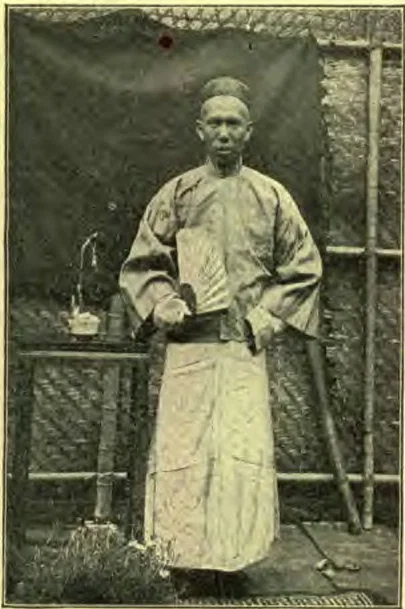
A CHINESE STUDENT
A CHINESE STUDENT
The man you choose will draw up in front of you, and drop down the shafts to allow you to take your seat; then he makes sure of the greasy, slimpsy excuse for a towel with which he expects to dry away the perspiration precipitated by your ride; gives a few twitches to the leather belt that confines the wide top of his loose trousers, to insure its doing proper service for the trip; and, finally, at your signal, starts off with a few easy strokes that soon break into a brisk trot. If it is a rainy day, he will wear a broad-brimmed hat made of bamboo splints and a kind of oiled or otherwise prepared paper, with the curious little peaked crown you see in pictures, and a rain-coat made of palm leaves stitched together at the rib-line to give a sort of cape and skirt effect. The trousers are then rolled to the knees, or more likely, thighs, when, except for the broad hat, you might mistake him for some long-legged water-bird, the tattered edges of the palm-leaves resembling bedraggled feathers. On a very warm day he may offer his services dressed simply in a pair of loose trousers, with the indispensable leather belt. The big hat will be shoved under the strap on the bottom of the conveyance.
The American consul at this place goes about in a fine chair borne by six coolies, with the stars and stripes of Old Glory on the back and shoulders of their uniform. The chair is by far the pleasantest means of conveyance, although slower, as the coolies do not trot, and is necessarily the sole conveyance in the hill district. The outfit of the well-to-do is often quite elaborate, and on meeting several fine ladies in their turnouts, you begin to dream over again the tales of knight and lady told of the days of chivalry.
As I said before, my democratic spirit suffered all kinds of torment at the first. But now I have come to feel quite differently about it; for the facts are that the jinrikisha men are better paid than the men who swelter in sultry engine-rooms and in mechanical work-rooms, and they do not work harder nor longer, while they enjoy much more liberty. To be sure, they must go when called, or lose their licenses; but, if they are too tired to run, they can hide away where they can not be called. There is no enterprise in China. Rich mines are unworked, broad fields away from the villages are uncultivated, and everything is in a very backward state, so men are only too glad for any employment by which they may be able to earn their rice and fish. They are as glad of the help the coin will be to them as I am of the help the muscle of their strong calves and thighs will be to me.
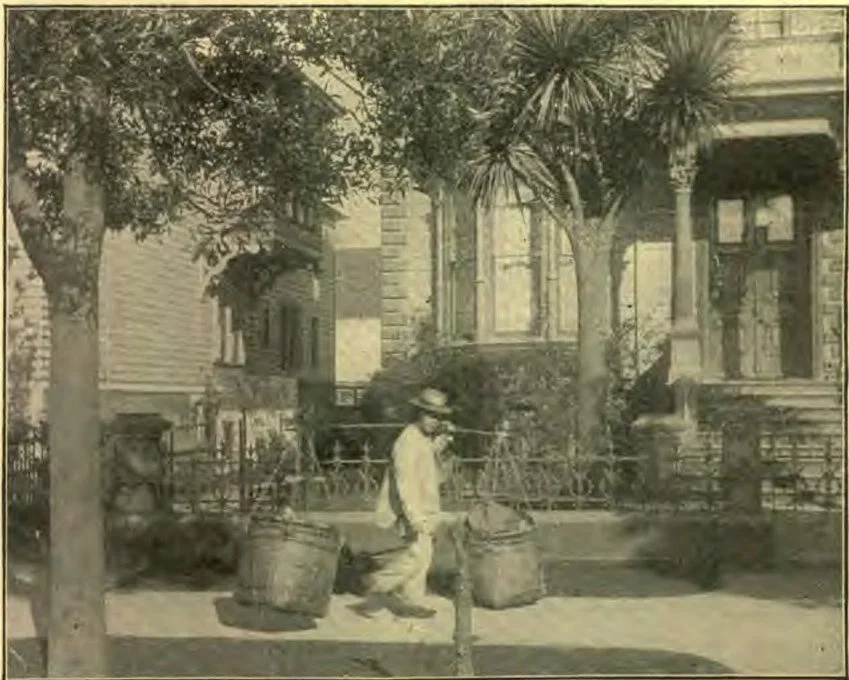
A CHINESE HUCKSTER
A CHINESE HUCKSTER
It is quite surprising how very muscular the people are, when we consider that they are fed principally on rice, with coarse vegetables half cooked with peanut or bean oil, and a bit of fish or pork. Two coolies carry quite comfortably a load of six piculs, or about eight hundred pounds, simply by means of a bamboo pole strung on the shoulders. The other day a coolie—not a large one—picked up a barrel of oatmeal, and carried it on his shoulder up a long, steep, narrow flight of stairs, to Brother La Rue’s rooms. It is quite common to see one trotting from the boat docks to the “go-down,” as the warehouses are called here, with five sacks of flour stacked upon his shoulder.
The women, too, are very strong, and carry brick, stone, and mortar up the mountain for building purposes, quite as easily as do the men. Sometimes one sees a woman “packing” an enormous load, with a baby on her back. The women work at all kinds of common labor together with the men.
On the other hand, it is impossible to conceive of a more enervated, flabby piece of human mechanism, than a well-bred, well-to-do Chinaman, unless, indeed, it be his small-footed wife. He shrinks from the slightest exertion in behalf of his own physical existence, even so much as to shut or open a door.
But the people in general are so simple and so eager to be taught that I find them very charming. Our little house-boy, Akow, for example, is so sunny and affectionate, so considerate of any indisposition, so watchful lest I shall overtax myself, and so jealous of our interest lest his fellow countrymen should take advantage of us in trade, etc., that we can not but love him. This is a very rare combination in a Chinese servant. He is growing into an active, enthusiastic little Christian, too. He is sixteen years old, but not large, weighing less than one hundred pounds. He is getting on with English very much faster than we with the Chinese, but some of his combinations are amusing. For instance, he always inquires if he shall “hurt” the potatoes, meaning, shall he mash them,—I suppose from the fact that a blow on the body is spoken of as “hurting.”
(Concluded next week)

Strength in Humility

Moses was chosen for a special work. Having been adopted by Pharaoh’s daughter, he was greatly honored in the king’s court. Every one was intensely desirous of exalting him. Pharaoh determined to make him his successor on the throne.
Moses was a man of intelligence. In the providence of God he was given opportunity to gain a fitness for a great work. He was thoroughly educated as a general. When he went out to meet the enemy, he was successful; and on his return from battle, his praises were sung by the whole army. Notwithstanding this, he constantly remembered that through him God purposed to deliver the children of Israel.
But although he was “learned in all the wisdom of the Egyptians,” while in the service of Pharaoh the character of Moses received a mold that disqualified him for the wonderful work he was to do, making him weak where he should have been strong. This weakness was manifested when he visited his brethren, and “spied an Egyptian smiting an Hebrew.” Taking the case in his own hands, he privately “slew the Egyptian, and hid him in the sand.” He would not have done this had he not, during his training in the Egyptian army, received the impression that the Israelites were to be delivered by the sword.
In order to prepare Moses for his work as the general of Israel, God removed him from Pharaoh’s court, and placed him in another school,—the school of self-denial and hardship. The leader of the Egyptian armies went into the mountains, to become a keeper of sheep. What a change in his life and employment! Looking at the experience from a human point of view, men would pronounce it a failure.
Forty years Moses spent in the solitude of the wilderness. Here he had opportunity for study, meditation, and prayer. From the book of nature open before him, he drew many useful lessons. Surrounded by the evidences of God’s power, he was led to humble himself, and to exercise living faith in God, thus obtaining a preparation for the work before him. God designed that Moses should stand alone, leaning only upon the arm of divine power.
Several years ago I saw the results of a tempest that had just passed through a forest, sweeping down everything before it. The trees standing close together had been uprooted and leveled like grass before a scythe. But a few trees standing out alone had not been overturned. I inquired the reason of this, and was told that the tap-roots of the trees unmoved by the hurricane were firmly fastened deep in the earth. These trees had gained strength to withstand the storm, while those that had stood close together were swept down.
The lesson is for us. We should know for ourselves what it means to stand firmly for God, ever learning that which Providence designs to teach us. But too often we think as others think, and do as they do. We are influenced by the habits of our associates. When we depend on finite help to support us, we do not really know our weakness, and when the storm comes, we are overthrown. But when thrust out where we must stand alone, our faith fastens upon the only sure support—the infinite God.
When at last Moses was called to bear God’s message to Pharaoh, Moses had reached the place in his experience where he had a humble estimate of himself. He felt incapable of doing the work, and he pleaded earnestly that he might not be required to bear this responsibility. Not until the Lord had convinced him that he was his chosen instrument to deliver Israel, did he consent to go. He cherished no self-exaltation. While tending his flock among the lonely mountains, he had learned humility—that precious lesson so important for us all.
The more diligently we learn meekness and lowliness in the school of Christ, the greater advancement we shall make in a preparation for God’s service. We should never feel that we have learned everything worth knowing. Let none think they are ready for graduation. As long as we remain on this earth, there will be new lessons for us to learn. And throughout the ages of eternity we shall have something to learn in regard to the wonderful plan of redemption.
Lack of humility is one great cause of our weakness. Too often we attempt in our own strength to do something great. Christ says, “Without me ye can do nothing.” “Take my yoke upon you, and learn of me.” By wearing his yoke, we can be co-workers with him. Every morning we should inquire, “Lord, what wilt thou have me to do?” Thus we shall learn of Christ.
Not he who is pompous, boastful, and unbelieving, but the humble, faithful soul, is in God’s sight accounted a man of power. In order that he may answer the prayers of his people, the Lord desires them to obtain a personal knowledge of Christ. The clearer their view of the Saviour’s loveliness, the more humble will be their opinion of themselves. And the lower their estimate of self, the more distinct will be their view of the glory and majesty of God. When we begin to have a high opinion of ourselves, let us remember that for whatever we are or have in advance of our fellow men we are indebted wholly to the gift of God.
“Esteeming the reproach of Christ greater riches than the treasures in Egypt,” Moses kept his eye fixed on “the recompense of the reward.” Let us likewise keep our eyes fixed on the reward that God has promised, and walk in humility before him; for He who says, “Them that honor me I will honor,” will crown his faithful children with eternal honor. Mrs. E. G. White.

Look Thou Within

Take thou no heed to all words that are spoken Beside thee or within thine ears’ quick reach; Refuse to listen to the voice of anger, The evil curse, or bitter, taunting speech: The curse may be upon thyself directed, The galling gibe be turned to harass thee; But if thine ears are closed, the shaft falls harmless, And thou hast meekly learned humility;
For oftentimes, when tempted much to listen To words far better one should never know, Thine own heart knowest that such turbid trickles From its own fountains often spring and flow; While others’ railings, cherished, bring to vision The railings thine own lips have flung around, And others’ curses, pondered, shame the curses That, voiceless, yet within thy soul abound.
Ears were not made for angry, cruel speaking, But the soft voice of God on sea, and land, And in the air, whence varied tones are stealing, In wondrous unison on every hand; And only pure, sweet words of peace and beauty, Can, without discord, join the harmony Of souls infused with kindly love, vibrating Like that sweet song of nature in the sea.
Minnie Rosilla Stevens.

The Head Nurse's Story

When little Jem was first brought to the hospital, it was in a carriage with liveried servants. His father was a mill-owner in Pennsylvania, and Jem was an only child. He had the largest room in the private ward.
His parents brought the boy fruit, flowers, and books.
“Please take them to that cripple in the next room, and to children in the free wards, with my love—little Jem Bruce's love,” he would say, raising himself in bed, with flushed cheeks and shining eyes.
In two months he recovered, and went away. But two years afterward Mrs. Bruce brought him back. She was dressed in black, and asked for a cheap room. Mr. Bruce, I heard, was dead, and had left his widow little money.
Jem's knee was worse than ever. But what a cheery, happy fellow he was! He soon learned the story of all the patients in the neighboring rooms, as he had done before. And when his mother brought him a bunch of pinks or a basket of apples, he would eagerly divide them.
“Maybe they will make some one feel happier just for a minute,” he would say, with his rare smile.
His right leg was taken off at the knee. Then I lost sight of Jem for three or four years. Last winter he applied for admission to the free ward. His mother was dead. The disease had appeared in the other leg some months before. Jem had been supporting himself by typewriting, but was now no longer able to work.
He met me as if I had been his old, dear friend,—as, indeed, I was,—and then hobbled round the wards to see if he knew any of the patients, stopping to laugh and joke and say some kind word at each bed.
The doctors amputated the other leg that day. It was the only chance for his life. But in a week they knew that it had failed.
“Make that boy comfortable,” the surgeon said to me; “it is all that can be done for him now.”
Jem knew the truth from the first. But he never lost courage. This was his bed (pointing to the middle one of a long row of white cots in the great ward). He learned to know all the men, and took keen interest in each case.
When Johnny Royle died, Jem took out the few dollars remaining in his pocket, and gave them to me. “They're for his little children,” he whispered. “They have nothing.” And when old Peter was discharged, cured, he came to Jem's bed to say good-by as if he had been his brother. Jem wrung his hand, and said: “Take my overcoat, Peter; yours is gone, and—I'll never need mine again.” He waved his hand, and cheered feebly as Peter went away.
He had nothing left to give now—I think that cut him sharply. But one day he began to sing. He had a remarkable voice, clear and tender; it would force the tears to your eyes. Every head in the ward was turned to listen. That delighted Jem. “I can sing for them occasionally,” he said, “if the doctors will allow it.”
So, whenever it was possible, Jem's sweet voice was heard, sometimes in humorous song, sometimes in a hymn. I used to think he was standing at heaven's gate when he sang those hymns. But one morning his voice was gone, and before night every one in the ward knew that he was dying. The patients were silent, many of them crying, for they all loved the boy. He died at sundown, sitting up in bed, leaning against my shoulder. He glanced around the ward, and they nodded, and smiled.
“Give them,” he whispered, then stopped, remembering, poor child, that he had nothing to give. Then he said, suddenly, aloud, his eyes brightening, “Give them my love—Jem Bruce's love.”—Household.

Wasting What Others Could Use

“There is hardly anything that we selfishly destroy after we have done with it, that would not be a boon to somebody. We destroy it because that is the easiest way to get rid of it. We do not like to take the trouble to find out where it would still be a blessing to some one.”

How the Weather Is Foretold

“Evening red and morning gray Sets the traveler on his way; Evening gray and morning red Brings down rain upon his head.”
Such was the way in which our grandparents foretold the weather. They did not have any printed predictions as we have to-day, except those in the almanac; and as those were only guesses, and very poor guesses at that, they did not amount to much in a practical way, except to put money into the pocket of the almanac-maker; for in those days no household was complete without an almanac, and a great many people believed everything it said, no matter how often they were deceived. But, in spite of their faith in the almanac-maker, the old-time folks always kept their eyes and ears open for the signs that nature gave them.
If it was noticed that the old tabby washed herself by rubbing her paw over her ear, or that the little tree-toads trilled their mournful little songs, or the fireflies flitted low among the flowers and the vines, the old folks shook their heads and spoke of rain; or if grandmother’s feet ached, the little folks grew very sorry—because it meant bad weather on the morrow.
But sometimes, in spite of ducks and pigs and creaking chairs, it did not rain at all, and many times feet were very painful in the driest kind of weather, and soot and even chimneys fell down without bringing so much as a cloud; so that, notwithstanding all these signs, nobody could tell for certain what the weather was going to be from day to day.
But now, instead of watching insects and learning rhymes, to find out what the weather is to be, and not being very sure of it even then, Uncle Sam has built a Weather Bureau, and employs a large number of men to manage it for him. He does not ask them to do anything more than to keep a record of the weather, and to predict as well as they can what the weather will be the following day; and if they sometimes make a wrong prediction, Uncle Sam only smiles, and tells them to try again.
This Weather Bureau is in Washington, the capital of the United States. It is situated on a large square in the northwestern part of the city, where there is plenty of room, and not much noise or confusion of any kind. It is a large brick building, standing far back from the street, and having pretty flower-beds and terraces in front of it. At first sight the building looks something like a big toy house, with its roof bordered with turrets and filled with chimneys, and all sorts of contrivances that are spinning and turning around.
In the box perched upon the middle of the roof are the thermometers that tell how hot or how cold it is. Two of these are for telling the temperature at any time during the day, another marks the highest point reached, and the fourth shows what has been the lowest temperature; so that by opening the little door in front of the box the observer, or the man who looks after the weather, is able to see just what the temperature is at that time, and how high it has been, or how far down it has gone, since he last peeped into the box. To one side is a very large weather-vane, to show in what direction the wind is blowing. Then there is the anemometer, four little metal sticks with a cup at the end of each, perched up on a high pole. The least breath of air turns this around, and it is so arranged that when it turns around five hundred times, it shows that the wind has traveled a mile, and in this way the observer can tell just how fast the wind is going. Then there are the rain gauges,—long, narrow tanks with a little hole at the top, looking like small stove-pipes standing on end, which catch the rain and measure how much has fallen. On one edge of the roof is the sunshine-recorder, a little instrument that keeps an account of every minute the sun shines, and of every minute it does not shine.
But the most important instrument used in predicting the weather is not on the roof, but is in the building, away from the sun and the wind and the rain. This is the barometer, which measures the pressure, or weight, of the atmosphere. When the air is settled, it presses more heavily on the mercury that is in the barometer, and sends the little stream farther up into the long glass tube, and this we call a sign of good weather. But when the air is unsettled and light, the mercury falls, and so does the weather.
All of the instruments in the main part of the building are used in the observations that are made every day, and are looked at directly by the observer; but in the other part of the building there is another set of these instruments connected by electricity with machines that run by clockwork in a large room called the instrument-room. These are for the purpose of keeping a constant record of the weather, and all day long, and all night long, month after month and year after year, these ingenious machines are ticking away and keeping a complete account of what the weather is doing outside. It is all done in writing on paper—not the kind of writing you do in your copy-books, but a kind which the Weather Bureau people can read as easily as they can read the finest copper-plate. Now, all this writing done by the machines is filed away from day to day or week to week, just as any other official records are preserved.
So perfectly do these little machines do their work, that if a person wanted to know what the weather had been on the Fourth of July in the year 1890, the people at the Weather Bureau, by looking at the written record for that day, could tell him exactly what the temperature was at any time during the day, how fast the wind was blowing and in what direction it was going; when the sun shone, and when it did not shine; whether it rained, and if so, how long it lasted, and how much fell; whether there was any thunder or lightning, and what the barometer marked; and if there had been an earthquake that day, they would tell him just when it happened, how long it continued, and what particular kind it was.
Strictly speaking, the Weather Bureau is made up of a great many buildings scattered all over the United States, and this one at Washington is the central station that governs and directs the smaller ones, and to which they send in their daily reports; for it is by getting reports from all the different sections of the country that Uncle Sam’s weather-makers are able to make their predictions. There are one hundred and eighty towns and cities in the United States where there are observation stations, having the same instruments and apparatus as the Washington bureau. Now, the observers at these one hundred and eighty stations do not spend their time waiting for spiders to crawl out of their holes, or looking at the sky to see whether it is red or gray in the evening. They look at their thermometers, barometers, anemometers, and so on, which are far better guides than all the other signs put together.
At eight o’clock in the morning, and at eight o’clock in the evening of every day, the observer at each of these weather-stations from Maine to California looks at his different instruments, and carefully notes what each of them marks. Then he takes a look at the sky, to see whether it is fair or raining or snowing, and to see what sort of clouds may be sailing about. According to the Weather Bureau, there are seven different kinds of clouds, and it is important that the observer should see what particular kind is hovering around, for each kind means some special sort of weather or some particular state of the atmosphere. When he has finished his observation and noted all the indications, he telegraphs his report to Washington.
In that way, then, the Washington station receives an account of the weather at all parts of the country at the same time, and, as you may easily believe, it keeps the four telegraph operators busy receiving the messages that come pouring in soon after eight o’clock. As each message is received in the telegraph-room, it is carried by a messenger across the hall to the forecast-room, or room where predictions are made, and taken to the translator.
Perhaps you will think it strange that these dispatches have to be translated, but nevertheless it is true. It is not because they are written in a foreign language, but because they are sent in cipher, or in words that do not mean anything in themselves. This is not done to keep the reports secret, but to save expense; for, as you know, every word in a telegram has to be paid for, and as there are a great many messages, and as some come from a great distance, it would cost Uncle Sam a considerable sum of money if each weather report was written out in full.
As the translator reads aloud the reports from the different stations, other men in the room mark what he reads upon a map of the United States, so that when the last message has been translated, the map shows just what the weather is at each one of the one hundred and eighty stations. The map is then turned over to the official who is to make the predictions. In order to get bearings, he traces across the map the different places throughout the country where the temperature is the same, and the places where the barometer is the same. The one he marks with red lines, and the other with black lines; and if you will look at a weather map, you will see these red and black lines wriggling and twisting all over the country.
The Weather Bureau publishes instructions as to how to predict the weather by looking at one of these weather maps, but while people may be able to tell in a general way what the weather is likely to be, it takes a man with much experience and knowledge in weather matters to make a really good and reliable prediction; for while there are some things which are known for certain, there are a great many things about the weather which are still very mysterious. When the forecast official sees a particular kind of weather away out in Oregon, he knows that it is going to move eastward, because it is a regular habit of the weather-waves to move from west to east, no matter in what direction the wind is moving. But just how far east one of these warm or cold waves will come, or just how fast or what path it will follow, are very difficult problems to solve, and this is where the knowledge and the skill of Uncle Sam’s weather-maker show themselves.
When, for instance, the reports from the Northwest show a great fall in temperature, he knows that a cold wave has started on a journey through the United States, and he keeps a lookout to see how fast it reaches the different stations in the West. Then he calculates how rapidly it is moving, and what kinds of weather it has to encounter, and perhaps when he has worked out the problem he will telegraph the following bulletin: “Hoist cold-wave flag; thermometer will fall thirty degrees in next twenty-four hours,” and, sure enough, by next day Jack Frost has got hold of our noses and toes, and the cold-wave flag is almost tearing itself to pieces with delight. But sometimes the cold wave does not come as was expected,—it is switched off on a side-track or it melts on the way,—and then the cold-wave flag droops in shame.
Well, after the forecast official has made his predictions for the next thirty-six hours, a drawing is made of the map, and it is then reproduced and printed, and copies of it are sent to the newspaper offices, and to various offices and buildings where they can be seen by the public. Each one of the little circles on the map stands for a weather station, and the little arrow in each one points in the direction the wind is blowing. If the weather is fair, the circle is left clear; if it is partly cloudy, you will see that half of it is black; and if it is very cloudy, it is all black. Thunder-storms are shown by little zigzag marks, and whenever it is raining or snowing, you will see the letter R or S. If there is rain over any extent of country, it is shown by dark-gray spaces that look like blots on the map.
By taking careful note of all these weather conditions, and knowing that the weather moves from west to east, and that the wind generally blows from the direction of a high barometer to that of a low barometer, you will be prepared to predict, with a little experience, what the weather is likely to be, in general, for the coming day.
The whole work of making observations, of telegraphing the reports, of translating them, of marking them on the map, of predicting the weather, of drawing and printing the maps, is finished before eleven o’clock. In order to save time, this same work is done at nearly a hundred of the smaller weather stations, and they supply the country round about them with predictions and weather maps.
In this way, then, twice a day, the weather in the United States is predicted.—Clifford Howard, in St. Nicholas.

The New Tracts

All the children and young people who have read the Review and Herald have surely learned concerning the Tract Campaign. We wonder if you have thought this work to be wholly for the old people. If you have thought so, please listen while we give you a good, earnest invitation to join the workers, and help scatter the precious seed far and wide. Paul says, “I have written unto you, young men, because ye are strong.” The work is great, and the laborers are few; and the Lord’s work is in great need of the splendid service which you can render with your strong young hands and active, willing feet. Do not put off your days of active service for the Lord until you are older. Samuel began his life work for God when only a little child. Joseph in his youth, was sent to a foreign, heathen land, alone, as a missionary; and Daniel and Isaiah were young men when God placed upon them the gift of prophecy. “It is good for a man that he bear the yoke in his youth.”
When you gave your heart to the Lord, your first desire as a Christian was to go to your brother, your sister, or to some intimate friend, and tell the story of Jesus’ love. Have you found that “first love” passing away? and have you wondered why? Perhaps it is because you have not continued your work of love for others. Our first experiences can only be kept by using. We must gain a fresh experience every day, and these experiences come through serving others. Give to your associates the good things God has given to you, and he will renew his blessings to you day by day. If you shut up the blessings within your own heart, and do not pass them on to others, they will wither away, and become your condemnation. We must gather the manna of the Christian life every day. That which we gathered yesterday is spoiled, and will not feed us now. Try it, dear young friends, and learn from personal experience what the blessings of earnest service are. Join with your parents and with the members of your church in circulating the new tracts this winter.
The first one of the series, “We Would See Jesus,” is good to begin with. Read it, and then carry it to others. Pass on the good things of the message which God is providing for the world.
“Have you seen the heavenly light? Pass it on; Souls are groping in the night, Daylight gone: Hold your lighted lamp on high; Be a star in some one’s sky; He may live, who else would die, Pass it on.”
E. R. Palmer.
Continue reading: The Weekly Study