The Youth’s Instructor, Vol. 43, No. 32.

HOMES FOR THE FEEBLE-MINDED

The Youth’s Instructor

Aug 8, 1895

S. D. A. Publishing Association · Battle Creek, Mich. · Aug 8, 1895

HOMES FOR THE FEEBLE-MINDED.
Ever since the curse has rested upon the earth, diseases of all kinds have taken hold upon the human family. In every large city, men, women, and sometimes children may be found who have lost their hearing, eyesight, and the power of speech. In some cases these afflictions are caused by accidents, but many times they come from the violation of some law of their being. These are sad calamities to come upon any one, yet to lose the control of the mind is a much sadder calamity. When the mind fails to act, the individual's life becomes worse than a blank.
We read in the Bible of those who were possessed of devils, whom Christ met, and his tender heart of pity was drawn out toward them. In Luke 4: 32–35 we read of Christ meeting one of these afflicted ones. Jesus by one word healed him and gave him his right mind. “An unclean demon, in the language of Christ’s day, was an evil spirit that drove the person possessed, to haunt burial places and other spots most unclean in the eyes of the Jews. There were men who affected the black art, pretending, like the witch of Endor, to raise the dead, and for that end, lodging in tombs, and macerating themselves with fasting, to secure the further aid and inspiration of such evil spirits, and others into whom the demons entered, driving them involuntarily to these dismal habitations.”—Geikie.
The insane were turned out to roam where they pleased, and were looked upon as wild men, who would be shunned even by the members of their own families. From the brief account given of this class, we can reasonably come to the conclusion that they were quite numerous. No doubt Jesus met many of them in his travels from place to place. In every recorded instance where he found these weak-minded persons, he stopped and relieved them of their sufferings. He did this to teach us the lesson that pure religion is to care for those who are unable to care for themselves.
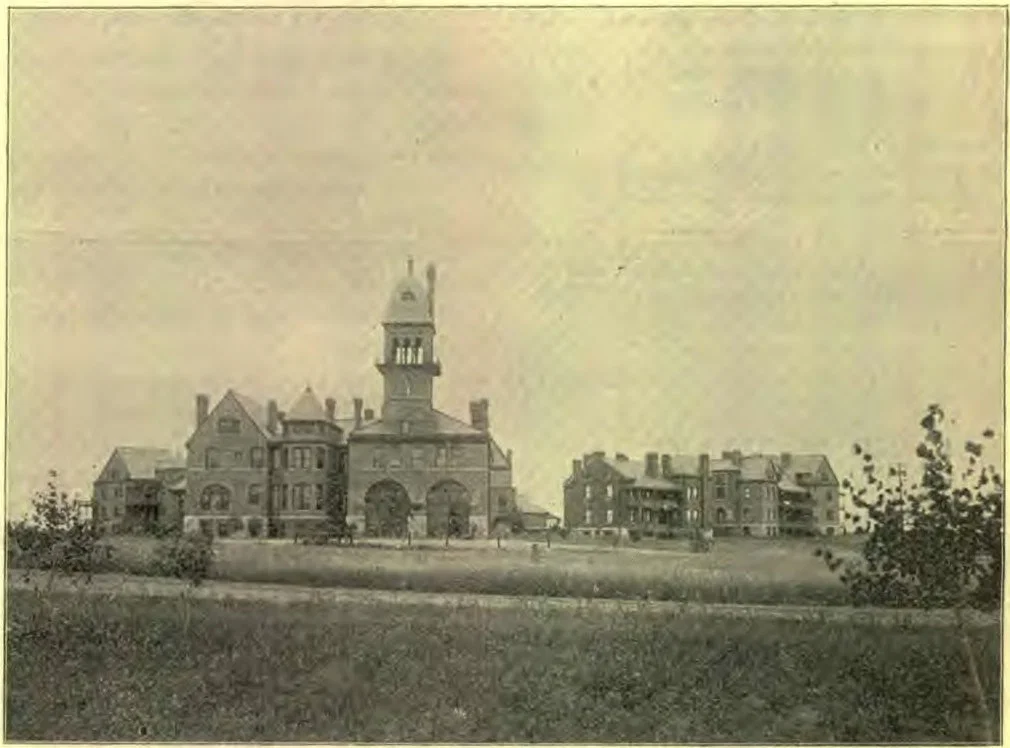
Insanity is on the increase in our day. Nearly every State has one or more institutions for the care of this class of people. Not long since, we visited one of these State institutions located near Jamestown, N. Dak. We thought how differently the imbeciles are now cared for from what they were anciently. Instead of living in the mountains among the wild beasts, as did Nebuchadnezzar, or among the tombs, as was the custom when Christ lived on the earth, pleasant homes are provided where there is every facility for health and comfort. The North Dakota institution has five buildings on a pleasant spot of ground, all connected by underground subways, so that all parts of the institution are accessible from the superintendent’s office, without going out of doors. Each building is divided into wards, with sleeping apartments, dining-rooms, and parlors. The latest improved conveniences are connected with the institution for cooking, laundry, farming, etc. Convalescent patients are furnished with employment as soon as they are able to engage in work. A pleasant hall is connected with the hospital, where the patients are called together for amusement or religious services.
INSANE ASYLUM, JAMESTOWN, NORTH DAKOTA.
The officials are kind and obliging both to patients and visitors. While there are between three and four hundred patients in the institution, we were told that force was rarely used to control them. The most of the patients were in the sitting-rooms or on the verandas, but very few being confined to barred rooms.
As we passed through the different buildings, and saw so many human beings whose minds were unbalanced, we could not but ask the question, “Is this as God would have it?” The answer would come, “This is the effect of Satan’s work.” In the men’s wards the majority were below forty years of age. In the women’s wards there was about an equal representation of all ages. Their faces showed that a violation of nature’s laws was the cause of the mental breakdown, and we were led to see how important it is that children and young people should study the laws of their being, and walk in harmony with them. No doubt that many of these minds fail on account of the sins of their parents. When sending their children to these institutions for treatment and care, they are reminded, when too late, of their own folly. How important it is that we know God’s laws for the care of our bodies, and closely follow them, for our children’s sake as well as for our own.
We saw many in those rooms who might be sitting at some office desk as clerk or official, or who might have been in happy homes associating with kind friends, instead of crouched in some corner or pacing the floor of the halls, going through some harangue of business or religion, unconscious of its meaning. It was a scene to be looked upon with pity, and we wished that a word could be spoken in His name who commanded the evil spirits to depart, that would restore these afflicted ones to a perfect mind; but as this was not within our power, we could only lift the heart to God, that we might have wisdom to seek out the erring ones and try to rescue them before the power of reason has departed. J. H. D.
(Concluded next week.)

Books That Stimulate Thought Over Mere Reading

MANY books require no thought from those who read them, and for a very simple reason,—they made no such demand upon those who wrote them. Those works, therefore, are the most valuable that set our thinking faculties in the fullest operation. For as the solar light calls forth all the latent powers and dormant principles of vegetation contained in the kernel, but which, without such a stimulus, would neither have struck root downward, nor borne fruit upward, so it is with light that is intellectual. It calls forth and awakens into energy those latent principles of thought in minds which, without this stimulus, reflection would not have matured.—Colton.

A VISIT TO JEYPORE.

IN FOUR PARTS.—PART II.

After a pleasant and comfortable night at the hotel, where everything was conducted after the European custom, early in the morning, with a Hindu guide, I entered the city of Jeypore by the main road, through a large arched gateway on the west. The general plan of the city is most simple. A main street, about two miles in length and one hundred and twenty feet in breadth, runs through the city from east to west. It is intersected by several streets of about the same breadth. Narrow streets lead from these to all parts of the city. At each point of intersection is a market square, where goods, wares, grains, fruits, vegetables, Hindu gods—some of them are of the most revolting appearance—and curiosities of all kinds, are for sale. The babel of the salesmen, as they cry out their merchandise, is at times almost deafening.
We then passed a company of gaily-dressed Hindus who were on their way to a temple, with a very bountiful breakfast for their god. I counted upward of fifty good-sized, well-filled baskets of sweets, pastries, and fruits of various kinds, which were borne gracefully upon the heads of the worshipers. Others had jars of intoxicants, milk, etc. The procession was led by a band of musicians. Their instruments were the tom-tom, the horn, and the drum. As each musician strove to outstrip his neighbor, both in rapidity and loudness, there was a tumult of frightful sounds, which one might suppose were intended more to frighten the ears of a demon than to charm the senses of a god.
After arriving at the temple, various methods are resorted to to awaken the object of worship, which may be a hideous image, or nothing more than a stone. The deity is then bathed. The water with which he is washed is supposed to be holy, and is often drank by the worshipers. The god is then dressed, and many more ceremonies, which to the Christian are disgustingly foolish, are performed. It is like child’s play. Little children talk to their dolls; they dress them with warm clothes, wash them, pretend to give them food, fan them to keep them cool, and put them to sleep behind curtains, lest the mosquitos might bite them. They treat them as though they were living beings. Hindus are the worst kind of polytheists, and they worship not less than three hundred and thirty million gods, goddesses, and demons that have no existence.
Nearly three thousand years since, the sweet singer of Israel penned the words of inspiration showing the folly of idolatry:—
“Their idols are silver and gold, The work of men’s hands. They have mouths, but they speak not: Eyes have they, but they see not: They have ears, but they hear not: Noses have they, but they smell not: They have hands, but they handle not: Feet have they, but they walk not: Neither speak they through their throat. They that make them are like unto them; So is every one that trusteth in them.”
It is a fact that the mind, by continually meditating on a material object, becomes materialized; and these people, who have worshiped these senseless images so long, are so ignorant that their religious teachers deceive and dupe them in every possible way.
As one beholds this dumb idol worship, he feels in his heart that it is no small blessing to be taught when a child to say, “Our Father, which art in heaven.” Could you all see what I have seen during the eighteen months since coming to India, your hearts would swell with gratitude to God for the blessings conferred upon you, and there would be a longing to labor for him.
WILLIAM LENKER.

THE BELIEVER'S REST.

WHEN the long night of weariness and pain Is full of bitter thoughts and doubts that sting, Do we not long to hear some holy strain That far-off angels sing?
When every golden deed the heart hath planted Is darkened by the fear of failing powers, And all our life seems like a barren land, Unblessed by sun and showers;
When every word that loving lips have said Sounds, to the morbid fancy, falsely sweet, And every truth that we have heard or read Seems poor and incomplete;
When the one thing whereon our hopes are set Is still withheld, although we pray and weep, Until we murmur; “Can the Lord forget? Or doth the Master sleep?”
When the old sin that we had nearly crushed, Arrayed in all its fearful might appears, And yearning voices that we thought were hushed Call from the departed years,
Then, like an evening wind that, unperceived, Beareth an odor from the rose's breast, Comes the remembrance: “We which have believed Do enter into rest.”
And our eyes close, and all the phantom throng Of doubt and troubles vanish into air, And the one face that we have loved so long Smiles on us calm and fair,
The face that in our darkest hour is bright, The tranquil brow that never wears a frown, The steadfast eyes that never lose their light Beneath the thorny crown.
So at His word the clouds are all withdrawn, The small sharp pains of life are soothed away; After the night of weeping comes the dawn, And then his perfect day.
— Sunday Magazine.

DERELICTS

THESE are the wrecks of abandoned vessels turned loose to be carried hither and thither by wind and tide. They form one of the serious dangers to ocean navigation. In spite of all efforts to rid the sea of them, many of these unguided prowlers still drift and toss up and down the deep, threatening every passing ship with wreck. May we not find in this a parable? Derelicts—social, moral, religious—are a chief danger to safe sailing on the ocean of life. And such are found drifting everywhere. Your son and daughter and you yourself would be safer if it were not for these wrecks of humanity, lost to conscience and morality and God. Every ruined soul threatens others with ruin. One misguided or neglected youth may, in the course of a lifetime of drifting and sinning, wreck a hundred others. It is a peril, as well as a crying sin, to let any boy or girl be turned adrift without moral restraint or guidance, or to allow those already lost to continue drifting while we put forth no effort to arrest or save them. Prevention is better than cure. Parents should see that the hearts of children are so anchored to Christ, and their lives so trained for him and ruled by his love, that no derelicts shall go forth from their homes.—Cumberland Presbyterian.

CONFESSION OF CHRIST.

Now is the time to confess Christ before the world; by a consistent life and conversation to be a witness for Jesus Christ. By so doing you will exercise an influence over others, and will aid others to confess that Christ is Lord, to the glory of God the Father. The more light you have, and the more Christ works through the Holy Spirit to win you from a course of guilt, the more responsible you will be for resisting his mercy and refusing his invitation. The Jewish nation rejected Christ, and the darkness that came upon them corresponded to the great light that had been given them. So it will be with you. The greater the light you have, the greater will be the darkness that will enshroud you. You will press closer to the enemy of Christ, and make it more manifest than before that it is your choice to be Satan’s slave rather than Christ’s free man. Not enlisting in the service of the Captain of our salvation, you show to the world that you have chosen another leader.
The kingdom of heaven has come near unto you, and you have seen the Father and the Son. You think that the time will never come when you will mock and deride Jesus. You think that if you had lived upon earth when Christ was here, your voice would not have been raised with that of the multitude who cried, “Away with him! Crucify him!” But if you persist in rejecting Christ, you will be at the mercy of the enemy, and will do his bidding at last. I beseech of you to take your stand without delay on the side of Christ. Jesus has bought you with an infinite price because he loves you. Why not reveal to the world that you do not hate and reject Jesus? Why do you not manifest that you love the attributes and the service of Christ more than you love the attributes and the service of Satan? Why do you ventilate what you call skepticism, when you know that Jesus Christ came into the world to save just such foolish sinners as yourselves? Why do you look upon religion as a restraint, when the practise of godliness will keep you from ruining your happiness in this life, and will give you a title to the future, immortal life? O let it not be said of you, “Ye have seen and hated both me and my Father.”
Jesus has done much for you, and he is willing to do much more. Every blessing, every talent, every capability you possess has come to you through Jesus Christ. Those who reject Christ, reject their only hope of happiness in this life, and cut themselves off from the hope of eternal life. Every step of rejection of Christ is a step toward the rejection of the goodness of salvation, and toward the sin against the Holy Spirit. It is evident that not one who stands under the banner of Jesus Christ, who serves him as a faithful soldier, has committed this sin. The sin against the Holy Ghost is not confined to any one period of time, or limited to any one generation. The Jewish nation who rejected Christ committed the unpardonable sin, but by taking the same course that they took in refusing the invitation of mercy, we may commit the same error. You offer insult to the Prince of life, and put him to an open shame before the synagogue of Satan. “We are made a spectacle unto the world, and to angels, and to men.” You should not delay one day. The peril is too great. You may lose your life. Satan is watching every opportunity in order that he may destroy both soul and body; but Jesus is ready to pardon all your sins, and to make you a child of God, an heir of heaven.
MRS. E. G. WHITE.

NASRULLA KHAN.

For several weeks the government and people of England have been making much ado over Nasrulla Khan, second son of the ameer of Afghanistan. He has been in England, and everything possible for his honor has been done. The Indian government is paying his expenses, which, as may be supposed, are not light. The young prince also brought presents from the ameer for the queen and royal family of England to the value of twenty thousand pounds. Although every attention has been paid to the prince, he has proved himself to be a very disagreeable person to get along with; and sometimes those who have him in charge have been at their wits end to know what to do with him. His chief desire seems to be to do just as he pleases, and the etiquette of the British court is a constant source of annoyance to him. He is a devout Mohammedan, and observes the hours of prayer wherever he may be; but all his peculiarities are borne with because of the position which his father, the ameer, occupies.
Afghanistan is the key to India on the north, and so England is very desirous to retain the friendship of the ameer, that she may have a strong ally in that quarter. Afghanistan is what is called a “buffer state” between British India and Russia. In case of a Russian invasion of India, Afghanistan would be a very valuable ally for England. There has been a diplomatic struggle between these two great powers to see which should gain the friendship of the ameer, and England was successful. If England doubted the sincerity of the ameer, she would not hesitate to seize the strongholds of Afghanistan herself; but she now allows the ameer to hold them, at the same time keeping a watchful eye upon him. The ameer rules over about six millions of hardy and warlike people. If England succeeds in binding Afghanistan to her interests, there will be an additional security to her Indian possessions.

TURBULENT BULGARIA.

Events of the gravest character have lately come to pass in Bulgaria. A few days ago M. Stambuloff, premier of Bulgaria, was attacked by ruffian conspirators and so badly wounded that he died. There were police near by at the time of the murder, but they appeared to care little for what was being done, and they are suspected as being privy to the crime. M. Stambuloff has been one of the ablest statesmen of Europe, and he has often been referred to as the Bismarck of Bulgaria. It certainly has required the sagacity of a Bismarck to steer the Bulgarian ship of state through the shoals and breakers which beset her on every hand.
Bulgaria is a dependency of Turkey. It was the intention of Russia to take possession of Bulgaria at the close of the Russo-Turkish war, in 1877. The czar took up arms in that war, ostensibly to free the Bulgarians from the misrule of Turkey. The atrocities perpetrated upon the Bulgarians by the Turks gave Russia the sympathy of the western nations of Europe in the war; but the fear of a great extension of territory on the part of Russia toward the south caused these same powers to refuse to allow Russia to rule over the country her arms had given into her hands. So Bulgaria was raised into a semi-independent kingdom, and her position among the powers of Europe was guaranteed by the powers which had compelled Russia to give her up. Really it was the intention of the powers to make of Bulgaria a buffer state between Russia and Turkey. Since then it has been the constant aim of Russia to foment troubles in Bulgaria, and make the government as unstable as possible. Russia wants no dependency of Turkey or independent government between herself and Turkey.
These intrigues have worked very successfully in this but half-civilized country. Each country having an interest in Bulgaria has shown that it cares little for the interests of the Bulgarian people, but that it is looking out for its own interests. So when any ruler of this country tries to act independently of the powers for the interest of his own country, he will not be allowed long to continue in power. Prince Alexander was compelled by his very interest for Bulgaria to abdicate, and those who have desired to see Bulgaria a strong, independent nation, and those who wish to see her under Russian control have struggled for the mastery. Stambuloff believed in Bulgaria, and he has tried to elevate his country in the scale of nations; but we are likely to see another exemplification of the fact that a nation can only rise as fast as the whole people are ready for such advance. He has fallen by the hands of the people whom he hoped to benefit—the common people of Bulgaria, who as yet are little better than, if as good as, the Turks.
Their feelings may be seen by their conduct at the funeral. As the funeral cortege was on the way to the cemetery, an immense rabble attacked it, tore the wreaths from the casket, and trampled them in the mud. The representatives of the foreign governments were compelled to fly and take refuge in the houses. The soldiers were compelled to charge the mob, and fight like men in actual battle before the remains of the statesman could be committed to the earth. It is said that no such shameless affair has ever taken place in any civilized country in time of peace. It shows that the Bulgarian is as savage as the Turk, and that he does not have the Turks’ respect for authority. To what all this will lead cannot now be told. All feel that Bulgaria has disgraced herself. The Turk cannot be accused of being the cause of this murder and riot, still this affair will have a tendency to cause the whole eastern question to be reopened.

THE CONQUEST OF FORMOSA.

By the terms of the treaty between China and Japan the latter country acquired the ownership of the island of Formosa, lying south of Japan and east of China; but this cession of Formosa was very much like what is known as a “quit claim deed.” China herself has exercised a very uncertain authority over the island. A few years since, when France complained to China of the ill behavior of the “black flags” of Formosa, Li Hung Chang replied that China would not hold herself responsible for their conduct, and that France might kill as many of them as she pleased. Now that China has yielded to Japan her claim to Formosa, it remains for the Japanese to make that claim good by conquest. Japan did not propose to govern the island in the loose way it had been governed in the past, and so she immediately began to take possession of the island.
At the first news that Formosa was to be given up to Japan, there was much dissatisfaction in the island. A republic was proclaimed, but it proved a very short-lived government, dissolving into thin air upon the approach of a Japanese army.
The Japanese found it an easy task to take possession of the coast towns, but as they have penetrated farther into the interior, they have encountered greater difficulties. In some battles which have lately taken place, they have suffered some transitory reverses, but they are going steadily forward, and the complete subjection of the island will only be a question of time. Formosa will form an important part of the island empire of the East, as it possesses great natural resources, which as yet have only been slightly developed. The conquest of the island will be valuable from a military standpoint, as it will give the soldiers of Japan a training in real war, which will fit them for greater conflicts. Formosa will be to Japan something as Algeria has been to France,—a training-ground for her armies.

A GREAT RUSSIAN CANAL.

THE success of Germany in constructing the Kiel canal from the Baltic to the North Sea has caused the Russians to revive the project of connecting the Baltic and the Black seas by a ship canal through Russia. This will be a task of such magnitude that the Kiel canal sinks into insignificance compared to it. Such a canal would be about one thousand miles long. The plan as projected will connect Riga on the Baltic, with Kherson on the Black Sea. The rivers Dwina, Beresina, and Dnieper are to be utilized part of the way. Its estimated cost is twenty million pounds. No difficult engineering feats are required, as the country is generally level. A sufficient sum of money will be the main thing necessary. It would take about six days for a ship to pass through this canal. Commercially such a canal would be of great advantage, as ships would be able to pass from the Baltic through the Bosporus to the Mediterranean Sea, without going round the west coast of Europe and through the Straits of Gibraltar, as they are now obliged to do. It is probably the intention of Russia to push the Turk away from the Bosporus, and then she will have the exclusive control of one of the great waterways of the world. In time of war her fleets could pass through either way unmolested by her enemies.

CHINA MUST PAY.

THE foreign ambassadors at Pekin are taking strong ground against the government of China on account of the outrages perpetrated upon the citizens of their respective countries in the province of Liu. Since the weakness of China has been demonstrated by the war, the ambassadors have not hesitated to make a strong demand, and they are prepared to make a show of force if they are refused. France takes the lead, but she is seconded by England and the United States. The Chinese foreign office is in a great panic over these demands. It deprecates the affair and offers to pay all damages. The governments whose citizens have been killed want more than this. They demand the punishment of the guilty parties, full pay for all damages done, and a guaranty for future good behavior. France, especially, is crowding China hard, and her ships of war are gathering at the points of disturbance.
M. E. K.

LITTLE SINS.

“Sin is the transgression of the law.” “The wages of sin is death.” These are facts that God has put on record for our good. He also says, “He [Christ] was manifested to take away our sins.” But when the Lord forgives our past sins, and we rejoice that it is so, Satan seeks to destroy that peace, by leading us to sin again. We hate robbery, murder, and adultery; but how often it is true that we still love the things that lead to these greater sins.
Be frightened at the little sins. Be alarmed at even an evil thought, wish, or desire. They are as it were the germs of sin. Like the rattle of a snake or the hiss of a serpent, that reveals the enemy near and about to strike, so these should cause us to spring from the danger before we are caught in Satan’s trap.
How often people give way to fits of temper, and think it amounts to but little, as long as they do not strike the one with whom they are angry! or we may even speak unkindly to a brother or sister in the family and think there is little harm in this. Yet this is the hiss of the serpent that warns us we are in danger. “Abhor that which is evil; cleave to that which is good.” Anything that is contrary to Christ’s way of speaking or acting, however little it may look in our eyes, leads onto forbidden ground.
While we stand in abhorrence of great sins, how do we act in regard to little sins? Of habitual intoxication we may have the greatest disgust; but what of the occasional indulgence? We may shun the ball-room; but what about the theater or the social party? We may guard our words when speaking of others on public occasions; but how do we speak of them in the family circle? We may even condemn the theater-going; but how do we look upon novel-reading?
Look at these things as they are. These little sins are exceedingly dangerous. What may now seem to be a small thing, before long may stand before us in its real character. He who is now the vilest sinner, began with the small sins first. Murder was at first a petty jealousy or envy of the heart. Its first appearance was in an unkind word to a brother or sister in the family. But it grew.
It is said of Pompey that, when he could not prevail upon a certain city to lodge his army, he persuaded it to take in a few of his disabled soldiers, who, when they recovered, threw open the gates to the whole army. Thus it may be with us. Satan may not persuade us to commit great sins; but we may be induced to commit little ones which by growth may become so mighty as to overwhelm us by their power. The only safety for us is to flee at the very first appearance of evil.
J. H. D.

SHORT WORDS.

We are living in a time of pomp and show. Sometimes speakers and writers give more attention to producing long words than they do to valuable thoughts. Often words are used that on some other occasion would cause the speaker to stop and wish for a dictionary. We teach ourselves by what we hear and read and think. We teach others by our words. We need to be careful that we think and speak in a way so clear that we do not cheat ourselves, or mislead others by vague or misty ideas. We should be able to put our thoughts into words, and form a habit of using these in thought with the same care we use when we speak or write.
We must not only think in words, but we must also try to use the best words, and those which in speech will put what is in our minds into the minds of others. This is the great art which those must gain who wish to teach others. To do this in the right way, they should use the short words which are learned in early life, and which have the same sense to all classes of men. They are the best for the teacher, the orator, and the poet.
If you will read the best things that have ever been written in prose and in verse, you will find that short words are invariably used. Count them in “Gray’s Elegy,” which all love to read, and you will find that short words make up the large share of the words used. Notice the language of the Bible. Now and then there is a long word, but in most cases these could be supplied with a shorter word, and the sentence would be made clearer. Take that verse which says, “O generation of vipers, who hath warned you to flee from the wrath to come?” The older versions read “brood” instead of “generation,” which gives a clearer idea than the more modern English. Read the verse again with this term, and you will feel the force: “O viper’s brood, who hath warned you to flee from the wrath to come?”
Love, hate, and zeal waste their force by the use of long words and phrases. Short words are not vague sounds which lull us as they fall upon the ear. They have a clear ring which stirs our minds or touches our hearts. They best tell of joy or grief, of rage or peace, of life or death. They are felt by all; for these terms mean the same thing to all men. We learn them in youth; they are on our lips through all days, and we utter them to the close of life. They are the grand words of our tongue; they teach us how the world was made: “God said, Let there be light, and there was light.” J. H. D.

SERVING GOD FROM PRINCIPLE.

God loves the service which is rendered to him by willing hearts; and to worship God aright the heart must be entirely given to him. All the plans of life are then submitted to God, that he may give such wisdom to direct us that all our ways may be ordered of him. The Lord also desires an intelligent service. We should count the cost, and when we enter his service, it should be for life. The nearness of the coming of the Lord is often used as an incentive to duty. It is an additional reason for ardent service, but our duty and privilege to serve God do not depend at all upon the nearness of the advent of Christ. All our life, even should it be many years, is very little to give to the Lord.
We should recognize the fact that God is our Creator and Redeemer, that he is entitled to our continual service, that it is right and noble to serve God, and that virtue is its own reward. Serving God should not be something which is done now and then in times of revival or especial religious interest, but as a matter of a deep-seated principle to give unto God the glory which is due unto his name. Said the apostle Paul, “And herein do I exercise myself, to have always a conscience void of offense toward God, and toward men.” Acts 24 : 16. To have such a conscience every day is the privilege of every Christian. David prayed for a right spirit, or as it reads in the margin, a constant spirit. Ps. 51 : 10. The language of every child of God should be,—
“Every day, every hour, Let me feel thy cleansing power; Let thy tender love to me Bind me closer, closer, Lord, to thee.”
M. E. K.

STRENGTH AND GENTLENESS.

Power is one of the qualities of the Deity. Without power God could not be God. When we go into the mountains and stand at the foot of some mighty cliff of rocks, reaching hundreds of feet above us into the air, and to unknown depths below, then we better understand these words of inspiration: “The strength of the hills is his.” At such a time we can also better understand the power of God, of whom it has been said, he hath “weighed the mountains in scales, and the hills in a balance.” God is the source of all power. It is a part of his character. Said the psalmist, “God hath spoken once; twice have I heard this; that power belongeth unto God.” If God had no other attribute than power, we might fear him, but he never could win our hearts. A God of power, even if that power was infinite, if with that power there were no gentleness, love, and mercy, would be nothing but an exhibition of almighty tyranny and brute strength—nothing more. We could not love such a being.
But there is something more than this in our God. He is more than power; he is our heavenly Father, with all that name implies,—love, protection, sympathy, and care. So we read: “Like as a father pitieth his children, so the Lord pitieth them that fear him.”
If we should look through the Scriptures, noting the verses which speak of the power of God, we would find many of them; but we would probably find as many more that speak of his love, goodness, mercy, and patience toward the children of men. Often when his power is mentioned, it is that the comforting assurance may be given to his people that he who is able to save will be their helper; so the thought of his power should be a comforting thought to us. In the final scenes of the dissolution of this earth, when it “shall reel to and fro like a drunkard, and shall be removed like a cottage,”—at that time, when there shall be such an exhibition of God’s power as shall cause the ungodly to cry to the rocks and mountains to fall upon them to hide them from the presence of God, the people of God will be secure.
God has shown his character to us in Jesus Christ. He was God manifest in the flesh. In him deity is brought down to the measure of human capacity. He is both “the lion of the tribe of Judah” and “the lamb slain from the foundation of the world.” Standing before the tomb of his friend Lazarus, the gentle emotions of his godlike nature caused him to weep; but the next moment, by an exhibition of almighty power, the bonds of death were broken, and Lazarus came forth alive. Could we not love such a person if he were here on earth? and cannot we love him in heaven? He is all-powerful, but his love and mercy are equal to his power. He is a great God, but his greatness largely consists in lovely attributes. He is great in goodness, mercy, and truth. So while God is all-powerful, that power will only be used for the best good of all his children. M. E. K.
Continue reading: LESSON 8.—THE SEAL OF GOD