19. How may all this be done for us? James 4:7, first part; Isa. 64:8. (See note 4.)
NOTES.
1. A seal used in connection with a legal document is a device by which a document is so stamped as to show it to be authentic, or genuine. By reference to Esther 8:8 and 1 Kings 21:8, it will be seen that a law must be sealed to be authentic. In the matter of a law, the seal must show the name of the ruler who gave the law, the position he occupies, the authority he exercises, and the extent of his dominion; in brief, the name, the authority, the territory. If any of these are lacking, the law would not be valid, or the document authoritative. The seal of God must be connected with his law, the only document he ever wrote, and must contain these three characteristics. When placed upon God's servants, it [his mark, or seal] stamps them as his, and his alone.
2. The work of sealing predicted in Isa. 8:16 is a work that pertains to the Christian dispensation (verse 14), and undoubtedly refers to Christ. (See references from verses 15, 17, 18 to the New Testament, where this Scripture is applied to Christ, and his work, and his disciples.) Verses 19-22 refer to the last great deception of Spiritualism, and the blackness of darkness which will come upon the wicked. The plans, schemes, confederacies, and associations of men to put off the evil day, so manifest at the present time, is referred to in verses 9-12. The sure refuge is pointed out in verse 13, the Lord of hosts, in the heart. (Compare with 1 Peter 3:15.) And finally verse 17 shows that the sealing work is carried on when Christ's disciples are waiting for his coming in glory. 1 Thess. 1:10; Isa. 25:9. Then those who bear his seal will say: “Yea, in the way of thy judgments, O Lord, have we waited for thee; to thy name and thy memorial [the Sabbath] is the desire of our soul.” Isa. 26:8, R. V. Then will the testimony, the witness, the attestation, of God's law be restored.
3. The prophecy of Rev. 7:1-4 also refers to the last days. It is a work which takes place under the sixth seal before God's judgments are manifest. It comes in between verses 13 and 14 of Revelation 6. They are those redeemed from the earth when the Lord comes. Rev. 14:1-5. They are called “Israel” in the prime meaning of the word,—those who have prevailing faith with God. (See Gen. 32:24-28.) All the redeemed host of God will be called “Israel.” They will enter the glorious city of the redeemed through one of the twelve gates which are named after one of the twelve tribes. Rev. 21:12. They have upon them the name of Jerusalem, their mother. Rev. 3:12. This company,—the redeemed as a whole,—are not among the numbered tribes of earth, but all are numbered, in the records on high, as children of God. They are those who have had sincere repentance, who weep over sin (Eze. 9:4), and who are Christ's disciples indeed. Isa. 8:16; John 8:31, 32. They are the true Israel of God by faith. Rom. 2:28, 29; Eph. 2:13, 14, 19, 20.
4. It is the meek and humble that God will teach and guide; it is the submissive that he will mold and purify and refine through trial by his word. The dross will be burned away till the pure metal reflects his image. The stubborn clay will be beaten and molded and softened if possible, till God can stamp it with his own seal. The stamping—the sealing—is the finishing part of the work. The soul is tried, and is not found wanting. The law is written in the heart, and the seal of the law,—the fourth commandment, which reveals to us the fulness of Christ's power and character as the only living and true God, which reveals to us in that character that “name above every name,”—is the last work of the Spirit of God prior to the coming of Christ. That seal will be placed upon no one who loves sin. It will be impressed upon every one who hates all sin, loves Christ, and chooses Christ above all things else.
THE SPADE AND THE BIBLE.
By David Gregg
It has been tacitly assumed by the critical school that the art of writing was practically unknown in Palestine before the age of David. Therefore little historical credence can be placed in the early records of the Hebrew people. The events not being recorded at the time of their occurrence, the Bible history of them became traditional and mythical before they were finally written.
Even Renan allies himself to this theory in his “History of Israel.” He distinctly says that writing was unknown in the day of Abraham, and Isaac, and Jacob, and laughs at the mistakes of Moses.
In 1888, some fellahin in upper Egypt, while digging for nitrous soil to enrich their gardens, accidentally dug in upon certain clay tablets. It was a discovery, and the scholars were soon on the trail. Several hundred tablets were found. Professor Sayce, of Oxford, has been at work deciphering these tablets found at Tel El Amarna, and what do they turn out to be, now that they are deciphered?—They turn out to be documents older than the Exodus, and copies of letters between Egypt and the nations of the East. Among these are communications from Palestine. From these tablets Professor Sayce tells that he learns that knowledge was far advanced in that early period, and that philosophy and science were common. That ancient period had advanced schools of learning, and many cities had as a possession large public libraries. For example, the old name of Hebron, a town of Judah, was Kirjath-Sepher; this was the name of the town before the Hebrews took it. That name literally means book town, and it was called Book Town because it was the seat of a public library. That was away back centuries before the organization of the kingdom of Israel.
But this is not all. What is more remarkable is this: The site of the city Ur of the Chaldees, the native place of Abraham, has been unearthed, and even there a library has been discovered, showing that Abraham’s people were a literary people. There are to-day some of the sacred songs which they sung in that far-off age, in the British Museum, and also a carved signet which they used for the stamping of deeds and contracts. This marvelously confirms the story in the book of Genesis, and testifies to the correctness of Moses, who tells us that Abraham bought the cave of Machpelah from the children of Heth in a business way.
You see the point of all this. It is this: The credibility of Scripture has been assailed, since the beginning of the present century, on the ground that the narratives contained in it are not contemporaneous with the events they profess to record, because they represent an incredible amount of civilization as existing in the ancient eastern world, and because they are inconsistent with the accounts of classical writers, and because writing was little known or practised at so early a date. Discoveries show that there is absolutely no ground for such adverse reasoning, and that its premise is wholly false. There was a high civilization back there; the art of writing was well known, and the state of things was precisely what the Bible represents and requires. The spade has actually uncovered the old civilization, and we see it. Its products are before our eyes, and seeing is believing.
Sargon’s name occurs but once in the Old Testament. Isa. 20:1. As no trace of Sargon could be found in classical writings, he was objected to as fictitious. The finger of the skeptic pointed to the name “Sargon” in ridicule, and the Bible was charged with putting off fiction as history. How strange! The quaint old tablets of Nineveh have been exhumed, and with them the history of Sargon. It is found that so far from being a fiction, he was one of the greatest monarchs that ever ruled in Assyria, and his reign lasted seventeen years. The very event recorded by the prophet Isaiah, in connection with which his name is mentioned, is recorded in Sargon’s annals, and unexpected light is thrown upon the scripture.
In the Bible there are several allusions to a people called the Hittites. Objectors to the historical truth of the narratives of the Old Testament, like Professor F. Newman, declared that these allusions destroyed the credibility234of the Bible. There was no reference to this people anywhere in classical writers. The Bible stood alone in affirming that they once existed. It had no witnesses to confirm or corroborate its statements. Thus it was until a very few years ago. But now Hittites’ monuments, disinterred, are in all the leading museums of the world. This lost kingdom has been reclaimed. Its very wealth has been dug up, and it is found that it existed before the days of Abraham, and long after his days, and was equal in greatness and civilization and in military prowess to Assyria and Egypt. Whole volumes full of real thrill have been written during the past ten years, upon this wonderful find of the Hittites.
Take one other case. In 2 Chron. 33:11 it is said that when Esarhaddon, king of Assyria
took Manasseh captive, he carried him to Babylon. For a long time the objectors to the Bible pointed their fingers at this record and said, Here is one of the mistakes of the Bible. “It could not be, for Nineveh was the capital of Assyria, and not Babylon.” In his excavations of Nineveh, George Smith unearthed a whole library in the palace of King Assur-banapal. It is called the stone library, for its books were clay tablets baked to stone. On these clay tablets he found written the very story of the Chronicles, and written there as it is written in the Bible; and more than that, he found it explained how it came that Esarhaddon carried Manasseh to Babylon and not to Nineveh. To keep down discontent in Babylon, which was a province of Nineveh, the king built a palace there, made it his second capital, and carried prisoners of war to it, thus honoring it. Even in the nineteenth century God keeps
on confirming his own book by unexpected surprises; and what is noticeable is this: these surprises come as needed rebuttals of specific objections against the Bible. Now remember this, that every wonderful answer to the scoff and objection of the skeptic which exploration gives us is not only a foe of skepticism; it is at the same time a friend of faith. A solid and irresistible answer to an objection against the Bible is a solid and powerful argument in support of the Bible.
As we behold the nineteen centuries after Christ confronted, by means of the pick and spade of the explorer, with the nineteen centuries before Christ, and learn for the first time how to answer objections which for ages seemed to be unanswerable, and to explain difficulties which until now seemed too inexplicable, may we not learn a lesson of faith and of patience? Learn patience and wait for God’s own time as to the removal of difficulties that are still unsolved. Learn faith, and sit down as calmly in the presence of acknowledged objections as you do in the presence of objections which have been reconciled, and which you now call harmonious facts. By means of the story of the past learn to trust the Bible for the future.—Dr. David Gregg.
THE PRINCE OF GLACIERS.
By August Kunz
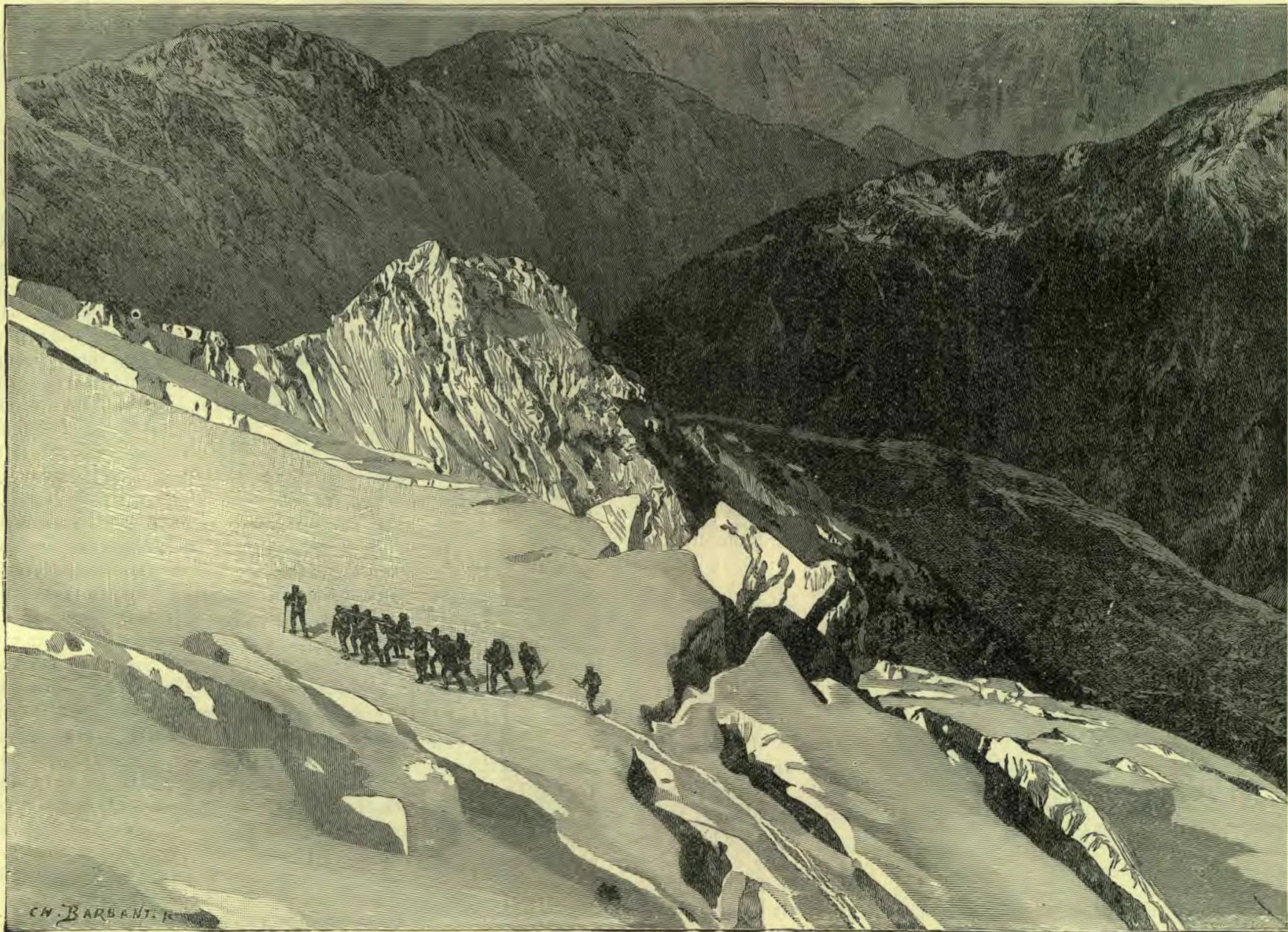
Mont Blanc, which deservedly bears the name of “Monarch of the Alps,” is situated in the midst of a mountain complex. There is no greater attraction in all Switzerland, or in all Europe, as far as that goes, for the lover of mountain climbing, than Mont Blanc and its adjuncts; and this is deservedly so, for it is the highest of all European mountains, towering, as it does, fifteen thousand seven hundred and eighty feet above Lake Geneva, and twelve thousand three hundred and thirty-five feet above the valley of Chamouni. Viewed from the latter place, the mountain and its environments present a very pleasing aspect. The enormous glaciers which clothe the flanks of this colossus of the valley descend now in gentle curves, now in broken and rugged lines; and their splendor illumines the flowery meadows, and penetrates to the very verge of the forests.
THE PRINCE OF GLACIERS.
The entire chain of the group in which Mont Blanc is the most conspicuous member has a length of about thirty-six miles by from three to six miles in breadth. The northern part belongs to Switzerland, but the southern part to Italy, while France claims the remainder. At first sight it does not appear to be an easy matter to find the clue to this labyrinthine group of peaks and ravines with contours crossing one another in all directions. From the central range lateral chains of various length extend northeast and southwest, their heights varying from ten thousand to thirteen thousand feet. In the more northern part enormous glaciers are embedded; but toward the east and south the volume of the ice masses is much reduced.
This immense group may be divided into255three parts: The northern part extends from the Pointe d’Orny and the Glacier du Trient to the boundary wall of Les Courtes and Les Droites, which meets it at almost a right angle. This natural rampart extends from east to west, from Mt. Dolent to the Aiguille Verte. To this district belong the beautiful Glacier d’Argentière, inclosed between the ridge just mentioned and the central chain,—the glaciers du Tour, d’Orny, de Saleinoz, and de Lanenvaz,—dominated in the center by the Aiguille de Chardonnet; in the southeast by the Aiguille d’Argentière, the Tour Noir, and the Dolent; in the west by the Aiguille de Dru; and in the north by the Grande Fourche and the Aiguille du Tour, flanked by the beautiful mountains of Ecandies, Orny, and Postalet, in Canton Valais.
The central part of the group, with its glaciers, presents, when viewed from above, the form of a trefoil, the stalk of which is represented by the Glacier des Bois, and the right-hand leaflet by the glaciers du Géant and du Tacul, in the south; the middle one by the glaciers de Léchaud and de Mont Malet, and the third leaflet by the Glacier de Talèfre, in the north. Five summits of this group command the valley of the Arve, and are all visible from Chamouni.
The southern part of the group is the loftiest. Its center is Mont Blanc, whose rounded summit dominates this array of peaks rising toward heaven like an ocean of motionless waves. The principal summits in immediate proximity to the culminating point of the European continent are the Dôme and Aiguille du Goûter, the Dôme and Aiguille de Miage, and the Pointe de Trélatête, with a magnificent assemblage of glaciers, of which the following are the chief: Toward the north, the glaciers of Bossons and Taconnaz; in the west, those of Bionassey and Trélatête; in the south, those of the Allée Blanche, the Miage, and the Brenva, whose ice masses sink down nearly to the banks of the Doire.
I subjoin an account of J. Janssen, member of the Academy of Sciences, Paris, descriptive of one of his ascents made in 1888, for the sake of pursuing some scientific investigations. A word with regard to this, first. It is said that the oxygen gas which forms part of our own atmosphere extends its action to the solar spectrum by the special phenomenon of absorption. These are, first of all, the rays belonging to the groups A and B of the Fraunhofer spectrum, and also those of the group a. They are, in other words, bands which, it is true, are not visible, except when the sun is already below the horizon, but which still pierce the large and dark bands in the regions of the red, the yellow, the blue, and even the violet.
Some one may ask whether these rays and these bands are due exclusively to the terrestrial atmosphere, or whether the atmosphere of the sun has not something to do with it; or, on the contrary, whether the mundane atmosphere simply favors a phenomenon, whose first origin would have its seat in the sun’s atmosphere. Oxygen plays so prominent a role in the constitution of the earth’s crust and the rocks composing part of the same, and of the fluids which form its oceans as well as those that enter into the makeup of our atmosphere—in short, it is an agent so vital to all manifestations of life, that the question of its presence, be it in the sun or in the other stars, is of the greatest importance.
In reference to his investigations in this direction, Mr. Janssen says:—
“The observations of which I wish to render an account do not claim to solve the question in all its details: to know whether oxygen makes a part of the materials which compose the solar globe. The complete solution of this grand and difficult question will demand, no doubt, new advance moves in spectral analysis, and difficult researches. My task was more limited; but it represents a necessary step in the course yet to be run in order to arrive at a complete solution. As aforesaid, it is to be ascertained whether the solar atmosphere contains oxygen gas in such a state that it could produce the actions of absorption similar to those of our atmospheric oxygen; in a word, whether the rays and bands recognized by the solar spectral analysis to produce atmospheric oxygen are exclusively due to our atmosphere, or not. A question of this kind may be solved by occupying some high point for the observations necessary thereto. If one makes comparative observations, both on the level plain and at such altitudes as leave beneath them a large share of our terrestrial atmosphere, one will obtain means of comparison that admit of conclusions such as bring the observations to the very limit of the atmosphere, and consequently to the solution of the question.
“In order to give the results all the exactness possible, it seemed necessary to rid the spectral rays of the watery vapor; for these rays show themselves in great abundance in the spectral regions themselves, where one finds these groups, owing to the oxygen.
“This induced me to make the observations during a very cold time, and so I was led to mount to a great height, to be able to reduce to a considerable extent the action of the atmospheric oxygen, and to choose a cold season in order to annul the action of the aqueous vapor, and to lead to spectral manifestations in all their simplicity.”
“Now the admirable altitudes of Mont Blanc, of which science has made comparatively little use, seemed to me to correspond to all the exigencies involved. Upon one of the most elevated and most interesting points of this grand monarch of the Alps is found a refuge, a very comfortable shelter, called the Grands Mulets.
“This retreat lies fully one thousand feet above the sea level, at the juncture of the two principal glaciers that slope down from Mont Blanc, and dominates the most important glacial phenomenon of the whole mass. The presence of the grand glaciers seemed to me very favorable to the purity as well as the lowering of the temperature in the atmosphere which I was investigating. At the time of year when this ascension was to be made (in October), the daily temperature of the atmosphere actually fell at this station much below zero. I resolved, therefore, to ascend to the Grands Mulets with my instruments, there to await a favorable season for my observations. But this ascent at this particular time of year, presented especial difficulties. The refuge was already abandoned for the winter, and recently a vast amount of snow had fallen, effacing the footpaths and covering the crevasses, so that marching was rendered extremely difficult. Finally the cold, already rigorous in these high regions, necessitated special dispositions and arrangements to admit of a prolonged stay. I caused the chief of the guides to come along, whom I had chosen as among those of most experience, and, after having examined the question most thoroughly together, it seemed not absolutely impossible, and we completed the arrangements necessary to adopt.
“I sent at once a detachment of the most experienced guides and mountaineers, whom the chief guide took in charge, to look up the route, and mark the track which the expedition ought to follow, from Pièrre-a-l’ Echelle, which is situated at the entrance of the glacier, as far as the cabin of the Grands Mulets, where the observations were to take place. These preliminary labors proved extremely laborious, and not without danger. The men often had the snow come up to their hips and belts, so that they could hardly stake off the route which we were to follow erelong. The distance of the way from Pièrre Pointue to the Grands Mulets, and the difficulties all along the track in midst of the blocks of ice, where the Glacier des Bossons joins that of Taconnaz, taxed my human strength beyond its powers, so that I had an apparatus fixed in which I could be carried a good share of the way at least. At six o’clock A. M., Oct. 13, 1888, we started from Pièrre Pointue. At the point named—Pièrre-a-l’ Echelle—the route rises to, and crosses over, the sudden slopes of rocks belonging to the Aiguille du Midi, and the moraine (ice-bed) of the Glacier des Bossons. The route stretches along the foot of the Aiguille du Midi, a place which the guides consider especially dangerous, on account of frequent avalanches and stone-slides coming that way. Hereafter we come in contact with the glacier itself, and at a point where the ice forms a graceful plain, with slightly undulating surface and but few fissures, the traveler can be carried, and steady advancement be made without much of any fatigue; but having reached a point which the guides call the junction, the difficulties become greatly augmented. The crossing of crevasses, the incessant ascent and descent, in midst of these blocks of ice, thrown down pell-mell and buried in the snow, require a dexterity of limbs and an expenditure of strength to which only youth in its best years is equal. By heroic perseverance, frequent stops to rest, and grace and devotion on the part of the guides, we at length, after the laborious efforts of many hours, come to leave this chaos. The next task is to get over the precipitous slopes of the Glacier Taconnaz that run in front of the rocks of the Grands Mulets, where the cabin is situated. There are still vast fissures; the route worms around them, and rises in windings innumerable as far as the foot of the rocks. Here the only difficulties we have to encounter consist in the depth of the snows and the narrowness of the way to be traversed, which does not admit of the use of the ladder. Night surprised us before we had reached the Grands Mulets. By the aid of lanterns, the ascent is still continued. At some slope where the road widened and admitted of doing so, the carrying apparatus was brought into requisition, which gave me some little rest. At length we reached the cabin, where those guides that had preceded us had prepared a fire and some refreshments. But the extraordinary efforts which I had been obliged to make in order to accomplish this ascent, did not admit of my safely partaking of food just then. We had consumed thirteen hours, from the shepherd’s hut at Pièrre Pointue to the hut of the Grands Mulets, a distance which in a favorable season of the year can be traversed in from four to five hours.”
These investigations demonstrated that other planets, as well as the sun of our system, have oxygen.
While men thus ascend to the loftiest heights, and others descend to the lowest depths of earth, to find some of nature’s secrets, he is wisest and happiest who will ever keep his ears open to the still small voice of God, that speaks to the heart, and will follow its guidance until we shall see as we are seen.
AUGUST KUNZ.
Leaving a Monument of Virtue Through Good Deeds
By Dr. Chalmers
Do good, and leave behind you a monument of virtue that the storm of time can never destroy. Write your name in kindness, love, and mercy on the hearts of the thousands you come in contact with year by year; you will never be forgotten. No; your name, your deeds will be as legible on the hearts you leave behind as the stars on the brow of evening. Good deeds will shine as the stars of heaven.— Dr. Chalmers.
RECKLESSNESS OF LIFE.
It is painfully evident that thousands of people treat that most precious gift of all gifts, life, as though it were of little value. Ordinary precautions to preserve life are not taken, but it is often flung away as one throws away the most useless and valueless thing. A few days ago a young man on a bicycle fairly run into an engine on a fast train, and was killed, not a hundred rods from this office. The papers fairly teem with reports of similar acts of recklessness. One may suffice as an illustration. A young Italian, in one of our cities, loaned a few dollars to another Italian. He called to get the money. The man was away, but the woman told him that her husband had been out of work so much that he could only earn bread for the family, but that next week he would have steady work, and would be able to pay some of the debt. The young man immediately opened fire upon her with a revolver, and after mortally wounding her, turned the weapon upon himself and blew out his own brains! Think of it; a young man commits murder and then suicides because he could not collect a debt of a few dollars just when he wanted it! It is becoming a very common thing for people to kill some one and then kill themselves. This is heathenism, pure and simple. It seems a pity that people with such intent cannot begin on themselves first. A good and noble purpose in life makes us value it. Low and degrading purposes cause men made in the image of God to regard their lives of less value than the beasts value theirs; for beasts do not commit suicide.
GIVING UP.
By Jennie Harrison
What will you give up, children,
For Jesus Christ's dear sake?
What offering from your young lives
Will each one gladly make?
He gave up heaven, and came to you;
Then what, for him, can you not do?
What will you give up, children?
Something you love quite well?
Some pleasure, or some precious thing,
Which none but you can tell?
He gave his life, that you might live;
Then what, for him, can you not give?
What will you give up, children?
Yourselves, and all your own?
Just to belong to Jesus Christ,—
His children, his alone?
He gave himself,— your Saviour true;
Now give yourselves—ah, will not you?
— Jennie Harrison, in the Shepherd's Arms.
A BELIEF IN GOD.
By Agassiz
I WILL frankly tell you that my experiences in prolonged scientific investigations convince me that a belief in God—a God who is behind and within the chaos of vanishing points of human knowledge—adds a wonderful stimulus to the man who attempts to penetrate into the regions of the unknown. Of myself, I may say that I never make the preparations for penetrating into some small province of nature hitherto undiscovered without breathing a prayer to the Being who hides his secrets from me only to allure me graciously on to the unfolding of them.—Agassiz.
A NEW COAL TRUST.
By Editor
A coal trust of great magnitude has lately been formed in our southern States. What is a trust? It is a combination of men who are dealers in some staple article or commodity to fix a higher price upon their wares. It is an attempt to override the natural law of supply and demand by an arbitrary arrangement. It is stated that the reason for this lately-formed trust is that coal is so low that it does not pay for mining it, and that the miners are compelled to work for low wages. This may be so, but we doubt if the low price of labor is the primary cause of the trust. If by a trust the coal companies will increase the price of labor, giving their employees a fair share of the increased price, the trust will result in good in one direction. But if the miners get no more pay, and the increased price paid for coal goes into the coffers of wealthy men, the benefit of the trust may be questioned. Trusts have been pronounced illegal by the laws of several of our States; but wealth does about as it pleases in this country, no matter what the laws may be.
THE POWER OF CHRIST.
By Phillips Brooks
COULD not Christ have saved Lazarus from dying? Could not Christ save you or me from perplexity, or from temptation, or from doubt? Surely these are questions which have their lower and higher answers. He could, because the power of life and death was in him. But the power to use the power depended on other things. It depended on the necessity which lay back of all things in Jesus to do the absolutely best thing, not the second best thing, but the absolutely best of all.
If it were best for Lazarus to die, then Christ could not have caused that he should not have died. This is a sublime incapacity; to stand with the gift of life in the all-powerful hands, to see the cry for life in the eager eyes, to hear it in the dumb appeal of the terrified lips, and yet to say, “No, not life, but death, is best,” and so be unable to give life—that is a sublime, a divine incapacity! Could not Christ have answered your prayer? No, he could not; not because the thing you asked for was not in his treasury, but because behind the question of his giving or refusing it, there lay the fundamental necessity of his nature and his love that he should do for you only the absolutely best. The thing you asked for was not absolutely best, therefore he could not give it. Back of how many unanswered prayers lies that divine impossibility!—Phillips Brooks.
Gold Withdrawal From Treasury Raises Financial Concern
GREAT interest has been felt in financial circles from the fact that July 14 two hundred and fifty thousand dollars in gold coin and bars was withdrawn from the United States treasury by presentation of treasury notes for redemption. This money is for shipment to Europe, and it is the first gold which has been drawn from the treasury since the bond contract was signed. The bond contractors agreed to exert their powers to prevent a further withdrawal of gold, but they may not be able to prevent it. There is no harm done to the gold reserve by so small a withdrawal; but many fear that it is but the beginning of a flow of the yellow metal to Europe, which will go on until the treasury will be depleted, and the government be compelled to issue another series of bonds.
A STORY OF MR. GLADSTONE.
In Mr. Gladstone’s household at Hawarden was an old woman servant who had a son inclined to go wrong. The mother remonstrated, and advised her boy, but all to no purpose; he seemed determined on a headlong course to ruin. At last the mother in her desperation caught the idea that if she could persuade the premier to take him in hand, perhaps the prodigal might be reclaimed. Screwing her courage to the sticking-point—for what will a mother not do for a child?—she approached her master, and in trembling tones preferred her request.
Mr. Gladstone responded at once; and though the affairs of the greatest kingdom in the world pressed heavily upon him, with genuine simplicity of character he had the lad sent to his study, when he spoke tender words of advice and remonstrance, and eventually knelt down and prayed God to help him in the work of reformation and redemption. This kindly action was effectual, and the lad was saved.—Exchange.
A POWERFUL SERMON.
An old woman in Dr. Todd’s famous New England church kept a small grocery store, and it was currently reported that she was dishonest in her dealings with the few townspeople who bought of her. One Sunday Dr. Todd preached a powerful sermon from the text: “False weights are an abomination unto the Lord.” The old woman was much roused by this sermon. She was trying to tell an old acquaintance about it. “A very powerful discourse, Maggie. Ah! but he came down on the sinners. It would ha’ done your heart good to hear him.”
“What was the sermon about? What was the text?”
“Ah! I cannot remember the text. But it was about weights and measures and groceries and balances.”
“But what was the subject? What was the theme of the discourse?”
“O! the theme? I don’t know. But this I do know, Maggie, I went right home and burned my half bushel!”—Exchange.
A VICTORY FOR BEER.
By Editor
Now that the smoke of the political battle between the Liberals and Tories in England has been swept aside, it is found that beer formed quite an important part of the campaign. The Liberals were moving in the direction of restricting the sale of beer, and the British workman could not entertain any proposal to limit his beer! Now that the Tories are in power, the price of bar-rooms has risen all over England. When we learn that the election was decided to some extent by beer, we need not be surprised to hear of the disgraceful scenes which accompanied the Tory victory, when the wives of leading Liberals were attacked by mobs and covered with garbage. Liquor makes brutes of men, whether in England or America.