Your ShelfYour Projects

Review and Herald, Vol. 57, No. 20.

The Organic Unity of the Bible
Earlier text: TENNESSEE AND KENTUCKY

Church Lotteries and the Push to Legalize Them

—It is time that church gambling should come to the end of its rope. Instead of that wholesome result, there is an attempt in New York to legalize church lotteries, and a bill for this purpose has been introduced into the legislature of that State. The Methodist “supposes that the Romanists are more directly behind the measure.” We trust it may be so, but it is a sure index of its character for any church to seek “the power to do a thing, which on grounds of public morality, and for the protection of the young and the poor from a ruinous habit, is forbidden as a business enterprise.” We are convinced from observation that there are too many Protestant churches as ready as Catholics to increase their revenue in this disgraceful manner. If the leaders in such churches have no compunction of conscience on their own account, they should remember that “when the Abbot throws the dice the whole convent will play.”

Evolution Gone Awry: Gatling Gun and Burglar Brothers

—How things do turn out! There was that North Carolina boy, Gatling, who set out to invent a corn planter, and he kept improving, no, not improving, but changing it until it came to be one of the most destructive implements of modern warfare, the Gatling gun. Then, there were those two brothers who were studying for the ministry at Phillips Academy, one of them shot dead in an attempt at burglary, the other, his companion in crime, confessing to a long course of robbery. Yes, when a corn planter grows into an engine of destruction, and ministerial students turn burglars, we must believe in evolution—evolution of some kind.

Growth of the Congressional Library Collection

—Of the making of books there is no end, even if “finis” is put at the last of each of them. Within the past fifteen years the Congressional Library has doubled itself three times. It is expected that the library will soon contain 1,000,000 volumes.

Notes of News.

—The Mont Cenis tunnel, between France and Italy, is blocked by a landslide.
—Trichinae has been found in a fish in Cincinnati, the first instance of the kind known.
—On Monday, May 9, 6,521 immigrants landed at Castle Garden from six European steamers.
—Slabs and edgings of the lumber-mills are transformed into paper in a paper-mill at Lock Haven, Pa.
—The bill to allow clergymen to sit in the British House of Commons has been defeated by a close vote.
—According to the census returns, the people of this country pay $26,250,100 annually for their daily newspapers.
—An electric railway has been opened from Berlin to Litchterfeld. The experiment has proved a decided success.
—Reports from eighteen counties in Kansas indicate that the wheat crop this year will be the largest ever known.
—A coal-shaft in Osage Co., Kan., recently caught fire from a furnace in the air-shaft, and ten men perished in the flames.
—The Michigan Legislature has passed a bill which provides for a $300 tax on spirit retailers, and $200 on beer sellers.
—The Hon. Stanley Matthews’s appointment as Associate Justice of the Supreme Court has been confirmed by the Senate.
—The Marquis of Salisbury has been unanimously elected leader of the conservative party in the British House of Lords.
—The Khedive of Egypt is about to establish at Cairo a school for the education of girls of the higher classes, at his own expense.
—In Ireland there have been more arrests under the coercion act, and one agrarian murder. The victim is Lord Dundale’s bailiff.
—The Florida people estimate that 30,000 persons visited their resorts last winter, and that they spent three million dollars while there.
—The Czar of Russia has informed the Senate officers that hereafter his sanction will be required for its laws only when they are of exceptional importance.
—Seventy years ago the first Hindoo convert was received into the church, and now there are 500,000 professed Christians in India, Ceylon, and Burmah.
—Cuba is rejoicing over the promulgation of a constitution, which she regards as a step to other important reforms. Greater liberty of the press has been granted.
—There are about forty expeditions of various kinds,—missionary, commercial, and scientific,—organized to penetrate the continent of Africa from different points.
—The Christian Weekly states that during a year and a quarter the enormous sum of $19,000,000 has been given by private individuals in this country to the cause of education.
—It seems that the late inquiry into the murder of Abdul Aziz was instituted to prevent a similar combination of the implicated men against the present Turkish Sultan.
—A suit for $10,000 damages has been brought against Henry Ward Beecher by the Agricultural Society of Western Maryland, for failure to lecture according to agreement.
—The strike of the switchmen of Chicago, which has seriously interfered with the running of trains, is breaking up. Several gangs of men have gone to work on the companies’ terms.
—In South Africa, hostilities have recommenced between Kaffir chiefs, Europeans and Boers participating. There is also a rumor from Cape Town of fighting between colonists and Basutos.
—The United States Brewers’ Association met in Chicago, May 11, for the purpose of holding their annual convention. They propose to test the constitutionality of the Kansas prohibition law.
—In honor of the marriage of the Austrian Crown Prince, which occurred May 10, the Emperor has pardoned a number of prisoners whose offenses were unpremeditated, arising from poverty.
—Strikes have become fashionable, and even the “noble red man” has caught the spirit of them. He demands $2.50 per day for piloting rafts down the Lachine Rapids, in the Province of Quebec.
—The French have a compulsory-education law, which provides for instruction in the duties of citizenship, the constitution of the country, elementary notions of political economy and law, and gymnastics.
—It now seems that in depriving the Bulgarians of their constitution and usurping unlawful authority, Prince Alexander acted under advice from the Russian government, with the consent of Austria and Germany.
—The French government is attempting to do in Northern Africa what England did in India. The Bey of Tunis objects, and has appealed to the powers. France protests that she is only protecting her Algerian frontier.
—President Lincoln’s old house in Springfield, Ill., was recently torn down. An enterprising boy bought all the shingles for a dollar, and with his scroll saw is turning them into ornamental mementoes, which he sells at from fifty cents to a dollar each.
—The losses of the Jews by the recent riot in Elizabethgrad, Russia, are estimated at nearly $2,000,000. The Jews in another Russian town were attacked by a mob while at the railway station preparing to leave the city; but the military came to their rescue.
—The anti-Jewish riots in Russia continue, and an immense deal of property has been destroyed. Southern Russia is in a state bordering on anarchy. Students as well as Jews are attacked, buildings and railroad trains are destroyed, and laborers are starving.
—The levee known as the Willard’s Landing levee, ten miles from Anna, Ill., broke on the 7th inst., and the river came in with a mighty rush. The levee broke in another place also, and a large tract of land is covered with water from one to ten feet deep. The loss is estimated at $100,000.
—In the British House of Commons, Mr. Gladstone, in moving that an appropriation be made for a monument to Lord Beaconsfield, paid a high tribute to the memory of the deceased statesman. Sir Stafford Northcote replied that Mr. Gladstone had already erected a monument better than one of marble.
—The United States Senate, after spending two months in political wrangling, has commenced business. The Chinese immigration treaty, giving the United States government power to regulate such immigration at its discretion, was ratified by a practically unanimous vote. After this, several other important treaties were successively considered and ratified.
—Bradlaugh, the atheistical member of Parliament, who was fined not long ago for attempting to vote in the House of Commons without taking the customary oath, has been returned by his colleagues. He has abandoned his doctrine that an affirmation is as good as an oath, and has demanded to be sworn. On the last occasion he was removed by the Sergeant-at-Arms, and a resolution, offered by Sir Stafford Northcote, making the removal operative until he should promise not to disturb the proceedings of the House, was adopted.
—Harper’s Weekly complains that New York city suffers outrages at the hands of unscrupulous corporations that in almost any European city would lead to revolution and bloodshed. It says: “The railroad companies seize upon our streets, obstruct the sidewalks with great iron pillars, shut out the daylight, destroy business, and nearly craze those who cannot get away from the incessant din and roar of passing trains.” A similar complaint is made against the telegraph and gas companies. And as these companies have special charters from the State, the city is absolutely at their mercy.
—A pauper in a Pennsylvania almshouse opened his eyes only once in more than seventy days, and he has hence been termed “the sleeping Hungarian.” When efforts were made to arouse him, he seemed to be conscious of what was going on. He recently fell from a second-story window, but was not seriously hurt. He has since approached more nearly to the condition of a person awake, and it has been suggested that had he fallen four stories, he might have been fully aroused. The attending physician has received a letter from a spiritualist in Jacksonville, Pa., who states that the Hungarian’s spirit is traveling through space, and acquiring information which will be of incalculable value to mankind.
—The Christian Union, in its column of religious news, gives the following curious item: “During the last illness of the late Maharajah of Travancore a most touching ceremony was performed, which bears some resemblance to the Jewish institution of the scape-goat. A man was found willing, for a consideration (10,000 rupees), to bear the responsibilities of the Maharajah’s sins. He was brought into the royal presence, and after the Brahmins had performed certain ceremonies over him, the sick man tenderly embraced him. He was then led out of the country of Travancore into the Tinnevelly district, with a charge never to return.”

The Experience of a Tea-Drinker.

The reckless and extravagant use of tea came upon me gradually and unawares. Its stimulating effects afforded me all I could desire in the way of ambition and strength to carry that ambition out; and, false though that ambition might have been, it impelled me on to strive to accomplish more each day than ever should have been required of one brain or one pair of hands. I must sit awhile at my easel; dictate a letter; I must take a few stitches, and, like a faithful wife, keep the buttons on pater-familias’ shirts; must look after the dear little ones, to see that the nurse did not take it upon herself to administer chastisement, or by improper means bring them under subjection. I must carefully supervise, early and late, and all day long, my servants, and domestic matters generally, and keep all the wheels of the home machinery well oiled and in motion. All this, and more, I was eager to do, and for my own credit and to deserve my husband’s approbation, to do it well.
No half work with me, tea-drinking or anything else. I felt able to accomplish anything, when, having imbibed the luscious draught, all my nerves were strong for action and duty. Did excitement lag, I ordered another cup, the stronger the better; weak tea had no charms for me, but a perfectly heroic decoction of the very herb itself, with all its delicious aroma,—just that, and nothing more or less.
For four successive years this was my daily programme: Rising at seven in the morning, I repaired to the “family room” and ordered at once a good cup of tea. Breakfast at nine, and two more strong cups, to make my chops and muffins relish. At eleven the waiter brought me another cup; at lunch two more. The waiter appeared regularly at three P. M. with one more cup, and at the six o’clock dinner, at least one cup more, to make the various viands better digest. There it was, six or eight cups a day, and each one so bitter with its own strength as to make me shiver. From day to day I went through this same routine; with health apparently perfect, with my strength and endurance of care and duty to all appearances unlimited. I was really a “slave to the cup,” and that the cup of tea! How long can this state of things continue? I often asked myself, while yet there was no visible sign of the slow, sure poison undermining my health and using up my nerves. I lived upon my tea. I loved it, and must have it, and the tempting draught being swallowed, “Richard was himself again.” When I felt the least weariness stealing upon me, another cup was ordered. Did my head ache a little, I took another cup to ward off a serious attack. Did I notice the least indigestion, an extra cup was brought in. It was my sovereign remedy for all ills poor flesh is heir to. I felt the thralldom,—the chains which I forged for myself,—but then I enjoyed the vim and vigor it bestowed. I felt that I had much to accomplish in many directions, and that I was able to achieve success in any undertaking, under its stimulating influence. But the time was close at hand, after several years of this kind of dissipation, when the grand shattering of the temple, supported by frail and precarious pillars, must surely come.
“So tired,” just escaped my lips, as I was going to my room for the night, and falling, all unconscious, save of agony, I was borne by kind, familiar arms to my own couch, where I lay with whirling brain and sinking breath, till the “wee sma’ hours” of morning, with no feeling save of suffocation, of stifled breath, and general misery. This night of suspense to my anxious, watching friends, dragged slowly by. The family physician plied all his arts to save. The morning found me all weak and exhausted, and what was more alarming, completely benumbed, paralyzed from head to foot, but with brain quite too active not to appreciate the danger of my situation. Walk or stand, of course I could not, yet I was determined not to be crippled. The will that urged me on in health came to my rescue in sickness. For twelve long weeks I lay between hope and fear, yet resolved to overcome and recover. That will and spirit seemed to save me. I gradually felt the nerves return to their original sensitiveness, and at last I was able to walk again. I was “on my feet” once more.
But there was the tea,—the long-loved luscious cup! Should I again risk such fearful bondage to this accursed tyrant? Should I yield again, and again become a slave? Could I play with fire, and not be burned? My physicians had ascribed to it all my sufferings for three long months, and should I now indulge again? Not unmindful of the self-denial it would cost me, I resolved to give it up, at once, wholly, and forever. I had suffered enough from its power. I would be free. Henceforth, not a drop of tea, I pledged myself. The same will and determination that brought me off a sick bed has carried me safely through all temptations to this hour. More than four years have passed, but not one drop has ever touched my lips.
But I little dreamed of the web I was weaving when I made the decision; the self-sacrifice I was to endure; the perfectly painful efforts I must make before I would be free indeed from a cup of tea,—“to master it or have it master me,” as Gough quaintly puts it for the poor inebriate. In the cold winter days I longed for it to warm my blood and invigorate me generally, and in the sultry, summer days, when I felt languid and weary, to drive the dull ennui away.
I have lived through the struggle; I desire it no longer. My health and vim are genuine and firm, and if these lines fall under the notice of any who are so foolishly addicted to excessive tea-drinking, I cordially bid and encourage them to go and do likewise, and by taking only the tea of Mother Eve find in it health and strength, and reap a rich reward.—Free Press.

DARK DAYS.

Dear Lord, I do remember thou hast said That I may cast my every care on thee; But see, this deep oppression will not go, But with its leaden hands holds fast to me;
Holds fast, and drags me down, and shuts my mouth, Strangles the cry that fain would pierce the skies; Helpless I lie before thee, with no words Upon my lips, with sad yet tearless eyes.
So be it, Lord; my joyous soul has need Of its dark days, and in this dreary night Roots shall strike downward, that anon shall shoot In rich and living branches to the light.
Oh, may these branches bear some fruit for thee, In grateful memory of the loving hand That cast me in this gloomy, cheerless spot, And all its dreariness and darkness planned. —Mrs. Elizabeth Prentiss.

Courtesy Among Christians: Can Good People Be Rude?

—“Well, I must confess that Sister C. is rather rude in her speech and manners, but, after all, I think she is a good woman.”
“Good! Do you believe that really good people can be habitually rude?”
What think you, honest reader? I only know that in the word, Christians are exhorted to “be courteous.”

Offering Basket and the Widow's Mite

—“The Lord hath need,” pleaded the minister. “Freely ye have received, freely give.” A dainty lace handkerchief wiped a tear from the eye of the richly dressed lady before me, as she dropped into the basket from a white hand on which sparkled a thousand-dollar diamond, a silver ten cent piece. O mammon, mammon!

GOOD HEALTH.

J. H. KELLOGG, M. D., Editor.
This popular health journal enters upon its fifteenth volume with the most flattering prospects for a continuation of the prosperity that has attended its publication in the past. It has for several years enjoyed the LARGEST CIRCULATION OF ANY HEALTH JOURNAL IN AMERICA, and its publishers are determined, not only to maintain the high position already attained, but to greatly increase its circulation the coming year, and thus enlarge its field of usefulness.
During the year each number will contain a large amount of valuable and interesting matter on the subjects of Health, Temperance, Popular Science, General Literature, and other topics of interest. The practical information in its pages on Sanitary Science, Public and Domestic Hygiene and topics of kindred nature, gives it a scope and field of usefulness peculiar to itself, and unoccupied by any other journal.
AN ILLUSTRATED ARTICLE on practical hygiene, or some other topic of general interest, will appear in each number, as a new and permanent feature of the journal in the future. In addition to this the Department of Questions and Answers, which has contributed so much to the success of the journal in the past, will be revived in a practically useful form, and made more valuable than ever before.

SUBSCRIPTION PRICE, $1.00 A YEAR.

PREMIUM FOR NEW SUBSCRIPTIONS.—The “Household Manual” a work of great value as a book of ready reference, packed full of practical information, and sold at retail for 75 cents, is offered new subscribers with GOOD HEALTH for a year, for $1.25. We regard this as the best premium offer ever made, as the book alone is well worth the subscription price of the journal, and 25 cents extra secures both.
Specimen copies of the journal will be sent free to any address on application.
Address GOOD HEALTH, Battle Creek, Mich.

Obituary Notices.

“Blessed are the dead which die in the Lord from henceforth.” Rev. 14:13
Hawkins.—Died of paralysis, in Convis, Mich., April 9, 1881, my dear father, Asahel Hawkins, aged nearly 75 years. Mrs. A. O. Burrell.
Beeman.—Died of diphtheria, on Tuesday and Friday of the same week, Mannie and Myron, twin boys of John and Julia Beeman, at Albion, Neb., April 18 and 22, 1881. But the last enemy will soon be destroyed. Geo. B. Starr.
Pierce.—Died, of hemorrhage of the lungs at the residence of his son Andrew, in Cedar Lake, Mich., H. H. Pierce, aged 68 years, 11 months, and 28 days. Discourse by the writer, from Eccl. 9:10-12, the importance of earnest labor being the principal theme. O. Soule.
Penn.—Died of scarlet fever, at Waterford, Ohio, April 17, 1881, Mary C., daughter of E. C. and S. J. Penn, aged 5 years, 1 month, and 28 days. She rests till the Restorer comes. Parents and brothers hope to meet her then to part no more. Funeral discourse by the writer, to a large and attentive audience. A. M. Mann.
Hoover.—Died of phthisis, near Six Lakes, Montcalm Co., Mich., March 28, 1881, Lucenia, wife of G. W. Hoover, aged 24 years, 9 months, and 28 days. A husband and three small children feel their loss, while a father, mother, brother, and sister feel that a link is broken in the family chain; but they mourn not as those that have no hope. E. Van Deusen.
Haner.—Died of consumption, at Saranac, Ionia Co., Mich., May 1, 1881, Mary Haner, aged 53 years, 2 months, and 29 days. Three daughters and an aged husband will miss her. Sister Haner embraced the Sabbath and kindred truths under the labors of Elds. Lawrence and Strong, nearly seven years ago. Shortly before she died, the brethren met at her house, and with her partook of the emblems of our Lord’s broken body and shed blood. The church feel that she sleeps in Jesus. E. Van Deusen.
Cook.—Died in Washington, D. C., April 1, 1881, of pleuro-pneumonia, after an illness of nine days, Sister Mary Eliza Cook, aged 42 years, 3 months, and 26 days. She leaves a loving husband, a son of 15 years, and three little daughters younger, to mourn their great loss. Sister Cook had been an observer of the Sabbath of the fourth commandment for quite a number of years, and was a member of the church at South Lancaster, Mass. For more than seven years she has held up the light of truth in our nation’s capital, both by her labors as a missionary, and by her faithful example, much of the time all alone.
May her faithful words and works be blessed to the salvation of many, and especially of her dear husband and motherless children. C. W. Stone.
Masters.—Died at the residence of her daughter, in Lawton, Mich., April 20, 1881, Mrs. D. B. Masters, aged 74 years, 2 months, and 8 days. At the age of fifteen, Sister M. embraced Christ as her Saviour, and united with the M. E. Church. She remained a member of that church until two years ago, when she commenced to observe the Sabbath of the Lord. She rejoiced in the light of present truth, and often spoke of the increase of faith and joy since seeing the wonders of the law of God. Sermon by Eld. West (Baptist), from Eccl. 8:2: “I counsel thee to keep the king’s commandment, and that in regard to the oath of God.” A large number of relatives and friends mourn their loss in the removal of this dear mother in Israel; yet the Spirit says for our comfort, “Blessed are the dead that die in the Lord from henceforth.” D. B. Richards.

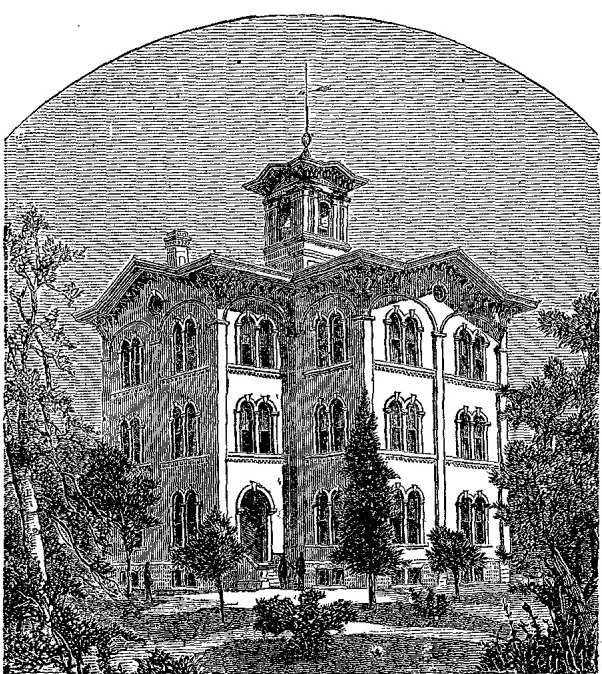
BATTLE CREEK COLLEGE.

A MODEL EDUCATIONAL INSTITUTION, COMPRISING FIVE DEPARTMENTS.

Nearly 500 Students Enrolled Annually, Coming from 32 States and Territories.

DEPARTMENTS

I. DEPARTMENT OF THE ARTS AND SCIENCES.

This includes a Classical Course of FOUR YEARS and an English Course of three years, each with its Preparatory Course of two years.

II. NORMAL DEPARTMENT.

This includes a Teachers' Course of FOUR YEARS, and a Model School. The course in this department includes all the branches required for a first-class certificate in any State. Professional instruction in Didactics is also given to those in this department who are expecting to teach.

III. COMMERCIAL DEPARTMENT.

This includes instruction in the following topics: Book-keeping, Business Correspondence, Business Forms, Business Penmanship, Commercial Law, Banking, and Telegraphy. The common branches are also pursued in connection with the topics given above; also, French and German.
There are two sessions daily—afternoon and evening.
The courses in this department are of varying length, and the tuition ranges from $5.00 to $30.00.
Superior advantages for those desiring to prepare themselves for Tract and Missionary Secretaries and Librarians. (Send for special circular.)

IV. DEPARTMENT OF THEOLOGY.

This department has a course of three years, which includes besides the usual common branches, Geology and Greek.

V. DEPARTMENT OF HYGIENE.

This department has a course of one year. It is designed for those who desire to obtain accurate and scientific information on all subjects pertaining to the preservation of health, together with a fundamental knowledge of anatomy and physiology, and a practical acquaintance with the nature and ordinary treatment of common diseases.

THE FACULTY

numbers fourteen members. They are all men and women of experience and critical scholarship.
The majority of the students are young men and women of true moral worth. Their influence over the unstable is highly restrictive and salutary, making it comparatively easy to maintain the most rigid discipline.

EXPENSES

Probably there is no other College in the United States where a thorough education can be obtained at so small an expense. A system of clubbing, which has become very popular among students, enables them to secure excellent board at $1.10 a week, exclusive of lodging, which costs 50 cents to $1.00 more. The annual expenses of each student, including all but traveling expenses and clothing, need not exceed $113.00. A full descriptive Catalogue will be sent free, upon application.
Address BATTLE CREEK COLLEGE, Battle Creek, Mich.

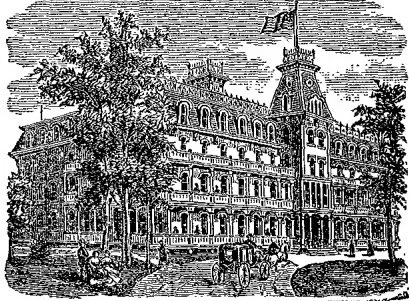
MEDICAL AND SURGICAL SANITARIUM,

Battle Creek, Michigan.
This institution, beautifully located in one of the most healthful cities of Michigan, is everywhere recognized as the

GREAT SANITARIUM OF THE WEST.

More than 4,000 patients successfully treated. The erection of new buildings and the addition of all the most approved remedial appliances known to the profession, have made it The Most Complete Institution of the Kind in America. All modern hotel conveniences furnished. Terms very reasonable.
J. H. KELLOGG, M. D., Medical Superintendent.
Address. SANITARIUM, Battle Creek, Mich.

REVIEW AND HERALD PUBLISHING HOUSE.

BOOK AND JOB PRINTING,
BOOK BINDING,
Electrotyping, Stereotyping, Paper Ruling, Blank Book Manufacturing, Etc.
The largest and best equipped printing office in the State. Orders by mail promptly attended to.
Address REVIEW AND HERALD, Battle Creek, Mich.

Tracts Available: Sabbath, Prophecy, and Doctrine Topics

TRACTS.—24 pages, 3 cents each. The Second Message of Rev. 14—Who Changed the Sabbath?—The Lost-Time Question—Scripture References—The End of the Wicked—Infidel Cavils Considered—The Pocasset Tragedy—Sabbaton.

MICHIGAN CENTRAL RAILROAD.

GOING EAST STATIONS. GOING WEST
Night Exp. Atlantic Exp. N. Y. Exp. Day Exp. Mail. Local Pass. Mail. Day Exp. Even’g Exp. Pacific Exp.
8.00 A.M. 3.45 A.M. 11.50 P.M. 6.30 P.M. 6.50 P.M. Ar. Detroit Dep. 4.00 A.M. 7.00 A.M. 9.35 A.M. 8.30 P.M.
5.00 A.M. 12.45 A.M. 9.32 P.M. 4.05 P.M. 3.45 P.M. Jackson 7.05 A.M. 10.20 A.M. 12.15 P.M. 1.30 P.M.
3.18 A.M. 11.10 P.M. 8.18 P.M. 2.15 P.M. 1.28 P.M. BATTLE CREEK 8.37 A.M. 12.19 P.M. 1.57 P.M. 1.08 P.M.
2.25 A.M. 10.25 P.M. 7.41 P.M. 1.38 P.M. 12.33 P.M. Kalamazoo 9.30 A.M. 1.13 P.M. 2.36 P.M. 1.53 P.M.
11.30 P.M. 7.38 P.M. 5.30 P.M. 11.13 A.M. 9.25 A.M. Michigan City 12.38 P.M. 4.23 P.M. 8.15 P.M. 5.03 P.M.
9.10 P.M. 5.15 P.M. 3.30 P.M. 9.00 A.M. 7.00 A.M. Dep. Chicago Ar. 3.00 P.M. 6.50 P.M. 7.48 P.M. 7.30 P.M.
Day Express and Mail daily, except Sunday. Pacific Express and Local Passenger west and Atlantic and N. Y. Express east run daily. Night and Evening Express daily, except Saturday and Sunday. H. C. WENTWORTH, Gen. Pass. Agent.

THE IOWA CONFERENCE AND T. AND M. SOCIETY

Appointments.

“And as ye go, preach, saying, The kingdom of Heaven is at hand.” Matt. 10:7.
The eleventh annual session of the Wisconsin Conference will be held at Neenah, Wis., in connection with the camp-meeting, June 16–21. Let every church be represented by delegate, if possible; if not, be sure to send a letter. O. A. Olsen, Pres. Hickory Corners, Mich., May 21, 1881. T. M. Seward.

THE IOWA CONFERENCE AND T. AND M. SOCIETY.

The annual sessions of the Iowa State Conference and T. and M. Society will be held at Des Moines, Iowa, June 9–14, in connection with the camp-meeting. Let every church see that delegates are duly appointed in season. Each church is entitled to one delegate. If they have thirty-five members, they are entitled to two, and one in addition for every fifteen members more. Let all delegates be on the ground Wednesday, that the business may be promptly attended to at the beginning of the meeting, and be out of the way of the spiritual interests of the occasion. Let all delegates remember this, and be in season. Also let every director be present early. Important business must be brought before the Board, which needs prompt attention. Let all be prompt. Geo. I. Butler, Pres. Iowa Conf. and T. and M. Society.
The next annual session of the Iowa Sabbath-school Association will be held in connection with the camp-meeting of the Iowa Conference, June 9 to 14, 1881. We should be very glad to have every school represented, either by delegates or letter. E. W. Farnsworth, Pres.
The third annual session of the Health and Temperance Association of Iowa will be held in connection with the camp-meeting of the Iowa Conference, June 9 to 14, 1881. Let every society in the State be represented. In addition to the usual business, we wish to discuss and lay some definite plans for the future. E. W. Farnsworth, Pres.

UPPER COLUMBIA CAMP-MEETING.

The Upper Columbia Conference will hold its first annual camp-meeting, the Lord willing, in Jesse Day’s Park, at Dayton, Columbia Co., W. T., June 1–7, 1881. Eld. J. H. Waggoner is expected, and others are also invited. We expect God’s blessing. Let there be an earnest effort to attend this annual gathering of the Seventh-day Adventists of this new field. G. W. Colcord, Wm. Goodwin, Ambrose Johnson, U. C. Conf. Com.
No providence preventing, I will meet with the church of Texas Creek, Col., where Bro. A. J. Stover may appoint, May 28, 29. E. R. Jones.
I will meet with the church at Smithland, Iowa, May 21. Hope to see a general attendance. Let us come, brethren, seeking to draw near to God by fasting and prayer, that we may obtain the blessing. R. C. Porter.
There will be a general quarterly meeting of the tract society and Sabbath-school in Dist. No. 1, Ky., at Bro. Barr’s, near Elizabethtown, Sabbath and first-day, May 28, 29. This is a very important meeting, and we hope to see a general turnout. As Bro. Barr has been burned out, it is desirable that as far as possible the brethren bring provisions, and come prepared to care for themselves and others. We hope for a full report of the T. and M. work. Will all come prepared to pay up their dues to the cause, as far as possible? S. Osborn.

APPOINTMENT WITHDRAWN.

I shall not be able to fill my appointment at Parkville, Mich., May 21, 22. M. B. Miller.

FUTURE LABORS.

The opinion prevails that the backward spring will so crowd the farmers of Michigan during the month of June as to make it necessary to postpone the proposed camp-meetings till after grain harvest. When they were first suggested, an early summer was anticipated, and as we designed to spend July, August, and September in Colorado, on our way to California, we greatly desired to see our people in Michigan during the month of June.
Meanwhile most urgent calls for help have come to us from the New England States. It is under a sense of duty to the old friends of the cause in the Eastern States that we postpone the Michigan meetings to a more convenient season. We shall probably spend the summer months in New England and New York, and hope to be able to serve our brethren in Michigan at a time that will better accommodate them.
Providence permitting, we will hold meetings at Danvers, Mass., May 28, 29. We hope for a general attendance from the N. E. Conference. From that point arrangements can be made for other Eastern States.
JAMES WHITE. E. G. WHITE.

Fast Day Reminder for Next Sabbath

Remember the fast day, next Sabbath, May 21. Read again the objects, as stated in REVIEW two weeks since, and enter into the spirit of the work.

Brother Daniels on Haste and Sluggards

Bro. Daniels’ article on “Haste” in another column is only designed to put the brakes on the flyaways. He will supplement it shortly by another, telling the sluggards to hurry up.

Upper Columbia Conference Reports Four Meeting-Houses

The secretary of the Upper Columbia Conference in his report for the quarter ending March 31, 1881, states the gratifying intelligence that they now have four meeting-houses in that Conference, valued at seven thousand dollars.

POSTPONEMENT OF CAMP-MEETINGS.

IN the West the season has been very late, nearly one month later than usual. In some sections the ground has been so wet that people at this date (May 12) may still be found sowing. Corn-planting is very much behind. Under these circumstances, which could not be known at the time the camp-meetings were appointed, we have felt much anxiety lest the time given would be too early for Iowa, Wisconsin, and Minnesota. We have corresponded with the presidents of the two latter Conferences, and with many leading brethren in Iowa. None have objected to a postponement of one week, while most have expressed a decided preference for it. Quite a number have expressed the belief that the attendance would be small unless a change was made.
We therefore decide to postpone the time of the camp-meetings one week in each of these States, so they will be held as follows: Iowa, June 9-14; Wisconsin, June 16-21; Minnesota, June 23-28; Dakota, June 30 to July 5. Two of the members of the General Conference Committee will probably attend these meetings. Other laborers will also be present. The appointment for Kansas will remain the same as ever. GEN. CONF. COM.
Continue reading: RAILROAD FARE TO THE WISCONSIN CAMP-MEETING