On Thursday morning, January 6, there gathered a company of workers in the church at Santo Amaro, a suburb of Sao Paulo, Brazil. By actual count, more than seventy-five persons were present. It was the first meeting of the workers of the Brazilian Union Conference, who had come together for a week of study and exchange of experiences before the opening of the regular biennial session of the conference. Some of these had been laboring in the interior, and had not met any of their fellow workers during the biennial period. They had therefore been looking forward to this meeting as a time of special privilege, when they could once more unite with others engaged in the same work16in waiting before the Lord for such blessings as would prepare them for more efficient service in winning souls for the kingdom of God.
During the last two years a church has been raised up in Santa Amaro, and a neat church building has been erected, in which the conference meetings were held. Quite a number of the members of this church met with the workers, so that the audience room was well filled at the first meeting.
The program provided for three meetings in the forenoon, two in the afternoon, and one in the evening. This gave opportunity for some committee work between the public meetings. Elder F. W. Spies, the president of the Brazilian Union Conference, conducted the opening service at the first meeting, and nearly an hour was spent in giving expression to the feeling of gratitude which prevailed in view of the privileges of the hour and of expected blessings. I then began a series of Bible studies, which continued during both the workers' meeting and the conference. The general purpose of these studies was to show that the whole Bible is a revelation of Christ and his gospel, and that the third angel's message is the final presentation of that gospel before the setting up of the everlasting kingdom of God. Two texts were taken as a motto: “Looking unto Jesus,” and “Christ is all.” Christ was then presented as the only and all-sufficient Saviour, the Mediator of the new covenant, and our High Priest in the heavenly sanctuary. Some time was spent in the study of the prophecies of Daniel and John, in order to make clear our time and our work. An excellent interest was shown in these studies, and I was led to believe that they were a real help to the workers.
During this whole time Elders O. Montgomery and N. Z. Town conducted daily lessons upon important topics. These included the place of our literature in finishing our work, the principles of organization, the home missionary work, the work of the ministry, etc. The attendance upon all these studies was regular, and the interest was excellent.
Portuguese is the language of Brazil, and as we three could not speak in that language, interpreters were necessary.
WORKERS IN ATTENDANCE AT THE BRAZILIAN UNION CONFERENCE, JAN. 6-23, 1916
Elders H. Meyer, the president of the Rio Grande do Sul Conference, John Lipke, and E. C. Ehlers served in this capacity, and were successful to a gratifying degree in bringing us into sympathetic touch with the hearers. Much depends upon the spirit of the interpreter, and these brethren spoke from the heart as well as from the mouth.
The three Sabbaths of the workers' meeting and the union conference were days of special blessing. The word of God was earnestly preached, the need of a vital and fresh experience on the part of each worker was emphasized, and calls were made for decided action in putting away sin by repentance and confession, and for a new consecration to God's work. There was a good response, especially upon the last Sabbath, when the work of Christ in cleansing the heavenly sanctuary and the church on earth was presented. Victories were gained, and advance steps were taken. As a result of the instruction given, many testified with gratitude to God that they had obtained a new spiritual experience during the meetings, and I am sure that more abundant fruit of their labors will appear.
In the sessions of the union conference encouraging reports were given concerning the progress of the work in various parts of Brazil. Elder F. W. Spies, the president of the conference, in his opening address, presented a brief review of the fields and the different lines of work. The presidents of the two organized conferences and the superintendents of the five mission fields entered into more details in their reports, and told of some most interesting experiences, especially in new fields. The impression left upon my mind was that now is a most favorable time to work in Brazil. Doors seem to be opening on all sides. Many of the people have lost confidence in their priests, and some are looking for better things. A very large proportion of the converts to the truth come directly out of Roman Catholicism, and I was surprised to learn that, generally speaking, it is not very difficult to secure a hearing for the message. The Bible workers find all the openings they can fill, and some excellent families are deeply interested. I wish the number of workers were increased tenfold.
From the reports submitted I have gathered the accompanying statistics showing the progress of the work in this union conference during recent years.
These figures show that there has been a steady gain in membership, and that during the last biennial term there has been a net increase of 575. This result has been attained in the face of a determined and persistent effort carried forward in a number of churches to overthrow confidence in the Spirit of prophecy and to bring about a schism.
In order that the financial part of these statistics may be better appreciated, I will copy a paragraph from the president's report:— “A rather severe financial crisis was17burdening Brazil at the time of the last session of our union conference, and things in the commercial world moved slowly and uncertainly. But when the European war suddenly broke out, the already acute condition in the business world grew worse, and for a little time it was not even possible for us to obtain from the banks the money we had deposited in them. Added to this crisis, the year 1915 brought a terrible drought and consequent famine in the northern part of the country. The famine was so great in several states that the people in certain places were compelled to abandon their homes and flee to the coast. Many who did not do this, or who delayed too long before doing it, perished from hunger and thirst.”
In spite of the financial crisis and the hard times in the North, the tithes and offerings have increased, if the last quarter of 1915 averages with the other three quarters reported. The book sales have shown a very decided increase—an increase which is most encouraging under the circumstances.
An interesting feature of the meeting was the call for special donations in behalf of the school. The needs were presented, and a statement was made concerning a plan to devote a thirteenth Sabbath offering in the United States to this school enterprise. The response was hearty, and the whole amount asked for (three thousand milreis), was subscribed, and something over.
The officers of the union conference were chosen as follows: President, F. W. Spies; secretary, L. Lotz; treasurer, A. Pages; other members of the committee, H. Meyer, A. Rockel, John Lipke, F. R. Kuempel, R. Wilfart, M. Rhode, R. M. Carter.
During the last two years the secretary of the union conference, Brother Paul Hennig, has taken a special interest in developing the Sabbath school, the home missionary, and the young people's work, although the departmental work had not been formally organized. At this session of the union conference it was thought advisable to organize the various departmental lines of work as far as circumstances would permit, and Elder F. W. Spies, the president of the conference, was selected to act as educational secretary, and Brother Max Rhode was placed in charge of the Sabbath school, the home missionary, and the young people's departments. The fact that it was necessary to make the president of the union conference a departmental secretary, and to choose only one secretary for three other departments, will show how the brethren in the mission fields are compelled to cut the garment according to the cloth. The scarcity of well-trained laborers is a constant embarrassment in the effort to enlarge the work.
While the conference was in progress, evening meetings were held in a tent fifty by seventy feet, for the benefit of the people of Santo Amaro. Announcements were circulated and the usual invitation to attend was extended. From three to five hundred persons were present at these services. At the same time a special mission was being held in the Roman Catholic church only two or three blocks away. Whether this mission was appointed at this time in order to keep the people away from our services, I do not know, but I was told that the same thing happened two years ago when the union conference was held in the same place. The method of conducting the Roman Catholic mission was in rather marked contrast with the way in which we worked. At frequent intervals during their mission they fired off a large quantity of fireworks, including ordinary firecrackers, giant crackers, and rockets. At these times there was an incessant clanging of the bell in the church tower, and at night this tower was illuminated with electric lights of various colors. Some of these noisy celebrations were held as early as four o'clock in the morning, and quite near our church. On the closing day of the mission there was a procession to the cemetery, led by a brass band.
I am writing the latter part of this report on board the steamship “Vestris,” en route from Santos to Buenos Aires. This is a good ship, and with comfortable weather and a quiet sea we are able to get some rest after about three weeks of rather strenuous work. We are due in Buenos Aires on Sunday, January 30, and shall then proceed at once to La Plata, where the workers' meeting for the South American Union Conference is now in progress. This will be followed immediately by the biennial session of that conference. I will tell of these meetings in my next report.
W. W. PRESCOTT.
NEWLY ELECTED UNION COMMITTEE
The Literature Work in Brazil
By N. Z. Town
One of the most encouraging features of the work in Brazil is the success the brethren have had in establishing and developing their printing plant. This branch of the work began in 1904, when Brother John Lipke, while on a visit to the States, received a second-hand press from the Berrien Springs school as a donation. He also collected about $1,800 in cash for the enterprise. After his visit to Brazil in 1906, Brother W. A. Spicer reported to the General Conference Committee that “in Brazil they have a small printing plant; they have a small press, and one man turns the crank while another feeds in the sheets. I found that they did not have anything in the way of literature in the language spoken in Brazil to offer to the people on the second coming of Christ.”
But since Brother Spicer made this report, things have greatly changed. The printing plant has been moved from Rio Grande, in the south of Brazil, to Sao Bernardo, a small town about eleven miles southeast of the city of Sao Paulo. This location is much nearer the center of the work in Brazil. Twelve acres of land were secured, on which the plant has been established, and also dwelling houses for the workers. The main building has a press and type room about thirty-five feet square, a bindery and signature room about the same size, a shipping room, an editorial room, a chapel, and a business office. Then there is a building twenty-six by forty feet, used as a stock room; and a third building has a stereotype room, a storeroom, etc. These are all substantial one-story brick buildings, which are a credit to our work. The garden and grounds are well kept, and everything about the place has an appearance of thrift and prosperity.
The note of courage and progress which Brother A. Pages, the manager, sounded in his biennial report at the union conference, had a familiar sound. It is the same cheering note that comes from every land where our publishing work is being carried on. The following is a translation of a few extracts from this good report:—
“If there is anything in these last days which reveals the mighty hand of God, it is the revival and progress of our literature and publishing work. In 1906 the machinery in our plant consisted of one cylinder press, one job press, a paper cutter, and a wire stitcher, with a total value of three contos of reis, or about $1,000. Until three years ago all our sewing and folding had to be done by hand, but since then we have had a book-sewing machine and a folder, which are a great help.
“At present we have the following machinery: One large cylinder press, one pony cylinder press, one job press, one folding machine, one book-sewing machine, one wire stitcher, a rounder and backer, a card cutter, and a stereotype outfit, with a total value of seventeen contos, or $5,600. The presses and folder are now run by electric power instead of by hand. In 1906 the total value of literature printed in one year amounted to $1,000, while in 1915 it had increased to nearly $17,000.
“Aside from the Rundschau and Revista [union conference papers in German and Portuguese], Week of Prayer Readings, Sabbath school lessons, etc., we have printed during the past two years the following in the Portuguese: 500 copies of ‘Testimonies for the Church,’ a pamphlet of 56 pages; 5,000 of ‘Home and Health’; 18,000 of ‘Christ Our Saviour’ in two editions; 3,000 hymn books without music; 5,000 of ‘Gospel Primer’; 10,000 of ‘His Glorious Appearing’; 10,000 of ‘Steps to Christ’; and 16,000 of ‘The Coming King.’ We have also published the following tracts: 10,000 each of ‘Why Not Found Out Before?’ ‘The Catholic Christian,’ ‘Catholic Authorities,’ ‘The Future Explained,’ ‘The New Birth,’ ‘The Second Coming of Christ’; 500 of ‘Spiritualism,’ 4,000 of ‘Missionary Tract,’ and 500 of ‘Faithfulness in Health Reform.’ We also published three special war periodicals, of which we sold 30,000 of the first number and 20,000 of each of the other two.”
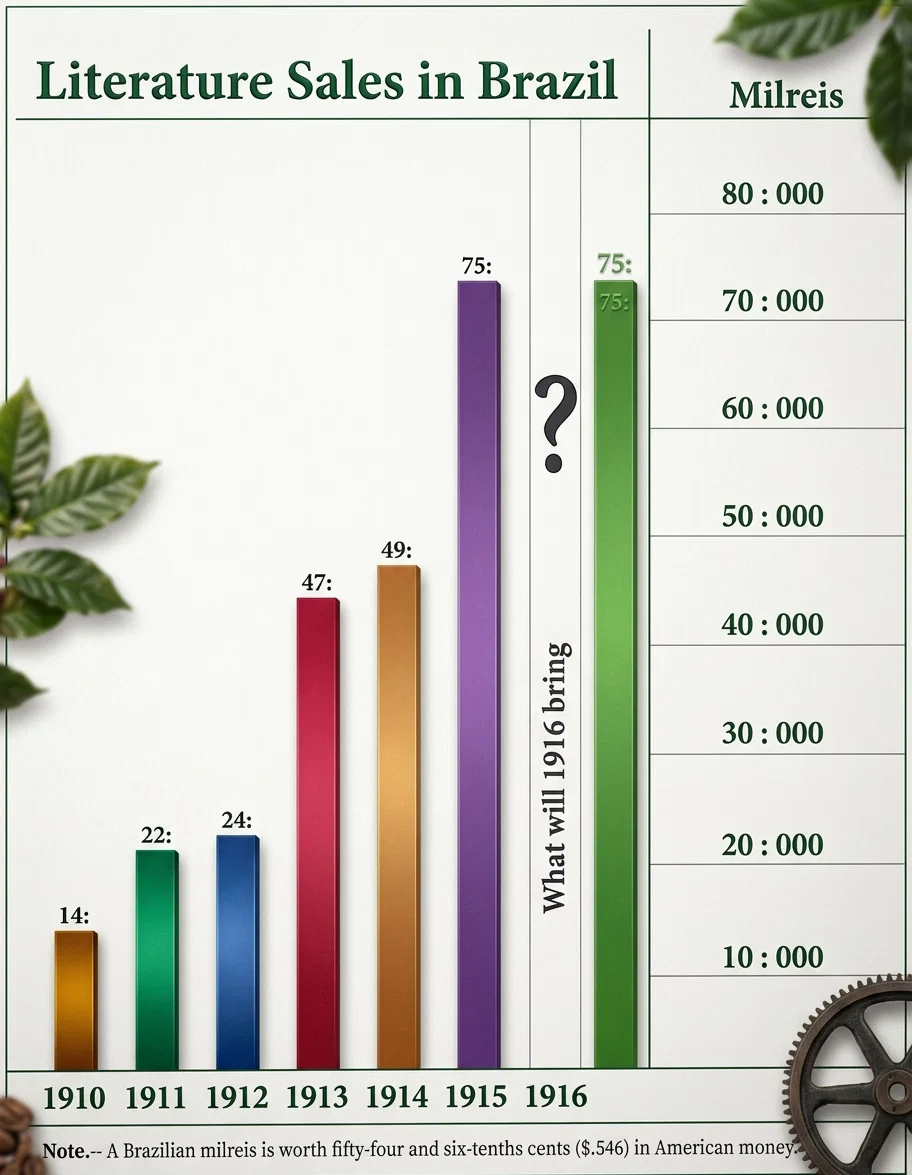
The accompanying chart shows how the Lord has been blessing the work of the colporteurs in the field. A gain of from fourteen thousand milreis in 1910 to seventy-five thousand in 1915, or18$7,644 to $41,050, in a country where only fifteen per cent of the people are able to read, is another evidence that the success of the colporteur work is not dependent on circumstances. When the war broke out, Brazil was one of the countries that suffered most; but as in other countries, the colporteurs here have learned that there is no crisis with the Lord. They kept steadily at work, and as a result the sales of literature during 1915 show a gain of nearly sixty per cent over 1913, and fifty-three per cent over 1914. Brother R. M. Carter, who has been acting as field missionary secretary in Minas Geraes during the last eighteen months, gave a cheering report from that field. Through the efforts of Brother Carter and another brother when they first went to that state a little company began to keep the Sabbath. Out of this company Brother Carter secured five canvassers, and trained them for the work. During 1914 the sales in Minas Geraes amounted to five thousand milreis, but during 1915, by the blessing of God, Brother Carter and his workers were able to bring the sales up to twenty-seven thousand milreis. The state of Sao Paulo came next, with twenty-six thousand milreis during 1915.
COLPORTEURS IN BRAZIL
Careful consideration was given to the interests of the colporteur work at the recent union conference. As the greatest apparent need was a man to take general oversight of the work in the union, it was unanimously voted that Brother Carter act as the union field missionary secretary. The Rio Grande Conference has had a field missionary secretary for some time, and at the union meeting two native brethren who have done successful work were appointed to do the same work in the Sao Paulo Mission and in Minas Geraes. Brother Carter has a field larger than the United States, but for the present he will have to give his attention to three or four of the central states, where the most of his men will be located. He must have other good, strong leaders as soon as they can be provided.
Literature Sales in Brazil
The scholarship plan was started at this union meeting, and several young people will probably earn scholarships this year.
From the beginning of our work in Brazil, the literature work has been an important factor, and many have been brought to the truth through this means. One interesting experience was told us at the union meeting. A native Brazilian, sixty-three years old, who had been a Protestant minister several years, accepted the truth and entered the canvassing work. In the town where he began work he soon found persons who were interested. He read the Bible with them evenings, when he could get time from his canvassing work. As he continued his work, the interest increased. He remained in the place eight months, supporting himself by his literature sales, and teaching the people the truth. As a result of his work, forty-three were baptized, and last year they paid over a thousand milreis in tithe. Brazil is one of the best fields in the world for our colporteur work, and now is the time to push forward as much as possible.
N. Z. TOWN.
Five-Year Statistical Summary
YEAR
CHURCHES & COMP.
MEM.
MIN. & LAB.
TITHE
OFFERINGS
BOOK SALES
1911
42
1,320
30
$14,958.10
$2,283.31
$7,230.36
1912
55
1,512
33
16,259.38
2,511.18
7,980.67
1913
53
1,622
50
18,508.50
2,583.38
15,316.92
1914
65
1,838
70
16,118.08
2,733.38
16,045.75
1915
66
2,197
70
112,538.58
12,113.50
223,548.39
Publishing Department
N. Z. TOWN - - - General Secretary
W. W. EASTMAN - N. Am. Div. Secretary
The Blessings of Cheerfulness
To be full of goodness, full of cheerfulness, full of sympathy, full of helpful hope, causes one to carry with him blessings of which he himself is as unconscious as a lamp is of its own shining.—Christian Observer.
A Prayer of Submission
O LORD and Master of us all,
Whate’er our name or sign,
We own thy sway, we hear thy call,
We test our lives by thine!
— Whittier.
Health and Temperance Day
By H. W. Miller
The first Sabbath in April has been set apart as Health and Temperance Day. Action to this effect was taken at the Loma Linda council by the North American Division Conference.
Not least among the blessings coming to those connected with this wonderful message, has been the development of body and mind as well as the great freedom from disease which our people have enjoyed, in contrast to those not thus enlightened in reference to the great principles of health and temperance reform.
This should be a day of thanksgiving for temporal prosperity due to good health. The carrying of this message to all the world, in varying climates, in many places where sanitation is not to be found, where exposure to disease of a contagious character cannot be avoided, and where tremendous responsibilities rest upon our laborers, who work often under conditions of privation,—such a work can be carried on and successfully maintained only by a people to whom has been committed light in regard to the care and hygiene of the body. Much still remains to be learned and practiced, and what has been revealed needs to be more perfectly interpreted and taught to others. Fortune and comfort depend on health. The failing health of the man making the plan has caused many important projects in this work to be temporarily abandoned, with very great loss. Disappointment and discouragement often come to individuals, when all that is needed is knowledge in the care of health. “My people are destroyed for lack of knowledge.” Hosea 4:6.
A program has been prepared for the use of all the churches on the first Sabbath in April, with the special object in view of creating a still greater interest in the preservation of bodily energy, and to give those intrusted with the carrying of the gospel message greater efficiency through improved health conditions. As a people, we need again to review the great fundamental principles known as the laws of life, which are as fixed and as much to be respected as any laws commanded by the Creator.
Never before have our health institutions enjoyed such prosperity and good patronage as during the recent past. The public is becoming more and more favorably disposed toward those distinctive methods by which we have cared for the sick during the last quarter of a century, until now, instead of our system of treatment being ridiculed, it is held in highest esteem among medical men, and is also becoming popular among the people. As a result of this, our institutions are filling with guests searching for health, and we are very happy to see the great majority of these leave the institution with a more favorable impression than when they came.
If these great principles are doing so much, and becoming so highly appreciated by the world, certainly Seventh-day Adventists ought to profit beyond their fellows, in the care of health and in securing relief from sickness and disease. The primary object of our health institutions was for the benefit of Seventh-day Adventists, and every effort is now being put forth to place the facilities of our sanitariums within the reach of all our brethren and sisters. A large number of our people have, through their liberal contributions, and in some cases through illness and misfortune, become so limited in means that in times of illness they cannot have the advantages of our sanitariums. For such, arrangements have now been made with every conference to care for their needy sick at a very nominal sum per week.
Another purpose of this Health and Temperance Day is to provide, through a general collection, a fund to be held in store by the several conferences for the sick poor among our people.
Already we have a large corps of trained doctors and nurses who are enlightening the public concerning these principles, and their work should be greatly aided through dissemination of medical literature and the work of our local churches.
In connection with the reading which will be sent out for use on Health and Temperance Day, there will be a more complete and detailed explanation given of the plans already mentioned.
This work should have the hearty support of every church member, who may be assured of personally reaping returns from his interest in this kind of missionary endeavor.
H. W. MILLER, M. D.
An Offering for the Sick Poor
By L. A. Hansen
THE offering to be taken in connection with the program for the first Sabbath in April, which has been appointed Health and Temperance Day, is one that should appeal to all. It is for the sick poor among us.
Probably no harder question comes to our sanitarium managers than the one of how to answer the many calls that come for special consideration in the matter of rates. The protection of the institution's interests demands the exercise of caution in the matter of granting discounts. At the same time the appeal of the suffering poor is so strong that one must have a heart of stone not to be moved. If left to individual decision, most managers would probably throw caution to the winds, and open the doors wide to the many applicants.
Those in charge of our institutions cannot deal with this question on the basis of impulse. As a denomination we have long known that the burden of caring for the sick poor cannot be thrown on our institutions, if we expect them to continue in existence. Their income must be assured. Their rate schedule is their material dependence, and must be protected.
It is not generally recognized that the expense of caring for the sick in our sanitariums is necessarily large. There is a general, or overhead, expense that cannot be materially reduced, and that is considerable, regardless of the number of patients cared for. An itemized statement of such expense might be too long to give here.
The manner of caring for our patients and guests, and the outlay required in treatments by our methods, make the expense per patient a heavy one. Of course we also feel the effect of the increasing cost of living. The cost of institutional care of the sick cannot be measured by what it would cost one to be cared for at home.
Not long ago I visited one of the largest hospitals in this country. Most of the patients are kept in large wards. The number of patients mounts up into hundreds of thousands a year, and the institution is full all the time, with two thousand patients or more. Most of the patients are bedfast; a number are babies and children. The care is largely charitable. One of its responsible business men told me that it costs the institution over two dollars a day for each patient. This is with a well-developed plan of economical and efficient management, and does not include interest on investment.
It may not surprise some to learn that in some of our sanitariums the cost of care per patient averages more than twenty-five dollars a week. This, of course, includes overhead expense, such as interest on investment, taxes, and insurance. This cost is not affected by the religious belief of the patient; it is the same for one of our own people as for one of another faith, or for a nonbeliever, as far as that is concerned.
Our sanitariums offer rates based on the class of accommodations given, usually as to the rooms occupied. The individual of average means can generally afford to pay the regular prices. There are those, however, who cannot meet even the lowest rates. Special arrangements are made whereby the institution does a large share to meet the needs of such. It falls to others to make up the remainder.
The offering to be taken on the first Sabbath in April is to be a fund for helping the sick poor among us to secure suitable care. This fund is to be in the care of conference officials. No more worthy cause could be offered us whereby we may help with our means. Come to this meeting prepared to give.
L. A. HANSEN.
Medical Missionary Department
W. A. RUBLE, M. D. - - General Secretary
L. A. HANSEN - - Assistant Secretary
E. W. MILLER, M. D. - N. Am. Div. Secretary
Henry Ford’s Campaign Against Militarism
— It is announced that Henry Ford is preparing to launch a campaign as wide as the nation against the program for a large army and navy. It is said that Mr. Ford is willing to spend millions in a campaign of education against the large navy and military expenditures proposed by the preparedness advocates. His campaign will be so wide and so extensive, utilizing papers and magazines of every kind, that he hopes to reach every man and woman in the country. He says he will not be satisfied until all the people have been reached by this educational propaganda.
United States-Nicaragua Canal Treaty
— The United States has ratified by a vote of fifty-five to eighteen the proposed treaty with Nicaragua, whereby the United States will acquire a ninety-nine-year option on the Nicaraguan canal route and a naval base in the Gulf of Fonseca, for $3,000,000. The resolution has a provision that the United States does not intend to violate any existing rights in the Fonseca Gulf, of Costa Rica, Honduras, and Salvador. It is expected that the convention will immediately be ratified by the Nicaraguan government. The purpose of obtaining this canal route is to make it impossible for any other nation to parallel the Panama Canal.
March 26: Certainty of God's watch-care for his people.
March 27: “To obey is better than sacrifice.”
March 28: Is my heart clean in God's sight?
March 29: The worthiness of true friendship.
March 30: The bitter fruit of jealousy.
March 31: Returning good for evil.
April 1: God will finally reject the disobedient.
The Bible
“When you are reading a book in a dark room, and come to a difficult part, you take it to a window to get more light. So take your Bibles to Christ.”—Robert McCheyne.
“The Bible alone of all the books in the world, instead of uttering the opinions of the successive ages that produced it, has been the antagonist of these opinions.”—Stuart Robinson.
“I never saw a useful Christian who was not a student of the Bible. If a man neglects his Bible, he may pray and ask God to use him in his work; but God cannot make much use of him, for there is not much for the Holy Ghost to work upon.”—D. L. Moody.
First and Second Samuel
Originally these two books were reckoned as one, and for the present purpose will be so treated. They contain three “interlaced biographies,”—those of Samuel, the last and greatest of the judges; Saul, the first king of Israel; and David, the most noble and beloved of her rulers. It is supposed that the books are called by the prophet's name because his history comes first in the record.
The authorship of the books is a matter of dispute. One widely accepted theory is that the first twenty-four chapters were written by Samuel, and the remaining portions by Nathan and Gad, since these prophets are referred to in 1 Chron. 29: 29 as having a part in writing the life of King David. But though the human hand that traced these ancient pages may be unknown, the authority of their divine Author is clearly seen. “The book of Samuel is one of the best specimens of Hebrew prose in the golden age of Hebrew literature. In prose it holds the same place which Joel and the undisputed prophecies of Isaiah hold in poetical or prophetical language.”
Ebenezer
When Samuel set up a stone between Mizpeh and Shen (see I Sam. 7: 12), to commemorate Israel's victory over the Philistines, he was following an old, old custom among the peoples of the East. Only two hundred and seventy years after this time, a king of Moab, Mesha by name, who was a contemporary of Omri, set up a pillar to commemorate his deliverance from the yoke of Israel. This pillar was set up at Dibon, in the hills of Moab, a day's journey eastward from the Red Sea. In 1868 this pillar was still standing, and was in a good state of preservation. It is now in the Louvre, in Paris.
Saul
The life of the first king of Israel may be divided into three parts: (1) Promise time; (2) testing and failure; (3) disobedience and doom. He entered upon his career with the fairest possible prospects; before him were spread out “wonderful and beautiful possibilities. The morning of his kingdom rose almost cloudless.” That his life should have gone out in such darkness and disgrace was due, not to a lack of opportunity for the development of moral fiber, but to his neglect to restrain and subdue the natural impulses of the human heart. “Saul was a clever man, a great military leader, an able statesman; yet his life was a miserable failure because he tried to put himself in place of God, and to carry out his own plans. He was self-willed and disobedient. He failed to see that which he ought to have perceived at once, that this was God's nation and not his own, and that Jehovah had plans which must be carried out.” Self-will, jealousy, and greed were allowed to rule his course; and gradually “he lost his kingly nature and power. His faults developed—treachery, vanity, selfishness, iniquity, blasphemy. He became almost insane.”
Requests for Prayer
A WASHINGTON sister asks prayer for healing, or if this is not the Lord's will that she may be given grace to bear her affliction.
A sister writing from Colorado begs our prayers in behalf of her husband, who is an unbeliever.
A nurse in South Carolina desires us to pray that a young lady whom she is treating may be helped and led to accept present truth.
“Please pray for my two sons. One is a morphine victim, and the other a drunkard. Will you not pray also that my hearing may be restored?” These requests come from a mother in Texas.
Missionary Volunteer Department
M. E. KERN - - - Secretary
MATILDA ERICKSON - - - Assistant Secretary
MRS. I. H. EVANS - - - Office Secretary
MADAME MACGUIRE
C. L. BENSON - - - Field Secretaries
J. F. SIMON
The Bible
By Walter Scott
WITHIN this ample volume lies
The mystery of mysteries;
Happiest they of human race
To whom their God has given grace
To read, to fear, to hope, to pray,
To lift the latch, to force the way;
And better had they ne'er been born
Than read to doubt, or read to scorn.
— Walter Scott.