I know that, generally speaking, the Review is not the place in which to state private matters and personal grievances; still there are some aggravated cases of such a nature that it is necessary to make a public statement concerning them. Such a case has lately come under my observation. I exceedingly regret the necessity of saying anything about it, but it has become a matter of public talk, and hence I think it best to state the facts publicly. The case is this: Several years ago a royal personage took up a large tract of land. Being quite wealthy, he improved this land, built tenant houses, and hired poor men to work upon it. Being zealous for the truth, quite a number of these men embraced it under his influence.
A few years ago, wishing to leave this country, he rented his large farm to these families of Sabbath-keepers. As they were really his own children in the faith, he felt a special interest in them, and so gave them better terms than he would have given any other persons. In order that they might do well, and also improve his land, he simply required them to pay taxes and give him one-tenth of all they should raise. This they readily promised to do.
This one-tenth was to be paid to his daughter, sister Mattie, whom he left on the place. She has a large family of children to support—to clothe, feed, school, &c., and they are all dependent upon her. The King thought that the income of the farm would abundantly support sister Mattie and her children, and so it would. For the first year these brethren did very well, and were quite prompt in bringing to sister Mattie her share of the produce as fast as it was gathered, though it appears that some were rather slow about it, and perhaps did not bring the whole amount as they should have done. The second year, however, it grew still worse. They were very backward in doing their duty in this respect. Some of them only brought half what they ought to have brought, and even this, long after it was due; others paid her still less than that; and some, as was clearly proved, kept all they raised.
The third year matters grew still worse. Crops were not very good, and taxes were high. The brethren complained that it took all they could raise to simply provide for their own families and pay their taxes; hence, as was proved in the investigation, some of them actually never gave sister Mattie so much as a bushel of potatoes during the year, though they had all raised more or less wheat, corn, potatoes, stock, &c. Some of them did, late in the year, bring her a small part of what was due. The consequence was that sister Mattie’s income was exceedingly small, and she had hard work to keep her family comfortable. The children complained, and she complained. But the way it was left she had no real authority to do anything about it by law, as the King had so great confidence in these men that he left it simply to their word and honor to deal justly and truly with his daughter. But, as the result shows, his confidence was not well-grounded.
When I went there this fall, sister Mattie came to me with tears, and stated her grievances in the matter. At first I could hardly believe that it was so. However, we called the brethren together, and a careful investigation showed that it was even worse than I expected. The brethren all acknowledged the great favors which had been shown them, and confessed that all they had they really owed to their kind Benefactor. Many of them freely acknowledged that sister Mattie was a good sister, and had not asked of them anything unreasonable; but they said that times were so hard, and they were so poor, that they had seen no way by which to raise what was due her. Others thought that too much had been required of them, more than was their duty under the circumstances. They did not think it was duty to take bread out of their children’s mouths and give it to sister Mattie, nor to let their own children go unclothed in order to clothe her children.
I am sorry to say that some of them appeared a great deal irritated when we urged upon them the just claims of sister Mattie. They said that her Father was a wealthy man and could abundantly provide for his daughter without oppressing them. Others said that they owed debts and taxes which must be paid; and that if they did not pay them their creditors would sue them, and the government would not wait for its taxes. These must come any way. Sister Mattie could not sue them, and the King was away, and they thought he would be easy with them anyhow.
I was astonished and grieved at such conduct and such reasoning. I know that no candid person could justify the course these brethren have taken. All that was required of them was that they should give sister Mattie one-tenth of what they raised. If their crops were large, they could certainly afford to give her the tenth. If they were small, then they only had to give a little. They ought to have felt that sister Mattie had wants, feelings, and rights, as well as themselves. And so the matter closed.
And now, reader, do you see the point of my parable? It was suggested to me by the following circumstance: A certain woman was working among our brethren. She heard them speaking now and then about Systematic,—that they must lay aside something for Systematic; that they must pay up Systematic; and that there was so much for Systematic. The woman was naturally curious to know what all this meant, so one day she said to a brother, “Who is sister Mattie about whom I hear you all talk so much? Is she some poor sister in the church?” The brother told her that sister Mattie was a very worthy sister who was dependent upon the church, and one whom all the members of the church had promised to help support.
As I said, this circumstance suggested to my mind the above parable in which the wealthy King represents the Lord. His farm is this earth and the things upon it. The tenants who embraced the truth under his influence are the members of his church. Sister Mattie is none other than our Systematic (Benevolence). The one-tenth is the tithe which the Lord requires of his people. See Lev. 27: 30–32. The neglect to pay sister Mattie her dues represents the neglect of our brethren and sisters to pay Systematic Benevolence. The arguments used in this case are the very ones I often hear used by our brethren and sisters who are not paying the Lord his dues in the Systematic. We hope you will see the point and mend your ways.
D. M. Canright.
ALL SIN IS SELFISHNESS.
By Mammon
Selfishness is the universal form of human depravity; every sin that can be named is only a modification of it. What is avarice but selfishness grasping and hoarding? What is prodigality but selfishness decorating and indulging itself—a man sacrificing to himself as his own god? What is sloth but that god asleep, and refusing to attend to the loud calls of duty? And what is idolatry but that god enshrined—man worshiping the reflection of his own image? Sensuality, and, indeed, all the sins of the flesh, are only selfishness setting itself above law, and gratifying itself at the expense of all restraint. And all the sins of the spirit are only the same principle impatient of contradiction, and refusing to acknowledge superiority, or to bend to any will but its own. What is egotism but selfishness speaking? or crime, but selfishness, without its mask, in earnest, and acting? or offensive war, but selfishness confederated, armed, and bent on aggrandizing itself by violence and blood?
An offensive army is the selfishness of a nation embodied, and moving to the attainment of its object over the wrecks of human happiness and life. “From whence come wars and fightings among you? come they not hence, even of your lusts?” And what are all these irregular and passionate desires, but that inordinate self-love which acknowledges no law, and will be confined by no rules—that selfishness which is the heart of depravity? And what but this has set the world at variance, and filled it with strife? The first presumed sin of the angels that kept not their first estate, as well as the first sin of man,—what was it but selfishness insane? an irrational and mad attempt to pass the limits proper to the creature, to invade the throne, and to seize the rights of the Deity? And were we to analyze the very last sin of which we ourselves are conscious, we should discover that selfishness, in one or other of its thousand forms, was its parent. Thus, if love was the pervading principle of the unfallen creation, it is equally certain that selfishness is the reigning law of the world, ravaged and disorganized by sin.
It must be obvious, then, that the great want of fallen humanity is, a specific against selfishness, the epidemic disease of our nature. The expedient which should profess to remedy our condition, and yet leave this want unprovided for, whatever its other recommendations might be, would be leaving the seat and core of our disease untouched. And it would be easy to show that in this radical defect consists the impotence of every system of false religion, and of every heterodox modification of the true religion, to restore our disordered nature to happiness and God. And equally easy is it to show that the gospel, evangelically interpreted, not only takes cognizance of this peculiar feature of our malady, but actually treats it as the very root of our depravity, and addresses itself directly to the task of its destruction—that, as the first effect of sin was to produce selfishness, so the first effect of the gospel remedy is to destroy that evil, and to replace it with benevolence. —Mammon.
ARE THERE BOOKS IN HEAVEN?
By Uriah Smith
A writer in the Sabbath Recorder of Jan. 6, 1876, in an article on the “Interpretation of Scripture,” says:—
“I have a book before me in which there is the attempt to prove from the Bible that there are literal, material books in Heaven. Among the passages adduced to show that our deeds are written in such a book are Ps. 56:8, ‘Thou tellest my wanderings; put thou my tears in thy bottle: are they not in thy book?’ and Isa. 65:5, 6, ‘Which say, stand by thyself, come not near to me; for I am holier than thou. These are a smoke in my nose; a fire that burneth all the day. Behold it is written before me.’ If these passages prove that there are literal books in Heaven, they also prove that there are bottles in Heaven, in which David’s tears are kept, and that his tears are written in His book; that the wicked are a smoke in God’s nose, and that they are a fire that burneth all the day. But such a conclusion is ridiculous, and cannot be entertained for a moment. The only conclusion we can arrive at is, that these are symbols used to express ideas, and therefore, we have no right to conclude that there are either books or bottles in Heaven.”
The fallacy in our friend’s argument as stated above, we conceive to lie in the assumed fact that the Bible never uses a word figuratively in one place and literally in another. Granted that, in the passages quoted, the words book, bottle, and smoke, are figurative; does it follow that nowhere else there are said to be in literal language, books in Heaven? Perhaps “we have no right to conclude that there are either books or bottles in Heaven” from these passages; but does it therefore follow that we have no right to conclude so from any other passages?
In describing the solemn scene of the Judgment, in as literal language as the majesty and sublimity of the scene will admit of, Daniel says:—
“I beheld till the thrones were cast down, and the Ancient of Days did sit, whose garment was white as snow, and the hair of his head like the pure wool; his throne was like the fiery flame, and his wheels as burning fire. A fiery stream issued and came forth from before him; thousand thousands ministered unto him, and ten thousand times ten thousand stood before him; the Judgment was set, and the books were opened.” Dan. 7:9, 10.
Reasoning on this passage, as our friend reasons on Ps. 56:8, we should say, There are no literal books to be used in the Judgment: these are only a figure of speech. Then the thousands that are seen ministering to the Ancient of Days are not literal beings but only figures of speech. Then there is no literal throne nor flame; and finally the Ancient of Days is not a literal being, but only a figure of speech. Thus the whole passage is explained away, and means anything or nothing, just according to the conceptions of the reader.
Again, John in describing a like scene, makes use of the following similar terms:—
“And I saw a great white throne, and him that sat on it, from whose face the earth and the heaven fled away; and there was found no place for them. And I saw the dead, small and great, stand before God; and the books were opened: and another book was opened, which is the book of life: and the dead were judged out of those things which were written in the books, according to their works.” Rev. 20:11, 12.
So here again, the same method of reasoning would lead to the same conclusion: No books, then no literal works brought into Judgment, no real Judgment, no book of life, no assembling21literally of the multitudes of the dead, no throne, and finally no God: all symbols, all mere figures of speech. Thus the effect of the most impressive and salutary truths of revelation, would be entirely destroyed.
The trouble is in jumping to the conclusion that because the Bible makes use of figures, therefore everything is figurative. This baleful method, introduced by Origen, is what has made the Christian system of interpretation like a bottomless pit, affording no foundation nor resting place for the soles of our feet. We are safe and our work trustworthy only when we fall back upon the rule given by Archbishop Cranmer, to let the Bible explain itself, taking those portions only to be figurative which are very evidently so, and letting the figurative find an explanation in the literal. U. S.
The preceding article closed with the inquiry upon our hands, Did the 2300 days end in 1844? The answer to this question involves an answer to two other questions already noticed; namely, 1. Are the seventy weeks of Dan. 9, a part of the 2300 days of Dan. 8? and, 2. Are they rightly dated from B. C. 457? To determine these points it will be necessary to look briefly at the prophecy of Dan. 8, in which the mention of the 2300 days is found.
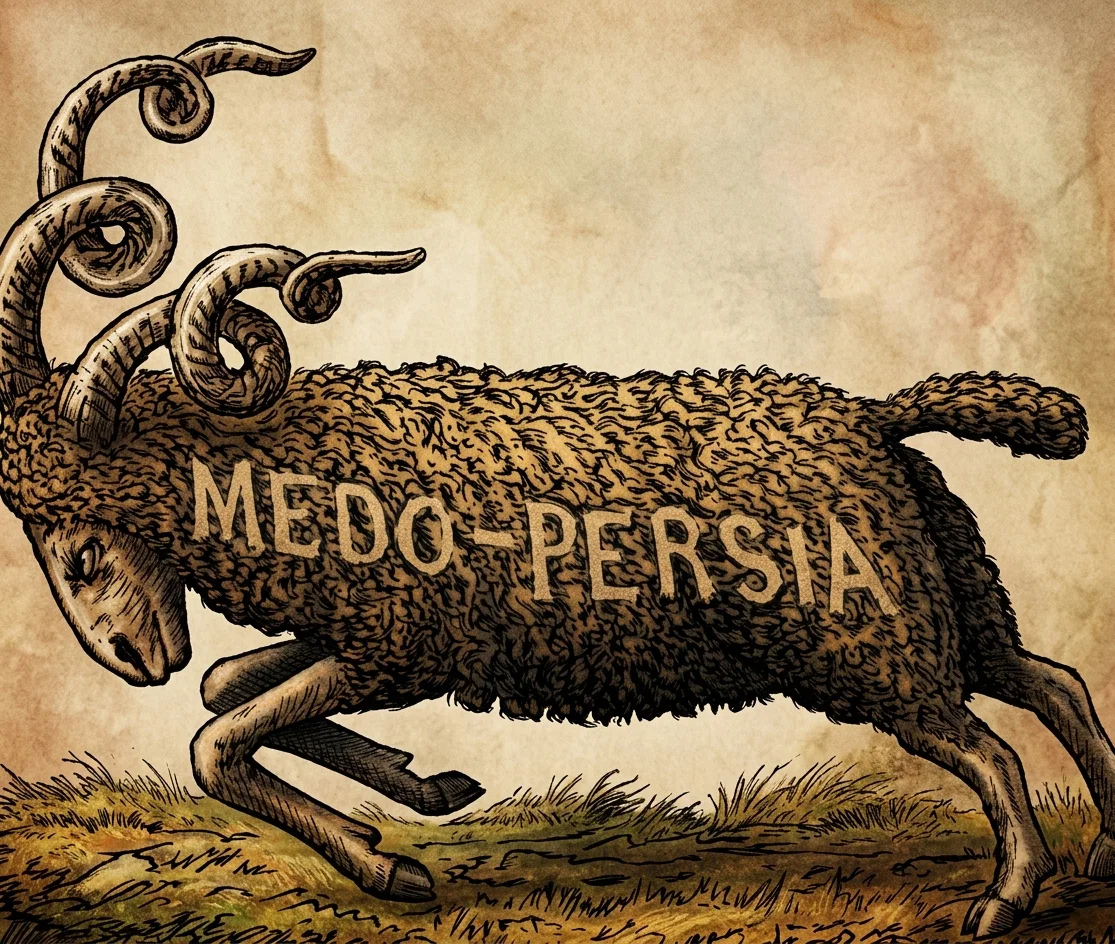
The first object presented to the eye of the prophet was a ram standing before the river, having two horns, one higher than the other. He saw this ram pushing westward, northward, and southward, with such vigor that no beast could stand before him, and he did according to his will, and became “great.”
Scene second. A rough he goat with a notable horn between his eyes came from the west with such rapidity that he seemed not to touch the ground. And he dashed into the ram, overthrew him, broke his horns, and trampled him into the ground. The he goat waxed “very great.”
But while he was defiantly prancing about in the plenitude of his power, suddenly the great horn between his eyes was broken, and in its place as suddenly sprang forth four notable horns toward the four winds of heaven.
Scene third. Out of one of these four horns of the goat the prophet then saw a little horn protruding. And lo, it grew with marvelous rapidity. It took a turn toward the south, and toward the east, and toward the pleasant land. It sprang upward to the host of heaven, and, encircling some of the stars, brought them to the ground and stamped upon them. It even reared itself against the prince of the host, took away the daily, cast down the place of his sanctuary, gathered to itself an overwhelming host by reason of transgression, cast down the truth to the ground, and practiced and prospered. The little horn waxed “exceeding great.”
Scene fourth. Other objects now come into the field of vision. Heaven does not look with indifference upon all the transactions indicated by the symbols and their work thus far introduced, especially as it affects the people of God. Angels regard it, and consult about it. Two of them held converse respecting it, in the hearing of the prophet. How long, said one to the other, shall be the vision concerning the daily sacrifice, and the transgression of desolation, to give both the sanctuary and the host to be trodden under foot? Then turning to Daniel, as in addressing him he would address the people of God, who are more especially interested in the response, the angel made answer: “Unto two thousand and three hundred days; then shall the sanctuary be cleansed.”
This is the entire matter of the vision, and fills the chapter to the 15th verse. It was now necessary that it should be explained; and Daniel immediately heard
AN EXPLANATION COMMANDED.
“And it came to pass, when I, even I Daniel, had seen the vision, and sought for the meaning, then, behold, there stood before me as the appearance of a man. And I heard a man’s voice between the banks of Ulai, which called, and said, Gabriel, make this man to understand the vision. So he came near where I stood: and when he came, I was afraid, and fell upon my face; but he said unto me, Understand, O son of man: for at the time of the end shall be the vision. Now as he was speaking with me, I was in a deep sleep on my face toward the ground: but he touched me, and set me upright. And he said, Behold, I will make thee know what shall be in the last end of the indignation: for at the time appointed the end shall be.” Verses 15–19.
Gabriel, true to the commission here laid upon him, proceeded at once to enter upon his duty and to give the explanation he was enjoined to make.
SYMBOL OF THE RAM EXPLAINED.
“The ram which thou sawest having two horns are the kings of Media and Persia.” Verse 20.
This is plain language. It cannot be misunderstood. This being the first symbol, we know at what point the vision commences. It does not begin with the empire of Babylon, as do the visions of the second and seventh chapters, but the Babylonian empire being very near its close in the third year of Belshazzar, when this vision was given, the view commences with the incoming Medo-Persian empire. The two horns of the ram denote the union of these two powers, the Medes and the Persians, in one government.
The Medo-Persian supremacy commenced at the overthrow of Babylon by Cyrus, B. C. 538, and extended to the battle of Arbela, B. C. 331, two hundred and seven years. So long a time is covered by the first symbol. In the explanation of the next symbol we have the power that overthrew the Persian empire, and consequently succeeded to its place.
SYMBOL OF THE GOAT EXPLAINED.
“And the rough goat is the king of Grecia: and the great horn that is between his eyes is the first king. Now that being broken, whereas four stood up for it, four kingdoms shall stand up out of the nation, but not in his power.” Verses 21, 22.
This also is plain and unequivocal language. The power that was to succeed the Persian in the empire of the world, according to the prophecy, was the Grecian. It was fulfilled two hundred and thirty-one years after the vision was given, when, at the battle of Arbela, Oct. 1, B. C. 331, Alexander the Great utterly routed the forces of Darius Codomanus, and became absolute lord of the empire to the utmost extent ever possessed by any of the Persian kings.
The great horn between his eyes was the first king. This was Alexander the Great. That horn was broken. Eight years after the battle of Arbela, Alexander died in a drunken debauch at the age of 33, Nov. 12, B. C. 323.
In place of this first horn, four came up toward the four winds of heaven. These, the angel said, signified four kingdoms to arise out of the nation. After the death of Alexander, much confusion arose among his followers respecting the succession. It was finally agreed, after a seven days’ contest, that his natural brother, Philip Aridæus, should be declared king. By him and Alexander’s sons, Alexander Ægus and Hercules, the name and show of the Macedonian empire was for a time kept up. But these were all soon murdered; and the regal family being then extinct, the chief commanders of the army, who had gone into different parts of the empire as governors of the provinces, assumed the title of kings. They thereupon fell to leaguing and warring with each other to such a degree that within the short space of fifteen years from Alexander’s death, the number was reduced to just four, as the prophecy had declared. These kingdoms thus originated about 308 B. C. They were Macedonia, Thrace, Syria, and Egypt, ruled respectively by Cassander, Lysimachus, Seleucus, and Ptolemy. The kingdom of the goat dates from B. C. 331 to the time when a succeeding power appears upon the scene, B. C. 161, as we shall hereafter see. A period of 170 years is thus covered by this symbol.
THE SYMBOL OF THE LITTLE HORN EXPLAINED.
“And in the latter time of their kingdom, when the transgressors are come to the full, a king of fierce countenance, and understanding dark sentences, shall stand up. And his power shall be mighty, but not by his own power: and he shall destroy wonderfully, and shall prosper, and practise, and shall destroy the mighty and the holy people. And through his policy also he shall cause craft to prosper in his hand; and he shall magnify himself in his heart, and by peace shall destroy many: he shall also stand up against the Prince of princes; but he shall be broken without hand.” Verses 23–25.
This little horn is unquestionably a symbol of the power that succeeded Grecia in the dominion of the world. And this, according to the prophecies of Dan. 2 and 7, was Rome. Some special reasons must be given if we are to take the ground that this prophecy does not run parallel with the others, and from the time of its beginning bring to view the same universal kingdoms.
Such a view, however, is taken; but such good reasons for it are not produced. Romanists, to avoid the application of this part of the prophecy to the Roman power, pagan and papal, endeavor to shift the application from Rome to Antiochus Epiphanes. And this lead of the papists has been followed by the majority of those who oppose the Advent faith. In our next we shall show that this view cannot be correct, but that the reasons fixing this upon Rome, are more clear and numerous than those even which determine the application of the other symbols.
U. S.
THE IMAGE AHEAD.
By C. S.
THE great image shown to Nebuchadnezzar, as described in Daniel 2, was smitten upon its feet by the stone cut out of the mountain without hands; and the stone became a great mountain and filled the whole earth.
This stone, it is claimed by some, represents the kingdom of Christ in the world in its present state; and they further claim that this kingdom was set up at the first advent of Christ; it was there and then that the stone smote the image, and from that time it was to increase into a great mountain and fill the whole earth.
We have had 1800 years of history since Christ was here upon the earth, and by this time we ought to be able to judge pretty accurately, from the facts in the case, in regard to two things; namely, whether the prophecy has proved true, or whether the foregoing application is correct.
How, then, in a word, has it been with Christ’s cause in the earth since that time? Earthly kingdoms, as symbolized by the image, have still borne sway; the true church, the humble people of God, those who can in any manner be considered the subjects of Christ’s kingdom upon the earth, have been continually in subjection to earthly powers, and oftentimes cruelly oppressed, persecuted, and hunted like beasts of the forest. If this church is the stone, it has not smitten the image very hard. The smiting has been on the other side. The image has dealt upon it some crushing blows. In other words, the image has made the stone a football and kicked it about in the most lively and nimble manner, for the past 1800 years. And the stone has grown smaller under the process; and at one time, certain days had to be shortened. Matt. 24:22, or it would have been reduced to powder and destroyed. And in proportion to the population of the earth, the number of true Christians in the world to-day is less than at many other times, if not less than at any other time since the apostles’ days. In this race, the image is a long ways ahead, and is gaining ground continually.
These are the stubborn, unyielding facts in the case. In the light of them, how evident that the stone signifies a kingdom not yet set up. But if our friends of other denominations, rather than acknowledge the truth, choose to butt their heads against these facts, they will find the facts a great deal harder than their heads.
C. S.
THE NEW YEAR.
By James White
Sabbath, January 1, 1876, was the most important day in the history of Seventh-day Adventists. In addition to that good day being the holy Sabbath of the Lord, it was the first day of the new year, sacredly observed by our people, throughout the length and breadth of our land, for humiliation, self-examination, confession, fasting, and prayer. The day was important and profitable to the congregations at Oakland and San Francisco, and we are expecting cheering reports from all parts of the wide field. Having commenced the year 1876 well, God grant that it may be the best year to our people and our cause that they have ever enjoyed.
Thousands renewed their covenant on the first day of the current year to serve the Lord with singleness of heart all the days of their life. May they keep it unto the end. And thousands resolved to be more forgiving, less exacting, less censorious, and more consecrated in life and efforts to advance the cause of Christ. May God help them. Under the solemnities of the occasion, during the services of the worship of God on that Sabbath, promises, vows and consecrations were made with comparative ease. But now comes the battle of the year, yea, of life, until the Master shall come, to perform.
With the new year the SIGNS starts in to make its weekly visits to its patrons, and to all who may become such during the year. Its prospects of success are cheering. The receipts in the present number, and in the previous one, are principally from new subscribers, and indicate the deep interest taken in our paper. Our friends may depend upon the SIGNS weekly.
We commence the series of articles setting forth the reasons of our faith and hope, in this number, with the article on another page upon the millennium. These articles will continue in proper order quite through the year. Sketches of the life of Mrs. W. will also continue, and will be very important to those who should know the facts in her remarkable experience.
And we shall very soon commence a series of articles under the caption, The Matter Reversed, or, Christ in the Old Testament, and the Sabbath in the New. We design to thoroughly ventilate the question.—J. W., in SIGNS, Jan. 6, 1876.
TO CORRESPONDENTS.
By Uriah Smith
SYSTEMATIC BENEVOLENCE.
“Will you please tell me what S. B. really is? For instance, if I earn $1.00 a day, 10 cts. of that belongs to God. Does that 10 cts. belong to the S. B.? or can I give 5 cts. to S. B., and the rest to the cause as I may see fit?
“Is it right for a church to use a part of its S. B. to pay its running expenses, or does that come outside of the S. B.?” C. E. B.
S. B. (Systematic Benevolence) is benevolence by system, according to the direction of Paul in 1 Cor. 16: 2; and the object is to make the contributions as near as possible equal to the tenth which God anciently required of his people. Just what proportion of a person’s earnings should be given, has been a question of no small study. In the case above supposed, if the person’s necessary expenses were absolutely not less than 95 cts. a day, it clearly would not be his duty to give 10 cts. a day S. B., thus running into debt 5 cts. a day for the purpose. Again, if a person gives 10 cts. per day, but appropriates 5 cts. of that as he sees fit, we should say that only 5 cts. would come under the head of S. B., that is, a systematic contribution to the Lord’s treasury.
S. B. is designed primarily for the support of the ministry; its proper place, therefore, is the Conference treasury. Many churches appropriate their entire S. B. to their Conference; but some, under special circumstances, retain a portion for their own use. Were they required, without exception, to give it all to the Conference, the result would simply be that they would deduct from their entire contribution such portion as they wished to use themselves, and report the rest as S. B. The result to the Conference would be the same, but they would not get credit for a portion of what they raised.
CAIN AND ABEL.
“Were Cain and Abel born before Adam and Eve were driven from the garden?”
We read of but two that sinned and two that were sentenced, and driven out; and the account of the birth of Cain and Abel comes afterward.
SABBATH IN THE NEW EARTH.
“I frequently hear it said that Isa. 66: 22, 23, refers to the Sabbath in the new earth. How can this idea be made to harmonize with Rev. 21: 22-25?” T. J.
We understand Rev. 21: 22-25 to refer to the city only. But other portions of the earth will receive light from the heavenly bodies as now, only the moon then will be equal in brilliancy to the sun now, and the light of the sun will then be sevenfold what it is now. Isa. 30: 26. So days and weeks and months can still be reckoned; and the ransomed can assemble from Sabbath to Sabbath to celebrate the worship of the Lord, and gather from month to month beneath the tree of life to partake of its monthly yield of fruit.
W. G. SPRINGER: See explanation of Moses and Elias on the mount of transfiguration in Man’s Nature and Destiny, published at this Office. U. S.
A VOICE FROM WASHINGTON.
By S. N. Haskell
THINKING they might be interesting to those who are subscribing for a number of copies of the SIGNS which they design placing in the hands of interested readers, we give the following extracts from a letter from sister Cook of Washington, D. C., dated Jan. 4, 1876.
Sister Cook embraced the truth about four years ago. At that time we knew of no interest whatever upon the Sabbath question in that city. But she has labored efficiently in visiting, corresponding, and in every way that the providence of God has seemed to open before her.
The extracts are from one of her reports sent to the V. M. Society at South Lancaster, Mass. They not only show what can be accomplished by such labor, but also the interest that is being taken in our publications where they are judiciously distributed. After referring to her recent illness, she says:—
“As soon as I was able to leave my room, I examined the contents of the box of books, etc. I took a package of Almanacs and tracts, and went out, and called on about all of my neighbors. I also did what I could for our precious cause with my pen.
“I have been trying to see what I could do toward getting subscribers for the SIGNS OF THE TIMES. I first wrote to Bro.——, who lives just out of the city, calling his attention to the liberal terms on the SIGNS, offered by the Tract Society, and invited him to call and see the premium books. I learned through another person that this brother liked the SIGNS, and was interested. I am in hopes he will subscribe.
“Next, I wrote to another brother who also had had the SIGNS sent to him. He replied by letter that they were sorry to have the SIGNS stop coming. He said that from six to ten had been reading his paper, and the result was that a number had embraced the Sabbath, part of four families, I think. He said the people were poor, but full of the love of God, and love for the brethren, especially the seventh-day people. This brother says he has had employment only about one-fourth of the time for five months past. I would gladly send him the paper at my own expense if I could, but the best I can do at present is to send these people my papers. So every week I mail them something, and they are very thankful. All are strangers to me except this brother. His home is just out of the city.
“I called on a brother in this city who had been reading the VOICE OF TRUTH. He has become interested, and thought he would subscribe for the ADVENT REVIEW after the VOICE had stopped. Next, I called on another who also had received the VOICE free. He said he had been obliged to curtail his expenses of late; that he had stopped two Adventist papers, but he liked the VOICE OF TRUTH much; and that he gave the paper to others to read, and would subscribe for the SIGNS as soon as he could.
“I then wrote to a sister who now lives in Eldersburg, Md. I wrote her, soliciting a subscription for the SIGNS. She intends to become a subscriber, and I think will. She says her brother, who lives in another town near her, wants his paper continued, and will pay for it. So I must try to write him soon and see. She also mentioned another gentleman who believes in the seventh-day Sabbath, and was fined five dollars for working Sundays. I feel a deep interest in him, and must write this sister again soon, get this brother’s address, and learn more of him.
“I have written to other friends in relation to the SIGNS and REFORMER, but have received no responses as yet. Have invited those I have seen, who have had the REFORMER free, to subscribe. They speak well of it. Doubtless I could get some to subscribe if I could go and see them, but that is almost impossible at present, as I am not able to walk much. I intend to go out as much as I can with almanacs, tracts, and papers. I have friends and acquaintances from Maine to California to whom I can mail almanacs.”
We have recently received a letter from one of our brethren who has had much experience in this kind of missionary labor, stating that the leading Methodist minister in one of our Southern cities has embraced the Sabbath.
Thus we see that wherever a proper effort is put forth, the blessing of God seems to accompany it. We hope to see not less than one thousand active missionary workers enter the field the present year in addition to those already engaged. Working unitedly will enable us to accomplish tenfold more than can be done by any impulsive, independent moves. We should give a long pull, a strong pull, and a pull all together.
There should be one thousand men and women who can and will make use of at least five copies of the SIGNS each this present year. Shall we have them? Shall we not bring into the field the buried talent for corresponding, visiting, and such other efforts as will advance the cause of Christ? Now is the time for action. Souls are perishing for want of the truth, and shall we not give it to them? A coming up to the help of the Lord is what is needed. We should seek for more of the pure principles of Bible religion, and an active faith in the solemn truths we believe. S. N. HASKELL.