Our great and mighty God, help us to sense
This hour's need. Do thou make more intense
Our zeal for souls.
May visions go beyond to regions dark
Where vile sin's curse has deeply left her mark,
Severe her tolls.
Help us to hear the voice of greatest need,
From Moslem lands, deluded by false creed
And hopes more frail.
Two hundred million souls await us there.
For this great work do thou our lives prepare;
Let us not fail.
The Crescent long has been a dangerous foe,
Has spread its blighting presence, unmeasured woe
Has ever brought.
Send us, O Lord, thy jewels to gather in,
Thy matchless love to tell, for long has sin
Her havoc wrought.
O purge each heart, we pray, of all its dross,
Make us more worthy bearers of thy cross,
O task esteemed!
For us no charm may earth's vain pleasures hold;
True joy be found in bringing to thy fold
Thine own redeemed.
We'll need thee, Lord, our helper ever near,
To face the dangers grave without a fear,
Though demons lurk.
Our hands we place in thine with trust and love,
With steady aim to go, eyes fixed above,
To thy great work.
Why I Believe in Missions
By Volga B. Jacobson
VOLGA B. JACOBSON
On Sabbath afternoon, when I was but a child, my mother used to gather brother, sister, and me around her and read to us from the INSTRUCTOR and Little Friend, and from books containing interesting accounts of the lives of the missionaries and workers in the far-away heathen lands. How wonderful it seemed to us to hear of the great sacrifices of Livingstone, Stanley, Mr. and Mrs. Judson, and all the others! But still more wonderful was the fact that they found so much joy in working for the needy people of those lands. It was with open-eyed wonder that we listened to the stories of the daring deeds of the pioneer workers, and we were much delighted when we could see the pictures of these missionaries or their children.
I remember many of these stories well, but there was one that gave me a deep interest in the work of the heathen fields. It was an account which a little girl had written of her trip across the broad blue ocean when with her mother and father she had gone as a little missionary. She told of the many new and strange things she had seen on the way, and then she described vividly the little yellow boys and girls that were waiting for the light of the gospel. How happy they were when they heard about Jesus, and how their little voices rang out in the strains of “Jesus loves me! this I know,” when they had learned to sing!
I also heard much talk in Sabbath school about the missionaries, and was eager to save my pennies, nickels, and dimes to help spread the gospel of Christ to all in far-away lands. Therefore I have always believed in missions; but since I have grown older I have tried to answer more definitely the question, Why do I believe in foreign missions? In doing so I have arrived at the following conclusions:
First, I know that it is the purpose of God to make himself known to all his creatures. When we become Christians, we naturally assume his purpose, and see the need of spreading the light of Christ into all the world.
Second, the fact that we have the light and knowledge of Christ above all others should be a great incentive in our lives to extend these beams of light to those less fortunate. It would be selfishness indeed for us to accept all these blessings and feel no burden for others. The great law of life is to live and give. Without giving, we ourselves would soon become like the stagnant water.
Third, we find in the countries not enlightened, and without the gospel of Christ, that they have no knowledge of medical science. Their blind, dumb, and maimed wander about the streets until they die. They have no asylums for the mental sufferers, and they run about the country in their wild way until death claims them. Nothing of any avail is done for them. Of course, a great many of the heathen believe that evil spirits cause these conditions, and most of them wear charms to drive away the spirits. Others torture themselves, trying to appease the anger of their gods against them. We need to send our means and missionaries to teach them how to live and how to care for their living temples. When these people learn of the true God who is so willing to heal them of all their diseases, both spiritual and physical, their gratitude knows no bounds, and they become sincere and earnest workers for the Lord.
Fourth, we have the commission of Christ: “Go ye into all the world, and preach the gospel to every creature.” Again, we have the precious promise in Matthew: “This gospel of the kingdom shall be preached in all the world for a witness unto all nations; then shall the end come.”
A T’sak’s Idea of God
By Stanley Anderson
We were on a boat that was slowly steaming up the muddy waters of the Yangtze to the interior of China. The pirates who so often plundered these boats had spared us, and our pilot had successfully evaded the shifting sand bars that so frequently menace the traveler. Altogether our trip was quite uneventful except for an incident that occurred on board our boat.
A T’sak, a native from the steerage, was caught stealing money from one of the first-class cabins. The captain of the ship learned of the theft, and brought the thief for trial. As was the Chinese custom, before the trial the thief was beaten severely so that at the trial he would not dare tell anything but the truth.9
When the thief was questioned about the matter, he replied that he had not come on board the boat to steal, but was returning to his home. However, the god that he carried with him would not cease from telling him that there was money in a certain first-class cabin and he must go and get it. The captain thought the best thing to do in this case was to remove the cause by relieving the thief of his god. At this the thief filled the saloon with noise and uproar. We wondered if it was not time to get out.
A T’sak saw that this wild protest was all for naught, and tried to reason with the captain, saying: “This god cost me money and time. I bought it and put an insect in it, and when the insect died, its spirit went into the god. I then knew that the god was alive, so I fed it sweetmeats and delicacies and talked to it. It was a very stubborn god. It would not answer my questions until I starved it, and then it would not always answer me, so I had to teach it more. It took me a long time to coach it, and now are you going to take it away from me? I will swear not to steal another thing on this ship if you will give it back to me.”
Of course, T’sak lost both the money and the god in spite of his protests.
This professional thief had so mesmerized himself that he was under complete control of an evil spirit working through this idol. Think of a conception of God as one who will aid in wrong-doing and gaining selfish ends! Then think of how often we as Christians neglect prayer until we get into close straights; or if we do pray, it is for selfish interests. If our prayers are only for the advancement and benefit of ourselves, is our conception of God any higher than that of the ignorant heathen?
STANLEY ANDERSON.
What South America Needs
By Elias Chuquityura
DOWN in a little town between two great mountain ranges, on the Peruvian coast of South America, stands my home. I can picture it now, built in the old colonial style. It is where I used to play, and where I learned to pray.
I recall one particular afternoon when my mother showed me the pictures of heaven, purgatory, and hell, and after she had finished her explanation I was filled with fear and stood before the altar trembling at that mysterious thought. I decided to be true to the saints, and from that very day I began to burn a candle every night to my favorite saint, the Virgin of Perpetual Mercy. I hoped that she might intercede for me and deliver me from the terrible torment of purgatory and hell.
For seventeen years my life was given to the worship of saints, but God delivered me from the power of darkness, from a religion that for a time may seem to be true, but later becomes only a tremendous burden. The increase of knowledge and the breaking up of the ancient molds of thought produce a widespread feeling of uncertainty, and the time comes when people do not care at all for religion. This is why eighty-five per cent of the educated class of South America are infidels.
Every time my mind goes back to my homeland I can see the country still,—remote, serene, and untouched by the hurry of the world. When Pizarro’s companions determined to leave him in one of the northern islands, he said to them, after drawing a line on the ground: “This road to the north leads to poverty, while this to the south leads to prosperity.” Many great financiers are finding this to be true today, and they are going down to South America to develop the activities of commercialism. But commercialism is not South America’s greatest need. The need of South America is the gospel of Jesus Christ, the true religion that completes human life.
The world appreciates the opportunities that South America is offering, and no one can doubt that soon she will be the center of the world’s colonization. Thousands upon thousands will go there seeking rubber, gold, and silver, but none of them will take the gospel which has power to transform the life of every human being. May many survey the promised land, and give, send, and go to save those millions of people that are deceived, as I was, by their religion and superstitions. I trust what I have said may find an echo in the hearts of all who love their fellow men, and who long for that day when our Lord shall return to this bleeding and exhausted world.
ELIAS CHUQUITYURA.
On Schedule Time
By Flora Vogan
On the morning my friend and I had planned to start on our journey, we raised the shade to find the sun high up the eastern sky. Dorothy looked at the clock and said excitedly, “It is only thirty minutes until our train leaves!”
We walked hurriedly and arrived at the station just as a loud shriek of the whistle warned us of the approach of the train. A glance at the clock showed that the train had arrived on schedule time.
In a few moments we were seated comfortably on the train. I sat nearest the window. My mind wandered here and there, as I looked out at the swiftly changing scenery. I watched the engine circling around the bend, sending up volumes of smoke, and racing on proudly toward its destination.
I turned to my companion and remarked, “Did you ever think what careful planning it must take to have a train run on advertised time? It does not wait to go when somebody wants it to go, on a whim or notion, but it goes out as scheduled.”
“That is true. Just like some people, isn’t it? You know there are some upon whom you can always rely, and others you may depend on only when they take a notion to act; and there are still others that—well, you can depend on it they won’t act at all. I wonder which class we are in.”
The engine crept slowly along as we crossed the switches, nearing a station.
“Look!” said I, “we are passing the yards where they repair the engines. I suppose our engine went through a similar process last night while we slept. You see, each engine is overhauled and made ready and tried out to see that everything is in good running order before starting on a trip.”
“By the way,” said Dorothy, “that is suggestive. Do you know we could save energy if we took time to plan or prepare our work the night before, or at least the first thing in the morning? I believe work would be more interesting and more could be accomplished, with some time left from each day for recreation, if we should decide beforehand what to do or where to go, and what preparations were necessary.”
“But it seems to me that is mostly theory! You know things do not always happen as scheduled.”
“Well, the same thing is true with the train. If a bridge is down, or if the train should run into a freight wreck, the engineer is not responsible for10such a calamity. He will do the best he can under the circumstances.”
“I believe you are right! Plan your work and work your plan! The unexpected obstacle is one that we must handle as best we are able. Though we cannot foretell its coming or its nature, we can meet it calmly; and if there is a wreck ahead on our line, we can get out and help clean up the wreckage!”
FLORA VOGAN.
King Arthur and the Round Table
By Grace Meyers
SOME students of history believe that King Arthur was a mythical person, about whom a cluster of romantic legends have gathered. It is, however, generally accepted today that the real Arthur was an ancient warrior, half Roman and half British, who was a great general, but never a king. He was born toward the end of the fifth century, and was the nephew of Ambrosius Aurelianus, a Roman general.
At the time the Saxons were sweeping across Britain toward the west, Arthur seems to have begun his military career by helping his uncle fight the Saxons. When the Romans withdrew from Britain, he was made a kind of protector, and had a roving commission to defend the island whenever it was attacked. He led his men in many conflicts, and was killed at the battle of Camlan. He was buried at Glastonbury, and a story is told of how in the days of Henry II, his body was dug up. A large stone was found at the depth of several feet, to which was fastened a cross of lead with a Latin inscription. A few feet deeper Arthur’s body was found in the trunk of a tree, and his beautiful wife was lying beside him, with her long golden hair flowing about her. His skull showed ten wounds, all healed except the one of which he died.
So much for the real Arthur. The ideal King Arthur was a heroic figure of interest and poetic charm. He was the very embodiment of chivalry. His deeds have been celebrated in Welsh, Briton, and old Norman romance in poetic chronicles beginning with the myths and legends recorded and sung by minstrels of his own time, and continuing down through the ages until the present day.
It is hard for us to tell how, when, and where the mythical tales of Arthur and his knights began. Many of us have been led to think Alfred Tennyson, in his “Idylls of the King,” had a great deal to do with their development. Yet those who wonder that way will often be bewildered and confused, for Tennyson, who drew his stories in the main from Sir Thomas Malory’s chronicles, added much that was his own. Tennyson’s tales, exquisite in verse as they are, cannot be accepted as authentic legend. We must go back of Tennyson, back of Sir Thomas Malory, for the true Arthurian lore. The writers that built up the Arthurian romances fall into three classes: bards, chroniclers, and romancers; or, the men who sang, the men who historified, and the men who invented.
According to legend, Arthur, the son of Uther Pendragon and Igerna, was born in the Castle of Tintagel. Merlin immediately carried him away and gave him to the care of Sir Hector, who brought him up with his own son. Upon the death of Uther, Merlin brought young Arthur forward to establish his right to the kingdom. He was taken into the great church in London, and led to a block of stone, in which the sword Excalibur was held fast. If Arthur succeeded in drawing the sword from the rock, he would be regarded the rightful heir to the throne.
Arthur performed this task, and therefore became king. Arthur chose Guinevere, daughter of the King Leodegraunce, of the land of Camelyard, for wife. Guinevere is described as the most beautiful woman in Britain, and as coming from a noble Roman family. Robert de Barron also tells us that “Merlin warned the king privily that Guinevere was not wholesome for him to take to wife, and that Lancelot should love her and she him again.” Nevertheless, Arthur sent for Guinevere, and they were wedded with great solemnity, at Camelot in the church of St. Stevens.
We have all heard more or less about the Round Table, and we always read about it with interest. Layamon states that a skilled workman came mysteriously to Arthur at Cornwall and offered to make a great table for him and his knights. This was completed in four weeks. Each knight had his particular seat, and there was one vacant place called “the siege perilous” (the perilous seat), because it was fatal for any one to sit in it except the knight who was destined to find the Holy Grail. The seat was mysteriously reserved for Sir Galahad.
The Knights of the Round Table were personal attendants of King Arthur, and were permanently attached to his service. They sat at the Round Table in perfect equality and were served alike.
Thus goes the story of this the brave King Arthur. He had a mysterious ending, too, for he was taken up in a little boat on a calm lake, and was never seen again.
GRACE MEYERS.
Evening Reveries
By Lotte Westermeyer
How sweet the tide of memory
This eve my heart overflows,
The tiny ripples play a song
Which only fancy knows.
The fairy lights are twinkling high,
And bright with pretty lore
Their mirrored faces in the lake
Are beaming toward the shore.
Beneath, the modest violets
Are crowding close in love,
Their sweetness wafted on the breeze
That rocks the boughs above.
The rugged peaks rise high against
The heaven’s spangled dome,
The deep pines tooth their silent forms
And claim them as their home.
The twilight hours have lulled to sleep
Each birdling in its nest;
Their songs of praise have died away,
And nature’s gone to rest.
A holy calm falls as the dew
That wets the grassy sod—
A touch of that sweet influence
That whispers thoughts of God.
LOTTE WESTERMEYER.
The Larger Prayer
By Vernon Edwards Hendershot
A Sonnet
A MOMENT'S pause in the bloody battle's raging;
The silence of cannon's fiery pour of death;
A hush of propeller's whiz and hum o'er hearth
Of innocent child and mother;—a different staging.
For years hath blood as winter's waters flowed
Down from the merciless peaks of autocracy's height
Into the vale of sorrow, misery, and blight,
Till Justice Supreme his staying hand he showed.
For peace, oh God, we thank thee! A billion voices
Utter the prayer of gratitude, love, and praise
That thou didst check the enemy's power and craze,
For thine own sake,—and all the earth rejoices.
Lord of heaven, reveal thy chosen way,
Else peace be lost and death once more hold sway.
VERNON EDWARDS HENDERSHOT.
A Broken-Hearted Turkey
By Birdie Ritter
(A True Story)
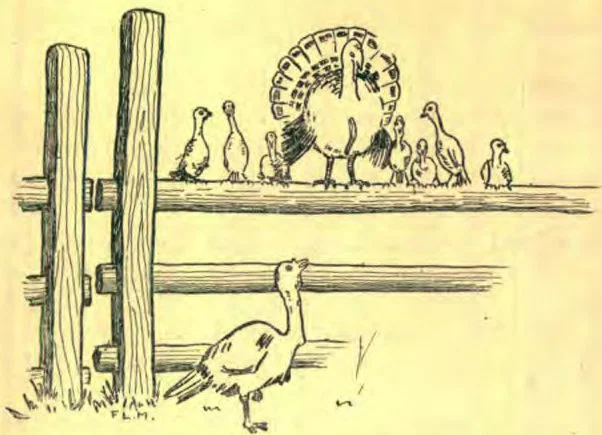
MRS. TURKEY had made a snug nest in the woodpile for her pretty, large, speckled eggs. For seven days she had felt the eggs grow warmer as they pressed against her beating heart. Only three weeks more, and she would be the proud mother of nine little turkeys. Her hopes ran high, but one morning she returned from her hasty breakfast to find Mr. Gobbler seated comfortably on her nest. She walked around close by as if gently to suggest to him, “I appreciate your care during my absence, but now I am back.” But Mr. Gobbler sat unmoved, like a king upon his throne. Every gentle persuasion our little queen could devise having failed, she sat down close beside him.
The rancher’s wife became alarmed and thought to remove the usurper. “Who ever heard of a gobbler hatching turkey eggs!” she said. However, her husband persuaded her that it was worth running the risk of spoiling a setting of eggs to see what Mr. Gobbler would do. During the next three weeks the sun in its course was not more constant than he. It seemed that he never spared time to eat. The mother turkey walked around the yard most of the time, and ate well, but often resumed her position by his side.
The reward came at last, as it comes to all who persevere with patience, and seven bright little turks chirped after their daddy. He had grown thin during his three weeks of sitting, and was active now in his search for bugs and grasshoppers. He was often heard calling his flock to a fruitful harvest with his heavy “gobble gobble.” The little mother followed the family, and tried to attract their attention with her gentle “turk, turk,” but the husky little youngsters did not know her voice, and ran the harder after Father Gobbler. Although he was not harsh to Mrs. Turkey, yet he ignored her entirely. At night he roosted on the barnyard gate with the seven turks, and she flew upon the fence near by.
All summer Father Gobbler tended his flock with admirable fatherly care, and just as faithfully and lovingly she followed close by, only to be unobserved by her dear ones. Disappointment and the sense of neglect was too much for the mother heart, and on a bright afternoon she drooped her wings and died.
BIRDIE RITTER.
Turtles : Their Habits and Mine
By Carl Mock
CARL MOCK
TURTLES have habits which are not altogether peculiar to themselves. The first of these which I shall consider is their speed. “O,” you say, “but the turtle is so slow!” Yes, ’tis true, but so am I. It takes the turtle a long time to reach his goal because he travels so slowly. I am perhaps just as slow about reaching my goal. Not that I travel so slowly when going, but that I fail to go.
The turtle is thrown about by thoughtless boys, or played upon by some restless puppy that is courting his master’s favor. Yet he disregards all these obstacles, and has no disposition to retaliate. He is soon seen stalking forth as bravely as ever, and eventually reaches his goal. I, when tossed about by others, getting my feelings ruffed up and losing my bearings a time or two, seek revenge and retaliation, become discouraged, and perhaps exhaust all the energies of my friends in their efforts to put me on my feet and start me going again. Like the turtle when he is thrown about, I am farther from my goal than ever; but nine to one I have less courage with which to renew the struggle.
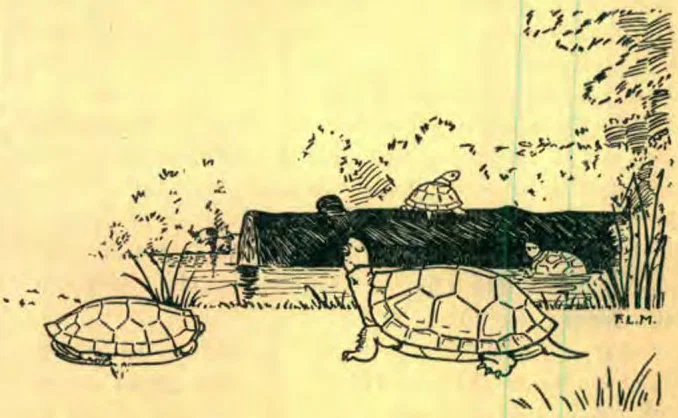
We do not think of the turtle as being proud. It is hard to conceive of a reason why he should be. Yet when we come suddenly and unobservedly into an opening in the woods or a lone place in the road and happen to see a turtle, or perhaps two or three, stalking about with their heads high and conspicuous, we are led to think they have the necessary qualifications. When one suddenly steps out among them, their heads are lowered, they recoil within their shells, and for the time being an air of modesty replaces that of pride. I find within myself the same tendency. How often, when under certain elating circumstances, I raise myself as high as possible from earth and stalk about in a very conspicuous manner. I seem to have been transferred from just an ordinary position to one that is most high and lifted up. I think that certainly none could have the audacity to enter my realm without first prostrating himself and going through the proper ceremonies. Suddenly a change takes place. I come in contact with a person who towers head and shoulders above me. A few turns of his hand, a little display of his just common, ordinary abilities, and I recoil within my own little shell as unobserved as possible. There I am content to remain until this “lord of creation” has disappeared from my own immediate circle. Then, like the turtle, I again raise my head in a haughty, conspicuous attitude. The difference in the two is the unnaturalness on my part, while the turtle exhibits his perfectly natural habits.12
I am prone to look with contempt upon the turtle because of his habits of life. He is content to crawl about in the dirt. He is incapable of seeing anything except his immediate surroundings. If he gets in my path I give him a contemptuous kick. But when I look at myself, with my own habits and inclinations, in view of the great opportunities which are mine, in view of the privilege of moving in a greater circle and of living above the dust and filth of earth, I am led to wonder just what beings of a higher order than I must think of me. My contempt for the turtle vanishes.
Afloat on an Ice Cake
By Grace Rosenthal
Boys, it is a long time since I had the fun of seeing the ice go out; what do you say to taking a run down to the river to see the ice breaking up!” said Chris Crawford, who was just back from sunny California, and was visiting Minnesota friends.
“All right! Come on!” said his three friends. Whereupon hats, coats, and rubbers were secured, and all four started for the Cedar River. It was early spring, and the stream was filled with blocks of floating ice. The swift current carried the ice rapidly down the center of the stream. The ice along the edge appeared to be firm and solid.
Upon reaching the river a long-drawn-out whistle from Walt, a twinkle in Bill’s eye, and an “O boys!” from Joe, meant that there was excitement ahead. Never had the boys seen the current so swift nor the ice blocks so numerous. Walt, who was the eldest of the boys and then eighteen, was accustomed to this sport. He was daring, too. So he was the first to venture out. He landed on a large floating cake of ice, which was soon shared by Joe. As they glided downstream, they called back to the other boys, “Come on, this is sport!”
Bill had taken his place on a stationary block, which he was trying to loosen with a large stick. At the same time he urged Chris to get on with him before it started down the stream. Chris, who was not used to such daring sport, hesitated. He, however, ventured out on what seemed to be solid ice. It broke, and he gave a leap which landed him just where Bill wished him to be — on his cake of ice. The sudden jar loosened their raft, and they were sent into the midst of the swirling stream.
Soon they reached a bend in the river. Here they saw the other two boys. “Hey, fellows! What seems to be the trouble? Are you stalled? Jump on with us! Always room for more!” shouted Bill. But there was no time for this. The swift current carried Bill and his companion down the stream at a dizzy rate.
Not until they had gone almost a mile did they think that the dam was not far distant. At this thought Bill’s face grew pale with fear. He hardly dared look at Chris, for he felt sure there would be no encouragement written on his face. Bill himself had absolutely none to offer, but determined to make the best of it. With an attempt at cheerfulness he ventured, “Wouldn’t mind if we had been stalled at the bend, too; this is fun and plenty of it.”
“Yes, and you lost the stick you had, didn’t you?” said Chris. The chatter of his teeth showed plainly the feeling within.
“O it wouldn’t have helped much anyway!— but say, we must do something and that right quick.” This fact was not hard to realize, for just ahead was the dreaded dam and nothing in sight to save them from going over.
“What shall we do?” said Chris in terror.
Bill, who had a resourceful mind when he came to a crisis, said, “Just before we get there we shall have to sit down and see if we can brace our feet against the dam to keep us from going over.”
“I’m afraid the water is so high there won’t be much of a chance to do that,” said Chris with a shudder.
Just then the block was suddenly caught in the edge of a whirlpool, and they were sent toward the western bank of the river.
In the meantime Walt and Joe had followed the bank in a vain effort to keep in sight of the boys. But it was slow progress. They slipped along through the slush, jumped slippery logs, and crawled through fences. Not getting a glimpse of the boys as they ran on, they began to feel much frightened.
“I hope they haven’t gone over the dam,” remarked Walt with traces of misgiving in his tone.
“It is about time for them to be there now if they haven’t been able to steer for shore. Look! I see something just this side of the dam. It looks like them.”
In the dusk, two forms could be seen on a whirling cake of ice which was heading its way toward their side of the bank.
As the block crashed against the bank, Bill jumped. He landed high and dry on the solid ground. With his jump the ice block and Chris were started back into the stream. Chris jumped, however, and landed, but not on the bank. He scrambled for shore, and came out wet to the knees.
Chris’s wet feet told part of the story, and the home folks guessed the rest, but refrained from offering any rebuke, as the serious faces of the boys showed that they had already learned a valuable lesson. After supper and family worship, the boys went to their room. The silent prayers that ascended to God when Bill and Chris knelt by their bed that night were full of gratitude. Long after the house was quiet the boys lay awake. Bill broke the silence by saying,
“Chris, I am very thankful to God for his protection over us today, when we were so careless and took our lives in our own hands. I have resolved to be more careful in the future.”
“I will, too, with God’s help,” answered Chris.
With these good resolves the boys soon fell asleep.
GRACE ROSENTHAL.
Her Father’s Wish
By Marian Heywood
The cool shadows of late afternoon fell across the abandoned old skid road. The damp smell of green ferns and mosses came from the dusky undergrowth of the woods. The alert eyes of a young girl wandered with pleased curiosity over the mountain landscape. Presently her attention was arrested by the sharp barking of a squirrel which had scampered up a tree trunk and sat saucily eying the intruder. She playfully raised her gun and sent such an echo through the treetops that the little fellow was more enraged than ever. He ascended to a higher branch and fairly shrieked forth his indignation at the presence of what he thought might be a rival for the proprietorship of this magnificent old tree.
The young traveler came into a clearing, and retraced her steps to the log cabin at the foot of the mountain road.13
Helen Bryce was spending one of the most unique vacations of all her seventeen years. Although left motherless at the age of four, she had gathered through the lapse of years a variety of interesting experiences. Just now she was visiting her father at his homestead in the Canadian Rockies. They had seen little of each other since her mother’s death.
The homestead cabin, fitted snugly against the protecting hill slope, lay basking in the sun like the small cubs and hedgehogs that people the rough mountain sides in summer.
The old man looked up as she passed breathlessly into the low-ceiled kitchen and put away her gun.
“You didn’t see anything today?” he queried, humorously.
“No, I wasn’t looking for game, father, but I saw a new kind of squirrel that was worth going five miles to see. Did Harry go after the mail? Nothing for me?”
Absorbed in thought, she began to prepare supper. The old man leaned back in his chair and picked up the newspaper that had fallen from his hand. His eyes were following the movements of his daughter.
“Your mother was the best housekeeper in the country,” he said reminiscently. “I remember—” and the childish mind lapsed into a meandering account of the old home and neighborhood of Helen’s early childhood.
She was always alert to these little suggestions concerning the mother whose face she could not recall. The father seldom mentioned her, and in spite of Helen’s tactful efforts to draw him out, he would only talk delightedly of the friends and acquaintances of his youth.
The days of that serene summer passed quietly away, spent in the full, rich companionship of wooded hills and the troop of comrades, glad or gay, that dwelt between the covers of her books. Happy in the thought of keeping forever the memory of this beautiful summer, Helen talked of her return to school, and of the time when, after having finished her course, she would go forth to serve the Master. Her father answered only in slow monosyllables these unsuspecting appeals for him to join her in her gladness.
One day as she came home from a rambling trip, tired, yet full of the fresh glow of mountain sun and breeze, she heard her father’s voice behind the neat pile of winter firewood. Arrested by the sound of her name, she stole nearer.
“Oh, I’d be happy, Lord, if she could—if she could just stay—but you have first claim and I’ll let her go. She will serve you faithfully, just as did her mother. But oh, my God, I want to die up here on this homestead, and be buried in these mountains as was Moses of the old Book!”
Helen moved dazedly away and went, she knew not where. Anywhere to be alone and away from human eye or voice—alone with her thoughts. Could it be that the life she had planned should be so unselfish, had missed its aim and lost its way? And so she prayed for guidance, for strength to make the sacrifice. She sent no word of her trouble to the sympathizing sister who lived away on the other side of her beloved mountains. But with firm decision, as they talked together in the quiet of a warm summer evening, she told her father of her new plan, of how she had come to love this wild country, and of how her life would expand in its soothing atmosphere. She had no strength to meet the well-meant protests. She arose and wandered away to the little shrine among the quivering poplars.
If the summer had been beautiful, the early fall was grand. The shortening summer days brought with them the rugged richness of autumn dyes in sunset, in mountain side, and in the misty veil that hung over the river at twilight. The small animals of the woods were either storing away a winter’s food supply or searching a snug place for their long nap.
“Two letters from Iris!” announced Helen delightedly at the close of one day.
“Let’s have them read, Helen,” urged the father.
But Helen needed no invitation. Hastily scanning the page, she gave a merry shout and pounced upon the astonished old man with hugs and caresses.
“She’s coming to spend the whole year with you father! A whole year! Says the doctor has ordered a change, and she’s coming up here to live among these beloved mountains and let them bring back her lost vitality; and the baby is coming along, and, oh, won’t this be the happiest, noisiest, blessedest place in the world?”
The homestead never looked so appealing in all its short life as when on a mid-autumn morning, Helen took her last survey of the familiar surroundings. Iris, already fresh and happy, was feeding the little brown puppies their breakfast. Grandfather, with small Bobby on his knees, sat in the lawn chair out under the trees, singing the “big doggie” song, which the baby called for loudly whenever the music stopped. In another hour the huge old freight would take Helen past the homestead scenes away toward the South, there to learn more fully that “Thou hast heard the desire of the humble.” MARIAN HEYWOOD.