The Exercise May Be Transformed from an Evil into a Blessing.
“There is no evil that is not a perverted good,” writes Edward B. Warman in the November Ladies’ Home Journal. “So the stairs may prove a blessing instead of a detriment, if women will learn how to go up and down them without fatigue. The majority of persons, especially women, climb the stairs. To avoid the difficulty and reap the benefits, do this: Incline the body forward, but do not bend at the waist-line. Do not stoop. Keep the chest raised and fixed. Ascend as it were from the chest, and no matter what may be your weight your touch of the foot on the step will be as light as that of a child. Touch only the ball of the foot to the step. Close the mouth and keep it closed when ascending the stairs and until the breathing is quite normal. Every inhalation should be felt at the waist-line. In going down stairs keep the body perfectly erect; touch only the ball of the foot to the step, yielding at the knee.”
IN EMERGENCIES DO AND DON'T.
Keep cool and don't get excited.
Be quick, but don't hurry here and there aimlessly. Carefully remove all obstacles to breathing, as a tight collar, a corset, or a skirt band.
Smother the flames with an overcoat or a blanket, and don't fan them to fury by rushing about.
Remember fainting is due to lack of blood in the brain, and don't forget that blood, like water, runs down hill and will flow readily into the head when the head is lower than the body. Also that blood freely flowing from a cut can be stopped by elevating the injured member and by pressure on the part. Press firmly, and don't wash away the blood too soon; allow it to clot.
There is always air to breathe on the ground or floor; don't walk, but crawl, out of a burning building.
If you find yourself in deep water, hold your breath as long as possible, and don't suck the water into your lungs. Keep cool; a struggling man is always a sinking man.
When your child has taken poison by mistake, empty the stomach at once by administering a teaspoonful of mustard in warm water. In a few minutes give a copious draught of milk, and send for the doctor.—Selected.
PITY THE HORSES.
By Geo. T. Angell
[Geo. T. Angell, in Our Dumb Animals.]
On a very hot day keep a sponge, a towel, or your handkerchief soaked with pure cold water on the top of your horse's head.
If your horse's back is sore, use pure cold water on it freely every time the saddle is removed.
In hot weather tell your herdic or cab or carriage driver to drive slowly, especially up hills, and give him five or ten cents extra for doing it.
In hot weather be sure your check-rein is loose and your horse frequently watered.
In hot weather a mouthful of grass, or a piece of bread, or a cracker even, will help your horse wonderfully.
Nobleness to Serve
By Emerson
AND ye shall succor men;
'Tis nobleness to serve;
Help them who can not help again;
Beware from right to swerve.
—Emerson.
The Waters Know Their Own
By V. Burroughs
THE waters know their own, and draw
The brook that springs in yonder heights;
So flows the good with equal law
Unto the soul of pure delights.
—V. Burroughs.
Speak Low to Me
By Browning
SPEAK low to me, my Saviour, low and sweet,
From out the hallelujahs, sweet and low,
Lest I should fear and fall, and miss Thee so,
Who art not missed by any that entreat.
—Browning.
Seeking God's Approval
By Margaret J. Preston
If no withheld approval damps thy zeal,
When God's pure eye thy hidden motive scans,
As with bared soul thou dost to Him appear,
What need'st thou care for man's?
—Margaret J. Preston.
The Heart That Attains
“Ah, how skilful grows the hand
That obeyeth God’s command!
It is the heart, and not the brain,
That to the highest doth attain;
And he who followeth Love’s behest
Far exceedeth all the rest.”
A MORNING ON THE GANGES.
By Helen H. Holcomb
[By Mrs. Helen H. Holcomb, in New York Observer.]
PROBABLY no other river in the world is regarded with such veneration as is the Ganges by the Hindus, from its source amid the snows of the Himalayas, to the place where through many mouths it empties its waters into the Bay of Bengal; but at Benares, the “Holy City of India,” it is held in special sanctity. Benares is one of the oldest cities in the world. There is no authentic history of its origin, for the people of India are not historians. Gautama, the founder of Buddhism, is supposed to have lived about the sixth century before Christ, and he chose this city as the center from which to propagate the new faith. Benares must, therefore, have been at that time a great and important city.
In the twelfth century A.D., Benares came under the sway of the Mohammedans, by whom the Buddhists were expelled. When the Mohammedans, in their turn, lost the ascendency, Benares became once more the seat of Hinduism. During the occupation of the city by the invaders, both to show their power and their detestation of idolatry, they converted all the larger temples into mosques and tombs, and mutilated or destroyed the remainder. There are in Benares at the present time 270 mosques, the most noted of which is the mosque of Aurangzeb, which stands on the site of a Hindu temple, demolished to make room for it. This lofty building, which faces the river, is surmounted by two minarets of exquisite symmetry, rising 147 feet above the highest part of the mosque. Near the Golden Temple, very sacred to the Hindus, is another famous mosque, also erected on the ruins of a temple destroyed by the Mohammedans. Between the worshipers of mosque and temple there is constant friction, leading not infrequently to open riot.
In 1775, Benares was ceded to the British, and under English rule there is security to life and property hitherto unknown. The city is on the northern bank of the Ganges, on a cliff one hundred feet above the water. The river at this point is crescent shaped, giving a frontage of three miles and a depth of one mile. There are fifty principal ghats, or flights of steps, leading down to the water to facilitate bathing. During a recent visit to Benares, under the escort of a resident missionary we paid a visit to some of the temples, shrines, and holy wells for which the city is famous.
The streets of Benares are mere alleys, too narrow to admit of wheeled traffic. Sacred bulls roam about at will, and the foot passenger is constantly jostled by fellow pedestrians, many of whom are priests watching for opportunity to act as guides to pilgrims. Benares is said to contain 30,000 of these priests. The streets of the city are not only narrow, but dark, as the houses, several stories in height, almost entirely exclude the sun. The houses, which are built chiefly of stone, have windows high above the street, and very small, to prevent observation. In many cases the upper stories project beyond the lower, and in some instances houses on opposite sides of the street are connected by bridges.
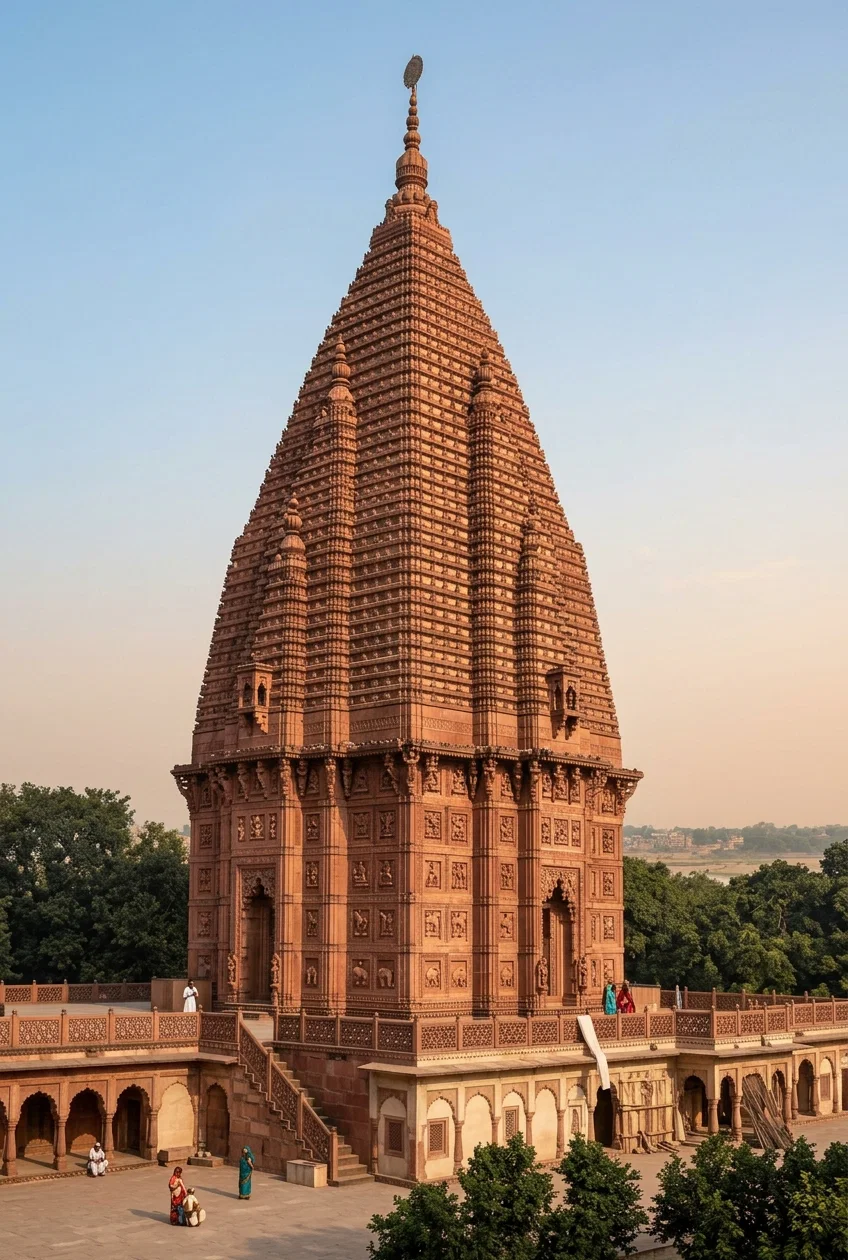
Temple at Ramnagar near Benares.
The so-called holy wells of Benares attract as many pilgrims as do the temples. One of these is called the “Well of Knowledge.” The offerings presented consist chiefly of flowers, which are cast into the well, whose waters are thus made putrid; but an attendant priest serves to each worshiper a sip of the nauseous fluid. The “Well of Fate,” whose waters are not less foul, attracts myriads of devotees. Another well bears the title of “Complete Source of Felicity,” and is regarded as chief among the places of pilgrimage in the holy city. Into this well, in addition to flowers and the leaves of the bael tree, milk is poured as an oblation. Steps lead down to the water; and each seeker after happiness laves his head and his body in the loathsome water. Many of the temples are as foul as are these wells, but all are thronged with worshipers.
The regularity of the ghats leading to the river is broken at intervals by platforms where, under canopies, sit priests who read and expound the sacred books of Hinduism to the pilgrims who gather about them, and who are expected to bestow a gratuity in return for this pious service. Down the long flights of steps men, women, and children were continually making their toilsome way. The children, with wondering eyes, were plunged for a moment beneath the water, then, shivering, were placed on terra firma. There is sometimes among the women bathers a strange admixture of devotion with laughter and talk of household and family concerns, while occasionally some irate female improves the opportunity to heap upon her neighbor all sorts of abuse. Parties of pilgrims from the same region of country like to keep together; for the Hindu is by nature extremely timid, as well as gregarious.
There is always a babel of voices, for the kaleidoscopic multitude has come from all parts of the great Indian empire. There is no more pathetic sight than that of the aged pilgrims who are brought here. Supported by their friends, slowly and painfully they make their descent to the water’s edge, looking out with wistful eyes upon the river of whose sanctity they have heard since the dawn of existence. Much of sorrow has life held for them, and perhaps much of sin. The days of their pilgrimage almost over, before plunging into the great Unknown, they would plunge beneath the sacred flood which they have been taught to believe can wash away the accumulated guilt of a lifetime. This ceremony over, they are helped out of the water, and with diminished physical strength and little accession of heart-joy, begin the painful ascent.
Some of the men seen at these bathing ghats are haughty of mien, with intelligent faces, silent and apparently unobservant of all that is passing around them. The prince and the peasant come to this holy place for cleansing, the prince in all the pomp13and splendor befitting his high station, carried in a palanquin by obsequious bearers and followed by a retinue of retainers; the peasant, unattended, and with no costly garments to be laid aside, steps down into the water with his loin cloth, and emerging climbs the slippery steps, leaving a wet trail behind him. Notable among the objects on the river’s bank are the spacious and imposing residences which Indian princes and lesser noblemen have provided for their accommodation when on pilgrimages to the holy city. Palaces, mosques with graceful minarets, temples with gilded domes and pinnacles, are side by side with ruinous houses, broken ghats, and heaps of rubbish.
Among the Hindus, cremation is the usual mode of disposing of their dead. The burning ghat at Benares is pre-eminently the most holy place in India where this rite can be performed. The space allotted to this purpose is in immediate proximity to one of the most frequented ghats leading to the river. When bereaved friends are too poor to purchase sufficient fuel entirely to consume the body, it is only partially burned, and the charred remains are then consigned to the Ganges. Such wrecks, rising to the surface, attract greedy vultures, and these may often be seen perched upon a carcass borne outward by the current. Such spectacles met our gaze as we were rowed past the city. The bathers paid no more heed when such an object floated past them than if instead it had been a log of wood.
The Hindus believe that notwithstanding the sanctity of the place, the spirits of their deceased friends will not attain eternal felicity unless the fire which consumes their bodies is lighted with a coal taken from a domra, the lowest and most despised caste in India. The domra who holds the monopoly of the sacred fire at this ghat is a man of great wealth. His business stand is close to the ghat, where under a bamboo shelter he keeps a smouldering fire ready to serve customers. He knows nothing of fixed prices, but takes advantage of wealth and station. A Hindu prince was compelled to pay one thousand rupees for a coal with which to light the funeral pyre of a deceased relative.
In the vicinity of the burning ghat are numerous tomb-like structures. These mark the spots where in former times widows were burned alive with their dead husbands. To Lord William Bentwick belongs the honor of abolishing by law the horrid rite of sati, or widow burning. For many years the trio of famous missionaries at Serampore,—Carey, Marshman, and Ward,—had done all in their power, both by voice and pen to induce those in authority to set in motion the wheel of the law against so monstrous a custom; but it was declared that the time had not yet come for taking a step which affected so vitally the religious and social life of the Hindus. When in 1829 Lord William Bentwick was made Governor-General of India, he resolved that no time should be lost in stamping as a criminal offense this diabolical rite. To William Carey, the great missionary, was given the honor of translating from English into the vernacular, the edict which prohibited, on pain of death, the rite of sati. The paper was sent down to him from Government House on Sunday, and instead of going into the pulpit, according to custom, he sent for his pundit, and at once began the translation of this important document. “It is a work of mercy,” he said, “as the delay of a single day means the sacrifice of two victims.”
The impression left upon the mind of the visitor to Benares is that the city is wholly given to idolatry. Is this because the inhabitants of this far-famed city are more ignorant than are the inhabitants of other Indian cities? The holy city is the seat of Sanscrit learning. There are in Benares 200 monastic institutions, with 2,000 students in attendance. These come from all parts of India, and each, when his course of study is completed, is expected to return to his own neighborhood, to be there an expounder of Hinduism.
The disciples of the heavenly Master might learn lessons of stewardship from some of the disciples of the false religions of the Orient. A wealthy shopkeeper in Benares set apart a garden for the residence of two hundred Brahman students, who were to be fed and clothed at his expense. The Maharaja of Kashmir maintains a Sanscrit school in a fine building near one of the ghats, with eleven Pundits and two hundred Brahman students. Another Maharaja maintains a still larger school near the Golden Temple, and there are numerous private schools.
What kind of instruction is given in these schools?
“False morality, false history, false philosophy, and ‘false physics,’” says one well qualified to judge. The effect of such an education as is given in these schools is seen in the pundits, who, as a rule, are the most bigoted portion of the community, and opposed to all reform.
Some of the pilgrims who visit Benares deem it sacrilege to enter the holy city standing upright as men. Instead they prostrate themselves and measure their length along the ground. Touching the sacred soil with his forehead, the pilgrim rises and places his foot where the forehead had been, then again prostrates himself, and in this manner continues his slow and painful journey. After leaving the boat, we turned to look once more upon the river with its teeming life, and while we thus stood a long railway train on its way to Calcutta came thundering across the magnificent iron bridge which spans the river at this point, and which is nearly a mile in length. How wide the contrast between this splendid bridge, a triumph of nineteenth-century engineering, and the devotee of Hinduism, like a worm measuring his length along the ground—the one an exponent of Hinduism, the other of Christian civilization.
Jhansi, India.
WHAT DIDST THOU SOW?
By Watch Tower
ONE wept that his harvest was small,
With little of fruit or of grain;
While his neighbor, with barns running o’er,
Still followed the full-freighted wain.
“How much didst thou sow,” I said, “friend?”
“A handful of wheat less or more.”
“And didst thou expect broad acres would bend
To thy sickle from such scanty store?”
Who sparingly soweth, must look
For little of fruit or of grain;
’Tis only the bountiful sower can reap
A bountiful harvest again.
A lesson, I said, to thee, soul,
For harvest time soon will be here;
Sow with bountiful hand, lest thou weep at last,
When the Lord of the harvest draws near.
—Watch Tower.
OUR WORK AND WORKERS.
WITHIN a few weeks just past, seven persons were baptized at Roaring Branch, Pa.
AT the last quarterly-meeting of the church at Muskegon, Mich., five candidates were baptized by Brother B. F. Stureman.
THE Watchman says the school at Hazel, Ky., is “an assured success.”
THE house of worship in Memphis, Tenn., is being enlarged and improved, which is encouraging news.
AT the recent camp-meeting held at Burlington, Kansas, forty-three persons were baptized in the Neosho River.
THE church at Utica, Mo., has but forty-five members, yet they report a good school building, with beautiful grounds. The school will open about the middle of this month.
AT the last quarterly-meeting of the church at Milburn, Neb., six members were added by baptism. The ordinance was administered by the church elder, Brother Albion Cummings.
A TENT-MEETING is being held in Cheboygan, Wis., by Brethren O. Soule and E. A. Bristol, and a recent report notes that four have accepted the truth as presented from the Scriptures.
REMEMBER that the second Sabbath in this month (the 14th inst.) is the date appointed by the General Conference Committee for taking a special collection for the benefit of Skodsborg (Denmark) Sanitarium.
IN June last twenty-two persons were baptized at Cooranbong, N. S. W., Australia. These were mostly connected with the school, and represented four of the Australian provinces, besides Tasmania, New Zealand, and Fiji.
THREE converts are reported by Brother G. R. Hawkins, of Ida Grove, Iowa, where he is holding tent-meetings. The outlook for further accessions was encouraging at the time of his report, as the attendance and interest were good.
IN Adelaide, South Australia, June 8, eight candidates were baptized. These candidates were from eight to eighty-seven years of age. Others were soon to follow in the observance of the rite. Meetings had been conducted for a few days by Brethren J. H. Woods and A. W. Semmens.
THE last Record received here announces the arrival in Sydney of Brother G. A. Irwin and wife, and Brother W. D. Salisbury, manager of the Echo Publishing Co., on June 23. Hearing of his wife’s illness, Brother Salisbury started immediately to Melbourne by rail, while Brother Irwin and wife went to Cooranbong.
A NOTE signed by Brethren Geo. H. Smith, W. J. Wilson, and Geo. H. Skinner, dated Callaway, Neb., August 22, says: “We have just closed a series of tent-meetings here. As a result a few have embraced the truth, and a Sabbath-school of eighteen members has been organized. Scores of others acknowledge that we have the truth, but as yet do not obey.”
A NOTE from Brethren C. M. Gardner and A. S. Marchus, dated Eureka, Cal., August 19, says: “The Lord has wonderfully blessed the camp-meeting here. Nineteen were buried with their Lord in baptism. Meetings will be continued for a time, as there is a large audience of attentive hearers every night. Pray for the work in this part of the field.”
WILL OPEN SOON
By Editor
Are you desirous of obtaining a college education? The Fall term opens soon. Why not improve this opportunity?
START YOUR SUBSCRIPTION LIST TO-DAY
We will furnish a FREE SCHOLARSHIP for one year for one hundred new yearly subscriptions to the SIGNS OF THE TIMES at $1.50 each, in any of these excellent institutions:—
EMMANUEL MISSIONARY COLLEGE, Berrien Springs, Mich.UNION COLLEGE, College View, Neb.WALLA WALLA COLLEGE, College Place, Wash.HEALDSBURG COLLEGE, Healdsburg, Cal.SOUTH LANCASTER ACADEMY, S. Lancaster, Mass.MOUNT VERNON ACADEMY, Mt. Vernon, OhioKEENE INDUSTRIAL ACADEMY, Keene, TexasSOUTHERN INDUSTRIAL SCHOOL, Graysville, Tenn.
This is a rare opportunity for the young man or woman who is desirous of obtaining a Christian training in one of these colleges. A number have already taken advantage of this most liberal offer. Write at once for further particulars, but you need not delay commencing work.
ADDRESS, SIGNS OF THE TIMES, OAKLAND, CAL.
PLEASE GIVE ATTENTION.
THE long evenings for study are here, and would you not like to improve them by taking up the work of the Correspondence Course connected with the Sanitarium Medical Missionary Training School? Lessons are sent weekly to a class of students who are unable to leave home duties in order to take a regular course at one of our sanitariums. This is the third year this course has been carried on, and scores are availing themselves of it. Studies on eleven subjects are given, among which missionary work and care and treatment of the sick are prominent.
The tuition is $3.00, which barely covers the cost of sending out the lessons, correcting the replies, and returning the reports to the students. The books required for this work are furnished at actual cost-price. We shall organize a new class in October, which will continue one year (some finish in six months), and shall be glad to hear from all those interested. A descriptive circular giving full particulars, also testimonials from those who have taken the course, will be sent free on application. Address Cor. Dep't. Sanitarium Training School, Battle Creek, Michigan.
LESSON XII.—SEPTEMBER 21.—THE COMING OF CHRIST.
Its Results to the Righteous and the Wicked.
Note to the Student.—These lessons are not designed to be exhaustive, but suggestive. In references to the “Desire of Ages,” in the lessons, the subscription edition is referred to. Those who have only the trade edition will find the matter in chapters 1, 4, 27, 71, 77, 78; also read “Patriarchs and Prophets,” chapters 5 and 30. “Christ Our Advocate,” Bible Students’ Library No. 129 (price, 10 cents), and “Looking unto Jesus” (price, $1.00) will be found a great help. The SIGNS OF THE TIMES will have an article on the subject of each lesson this quarter by J. O. Corliss. Read these articles in connection with the study of the lesson. We have not space to print all the scriptures. Let the student study them carefully from the Bible. Those printed are from the Revised Version.
SUGGESTIVE QUESTIONS.
1. At what time are God’s people delivered?
“For the Lord Himself shall descend from heaven, with a shout, with the voice of the archangel, and with the trump of God; and the dead in Christ shall rise first: then we that are alive, that are left, shall together with them be caught up in the clouds, to meet the Lord in the air; and so shall we ever be with the Lord.” 1 Thess. 4:16, 17. (1 Cor. 15:51, 52.)
2. What is caused by the voice of God?
“And the Lord shall roar from Zion, and utter His voice from Jerusalem; and the heavens and the earth shall shake; but the Lord will be a refuge unto His people, and a strong hold to the children of Israel.” Joel 3:16.
“See that ye refuse not Him that speaketh. For if they escaped not, when they refused him that warned them on earth, much more shall not we escape, who turn away from Him that warneth from heaven: whose voice then shook the earth; but now He hath promised, saying, Yet once more will I make to tremble not the earth only, but also the heavens. And this word, Yet once more, signifieth the removing of those things that are shaken, as of things that have been made, that those things which are not shaken may remain.” Heb. 12:25-27. (Matt. 24:29; Isa. 2:19, 21. “Early Writings,” page 33.)
3. In what words do God’s people then express their faith?
“God is our refuge and strength, a very present help in trouble. Therefore will we not fear, though the earth do change, and though the mountains be moved in the heart of the seas; though the waters thereof roar and be troubled, though the mountains shake with the swelling thereof.” “The Lord of hosts is with us; the God of Jacob is our refuge. Come, behold the works of the Lord, what desolations He hath made in the earth. He maketh wars to cease unto the end of the earth; He breaketh the bow, and cutteth the spear in sunder; He burneth the chariots in the fire. Be still, and know that I am God: I will be exalted among the nations, I will be exalted in the earth. The Lord of hosts is with us; the God of Jacob is our refuge.” Ps. 46:1-7.
4. What other event takes place at the same time?
“And at that time shall Michael stand up, the great prince which standeth for the children of thy people; and there shall be a time of trouble, such as never was since there was a nation even to that same time; and at that time thy people shall be delivered, every one that shall be found written in the book. And many of them that sleep in the dust of the earth shall awake, some to everlasting life, and some to shame and everlasting contempt.” Dan. 12:1, 2. (Rev. 1:7; Luke 21:27-30; Matt. 26:64.)
5. What follows the shaking of the powers of heaven?
“And then shall appear the sign of the Son of man in heaven; and then shall all the tribes of the earth mourn, and they shall see the Son of man coming on the clouds of heaven with power and great glory. And He shall send forth His angels with a great sound of a trumpet, and they shall gather together His elect from the four winds, from one end of heaven to the other.” Matt. 24:30, 31.
6. How do the saints welcome their Saviour?
“And it shall be said in that day, Lo, this is our God; we have waited for Him, and He will save us: this is the Lord; we have waited for Him, we will be glad and rejoice in His salvation.” Isa. 25:9.
7. What will be the result of His coming to them?
“For our citizenship is in heaven; from whence also we wait for a Saviour, the Lord Jesus Christ; who shall fashion anew the body of our humiliation, that it may be conformed to the body of His glory, according to the working whereby He is able even to subject all things unto Himself.” Phil. 3:20, 21. (1 Thess. 4:16-18; 1 John 3:2; 1 Cor. 15:51, 52; Matt. 13:43.)
8. With what feelings will the Saviour and the saints view the results of redemption?
“He shall see of the travail of His soul, and shall be satisfied; by His knowledge shall my righteous servant justify many; and He shall bear their iniquities.” Isa. 53:11.
9. What will be the experience of the wicked at the coming of Christ?
“And the heaven was removed as a scroll when it is rolled up; and every mountain and island were moved out of their places. And the kings of the earth, and the princes, and the chief captains, and the rich, and the strong, and every bondman and freeman, hid themselves in the caves and in the rocks of the mountains; and they say to the mountains and to the rocks, Fall on us, and hide us from the face of Him that sitteth on the throne, and from the wrath of the Lamb: for the great day of Their wrath is come; and who is able to stand?” Rev. 6:14-17. (Isa. 2:19-21; Zeph. 1:14-18; Jer. 25:34; Isa. 13:6.)
10. What will be the result of His coming to them?
“Behold, the day of the Lord cometh, cruel, with wrath and fierce anger; to make the land a desolation, and to destroy the sinners thereof out of it.” Isa. 13:9. (Jer. 25:33; Zeph. 1:2, 3.)
11. What effect will the coming of the Lord have upon the earth?
“I beheld the earth, and, lo, it was waste and void; and the heavens, and they had no light. I beheld the mountains, and, lo, they trembled, and all the hills moved to and fro. I beheld, and, lo, there was no man, and all the birds of the heavens were fled. I beheld, and, lo, the fruitful field was a wilderness, and all the cities thereof were broken down at the presence of the Lord, and before His fierce anger. For thus saith the Lord, The whole land shall be a desolation; yet will I not make a full end.” Jer. 4:23-27. (Isa. 24:1, 3-6; Rev. 20:11.)
12. What other great event takes place in connection with the coming of the Lord?
“And I saw an angel coming down out of heaven, having the key of the abyss and a great chain in his hand. And he laid hold on the dragon, the old serpent, which is the Devil and Satan, and bound him for a thousand years, and cast him into the abyss, and shut it, and sealed it over him, that he should deceive the nations no more, until the thousand years should be finished: after this he must be loosed for a little time. And I saw thrones, and they sat upon them, and judgment was given unto them: and I saw the souls of them that had been beheaded for the testimony of Jesus, and for the Word of God, and such as worshiped not the beast, neither his image, and received not the mark upon their forehead and upon their hand; and they lived, and reigned with Christ a thousand years.” Rev. 20:1-4.
13. What is the type foreshadowed of this?
“And when he hath made an end of atoning for the holy place, and the tent of meeting, and the altar, he shall present the live goat: and Aaron shall lay both his hands upon the head of the live goat, and confess over him all the iniquities of the children of Israel, and all their transgressions, even all their sins; and he shall put them upon the head of the goat, and shall send him away by the hand of a man that is in readiness into the wilderness: and the goat shall bear upon him all their iniquities unto a solitary land: and he shall let go the goat in the wilderness.” Lev. 16:20-22. “Great Controversy,” p. 659.
14. Where are the righteous during the thousand years?
“After these things I heard as it were a great voice of a great multitude in heaven, saying, Hallelujah; Salvation, and glory, and power, belong to our God.” Rev. 19:1. (Rev. 20:4.)
NOTES.
Read “Great Controversy,” chapters 40, 41.
Chicago in LESS than 3 Days From San Francisco at 10 a. m.
CHICAGO, UNION PACIFIC & NORTHWESTERN LINE
DOUBLE Drawing-room Sleeping Cars, Buffet, Smoking, and Library Cars, with barber. Dining Cars—meals a la carte. Daily Tourist Car Service and Personally Conducted Excursions every week from San Francisco at 6 p. m. The best of everything.
R. R. RITCHIE 617 MARKET ST. GEN. AGENT PACIFIC COAST SAN FRANCISCO