The Youth’s Instructor, Vol. 66, No. 11.

The Pan-American Building in Washington

The Youth’s Instructor

Mar 12, 1918

Review and Herald Publishing Assn. · Takoma Park Station, Washington, D. C. · Mar 12, 1918

The Pan-American Building in Washington
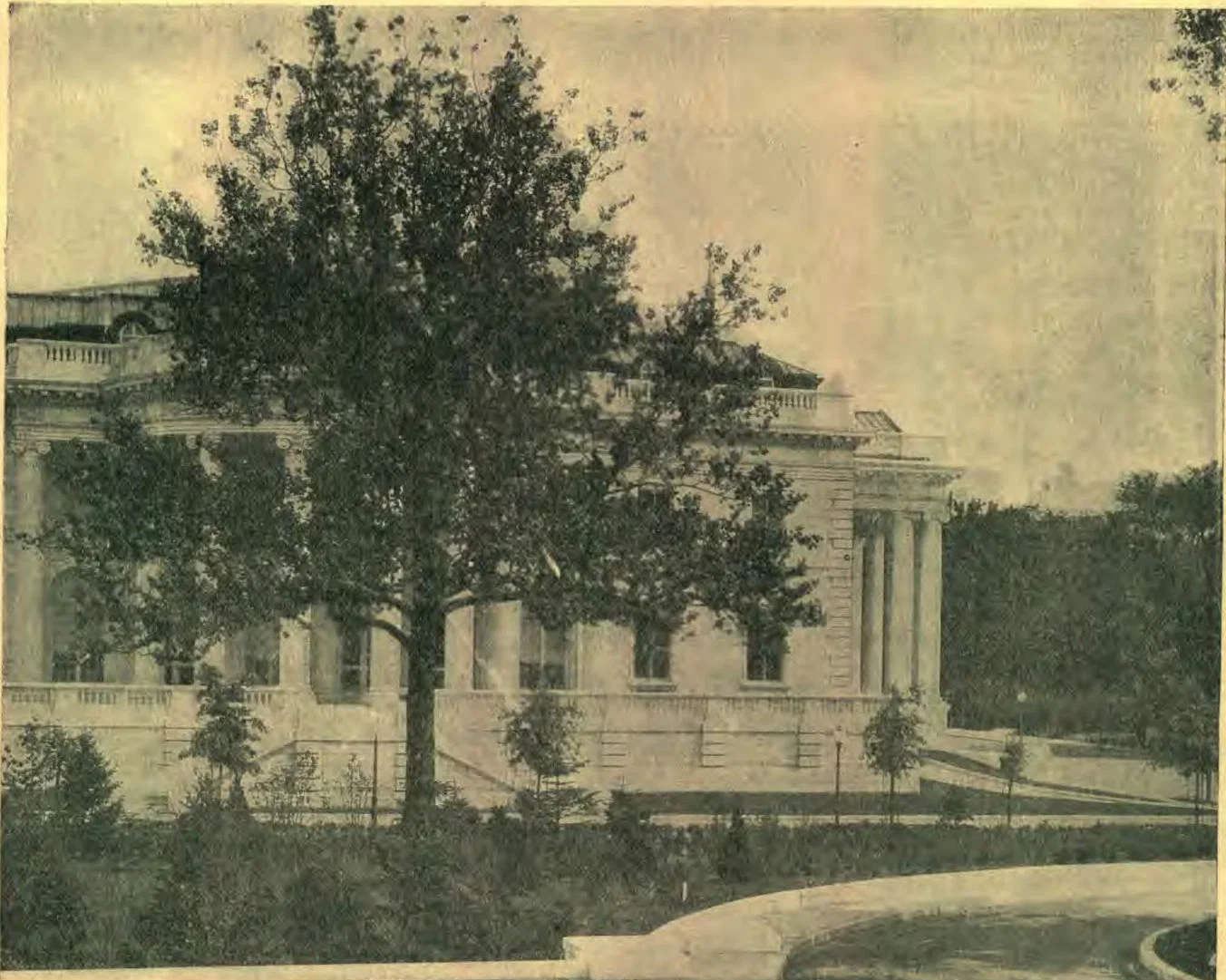
Pan-American Building
THE Pan-American Building in Washington is the home of the Pan-American Union, the official international organization of the twenty-one American republics devoted to the development of commerce, friendship, and peace among them. This noble building, constructed entirely of white marble, and its beautiful grounds, represent an investment of $1,100,000. The greatest living French architect has described the building as combining beauty of architecture and usefulness of purpose. It is literally the capitol of the Western Hemisphere in the national capital of the United States, for there meets regularly within its walls the governing board of the Pan-American Union, which is the actual congress of all the American republics, composed of the Secretary of State of the United States and the Latin-American ambassadors and ministers in Washington. This board has the unique distinction of being the only permanent international peace council in the world, while the building and the organization is the only one in the world controlled jointly by a large group of nations. In its practical everyday work the Pan-American Union is a great international bureau of information. Its director general is John Barrett, former United States Minister to Argentina, and its assistant director, Francisco J. Yánes, of Venezuela.—Young People.

Horsepower Needed to Fly a Small Airplane

A hundred horses, fifty span, would be required to supply the power for a small airplane.
Whole wheat contains about 98 per cent of digestible material, while the average meat has rarely more than 93 per cent.
We are indebted to Koreans, we are told, for our double-entry method of bookkeeping. It was a product of the twelfth century.
When $15,000,000 a day are required to feed the world's soldiers, there should be no waste of food. Let all surplus money be used for supplying food.
William P. Kenney, a former newsboy, has just been elected president of the Great Northern Railroad, succeeding Louis W. Hill, son of the late “empire builder,” James J. Hill.
At thirteen of the cantonments arrangements have been made for feeding hogs on the camp garbage. It is estimated that this will in a year produce more than 18,000,000 pounds of pork meat.
We have our meatless, heatless, wheatless, and wasteless days. Now Senator Smoot from Utah proposes that we have an eatless day once a month. We shall be fortunate not to have more than that before this bloody conflict is over.
Madam Schumann-Heink, the famous sweet singer, is an Austrian by birth; but she is sufficiently Americanized to give three sons to the American army. And for her own war relief work she has been made honorary colonel of the 21st United States Infantry.
President Wilson has authorized the awarding of decorations for acts of heroism, meritorious service, length of service, and wounds, similar to those of the other Allied armies. The order creates four new decorations in addition to the present medal of honor, which is rare and extremely difficult to secure.
Sir Cecil Spring-Rice, British Ambassador to the United States since 1912 until very recently, died on February 14, at Ottawa, Canada. The ambassador had many friends in this country, and showed great skill in handling the perplexing problems that arose in this country because of the entente blockade.
In Montreuil, France, not many miles back of the battle line, French peasants are still permitted to give attention to their peach crop, now made doubly precious by the devastations of war. Here the peach trees are trained on walls and trellises, and climb as does the wild rose. The peach trees are often grafted on almond trees, and under the careful culture they receive from their owners, produce very large and most delicious fruit, which commands a high price in Paris and London markets.
Indiana's State-wide prohibition law was held to be unconstitutional and void by Judge F. M. Hostetter of the Vanderburg County Superior Court, in ruling on a demurrer to a complaint filed by a number of brewing companies against the county prosecutor to enjoin him from enforcing the law after April 2, 1918, the date named for it to take effect. The action of the court disposes of the last of the preliminary steps before actual trial on the facts, and opens the way for an immediate appeal to the Indiana Supreme Court if the “dry” interests desire to take that step.
The Mississippi Valley produces every year nearly 1,000,000,000 tons of commerce. To help in handling this river trade steel barges of unique construction are now being put in operation. These carry more freight than the largest steamboats could carry. Eighteen hours of work by twenty men loading and unloading an electric loader are required to empty one of these of its cargo. These barges are driven by powerful internal-combustion engines driving four propellers. The heating and cooking are done by electricity. The boat is keyed, wired, telephoned, and gaged, everything being done to save steps, avoid smoke, and eliminate friction, whether mechanical or human. The crew of the old steamboat “Robert E. Lee” numbered one hundred twenty-five men, while the new barges are handled by twelve men.
A steel ship for the emergency fleet is launched for the nation at Seattle every eight days. The 21,000 shipyards workers, roused by conviction that ships can win the war; that any let-up will cost American lives; that a slowing down of energy in shipbuilding is just as damaging as would be the inactivity of artillery on the battle front, are working with furious energy, conquering all obstacles. On February 6, the end of a seventy-day period, sixteen steel leviathans had been launched, with a total deadweight cargo capacity of 142,600 tons.
Ten months of the war have cost the United States about $7,000,000,000—at the rate of $710,000,000 a month, nearly $24,000,000 a day. More than half of this huge sum, or $4,121,000,000, has been placed as loans to the Allies, and the balance, about $3,000,000,000, represents America's outlay for its own war purposes, exclusive of more than $600,000,000 for ordinary governmental expenses.
More fearful even than actual death and injury are the effects of air raids upon the minds of children, according to investigations of British pathologists. Great harm is done to the nervous systems of thousands of youngsters, and many are incapacitated from serious endeavor. The only cure is to remove them from the scene of their terror.
According to reports to the United States Food Administration for the week ended February 9, twenty-nine principal articles of food cost less in Washington than the average cost in 1,000 cities and towns, all the forty-eight States being represented in the cities and towns reporting.
The nation's foreign commerce has increased from two billions of dollars in 1913 to nine billions of dollars. There has been placed on the railroads little more than one half the number of locomotives needed to care for the increased traffic, the remainder being sent to France and Russia.

The Faithful Friend

MRS. J. L. VAUGHN
A noisy city street with dust bestrown In sunshine of a sultry summer day, And running round are children at their play, I see a babe in carriage there alone Asleep, fanned by the dusty breezes blown; No mother stands to chase the flies away, Nor passer-by does for a moment stay— His little dog keeps silent watch alone.
The busy stream of life keeps on its way, They do not see the baby sleeping there, Nor little dog that watches with such care; I only see those loving glances sent As on the sleeping child his eyes are bent. Oh! what a faithful, loving little friend! Your weary task will soon be at an end; But in my thoughts the scene will always stay.
Oh, little babe, sleep on while daylight flies! The city noise and strife you do not hear Nor see the patient friend that watches near. Only to me a lesson it has taught, So full of love and patience it was fraught. Oft on the screen of memory it will rise, This scene of life that now before me lies, This day beneath the sultry summer skies.

Washable Virtues

SOMETHING like two hundred years ago, a good Quaker father inscribed under the record of his child’s birth this quaintly worded petition, “And fit her for her long journey, O Lord, with virtues that will wash.”
Those were the days when fabrics were dyed at home, and it was not always easy to get a fast color. Indeed, it is not so many years ago since our mothers used to buy an attractive pattern of cotton goods over the counter, only to see all its beauty blur and fade with the first washing. I am not sure but the same thing happens occasionally even in these days of improved dyeing processes.
“Virtues that will wash.” Turn that homely phrase over in your mind for a thoughtful moment, please. Good qualities of mind and heart — honesty, kindness, patience, and perseverance — are compared here to the colors which make a piece of new cloth beautiful and attractive. And the question raised is whether these good qualities will bear the hard tests of life, and come out of them just as bright as they were before.
One of the most threatening perils of a young life is inexperience. It never is really put to the test until it is launched for a rough-and-tumble contact with the world, where everything depends upon how deeply its virtues are rooted and how much strain they will bear.
A boy might go through his school days without once being very seriously tempted to dishonesty. If he merely believes that “honesty is the best policy,” and that a fellow comes out better by keeping the straight path than by taking a crooked one, he may have trouble later on, when some sophistry of business practice makes things look quite the other way. His virtue is good as far as it goes, but it won’t wash. To do that it must be a sound principle of right, grounded in a conviction that we are responsible to God for how firmly we stand by it or how lightly we let it go.
Again, most of us have little difficulty in being kind to agreeable people, and doing favors for those who, in turn, are ready to do favors for us. When it comes to disinterested kindness, helping people in need, just because they need it, without any expectation of a return, or even a word of appreciation — everything depends upon whether our kindness is dyed in the wool or merely painted on the outside. If it has love behind it, and that love is of the sort which Jesus practiced and commended, it will keep its color, even under the acid test of indifference and ingratitude, and do its best for Jesus’ sake, and for the good of those who need it.
Sometimes a lad fails in life because his industry and perseverance fade out in the first thorough washing. He never considered himself a quitter, but his resolution to accomplish some task never was strong enough to keep plodding on, and on, and on, day after day, apparently without getting much nearer the goal than if he stood still. At bottom, he has no strong conviction that his life was meant for some particular thing, and so he comes presently to drift along the line of least resistance, instead of keeping resolutely at the oars and making sturdy strokes upstream, be the current what it may.
The seed which fell on thin soil and sprang up quickly, but which had no root for a vigorous, fruitful growth, is Christ’s figure of a religion which won’t bear washing. We accept Christ because our emotions are stirred, perhaps, or because it seems the right thing to do, or because others around us are doing it; and, though we may be perfectly sincere, we don’t count beforehand what whole-hearted service of Christ is going to cost us. Presently a big sacrifice is required, — something which bites deep into our ease and self-love,— and we draw back timidly, and begin to make excuses. In other words, our loyalty to the Master will keep up appearances well in fair weather, but it won’t hold its color under a soaking downpour.
Take a mental inventory of yourself, and find out just how much washable material there is in your nature. It is the only part that really counts for much as an asset in life, and it is vitally important that we do not deceive ourselves by taking fast colors for granted. How much wetting and rubbing will your faith in God bear? Is your love for men, your purity of heart, your integrity of purpose, proof against a thorough drenching? We can’t always tell just what will be required of us, but preparedness does a vast deal to anticipate disasters and to prevent them.—Charles T. White, in the Wellspring.

The Danger of One Wrong Step

“ONE wrong step may give you a great fall.”

Who Wins? Shall You? Shall I?

A CHAIN is no stronger than its weakest link. So our Christian experience is no stronger than our weakest point. Upon the characteristic of our life which is hardest to overcome but is not in accordance with Christ’s will and ideal for us, there hangs our real strength.
Sometimes the greatest blessings God has for his children, are inclosed in the crusts of hardship, trial, and even failure, which we are constantly encountering in life’s way. We have work to do, a mission to fulfil. We are not here to play, to dream, to drift and accomplish nothing in this life. We have loads to lift, burdens to bear, that no one but you and I can lift or bear; circumstances, obstacles, and failures to surmount, not merely to pass by and acknowledge that we are defeated, but to know that we have conquered and have fewer weak links in the chain of our experience,
We cannot hope to live in a world without care. Such life is impossible. The greater and more important the place we are called to fill in this life, the more care and perplexity we must meet, the more we must guard our lives to strengthen our weak links. We need to stay our minds upon God, trust in him, and day by day, hour by hour, the chain of our Christian experience will be strengthened.
Many times the hardest task we ever undertook is to overcome, to master, to strengthen these weak links. All do not have the same trials and hardships, nor the same hereditary weaknesses, the same passions and desires. Thus, we must not judge the motives of our friends by their actions. What is my weak link may not be yours. It is a battle between myself and Satan, between yourself and Satan; and who will triumph? Ask yourself this question, “Who will conquer?” Am I to be defeated by one weak link? or, will I take God as my armor in the battle, my Captain, and allow him to win for me?
So frail is human strength that without God we can do nothing. We cannot make of our lives what they must be. We cannot strengthen the chain of our experience. But no matter how low we may sink in weakness, in trouble, in sorrow, or how many times we may faint on the journey, we can never sink below the reach of God’s everlasting arm.
“God hath not promised Skies ever blue, Flower-strewn pathways, Always for you. God hath not promised Sun without rain, Joy without sorrow, Peace without pain. But God hath promised Strength from above, Unfailing sympathy, Undying love.”
No matter how beautiful a character may appear to be, yet without an intimate friendship and daily walk with God there is a link missing. And with just this one link missing our chain will be too short to reach the standard. It is now, in youth, when each year adds another link, this link of ‘knowing God’ must become the master link of our chain. Emerson says: “When duty whispers low, ‘Thou must,’ the youth replies, ‘I can.’” To know God is to have confidence in yourself and others.
The human being craves love, affection, tenderness, and devotion. The most hardened and debauched sinner will respond to a kind word, an act of tenderness. It is only human to love. But why should we shrink from and shun the love and friendship of God? For God is love, God is eternal, tender, and merciful. His gentleness is infinite. Oh, where can we find such love and devotion? Who would do for you and for me what Jesus did? Who would suffer on the cruel cross, and in the garden of Gethsemane, what Jesus suffered for you and for me? Yet, why do we hesitate to reciprocate his love for us? Why do we leave him out of our lives? Let us stop, think, and realize what we are doing!
Our greatest strength lies in the victory over one weak link. Who wins? Shall you? Shall I?
JOSEPHINE FRANKLIN.

Thoughts from Orison Swett Marden

As a man thinketh in his heart, so is he. Keep a high ideal of health and harmony constantly before the mind. A plan in the mind will appear in the statue. The coming physician will teach the people to cultivate cheerfulness, good will, and noble deeds for a health tonic as well as a heart tonic, and that a merry heart doeth good like a medicine. It’s a great thing to have brains, but vastly greater to be able to command them. Self-control is at the root of all virtues. Teach self-denial and make its practice pleasurable, and you create for the world a destiny more sublime than ever issued from the brains of the wildest dreamer. A self-controlled mind is a free mind, and freedom is power.
Give me a great thought, that I might quicken myself with it. The power of grand sentiments and great thoughts refine the face and manner. Love our enemies, for they are very often our best friends in disguise. They tell us the truth where friends flatter. Their biting sarcasm and scathing rebukes are often mirrors which reveal us to ourselves. Friends cover our faults, but rarely rebuke. Enemies drag out to the light all our weaknesses without mercy. We dread these thrusts and exposures as we do the surgeon’s knife, but we are better for them. They reach depths before untouched, and we resolve to redeem ourselves from scorn and inferiority. We are victors of our opponents. They have developed in us the very power by which we overcome them. Without their opposition we should never have braced and anchored and fortified ourselves as the oak is braced and anchored for the thousand battles with the tempest.
The man who has triumphed over difficulties bears the sign of victory in his face; an air of triumph is seen in every movement. Strong characters, like the palm tree, seem to thrive most when most abused. It is defeat that turns bone to flint; it is defeat that turns gristle to muscle; it is defeat that makes men invincible; it is defeat that has made those heroic natures that are now in the ascendancy, that has given the sweet law of liberty instead of the bitter law of oppression. Difficulties call out great qualities and make greatness possible. Few knew Lincoln until the great weight of the war showed his character. Perhaps Phillips and Garrison would never have been known to history had it not been for slavery. The best tools receive their temper from fire, their edge from grinding. The noblest characters are formed in the same way. The harder the diamond the more brilliant the luster and the greater the friction necessary to bring it out. The spark in the flint would sleep forever but for friction. The fire in man would never blaze but for antagonism. The friction which retards a train upon the tracks, robbing the engine of a fourth of its power, is the very secret of locomotion. Oil the track, remove the friction, and the train will not move an inch. The moment man is relieved of friction or opposition and the track of his life oiled with inherited wealth or other aids, that moment he often ceases to struggle and therefore ceases to grow.
If the germ of the seed has to struggle to push its way up through the stones and hard sod, to fight its way up to sunlight and air and wrestle with storm and tempest, the fiber of its timber will be all the tougher and stronger.
Rough seas and storms make sailors. Emergencies make giant men. But for our Civil War the names of its grand heroes would not be written among the greatest of our time.
The prison has roused the slumbering fire in many a noble mind. “Robinson Crusoe” was written in prison. “Pilgrim’s Progress” and Penn’s “No Cross, No Crown” were written by prisoners. Sir Walter Raleigh wrote “The History of the World” during his imprisonment of thirteen years. Luther translated the Bible while confined in the castle of Wartburg. Every obstacle overcome lends strength for the next conflict.
Obstacles and oppositions are but apparatus of the gymnasium in which the fiber of manhood is developed. Through pit and dungeon Joseph came to the throne. There is no more helpful and profiting exercise than surmounting obstacles. A constant struggle, a ceaseless battle to bring success from inhospitable surroundings, is the price of all great achievements.
If you think there is no difference between the plank made from the rugged mountain oak and one from the sapling of the forest, place both planks in the bottom of a ship and test them in a hurricane at sea.
The sculptor thinks only of the angel imprisoned in the marble block. So nature cares only for the man or woman shut up in the human being. The sculptor cares nothing for the block as such. Nature has little regard for the mere lump of breathing clay. The sculptor will chip off all unnecessary material to set free the angel. Nature will chip and pound as remorselessly to bring out our possibilities. She will strip us of wealth, humble our pride, humiliate our ambition, let us down from the ladder of fame, discipline us in a thousand ways, if she can develop a little character. Everything must give way to that. Wealth is nothing, position is nothing, fame is nothing, manhood is everything. Not ease, not pleasure, not happiness, but a man, nature is after.—Compiled by Emma Musick.

The City over There

THERE'S a land of joy and sunshine, Where the shadows never fall: There we'll meet our blessed Jesus, Our Saviour and our all.
Here life's ways are sad and dreary With the pain of toil and care, And our thoughts, they wander often To the city over there.
Dimly think we of the glories That nevermore shall fade; We will praise our God forever For the beauties he has made.
If we're faithful through life's journey, Till our days are at an end, We shall meet our blessed Jesus, He our Saviour and our Friend.
When we see that glorious city, We shall feel for all repaid— For the life of toil and duty— In the home that God has made.
In that fairest of all cities, With our King forevermore, We shall live in joy forever And our partings shall be o'er.
DOROTHY BROCKMAN.

Safety First

“SAFETY FIRST!” How it greets us, and warns us, and admonishes us from every point of advantage! About the railways especially, and the manufacturing plants, does this trite warning shock us into carefulness and thoughtfulness. How quickly our minds revert to the dangers around us when our eyes are greeted with the friendly warning “Safety first.” It is right; we should “play safe” and take good care of these bodies until God is ready to have them laid aside.
To disregard these warnings of physical danger and carelessly allow ourselves to be mangled and crushed or killed outright, would be criminal carelessness. It would be wrong.
We must remember that one who, in spite of modern safety appliances and warnings, falls victim to accidental violence, and is rushed in motor ambulance to the modern operating-rooms of the well-equipped emergency hospital, where trained surgeons and cool-headed nurses exert all their skill in restoring the mangled body to its natural uses, is never the same again, even though all was done for his recovery that could be done. He cannot grow another hand or foot or even a new finger,—he is forever under the influence of that accident. He will carry the marks of that experience to the grave.

Our Spiritual Surgeon

So in the matter of spiritual safety,—in safeguarding our souls. If we disregard the “safety first” warnings of the gospel message and are crushed under the wheels of sin, we must forever labor under the handicap of that experience and bear the scars of the conflict. All the machinery of the church cannot restore or replace the innocence and purity lost through the violence of sin. The spiritual emergency hospitals are unable to remove the fact of the accident. If we fail, I say, to heed the “safety first” cry,—important things first, first things first, if you please,—and in spite of spiritual safety appliances and devices installed to protect us (such as prayer, reading the Word, attending divine worship, helping-others), if, in spite of all these, we have a spiritual accident and make shipwreck of faith, then we have an advocate with the Father, Jesus Christ the Righteous One, who will act as our spiritual surgeon and bind up our wounds and heal all our infirmities. But even he, our so great Physician, cannot remove the scars of the conflict. We are forgiven if we confess and repent; our sins are washed away; our guilt is purged; but—
“The bird with the broken pinion Never soared so high again.”
Adam and Eve were forgiven, and their sin blotted out, and their names head the list of the millions written in the book of life, but they lost Eden; and the bitter remorse of their transgression followed them for hundreds of years. They could not get rid of the marks of their experience.

Experience a Good Teacher

How much better it would be if we could learn to profit by the experience and sufferings of others and not have to be torn and broken by the so-called “best teacher.” Experience may be a good teacher, but it is a very unpleasant one, and usually brings with it misery and bitter reflections. We need to learn from the Word of God. We need to be warned by the recorded failures of others and by the suffering those failures have cost. We need to shun evil things as we would and do shun the deadly wheels of the railroad trains; and as we heed the “safety first” signs along the right of way, we must be obedient to the “safety first” admonitions of God’s most holy Word, and through the strength of Christ “turn from evil.”
J. D. MONTGOMERY.

The Swan’s Library

[The following article appeared in a Spanish magazine, published in Tegucigalpa, Honduras, Central America. Brother Henry Brown, who has charge of the work in that field, finding the article interesting as voicing perhaps the troubles of owners of books in every land, translated it for the INSTRUCTOR.]
ONCE the wolf went to pay a visit to the swan and found him profoundly melancholy. The visitor on entering said affably, “I find you just a bit melancholy.”
“Yes,” responded the swan, “sorrow always invades my soul when I think that this world must be well supported not to sink beneath the ponderous weight of knavery and villainy there is in the hearts of the beings that inhabit it.”
“Bah,” exclaimed the wolf smiling cheerfully, “that isn’t sufficient reason for so much melancholy. The fact is, my dear friend, that all wickedness in the world is inherited. Why should we be commanded not to practice deceit, when we are naturally imperfect? But come, what unlucky occurrence has provoked in you these mournful ideas?”
“The recollection that my library has been plundered,” replied the swan.
“How? By whom? Have your walls been scaled or your house broken into?”
“No,” said the swan; “I myself delivered the books to the thieves.”
“Then,” replied the wolf, laughing heartily, “there hasn’t been theft or robbery; it has been a simple donation.”
“No,” protested the swan, “I gave them as a loan, with an understanding that they would be returned, but they have been kept: books by celebrated authors, as Guizot, Herodotus, Taine, Thucydides, Euripides, and—but how can I name them all? All have disappeared!”
The wolf instantly became serious. There was a long silence, then he said, “Come to think of it, Friend Swan, I believe I have a book of yours that you were kind enough to lend to me, entitled ‘Infallible Rules for Catching Easily All Birds.’ This book has been very practical to me, and I have retained it in my possession for several years now, it is true, but I had never intended to preserve it as my own.”
“Oh, of course not,” interrupted the swan courteously. “You understand I was speaking without reference to you. I was thinking of that legion of rapacious rogues who form their libraries from the libraries of others. Do you not consider my indignation justifiable?”
“Certainly,” agreed the wolf, “but why do you not make use of the same methods?”
“Of what methods?” asked the swan.
“Of those practiced by your enemies—of borrowing books and retaining them so as to enrich your library.”
“Oh, no!” objected the swan, shocked, “that would be rude. And then I still have quite a number of books from which I may derive entertainment.”
There was another long silence. The wolf was a bit ashamed, and desired by some good advice or helpful hint to remove the impression caused by the remembrance of the borrowed book he had intended to keep as his own. Presently he said, “I believe I can tell you of an unfailing means of recovering your lost books.”
“What means is that?” asked the swan, doubtingly.
“Go to each of your ‘book keepers’ and confide in him as you have in me this afternoon, and I assure you that the books will soon be delivered. I had no intention of appropriating your book, it is true, but had I had such an intention, after listening to your distressingly pitiful tale, I should have returned it to you without delay. Make use of this same means in approaching the other delinquents, and you will see its efficacy where they easily suffer shame, and even where conscience is dormant.”
“Ah, my noble friend,” said the swan, “you are not acquainted with the soul of some individuals in whom remorse does not exist. Imagine! I loaned upon one occasion to a certain personage a book that I myself had not read. In a few days I met him on the street, and he said to me as cheerfully as you please, rubbing his hands together, ‘That book you let me have is magnificent! I’ll just keep it; my library lacked just such a book. A thousand thanks.’”
“And what attitude did you assume?” asked the wolf.
“Well, before such brazen audacity I could but remain mute with surprise.”
“Had I been in your situation I should have given him such a response that he would have considered himself fortunate to have escaped with his life.”
After this dialogue and after having talked of politics and the war the wolf warmly shook the swan’s foot and left.
The swan, desirous of testing the practicability of the wolf’s suggestions, visited the possessors of his books. He spoke to the fox, who understood at once the insinuations of the swan, and discreetly gave up his borrowed tomes. He spoke to the owl, who returned the books that night. He spoke with the turkey, but that creature did not gather that he himself was alluded to, and after listening to the lamentations of the swan, he exclaimed:
“But that is monstrous! Plundered your library! That is unhearable! You should not allow yourself to be surprised by these speculators of friendship who borrow books and then do not return them.” The turkey had the complete works of Shakespeare that he had kept for several years. He immediately changed the conversation.
The swan, after having approached the turkey, the pelican, and other individuals of the same stamp, tired of his labor and preferred losing his books. But in compensation he placed in the vacancies on his shelves cardboard shaped like tombstones, with sorrowful epitaphs giving the names of the books that had disappeared.
“Do not lend your wife or your horse,” counseled the Arab; and we may add, “nor your books.”—Luis Andres Zuniga.

Unhappiness Is One's Own Fault

If a man is unhappy, remember that his unhappiness is his own fault, for God made all men to be happy.— Epictetus.
Continue reading: Doing Plain Things in a Beautiful Way