EVERY girl wants to be beautiful, and rightly so; but not all girls are blessed with beauty of face and form. But there is one kind of beauty which every girl may cultivate; and if she makes it the daily habit of her life, in time even the plainest features will take on a form of loveliness, the reflection of inner beauty.
What is it that every girl may cultivate? It is doing things in a beautiful way. The most humble task may be made lovely by doing it in a gracious way, and unconsciously the one who does this grows an inner beauty that radiates from her personality, giving it a charm all its own.
There is all the difference in the world between a task done in a beautiful way and the same task done in an unlovely way. This is true in the home, in school, in social life, in business, and in our church and Sunday school work, and every girl can cultivate the beautiful way of doing things. There are many tasks in the world that do not seem very lovely in themselves,—tasks that are hard and unapplauded and some that even seem like drudgery,—but if they are necessary tasks they are noble ones, and we can make them dignified and lovely if we do them in a beautiful way.
Then there are some tasks which come to all of us—like the simple one of saying “Good morning” to our families, which may be done in one of two ways. Have you noticed that some folks say “Good morning” in so ungracious a way as to upset others for hours and hours, while some give the greeting with such kindliness and charm as to cast a radiance over the entire day?
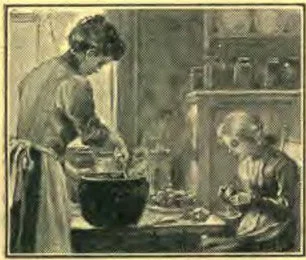
The motive which prompts a deed and the way in which we do it are quite as important as the deed itself. In every home, for example, dishes must be washed. Now, the daughter may help mother wash the dishes because she feels that she must, and she may sulk throughout the process. Or she may have chosen as an ideal to do things in a beautiful way; and knowing dishwashing to be a necessary task, she recognizes it as an opportunity for service, and with the fixed purpose of being truly helpful and doing all things in a lovely spirit, she washes the dishes, filling the kitchen and mother’s heart with sunshine as she does so. One may light a fire in a grate in so beautiful a way as not only to warm the physical bodies, but to cheer the heart and refresh the spirit as well. One may set a table and serve a meal in a way that will not only satisfy physical hunger, but give spiritual strength and comfort.
And this principle applies in our social life, our school and church work. The most brilliant social affair planned by a committee is a failure if jealousy or selfishness or touchiness is allowed to come in among the committee workers. The most remarkable record of a class president is not a success if the girl has worked from desire for praise or for self-glory. The most humble class task performed from the desire truly to serve and done in a beautiful way, with love the motive, is the real success. And so in all life’s relationships the spirit of our deeds, the way in which we do them, is the thing which determines their real value in the eternal reckonings. To do things, from the simple, most humble task of the daily routine to the most responsible and exalted one of special opportunity, in a beautiful way, is to grow in grace and loveliness, radiating beauty and joy wherever one goes. This is an ideal worthy of every girl’s choice.—Elizabeth Nevison, in the Visitor.
Appreciative Young People
By G. W. Tuttle
NINE persons out of ten have thoughts that are appreciative; the tenth man speaks out loud. You have heard the story of the wife who prepared an extra good supper for her husband, which he ate with great satisfaction, but in silence.8
“Did you enjoy your supper?” said the good wife. “Why, certainly,” replied the well-fed and contented husband.
“Why didn’t you say so, then?” said the expectant wife, with a smile.
Young people, be appreciative! It will make life worth while for you and for those about you. Appreciation is like oil upon the troubled sea of life; it makes smooth sailing. Look about you! Open your eyes! You may find some timid, shrinking young person who is simply starving for a word of appreciation. Appreciation to such a life is often what the dew is to the flower. It is easy enough to say, “Virtue is its own reward;” but let us add our flower of appreciation.
Appreciate your friends—their virtues, kindness, ability, faithfulness, love. Have wide-open eyes for their virtues, but be a little blind toward their failings. A true friend is worth more than all the gold of earth.
Appreciate the good in people who have not been your friends—yes, even in those who have illtreated you. Get the habit of looking for the best in every one. Appreciation is a magnet that draws the best in hearts and lives to the surface.
Appreciate aged people, those who are bent with the storm and stress of many years. Be sympathetic, kind. How age loves youth when youth is sympathetic, kind, considerate! Never mind the peculiarities of old people; a little true goodness will outweigh many peculiarities. Kindness to the aged pays big dividends and opens joy founts in the hearts of both youth and age.
Be kind to children; appreciate their smallest attempts to please. Many a good purpose dies in the heart of a child because none appreciate.
Appreciate tired people who have toiled long and are weary. Don’t expect weary people to be always angelic. Rest them by a little appreciation if you would have them good-natured.
Appreciate your pastor. Has he been helpful to you? Tell him so. He may have had a strenuous day, and your appreciative words may be the bright spot in his day that makes his heart leap and sing for joy. Possibly when he prays that night he will say: “Thank God, it pays! I am helping some one.”
And, most of all, we must be appreciative of our Father’s goodness and remember his blessings with glad hearts. Be like the smiling little Salvation Army lassie who came in just now to sell me a War Cry. I said: “Why are you smiling? Do you know that the clouds have covered the sun, and it is dark and threatening?” Her smile broadened as she cheerily replied: “I am smiling because the sun shone this morning.”
If the clouds gather as the day wanes, let us not forget to be thankful for the sunshine of the morning.
— G. W. Tuttle, in the Visitor.
A Good Letter
[A young man who has been serving as stenographer at one of our general offices was recently suddenly bereaved of his mother. In response to a letter of sympathy written to him by the editor, the following letter—a beautiful portrayal of filial devotion and Christian character—was received. Without permission the editor passes it on to INSTRUCTOR readers, hoping it may incite to greater appreciation of parents, and to more frequent expressions of appreciation by word and act.]
YOUR very kind letter of the first instant, bearing its message of sympathy and comfort, was received with an appreciation of the kind thoughts which prompted its writing. Our friends have been very tender and sympathetic with us in this dark hour, and it has helped a great deal to bear the loneliness of the loss of the one whose place in the home cannot be supplied as it was so fully and sweetly filled by my mother.
I know that my mother was a rare jewel whose excellence and grace shone forth brighter and more beautiful the longer I had her and the more I knew her. God was most marvelously good to me in giving me such a mother. No boy or girl ever had a better. There may have been some almost equal to her to some other boys. But no one ever will know as well as I do what that loving mother’s care meant and will mean to me, or what pitfalls which are laid for every young boy’s feet were escaped because of the eternal vigilance and devotion of my mother. She had given me to the Lord from a child, and was determined by the grace of God to prevent the snares of the enemy from stealing me away from that consecration. I truly thank God for the privilege of having my mother these years, and pray that he will give me the strength and manhood to live up to the ideals mother had for me.
One thing is quite a comfort to me just now, too, and that is the fact that I appreciated my mother while she was living, and told her so. I have heard of the regrets that some boys have expressed when their mothers left them, because they had not appreciated the worth of a mother while she was yet with them, or if they had, they had not expressed that love and appreciation. While I could not know what was coming, I was determined that no such thing would ever happen in my case. I have now truly learned by experience that great comfort comes from such memories, and I wish you would tell my boys in Sabbath school not to be timid about going up to mother, and telling her they love her. They cannot tell when she may be taken from them. No, the boys have not written me yet. I wish they would. The longer I was with them the more I came to like them, and I longed to see the time when they would give their hearts all to Jesus, and live only for him.
Father and I do not mourn as those without hope. We know that mother is sweetly resting, having escaped the terrible scenes and pains of the time of trouble. To her it will be but a moment till she hears the voice of Jesus calling her. The coming of Jesus and the resurrection have become very real events to us in the last few days. I have a personal interest in both now, and my greatest desire is to see the work of the gospel finished quickly, so that this separation may be ended as soon as possible. May God grant it.
With best wishes and friendly esteem, I am Very sincerely yours.
Warning to the Young
By Josephine Smith
MY cry to every Seventh-day Adventist young person is, Do not marry an unconverted person. It is natural for every normal person to desire a life companion, but it is far safer and better in every way to remain single rather than marry one who is not a true believer in Christ. I am personally acquainted with many who have married out of the church, and most of them have had little else than sorrow. One young woman married a worldly man twenty-five years ago. To them were born six children. All of these who are grown are out in the world, and the mother is crushed and sad. When the mother would attempt to teach the children the Sabbath school lesson, the father would make fun of them. When the mother, who has been faithful in holding morning and evening worship, would gather her children for prayer and reading of God's Word, the father would often command9one or more of them to go on an errand. And even now, after all these years of unkindness and sorrow, as the mother arises early so she can study her Morning Watch verse and read the Bible undisturbed, if the father is out of humor he tells her if she would let that old Book alone she would get her work done better. Much could be added to this recital, and there are many other persons living amid similar perplexities.
It is better, far better, to remain single than to marry a young man not of your religious faith. May God help our young people to see and shun the sorrow of unholy matrimony. God gives command not to be unequally yoked with unbelievers, therefore one should not encourage the attention of worldly people nor cultivate intimate association with unbelievers.
JOSEPHINE SMITH.
A Birthday Present to the Nation
THE heart of an airplane is its engine. We know a great deal about gasoline engines, especially automobile engines; but an airplane engine is a very different proposition. It must be tremendously powerful, and at the same time extremely light. Every ounce of unnecessary weight must be shaved off. It must be built with the precision of a watch, its vital parts must be true to a ten-thousandth part of an inch. It takes a very powerful horse to develop one horsepower for a considerable length of time. It would take one hundred horses to supply the power for even a small airplane, and they would weigh one hundred twenty thousand pounds. An airplane motor of the same power would weigh less than three hundred pounds, which is a quarter of the weight of a single horse. It was this powerful, yet most delicate machine that we were called upon to turn out by the thousand. There was no time to waste; a motor must be designed that could be built in the American way, without any tinkering or fussy handwork.
Two of our best engineers met in a hotel in Washington on June 3, 1917, and worked for five days without once leaving their rooms. They had before them all the airplane knowledge of our allies. American engine builders offered up their trade secrets. Everything was done to make this motor worthy of America’s reputation. There was a race to have the motor finished by the fourth of July. Sure enough, on Independence Day the finished motor was there in Washington—the “Liberty motor,” a birthday present to the nation. It was a wonderful engine. Twelve different factories, from Connecticut to California, had helped to make it, yet so accurately had the parts been machined that they were assembled and put into a single motor without any special hand fitting. The Liberty motor has stood up splendidly under every test.10
Big factories are now making the motor, and before this article is published the Liberty motor will be turned out by the thousand.
A Twenty-six-Acre Factory
The bodies and wings of our air fleet are being turned out in other factories. One big plant, which was built in three months’ time, covers twenty-six acres with a single building. It measures nine hundred feet one way and thirteen hundred feet the other way. To give some idea of its enormous size, let us imagine how it would look if placed in the heart of New York City. Suppose we pick out Madison Square as the site of the vast factory. We should have to push back a little the buildings on the north and south sides of the square to squeeze the factory in, and then we should have to tear down the buildings on the west side of the square nearly all the way to Sixth Avenue to make room for the enormous length of the structure. The factory is an enormous mill into which canvas and spruce are being fed at one end, while from the other end a steady stream of airplanes will be ground out, when everything is in good running order, at the rate of fifty machines a day, or one every nine and a half minutes of an eight-hour workday.—St. Nicholas.
Favorite Axioms
To dodge difficulties is to lose the power of decision.”
“Many spoil much good work for the lack of a little more.”
Do not grasp at the stars, but do life's plain common work as it comes, certain that daily duties and daily bread are the sweetest things of life.—Lord Houghton.
No one is useless in this world who lightens the burden of it to any one else.—Dickens.
The Voices of Spring
By Grace E. Bruce
“Thou makest the outgoings of the morning and evening to rejoice.” Ps. 65: 8.
I WANDERED down to the meadow
One morning in early spring,
To list to the meadow voices
And the songs they love to sing.
It was in the early morning,
The sun was just peeping up,
Each sweet wild rose ’twas kissing,
And the yellow buttercup.
The air was filled with music,
And all nature’s arches rang,
As the songs of praise ascended,
While the meadow’s chorus sang.
A million pearly dewdrops,
Were seen in the fragrant grass,
A squirrel climbed an ancient oak
And chattered as I passed.
On a willow slender, swinging
Above the streamlet gay,
A wood thrush sweetly warbled
To greet the sun’s first ray.
As I listened in silent rapture
To those notes so sweet and clear,
The world and its treasures receded,
The riches of heaven grew dear.
And I read in the book of nature,
Lying open before me there,
“Thy works, O Lord, shall praise thee,
Thy greatness shall they declare.”
GRACE E. BRUCE.
Are You Planning Your Garden?
Of course you are going to have a garden this season. If you have no garden plot you can make one out of a window, a box, and some dirt. Lettuce, radishes, and parsley can be thus grown. Women have sometimes supplied their tables with the products of such gardens. There are few who cannot find a garden plot that they can rent, buy, beg, or borrow for use during the summer; so boys and girls, find your plot and begin work at once. Seeds can be obtained from local sources; or the Children's Flower Mission, of Cleveland, Ohio, will supply you with penny packet seeds of flowers and vegetables. These are regarded as reliable. Last year the firm supplied 71,000 schools with seed. The reason it can sell good seed so cheaply is partly due to its immense business. Last season it purchased cucumber, lettuce, and radish seed by the ton, and sold more than two tons of sweet peas and one hundred fifty bushels of nasturtium seed.
Where They Get Their Seed
It may interest you to know that in the past “the best beet, carrot, and radish seed have always come from Europe, but owing to war conditions only small quantities are now available from that source. Growers in California, Michigan, and other States are now supplying these varieties, grown from French stock seed, which are quite satisfactory.
“A few years ago ninety per cent of all flower seed were grown around Erfurt and Quedlinburg, Germany. Today the American supply is mostly grown in Southern California, where hundreds of acres are devoted to their production, one of our growers alone requiring more than twelve hundred acres.”
Write to the editor and tell her all about your garden. She would also like to know what you accomplished gardening last year, and how you plan to make your effort this year count for more than it did last year. But whether you do this or not, plant a garden.
Birds and the War Garden
EVERY boy and girl in this country wishes to do his or her bit to help win the war, and there are many who will be raising vegetables and fruits this summer. There will be many war gardens, large and small. In planting the plots in the spring we should remember that all crops must be guarded against insects. The best helpers we can possibly have in keeping away the worms and bugs, are the birds, for these winged allies of the farmer and the gardener are fighting against the insect pests in both winter and summer. Even when the weather is cold they are boring into the bark of trees, hunting for the eggs of the insects; and when spring comes they are never idle.
The National Association of Audubon Societies, at 1074 Broadway, New York City, has a young people's branch called the Audubon Junior Classes. The association would like to have enrolled as members every boy and girl in the United States who is making a garden this year, or who would like to help in protecting the many useful birds. These creatures are aiding the farmer to keep his crops from being destroyed by insects and mice and from being choked by weeds. If the birds help, there will be many millions of weed seeds eaten before they have a chance to grow this spring.
In order that the children of this country may learn how much help the birds are in war time, and thus learn to protect them, the following offer has been made. The association this year has issued a new series of eight leaflets for the use of the junior classes. These leaflets describe the bald eagle, egret, meadow lark, bobolink, downy woodpecker, scarlet tanager, towhee, and white-throated sparrow. Special stress is laid upon the description of the eagle, for the entrance of the United States into war has concentrated much attention upon the bird which serves as our national emblem. The studies of the eagle are based upon personal observation and upon a digest of the highest authorities. Each leaflet is accompanied by an accurately colored portrait of the bird treated, and also a reproduction of an outline drawing, which school pupils may color for themselves.
In connection with the junior work the association has also printed a folder on heavy cardboard, arranged as a cabinet, in which are displayed pictures of seventy-four birds in the natural hues of their plumage. These cabinets will help bird students in recognizing the various species.
Through the generosity of General Coleman du Pont and others the National Association has been able to furnish these publications at a merely nominal charge of ten cents for the series, which is about one half the actual cost. The association's plan is offered to all teachers who are willing to conduct simple bird-study classes of fifteen pupils or more. They not only assume no expense, but receive much valuable material free, including the magazine Bird-Lore, by sending the $1.50 collected from a class.
An Unbelievable Discovery
By Walter K. Putney
ABOUT thirty-five years ago there lived in Arizona a tribe of Apache Indians, led by Chief Geronimo. These Indians troubled the settlers so much that at length the frontiersmen followed them into the very heart of the Apache country. Several pursuits were made, and during one of these a cowboy by the name of Adams found himself in a remote and previously undiscovered petrified forest.
In this forest the cowboy noticed petrified wood of a wonderful coloring. There were reds, grays, blues, and greens, so blended as to make rarely beautiful combinations. He examined these very carefully, and reported his discovery to the governor of Arizona.
People laughed at him, because previous discoveries of agate had found only neutral tints, which lacked the perfect likeness of the trees from which they were formed. These new agates, however, showed concentric rings, radiating lines, knots, and bark in almost perfect duplicate.
When this cowboy was told bluntly that his story was not believed, he said that he would bear all the expenses to the place and return for any party the governor might appoint, if the forest was not found to be as he described it.
An expedition was fitted out, and the scientists found in the depths of a lava desert the remains of what had once been a great forest, now changed into brilliant-hued, translucent agate, bordered by petrified bark, with every knot and ridge visible.
Cutting and polishing such agates is done with great difficulty. Often it takes a month to saw through an agate log. No steel has been made hard enough to do the work, and so saws with diamond teeth have to be used, together with diamond dust.—Walter K. Putney.
Happiness Was Made to Be Shared
HAPPINESS was made to be shared.—Racine.
Breathes There the Man: Walter Scott's Patriotic Verse
Breathes there the man, with soul so dead,
Who never to himself hath said,
This is my own, my native land!
Whose heart hath ne'er within him burned,
As home his footsteps he hath turned,
From wandering on a foreign strand!
If such there breathe, go, mark him well;
For him no minstrel raptures swell;
High though his titles, proud his name,
Boundless his wealth as wish can claim;
Despite those titles, power, and pelf,
The wretch, concentered all in self,
Living, shall forfeit fair renown,
And, doubly dying, shall go down
To the vile dust, from whence he sprung,
Unwept, unhonored, and unsung.
—Walter Scott, in “The Lay of the Last Minstrel.”
Relationship
By George Matthew Adams
A COMMON ownership runs the race. And there is nothing so comforting as to realize that what belongs to each of us quite as much belongs to everybody.
The house you think you own, your lands, your business, your books, your jewels — your all. In reality, these are only yours on loan. You can’t take them with you when you quit this earth. Somebody will take them up where you left them, and after him some one else, and so on. Even the applause given you today will be handed to some one else tomorrow.
Even you belong to some one else. Your efforts toward success and happiness cannot turn solely to you. No man loves isolation. It would finally break the hardest heart.
Relationship makes folks possible. No one is so happy as when he is doing something to make some one else happy. If you doubt this statement, put it to the test and learn for yourself. If you are greatly gifted, share those gifts and you will presently realize that your gifts have enlarged. For it is only by giving away that you are able to get.
The next time you feel like getting the best of the other fellow, bear in mind that that chap is related to you. That fact will make a difference worth considering.
Think this over, you, whoever you are. We all have something in common. Our faces all look something alike. We laugh and weep and get stirred up over about the same things. There isn’t very much difference between any of us, after all. So I think that if you can stand me, I can stand you, and be mighty glad that there is a relationship, rich and fine and healthy between us.—George Matthew Adams, in “Take It.”
Books of Worth
By Annie Hamilton Donnell
GRADED Exercises in Punctuation and Use of Capitals.” Price, 25 cents.
“Winning Declamations — How to Speak Them.” This book consists of more than one hundred selections from the writings of President Wilson, Messrs. Bryan, Roosevelt, Borah, Grady, Lane, Root, Twain, Finley, Jerome, Kipling, Van Dyke, and Vest, and many other good writers and speakers. Price, $1.25.
“Poems My Children Love Best of All.” Price, $1.25.
“Take It,” by George Matthew Adams. Price, $1.
“In Nature’s Haunts with Youthful Minds.” Price, 75 cents.14
her own. Not this little face, but her little face—hers, that belonged to her.
“Poor thing, you haven’t any, have you?” murmured Milly’s voice, but so gentle a one and so full of sympathy that it was scarcely an interruption.
She wondered at herself that she did not resent it. She had always been quick to resent things.
“Did yours—have you lost yours?”
She shook her head, dumb with the pain at her breast.
“O poor thing! then you never had one.” Milly whispered. “I’m sorry,” she added simply, and stooped to kiss her little sleeping son. Her common face was uncommon with love.
The lady saw it through her tears, beautified. Around them both, the woman denied and the woman beautified, reached clean stretches of fields and woods, a thread of river, a lake in the sun. The cry of their common sex drew them together.
It was a humble enough meal. The lady had never shared a humbler one. At first there was natural embarrassment in the presence of a stranger; then the spirits of the children asserted themselves, and a babble of small tongues arose, with the undertone of John’s deep bass. Shrill laughter was provoked by small witticisms, and the mirth ran high.
“Do you mind?” Milly asked in half apology, half pride. “They’re just children. John’s one, too.” Her eyes dwelt enjoyingly on the big, unbeautiful features. “He doesn’t get a chance to laugh like that often, and I’d hate to stop him—”
No, no, he must not be stopped. The lady did not mind. Mind? She would like to be able to laugh like that herself. It was genuine and wholesome and sweet, and she had missed genuine and sweet and wholesome things, and hungered for them, and thirsted. The Johns she had known had been artificial Johns.
“I envy you,” she cried sharply to the wife of this humble John, the mother of these humble, laughing children.
Confidences came with after-dinner relaxation. Milly, with her baby leaping in her arms, made a confession.
“You can’t guess something. John and I were angry with you for coming, at first! It seemed kind of mean, when we wanted to come alone, just us and the children. We didn’t think you had any right; it was going to be our Mount today, we said. Weren’t we pigs? But first John came to, and then I did. I can stay a pig longer than John can. ‘She’s got just as good a right as we have,’ we said then, and felt better. And here we are being glad you came!”
The lady’s eyes sought for distances. Could she make her own confession? No, no, she lacked Milly’s courage. She could not say: “I can ‘stay a pig’ longer than either of you. I should be one now if you and John had not saved me.” She did not want them to know; she felt a humble desire to remain in the good graces of these plain people.
The baby lurched toward her, and she held out her arms to him in sudden inspiration. She would confess to the baby!
Her lips found a little pink ear. “You tell them for me after I’m gone,” she whispered. His little hands clutched at her hair, her ribbons, her heartstrings. “Be sure to say I’ll never do so any more.”
In her room at night she reviewed things.
She had found real people and spent the day with them.
She had had her Sermon on the Mount. She had brought home with her new creeds—and the touch of tiny fingers on her face.—Annie Hamilton Donnell.
Rain
[The little book “Take It,” from which this and the two following selections are taken, consists of about one hundred fifty short, virile, inspiring articles, the kind of suggestions that help children and youth, together with older ones, to find the best of life. Price, $1. Order of the Review and Herald Publishing Association, Takoma Park, D. C.]
MUCH of the most profound in life is expressed in the rain that we always seek to avoid, but hardly to study.
What pictures of our moods in the raindrops! Now slowly, silently falling into a dark and gloomy day; then, in torrents, with fierce, cruel-like force beating its life toward the earth; and again at other times, gently dropping, colored and flickering from the soft rays of the sun, all the beauty and glory of nature joining in its frolic.
Rain — how human you are!
Good Losers
SOMETIMES those who fail — win. There is something big and fine and inspiring about a good loser.
No one ever wins all the time.
The three hundred brave men at the pass of Thermopylæ who saw certain failure rushing fast upon them unto their death, never flinched, never faltered — but lost — finally to win on into the centuries and to inspire millions to big deeds and big sacrifices.
No one ever wins all the time.
But the fields of battle can never corner the heroic actions of the world. The everyday has her victories, her heroes and heroines — in the home, at the office — everywhere. And here it is that we daily applaud the good losers as well as the winners. For—
No one ever wins all the time.
Baseball is one of the greatest sports of all times. Poor in something is the man or woman who does not appreciate this game. Daily, as fine a bunch of good losers as ever walked or breathed is revealed on the baseball diamond. One of the finest examples in all baseball of a good loser was the great pitcher, Christy Mathewson, of the New York Giants. He was one pitcher that every spectator always liked to see win. For when he lost — he was a good loser. He always took his medicine with a smile, thereby making character alongside baseball history.
No one ever wins all the time.
So, be a good loser always. Smile it out, and grit it out. Your chance will come again. Perhaps the very next time you will be a winner. You surely will be if you are a good loser now.
Our Counsel Corner
By A. B. E.
Is it best for young men and young women to do missionary work for each other? R. E.
A worker of wide experience says: “The only way in which they can do missionary work for each other is in each making of himself or herself the very best representative of everything that is best and truest in good manners, according to the divine model, and then leave the detail work for young men to men, and for young women to women. Any man who must be led to Christ by some woman, instead of some good brotherly man, can never be saved.”
Why are the subjects of the programs of our Missionary Volunteer meetings printed three months in advance in the Gazette? L. L.
For just one reason! Can’t you guess what it is? Why, it is so that every Missionary Volunteer leader, and every member of the program committee, where are program committees, may have their eyes wide open to see everything that would have a bearing on that meeting. Don’t you know that ten persons can bring more ideas to any one subject than you can bring all by yourself, or than I can bring all by myself? Suppose, for instance, we take the subject for April 20—“Living by Principle.” In all our reading, between the time to prepare for this meeting and the present, we should think what it means to live by principle, and15be on the lookout for illustrations and examples that will be a help in the meeting. Or take the topic for May 11—“Mission Pictures from the West Indies.” If we remember that we are going to study the West Indies in one of our Missionary Volunteer meetings, we shall be on the watch for everything of interest we can find about that field. We shall read our papers carefully, and preserve any items of interest that will be of help in the meeting.
So that is the reason. Are you co-operating? A. B. E.
A Boy’s Promise
By George Cooper
THE school was out, and down the street
A noisy crowd came thronging,
The hue of health and gladness sweet
To every face belonging.
Among them strode a little lad
Who listened to another,
And mildly said, half grave, half sad,
“I can’t—I promised mother.”
A shout went up, a ringing shout
Of boisterous derision;
But not one moment left in doubt
That manly, brave decision.
“Go where you please, do what you will,”
He calmly told the other;
“But I shall keep my word, boys, still;
“I can’t—I promised mother.”
Ah! who could doubt the future course
Of one who thus had spoken?
Through manhood’s struggle, gain and loss,
Could faith like this be broken?
God’s blessing on the steadfast will,
Unyielding to another,
That bears all jeers and laughter still
Because he promised mother.