The Youth’s Instructor, Vol. 66, No. 11.

The Pan-American Building in Washington
Earlier text: Doing Plain Things in a Beautiful Way

XII — Hagar and Ishmael; Abraham’s Faith Tested

  • (March 23)*
LESSON SCRIPTURE: Gen. 21:5-21; 22:1-19.
MEMORY VERSE: “Without faith it is impossible to please him.” Heb. 11:6.
STUDY HELPS: “Patriarchs and Prophets,” pp. 145-155; “Bible Lessons,” McKibbin, Book One, pp. 81-84.
When Abraham and his son were welcomed back, “Said they, under breath, from man to man, The while they passed along the homeward way, ‘The prince has seen—has seen and talked with God.’”

Questions

1. How old was Abraham when Isaac, “the child of promise,” was born? What did Sarah see at the feast that was held in honor of Isaac? Gen. 21:5, 8, 9. Note 1.
2. What request did Sarah then make of Abraham? How did this appear to Abraham? What instruction did the Lord give to him? Verses 12, 13.
3. How did Abraham respond to the command of the Lord? What experience did Hagar have after she went away? Verses 14-16.
4. How did the Lord show pity for Hagar? Verses 17-19.
5. What is said of Ishmael as he grew to manhood? Verses 20, 21.
6. In what way did God test Abraham? Gen. 22:1, 2. Note 2.
7. How promptly did Abraham obey the Lord? What did he take with him on the journey? How long did it take him to reach the land of Moriah? Verses 2-4. Note 3.
8. When Abraham saw the mount “afar off,” what did he say to the young men? As he and Isaac went on, what did each carry? What conversation took place between them? Verses 5-8. Note 4.
9. When they reached the place, what did Abraham first do? When the altar and the wood were ready, what was next done? Verse 9. Note 5.
10. How did Abraham further show perfect obedience to God? How was he restrained from carrying out his purpose? Verses 10-13.
11. What enabled Abraham to make such a sacrifice? What promise had been given him concerning Isaac? Heb. 11:17, 18. Note 6.
12. What hope did Abraham cherish concerning Isaac? Verse 19.
13. What did the angel say he now knew? Gen. 22:12, last part.
14. What promise did the Lord then renew to Abraham? Verses 15-18.
15. To what place did Abraham return? Verse 19.
16. Why was this test given to Abraham? Note 6.

Something to Think About

Why was Isaac sometimes called “the child of promise”?
Make a list of the strong characteristics shown in Abraham’s life.
What message does Abraham’s life preach to the people of today?
What custom of the heathen concerning their children is mentioned in the Bible? See 2 Chron. 28:3; 2 Kings 17:31; Eze. 16:20, 21.
Why would this custom make it still more difficult for Abraham to follow the instruction given to him?

Notes

1. When Isaac was born, the hearts of Abraham and Sarah were filled with gladness, but Hagar was bitterly disappointed. Ishmael was now a youth, and both he and his mother hated Isaac. The rejoicing at the feast added fuel to the jealous flames burning in their hearts, and Ishmael finally dared “openly to mock the heir of God’s promise.”
2. “At the time of receiving this command, Abraham had reached the age of a hundred and twenty years. He was regarded as an old man, even in his generation. In his earlier years he had been strong to endure hardship and to brave danger; but now the ardor of his youth had passed away. One in the vigor of manhood may with courage meet difficulties and afflictions that would cause his heart to fail later in life, when his feet are faltering toward the grave. But God had reserved his last, most trying test for Abraham until the burden of years was heavy upon him, and he longed for rest from anxiety and toil.”—“Patriarchs and Prophets,” p. 147. Isaac at this time must have been about eighteen or nineteen years of age.
3. It is interesting to note that the Lord chose for the site of the temple the top of this Mt. Moriah, where Abraham endured this test of faith, where he offered the sacrifice of the ram caught in the thicket. The Lord had this mountain in mind. It was called the glorious holy mountain, and made glorious by these things which happened there.
4. “None but God could understand how great was the father’s sacrifice in yielding up his son to death; Abraham desired that none but God should witness the parting scene. He bade his servants remain behind, saying, ‘I and the lad will go yonder and worship, and come again to you.’ The wood was laid upon Isaac, the one to be offered, the father took the knife and the fire, and together they ascended toward the mountain summit, the young man silently wondering whence, so far from folds and flocks, the offering was to come. At last he spoke, ‘My father,’ ‘behold the fire and the wood; but where is the lamb for a burnt offering?’ O, what a test was this! How the endearing words, ‘my father,’ pierced Abraham’s heart! Not yet—he could not tell him now. ‘My son,’ he said, ‘God will provide himself a lamb for a burnt offering.’”—Id., p. 152.
5. “At the appointed place they built the altar, and laid the wood upon it. Then, with trembling voice, Abraham unfolded to his son the divine message. It was with terror and amazement that Isaac learned his fate; but he offered no resistance. He could have escaped his doom, had he chosen to do so; the grief-stricken old man, exhausted with the struggle of those three terrible days, could not have opposed the will of the vigorous youth. But Isaac had been trained from childhood to ready, trusting obedience, and as the purpose of God was opened before him, he yielded a willing submission. He was a sharer in Abraham’s faith, and he felt that he was honored in being called to give his life as an offering to God. He tenderly seeks to lighten the father’s grief, and encourages his nerveless hands to bind the cords that confine him to the altar.”—Id., p. 152.
6. “It was to impress Abraham’s mind with the reality of the gospel, as well as to test his faith, that God commanded him to slay his son. . . . No other test could have caused Abraham such torture of soul as did the offering of his son. God gave his son to a death of agony and shame. The angels who witnessed the humiliation and soul-anguish of the Son of God were not permitted to interpose, as in the case of Isaac. There was no voice to cry, ‘It is enough.’ To save the fallen race, the King of glory yielded up his life. What stronger proof can be given of the infinite compassion and love of God? ‘He that spared not his own Son, but delivered him up for us all, how shall he not with him also freely give us all things?’”—Id., p. 154.

Duty Performed Daily Brings Eternal Life
What shall I do to gain eternal life? Discharge aright The simple dues with which each day is rife? Yea, with thy might. Ere perfect scheme of action thou devise, Will life be fled; While he who ever acts as conscience cries Shall live, though dead. — Schiller.
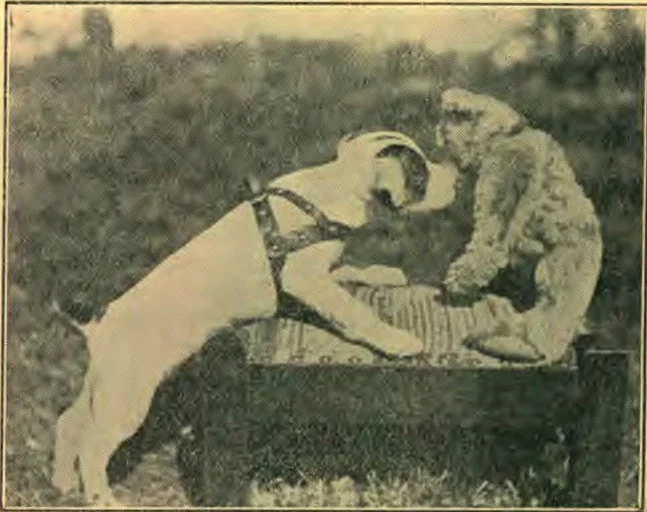
Making Sure Whether Teddy is Friend or Foe

Are You a Mover or a Relic?

THERE is a little river whose muddy waters are sluggishly but surely rolling onward toward the sea. At a certain place in its tortuous course there is a narrow bridge over the stream. Its iron girders clank together and the boards of its floor rattle as a farm horse leisurely draws over it the family cart. Hanging from the overhead supports at each end of the bridge are weather-beaten signs which proclaim it a misdemeanor to drive across the bridge on a trot. An automobile can hardly pass through it. The bridge is inadequate to present-day service.
Across the stream a short way above the bridge are the remains of a dam. Its large, well-hewn stones have withstood time and tide to a remarkable degree, but at many points there is a missing stone or a part of a stone broken away, and the water runs through. These stones are either not of so firm fiber as their fellows, or perchance the workmen who placed them did not use so much or so lasting cement in their setting.
On the bank of the stream just below the dam stands an old gristmill. The shingles left on its roof are twisted and covered with moss. A few pieces of glass remain in the windows that still possess their frames. Cobwebs are strung from one portal to another of the paneless windows. The door that faces the road is hanging askance by its rusty hinges. Dust fills the bowl of the silent millstone, and the mill race that once carried the energy-producing water is now used by the barefooted boys as a crayfish pool. The old stool where the miller sat lies at the foot of his topless desk. The mill is an interesting relic of former days; but its work is over. It did not keep pace with the world's progress.
These illustrations remind us that we must be alert to the ever-increasing demands of life; we must be adding strength to strength or old age may catch us with an empty purse, a broken-down body, and a shriveled, inefficient mental equipment.
LOE A. SUTTER.

The First Robin

About a score of snowdrop buds Are peeping from the ground; The sparrows chirp and twitter With a very happy sound. A big fat robin's bright red breast Is seen 'mid mud and snow, His feathers tossing loosely, For the March winds blow.
L. MYRTLE SOURS.

For the Finding-Out Club

  1. In what States are women allowed to vote?
  2. Who are the bolsheviki?
  3. Name the members of the President’s cabinet.
  4. How does a pump raise water from a well, and from how great a distance can it be raised?
  5. Name the prohibition States.

Street-Car Rules

THE vice-president of one of the leading railway lines of the city of Washington, recently gave the public the following rules for street-car conduct:
“Don’t carry on a conversation while alighting from a car.
“Don’t cross your legs while sitting.
“Don’t try to get on while others are getting off.
“Help motormen and conductors.
“Move forward, please.”
These are important rules; but there are others that young people especially should not forget. Courteous boys and girls, young men and women, are quick to offer their seats to older persons. They never remain seated while an elderly man or woman stands. A writer in the Washington Post, speaking of the growing habit of men not offering their seats to the ladies, says that he was “recently compressed in a car while three women stood near him. Men were seated all about. The writer gave his seat to one of the three—a little woman of maybe forty years whose back was deformed. The other two, both close to fifty years of age, resignedly clung to straps, whirled and crushed in the maelstrom of incoming and departing passengers.”
Washington men were once noted for their chivalry to women; but the last few years a change in this direction has taken place. Perhaps this has been brought about partly from the fact that young girls often are too ready to take seats that should be used by elderly women or by men who have been at work throughout the day; and perhaps it is because all women are not careful to express appreciation of courtesies shown. If the girls and young women were more thoughtful, perhaps the men would be more chivalrous to womankind in general.

Reversed Values

Man and God do not agree at all as to the values of things. Man says one thing; and God flatly contradicts it. That is, the natural man; when he has been born again and has received an entirely new nature from God, the man can begin to see things as God sees them. We can learn a lesson from the discovery made by a little boy who was just toddling up the first step of the stairway of knowledge. He brought home from school some slips of paper with a word written on each. He said to his parents, “Do you know how I can tell these words? This way: I know ‘little’ is ‘little’ because it is big, and ‘big’ is ‘big’ because it is little!” Men would be saved from a lot of mistakes and difficulty and trouble if they would just recognize that their “littles” are usually big, and their “bigs” are usually little. God settles it for us when he says, “For the wisdom of this world is foolishness with God.” I Cor. 3:19. And when we recognize the folly of our own wisdom, then for the first time we begin to be wise.—Sunday School Times.

Advancing in Life: A Heart Growing Softer
He only is advancing in life whose heart is getting softer, whose blood warmer, whose brain quicker, whose spirit is entering the living peace.— Ruskin.
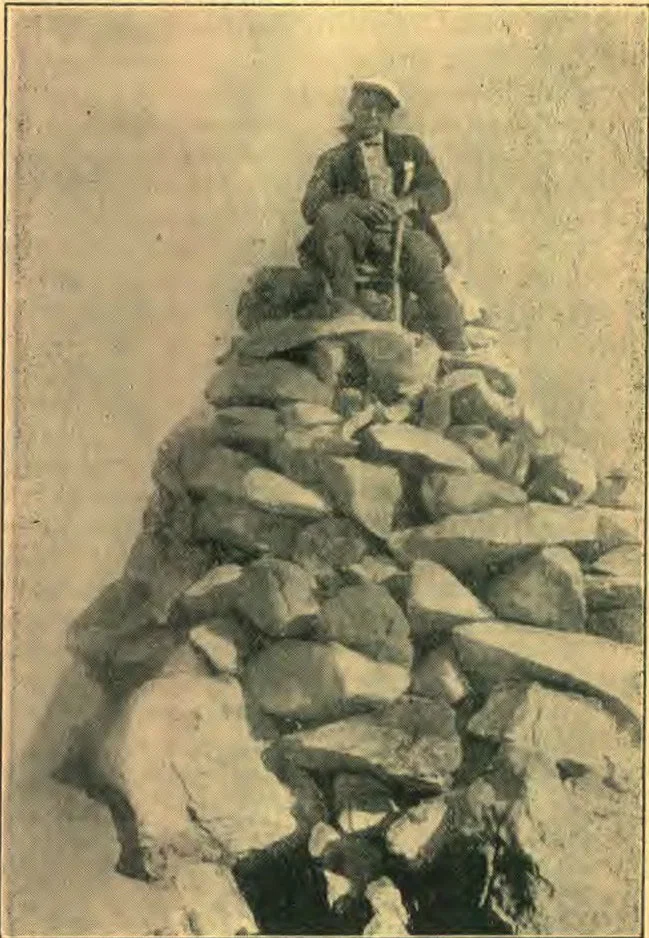
Viewing California from Old Gray back. (Described in Last Week's Issue)

You have reached the end of this edition.

The Youth’s Instructor · Mar 12, 1918