The Youth’s Instructor, Vol. 48, No. 8.

GOLD-MINING IN QUEENSLAND

The Youth’s Instructor

Feb 22, 1900

Review and Herald Publishing Company · Battle Creek, Mich. · Feb 22, 1900

GOLD-MINING IN QUEENSLAND
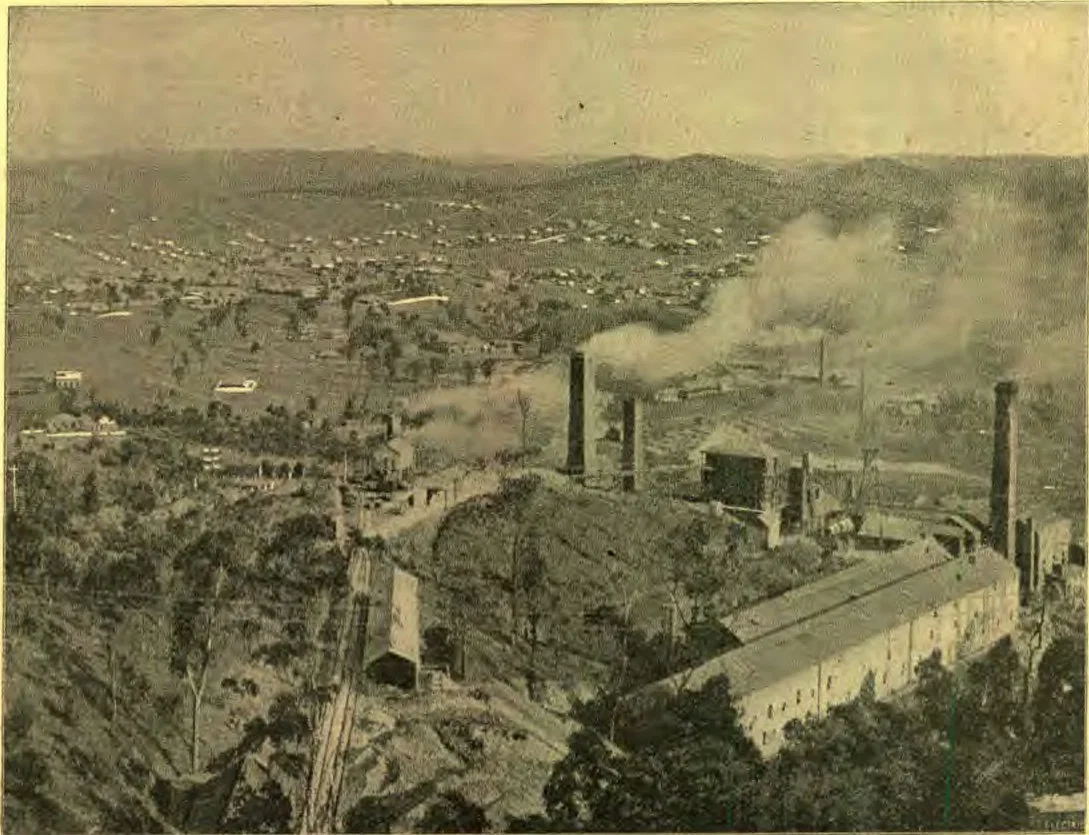
THE principal products of Queensland are wool, gold, and sugar. In 1895 there was exported of the former nearly fifteen million dollars' worth; of gold, nearly as much; and over three million dollars' worth of sugar. Some of the most noted gold mines in the world are found at Mt. Morgan, near Rockhampton, in central Queensland. Recently I made a visit to these mines. Mt. Morgan is, or was, a haystack hill several hundred feet in height. Perhaps fifteen years ago this hill was found to be impregnated with gold, which had apparently been carried to the summit in solution by some thermal spring, and thence filtered through the soil and rock of which the hill is composed. A company was formed for working the mine; and now the entire mountain is being removed and treated for the precious metal.
The method employed is principally that known as the “chlorination process.” The soil and ores, after being ground to the finest dust by rolling in iron pans with large cannon balls, is intensely heated in great retorts, where the dross is all consumed, and nothing left but the rock and the gold. This mixture is treated in a bath of chemicals, by which the gold is reduced to a solution in water. The rock sediment settles, and the water, with the gold, is strained through a filter of charcoal, by which the gold is arrested. The burning of the charcoal releases the gold that is gathered out of the ashes. The illustration gives but a partial view of the works as they now exist. Over one thousand men are here employed. As I watched the process of digging, crushing, burning, I thought of Christian experience. I thought of Job, who, in the midst of his distress, cried out, “I shall come forth as gold.” Sin is the only thing that perishes, even in this world. God suffers not one grain of gold to be lost. And yet the process of separating the gold from the dross is often a painful one.
PLANT OF THE MT. MORGAN MINE.
Of the wonderful richness of this mine, not much can be told. There is a great variety of ores, so that the managers can keep the output of the mines at a very uniform figure. They could, it is said, ruin the country with the immense amount of gold they could put out, if they exerted themselves in that way; but by a judicious mingling of inferior grades, the market values of things are held in equipoise.
At a later time, in company with a friend, I paid a visit to the Brilliant gold mine of Charters Towers. This is in the northern district, where a city of about twenty thousand inhabitants has sprung up in a desolate country, dependent upon the mines of gold that have been discovered. These are now almost entirely confined to the deep mining in the bowels of the earth. Calling at the Brilliant mine at a time when the shifts of men were changing, we were soon fitted out in rough miners’ suits, and supplied with candles. Stepping into the cage, down we went eleven hundred feet to the first station. Here was a large gallery, brilliantly lighted with electricity, and containing a powerful steam-engine, with pumps, air-blowers, and winding machinery. We changed cars, and took a lying-down posture, with our feet against the dashboard. As soon as we started, our posture became more upright; for we were shot down a tunnel at an angle of more than forty-five degrees. It was no pleasant sensation that went up and down our spinal columns as we looked downward hundreds of feet into the lighted passage, and tried to reckon what would become of our pieces in case the rope should break. Six hundred feet more, and the signal was given to stop. We alighted; and for the next two hours the obliging manager led us such a chase through galleries, over ledges, crawling through seams, sometimes feet first and sometimes headforemost, that we were not sorry when our visit of inspection was at an end. Often there was simply room to lie down and slide, trusting entirely to the knowledge of our guide as to where or how we should land. In many places the creaking and crushing timbers showed the terrible weight that was seeking to crush us to atoms, and the sight caused a shudder as we thought of being buried in a grave two thousand feet deep. Our course was ever downward; and at last we owned up to having had a plenty of that kind of experience for once, and the manager told us we were two thousand one hundred feet down in the earth. We took a good supply of specimens, mounted a reclining car, and were soon rejoicing as never before in the beauties of sunshine.
Even now it causes a shudder as we think of the hundreds and thousands who, for the sake of a little of the perishable gold of this world, will risk life, and sacrifice so much that we who live above ground hold so dear. At the same time many of these men are indifferent to the crown of imperishable riches, which is invitingly held out to them and to us all by our Heavenly Father.
The Mt. Morgan mine has paid, in dividends, about thirty million dollars, which represents only a part of its income; and hundreds of millions have been found in other centers. Yet all this gold has but little real value; for if one man had it all, he could use but a small portion, and would soon leave it. It is not for this poor wealth we are living here. There are poverty and suffering, sin and sickness, on every side; and we long to see sorrowing souls made happy in the riches of God’s love. The blessed Saviour calls to all, “Buy of me gold tried in the fire, that thou mayest be rich.”
G. C. TENNEY.

FEBRUARY

O my heart is glad to-day, February! And a song I can not stay, February! For the spring is drawing near, Bud and bird must soon appear; Lo, their signs I see and hear, February!
March, indeed, must come and go, February! Rudely first his blasts must blow, February! But so brief thy stay, we gain Confidence to bear his reign, Viewing April in his train, February!
So I greet thee once again, February! Hailing thee with voice and pen, February! Spring is speeding on apace, With her gentleness and grace; I can read it in thy face, February!
— Philip B. Strong.

HOW TO STUDY

How many discouraged persons are ready to say, “If only I knew how to study, or at least was able to recall what I have studied, I would feel encouraged; but my mind is like a sieve. I fear I shall never amount to anything.”
The fact that persons believe they have a poor memory is no evidence that such is really the case. The best way for you to test the matter for yourself is to consider a few questions: Did your house ever burn down? Have you any difficulty in remembering all about that? Was your brother or sister killed in an accident? If so, have you forgotten all the shocking details? Do you remember the tragedy that occurred in your community? or do you have to stop and review such things every few days, for fear you may forget all about them? Some will say, “Oh! but that is very different.” No, it is not different; it requires the same kind of memory to recall such things as is needed to remember what you see and read and hear. The only difference is that such events make a vivid impression on your mind, while you have failed to learn the valuable secret of making what you regard as “ordinary” things impress you in a similar manner.
When we get down to the root of the matter, there is nothing really ordinary in the world. Every act of our lives is full of realities. Every opportunity we have of looking into a book ought to change us for time and for eternity. The great secret of remembering what is studied is the ability to concentrate the mind fully upon it, thus shutting out everything else for the time being. Then a definite, ineffaceable picture of what is read is made on the mind; and in proportion as we appreciate the importance of what we are studying, to exactly that extent will it become easy to concentrate the mind upon it. We should never read nor study anything that is not worth focusing our attention upon almost as intently as if our very life were at stake. Has not God bidden us study to show ourselves approved unto him, as workmen who need not to be ashamed, rightly dividing the word of truth? You can study even the truth, and get so muddled and confused an idea of it that it will seem tame and uninteresting to those to whom you try to tell it; or you can so study it that it will fall from your lips clear-cut and beautifully expressed, fascinating all who hear. The thought of having God’s approving smile upon us moment by moment in our study ought to be sufficient incentive to us thoroughly to concentrate our attention upon it, so that as vivid a picture may be made upon the mind as would be made should the house burn down.
So much for the fundamental principles of study. We can do other things to help fix in mind what we wish to remember:—
1. Write on a card or in a note-book the chief points in the lesson, and review them while walking from one place to another, or when you are about your work. Constant repetition will help fix each lesson indelibly upon the mind.
2. Underline the important points as you read. The very drill in discriminating between what is important and what is not, is excellent mental exercise. At subsequent readings you need read only the important portions. Do not regard your books as too valuable to be marred by a pencil mark: books are only servants; and any mark, stamp, or sign you can place upon them, which increases their usefulness, is legitimate and proper.
3. When you have read a chapter, page, or paragraph, close your book, and test yourself by finding out how much of it is actually fixed in your mind. At first you may be discouraged at the result; but after a while these mental gymnastics will produce results so wonderful that you will never think the time so spent is wasted.
4. Correlate, or associate, what comes to your mind with something previously there. That is, as soon as you read anything, dig down in your mind for all that you can find there on that same subject, and then consider the points of similarity between what you have just studied and what you have previously read, so that when you think of the one, you will think of the other.
5. Read comparatively. Investigate what others have written on the subject. Thus some strong points made by them will leave a more vivid picture on your own mind.
6. After reading a lesson or an article, talk it over with your roommate or some other interested person. The healthy discussion of any topic helps fix the main features so firmly in the mind that time will not obliterate them.
7. When two are studying the same subject, it is an excellent thing for one to question the other, after a careful reading. There are only a few persons who possess the art of asking questions in the highest sense, so this will be equally excellent practice for both questioner and answerer. Christ so fully understood the secret of questioning that every one of his questions suggested oceans of truth.
8. Associate what you read with some personal experience. After all, the fundamental object of reading and study should be to help others. Human experiences do not differ so very widely. For example, you read of some method of helping those who are discouraged. Think back in your own personal experience until you strike the exact spot where you were discouraged. Try to determine whether you would have derived any help from those suggestions. If you are not sure of it, don’t spend your time trying to learn them.
There is no faculty of the human mind so susceptible of rapid and permanent improvement as the memory. There are no specific memory systems, nor is there any royal way of acquiring a good memory. Nevertheless it is a royal thing when once you have secured it.
DAVID PAULSON, M. D.

BEREAN LIBRARY STUDY

Dan. 9:25-27; “Thoughts on Daniel,” pages 196-212

NOTES ON LESSON 13

(February 25 to March 3)
1. God's Purpose.—God had marvelously delivered Israel from Egypt, and had located them in Palestine, that they might make known the true God to all the nations of the world. But Israel wished to be like the other nations. In trying to be like them, they became even “worse than the heathen.” When Israel as a nation lost the power of drawing other nations to God, he scattered them, even bringing them into captivity to the ruling nation, that through individual persons of his people he might manifest his power and fulfill his purpose. In this we have the reason of the seventy years’ captivity. To-day God is working on the same plan. He has scattered his people, and is calling on them to scatter themselves still further, that he may work through each one in every place, in making known the message for this time.
2. The Seventy Years’ Captivity.—The first of the Reading Circle lessons gave the account of the beginning of this captivity. It will be well to read again pages 24 and 25 of “Thoughts on Daniel.” During this period some of the Jews were in high positions at court, but the larger number of them were employed, with other captives from Egypt, Phenicia, and Syria, in rearing those stupendous masses of masonry that were the pride of ancient Babylon.
3. Another Prophecy Concerning Cyrus.—In Isa. 45:1 the Lord calls Cyrus by name, and the part that he was to act in the destruction of Babylon is plainly stated. In the thirteenth verse of the same chapter, the work that Cyrus was to do in behalf of captive Israel is set forth: “He shall build my city, and he shall let go my captives, not for price nor reward.” All this was stated concerning Cyrus about one hundred and seventy-four years before he was born.
4. The Fulfillment.—Accordingly, the first year that Cyrus was king of Persia, he made a proclamation permitting all the Jews who wished to do so to go up to Jerusalem and rebuild the house of the Lord; those who did not go were told to assist in the work by making offerings of gold, silver, and goods. Ezra 1:1-4. Cyrus also brought forth the vessels of the house of the Lord, and sent them with the returning Jews to Jerusalem. About fifty thousand of the Jews availed themselves of the opportunity thus offered, returned to Jerusalem, and began the restoration of the worship of the Lord.
5. Other Decrees.—In numerous ways the work begun under the decree of Cyrus, B. C. 536, was hindered, and the plans were frustrated. In B. C. 519 a proclamation was issued by Darius, which provided for the carrying on of the work. Ezra 6:1-12. But both these decrees were preliminary and preparatory to the decree granted Ezra by Artaxerxes, B. C. 457. Ezra 7. About seven thousand Jews went up from Babylon to Jerusalem with Ezra. These various proclamations are all referred to as one commandment in Ezra 6:14. Thirteen years later, Nehemiah also went from Babylon to Jerusalem, with a commission from the same king, and assisted in the work.
6. Other Descriptions of the Event of Dan. 8:14.—The coming of Christ as our high priest to the most holy place, for the cleansing of the sanctuary, brought to view in Dan. 8:14; the coming of the Son of man to the Ancient of days, as presented in Dan. 7:13; and the coming of the Lord to his temple, foretold by Malachi [Mal. 3:1-5], are descriptions of the same event; and this is also represented by the coming of the Bridegroom to the marriage, described by Christ in the parable of the ten virgins, of Matthew 25.—“Great Controversy,” Vol. IV, page 426.
7. A Most Solemn Event.—For eighteen centuries the work of Christ continued in the first apartment of the sanctuary. According to the prophetic word, when the twenty-three hundred days ended in 1844, our High Priest passed from the holy place into the most holy place, and the judgment of the human race began. The books of record in heaven, containing the names and deeds of each person, are to determine the decisions of the judgment. “Beginning with those who first lived upon the earth, our Advocate presents the cases of each successive generation, and closes with the living. Every name is mentioned, every case closely investigated. Names are accepted, names rejected.”
8. From 1844 to 1900.—For fifty-six years this work of judgment has been going on. No one living knows the day or the hour when his name will be called up. Reader, “think how many years already this solemn work has been in progress! How much longer can it continue? More than half a century of this decisive work of investigative judgment already past, and yet how few of all the masses of the earth dream of their position! O church of Christ! lift up thy voice like a trumpet, sound an alarm which shall cause all the inhabitants of the land to hear and tremble; for the great day of the Lord is near; it is near, and hasteth greatly.”

ABOUT BONACCA

An out-of-the-way place is Bonacca. Its communication with the world is irregularly kept up by “tramp schooners,” which come to the Bay Islands of Honduras for bananas, plantain, and cocoanuts. Several of these trading-vessels were built here on the cays of Bonacca. Others were launched at Ruatan, the largest island of this group. Bonacca, being the eastward island of the group, stands in the best location to take advantage of the schooner trade. Sea breezes, or east winds, prevail throughout the greater part of the year, enabling the sailors from Bonacca easily to “lay” on the ports of the Southern States. This prevalence of the east wind is responsible for the custom of speaking of the east as “to windward,” or up the coast; while west is “to seaward,” or down the coast. These expressions are confusing to the stranger from “up North” or “down South.” Life upon and by the sea has brought other localisms into the language, or dialect, here. Things are “heaved,” not handed; a mule is “made fast,” not tied; a native “carries” an animal, instead of riding or driving one. After a time one understands the peculiar use made of some words, and the musical way of chanting sentences ceases to sound strange.
When we first came to this land, the cocoanut palm, with its sprawling base, giving one the impression that the tree stood on its feet when too young, causing the base to spread out, appeared ungainly. We missed the grassy lawns of our Northern homes; but as we become more accustomed to the change, the new schemes of color are not displeasing, and what at first seemed uncommon and even inartistic no longer gives those impressions. The stretches of white sand; the little unpainted houses on posts at the water’s edge; the groves of cocoanut trees fringing the shore, their long, irregular stems terminating in dense green foliage; the bright accents in the clothing of the people,—all unite in producing a harmony of their own.
You would be delighted with our back-yard neighbors. The coral rocks—those sepulchers of many generations—are interspersed with conchs and sea-urchins. Many a careless bather has gone limping home, with the barbed spines of a sea-urchin sunk securely in the soft flesh of his foot;—and the spines are not to be drawn out, either, until the parts fester. These spiteful darts fall off when the urchins die, and then we pick up their skeletons along the shore,—beautiful white domes studded with lines of pearl-like dots arranged in perfect order. One would scarcely suspect these dainty shells to have had any part in tormenting bathers.
Crabs are more lively than either conchs or sea-urchins, though the latter can and do move about slowly. Every morning we find the crabs making a skating rink of the boat-landing that leads out from our kitchen door to the water’s edge. There is nothing straightforward about them; they go spinning sideways and “spreading the eagle” in such a masterly manner that one would almost think they were diminutive skaters.
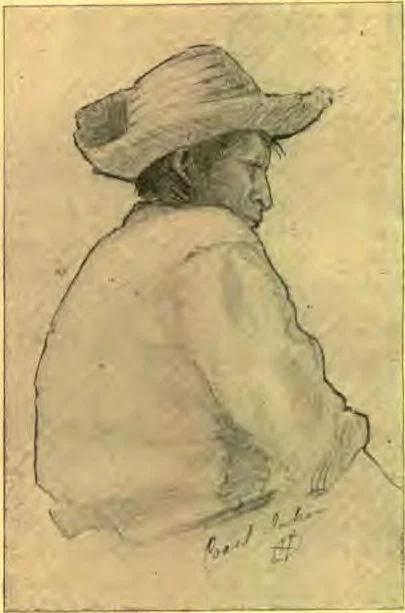
In another letter I will perhaps tell you something about the Indians and the Caribs on the coast. They often come here for work and trade. With this article is given a sketch of one of the coast Indians, that you may be thinking about them in the meantime.
H. A. OWEN.

FEBRUARY STUDY OF THE FIELD

Part IV: The Unoccupied Fields of Eastern Asia
(February 25 to March 3)
1. Basis of Study.—Read “The Unoccupied Fields of Eastern Asia,” February Magazine, page 70. The map found on pages 71 and 72 will be useful in locating the places mentioned in this study.
2. Buddhism.—Buddhism is the prevailing religion of Ceylon, Siam, Burma, Nepál, Tibet, China, Japan, and the Mongolian population of Central Asia. It was founded by Buddha, in the fifth century before Christ. The number of Buddhists is estimated at about four hundred and fifty millions—nearly one third of the inhabitants of the globe.
3. Buddhist Praying-Machines.—A praying-flag is formed by fastening one or more pieces of rag or cloth by one end to a string, stretched across a road, or path, leaving the other end free to float to the breeze. When a road is crossed for the first time, a piece of cloth is cut up to form a praying-flag. A strip torn off the material for a new dress serves the same purpose. As long as the rags are in motion, there is prayer, according to the belief of the Buddhists. Flying prayers may sometimes be seen on trees and shrubs. Prayer-wheels consist of cylinders, over which are placed sheets of paper containing prayers. These wheels are of different sizes, from a hand-wheel to very large ones. One is described as being made of paper, and revolved by the hot air rising from a fire in a tent. Another, an immense one in a Buddhist temple, was sixty feet high, and contained shrines, images, books, and prayers.
A CARIB INDIAN.
A CARIB INDIAN.
4. The Tibetans.—The inhabitants of Tibet are strong, with black, piercing, slightly oblique eyes, large mouth, brown hair, and a clear, ruddy, brownish complexion. Their noses are flat and broad, and their cheek bones high. They differ in height in various portions of the country. They speak the same language as do the Mongolians, a branch of the Chinese language. There are from fifteen to twenty times as many women as men.
5. Life among the Mongolians.—The inhabitants of Mongolia are a nomadic people. They usually travel on camels, taking their tents with them. The camel is the principal beast of burden. Horses and oxen are also used. Their wealth consists chiefly in their flocks and herds. They are fine horsemen. The children learn to ride at a very early age. There are no inns in Mongolia; and so it falls upon the people to entertain strangers in their tents. The man who refuses hospitality is considered “not a man, but a dog.”
6. The Kirghiz Steppes.—The Kirghiz Steppes of Russian Turkestan are large, uncultivated , barren plains. In spring and summer there is a little green herbage, which becomes parched in June from the heat and drought. In winter the steppes are covered with a thin layer of snow, which, when driven by the fierce winds, destroys every living creature within its reach. A few animals, such as wolves, foxes, antelopes, and hares, are found.
7. The Kirghiz.—The people who inhabit these steppes are wanderers. Some of them own as many as three thousand sheep and five hundred horses. To find pasturage for their flocks, and to escape the excessive heat, they move northward in the summer. Their flocks and herds provide them with food and clothing. The sparse vegetation furnishes fuel, the roots of the saksaul, a native grass, being used to burn. This grass reaches the height of six or eight feet. The roots, which are very hard, are collected during the autumn. Owing to the physical condition of the country that they inhabit, the Kirghiz have a fine sense of locality, and keen eyesight. To a stranger there is no landmark in this flat and unvarying country; but the native has no trouble in finding his way, even at night, and when there is no road.
8. Afghanistan Occupations.—The Afghanistans are divided into about twelve great clans, each of which is subdivided into others. Part of these people are nomadic, and part settled, in their manner of life. The latter form the villages. Their chief occupation is tilling the soil. They also constitute the main part of the army and navy.
9. Afghanistan’s Industrial and Agricultural Products.—The silk that is produced in several of the towns is used chiefly at home, although the best finds its way to India. The excellent carpets made are sold in India. From the wool of the sheep, goat, and Bactrian camel, fine felts and woven goods are made. The rosaries made find their chief market in Mecca. The wool trade is growing in importance. A large trade is carried on in horses. Almonds, raisins, fruits, and furs are exported to India.
10. Baluchistan’s Capital.—Khelat, the capital of Baluchistan, is seven thousand feet above the sea. It is built in oblong form. Three sides are defended by walls; the defense on the fourth side is completed by cutting away the face of the hill on which the city is built. The palace of the khan is in Khelat. There are about four thousand houses in the city and its suburbs. They are of brick or wood, and plastered over with mud and mortar. Most of the streets have a raised footpath on each side. In the center the filth is thrown, and there the rain-water collects.

WHAT BERNICE LEARNED ABOUT THE TWELVE APOSTLES

IV

The next Tuesday evening found the same little group in grandma’s pleasant sitting-room, ready to resume their talk about the apostles.
“I think it is Aunt Emma’s turn to begin,” said Bernice.
“Well,” said Aunt Emma, “I will tell you first what I have learned about the apostle Philip. Not very much is told about this disciple in the Gospels, but enough is said to warrant us in supposing that he, as well as Nathanael, might justly have been called ‘an Israelite in whom there was no guile.’ Philip’s home was in Bethsaida, the city where Andrew and Simon Peter lived. If you will open your Testament, Bernice, to John 1:44, you will find this fact recorded.”
Bernice read the verse aloud, and grandma said: “I am willing to admit that I have learned a little, already; for I did suppose that Simon Peter lived in Joppa.”
“I dare say you thought so,” said grandpa, “because Acts 10:6 says that he lodged with Simon the tanner. But it seems that his home was in Bethsaida.”
“It was Philip whom the Master first addressed in those brief but earnest words, ‘Follow me,’—a whole sermon in themselves,” said Aunt Emma.
“How many Philips were there?” asked grandpa.
“There were two,—Philip the deacon, and Philip the apostle. Philip the deacon is the one who baptized the eunuch, as described in the eighth chapter of Acts. After many trying experiences, among which was imprisonment, with cruel beating, Philip was at last condemned to death, though whether he was crucified or hanged is not certainly known. His dear friend and fellow laborer, Bartholomew, attended to his burial, but this act of kindness nearly cost him his life.”
“We must not think,” said grandma, “because the servants of the Lord were often allowed to suffer for the sake of the principles of truth, that God did not remember them, or that he forgot to care for them for a moment.”
“No,” said grandpa; “the Lord is just as kind and merciful when he allows death to end our labors, as when we live. ‘His mercy endureth forever.’ Persons sometimes say, ‘The Lord was very good to me in sending prosperity and health in the past, but now I am afflicted.’ They evidently forget that the Lord was never any better than at the present moment; we should not compare his goodness at any particular time with his goodness at another; for he was, is, and forever will be, perfect in all his attributes.”
“Yes, indeed,” said Aunt Emma; “we ought never to forget that, and that he has said, ‘The servant is not greater than his Lord. If they have persecuted me, they will also persecute you.’ It matters not how much we may suffer for the Master, we can never endure for his sake as much as he has suffered for us.”
MRS. L. D. AVERY-STUTTLE.

LION

A True Story

JOHNNY lived with his parents on a large farm out in the suburbs of Battle Creek. One day his father went several miles from home on business; and when he came back, he brought Johnny a little black, shaggy puppy,—a gift with which he was delighted. Of course the little fellow must have a name, and it was decided to call him Lion.
Lion grew into a large, quiet, noble-looking shepherd dog, and became the pet of the household. He proved to be a good night watch, never allowing a stranger about the house after dark. In the evening he would drive the cows to the barn-yard; and when his master gathered up the pails to go out to milk, he always wanted to help. It was his delight to carry an empty pail; if he could not have a pail, he was sure to pick up a stick, or carry a straw in his mouth.
One warm summer day, when the men were working in the field, the drinking-water gave out. They had a pail holding about six quarts, and this they gave to Lion, telling him to carry it to the house, and bring them some water. With the pail in his mouth, the dog trotted through several fields, then up to the well-curb, where he set the pail down. Then he went into the house and found the mistress. Stepping up to her side, he looked into her face, wagging his tail, and then took a few steps toward the well, and back to her again. He went through this performance several times, and finally she followed him to the well. Lion caught up the pail, and wagging his tail, looked into her face, then set the pail down again. By this time she understood what he wanted. The pail was filled one third full, the cover put on, and off Lion trotted to the men, with a refreshing drink.
One time when Lion saw a stranger passing through the fields, he went up toward him, and barked, just as any dog would do. The stranger angrily leveled his gun, and shot the faithful fellow. His master sent a man in haste for a doctor, who, after examining Lion, said that two shots had entered his lungs, and that of course he would die.
To think of losing our useful, noble dog brought sadness into our home. Seeing how deeply we all felt over the loss of our faithful pet, I went to my room, and told Jesus all about it; and asked that if he thought best, he would spare Lion’s life. I believed he could do it, and he did.
Lion’s master watched faithfully over him all through the night, giving him the medicine the doctor had left to break the fever; and in the early morning, Lion arose to his feet, and though very weak, tottered across the room. In a few weeks he was quite well again, and he lived a number of years, finally dying of old age.
H. E. S. HOPKINS.

THE QUEER LITTLE HOUSE

THERE'S a queer little house, and it stands in the sun; When the good mother calls, the children all run; While under the roof, they are cozy and warm, Though the cold winds may whistle and bluster and storm.
In the daytime this queer little house moves away, And the children run after it, happy and gay; But it comes back at night, and the children are fed, And tucked up to sleep in a soft feather bed.
This queer little house has no windows nor doors, The roof has no shingles, the rooms have no floors; No fireplace, no chimneys, no stoves, can you see, Yet the children are cozy and warm as can be.
The story of this funny house is all true; I have seen it myself, and I think you have, too. You can see it to-day, if you watch the old hen, When her downy wings cover her chickens again.
— Nature Study.

THE GARDEN BIRD

In New Guinea there is a bird that not only builds a house, but has a garden. He is known by the name of “garden bird.”
When he is going to build, the garden bird first looks for a level spot of ground, which has a shrub in the center. Then he covers the bottom of the stem of this shrub with a heap of moss.
Next he brings some long twigs from other plants. These he sticks into the ground, so that they lean, and leave a place open for a door. The twigs keep on growing, so that his little cabin is like a bower.
Last of all, in front of the door, this dainty bird makes a pretty lawn of moss. He carefully picks out every pebble and bit of straw. Then, upon this lawn he scatters purple berries and pink flowers. As often as the flowers wilt, he takes them away, and brings fresh ones.
The little cabin is sometimes three feet wide, and half as high. There is plenty of room in it for two or three families, if need be; and the garden is larger than the house.
The people of New Guinea think so much of this bird that they never molest his little dwelling.
You may like to know how this bird gardener is dressed. In modest colors, you may be sure. The top of his head, his back, and his wings and tail are olive-brown; and beneath he is greenish-red. He is about as large as a thrush or a blackbird.— W. H. Campbell.

What Ray Saw

Several neatly written answers have been received to the questions following the story of “What Ray Saw,” in the INSTRUCTOR of February 1; but the best, all things considered, came from ten-year-old Mary Moore, of Highland Park, Ill. This is the way Mary answers the questions:—
“DEAR EDITOR: ‘What Ray Saw’ is a story about the life of a ray of sunlight.
“Little Ray was a sunbeam.
“Old King Sol is the sun: ‘sol’ is the Latin word for ‘sun.’
“Light travels nearly twelve million miles a minute.
“On the way to earth, the sunbeam passed the planets Mercury and Venus.
“The beautiful sight Ray saw in the rain-drop was a rainbow.”
Continue reading: LEAF LABORATORIES