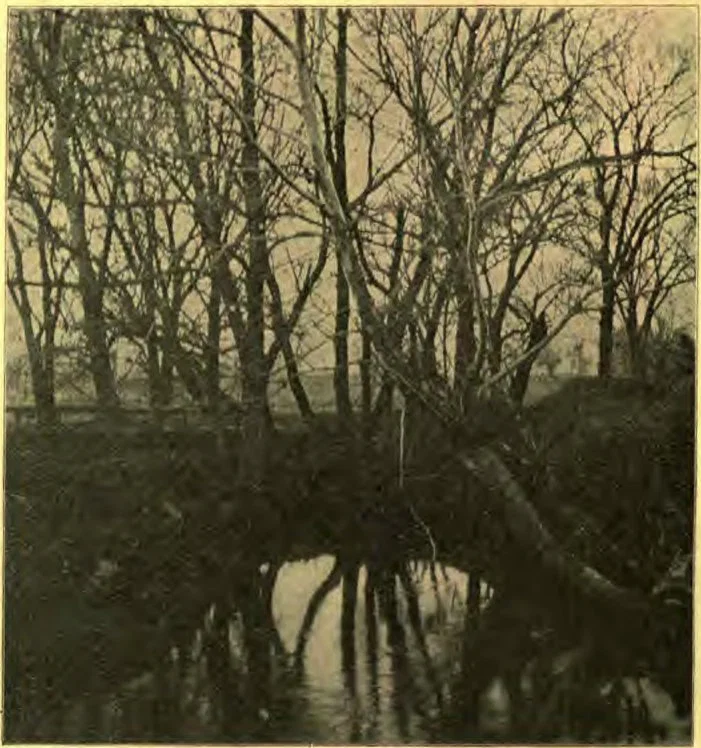
OUR deciduous trees lose their leaves at the close of summer. These trees are clad with foliage that is unable to defy the frost, and, therefore, are thrown off at the beginning of this unfavorable period. If these leaves were to fall off without any preliminary ceremony, all the substance in their tissue would be lost. To produce all the material in the leaves has required considerable work on the part of the plant; and now to throw all this away would entail a large and inexcusable waste. But in the economy of the plant—which is naught else but the economy of God—such waste is carefully guarded against.
Before the leaves are detached, as has been previously mentioned, everything in general that is of use to the plant is conveyed from the leaf-blades into the woody branches, trunks, or root-stocks, and there laid away for winter keeping. All the elements so stored up are deposited where they will find a safe resting-place, and where, unharmed, they will survive the cold of winter.
There is in the leaves one material that is not carried back into the plant; for the plant has no use for it. I refer to the crystals of calcium oxalate, which can not be employed further. These granules are of a yellow color, and to them we owe the yellow colors of the autumn foliage. These particles, these shining yellow granules, are mere sawdust in the wood-yard of the leaf. They are waste products, which the plant desires to get rid of.
To account for the presence of this calcium oxalate, we shall have for a moment to consider the formation of albumen. Albumen is a substance, the best example of which is the white of an egg. The white of an egg is almost pure albumen. The glutin of corn and wheat is an example of one form of vegetable albumen; legumin in peas, beans, lentils, and other pulse seeds, is another.
Chemically, albumen is a combination of carbon and water with nitrogen and sulphur. If we have a union of carbon and water alone, the substance is called a “carbohydrate.” This carbohydrate is changed to an albuminous substance by the addition of nitrogen and sulphur.
Nitrogen is obtained from nitric acid and ammonia, and some of their compounds, especially calcium nitrate. These are absorbed by the plant, and by means of it conveyed to the place where needed. The nitric acid must be taken out, or liberated from the calcium nitrate. To explain more minutely, calcium nitrate is a union of calcium, or lime, and nitric acid. Now, the calcium and nitric acid must be separated. This is done by means of oxalic acid. The oxalic acid takes the place of the nitric acid, and the nitric acid is set free; then the calcium and the oxalic acid, uniting, form calcium oxalate—shining yellow granules.
Sulphur is obtained in much the same way. The plant obtains calcium sulphate. Calcium sulphate is a union of calcium and sulphuric acid. Oxalic acid takes the place of the sulphuric acid, forming, with the calcium, calcium oxalate; and sulphuric acid is set free. The sulphuric acid is further worked over; and the sulphur, with the nitrogen, is used in connection with the carbohydric to form albumen.
It is a very complicated process. God does marvels in his leaf laboratories,—marvels that no chemist in the laboratories of our colleges or institutions of earth can ever accomplish, no matter how wise he is, or how well his laboratory is equipped. A great scientist says: “In the living plant these combinations, decompositions, and rearrangements are accomplished with great ease; and multitudes of substances, which can not be manufactured, either directly or indirectly, in a chemical laboratory, are produced in plant cells with a hand’s turn, so to speak.”
LEAFLESS TREES.
My object in taking this view of the chemical laboratory in the leaf is to show how the crystals of calcium oxalate came there. It is these crystals that give the fallen leaves their yellow color; and in the shedding of the leaves the no-longer-needed crystals are cast aside. Thus they do not longer accumulate to become a burden to the plant. If retained, they would be so much superfluous ballast, to hamper the plant in its next year’s work.
L. A. REED.
USE AND MISUSE OF PHOTOGRAPHY
By J. Edgar Ross
God never gave a good gift to man, but Satan endeavored to have man put it to a wrong use. The richest gifts, misused, bring the most sorrow upon the human family. But let us not condemn the gifts: it is only the misuse of them that merits censure.
God made the laws that control this universe, and gave man the wisdom to search out those governing the science of photography, and the knowledge and skill to apply them. But Satan constantly endeavors to make this science serve his malevolent purpose. In this he has in a great measure succeeded. But photography is not entirely given into his hand, as we can see from the many useful purposes to which it is put.
There is scarcely a science or an art that photography has not materially assisted, by giving it a cheap and accurate method of illustration. The physiologist, the zoologist, the botanist, may each contribute the light-written pictures of the subjects of his study; and thus others may become familiar with their actual appearance, where a written description would convey but a faint impression.
The astronomer trains his telescope upon a certain space in the sky, and is able to see many times more stars than can be seen with the naked eye. But he sees only the brightest of them; for some are so dim and distant that their light-waves make no impression on the eye, even when condensed by the lens of the most powerful telescope. But when the light falls upon a sensitive plate, it receives and stores up each faint ray until, after an exposure of one or two hours, the astronomer has accurately charted perhaps hundreds of stars that no conceivable telescopic power would ever make visible to the eye.
With the aid of his camera the traveler is enabled to make such faithful pictures of sights and scenes that those less favored than he may become familiar with all parts of the world in which we live.
I hope every one who reads this series of articles is a child of God. If this is true, you are a steward of the money God has given you, and will remember that he holds you accountable for the way in which you spend it. Many young persons, and some older ones, are guilty of great extravagance in the matter of having their pictures taken, and the majority of those who have cameras use them to gratify their own and their friends’ pride. The money thus squandered each year would send dozens of missionaries to foreign lands, or feed and clothe hundreds of the poor in our own country. By these remarks I do not wish to convey the idea that it is wrong under all circumstances to have your portrait taken. If you had a loved friend in some distant land, no doubt you would be willing to make some sacrifice to be able to send him your picture; but you wouldn’t have one taken every month, or every year.
In my experience as a professional photographer, I photograph few persons who really wish a true likeness of themselves. The negatives must be carefully “retouched” with a pencil.62The wrinkles must be filled up, the freckles taken out, a large mouth made small, a crooked nose made straight; in short, every trick and device must be resorted to, that the photograph may look better than the subject. Even when all this has been done, about three out of every five customers go away dissatisfied: they have not been sufficiently flattered to gratify their vanity. When a group of friends is photographed together, it is almost invariably the case that each is well pleased with every picture but his own: that is “simply horrid.”
Most photographers cater to the vanity of their patrons, just as the publishers of vicious literature cater to the depraved mental appetite of those who read their books; and I believe that one is just as much an agent of Satan as the other, though that may be taking an extreme view. But we would not condemn the publishing business because it is made to serve a wrong purpose; neither should we condemn photography for a similar reason. A child of God may use his camera just as another would use his pen,—to enlighten his fellow men and to glorify his Maker. If this is the object in view, there will be no fear of your wasting either time or money in photography. From every picture taken, some lesson will be learned, and some good accomplished. J. EDGAR ROSS.
ABIDE
By James Buckham
ABIDE!
Let naught thy faith, thy purpose, turn aside.
Say unto grief and pain and seeming ill,
“All ways are God’s, and I but follow still
His leading in the darkness deep and wide.”
Abide,
Albeit thou art vexed with doubt, and tried
By every test the steadfast soul may know.
Still say, “I trust,” and with calm spirit go
The way God wills; for he is at thy side.
Abide
In that sure love that never yet denied.
He who has promised thee, is he not true?
Nor surer winter’s snow nor summer’s dew
Than God’s rewarding. Heaven will provide!
Abide,
Nor let the paths of life and hope divide.
Hold fast thy faith, whate’er the trial be.
Yea, hold it fast, as God holds fast to thee,
And soon, ah! soon, thou shalt be satisfied.
— James Buckham.
THE SAVIOUR'S MISSION
By Ellen G. White
The first gospel sermon was preached in Eden, when God said to the serpent, “I will put enmity between thee and the woman, and between thy seed and her seed; it shall bruise thy head, and thou shalt bruise his heel.”
In Eden, Adam and Eve transgressed the law of God. God had forbidden them to eat of the tree of knowledge of good and evil. But instead of obeying the voice of God, they listened to the words of the tempter. “Hath God said, Ye shall not eat of every tree of the garden?” Satan asked. “And the woman said unto the serpent, We may eat of the fruit of the trees of the garden: but of the fruit of the tree which is in the midst of the garden, God hath said, Ye shall not eat of it, neither shall ye touch it, lest ye die. And the serpent said unto the woman, Ye shall not surely die: for God doth know that in the day ye eat thereof, then your eyes shall be opened, and ye shall be as gods, knowing good and evil.
“And when the woman saw that the tree was good for food, and that it was pleasant to the eyes, and a tree to be desired to make one wise, she took of the fruit thereof, and did eat, and gave also unto her husband with her; and he did eat.”
The transgression of Adam plunged the human race in hopeless misery and despair. But God, in his wonderful, pitying love, did not leave men to perish. He could not change his law to meet man in his fallen condition, but he devised a plan whereby he might have hope. He gave his Son to bear the penalty of transgression.
Christ might have come to earth clothed with the glory of his Father. But he did not do this. He did not even take the form of an angel. “Verily,” the apostle says, “he took not on him the nature of angels, but he took on him the seed of Abraham.” Divinity took humanity, that humanity might touch humanity. With his human arm Christ encircled the race, while with his divine arm he grasped the throne of the infinite God. The world that was separated by sin from the continent of heaven, he drew back into favor with God.
Had Christ come in his former glory, humanity could not have endured the sight. When the angel Gabriel came to Daniel to give him skill and understanding, Daniel could not look upon him. The angel had to reveal himself as a man before he could speak with the prophet. Thus we see the wisdom of God in planning that Christ should come as a man.
Had Christ come as a mighty general of armies to break the yoke of oppression from the Jewish people, and restore to them their kingdom, the nation would have received him. But Christ did not come to rank with the rich and honored. He took his place among the lowly. Though he was rich, yet for our sake he became poor, that we through his poverty might be made rich. He was acquainted with the sorrows and temptations of childhood. He experienced the dangers and snares to which the youth are exposed.
The prophet Isaiah had declared: “He shall grow up before him as a tender plant, and as a root out of a dry ground: he hath no form nor comeliness; and when we shall see him, there is no beauty that we should desire him. He is despised and rejected of men; a man of sorrows, and acquainted with grief: . . . he was despised, and we esteemed him not.”
When Moses prayed to God, “Show me thy glory,” the Lord said: “I will make all my goodness pass before thee. . . . And the Lord passed by before him, and proclaimed, The Lord, the Lord God, merciful and gracious, long-suffering, and abundant in goodness and truth, keeping mercy for thousands, forgiving iniquity and transgression and sin.” These attributes are the attributes of God. But Satan had represented him to man as arbitrary, stern, and unforgiving. All the misery and suffering he had brought upon man, he charged to God. He declared that man could not keep the law, and that God was arbitrary and cruel in demanding of him something that he could not do.
Christ came to represent the Father, and to show in what tender relation we stand to him. He showed that humanity can keep the law. “I have kept my Father’s commandments,” he said. He came to take the prey out of the hands of the enemy. “He hath sent me to heal the broken-hearted,” he said, “to preach deliverance to the captives, and recovering of sight to the blind, to set at liberty them that are bruised, to preach the acceptable year of the Lord.” Mrs. E. G. White.
THEY HAVE NO WINE
By Mrs. W. C. Sisley
At the marriage feast in Cana,
Eighteen hundred years ago.
'Mong the guests who gathered with them,
Went dear Jesus, whom we know,—
Went as ever with the longing
To add cheer and blessing, too.
When, “They have no wine,” was told him,
What, think ye, did Jesus do?
Do?—Why, turning then so quickly,
To the servants said he then,
“Fill the water-pots with water,”
And they filled them to the brim;
Then, “Draw out now,” to the governor
Of the feast ye all shall take;
“And they bare it,” says the record;
No excuse began to make.
Heeding then the words thus spoken,—
“Whatsoever he saith, do,”—
They with faith bore forth their pitchers,
Pouring wine, and wine so true
That they wondered at its goodness
Leaving best till last of feast,
Manifesting forth his glory
To the greatest and the least.
There is comfort in the lesson
That the Saviour no lack knows;
How he hastes, with love and comfort,
To our aid when unseen foes
Press about us! Then tell Jesus;
Never, nevermore repine.
Think how then he did, and now can,
Turn the water into wine.
MRS. W. C. SISLEY.
Good and Evil
By S. N. Haskell
The Lord said to Satan: “I will put enmity between thee and the woman, and between thy seed and her seed; it shall bruise thy head, and thou shalt bruise his heel.” The seed of the woman was to bruise the head of the serpent. In the end, Christ, the true seed of the woman, will destroy Satan, with all who give themselves to a life of sin, in the lake of fire, and purify the sin-cursed earth. Why, in killing a snake, do we always have an intense desire to crush its head?—The crushed head is a sure sign of death. There is something in the very nature of the enmity that God placed in the heart of man that leads him to do this. It is an object-lesson to show what God will finally do with sin and Satan.
Sin changed the operation of nature, so it taught the story of redemption, and the necessity of man’s co-operating with God in putting away sin. Instead of only useful trees and plants, thorns and thistles also grew. They are the natural growth of unredeemed soil. These thorns and thistles grew as the result of the defilement of the earth by sin. The sin of seeking good from a mixture of good and evil was impressed upon Israel by the exhortation of the Lord not to make marriages with the heathen nations: if they did this, they would be “snares and traps” to them, “scourges” in their sides, and “thorns” in their eyes, until they would perish from off the good land that the Lord had given them. Joshua 23: 12, 13. This intermingling with unbelievers would blind their spiritual eyesight. The god of this world blinds the minds of those who believe not, “lest the light of the glorious gospel of Christ, who is the image of God, should shine unto them.” 2 Cor. 4: 3, 4.
Because Israel obeyed not the voice of Jehovah in these things, they could not drive out the wicked nations before them, and the Lord said, “They shall be as thorns in your sides, and their gods shall be a snare unto you.” Judges 2: 2, 3. Wicked people, represented by briars and thorns, whose end is to be burned, will ever be found in this world. They are also classed with scorpions; and the people of God, who have a straight testimony to bear, are not to be afraid of them, whether they will hear, or whether they will forbear. Eze. 2: 6, 7. When men sin against the Holy Spirit, and it is impossible to renew them unto repentance, seeing they have crucified to themselves the Son of God afresh, and put him to an open shame, they represent ground that bears thorns and briars, whose “end is to be burned.” Heb. 6: 1–8. From the past experience of God’s people, we should shun evil companions as a deadly viper or a pricking brier: “If sinners entice thee, consent thou not.” S. N. Haskell.
Time: A. D. 31. Place: Jerusalem. Persons: Jesus, Peter, high priest, council, maids of the high priest, servants, Pontius Pilate.
QUESTIONS
1. What shameful treatment did Jesus receive when first condemned of blasphemy? Matt. 26:67, 68; note .
2. During the mock trial in the palace of the high priest, where was Peter? What was he doing? Luke 22:55; note . By whom was he here observed? Mark 14:66. What did she say to him? V. 67. What did he say in replying to her charge? What then took place? V. 68.
3. What occurred while Peter was in the porch? Matt. 26:71; note . What did he do to clear himself of the accusation? V. 72. About an hour after this second denial, what positive assertion was made by one of the servants? Mark 14:70. What question was also asked him? John 18:26.
4. By what strange course did he now seek to make them believe that he was not connected with Christ? Mark 14:71; note . After his third denial, what did he again hear? Luke 22:60. At this point what did Jesus do? V. 61, first part. What did this look of pity lead Peter to do? Vs. 61, 62.
5. With the arrival of day, to what place was Jesus again brought? V. 66; note . What question was immediately proposed? V. 67, first part. What touching answer did Jesus make them? What prophecy was made? Vs. 67–69.
6. What question did they once more ask? How definite was Jesus’ reply? V. 70. Having drawn out the answer they desired, what did they all say? V. 71.
7. As the trial was drawing to a close, who burst into the room? What did he say and do? Matt. 27:3–5; note . What disposition was made of the money thus returned? Vs. 6–8. What prophetic words were thus fulfilled? Vs. 9, 10.
8. The trial ended, to what place was Jesus immediately taken? John 18:28.
Turning a Besetting Sin into Strength
By W. C. Gannett
OUR besetting sin may become our guardian angel—let us dare to say it! This sin that has sent me weary-hearted to bed, and desperate in heart to morning work; that has made my plans miscarry until I am a coward; that cuts me off from prayer; that robs the sky of blueness and the air of freshness and human faces of friendliness,—this can be conquered! I do not say annihilated, but, better than that, conquered, captured, and transfigured into a friend; so I shall at last say, “My temptation has become my strength; for to my very fight with it I owe my force.”—W. C. Gannett.
Subscription Renewal Form for Youth's Instructor
By Editor
MARCH, 1900
If the yellow address-label on first page of this paper, or on the wrapper, bears this month and year (John Brown 1 98), it indicates that the following blank should be filled out by you now, and mailed to Review and Herald, Battle Creek, Mich., before the end of this month:—
Inclosed find $........ (money-order, express order, registered letter, or bank draft), for which please send..... copies of the YOUTH'S INSTRUCTOR ..... months to above address.
P. S.—If you object to clipping this out of your paper, or wish to forward other subscriptions, please write names and full addresses on a separate sheet, stating amount inclosed for that purpose.
To Reach BATTLE CREEK
FROM
CHICAGO, BUFFALO, DETROIT, OR TOLEDO,
Purchase Tickets Reading over the MICHIGAN CENTRAL
“The Niagara Falls Route.”
A First-class Line for First-class Travel between Chicago and New York and Boston. Elegantly equipped through trains pass Battle Creek in each direction daily.
R. N. R. WHEELER, Ticket Agent, Battle Creek.
O. W. RUGGLES, Gen’l P. and T. Agt., Chicago, Ill.
TAKE THE Canadian Pacific Railway
for . . . CHATHAM, LONDON, WOODSTOCK, PORTLAND, OTTAWA, GALT, TORONTO, and MONTREAL, QUEBEC, BOSTON.
All points in New England, the Maritime Provinces, Great Britain, and the Continent.
Illustrated literature, time-tables, and full particulars, upon application to—
J. FRANCIS LEE, GEN. AGENT,
Passenger Dep't. 228 SOUTH CLARK ST., CHICAGO
Branch Offices: 76 Ottawa St., Grand Rapids, Mich. Room D, Chamber of Commerce, Cincinnati, Ohio. 315 Chestnut St., St. Louis, Mo.
Cincinnati Northern Railroad Co.
TIME TABLE NO. 3.
In Effect Sept. 24, 1899.
Trains Pass Battle Creek, as follows:
WEST-BOUND.
No. 21, Mail and Express — 6.58 P. M.
No. 23, Accommodation — 2.07 P. M.
No. 27, Local Freight — 8.25 A. M.
EAST-BOUND.
No. 22, Mail and Express — 8.25 A. M.
No. 24, Accommodation — 1.45 P. M.
No. 28, Local Freight — 5.30 P. M.
Direct connections are made at Toledo with all roads diverging. Close connections for Detroit and Cincinnati.
J. L. READE,
Ticket Agt. Battle Creek.
E. R. SMITH, City Pass. Agt., 6 West Main St.
GRAND TRUNK RAILWAY SYSTEM.
Time-Card in Effect November 19, 1899.
C. & G. T. DIVISION.
WEST-BOUND FROM BATTLE CREEK.
No. 2, Mail and Express, to Chicago 12.15 P. M.
No. 1, Chicago Express, to Chicago 9.00 A. M.
No. 3, Lehigh Valley Express, to Chicago 3.40 P. M.
No. 5, Pacific Express, to Chicago, with sleeper 1.10 A. M.
No. 75, Mixed, to South Bend 8.20 A. M.
Nos. 9 and 75, daily, except Sunday.
Nos. 1, 3, and 5, daily.
EAST-BOUND FROM BATTLE CREEK.
No. 8, Mail and Express, to Pt. Huron, East, and Detroit 3.45 P. M.
No. 4, Lehigh Express, to Port Huron, and East 8.27 P. M.
No. 6, Atlantic Express, to Port Huron, East, and Detroit 2.35 A. M.
No. 2, Leh. Exp., to Saginaw, Bay City, Pt. Huron, and East 6.50 A. M.
No. 74, Mixed, to Durand (starts at Nichols) 7.15 A. M.
Nos. 8 and 74, daily, except Sunday.
Nos. 4, 6, and 2, daily.
A. S. PARKER, Ticket Agent, Battle Creek.
Training School Advocate Enlarged and Improved for 1900
The January, 1900, number of the Training School Advocate is just at hand, in enlarged and greatly improved form. The work is all done, and well done, by the students, under the direction of a competent instructor. In the past the Advocate was a local journal, the recognized organ of Battle Creek College alone; but with this number it becomes the organ of the church-school work in general, and will stand for the widest possible application of the principles of Christian education in the home and in the church.
Published monthly by the Training School Publishing Association, Battle Creek, Mich. Fifty cents a year; single copies, five cents.
OUR MISSIONARY GARDENS
Now is the time—and none too early, either—to begin to think about that missionary garden you are going to plant next spring. This is the month to select your seeds, and lay your plans. Perhaps last year’s garden did not succeed as you had hoped and wished; perhaps it was a complete failure, as far as the missionary envelope was concerned,—but even then it may not be called a “complete failure” if, by your experience with it, you have learned how to avoid the mistakes that resulted in disappointment. It takes patience to achieve in any undertaking—patience, and steady, persevering effort. With plenty of these, backed up and kept alive by a genuine love for the Master, and an earnest desire to bring to others the joy of the gospel, success is sure under almost any conditions that can come to you.
But perhaps you have not room enough to raise things to sell—only a tiny plot for flowers. Then remember that nothing is ever more acceptable and cheering in the sick-room or the home of the busy or discouraged than a bunch of dainty flowers,—great velvet pansies, nodding sweet peas, a single perfect rose,—and that nothing more surely or sweetly turns the thoughts heavenward. With your small flower-bed, you can be just as true a missionary as one who, with larger opportunities, is able at the end of the season to send a gift of money to some foreign field as the result of faithful work. We are each held responsible for our opportunities—no more.
SHALL WE GIVE THE PRISONERS THE GOSPEL?
By Editor
In March, 1899, the Life Boat, Chicago, issued a special number to prisoners. A large number of prisoners were brought to the light of the gospel by this special number, and hundreds of them have been in correspondence with its editors ever since. Many of them have come to Chicago to our various missions, and in this way we have been able to continue the influence begun by the Life Boat. A number of these men, who are working at the Training-School here in Chicago, have proved thoroughly reliable, and in not a single instance has our confidence been misplaced. Plans are now making to issue a special edition of fifty thousand copies of the Life Boat in March, 1900. This will be our second Prisoners’ Number. It costs but one cent to print and mail a copy of the Life Boat to some prisoner. It will cost but one cent each to supply the prisoners in your county jail. Why should not every prisoner in the United States have a copy of this special number? The publishers of the Life Boat will send to you, or to any prison that you may designate, one copy for every penny contributed to a fund for that purpose. Think of it! One dollar will send one hundred into the prisons; five dollars will send five hundred copies of the Life Boat. If you are interested, let us hear from you.
We shall be pleased to correspond with you in reference to the distribution of the Life Boat in your local prisons and jails. Something must be done to bring the message to the men behind the bars. Address the Life Boat, 1926 Wabash Ave., Chicago.
THE INSTRUCTOR MISSION FUND
THE interest in this fund still keeps up. Why should it not, when the field is so wide, and there are so many openings to use our papers?
Amount previously received, $27.35
Florence and Sarah Lufur, 1.00
Total, $28.35
FOR EVERY DAY OF THE WEEK
SUNDAY:
We need, each and all, to be needed,
To feel we have something to give.
—Lucy Larcom.
MONDAY:
Certainly, in taking revenge, a man is but even with his enemy; but in passing it over, he is superior; for it is a prince’s part to pardon.—Bacon.
TUESDAY:
“To think that education is a little arithmetic to sell potatoes with, a little spelling to write a letter with, a little grammar to talk to the preacher with,—all the mere tackle of a fisherman,—is utterly false to the conception of the soul’s march of duty, to reality, to God.”
WEDNESDAY:
Dear is the work He gives in many a varied way;
Little enough in itself, yet something for every day,—
Something by pen for the distant, by hand or voice
for the near.
Whether to soothe or teach, whether to aid or cheer.
—Frances Ridley Havergal.
THURSDAY:
Being forced to work, and forced to do your best, will breed in you temperance, self-control, diligence, strength of will, and a hundred virtues that the idle will never know.—Charles Kingsley.
FRIDAY:
“More things are wrought by prayer
Than this world dreams of.
For what are men better than sheep or goats,
If, knowing God, they lift not hands of prayer
Both for themselves and those who call them friend?
For so the great round earth is every way
Bound by gold chains about the feet of God.”
SABBATH:
“Finally, brethren, whatsoever things are true, whatsoever things are honest, whatsoever things are just, whatsoever things are pure, whatsoever things are lovely, whatsoever things are of good report; if there be any virtue, and if there be any praise, think on these things.” Phil. 4:8.
Books and Writers
The “Rand-McNally Atlas of Two Wars,” containing large-scale maps of the Philippine Islands and South Africa, has just come to our table. Seventeen good-sized maps are given, one of the most valuable of which is a full-page map showing the territorial growth of the United States since the close of the War for Independence. Price, twenty-five cents, postpaid. Address either the publishers, Rand, McNally & Co., Chicago, or the Review and Herald Pub. Co., Battle Creek, Mich.
“Health: How to Find It When It’s Lost; How to Keep It When It’s Found,” is the taking title of a new book in the interest of healthful living. It is a logical development of the principles of cause and effect, as set forth in the words of Inspiration, “Whatsoever a man soweth, that shall he also reap.” The book does not treat upon “glittering generalities,” but goes carefully and faithfully into the details of such practical, everyday subjects as good foods, food-combinations, influence of stimulants, advantages of vegetarianism, how to avoid consumption, care of the teeth, office of the skin, value of the bath, home remedies, seasonable recipes, etc., etc. To supplement these there are more than a dozen valuable and interesting tables devoted to the scientific side of the question.
The book contains 224 pages. Carefully indexed, and strongly bound in cloth. Price, one dollar, postpaid. Address the Pacific Press Pub. Co., Oakland, Cal.