WE are asked from time to time for detailed information relative to the care of schoolrooms; what the best treatment is for floors, walls, and desks. Below is given the regulations governing the work of the janitors of the Boston schools. We will gladly publish the regulations of other school communities if they are sent to the editor.
In the Boston schools the floors are of rift hard pine, in some instances of maple. Materials used for cleaning are washing-powders, soda, ammonia, sulphonaphthol, formaldehyde, oxalic acid crystals; the brushes, Russian bristle; the brooms, best corn; hard and soft soap.
In a few schools oil has been used on the floors, to the satisfaction of teachers and pupils. Muriatic acid is used for cleaning toilets, urinals, etc.
In sweeping, janitors shall use sawdust dampened with water and a suitable disinfectant, and once every two weeks shall cover all floors with sawdust, wet with a solution of formaldehyde, which shall be swept up before it becomes dry. Basements shall be swept once each week, or as often as may be necessary to keep them in good condition. Staircases, corridors, and rooms occupied by kindergartens, manual training, or evening classes, or for lectures, shall be swept daily; other rooms, including closets and dressing-rooms and assembly halls, twice each week, once by Wednesday night and again on Saturday. Floors paved with marble, slate, or terrazzo shall be washed as frequently as may be necessary to keep them clean.
Wainscoting, dadoes, window-sills, window-shades, moldings, hand-rails, furniture, and radiators shall be dusted every morning before the opening of school. Pictures, casts, shelves, walls, and ceilings shall be dusted as often as may be necessary to keep them in good order. Cloths shall be used for dusting, in preference to feather dusters.
Yards, walks, and outhouses shall be examined daily, and kept clean and in good order.
Chairs and desks shall be washed once a year, and those occupied by pupils who have contracted a contagious disease shall be thoroughly washed with a solution of formaldehyde.
Door-knobs and hand-rails shall be washed with a solution of formaldehyde at least twice each month.
All painted and varnished woodwork, oil-painted walls, dadoes, and wainscoting shall be thoroughly washed each year.
Windows shall be cleaned twice each year; namely, during the April vacation, and again during the last week of the summer vacation. Additional compensation, to be determined by the board, will be allowed for cleaning windows at other times during the year, which cleaning must be done only by direct authority of the schoolhouse custodian.
Sanitaries shall be flushed with water at least once each day, and kept thoroughly clean and disinfected. Urinals shall be washed with soda, potash, or diluted muriatic acid.—Selected.
A Chance for the Average Pupil
THERE has been a great awakening of interest in the physical welfare of school-children in recent years. As a result of the inspection of children by physicians, have come the nurses, whose province it is to see that the treatment for existing ills is carried out. In a few cities a further and most natural step has been taken, to preserve the physical welfare of the well, and by training to increase it. As the physically unfit are by proper treatment enabled to join the ranks of the physically fit, they at once enter upon the training which will lessen the chances of further illnesses. This is as it should be.
Is it possible to arouse an interest in this training among the children? The best results are possible only when this interest is aroused. The element of fun is most important. Physical exercises, and even the supervised play, may be25made mere tasks to be performed without any particular reason for them evident to the children. If carried on in this manner, there is no fun in them. The enthusiasm of the teacher, the element of fun in her, and her physical appearance, are of greater importance than many seem to realize. Among older children in the grammar and high schools, it seems possible to establish a ranking system that shall include progress in mental and physical development.
In most pupils there is a distinct pride in their school work. It is called forth by a system of ranking, perhaps, or by the words of praise on their monthly reports, or by prizes for excellence in general or particular studies. Why might not a similar pride in physical development be fostered? To only a very few are positions on the athletic teams possible. Could not the winning of high rank in the class room, or of special praise, or of prizes be made dependent upon progress both in studies and in physical development? Would not such a system, if at all feasible, awaken in pupils a pride in both achievements?
At a recent meeting in Lewiston of the Maine Academy of Medicine and Science, a most interesting and suggestive experience was given by one of the members. In a certain school prizes were offered for the best progress made in both mental and physical development over a definite period of time. Educational and physical tests were made at the beginning and ending of the session. The pupils making the greatest progress received the prizes. The method of procedure was somewhat as follows: At the beginning of the session A was marked 90 per cent on his studies, and 80 per cent on his physical development; B, 70 per cent on his studies, and 70 per cent on his physical development; C, 60 per cent on each. A started with a combined mark of 170, B with 140, and C with 120. At the close of the session, A received on his studies 95 per cent, on his physical development 90 per cent, a total of 185; B received 85 per cent and 85 per cent respectively, a total of 170; and C, 85 per cent and 80 per cent, a total of 165. A showed a progress of 15 points, B of 30 points, and C of 45 points. C won the prize because showing the most progress.
To the many, continued high rank is impossible from the lack of endowment with the necessary mental qualities. The same is true of physical development. To the many, then, the sentiment is expressed by, “What’s the use?” The suggestion outlined above gives to the many the chance of recognition for progress made. It handicaps only the superlatively endowed, and these do not need prizes for excellence of attainments often made without hard work.—School Hygiene.
The Teacher
By E. C. JAEGER
A Few Questions
THE following questions are such as we might use to judge the worth of a teacher in our schools:—
Personality of the Teacher
1. What is the teacher’s bearing before his class?
2. What can be said of his self-consciousness and self-abandonment?
3. How fresh, stimulating, and alive is he?
4. How far did the personal element of the teacher enter into his teaching?
5. What can you say of his tact?
6. How was his language with respect to grammatical correctness, articulation, clearness, and conciseness?
7. What can be said of the modulation of his voice?
8. How do his reading, writing, and spelling rank as models?
9. What can you say of his personal neatness and manner?
10. Does his dress become a Christian?
11. Does he possess a true missionary spirit?
12. Does he seem to realize that the Lord has committed to him as a solemn trust the souls of the children?
Preparation
1. What can you say of his preparation in text board-work, devices, and illustrations?
2. What can you say of the preparation of the class?
3. What can you say of the bond of sympathy between teacher and class?
Choice and Arrangement of Subject-Matter
1. Was the amount of material in proportion to the time allotted to the recitation?
2. How clearly did the teacher see the different points of the lesson in relation to one another as to proper sequence and relative importance?
3. Was his material such that it gave him an opportunity to draw forth divine lessons?
4. How did the plan of his lesson fit into his general plan?
Presentation
1. How clear was his presentation? and how logical was his development (when development was used)?
2. What was the character of his application drill and summarizing?
3. How clearly did the pupils see the facts in their relative importance?
4. To what extent did he require of his pupils answers careful in thought, expression, and pointedness?
5. What can you say of his directness?
6. What can you say of the distribution of his questions?
7. Did he talk too little, too much, or just enough?
8. What use did he make of the opportunities to work for character? and what can you say of his doing it?
Discipline
1. Did he obtain the attention of the different pupils, and cause them to share in the work in the proper degree?
2. To what extent did he give them rests, opportunity to stand, movements in room, concert recitation, etc.?
3. Did the teacher keep the whole class busy all the time?
4. To what extent were his eyes open to misdemeanors? and to what extent did many things happen while he did not notice or consider?
5. To what extent were apparent efforts necessary to obtain results in discipline?
6. What of his manifestation of gentleness, patience, and other Christian graces, in disciplining?
It is hoped that these queries will be helpful in stimulating thought, and that they will show more clearly what our standard ought to be.
E. C. JAEGER.
Practice Builds Christian Character
By Henry Drummond
If a man does not exercise his arm, he develops no muscle in his arm; and if a man does not exercise his soul, he acquires no strength of character, no vigor of moral fiber, no beauty of spiritual growth. Love is not a thing of enthusiastic emotion. It is a rich, strong, manly, vigorous expression of the whole Christian character—the Christlike nature in its fullest development. And the constituents of this great character are only to be built up by ceaseless practise.
What was Christ doing in the carpenter’s shop?—Practising. Though perfect, we read that he learned obedience, and “advanced in wisdom and stature, and in favor with God and men.” Do not quarrel, therefore, with your lot in life. Do not complain of its never-ceasing cares, its petty environment, the vexations you have to stand, the small and sordid souls you have to live and work with. Above all, do not resent temptation; do not be perplexed because it seems to thicken round you more and more, and ceases neither for effort, nor for agony, nor for prayer. This is practise which God appoints you; and it is having its work in making you patient, and humble, and generous, and unselfish, and kind, and courteous. Do not grudge the hand that is molding the still too shapeless image within you. It is growing more beautiful, though you see it not, and every touch of temptation may add to its perfection. Therefore keep in the midst of life. Do not isolate yourself. Be among men and among things, among troubles and difficulties and obstacles.—Henry Drummond.
Heart Education
By J. Garfield Smalley
However valuable intellectual training may be in its place, heart education can alone fit men to do their duty in society, or prepare them for that eternity of which life is just the entering door. Great intellectual attainments will aid men in many walks in life, and will secure for them the prizes in this world, and most of the monuments erected are for the clever rather than the just, the good.
It is the training of the head and the lack of the training of the heart (and we may add the hand) that leads to the predicted apostasy of so many of the human family in these last days, when, as Paul said, “Men shall be lovers of their own selves, covetous, boasters, proud, blasphemers, . . . having a form of godliness, but denying the power.” 2 Tim. 3: 1-5. This was also true among the antediluvians. Though great in intellect, they were more gigantic in their godlessness, until God in his just anger swept them away from the earth which they had desecrated by their sins.
Some ask what is meant by heart education. It is the Godward training of those moral sentiments which our Maker designed should have the supremacy. Solomon spoke wisely when he said, “Keep thy heart with all diligence; for out of it are the issues of life.” “True education is the preparation of the physical, mental, and moral powers for the performance of every duty. It is the training of body, mind, and soul for divine service.”
When rightly trained, intellect and26passion will be subordinate to moral feeling; and thus by the ordinance of God, the head so bows to the heart that the heart rules. Contrasting this, let us look at the life of Ahithophel (2 Sam. 15: 12), the false friend of David. Though devoid of moral feeling, he was so wise in mere head knowledge that his advice was regarded as an oracle of God. See 2 Sam. 16: 20-23. To-day God wants young men whose goodness is their greatness.
Time should be but a preparation for eternity. Those who fail of heaven, no matter what their earthly success, have really failed in this world. While time yet remains, let us seek to train the hearts of those God has given us.
J. GARFIELD SMALLEY.
Talk on Questioning
ONE of the most important qualifications of a teacher is the ability to question well. Though this can not come without experience, attention to the following points will enable you to improve more rapidly:—
The prime requisite for intelligent questioning is a thorough, accurate, analytical knowledge of the subject-matter to be taught.
The trend that any discussion is to take must be clear in the mind of the teacher before he can by questions direct the discussion.
Good questions can not be formulated offhand by the unskilful and unpractised teacher; hence many of his questions should be carefully thought out and once formulated in advance.
Distinguish between test questions and thought questions. The former call to consciousness what has already been learned; the latter stimulate the mind to trace out new relations. Though the kind of questions used will depend in part upon the subject-matter treated, all good teaching uses the thought question.
Let your questions be clear and definite. Do not ask questions that are ambiguous, or so vague that it is difficult to tell what you mean. In formulating your questions scrutinize them carefully to see whether a listener, who may not have been following exactly your order of thought, will know what you mean.
Never ask foolish or unanswerable questions.
Do not ask leading questions; that is, questions which imply their own answers through the form in which they are asked, the inflection of the voice, etc.
Do not frequently ask questions that can be answered by yes or no. Such questions are legitimate occasionally, to get the assent of the pupil to some proposition that you wish to discuss further. In fact, it is an indication of bad teaching for many questions to be answered by single words. The most helpful schoolroom environment is not where the teacher is simply testing the children, but where teacher and pupils are absorbed in the solution of some problem. Under such conditions questions are asked because the information is desired, and this information will usually have to be expressed in full sentences. Many of the questions, moreover, will be asked by the children; the higher the proportion of questions thus asked, the greater the presumption in favor of efficient teaching.
Choose your words carefully, and state your questions in as few words as will make your meaning intelligible.
State your question once, and wait for reply. Do not become nervous if the children do not answer at once. Allow them time to think their answer and formulate it well. . . .
If the class, after reasonable time for reflection, can not answer the question, this is usually a sign that you need to ask another question in regard to some more familiar fact which will enable them to understand the first point. For example, the child who can not tell the number of square feet in a square yard will probably be able to give the number of linear feet in a linear yard, and on this basis would be able to construct a square yard and compute its area. The ability to change quickly one's plan of procedure to meet an unexpected situation presented by the inability of the child to answer the question asked, is one of the highest tests of efficient teaching. After the lesson is over, analyze the cases of this kind that have occurred, and determine whether you have dealt wisely with them or not. This examination will enable you to meet more successfully similar cases in the future. Remember, however, that there is a limit to what can be developed; many things have to be told outright. Don't encourage guessing by overquestioning. Don't waste time trying to develop something that needs to be told at once.
Let your questions form an organic whole. That is, the sequence should not be determined by haphazard, but should lead up in logical order to some important thought that you wish to develop.
Never repeat the answers of the children. This is a waste of time, and usually an uncalled-for implication that the child can not express his own thought. If he does not so express himself, confine your efforts to helping his expression rather than to relieving him of the responsibility for good expression.
Always state your questions to the entire class. Before you call upon an individual to answer, expect and require every member of the class to attempt to formulate the answer in his own mind. Do not follow any discoverable order in putting questions to individuals, such as the order in which they are seated. Each child should be led to expect that the question may be asked of him even if asked of some one else first.
Do not call merely upon the bright pupils and those who volunteer to answer. The teacher who accepts largely the volunteer recitations of his pupils has ceased to manage and direct the activities of his class. In effect, he allows them to choose upon what they will recite, as if his wish in the matter or his assignment were of no consequence.—Selected.
An Encouraging Word
By T. E. Bowen
EVERY one appreciates an encouraging word. The man may simply be cleaning the snow and ice from the walks. He may be paid by the city for doing this work; but a cheery remark in passing, a word of appreciation for the work he is doing, may help to brighten his work for the entire day. The father and mother, the aged parent, as well as the children, are all helped by an encouraging word.
Then, too, here is the church-school teacher, struggling on day after day with his work, often, perhaps, on the verge of discouragement, fully appreciating, no doubt, his shortcomings, conscious of mistakes, yet putting forth his best efforts to make a success of his work. Why not give him a few appreciative words occasionally?
Try it, dear parents. Make it in your way to visit with him occasionally; or send a note by your little boy or girl to him now and then, telling him how glad you are that he is associated with you in your efforts to lead your children to the Lord. Let him know that you are praying for him, and that you stand by him in his work. Be careful that you do not form your judgment of him and the value of his work altogether by what your children may tell you. They often get things a bit twisted—not perhaps intentionally. But anyhow, the safer way is to know for yourself how some things are. It will not be time lost should you visit his school at least once during the year. Put yourself in his place. What besides a genuine love to help some parent's child along the right path, would lead him to leave home and encounter the many unpleasant experiences he knows he must meet in his work? Why not make his stay with you a little brighter by a few helpful words now and then? It will not spoil him, or make him vain. Instead, it will help in bringing out the very best efforts of which he is capable. Learn to brush aside the unpleasant incidents.
How true it is, “Death and life are in the power of the tongue,” as Solomon wrote. And David, his father, also wrote of the truth when he said, “What man is he that desireth life, and loveth many days, that he may see good? Keep thy tongue from evil, and thy lips from speaking guile.” And Peter made a comprehensive statement when he wrote: “Finally, be ye all of one mind, having compassion one of another, love as brethren, be pitiful, be courteous.”
An encouraging word along the way, how good is it!
T. E. BOWEN.
Methods
By Mary E. Kenniburgh
Our Geography Class
We have several copies of the series “Little People of Other Lands,” which we find very interesting. In the recitation we have, as a rule, taken the lesson in the text-book first. After that is finished, we talk of the religions of the country and of its civilization, noting the difference, in civilization, education, and all branches of industries, between Protestant countries and those of the Roman Catholic faith. We speak of the rise of the national church, whatever that church may be, and then of the progress of the third angel’s message there.
From the “Outline of the Mission Fields,” published by our people, we learn the progress of the advent message, the number of our missionaries, their location, number of Seventh-day Adventist churches, and number of members, together with many other interesting items.
The children thoroughly enjoy this study for its up-to-date facts, and the names of many of the missionaries are familiar to them. I have an envelope marked “Missionary Items,” and into that I put cuttings from the REVIEW. Every interesting item and report from other lands, within the last year, is kept, and read to the children when we study the country mentioned.
MARY E. KENNIBURGH.
Sewing
By Mrs. E. M. Long.
Manual Training for Our Primary Grades—No. 8
Sewing
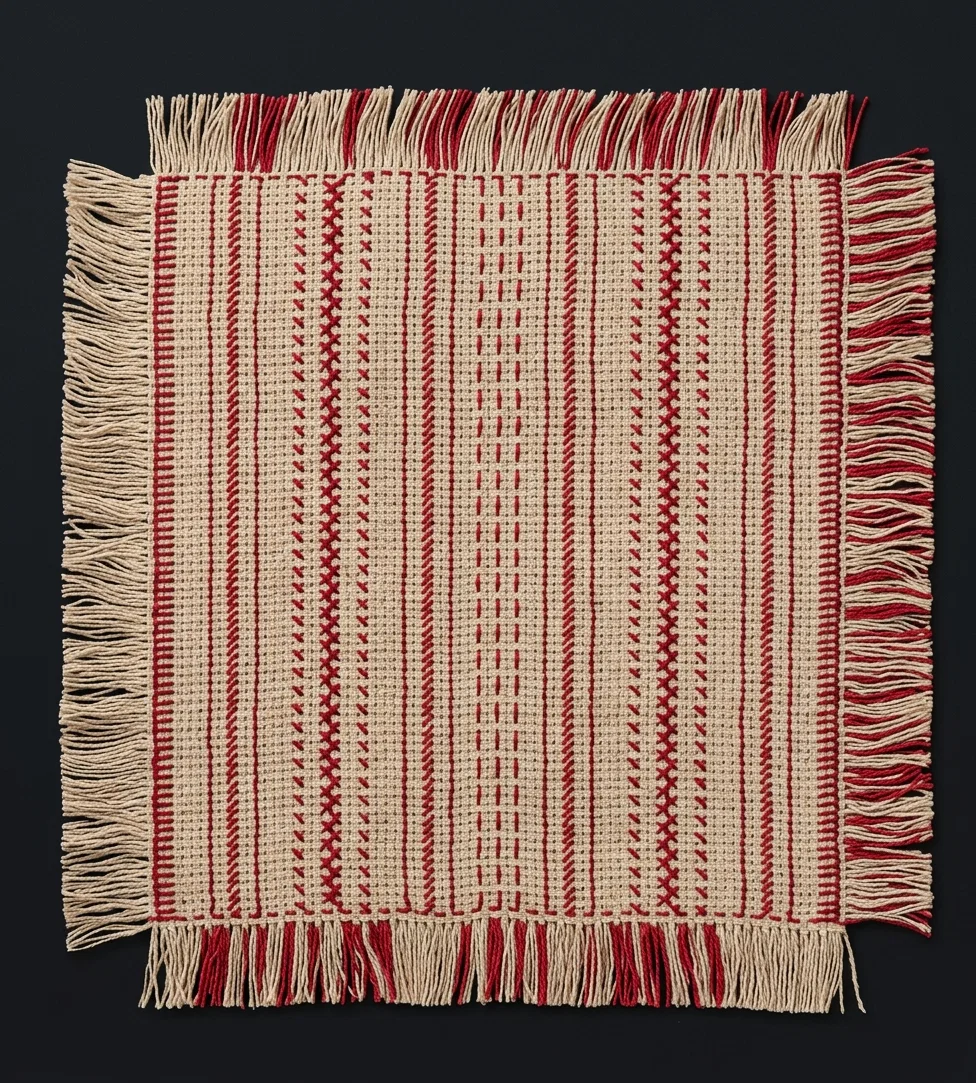
If desired, books may be made in which to preserve the sewing models until the close of the year. Twelve sheets of heavy manila paper, about eight by twelve inches, will be required for each book. Punch a row of holes a half inch below the top; sew through these forward and backward, and tie securely in the center. Write the pupil’s name on the cover. Pin the models to the leaves in order, and write the date when each was finished.
For the second model Java canvas is used, together with No. 12 Turkey-red, H. B. working cotton; the same needle as before.
The Java canvas is double-threaded like the first, but differently woven and softer. It may be had in eighteen- and thirty-six-inch widths, the price varying, with the width and quality, from twenty-five cents to one dollar a yard. Twelve squares to the inch is about the right mesh. One yard of the thirty-six-inch goods will make sixteen models, each nine inches square. The work of this model is simply a repetition of the stitches used in the first model, which may seem unnecessary if one does not understand the importance of thoroughly mastering first principles; but it is none too much repetition to enable the pupils to become familiar with the stitches, which in succeeding lessons must be used under much more difficult and exacting conditions. Do not forget that this work has been arranged for the purpose of making it possible for the pupils to do the work of each lesson correctly and without assistance, though not without instructions. By the time of the completion of this model, the correct position and habits of working should be thoroughly established.
The length of thread directed for the first model should be used throughout. As you start the various rows, expect the pupil to recognize and name each stitch.
Fold the canvas in the center lengthwise; insert the needle from the under side ten squares from the right end of the fold; open the fold and put a row of basting down through the center, taking up one square and leaving two; let the row end ten squares from the left end. All thread ends on this model should be left long enough to reach to the edge of the model; they require no fastening at either end.
At each end of this row of basting put a row of running across the width of the cloth to mark the beginning and ending of the various rows of stitches. Two squares each side of the center row of basting put another row of the same.
Notice that the work of this model consists of groups of three rows each. The corresponding groups each side of the center are the same, hence directions will be given for one side only. Unlike the others, the first, or center, group is made up of only one stitch.
The second group begins with a row of backstitching three squares from the last basting; two squares away put in a row of overhanding; and two squares farther another row of backstitching.
The third group is begun with a row of hemming four squares from the second group; two squares farther a row of cross-stitch, followed by another row of hemming two squares away.
The fourth group is a duplicate of the second, and is four squares from the third.
THE MODEL
Four squares from the fourth group put in a row of blanket stitch with the loops outward. Pupils should expect no help from the teacher on the second side.
Next take No. 50 white spool-cotton and the same needle, and overcast the four sides of the canvas, over the row of squares next to the blanket stitch on the sides and next to the running stitch on the ends. If the rows of unused squares on the four sides are unequal, trim off those that are superfluous. Press the model on the wrong side with a damp cloth over it, and then fringe down to the overcasting.
Many valuable lessons in regard to materials and their manufacture may be interwoven with the work of these models, if the teacher has access to books from which she can obtain the desired information. Where and how cotton, wool, and silk are obtained, and their manufacture into thread and cloth, as well as the origin and manufacture of needles, spools, and thimbles, will be matters of liveliest interest to the children, as well as a means of education.
MRS. E. M. LONG.
Our Schools
By Pearl West Mulford
How to Adapt Manual Labor to the Students with Whom We Have to Deal
For years we have been called upon to establish schools where the students may gain a knowledge of practical labor, while receiving their mental training. Feeble attempts have been made from time to time toward starting such schools, but each time we were brought face to face with the question, “How shall it be done?” and instead of solving the problem, the industrial phase of the work was usually abandoned.
Why are we called upon to establish industrial schools? I quote from the “Testimonies:” “The health can not be preserved unless some portion of each day be given to muscular exertion in the open air. Stated hours should be devoted to manual labor of some kind,—anything which will call into action all parts of the body.” “Brain and muscle must be taxed proportionately if health and vigor be maintained.”
Again: “Physical labor will not prevent the cultivation of the intellect. Far from it. A sound body is required for a sound intellect. It will soon be seen that those who unite work and study, make greater advancement in their books than those who devote all their time to study.”
“The effect is equally good upon the morals. Some do not appreciate the value of agricultural work.” “This work is essential to the education most favorable to spiritual advancement; for nature’s voice is the voice of Christ, teaching us innumerable lessons of love, and power, and submission, and perseverance.”
We are here to teach by precept and example what constitutes a true home and how to make one. With this in mind, let us consider how and where the industries should be taught. Would you take a student to the gymnasium to teach him how to swim?—Certainly not, and just as foolish would it be to go to the schoolroom to learn how to conduct a home. It is in the home that homemaking should be taught. It is on the farm that farming should be taught. Go onto the building if you would learn carpentry, or to the poultry-yard if you would understand how to raise poultry.
The schoolroom instruction on how to make bread may be as explicit as possible, but let the student go home and attempt to carry out that instruction, and we would all be much surprised should she go back taking a loaf of nice, light bread with her as the result. We learn to do by doing, and not by being told how to do.
But the problem by which we are confronted is this: The children do not live with us. We have them, perhaps from 9 a. m. to 3:30 p. m. Their parents need them at home outside of school hours. Shall we, because we have them but a short time, give them only book knowledge? Here is the answer: “If the youth can have but a one-sided education, and it is asked, Which is of the greater consequence, the study of the sciences or the knowledge of labor for practical life, we unhesitatingly say, the latter. If one must be neglected, let it be the28study of books.” “Education,” page 19.
We have made but a small beginning in our school at Fountain Head [Tenn.], but I am willing to give you the benefit of our limited experience. We spend the last hour and a half of each day’s work in manual labor. We have organized a sewing class, taking in all the girls and the little boys. These are divided into two classes. The tiny ones, under one teacher, are learning to take the “over and over” stitch in making quilts, while the older ones are learning to do practical sewing, such as darning stockings, making and mending garments, etc. During class time the children are allowed to converse, and we correct one another’s language. The older boys engage in some line of useful labor, receiving at the same time instruction and spiritual lessons. Thus far the building of the new schoolhouse has afforded ample class work in carpentry. Later we hope to take them into the orchard, where pruning and spraying will be taught.
In pleasant weather our sewing classes give way to an outdoor class, the work of which thus far has been the clearing up of our schoolyard. The students are made to feel that the yard is their own, and that it would not be right to ask the boys who are supporting themselves by hard labor, to stop their work to clear up the schoolyard. So the older boys grub out the stumps, while the rest of us rake, burn, or pick up the leaves, sticks, and brush, learning at the same time how God will make the rough places smooth, and take out even the roots of sin from our hearts.
By spring we hope to have a gravel walk out to the road, and bulbs, flowers, and shrubs on each side of the walk. Then we have a piece of land adjoining our school grounds on the east, which we hope to turn into a strawberry patch, to be planted and taken care of by the children. We also have grape-vines, which need pruning and training; this, too, will afford lessons for the children. While most of the children are working on the schoolyard, two girls clean the schoolroom, one doing the sweeping and the other the dusting. They report when finished, and then their work is inspected, and a chalk mark is made wherever dust or dirt is found. The two girls keep this work for a week at a time. Each child’s desk is considered his house, and the floor is the dooryard. These are inspected each evening before dismissal. During this period some of the girls are sent to the house, where they are taught practical housework. The one who is learning to make bread, puts the yeast to soak, stirs up the sponge, and leaves them to be stirred together in the evening by the teacher. She goes early the next morning, mixes it into a hard loaf, and places it where it will keep warm. Then she goes again and bakes it during the noon period. At each of these visits she is given scientific instruction about yeast, the nutritive value of foods, and spiritual lessons.
Those who wash the dishes are taught to first set back the chairs and sweep up the crumbs. They are taught how to clear the table and pile up the dishes, what to wash first, how to rinse, and how to wash out the dish-cloth when finished. Proper care of the dish towels is also taught. We resort to various ingenious devices for increasing speed and cultivating thoughtfulness. Those who pare potatoes are taught to do it sparingly, and at the same time to be careful to remove all the eyes. Economy is a lesson of no little importance. It is our intention to devote Friday afternoons to instruction and demonstration of simple treatments, using the students as patients and nurses as far as possible. What we have thus begun we hope to make much more complete as the work progresses.
Pearl West Mulford.
The Wise Shall Shine
“AND they that be wise shall shine as the brightness of the firmament; and they that turn many to righteousness as the stars for ever and ever.”
An Important Meeting
By F. G.
THE Conference for Education in the South held its twelfth annual meeting at Atlanta, Ga., April 14-16. At this meeting were leading educators of both the South and the North. The president of the conference is Mr. Robert C. Ogden, of New York. This movement was begun about twelve years ago by several philanthropically inclined men from the North. For eight or nine years Mr. Ogden, a retired business man of large wealth, has devoted himself to these interests.
The meeting was not merely one for the consideration of general educational matters in the South, but was the occasion also of the conference of Southern State superintendents, supervisors of Woman’s School Improvement Work, the Southern Association of College Women, and of the educational organizations of the Southern States under the direction of the commissioners of education of these various States.
Important addresses on the following subjects were given at the conference: “The American Spirit in Education,” by Dr. S. C. Mitchell, president University of South Carolina, Columbia, S. C.; “Educational Progress of the Year in the Southern States,” by Jere M. Pound, State school commissioner, Atlanta, Ga.; “Agricultural and Industrial Educational Movement in the South,” by G. B. Cook, State superintendent of education, Arkansas; “The National Program in Education,” by Elmer Ellsworth Brown, U. S. commissioner of education, Washington, D. C.; “The Educational Campaign in Texas,” by Clarence Ousley, editor of Fort Worth Record, Fort Worth, Tex.; “A School for Grown-Ups,” by P. P. Claxton, University of Tennessee, Knoxville, Tenn.; “The Country Road and the Country School,” by C. S. Barrett, president Farmers’ Union, Union City, Ga.; “Economic Organization of Rural Life,” by Dr. John Lee Coulter, University of Minnesota, Minneapolis, Minn.; “How the National Government May Co-operate with the States in Bettering Rural Conditions,” by Gifford Pinchot, the Forest Service, Washington, D. C.; “Women’s Club as a Factor in Education,” by Dr. Lillian W. Johnson, Memphis, Tenn.; “Educational Work of the Club Women of Georgia,” by Mrs. Robert Emory Park, chairman Education Department Georgia Federation, Atlanta, Ga.; “Higher Education of Women,” by Dean Lida Show King, Woman’s College, Brown University, Providence, R. I.; “Public Taxation and the Negro School,” by Supt. C. L. Coon, Wilson, N. C.; “Education and Economic Development,” by Dr. A. Caswell Ellis, University of Texas, Austin, Texas.
The program, as appears from these notations, was one of considerable diversity, and offered speakers from all portions of the country east of the Rocky Mountains. It is to be observed also that no other feature was so greatly emphasized as that of the value of industrial education. While educational interests in the South are in many respects behind those of the North, yet the South in its efforts of development recognizes that agricultural education is of paramount value, and this seems to be appreciated more fully than in the North. Over and over again during the conference was it emphasized that the soil is the mainspring of the life and development of any people, and, further, that the only way to make this idea of practical value is so to teach the children that they shall receive an intelligent appreciation of the value of rural life.
Wonderful reports were given of the marvelous progress which has been made in these Southern States in educational matters during the last ten years. While the amount of money expended for educational interests in all the Southern States does not equal that which is expended in two of the Northern States, Pennsylvania and New York, yet there has been an increase of over four hundred per cent in expenditures by these Southern States in the last ten years. Some of the States at the present time are building at the rate of over two schoolhouses for each day of the year.
With but one or two exceptions, negro education was treated in a very broad and fair-minded manner, and it was granted that a great responsibility rests upon the white people of the South properly to educate the negro. But it was also emphatically emphasized that the most proper way for him to be educated is in industrial lines; that the courses of study which are given him should embrace agriculture as one of their main subjects; nor was the same course less advocated for white children. It was clearly shown that the education of the negro was not a burden upon the white taxpayer, as the negro owns and pays taxes on more than enough property to pay for the education he is receiving; nor is he likely ever to be a burden, for, as his education increases, his property will naturally correspondingly increase.
In many of the States there are no compulsory educational laws, but the conference made loud calls for them. One reason that such laws have not been enacted to a greater extent is that they would have to apply to the colored as well as to white children; and there has been a strong prejudice in many sections against the education of the negro. But this feeling is rapidly giving way, and it is safe to say that to-day the majority of thinking men and women of the South believe that the right sort of education for the negro will not only be conducive to his betterment, but to the general development of the country.
Altogether the conference was one of great enthusiasm, and it clearly revealed many opportunities for the advancement of the work of the third angel’s message in this portion of the United States.