News Items on War, Prohibition, and Food Conservation
Page 2
The Youth’s Instructor
Jan 29, 1918
Review and Herald Publishing Assn. · Takoma Park Station, Washington, D. C. · Jan 29, 1918
News Items on War, Prohibition, and Food Conservation
Mississippi is the first State to ratify the prohibition Amendment to the Federal Constitution.
Mrs. Annie Sherwood Hawks, the author of the much-loved hymn “I Need Thee Every Hour,” passed away on Jan. 3, 1918.
During the past year 1,000 trawlers, which are used as mine sweepers around the British Isles, have swept an average of 3,000 square miles daily, and removed 4,600 German mines.
After more than three years of terrific war pressure, isolated Germany’s last loan offering produced over three billion dollars, or quite as much as our first offering, when we were figuratively rolling in untouched wealth.
Mr. Herbert Hoover, when a student at Stanford University, was one of the young men who were glad to help meet expenses by waiting on table in Encina Hall. He may therefore know more about the ways of and necessity for conservation of food than one might suppose.
The entire civilian population of Italy has been requisitioned for the purposes of war, official cables announce. There will be a general mobilization, and those persons unable to bear arms will be put to work on farms or in industries essential to the pursuit of the war. Every acre of tillable land has been requisitioned by the government and will be redistributed equally among the people.
It is feared that the antarctic relief ship “Aurora,” which took part in the Shackleton South Polar expedition, has been lost with all hands while returning to England. The vessel sailed from Wellington, New Zealand, in June with a crew of about twenty-two, and nothing has been heard from it since. Vessels sent out to search for it found only a life buoy marked “Aurora” and some wreckage.
Three thousand New York schoolgirls, working not more than one school hour a day, made 25,000 Red Cross articles in six weeks. It needs only the aid of a pencil to show that all the schoolgirls in the Empire State could make three million articles, and that the Red Cross would receive ten times as many, or thirty million articles, if every schoolgirl in America did as much as those schoolgirls in New York.
The Finnish government has declared its full independence of Russia. Finland has prospered in many ways in spite of Russia’s misrule. Under the absolute monarchy the people were goaded to the point of revolution; but under the limited monarchy the fires of liberty were fanned into a flame, and when their ruling government went to pieces the people found that it was their opportunity to become an independent nation.
The thirteenth Sabbath offering of the Takoma Park Sabbath school on Dec. 26, 1917, amounted to more than $600. All of this came from individuals except eighty dollars given by the Review and Herald Publishing Association. The offering of the Sabbath schools on this thirteenth Sabbath is devoted to the publishing work in the Asiatic Division. The General Conference Sabbath School Department was asked to raise $30,000, but it has hoped and worked for $50,000. If all the schools surpass their previous best effort as much as the Takoma Park school did, the fifty-thousand-dollar goal will be reached.
According to reports, twenty-two Norwegian ships were sunk by German submarines in the last month of 1917, and during the year, 367 vessels. Since the beginning of the war, 215 Danish ships have been sunk, 234 persons losing their lives.
Earl Reading, lord chief justice, has been appointed British high commissioner to the United States. Besides taking over the work of the embassy as ambassador, he will have charge of the work of the British war mission to this country.
A Unique Sabbath School Report
By Eva M. Winter
On the Sabbath day of November seventeen we came to Sabbath school “on time,” to feed our insatiable soul appetite upon the bread of heaven. If any were late they probably missed the first course of the meal, which consisted of choice morsels from the one hundred forty-second psalm. Feeling refreshed, we took a draft of the spirit of prayer, which Brother Freeman served to us.
The host of the day was not exactly satisfied with the music which accompanied the meal, so he very naturally made excuses to his guests. However, he promised to give us an appetizing relish in the near future, in the form of a five-minute exercise.
By this time we were all ready for some substantial food for our souls. Mr. Patterson served us with the same course we had had the week before, reheated and garnished. Adventists never seem to tire of this particular article of food, the law of God. Every time it is served to them, they discover a new flavor and aroma. So instead of tiring of this food, they grow more fond of it.
The last course of the meal was served, not at the large family table, but at small tables scattered about the room. The law was served in another form, and the gospel added to it. This is one branch of food conservation which Mr. Hoover has not regulated; so no one need have guilty feelings because of overindulgence. The children had their own tables, and were served with foods most needed to make them strong.
It seems strange to know that any one would deliberately stay away from such a feast; yet that is what forty-one members of our association did. However, their places were filled by fifty-two visitors. These guests and the two hundred members of the association who were present felt so much benefited by the repast, that they voluntarily gave $19.93. Our host said that this money would be used to provide the natives of foreign lands with the spiritual necessities similar to those of which we had just partaken.
Very truly yours,
EVA M. WINTER, Secretary.
To You, Young Men
By Loe A. Sutter
LOE A. SUTTER
“THE ISLES SHALL WAIT FOR HIS LAW.”
ISA. 42: 4
GREETINGS to all of our young men. We are now in the new year. The old is dead. Greetings to the new year. There are many possibilities in it. For these I cheerfully wait. There are many sorrows, no doubt, but for these I shall not worry. Old friends will move on, but there will be new ones, some of whom will be as true as the old and tried.
There will be responsibilities. My prayer is, that I shall shirk none of these. My aim is, that each task shall receive my most careful attention. Why should I slight any duty? Man expects of me, and God demands of me, that each task be well done.
The new year brings a challenge to youth. It flings its opportunities for work, play, and culture in the face of each boy and girl. What will you do with its proffers? The world needs you. God is calling for you, therefore arise in your might, and firmly grasp each duty, however small, so that each day may mark off some task well done.
Does the new year find you discouraged? Remember, it is not the world's fault that you are down. Perhaps you have talked too much, or worked too slowly. Or it may be you were too anxiously watching the clock for the closing hour, that brought about your discharge. Thank God you are still alive, and can have another opportunity to prove your worth.
The poor old world is jogging along at the same rate at which the Master started it. It will never stop for your whining, but it holds open its arms to embrace you if you are young, strong, and willing to work.
The shop needs you, the bank invites you, the farm will many times repay all your efforts; so why complain about lack of opportunities?
There are bridges to build. There are books to sell. There are laws to make, and to defend from breaking. What stand will you take in the matter?
Your greatest friend is the expression you wear on your face. You may not be wanted anywhere if your look is gloomy, but there is no door that a smile cannot unlock.
You are uneducated? That is unfortunate, but no disgrace. There never were so many good books as at the present time. Free night schools and correspondence courses are open to all. If you remain uneducated it is your own fault, and the world will jog on, and leave you.
You must be alert, active, accurate, and persevering, or some one will get your place.
Can you dream? If not, you have missed a pleasure, but alas, the one who dreams continuously never accomplishes a worthy task. It is your duty to see visions, but in order to accomplish this duty your hands must bring your visions to fruition.
Perhaps you are a cobbler? The world never needed cobblers more than now. The cobbler who will honestly put heels and soles on children's shoes will cheer the soul of many a burdened mother.
You are an ice man? And all you can do is to carry heavy cakes of ice to the rear door of houses? But for your early delivery of ice some baby's milk would have soured, and the little one have died. Your ice cooled the water for the burning lips of a fever patient. Keep delivering ice. It may be, this year, that you will do more good than last.
You are a poor student? Your lessons come hard, and your wardrobe is scanty? What of that? It is over this road that many an author or statesman has traveled. Be thankful for your hard knocks, and keep plodding on.
Young man, be in earnest. Unless you are dead in earnest, some other fellow will step in ahead of you. The world's favorite sons have earned their places by long hours of work, despite unkind remarks, and the jeers of the rabble.
Cheer up, look up, get up, and with all your strength build a character filled with good cheer, honesty, integrity, alertness, and abundance of common sense.
This new year will roll on apace.4Greet it with good will. Use each moment well. Not by moping in discouragement, or apologizing for your inability, but by reading good books, associating with intellectual friends, and with a deep faith in the eternal purposes of God content yourself with the new year's gifts.
A Great Soul-Winner
By J. E. Fulton
Ko Thah Byu was the first convert among the Karens, and he also became their first preacher. As an evangelist he ranked as one of the world’s great soul-winners. He was born about the year 1778 near Bassiem, Burma. As a youth he was possessed of a violent temper, was wicked and ungovernable, and later became a robber and a murderer. He hardly knew the number of men he had murdered, probably between thirty and forty, but through God’s saving grace he who had been a destroyer later became a savior of men.
He fell under the blessed influence of Judson, Boardman, and others, and in the year 1828 was baptized. Although a man of poor abilities and unlearned, he was possessed with a strong desire to make Christ known among his fellow countrymen, and like Paul of old, he began at once to preach Jesus. It was not long till he had interested some in the gospel, and with these he labored incessantly day and night. His earnestness and zeal knew no bounds. No sooner was one long tour finished than he was filled with longing and determination to go again to other villages where Jesus had never been preached. During the rainy months he would gather in the old and young, teaching them to read and instructing them in the ways of God, but as soon as the pleasant months came he began his tours of preaching.
Saved from Drowning
He was not a pastor. Those whom he had been instrumental in bringing to Christ, and who loved and esteemed him, would not long endure his preaching, for he was a man of very ordinary abilities, and many of his converts soon knew more than he, and demanded a preacher of more learning. But he was a successful pioneer preacher, and knew well those essentials of the gospel specially adapted to bring men to a saving knowledge of God. He hungered for souls, and was willing to undergo any privation to reach them. On one occasion, while traveling with another missionary in a small boat, he was in great danger of losing his life, when he cried out, saying, “I shall be drowned, and nevermore preach the word of God to the Karens.” He was a man of simple faith and great in prayer. At times, it was said, he spent, like his Master, whole nights in prayer. Here was the secret of his power as a soul-winner. Few men, from the days of the apostles, have been instrumental in winning more individuals to Christ than this unlearned and simple Karen preacher.
Rev. Francis Mason, a missionary to the Karens, in his biography of Ko Thah Byu, says of his devotion:
“There is another characteristic of Ko Thah Byu, as a preacher, which I shall endeavor to call a peculiarity; and which in a great measure accounts for the very great success that attended his labors. It was, if I may so speak, his idolizing his work. It was with him not only the great business of his life, but the only work to which he attached the least importance. He not only counted all things else but loss and dross in comparison with the knowledge of Christ Jesus, but, like his divine Master, it was his meat and drink to impart that knowledge to others. It was for the attainment of this object that he wished to live, and seemingly there was in his mind no other object for which even life itself was desirable.
Religious Conversation Always Seasonable
“In introducing the subject of religion, he was the most unceremonious person I ever saw. It seemed to be a settled point with him, that there could be no time or place unsuitable for the introduction of religious conversation. I have made a number of excursions with him, and I do not recollect that I ever knew him to pass a person in the road without stopping him for a few words of conversation on the subject of religion; and if the individual would consent, he would sit down by the wayside, and preach to him by the hour. Not unfrequently has he in this way been left by his associates; and in one instance they returned from one excursion, saying their patience was exhausted, and they had left Ko Thah Byu preaching by the wayside.”
On the ninth of September, 1840, Ko Thah Byu, worn out with his arduous labors and after much suffering with rheumatism, fell asleep. He was buried at the foot of one of the mountains of Pegu. “No mound marks his grave; no ‘storied urn or animated bust’ indicates his resting place; but the eternal mountains are his monument, and the Christian villages that clothe their sides his epitaph.”
“’Twas midnight in the jungle,
And not a leaf was stirred;
No restless stream was babbling,
No moonbeams woke the bird,—
When the fearful traveler started,
And held his listening breath,
His trembling fingers grasping
His instrument of death.
“A sound had broke the stillness,
And filled his soul with dread!
’Twas not the dead leaf rustling
Beneath the foeman’s tread;
’Twas not the tiger’s velvet step,
When creeping from his lair;
But ’twas a sound more dear to God,—
Ko Thah Byu in prayer.
“Ko Thah Byu is gone!
His jungle prayer is done;
The war of life is ended,
The crown of life is won!
But Karen converts tell
That prayer with God could gain,
And he hath sent the answer;
He did not pray in vain.
“He sleeps not where the Ganges roll,
Or sainted beech reed nods;
Beside his grave no lotus leaf
Bore up the god of gods.
He sleeps on Pegu’s mountain,
And naught disturbs him there;
With Karen hearts for monuments;
His epitaph, his prayer.5
“His simple grave has eloquence
Which living tongues have not;
For know the love of Jesus
Has sanctified the spot.
Go hither, proud idolater,
And, kneeling on that sod,
Own that a prayer, a heartfelt prayer,
Alone avails with God.”
J. E. FULTON.
The Morning Light
By John Oxenham
BEYOND the war clouds and the reddened ways
I see the promise of the coming days.
I see his Son arise, new charged with grace,
Earth’s tears to dry and all her woes efface.
Christ lives! Christ loves! Christ rules!
No more shall might,
Though leagued with all the forces of the night,
Ride over right. No more shall wrong
The world’s dread agonies prolong.
Who waits his time shall surely see
The triumph of his constancy:
When, without let, or bar, or stay,
The coming of his perfect day
Shall sweep the powers of night away—
And faith, replumed for nobler flight,
And hope, aglow with radiance bright,
And love, in loveliness bedight,
Shall greet the morning light.
— John Oxenham.
The End of the Opium Traffic
By Nathaniel Pfeffer
THE last wisps of smoke have curled from the opium pipes of China. The country is now comparatively free of opium. In ten years China threw off the most terrible bondage that ever enslaved a nation and at the same time consummated one of the finest achievements in the history of any people.
The last effort to prolong the life of the drug was frustrated under circumstances that provided a fitting climax to the sweeping surge of idealism that characterized the fight of a decade. For the last three years all China was closed to the traffic in opium except the three provinces in which, ironically enough, the foreign interests dominated: Kiang-su, in which is Shanghai; Kwang-tung, in which is Canton; and Kiang-si, in which is Kiu-kiang. While the Chinese themselves sacrificed whatever property interests they had in the traffic, the British importers who made up the Shanghai opium combine, forced an agreement three years ago allowing them to sell the drug in those three provinces until they disposed of their accumulated stocks. The expiration of that agreement was fixed at March 31, 1917, the date originally set by the Chinese government for the end of the evil throughout the country.
The combine, finding it could not dispose of its stock by that time, asked the government for an extension of that agreement until Jan. 1, 1918, offering $16,000,000 for the privilege. That offer the government refused. In financial straits as it was, its treasury depleted by revolution, forced even for a time to suspend specie payments, and negotiating—almost begging—for $5,000,000 loans in America, it refused. Strong political pressure was brought to bear; the combine even threatened to withhold $5,000,000 of the duty on its last months of operation. Still the government stood firm, a magnificent stand for a principle. Backward, material China! How many of the “civilized” powers, similarly situated, would have done the same? How many governments, hanging by so tenuous a thread, would have balked at so small a compromise for so large a stake?
It was with just that splendid disregard for the pressure of the pocket nerve that the whole war on the drug was carried on. To realize what this meant, financially at least, to China, you must compare it with the effect on the United States if the government were suddenly to forbid the cultivation of wheat and corn. Then imagine the people of those States not only submitting, but burning with elaborate ceremonies all agricultural implements.
Opium was for nearly a century the largest vested interest in China, an interest in which thousands had their entire wealth and from which millions drew their living. There were provinces in which there was virtually no other crop, for opium always commanded a much higher price than any other product. In addition, the customs revenue on the poppy imported from India and the internal tax on the native product represented a large proportion of the entire revenue of the country, more than $30,000,000. And on the personal side, at least half the 400,000,000 people of the country were addicted to the drug.
Is it any wonder, then, that when, in 1906, the empress dowager promulgated her decree ordering the suppression of the drug within ten years, the world looked for the tongue in her cheek? Or that when the Chinese asked Great Britain to stop the opium imports from India and urged the opium merchants in China to curtail their sales, a British official publicly said: “It is impossible not to be skeptical of the intentions of the Chinese government, with regard to this matter”?
It was not possible to be skeptical long. Two months after the empress’s decree the government council had framed a definite program for its execution—the immediate closing of the dens for smoking and the reduction of the area under poppy cultivation by one tenth each year. With savage, relentless strokes, without any regard for financial loss, that program was carried out. In six months the closing of the dens had begun. After three years American consuls reported that the production of the poppy had been reduced fifty percent and that two million dens had been shut. In 1912 five of the eighteen provinces had been closed to the traffic, and in 1913 five more. By 1914 fifteen were free from the drug.
The amazing feature of the whole fight was its overwhelming popular support. Seldom have there been such spectacles as the public burning of huge quantities of opium worth thousands of dollars, rich furnishings of dens, pipes, and all the paraphernalia of smoking. These have been held from time to time in various parts of the country with official and religious ceremonies.
The one ugly fact was the part played by foreigners, as it was through the whole history of opium in China. Forcing it originally on the Chinese at the point of guns, they resisted to the last its passing. Officially China was given co-operation though not ungrudgingly, in its effort to free itself from the curse.
But the attitude of the foreigners living in China who had an interest in the traffic was an ugly commentary on Western morals. So far from making any sacrifice, they made capital out of the suppression of the drug. In cities like Shanghai, Tientsin, Hankow, where the foreigners have concessions or the privilege of extraterritoriality, opium dens were open for years after they were closed in the adjoining districts under native jurisdiction.
The only places in the country where a Chinese could get the drug that was the curse of his people were those ruled by the civilized white man. And even to the last the opium merchants made their abortive effort, by bribe and threat, to prolong the life of those shops. But it was abortive. China won her liberty from the sinister tyranny that bound her to decay.
—Nathaniel Pfeffer, in the Independent.
Mountain Sunset
By Edmund Jaeger
The day is done.
Over the western hills of blue
The last bright rays of the lowering sun
Strike glory upward in a thousand blazing
streams of light.
From gold to pink, and then to gold again,
Lavender, rose-pink, and ruddy red,
The sky tints come and go,
Painting in quiet loveliness
The canvas of the evening sky.
Fir and pine and castled crag
Silhouette in darkened form
Their outlines 'gainst the glory scene,
Speaking stillness, breathing coolness,
Pointing upward to the blue.
EDMUND JAEGER.
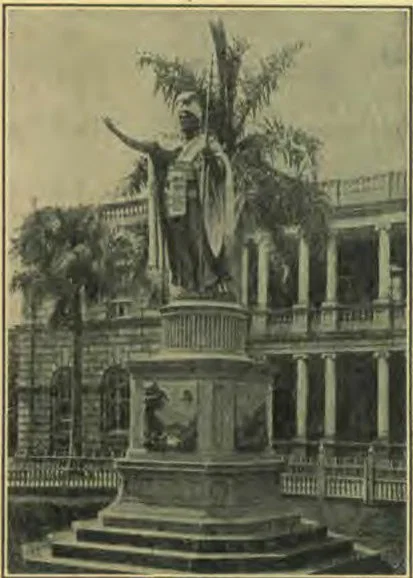
THE CAPITOL — FORMERLY THE ROYAL PALACE, HONOLULU
Queen Liliuokalani’s Funeral
The superintendent of the Methodist Hawaiian Mission, Honolulu, William Henry Fry, gave in the Christian Advocate a graphic description of the royal funeral held under the Stars and Stripes “when Hawaii’s eighth and last monarch was given burial with a state funeral whose beauty, vivid color, and impressiveness combined ancient and modern days—the régime of a Pacific monarchy and a United States Territory.”
The following paragraphs are a part of Mr. Fry’s account of the imposing ceremony:
Statue of Kamehameha the Great, the Hawaiian ruler from 1781-1819.
Statue
Great, th
1781-181
“Liliuokalani, last of the monarchs of Hawaii, last crowned ruler of the islands, queen and woman, sleeps today in the silent crypt where lie the bodies of her brothers, King Kalakaua and the other members of the Kalakaua family. Liliuokalani is dead, and with her dies the final vestige of monarchial rule. She was laid to her final rest in the beautiful Nuuanu Valley yesterday, with all the impressive honors that would have been hers had she when she died been the ruler of Hawaii. Nor was she honored in death by the people of Hawaii, her former subjects, only. A world joined hands to pay her final honors, not only as a former queen, but as a woman who, deprived of crown and scepter, reigned still for more than a score of years in the hearts of her people.
“Particularly did the United States Government, successor to all her former power, pay her honor and respect. The military escort, embracing all branches of the service, was one of the most imposing ever seen in Honolulu. Senators and representatives, representing the President of the United States, attended the catafalque to the cemetery and stood in sincere sorrow as the casket was borne into the silent crypt. Civil authorities were present, and a wreath presented by President Wilson lay upon the casket as the solemn words of burial were read over all that was mortal of Liliuokalani, the last monarch of the islands.
“The week of state mourning paid high honor to the queen and high respect to her race. There were unmistakable signs of sorrow upon many countenances. The last of the Kalakaua dynasty is gone, and the royal funeral is the last that will ever be held under the Stars and Stripes. The monarchy has run its course; the last link that bound the people of the islands to the ancient régime is severed.”
Why Not Use the Best?
By Mrs. D. A. Fitch
In the use of clothing and other material it is a matter of economy to use the poorest first if it will answer the purpose well, but not so with our language. The best is none too good, and it never deteriorates by use. A long list of expressions better than those frequently heard might be given with profit. A slang phrase or sentence may be perfectly grammatical and yet tell loudly of lack of education and refinement.
A teacher who was late in keeping an appointment said, “I just broke my neck to get here.” The waiting ones were glad her life had been spared to tell of the great effort she had made; but she certainly should have expressed herself more acceptably.
We were surprised to learn there were so many in attendance at the church school. Our informant said, “The teacher went out and drummed up patronage.” Would it not be more appropriate for a teacher to “solicit” patronage, and leave the drumming for those who deal in groceries, dry goods, and other wares?
Emma had a “chance” to “stay” at home. She was thankful for the “opportunity” to “remain” with her mother. Which is better? Take your choice of the following:
He never opened his head. He did not speak of it.7
If they were on their jobs. If they understood their business.
Mary put off her visit. Mary postponed her visit.
He looks very stylish. He appears very stylish.
When sister gets back. When sister returns.
MRS. D. A. FITCH.
A Spray of Columbine
THE young graduate, taking up new duties in the home, in the absence of the mother of the family, was entertaining her first caller. The caller was a neighbor, a middle-aged woman with keen yet kindly eyes, known to be the best cook and the best housekeeper for miles around. She was chatting pleasantly, but the young hostess was decidedly uncomfortable.
To cultivate the friendship of
The man behind the smile.
— Anonymous.
“Never, never again,” she was saying to herself, while her lips framed polite answers to her guest’s words, “will I go to the woods in the morning!”
At last the caller rose to go. As she moved toward the door she stopped for a moment to look at a slender glass vase on the table.
“What beautiful columbine!” she exclaimed. “It’s the first I’ve seen this year.”
The young hostess flushed to the roots of her golden hair. Then the cause of her discomfort was made evident.
“I’m dreadfully ashamed of the dust on that table, Mrs. Glyndon,” she said. “The truth is, I played truant this morning and went to the woods with my brother before I finished my dusting.”
The older woman laughed and her eyes twinkled as she said:
“Very wise you were to use the opportunity, and fortunate you were to have a brother to go with. Dusting we have always with us, but our wild flowers stay such a little while! Take a little advice from me, my dear,” she added, a shade of seriousness crossing her strong face. “Don’t bow down and worship your housework. If I had my life to live over again, I’d train my eyes to see more flowers and less dust.”
As she returned to her home duties, the young graduate thought, “I wonder if there is wisdom in her advice.” Then her thoughts ran on something like this:
“Training the eyes to see more of beauty and less of ugliness involves training the mind to an appreciation of the real values of life. And the real values of life are not always found where we expect them to be. A vase of columbine may be no excuse for habitual untidiness, but a morning in the woods surely does bring one a feeling of rest. From it one assuredly does return to the work of the day with a clearer brain and higher aims.”—The Girls’ Companion.
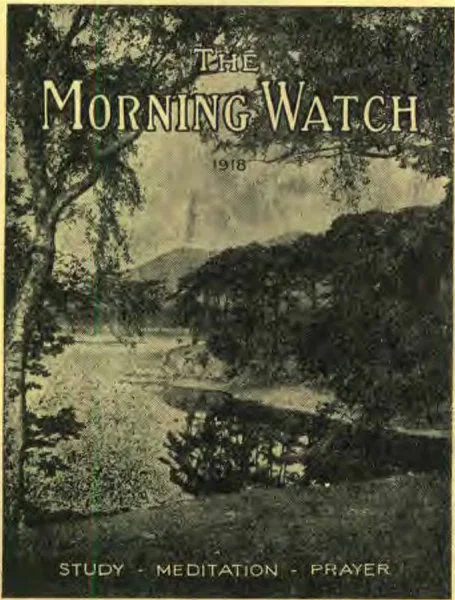
The Morning Watch
By W. C. Flaiz
IN a very much more real and definite way than we are apt to realize, we close our life's record every night when we fall asleep, and start new again each morning. To progress in Christian living, as in everything else, one must not only keep going, but keep going in the right direction. Going one direction one day and a different one each other day will not do. When clear sky breaks through after a period of thick weather, the mariner takes his bearings — rights himself on his course. In some such way a few of the first minutes of each new day spent in taking our bearings — squaring ourselves on our course for the new life that each morning brings — would go a long way toward taking out of our lives the wabbles, zigzags, and painful retracings that keep us going in a circle.
We should spend some time every morning in reading the Bible, in prayer, and in taking an inventory of ourselves. Comparing our actual selves with what we know we should be and expect to be, would give direction to everything we do. Instead of so many hours in the treadmill that so many of us find our day's work to be, each day's distance run might be one relay of a continuous journey, each day's work might be progress, and each day's record might be victory.
The Morning Watch is helping many to live this life of victory. Do you find yourself in a treadmill? Does your Christian life go in a circle instead of dead ahead? Try the Morning Watch. Try the Morning Watch remedy; it will be worth your while.
W. C. FLAIZ.
“Watch and pray, that ye enter not into temptation.” Matt. 26: 41.
The Man Behind the Smile
By Anonymous
I DON'T know how he is on creeds,
I never heard him say;
But he's a smile that fits his face,
And he wears it every day.
If things go wrong he don't complain—
Just tries to see the joke;
He's always finding little ways
Of helping other folk.
He sees the good in every one,
Their faults he never mentions;
He has a lot of confidence
In people's good intentions.
No matter if the sky is gray,
You get his point of view
The clouds begin to scatter,
And the sun comes breaking through.
You'll know him if you meet him,
And you'll find it worth your while
To cultivate the friendship of
The man behind the smile.