THERE is an apartment house in New York where you can, if you will and are able, pay $25,000 a year for your flat. If this is the latest word in houses that hold many families under one roof, Mr. Roy C. Andrews — recently returned from China, where he had been sent by the American Museum of Natural History — tells of finding what is probably the oldest in the world. Its tenants are exclusively bats, and the great community dwelling occupies an area equal to two city blocks on a mountain side on the Tibet border, and is many stories high. Here is the explorer’s story:
The Home of Thousands of Bats
Some persons might have described the place as a cave, although nature and the best bat families had developed it into an underground flat. We had to stoop in order to enter; but, for that matter, there are doors almost as small as this entrance, into Batland to be found at the front of metropolitan cliff dwellings. Having successfully made our entry, we found ourselves in a central court or great foyer, to the right and left of which there were deep galleries running back into the rock as far as the eye could see. On the roofs of those chambers or corridors were hanging more bats than I ever saw before or hope ever to see again.
There were many thousands of them. Each division had bats of one kind only. Apparently each species of bat never went to visit any other variety. The atmosphere was close and clannish. This segregation process had been going on for centuries, no doubt, for the cave gave evidence of having been occupied by that class of tenants almost from the beginning of time. For thousands of years these bats had been distributing themselves according to race. Generations of bats had come and gone, leaving their bones in the cavern; and their children had successfully kept up the class distinctions.
The Bat’s Caste System
The big bats gathered by themselves; the medium-sized brown bats had their own galleries; and the tiny bats, which seemed more like huge insects than animals, were clustered in special reservations. The arrangement was so orderly that one might think it was a bat department store in charge of a new efficiency expert. For any sort or condition of bat, you would go down so many aisles and turn to the right or the left, as you saw fit.
Imagine bats descended from long lines of forbears brushing disdainfully past the ones that had been in the cave only since the Kang-hsi dynasty, and gathering up their fur as they went for fear of coming in contact with social climbers. To such as these the events of our lives would seem as only incidents, they had been exclusive so long.
A BAT WITH WINGS EXTENDED
Our torches gave only enough light to make out the odd tenants of the place; and the still and drowsy air added to the uncanny effect. Presently a big fellow pendent from the end of a gallery stirred slightly and jostled his neighbor. A faint rustle, as of silken garments and furs, swept along the silent corridors, and the somber colonies stirred into action. Soon bats of all sizes and breeds were in flight. They flew about us, sometimes striking our faces with their smooth, damp wings.
Sometimes one reads of caverns of vampires, and here there came to us the thought of the legends that have to do with these strange fluttering things of the darkness. From such a retreat as this Dracula might have come. Some of the creatures were eighteen inches wide across their wings, and in the half darkness they seemed much larger.
When They Swarmed Down upon Us
Several times the bats swarmed about us, so that we were nearly carried off our feet by the impact of the soft bodies against us. We made our way back to the entrance, beating down the whirring masses about us with our clubs; but there was no time to stop and pick up any of them.
It was with a sense of relief that we gained the open air. After that we did our bat collecting at the mouth of the cavern by spreading a net across it and taking such specimens as came out at dusk.
From a scientific point of view, this excursion into the gloomy corridors gave fine results; for I have every reason to believe that our collections include several species never before described.
We left rather sooner than we wished, for a revolution or so had broken out in the vicinity. I have often wondered, since, whether the vampire aristocrats ever got their classifications and social distinctions back to normal; for certainly we did disturb the established order by our invasion.— Every Week.
Price Increase for In Nature's Haunts With Youthful Minds
The book “In Nature’s Haunts with Youthful Minds,” which was advertised in the INSTRUCTOR of Dec. 4, 1917, has been increased in price from fifty cents to seventy-five cents. Order of the Review and Herald Publishing Association, Takoma Park, D. C.
Making the Most of Scraps of Time
“DON'T let your scraps of time go to waste—they are all needed to fill out the pages of the book of life.”
Honesty in Religion and Business
“DON'T let your testimony get ahead of your experience—be honest in religion as well as in business.”
The Humble Enjoy Continued Peace
“THE humble enjoy continued peace, but in the heart of the proud is envy and frequent indignation.”
Stones from the Sky
IN 1492, just about the time that Columbus was discovering the New World, a great stone meteorite was seen to fall from the sky in Ensisheim, Alsace. Its coming was accompanied by a loud, crashing noise. This stone from the sky was carefully preserved, and today pieces of it are to be seen at the Smithsonian Museum, Washington, D. C.
A famous stone that came crashing down in Phrygia in Asia Minor, about 200 B. C., was worshiped by the people as an idol. They called it Cybele, the mother of the gods.
The Kaaba, of Mecca, the sacred black stone which the Mohammedans worship as a holy relic, is a meteorite, and fell in the seventh century. A very large and ancient sky stone, the Casas Grandes ironstone, which weighs a ton and a half, fell in Mexico in prehistoric times. It was found by explorers in an old Mexican temple, swathed in mummy cloths, showing that it had been venerated as an idol.
In those days no astronomer could explain the sky stones, and many denied that they really fell. As late as 1772 it was insisted by French scientists that a stone reported to have fallen at Luce was only an ordinary rock that had been struck by lightning.
But in 1794 Chladni collected all the accounts of known meteorites, and called the attention of scientific men to the Pallas ironstone. It was found among entirely different rocks on the top of a lofty mountain in Siberia. It could not possibly have been carried there by man. The stone must have fallen from the sky. As if to prove Chladni right, an observed shower of meteorites fell that same year at Siena, and the next year a fifty-six-pound stone fell out of a clear sky almost at the feet of a man in Yorkshire.
The French still doubted, however, until a shower of stones occurred in 1803 near Paris, when over three thousand stones fell. Then every one was convinced. But in some ways man knows no more today about where meteorites come from than he did long ago.
The sky stones have no trace of animal or vegetable remains, so they can reveal nothing of life in other spheres. All the stones have a thin, dark, glasslike crust, the surface having been fused by heat. Yet very few are warm when they reach the ground, and some are icy cold. Sky stones have fallen on a stack of straw without setting it on fire, or in dry grass without even charring it.
At night a trail of light shows the fall of a meteor; but in daylight they fall without any such appearance. Usually there is a noise like musketry or thunder. Their speed has never been measured, but one 560-pound stone at Knya Linya, in Hungary, penetrated the earth to the depth of eleven feet, which shows it was falling at high speed. Some observers computed its speed at forty-five miles a second.
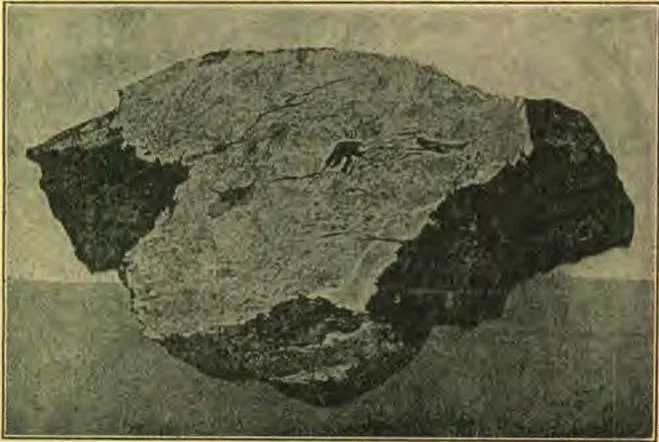
A METEOR WEIGHING 1,015 POUNDS, WHICH FELL IN AN ARIZONA CANYON
More than 650 falls and finds of meteorites are recorded. The largest known sky stone is the one Peary brought from Cape York, in Greenland. It weighs seventy-three thousand pounds. The next largest lies in the plain of Bacubirito, Mexico, and weighs fifty thousand pounds. The third is the Willamette meteor, in Oregon, which weighs thirty-one thousand pounds. These are all masses of meteoric iron. The largest mass of meteoric stone is the Knya Linya stone, which is now in a museum at Vienna, Austria.—Forward.
The War Octopus
The American motorist may well be thankful that he can secure gasoline at as reasonable a price as he now pays, for when he considers that France alone uses 4,000,000 gallons every month, Saloniki 1,500,000, Egypt 90,000, while 1,000,000 gallons are necessary for the English home forces, besides the immense output consumed by our own government, it is a wonder that he can secure the commodity at any price.
In the early part of the war all the canning and reshipping of the fuel for use of the armies on French soil was done at one English port. This was possible when the monthly consumption was only 250,000 gallons; but as the work expanded new methods of handling the gigantic business were devised. America is not the only place where things are done in a hurry; and since the new method of supplying gasoline to the armies meant the removal of canning factories to France, prompt action was taken. The Saturday Evening Post gives the following instance of genuine war-time hustle:
“On a certain Thursday night the largest of these gasoline-can factories was operating in a town in England. Exactly nine days afterward it was in full swing at a port in France. Every ton of machinery had been moved in that time and set up without mishap. It moved into a series of abandoned factories that had been carefully prepared for the change. Another can factory rose out of a marsh in exactly eight weeks. In this case wooden buildings had to be erected and the machinery assembled in England and shipped over. The construction and operation of these factories in France has released six ships that are now employed for other tonnage.
“These can factories work day and night. The operatives are English boys too young to fight but are a part of the army organization and wear khaki. Just as soon as they reach military age they go into the fighting forces or the army service corps. Meanwhile they are drilled and get a rudimentary idea of the military game. It keeps them fit.
“These boys are supplemented by thousands of Frenchwomen, who adapt themselves surprisingly well to the labor-saving machinery.
“The new cans go straight from the factory to the filling-room, where women do all the work. From eight to ten thousand cans are filled every day. Railway tracks run straight into these annexes, and every day four solid trains of gasoline go up the line from each depot. The standard railway freight car in France contains 1,200 gallons of fuel, and each train averages 40 cars. Immense as this supply seems, it is just enough to keep the voracious engine of British mechanical transport tuned up and humming.”
The Elephant's Sagacity
STEPHEN TROWBRIDGE says that frequently “as many as 350 elephants in one herd passing over the prairies, breaking down trees and bushes, and eating the grasses and leaves,” are seen in the Sudan. “The wild elephant is a very lively animal and a powerful fighter. He has a remarkable memory, and if he has ever been wounded by hunters, he is likely to charge ferociously the next time he meets any. In Mongala the natives climb trees, weight their spears with stones, and when the elephants pass beneath the branches, they drive at them with the weighted spears and then follow the wounded beasts for hours, in the hope of getting the ivory of the tusks.
“Elephants rarely cross bridges. You can follow their tracks for miles along a river or over a prairie, but when they come to a bridge, they turn aside. Sometimes they come out and travel on the government roads, as if they understood just what the road was made for. Elephants do not see well, but they have a very keen sense of smell, and they can wheel about with astonishing rapidity to attack an enemy.”
A Plague of Mice
EUROPEAN field mice have increased to such an extent that they are doing enormous damage throughout the states of New South Wales, Victoria, and South Australia. Their attacks upon the wheat lying stacked in bags, awaiting shipment, alone threaten loss to the extent of millions of dollars. To save this wheat all the stacks are being surrounded with mouse-proof fences of galvanized iron, with openings left every sixteen feet, in which are placed kerosene tins, sunk in the ground with six inches of water in the bottom. The mice already in the stacks when this miniature fortification is put in place must go out for water, and when they try to do so they fall into the tins. At one country railroad station nearly ten thousand mice were caught in this way in a single night. The experiment of driving the pests out of a stack by using the fumes of carbon bisulphide has also been tried with some success.—Scientific American.
Planting Trees Worth While
For one hundred fifty years the street department of Baden, Switzerland, has been planting all the roads with apple, pear, cherry, and nut trees.
The trees came from state horticultural schools, and cost about ninety cents apiece. Each tree yields an average of $2.50 a year — a clear gain per tree of $1.60.
The crop from these trees is sold at public auction, and the proceeds are spent on the upkeep of the roads and on planting and looking after the trees themselves.
The work is done by street wardens, who are obliged to take a course of four or five weeks' instruction at a state horticultural school in the cutting and transplanting of young trees, pruning, spraying, grafting, and protection from insects and blights.
Here is an idea for our fruit-growing States.— Every Week.
Light in the Vales of Necessity
By James Martineau
FROM the sunlit heights of life the deep vales and hollows of its necessities look darkest, but to the faithful whose part lies there, there is still light enough to show the way, and to no other eyes do the everlasting hills and blue heaven seem so brilliant.— James Martineau.
Canaries and White Mice
NOT long ago the War Department received a telegram from General Pershing, reading:
“Send one thousand canaries and one thousand white mice.”
The message was sent to the chief purchaser for the expeditionary forces. He read the words and sent the dispatch back to the Secretary of War with the request that it be uncoded. The coderoom of the War Department returned it with a note saying that it could not be uncoded, that it was just a plain telegram.
The purchaser was baffled. He did not know whether the telegram was a joke or an order, so he consulted a former United States military attaché in France.
“Do you suppose that General Pershing actually wants white mice and canaries?” he asked the captain, handing him the cable.
“Yes, sir!” was the military reply. “White mice and canaries are placed in the first-line trenches because they can detect poisonous gases much quicker than the soldiers. When a soldier sees a canary bat its wings or a white mouse try to bury its nose, he understands that it is high time for him to put on his gas mask. White mice and canaries have saved thousands of lives in France, and we should supply our army immediately.”
It is hardly necessary to add that the United States purchased the white mice and canaries at once and shipped them to France, and in doing so we almost exhausted the supply. I know of only two white mice that were left behind; perhaps there are many others, but these two belong to Mary Roberts Rinehart.— Saturday Evening Post.
Look Pleasant
We cannot, of course, all be handsome,
And it's hard for us all to be good;
We are sure now and then to be lonesome,
And we don't always do as we should.
To be patient is not always easy,
To be cheerful is much harder still,
But at least we can always be pleasant,
If we make up our minds that we will.
And it pays every time to be kindly,
Although we feel worried and blue;
If you smile at the world and look cheerful,
The world will smile back at you.
So try to brace up and look pleasant,
No matter how low you are down;
Good humor is always contagious,
But you banish your friends when you frown.
— Exchange.
Hope and Divine Presence Amid Trials
Keep a brave spirit, and never despair; hope brings you messages through the keen air — Good is victorious — God is everywhere.— The Calendar of Sunshine.
Gold Cannot Buy Old Associations
By Longfellow
WE may build more splendid habitations, fill our rooms with paintings and with sculptures, but we cannot buy with gold the old associations.— Longfellow.
The Sweetest Music: Tenderness, Truth, and Courage
THE sweetest music is not in oratories, but in the human voice when it speaks from its instant life tones of tenderness, truth, and courage.— Emerson.
Sunshine Within: Verses on Light and Days
By Christina G. Rossetti
My shortest days end, my lengthening days begin,
What matters more or less sun in the sky,
When all is sun within?
— Christina G. Rossetti.
A Boon, My Lord
By Mark Guy Pearse
Of all the golden gifts that there may be,
I would be bold, my Lord, to ask for this:
Be it in all my glory and my bliss
To make my little world think well of thee.
Be this the aim of every work and word,
The source and limit of my liberty,
Life’s blessedness and best prosperity:
To make the world think well of thee, my Lord.
I cannot pay thee for thy love to me;
But since I am so greatly in thy debt
I fain would give thee all that I can get,
And live to make the world think well of thee.
— Rev. Mark Guy Pearse.
The Power of the Cross
By M. G. Conger
M. G. CONGER
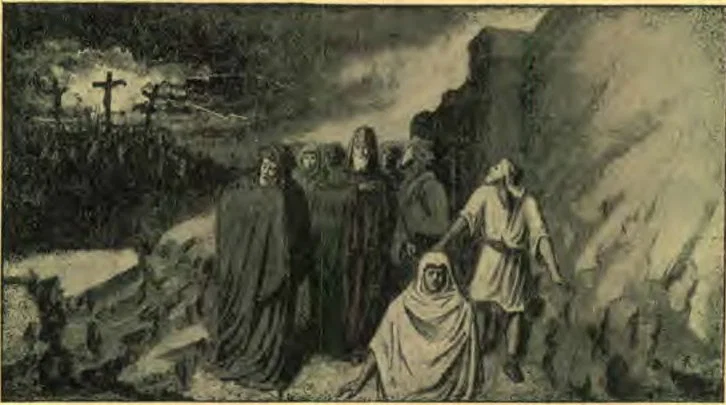
NEARLY three thousand years ago the city throng that went out of one of the most important Eastern cities viewed on a near-by hill the form of three crosses, on the center one an individual who, the inscription said, called himself the “King of the Jews.” From that day to this, for nineteen hundred years, the cross has been prominent in the world’s life, and men have had to consider whether they would make Jesus the center of life’s attraction, whether they would allow him to be King in their hearts.
Six millenniums ago serious rebellion broke out among the angels of heaven, which rebellion was carried to the newly created world, causing havoc and ruin to the souls of men as it had to the angelic host. The One with the Father looked down the stream of time and saw in the cross the power to save ruined man and the power to draw doubting angels, who sympathized in the rebellion, back to their allegiance to God. And he said, “I, if I be lifted up from the earth, will draw all men unto me.” The cross has proved itself to have an unlimited power for drawing souls from the evils that beset them to the life that is in God.
“THE SCRIPTURE WAS FULFILLED, WHICH SAITH, AND HE WAS NUMBERED WITH THE TRANSGRESSORS.” MARK 15:28
Into many lands the sweet message of the cross has found its way and lifted from the dregs honest-hearted men and women. A few nights ago some of our missionaries were walking down the streets of one of China’s cities, passing and being passed by throngs, when out of the darkness a musical voice rang out, “Ping-an si-mu,”— Peace to you, lady (the Chinese Christian’s greetings),— and they turned aside to catch a better glimpse of one who had been lifted from heathenism and whose clear voice in the midst of China’s darkness was praising the sacrifice of the cross. This Chinese Christian is only one of the hundreds of Chinese who are daily witnessing for Christ and who are of the same material that the several thousands were who, in the days of the Boxer uprising, rather than deny its power by spitting on the forms of crosses drawn in the sand, suffered the death of one hundred cuts.
Its strength cannot be estimated by earthly standards nor its power measured in our terms. It is the power of love. The warm rays of its benign influence have saving-man power and draw a world to the cross. On its silent, rugged bars the pure and unselfish love of Jesus is manifested. His love, like a white robe, covers the vilest sinner, and his blood, like a crystal stream, will cleanse the deepest stain. By his grace every sinner may obtain victory, may be lifted out of self into a new life and a more abundant service for Christ Jesus. It is the cross upon which he was crucified that brings to one’s mind noble, uplifting thoughts, that causes one to think of Jesus, of the value of a life, and of “what shall a man give in exchange for his soul?” It brings sweetness into all lives and dispenses grace and comfort wherever its power is felt. May the great God teach us its wonderful strength, help us to exemplify it in our lives, and to tell others of the secret of its power.
Counting the Cost
PEOPLE who visit the battle front remark upon the religious seriousness of the soldiers in the trenches.
It would be surprising and pitiable if such were not the case with men standing face to face with death; but the fact that many of the men are hungering for spiritual help offers opportunity to and throws great responsibility upon all Christians. Therefore by word of mouth, when possible, and by Christian literature, we should do our utmost to point the soldier men and boys to the Lamb of God, which taketh away the sin of the world.
Such effort must produce happy results. The following incident reveals what was accomplished by a solicitous remark even before the present struggle broke upon the people:
“Two young soldiers were talking about the service of Christ. One of them said, ‘I can’t tell you all that the Lord Jesus is to me. I do wish that you would enlist in his army.’ ‘I am thinking about it,’ answered his comrade, ‘but it means giving up several things; in fact, I am counting the cost.’ An officer passing at that moment heard the remark, and laying his hand on the shoulder of the speaker, said: ‘Young friend, you talk of counting the cost of following Christ; but have you ever counted the cost of not following him?’ For days that question rang in the ears of the young man, and he found no rest till he sought it at the feet of the Saviour of sinners.”
The enlisted men are not alone in their need of Christ. All men should now press close about him; but especially do our young people need to grasp the Lord’s guiding hand firmly that they may pass through the temptations and trials of this precarious time unhurt, their loyalty to right and truth unsullied, and their enthusiasm for service undampened.
Our Little Isabella
By L. Stoner Nolin
ONE Sunday afternoon when visiting in my old home town, an acquaintance said, “Come home with me; I want to show you something.” I accepted the invitation, and when we arrived my friend proudly ushered me into a room. Here, to his surprise, we found his baby, “Belle,” all alone. I was so stunned by the deathly expression on the child’s face I could not say one word, and I knew that the young father, who was not yet twenty, was anxiously listening for some word of praise about the wee bit of humanity that meant so much to him. I said, “Your baby looks very ill.” He pleaded, “O, don’t say that; surely she is all right.”
Soon the mother came in and I thought that she could not realize her child’s condition, so I said, “Unless something is done, and that right away, your baby cannot possibly live.”
To my consternation she said, “I know it, and I will be glad when she is out of the way. I want to attend balls and theaters, but all I can do is to stay here and take care of her.”
I at once concluded that she had not even done what she claimed she had to do. For several days I took care of the little mite. Then when I must return home I could not bear to leave the child in that condition, so I offered to take her home with me and care for her. At this suggestion the mother was pleased, but the father pleaded with her to keep their baby and take care of it. She refused.
I took the child home with me and found that she was not only starving, but had been drugged and otherwise seriously neglected. She weighed but six pounds, though three months old.
ANOTHER OF OUR HOME TREASURES
After a few weeks little Belle began to grow stronger and brighter. She grew right into our hearts and was the joy and pride of our home. When she had been with us one year she weighed only twelve pounds, one pound for each month. It seemed that her growth was stunted, but she was short and plump, and had the brightest mind for a child of her age I have ever known of. She loved to hear stories about Jesus and see pictures of him. It was a pleasure to us to teach her little songs, for she learned readily. She would learn a song and go to the organ and pretend that she was playing it, while her cheerful little voice would ring out above the discord of the organ. As she went about helping mamma she would sing, and her favorite song was, “There’ll be no dark valley when Jesus comes.”
When she was two years old she had gained only four pounds, but was growing a little taller. We carried her with us to visit my parents, and how they did love her and she them! Her own father was here at this place, and she saw him many times and became very much attached to him. The fact that she had one mamma and two papas puzzled her considerably.
She would tell her father about Jesus and ask him to read his Bible and pray. Often she would say, “Papa, don’t you love Jesus? I do.” He greatly enjoyed having her sing her little songs to him.
When baby Belle was three years old we moved to California. Here the greatest joy of her life was given her, that of Sabbath school attendance in the kindergarten division. She could hardly wait from one Sabbath to another. The Little Friend and the Memory Verse Cards were her most precious possessions. She was indeed an earnest little Christian. When any small trouble came into her path she would go alone and drop on her knees and pray Jesus to help her.
After being in California a few months she had la grippe, then contracted scarlet fever. For weeks she suffered intensely, and then pneumonia and spinal meningitis set in. She was brave, and tried hard to be cheerful. She would whisper to us to sing to her after she had tried and could not. One night about midnight as I was holding her in my lap, her face brightened, and she held her arms up and said in a strong, clear voice, “I’m coming, Jesus.” For several minutes she seemed in the presence of Jesus, then closed her eyes and said, “Mamma, I saw Jesus.”
She soon passed away, and though her life was short, three years and seven months, it was an inspiration to every one who came in contact with her. She was very thoughtful of others, always obedient, and a devoted little follower of Jesus.
Although it was hard to give her up, we know it is best that she never had to know that her own mother had gladly given her away. A full realization of the song, “There’ll be no dark valley when Jesus comes” will be hers in eternity. L. STONER NOLIN.
A Little Hindu Boy
By M. D. Wood
ABOUT twenty-five years ago, there lived in a village of central India, three Hindu brothers. They were all well-to-do farmers, but belonged to the Rajput dhobi caste. That is, they were warriors and also laundrymen. One by one, each of these brothers secured a large farm, many cattle, a comfortable house, and a wife. But, sad to say, only one of the families had any children.
When the father who was blessed with a child looked for the first time upon the face of his little son, he was very proud and happy. Of course this boy was loved by all the relatives. He had good care, and the best of food and clothes. Like all little Hindu boys from good families, he had jewelry on his arms and ankles and in his ears.
The Hindus have large camp-meetings or fairs every year, where they sell all sorts of pretty things, and where they worship large, ugly stone idols, all covered over with oil and red paint.
Now when Neraput Sing, as the little Hindu boy was called, was about six or seven years old, he was taken to such an idol camp-meeting, and while there, among so many thousands of people, cattle, etc., he lost his parents. His fond father searched and13searched for him, but could not find him anywhere. About this time there was an awful famine in central India. Many were starving for food and dying for water. The sepoys, or policemen, had been instructed to gather up all famine children, and take them to a large shed, where they were fed on milk and porridge. Many of their parents had forsaken them because they could not support them longer. Those were sad days for both parents and children.
And that was a sad day for little Neraput Sing, when he lost his father, and the policemen took him to another town and put him in with all those bony, half-starved little children. But he did not know the name of his father or his village, and so he had to go where the policemen led him.
For a long time, that anxious and worried father hunted everywhere for his little boy, but could find no trace of him whatever. A heavy rain fell in that part of the country, and the river was badly swollen. When the water went down, the swollen body of a little boy about the age of Neraput Sing was found, and they thought it must be the one the father was looking for.
The missionaries used to go to the sheds where the famine children were gathered, and take them away to their mission stations, where they would be cared for and taught about Jesus. And so it happened that little Neraput Sing was taken, with some of the others, by Mr. Godshall, to a mission station miles and miles away. There he found a home, and there he learned of Jesus.
But Mr. Godshall could not care for so many boys, so he asked me to take sixteen of them to our station, little Neraput Sing among the rest. When he joined us I called him Lem Wood, and he has gone by that name ever since. He has studied Marathi, Hindi, and English since then, and has also held a good government position and drawn good pay. He is married to a good Christian wife, and now has a son and daughter of his own.
Lem Wood hunted up his old father and his uncles, but they did not know him until he showed them a scar on his side, made by a big boil. Then they said, “O, yes, this is our child.” The old father was almost beside himself with joy. He gave presents to all in the village, and fed his boy on the best the market had. Then he went with Lem to visit his home. One day, later on, he sent him five big bags of wheat.
Today Lem Wood is keeping the Sabbath, and with his wife, is assisting in our mission work at the Kalyan station. We are glad that Lem was lost. And we are glad that we found him, and that he and his father and all their relatives are rejoicing. M. D. Wood.