A NEGRO physician, trained in a Methodist medical college, boarded a Pullman car in a certain city near Mason and Dixon’s line, en route to his home in a Southern State.
On entering the car he was the object of conversation and ridicule by a few Anglo-Saxons from John C. Calhoun’s State, who were not accustomed to riding with the Negro. Much was said by the South Carolinians about the Negro for his benefit, but the Negro was of the sort to grin and bear, trusting that the Lord would take him through, as so often colored men must do under similar circumstances. The limited sped along at a fifty-mile-an-hour gait, when all at once, a hundred miles down the line, one of the South Carolinians was taken seriously ill with acute indigestion, and the conversation and ridicule of the Negro ceased and turned to inquiry if a physician was aboard the train. When every white passenger aboard had been questioned, the South Carolinian reached the Negro and blurted out, “Are you a preacher or a doctor?” The Negro answered politely but assuringly, “I am a physician and surgeon.” “Well,” said the South Carolinian, “help this man.”
The Negro physician said: “Gentlemen, your conversation when I first came into the car put me in a very embarrassing position. I have been anxious to serve your friend, but afraid to offer my services. It will please me to do all I can.” The Negro physician proceeded to relieve the sufferer, see that he was taken to his berth and ministered to during the night. “No charge,” was the reply made when money was offered. The next morning the patient was in good condition, barring weakness, the party happy, and the relieved one thankful.
The Negro physician, having been up during the night, slept rather late the next morning, but the party, even though speeding through North Carolina, wanted the Negro physician to breakfast with them in the dining-car on the first call. The South Carolinian went to his berth, got the doctor up and took him into the diner and ate with him. The doctor ate a “square meal forty miles long,” so he says, and never had a better time in all his life. Thus essentials to progress possessed and demonstrated and waiting one’s opportunity win nonessentials. Man’s extremity is God’s opportunity.—Christian Advocate.
At the Door
Is that you knocking at the door,
Mr. Wind?
Is that you knocking at the door?
You needn’t knock so hard,
For the door is always barred,
So you needn’t leave your card,
Mr. Wind.
Is that you knocking at the door,
Mr. Rain?
Is that you knocking at the door?
We think you’d better stop,
For we do not need a drop,
And we haven’t time to mop,
Mr. Rain.
Is that you knocking at the door,
Mr. Snow?
Is that you knocking at the door?
You may try the window sills
And the valleys and the hills,
But you give us all the chills,
Mr. Snow.
Is that you knocking at the door,
Mr. Sun?
Is that you knocking at the door?
You’re welcome here today,
For you bring good news we pray,
And we hope you’ve come to stay,
Mr. Sun.
— Youth’s Companion.
Do Today's Duty and Trust Tomorrow
By Charles Kingsley
BE not anxious about tomorrow. Do today’s duty, fight today’s temptation, and do not weaken and distract yourself by looking forward to things which you cannot see, and could not understand if you saw them. — Charles Kingsley.
The Grumbler Will Find No Crown
“THE man who is always grumbling on earth will never find a crown to fit him in heaven.”
Good Form
By M. E.
When one meets an individual several times a day, is it necessary to speak each time, if one has recognized and greeted the acquaintance at the first meeting?
On this point one authority says: “It is not necessary to bow every time you meet in passing and repassing often during the day, although some sign of recognition is always good; but when upon the first meeting during the day proper greetings have been duly exchanged, a slight inclination of the head, a touch of the hat, a cordial glance, is sufficient. More could be made very tiresome if you were to meet often while about the day’s business.”
Junior Age
What is meant by a Junior Missionary Volunteer?
At the St. Helena council, held in 1915, the following action was taken: “That in general we consider eight to fourteen the Junior age, but that in elementary schools all scholars be included in the society, regardless of age.”
Books
I have a friend who is not a Christian, to whom I wish to give a book, not too religious. What would you recommend?
Your question is almost too broad to be answered briefly. You do not state whether your friend is young or old nor what kind of reading he enjoys. Possibly, however, to mention a few books that are fascinating as well as helpful will be all the suggestion you desire.
Here are a few good Junior books: “Boy Wanted,” by Nixon Waterman, $1.25; “The Girl Wanted,” by Nixon Waterman, $1.25; “Uganda’s White Man of Work,” by Sophia Lyon Fahs, sixty cents; “Winning the Oregon Country,” by John T. Faris, sixty cents; “Daybreak in Korea,” by Annie L. A. Baird, sixty cents; “Places Young Americans Want to Know,” by Everett T. Tomlinson, $1; “Children’s Missionary Story-Sermons,” by Hugh T. Kerr, ninety cents; “True Bird Stories,” by Olive Thorne Miller, $1; “The White Queen of Okoyong,” by W. P. Livingstone, $1.
If your friend would enjoy a book for more mature young people, get one of the Senior Reading Course leaflets, and look over the list of excellent books in past courses. We shall be glad to give you information about any of these books. “Wild Life on the Rockies,” by Enos A. Mills, $1.75, is a fascinating nature book. “The Days of June,” by Mary Culler White, sixty cents, is a most interesting biography of a young woman who went to China, and it cannot fail to leave the reader with a desire to live a more useful life. Any of these books may be secured from your tract society or the Review and Herald Publishing Association, Takoma Park, D. C. M. E.
The Heathen Beat
By E. I.
ROBERT'S uncle gave him a nickel. 'Now,' said Robert, 'I shall have some candy; I have been wanting some for a long while.' 'Is that the best way you can use it?' asked his mother. 'Oh, yes! I want the candy.' And off he ran to buy it. His mother, sitting at the window, saw him running, then suddenly stop. She thought he had lost his nickel, but he started off again, and she saw him stand before the candy store. Then he stood with his hand on the door latch and his eye on the candy in the window. His mother wondered what he was waiting for. Soon she was surprised to see him run back home without going into the store. Rushing into the parlor, he exclaimed, 'Mother, the heathen have beat! The heathen have beat!'”
“What do you mean?” she asked. ‘Why, as I went along, I kept hearing the heathen say: “Give us that money to help send us good missionaries. We want tracts and Bibles; help us, my boy, will you not?” But I kept saying: “Perhaps so, some other time, but now I want the candy, I do want the candy.” At last the heathen beat, and I am going to put all my nickels into the missionary box.’”
If you had your choice, would you rather earn, or save, or beg, in order to get money to give to the Lord?15
All three ways are open to Juniors. Robert resolved to save, and really that is one excellent plan. Why don't you get a small bank, and put it in a prominent place where you will see it every day, and just see how much you can save for missions?
SUMMER before last I went up into our attic one warm day, and collected all the newspapers and magazines that I could find. After tying them in neat bundles, I had them weighed, and sold them to a ragman who often passed by. I received forty-three cents for the bundles. They were doing no good stowed away in the attic, so you see the forty-three cents was clear gain. Boys and girls can earn many a nickel simply by saving and selling old papers and magazines. The only requirement is that the papers must be neat and clean. Save your old papers and get others to save theirs for you. It pays!
UNCLE SAM'S mail bag often brings to us interesting bits of news from our Senior Missionary Volunteer Societies; but only once in a long time do we hear anything from the Junior societies. I wonder why. Last week's mail brought a letter from Cape May Court House, New Jersey, where there has been a thriving Junior band for several years. They usually do splendidly with the Reading Course. So far this year, eight have completed the Junior course for 1917-18. It certainly is a fine course. Have you read it? E. I.
Missionary Volunteer Work in Brazil
By M. E. K.
ALL round the world our young people are springing into active service for the Master. Word from Brazil gives the following items for
The Missionary Volunteer Goal for 1918
150 To read the Bible through.
250 Reading Course certificates.
100 Young people converted.
200 Reporting members.
$500 For missions.
These words from one of the Brazilian young people express the spirit of our Missionary Volunteers in that great republic:
“I am very glad to write you some lines in regard to the importance of the young people’s society. By the help of the Lord I have tried to accomplish all my promises to the Lord. I have received such blessings from him, that by words I cannot express my gratitude to him. Before, I never had the desire or the custom to study the Word of God in a regular manner. But today, praise the Lord, I am ready to overcome all the difficulties by the help of our dear Jesus.”
The Missionary Volunteer secretary for Brazil writes:
“My experience in the work here among our people is, that in every place where new believers are brought into the truth, the Lord is calling many young people to accept it. I can see a very promising future for our work in behalf of our young people.”
Let our Missionary Volunteers from every land unite in making the year 1918 one of great conquests for the kingdom of Christ. M. E. K.
J is for Junior: Young and Strong
“J” is for Junior; though young, we are strong
And mean to fight bravely against sin and wrong.
Our lives hid in Christ, we shall conquer each foe,
Stand firm for the right, and learn to say “No.”
“S” for Society; in strength there is might,
With the breastplate of faith and the banner of light.
Then onward we’ll go, and triumphantly sing.
For Christ is our Saviour, and Captain, and King.
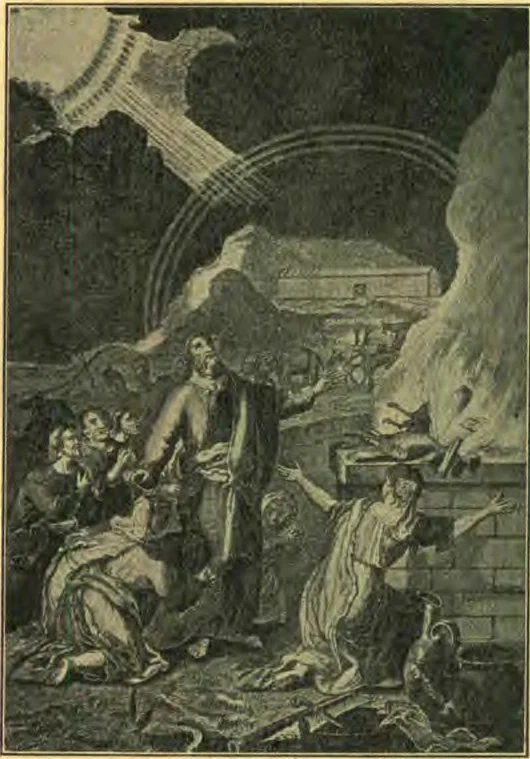
MEMORY VERSE: “I do set my bow in the cloud, and it shall be for a token of a covenant between me and the earth.” Gen. 9: 13.
STUDY HELPS: “Patriarchs and Prophets,” pp. 105-110; “Bible Lessons,” McKibbin, Book One, pp. 53-59.
“If all were rain and never sun,
No bow could span the hill;
If all were sun and never rain,
There’d be no rainbow still.”
Questions
1. In the experience of Noah what evidence is given us that the Lord does not forget those who trust and obey him? Gen. 8: 1. Note 1.
2. How did God cause the waters to abate? Verses 1-3.
3. Where did the ark find a quiet resting place? As the waters decreased, what were seen? Verses 4, 5.
4. What efforts did Noah make forty days later to find out if the earth was dry? Verses 6-12.
5. When the earth was dry, what did God say to Noah? Verses 13-16.
6. What effect did the flood have upon the earth? Note 2.
7. When Noah left the ark, what did he at once do? Verse 20. Note 3.
8. What did the Lord say in his heart? What will continue as long as the earth remains? Verses 21, 22.
9. After this what did God say to Noah? What were men not permitted to eat? Gen. 9: 1-3.
10. What covenant did the Lord make with Noah? Verses 8-11.
11. What was given as the sign of this covenant or promise? Verses 12-16.
12. What did John see in heaven? Rev. 4: 2, 3. Note 4.
Problems
How long was Noah in the ark? See Gen. 7: 9-11; 8: 13-16. What causes earthquakes and volcanoes? See “Patriarchs and Prophets,” page 108.
What makes a rainbow? What colors compose it?
Notes
1. It often seemed to the family within the ark that they must perish, as for five long months their boat was tossed about, apparently at the mercy of wind and wave. It was a trying ordeal; but Noah’s faith did not waver, for he had the assurance that the divine hand was upon the helm.”—“Patriarchs and Prophets,” p. 105.
THE BOW OF PROMISE
2. “The entire surface of the earth was changed at the flood. . . . The mountains, once so beautiful in their perfect symmetry, had become broken and irregular. Stones, ledges, and ragged rocks were now scattered upon the surface of the earth. In many places, hills and mountains had disappeared, leaving no trace where they once stood; and plains had given place to mountain ranges. . . . At this time immense forests were buried. These have since been changed to coal, forming the extensive coal beds that now exist, and also yielding large quantities of oil. The coal and oil frequently ignite and burn beneath the surface of the earth. Thus rocks are heated, limestone is burned, and iron ore melted. The action of the water upon the lime adds fury to the intense heat, and causes earthquakes, volcanoes, and fiery issues. As the fire and water come in contact with ledges of rock and ore, there are heavy explosions, . . . volcanic eruptions follow; and these often failing to give sufficient vent to the heated elements, the earth itself is convulsed, the ground heaves and swells like the waves of the sea, great fissures appear, and sometimes cities, villages, and burning mountains are swallowed up.”—Id., pp. 107-109.
3. “Noah had come forth upon a desolate earth; but before preparing a house for himself, he built an altar to God. His stock of cattle was small, and had been preserved at great expense; yet he cheerfully gave a part to the Lord, as an acknowledgment that all was his. In like manner it should be our first care to render our freewill offerings to God.”—Id., p. 106.
4. “In heaven the semblance of a rainbow encircles the throne, and overarches the head of Christ. . . . When man by his great wickedness invites the divine judgments, the Saviour, interceding with the Father in his behalf, points to the bow in the clouds, to the rainbow around the throne and above his own head, as a token of the mercy of God toward the repentant sinner.”—Id., p. 107.
A Creed
“By thine own soul’s law learn to live;
And, if men thwart thee, take no heed;
And, if men hate thee, have no care.
Sing thou thy song and do thy deed;
Hope thou thy hope and pray thy prayer,
And claim no crown they will not give.”
“THE man who wins is an average man,
Not built on any particular plan,
Not blest with any peculiar luck;
Just steady and earnest and full of pluck.
“For the man who wins is the man who works,
Who neither labor nor trouble shirks,
Who uses his hand, his head, his eyes;
The man who wins is the man who tries.”
Don’t Delay
“Now is the day of salvation.” To the Lord all time is present time. He never urges one to repent and be baptized tomorrow, neither does he counsel one to seek the Lord tomorrow. One should take advantage of the offers of mercy and grace now, today. To the Lord who sees the end from the beginning, who knows the future, the youth who rejects or neglects the counsel to remember his Creator in the days of his youth seems as unwise as does to us the old Scotch farmer who had been approached again and again by the local representative of a fire insurance company to take means of protecting his barn against fire; but who persisted in saying, “Na, Na!” with a wise shake of the head, “Ma barn ’ull nae gang on fire!” Then when one fateful day the unexpected happened, the neighbors were astonished to see the farmer, instead of helping to put out the flames, racing up and down the village street, and shouting, “Sandy! Sandy! Whaur’s that insurance man? It’s awfu’ that ye canna find a body when ye’re needin’ him!” The cry of the old farmer, “It’s awfu’ that ye canna find a body when ye’re needin’ him!” will in effect be the last soul-cry of all those who have put off the day of salvation until the door of mercy is shut never again to open. Now is the time to receive the seal of God, that one may be sheltered when the storm of eternal wrath breaks upon a wicked and impenitent world.
Recruiting Officers
A SHORT time ago, in Hamilton, Canada, certain officers, in an effort to bring their battalions up to the required strength for overseas service, turned their men free for three days, having instructed them to hunt up their relatives, chums, and acquaintances, and make an effort to get them to enlist. The results were encouraging, and the battalions were quickly brought to full strength. So it is that as soon as we enlist in the army of King Jesus, he immediately commissions us, not simply for three days but for life, as recruiting officers to bring in our relatives, friends, and acquaintances to his kingdom and service.
Meat in Due Season
THE following letters received by one of the members of the Takoma Park Missionary Society show the interest taken in our truth-filled literature. The writers are superintendents of public schools. One writing from Mississippi says:
“Accept thanks for the copy of the paper. I have read it and enjoyed the way it discusses the present war, and will appreciate very much any other literature you have that gives information concerning this great conflict. Thanking you for your kindness, I am.”
The other writes from Louisiana:
“Yours of the twelfth, with inclosed copy of the Present Truth, has been received, for which I thank you. This paper contains some of the most interesting and enlightening reading of the present world happenings that I have seen. I shall be glad to receive further literature on present-day topics as related to Bible prophecy.
“Yours sincerely.”
Work of Three Men Done by One
One of our missionaries in China in a personal letter to the editor gives a glimpse of the burdens and responsibilities even our young men are compelled to carry in the foreign field. Perhaps if we had been more generous with our means in years past, there would now be many more in the Orient to share the burdens of service. This worker says:
“God is leading in the work in this field, and day by day the message is progressing. We are here in inland China taking active oversight of a large school. There are many bright students, and promising workers among the others who are not so encouraging if we judge from the appearance. Besides this, I am endeavoring to build up our Missionary Volunteer work and the educational work in north China. I hope to have full time for this work later, but at the present time laborers are so few that I am carrying, as best one man can, three distinct lines of service,—secretary of the Educational and Missionary Volunteer departments, principal of the Honan Training School, and secretary and treasurer of the Honan Mission. We seemed like a large number of missionaries when coming across the ocean, but once here in this great needy land, were soon lost among the millions of China. There is a crying need of as many more young people to come out here at once to lead out in the great work. They must come soon or some of us will be returning broken in health because of the crushing burdens that we are necessarily bearing. We hear of the soldier boys marching to the help of Europe, and we muse of what an encouraging sound the tramp, tramp, tramp of the Christian soldiers coming to our rescue and to the active warfare in this land of the enemy would be. And then remember that at best they would have to go into training camps for a year before they would be available for service, for this is a hard language, and it needs a conquering spirit to master it, even with the Lord’s help. Surely God greatly blessed the missionaries who lately left the homeland, for in less than a year the majority were actively at work. But we are not perfect in the language and shall have hard study ahead of us for some years to come if we ever reach the high standard of fluency which is desirable. Pray for us.”
Giving
Hast thou plenty? Then rejoice,
Rejoice and freely share.
Hast thou scanty store? E'en then
A little thou canst spare.
And hast thou only bit or crumb,
A donor yet thou may'st become,
Since morsel from thy less or least
For bird or insect makes a feast.
Be thy portion small or great,
Thy loving, generous heart
Will always find it large enough
To give away a part.
—Norwegian.