Your ShelfYour Projects

Review and Herald, Vol. 64, No. 48.

OUR MISSIONS IN EUROPE
Earlier text

VIRGINIA

MT. GILEAD AND BRIDGEWATER.—Nov. 7, I joined Bro. Stillwell at Mt. Gilead, where he was holding meetings with a good interest. Some were already keeping the Sabbath, besides those who were keeping it when Bro. B. went there. There are several who have been keeping the Sabbath for four years, who came out under the labors of Brn. Corliss, Fordham, and myself, at Fairfax C. H., when we held a tent meeting there. These souls have been faithful four years, notwithstanding they have had no ministerial labor. I was glad to meet them again.
I left Mt. Gilead for Bridgewater, to be present at a discourse against the Sabbath. In a former report I stated that Eld. S. F. Sanger, of the Tunker Church, had stated that it was time to raise voice and pen against this great delusion, Adventism. We tried to get him to do this while we were here with the tent, but he refused to do so. The productions of his pen were two articles in the Gospel Messenger. A short time ago I received a card from him, stating that he had arranged to preach on the Sabbath question the fourth Sunday in this month, at Bridgewater, in their church, and requested that I should be present, etc. I came as requested. The people began to gather early Sunday morning, Nov. 27, and continued to come in from all directions until the large church was crowded, and all could not get in. It was estimated that 500 or 600 were present. He began at 11 o’clock A. M., and spoke three hours and ten minutes, but advanced no new arguments. He took the position that no law existed before the exodus, and that all the law was abolished at the cross. He gave no proof from the Bible to convince any mind void of prejudice that such a position could possibly be true. His main work was to abuse Seventh-day Adventists, and Sr. White in particular, stating that our whole theory was based on the dreams and visions of Sr. White. He finally closed by telling the people that the seventh-day Sabbath was abolished, as well as all the law. He said that the reason why they kept the first day of the week was, that Paul admonished them not to forsake the assembling of themselves together, and that they took the first day of the week on which to do it; but he left the impression upon the minds of the people that there is no day binding in this dispensation.
Many remarked at the close, that now they had no Sabbath nor law; that they were now free to do just as they pleased, work on all days if they chose, and would go to heaven at last. All can see that such a position gives license to sin; for sin is the transgression of the law; and where no law is, there is no sin.
I asked, at the close, for the privilege of reviewing the discourse in that church, but he refused to grant me that privilege. Many went away much dissatisfied; for they had expected that he would accommodate me, after promising that he would give me a fair chance, and inviting me to be present. I reviewed the discourse, however, last night in our hall here, and invited the Elder to be present; but he did not make his appearance. The room being small, many could not get in. Some came to me before meeting was opened, and said that as Eld. Sanger had left them without a Sabbath, they wanted me to show them plainly which day they should keep, if any. After the meeting they came to me and told me that they were convinced that there was a day, and that it was none other than the seventh. The interest is still good both here and at Mt. Crawford. May God bless his truth here.
Nov. 28. M. G. HUFFMAN.

WEST VIRGINIA.

PARKERSBURG, FREEPORT, ETC.—After our camp-meeting at Parkersburg, reported by Eld. Farnsworth, we continued our meetings for two weeks, until the cold weather had greatly reduced the congregation. We did not see all accomplished which we had hoped for and desired. There were many things which militated against our work. The week following the taking down of our tents, the Methodists held their annual conference in this city, which was largely attended, about four hundred ministers being present. A committee had been appointed to provide homes for the delegates to the conference, and they were distributed throughout the city, among all denominations. This conference, being held at this time, was very detrimental to our work. Some who were just on the point of obeying the truth were lulled into carnal security by the peace and safety cry. The Baptists held a convention the week following this conference, which was attended by scores of delegates. This, also, had its influence. We visited what we could during this time, holding Bible readings, etc. Three signed the covenant, and two or three commenced the observance of the Sabbath. We then tried to get a place to hold meetings in the city, but found that the rent would be more than we felt justified in paying. So we decided to erect a building in which to hold meetings temporarily, which we hope to see accomplished in the near future. There are ten or twelve Sabbath-keepers now in Parkersburg, and we hope soon to see a church organized here, and others added to their numbers. A Sabbath-school was organized, and weekly prayer-meetings will be sustained.
Nov. 11, we visited the company at Freeport, and remained with them about one week, and preached eight discourses, which were mostly practical. This church was organized in the spring of 1886, with eight members. Removals, etc., had reduced their number to five. No records had been kept, the ordinances had not been celebrated, and but twelve dollars tithe had been paid during this time. Some difficulties had existed, and after counseling together it was thought best to disband the church, and perfect a new organization. Some new ones took hold of the work, and a church of eight members was organized. The usual officers were elected, and the elder and deacon were ordained. All pledged to pay a tithe. Our cash collections here were three dollars. Several dollars’ worth of provisions were donated to one of our canvassers. We also organized a T. and M. society of six members. We started the church records, and left our brethren in good working order, and greatly encouraged.
We have taken thus far, in our visits among our brethren, ten new subscriptions for the REVIEW.
Fearing a false impression has gone out in regard to the work in West Virginia, through the report of our camp-meeting and work by Eld. Farnsworth, we wish to correct some statements made by him, he having been wrongly informed. He stated that “there are about 200 Sabbath keepers in the State, and 175 of them were present at the camp-meeting.” We would rejoice if this was true; but we find, in looking over our church records, that we had only ninety-two members at that time, in good standing. Eld. Foggin counted all there were encamped on the ground during the meeting, and states that there were only 125 Sabbath-keepers, including the children, and several of these were from Ohio.
We feel it due us to make this correction, as it will require a great deal of labor here to bring the work up to that standing; and if as favorable a report could not be given of our next annual gathering, some might become discouraged, or think that the work was not prospering here as it should.
We have just received a statement of the tithes paid by West Virginia, to the Ohio Conference, during the past year, which amount to $346.72. We would not want our brethren to think that we have 200 Sabbath-keepers, and pay only this amount of tithe. Some of our brethren are doing nobly in this direction, while others are doing but very little.
We would say to our brethren in West Virginia, that we desire to put in all our time from now until next camp-meeting, in hard work in new fields; and in order to do this, much more means will be required than has been paid in the past. We hope that our brethren will not rob God of the tithe, which is his, and thereby close the windows of heaven and shut out those blessings which God is waiting to pour out upon them. Unless more money comes into the treasury, it will necessitate our seeking other fields of labor. The work in this State, in many respects, looks encouraging. We have already several canvassers in the field who are meeting with fair success. Three canvassers are devoting their entire time to the “Marvel of Nations”; one, to “Thoughts on Daniel and the Revelation”; one, to the Good Health and “Sunbeams of Health and Temperance”; one, to “Sunshine at Home”; and several others will start out soon. There are several favorable openings for meetings, which we hope to enter soon.
We are now visiting the church at Berea. The Lord has come near and blessed in our meetings here; hearts have been made tender, and backsliders reclaimed. We praise God for his mercies and blessings to us, and for his Holy Spirit which has been present with us in these meetings. Our brethren have felt much encouraged and strengthened. To God be all the praise!
W. J. STONE. W. R. FOGGIN.

DISCUSSION IN BOONE CO., ARK.

Last September, at the close of a tent meeting which I held on Gaither Mountain, in Boone county, Ark., I was pressed by Elds. Wm. Harris and J. N. Kerns, for a public discussion on the Sabbath question and other points of difference between us. As soon as the arrangements were made, Eld. H. wrote to prominent lawyers at Harrison, the county seat, asking them two important questions (requesting an immediate reply), the first being based on the word “fulfill.” Matt. 5:17:—
Ques. 1.—“To fulfill a law is to do what?”
Ans.—“To render obedience to all its requirements.”
Ques. 2.—“What virtue, power, or force has a law where the penalty is taken off?”
Ans.—“Organic or fundamental laws do not have penalties affixed, but are the basis of legislation, to which legislation penalties may be affixed, and may be made or changed at the will of the legislature. A law based upon, or growing out of, a fundamental law, without a penalty is no law at all.
“Next to the ten commandments, the Constitution of the United States has been and is regarded by jurists as a master embodiment of fundamental or organic law.”
These important decisions were based upon the writings of Blackstone, and were signed by two of Harrison’s best lawyers, Samuel Murphey and G. E. Burney.
The discussion was a complete triumph in favor of the positions on the Sabbath and kingdom questions as held by S. D. Adventists. A gentleman at Harrison, whose mind the Lord had favorably impressed with his truth, seeing the above questions and answers in the lawyers’ hands, copied and brought the same to me, in good time to clearly refute Eld. Kern’s position, namely, that “to fulfill is to abolish and do away”; also, that “no law without a penalty is binding,” it being an answer to their own questions. The gentleman who thus favored me, in writing to the Harrison Times of Sept. 10, concerning the debate, makes the following statements:—
The main point of difference was the day we should observe as the Sabbath.
The first question was stated as follows: “Do the Scriptures teach that the seventh day, commonly called Saturday, is the Christian Sabbath, and binding in this dispensation?” Eld. Wood affirmed, Eld. Kerns denied. It was the opinion of nearly all present that Eld. Wood sustained his position by an abundance of testimony from the Bible. In his summary of fifteen minutes, he gave forty-five proof-texts. . . . He closed by saying that there can be no Christian Sabbath except the one that Christ kept, for “Christian” means Christ-like.
Eld. Kerns, taking the headache, was not able to go further in the discussion, so Eld. Harris took his place.
The next question was, “Do the Scriptures teach that the first day of the week, commonly called Sunday, is the Christian Sabbath, and binding in this dispensation?” Eld. Harris affirmed, Eld. Wood denied. They took the Protestant guide,—the Bible and the Bible alone,—and it was found uncomfortably silent on the Sunday Sabbath.
Several took their stand for the Bible Sabbath, and I learn that others have since taken hold, and that the work is progressing. J. G. WOOD.

MINNESOTA

AMONG THE CHURCHES.— Oct. 28, I left home again to labor with and for our people. My first visit was at Lake City, where I organized a health and temperance society nearly one year ago. I found all of good courage in all branches of the work. Oct. 7, I was at Winona. The interest in the work is increasing here. The Bible workers find all they can do. Their hearts have already been gladdened by several signing the covenant; others are interested. Bro. E. Johnson has come here, and is waking quite an interest among his own people. The German work, also, seems to be gaining ground. I see nothing but success for this mission, if all are humble and live near to God. I spoke four times, twice upon the subject of Christian temperance. All seemed interested.
Oct. 8-16, I was at Byron. Bro. Moon was with us Sabbath and Sunday. The Lord helped us in these meetings. One signed the covenant, and desired baptism. Two applied for admission into the church. Six signed the teetotal pledge. Oct. 17-23, I was with the Pleasant Grove church. The members of this church are scattered, some living from four to twelve miles distant, and most of them are too far away to attend evening meetings. As the Sabbath was a very unfavorable day for meeting, but few were present. While there I spoke a few times to those who could attend. There was no outside interest to speak of, except Sunday evening, when there was a good attendance of attentive listeners. I spoke from the text, “God is love.” That evening we rode four miles, where I spoke three evenings to a few who met in the farm house of Bro. Harris. Sixteen signed the teetotal pledge. Friday, the 25th, in company with the director and the district secretary, I came to Dodge Center, where we have reason to hope for an interesting meeting. H. F. PHELPS.

Obituary Notices.

“Blessed are the dead which die in the Lord from henceforth.”—Rev. 14:13.
VANCE.—Died of brain fever, at Hallowell, Kan., Nov. 19, 1887, Roy, son of J. N. and E. J. Vance, aged 11 months and 9 days. Sad hearts mourn the loss of this lovely babe. May they so lay hold of the grace of Christ that their little treasure will be restored to them in the glad resurrection morning. “Sorrow is better than laughter; for by the sadness of the countenance the heart is made better.” Eccl. 7:3. Joseph Lamont.
CROUSE.—Died at Traer, Kan., Oct. 27, 1887, Elena Crouse, wife of J. W. Crouse, in the thirty-sixth year of her age. In her childhood Elena gave herself to Jesus as her Saviour, and has always been a devoted follower of her Master. She was a native of Denmark, and a member of the Baptist Church. Six years ago she commenced to keep the Sabbath of the Lord, and through her missionary influence several Danish families are now keeping the Sabbath in her neighborhood. Funeral services by the writer. Wm. F. Crouse.
HALL.—Died near Canton, Kan., Bro. Whitman Hall, aged 77 years, 7 months, and 1 day. Bro. Hall was converted when about twenty-two years of age, and for many years belonged to the Free-will Baptist Church. He accepted the truth in 1864, and the most of the time since then he has held responsible positions in the church. He was a member of the Canton church at the time of his death. He had suffered many years from asthma, and when death came he was reconciled to the will of God, feeling that it would be a great relief to lie down and rest in the grave, in hope of a home in heaven at the coming of the Lifegiver, which he believed would be very soon. He chose as a text for the funeral occasion, 1 Thess. 4:14. Sermon by the writer. E. A. Morey.
VREDENBERG.—Died in Lincoln, Isabella Co., Mich., Nov. 22, 1887, of inflammation of the bowels, after a sickness of only six days, Mrs. Martha J., wife of A. C. Vredenberg, aged thirty-eight years. She was a fond and loving wife and mother, and was highly esteemed in that community. She leaves a husband and five children and a large circle of relatives to mourn her loss. Some ten years since she heard the present truth, and became convinced of the correctness of our position, but made no public confession of it. On her dying bed she most earnestly prayed that the Lord would forgive her and accept of her. Remarks were made by the writer from Rom. 8:28, to a large gathering of neighbors and friends. A. O. Burrill.
PALMER.—Died of congestion of the lungs, at Amory, Nov. 9, 1887, our beloved father, John H. Palmer, aged 75 years and 3 days. Father had gone to the above-named place for a short visit, and took a severe cold, which terminated in his death. He was a great sufferer for two weeks, but bore his sufferings with Christian patience and fortitude worthy of our imitation; and when told that his sufferings would soon be over, he responded: “Glory! Glory! Glory!” and died praising God. He leaves five daughters and two sons, besides a large circle of friends, to mourn his loss. But we mourn not as those without hope. Father was a member of the Baptist Church until about eight years ago, when he embraced present truth, and became a firm believer in all points of our faith. The funeral services were held at the school-house at Somerset, where he has made his home since mother's death. A large concourse of friends were in attendance. Words of comfort were spoken by Eld. A. S. Abbot (Baptist), from Prov. 10:7: “The memory of the just is blessed.” Mrs. C. L. Lord.

News of the Week.

FOR WEEK ENDING DEC. 2.

DOMESTIC.

—Local option was carried, Thursday, in Van Buren county, Mich., by 3,000 majority.
—Jacob Sharp, the New York briber, has been granted a new trial by the court of appeals.
—Five persons were killed by the explosion of a locomotive boiler at Pottsville, Pa., Friday morning.
—A party sailed from New York, Wednesday, for the purpose of making the final surveys of the Nicaragua canal.
—The high-level bridge across the Mississippi River at Dubuque, Ia., was formally dedicated and opened Wednesday.
—A tremendous flow of natural gas was struck, Tuesday, at Xenia, near Wabash, Ind. The people of the place are highly elated.
—A New York syndicate intends to plant, during the coming year, 1,000 acres of tobacco, in Gadsden and Columbia counties, Fla.
—The Strobridge Lithographing Company's building at Cincinnati, O., was totally destroyed by fire early in the morning of Dec. 1. Loss, $300 000.
—The city officials of Lincoln, Neb., were fined for contempt of court recently, in deposing Police Judge Parsons, and are now in jail, leaving the city without any mayor and city council.
—A fall of rock and earth in a quarry near Hummelstown, Pa., Tuesday evening, buried three men so securely that the bodies cannot be recovered for many weeks. Several other workmen narrowly escaped.
—The saloon scored a victory in Atlanta, at the recent election, the majority against prohibition being 1,128. This unfortunate result is said to be largely due to the negro vote, which was almost solid for the saloon.
—By the explosion of a boiler in the Kirby House, Milwaukee, Monday morning, one woman was instantly killed, several others were fatally injured, and a number more seriously hurt. The accident seems to have been the result of carelessness.
—Great excitement prevails at Dubuque, Ia., over the fact that the Chicago, Milwaukee & St. Paul Railway are preparing to remove all their shops from that place. The resident employees are given the privilege of going to work on the road elsewhere.
—A large gathering took place, Saturday, at Chickering Hall, New York, to listen to speeches of delegates from the British Peace Society, who are endeavoring to secure international arbitration for the settlement of national disputes and the abolition of armies.
—Trouble between the negroes and whites is threatened in Arkansas. Two negroes were killed and many others injured in a fight with the whites at Cat Island, Thursday, being shot down in court while on trial for insulting white women, and friends of the former are now arming for revenge.
—It is sensationally reported that a gold mine of fabulous richness has lately been discovered by Dr. Walter Kempster, superintendent of the Northern Wisconsin insane asylum. The mine is in Montgomery county, Maryland, and, it is said, has already been worked to some extent, yielding nuggets of pure gold as large as cherries.

FOREIGN.

—The excitement prevails in the City of Mexico, over a rumor that the United States has made a claim in favor of Editor Cutting.
—Ninety-five cigar factories at Havana, Cuba, employing 12,000 men, preferred Monday to shut down rather than concede an advance in wages.
—A reward of $10,000 is offered for the capture of the Mexican bandit, Eraclio Bernal, who has “ruined and almost depopulated many districts in San Ignacio.”
—A shock of earthquake was felt in Lancaster county, England, on the morning of Dec. 1. The people were severely frightened, but no serious damage was done.
—A crisis is said to be imminent in Manitoba politics. The legislature will convene Jan. 10, to investigate charges against the government made in connection with the Red River Valley Railway, and an attempt will be made to depose Premier Norquay.
—Sir Charles Dilke, who is considered a good authority, publishes in the Fortnightly Review an alarming view of Russian designs on India. He says he believes a Russian attack on India is certain, and in that event he places little reliance on the Indian army.
—Authentic information has been received of the complete ascent, for the first time, of Kilimanjaro, the loftiest peak in Africa, by Dr. A. Meyer, of Leipzig, in August last. The ascent to the summit of the crater occupied six days, and its estimated height is about 20,000 feet.
—The latest mail advices from the Upper Congo state that Tippo Tib, the Arab chief, had not yet sent the promised carriers to Stanley's rear guard at Yambuya, to convey stores for Emin Bey, and that Stanley had proceeded without them. Many of the men had died from starvation.
—The Argentine Republic, having, as it seems, abandoned all hope of getting the United States Government to establish steamer communication with them, because of the indifference of our Government toward the project, has made an arrangement with an English company whereby a semi-monthly line of swift ships will ply between their ports and New York.
—The Political Correspondence, a Vienna paper, referring to the recent visit of the Duke of Norfolk to Rome, for the purpose of conveying the congratulations of Lord Salisbury and the queen to the pope on the occasion of his jubilee, says the latter is occupied equally with the welfare of England and Ireland, and would like to act as peace-maker, and eventually as mediator, between them. No doubt! and the pope does not “mediate” for nothing, either.
—M. Grevy has at last resigned the presidency of the French Republic, and French affairs are left in a crisis. The prospects for a revolution seem very favorable, and the restoration of the monarchy is predicted by many. Serious rioting occurred in the streets of Paris on the evening of Dec. 2, and many persons were injured. The bulk of the visitors have left the city, fearing an outbreak, though the general opinion is that such fears are groundless. It seems certain, however, that the next few days will be very momentous ones for the French nation.
—The recent interview of the czar and Prince Bismarck has had the result of making the relations between Russia and Germany somewhat more cordial. The czar accused Bismarck of being hostile toward Russia, and supported his statements by producing letters purporting to come from the Berlin government, which the Russian authorities had intercepted; and Bismarck, in a violent passion, replied that they were forgeries. After the czar arrived in St. Petersburg, all the editors of the place were summoned by the press censor, and instructed to adopt a moderate tone regarding Germany.

RELIGIOUS.

—In round numbers there are about 1,000 unemployed Congregational ministers in the United States.
—The Rev. Dr. Happer has raised $100,000 for the purpose of founding a Christian college in China.
—The agents of the Bible society in Tokio, Japan, can scarcely meet the demand for the Bible in that country.
—The chief causes of defection from the Catholic Church in this country, according to the Catholic Standard, are, first, mixed marriages, and, secondly, the public schools.
—A series of meetings is proposed in Boston, to be conducted by about fifty Harvard under-graduates, for the benefit of those not ordinarily reached by religious organizations.
—From statistics gathered by the New York Observer, it appears that not more than four to five per cent of the churches of New England tolerate the hypothesis of future probation.
—The Rev. J. B. Fulton, who is engaged in delivering a series of lectures against Romanism, was recently attacked by a mob, in Biddeford, Me., who stoned the hall and drove the lecturer away. By invitation of the Protestant ministers, however, Dr. Fulton has returned and will continue his work.
—The present status of the Mormon Church is enough, figuratively speaking, to make Brigham Young turn over in his grave. The church property at Salt Lake City, including the Mormon Temple, Assembly Hall, the large Tabernacle, the Parsonage, and the Church Historian's Office, are in the hands of a receiver, and a demand has also been made for all books, papers, securities, and other personal church property.
—The Catholic Standard believes that while this country will lose its Protestantism, which it says is rapidly dissolving, it will not become Roman Catholic, because the people have been educated to believe that one religion is as good as another; and “it is harder,” says the Standard, “to convert such minds than it is to reach and influence those of actual pagans.” What kind of a religion it will have when it is neither Catholic nor Protestant, the Standard does not say.
—The work of the Salvation Army in India, it is said, has not accomplished the results hoped for by many at the time it began its work there five years ago. According to the Bombay Guardian, a reliable Christian journal, it has done no successful work in India where the door has not been previously opened by other missions, and has resorted to very questionable methods of evangelical work, exalting itself above the word of God, and departing from that word whenever exigency seemed to demand, and grossly exaggerating what little work it has actually accomplished.

SANITARIUM IMPROVEMENT COMPANY

Appointments.

“And he said unto them, Go ye into all the world, and preach the gospel to every creature.”—Mark 16:15.

SANITARIUM IMPROVEMENT COMPANY.

The fourth annual meeting of the Sanitarium Improvement Company will be held at Battle Creek, Mich., Dec. 21, 1887, at 10 A. M., for the election of officers for the ensuing year, and the transaction of other business that may come before the meeting. J. H. Kellogg, J. Fargo, G. H. Murphy, A. R. Henry, W. H. Hall, } Directors.

NEBRASKA APPOINTMENTS.

The Lord willing, we will hold meetings with churches in Nebraska, as follows:— Raeville and Lincoln, Dec. 9-14 Stearns Prairie, “ 15-20 Blair County, “ 22-27 Decatur church, Dec. 27-Jan. 3 Jackson, Jan. 5-8 Lincoln, (State meeting) “ 11-18 At each of these places the first meeting will be held on the day appointed, at 7 P. M. We trust that all our scattered brethren, and members of other churches within a reasonable distance of the places above named, will avail themselves of the privileges of attending these meetings. We will do the best we can to give our people the benefit of the good instructions we have listened to at the General Conference. Truly, we are living in a solemn time, when ministers and people need to seek God with a true purpose of heart. It has been stated in the “Testimonies,” that the Spirit and power of God do not attend the efforts of ministers as they should. We desire that God will give us his Spirit to labor for the best interests of his cause and all concerned. J. P. Gardiner, A. J. Cudney.
Victory, Wis., Dec. 10, 11 Leon, “ 17, 18 W. S. Hyatt.
The Lord willing, I will meet with churches in Dist. No. 10, Iowa, at the dates below named:— Nevada, Dec. 10-12 Radcliff, “ 13-16 Beaman, “ 17-20 State Center, “ 22-25 It is desired that our brethren should make a special effort to attend these meetings. Notify the scattered brethren who do not take the REVIEW. Is it not time to make a special effort to seek the Lord? J. S. Hart.
No providence preventing, I will meet with the churches in Dist. No. 5, Michigan, as follows:— Dimondale, Sabbath, Dec. 9 Orleans, Wednesday, 2:30 and 7 P. M. “ 14 Ionia, Thursday, “ 15 Saranac, Friday, “ 16 Lyons and Muir, Sabbath, 10:30 A. M. and 7 P. M. “ 17 Orange, Sunday, 2:30 and 7 P. M. “ 18 Westphalia, Monday, “ 19 Matherton, Tuesday, “ 20 Ovid, Wednesday, “ 21 Du Plain, Thursday, “ 22 The cause of God must and will go forward. The demand is urgent. Let us get ready for the week of prayer. Let every member in each church make an earnest effort to be present at the meetings appointed for their place. Let there be a large attendance at Lyons, from all places in the vicinity, on Sabbath, the 17th inst. In this visit we hope to give courage to all, and do for the cause all that is possible. I. D. Van Horn.

HERE AND THERE.

BY M. BAIRD.
In the land “beyond the river,” Where immortal life shall bloom, We shall meet for aye and ever, Those now sleeping in the tomb.
Cherished forms in death reposing, Hands that clasped our own in love, Eyes that beamed with fond affection, Filled with light from heaven above;
Voices oft our own hearts thrilling, Like the music of the blest, Shall with holy raptures greet us In the everlasting rest.
Touch of hand and lip shall greet us, Smile of eye and voice of song, Friends we loved here there shall meet us— Friends still midst the mighty throng.
Cedar Creek, Mich.

Publishers’ Department.

“Not slothful in business.”—Rom. 12:11.
The address of Bro. D. T. Shireman, of Kansas City, has been changed from 1858 Jefferson St. to 2006 E. 23d St.
All parties transacting business with, or sending papers to, the elder of the Cedar Springs (Mich.) church, should write direct to Leander Kellogg, Cedar Springs, Mich.

RECEIPTS.

Notice of expiration of subscription will be given by special stamp on the margin of the paper. We should be pleased to receive your renewal at once.
Notice.—The change of figures on the address labels will be in all cases a sufficient receipt for money sent for the paper. If these changes do not in due time appear, and if books ordered by mail are not received, notice should be given. All other business is acknowledged below.
In sending money to this Office, please observe the following rules:—
  1. Direct your letters REVIEW AND HERALD, and not to any private individual.
  2. Send by Draft, Money Order, Express Order, or Postal Note.
  3. Stamps may be sent for small amounts.
  4. Drafts should be made payable to REVIEW AND HERALD, on New York or Chicago Banks. Those written on other banks cost us a collection.
Books Sent by Freight.—M W Neal, W A Wild and J Deely, G W Green, M W Lewis, E H Gates, A E Field, Mrs G W Green, A H Beaumont, C C Ward, W V Field, Lizzie H Morton, A E Field, Arthur Hunt, C F Curtis.
Books Sent by Express.—Jno M Mountain, W Harper, J M Gallemore, Wade Sheltman, John Steinel, W Harper, Mrs Phoebe H Brown, Miss Vina A Nichols, Jane Van Horn, L L Cushing, Leonard V Hopkins, C D Wolf, R F Barton, D H Oberholtzer, A T Robinson, J H Dortch.
Cash Rec’d on Account.—Neb T and M Soc $170.07, Ky T and M Soc per R J Dougherty 9.98, Tenn T and M Soc per J H Dortch 50., No Pac Conf per G W S 14.25, Wis T and M Soc 100., Vt T and M Soc 103.37, Ind T and M Soc 42.38, Ohio T and M Soc 100., Mich T and M Soc 117.47.
S. D. A. E. Soc.—Mrs E B Hart $2., Wis T and M Soc 100., L L Cushing 1.
International T. & M. Soc.—Wis T and M Soc $65.81, Vt T and M Soc 21.98, Mrs W J Mills 1., Mich T and M Soc 12.03.
O. H. T. D. Fund.—Vt T and M Soc $105.
Scandinavian Mission.—John Johnson, $15., Mary C and James Erickson 25.
South African Mission.—Mrs E B Hart $1., Wis T and M Soc 3.85, Vt T and M Soc 3.15.
European Mission.—Martha Rice $5., Vt T and M Soc 1.50.
English Mission.—Martha Rice $5., Vt T and M Soc 20.
Australian Mission.—Vt T and M Soc $5.

SCRIPTURE REFERENCES.

A TRACT of 32 pages, containing a careful compilation of proof-texts on twenty-five prominent subjects, such as the Nature of Man, Destiny of the Wicked, Second Advent, Terrestrial Millennium, etc. A work of great value to all Bible Students. Price, 4 cts. Address, REVIEW & HERALD, Battle Creek, Mich.

Medical & Surgical Sanitarium.

THE LARGEST SANITARIUM IN THE WORLD.

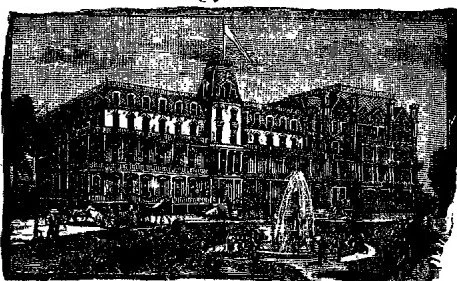
This Institution, one of the buildings of which is shown in the cut, stands without a rival in the perfection and completeness of its appointments. The following are a few of the special methods employed:
Turkish, Russian, Roman, Thermo-Electric, Electro-Vapor, Electro-Hydric, Electro-Chemical, Hot Air, Vapor, and every form of Water Bath; Electricity in every form; Swedish Movements—Manual and Mechanical—Massage, Pneumatic Treatment, Vacuum Treatment, Sun Baths.
All other remedial agents of known curative value employed.
Good Water, Good Ventilation, Steam Heating, Perfect Sewerage. For circulars with particulars, address, SANITARIUM, Battle Creek, Mich.
Continue reading: Travelers' Guide