Your ShelfYour Projects

Review and Herald, Vol. 64, No. 48.

OUR MISSIONS IN EUROPE
Earlier text: VIRGINIA

Travelers' Guide.

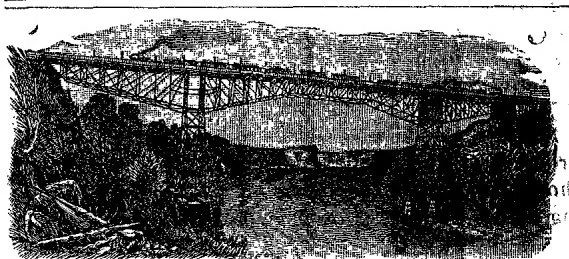
MICHIGAN CENTRAL CANTILEVER BRIDGE, NIAGARA FALLS.

MICHIGAN CENTRAL RAILROAD.

GOING EAST. STATIONS GOING WEST.
Mail. Day Exp's N. Y. Exp. Atl'n Exp. Nig't Exp. Pa'c Exp. Ev'g Exp. Day Exp. Chi'o Exp. Mail.
p. m. p. m. a. m. a. m. a. m. Ar. p. m. p. m. a. m. p. m. a. m.
6.00 6.45 10.45 6.00 7.30 Detroit 10.15 8.00 9.10 1.30 7.00
4.33 5.30 9.45 4.35 6.08 Ann Arbor 11.35 9.12 10.30 2.32 8.18
3.15 4.20 8.49 3.15 4.50 Jackson 12.54 10.52 11.35 3.32 9.45
2.00 3.10 6.59 1.58 3.43 Marshall 1.58 11.47 12.50 4.26 10.52
1.12 2.27 7.33 1.25 3.18 Battle Creek 2.23 12.12 1.12 4.40 11.20
12.17 1.50 6.58 12.33 2.27 Kalamazoo 3.07 1.20 1.50 5.16 12.07
10.38 12.15 5.49 11.13 12.55 Niles 4.28 3.09 3.22 6.27 2.08
9.08 11.11 4.54 10.18 11.27 Mich. City 5.45 4.32 4.35 7.32 3.28
6.50 9.00 3.10 8.15 9.10 Chicago 7.45 7.00 6.40 9.30 5.40
a. m. a. m. p. m. p. m. p. m. Dep. a. m. a. m. p. m. p. m. p. m.
Gr. Rap. & Kal. Ex. lvs. Kal'm'zoo 6.45 a. m., Bat. Creek 7.31, Marshall 7.57, Jackson 9.16, Ann Arbor 10.33, Detroit 11.50 a. m. Returning, leaves Detroit 4.00 p. m., Ann Arbor 5.30, Jackson 7.10, Marshall 8.20, Battle Creek 8.52, Kalamazoo 9.45.
All trains run by Ninetieth Meridian, or Central Standard Time.
Day Express, Grand Rapids and Detroit Express, and Grand Rapids and Kalamazoo Express, daily except Sunday. Pacific, Evening, and Chicago Expresses west, and Atlantic, New York, and Night Expresses east, daily.
Nov. 20, 1887. O. W. RUGGLES, Gen. Pass., Agt., Chicago.

CHICAGO & GRAND TRUNK R. R.

Time Table, in effect May 15, 1887.
GOING WEST. STATIONS. GOING EAST.
Chic. Pass. Mail. Day Exp. Pacif. Exp. B. Crk Pass. Mail. Lmtd Exp. Atl'to Exp. Sup'r Pass. Pt H'n Pass.
a. m. a. m. p. m. p. m. Dep. p. m. a. m. a. m. a. m.
5.55 7.15 8.05 4.10 Port Huron 10.20 1.15 7.35 10.50
7.28 8.31 9.34 5.40 Lapeer 8.42 11.05 6.17 9.17
8.05 9.10 10.16 6.20 Flint 7.55 11.21 5.44 8.40
8.48 9.35 10.58 7.20 Durand 7.05 10.58 6.08 8.05
10.00 10.30 11.53 8.26 Lansing 6.20 10.00 6.00 6.45
10.37 11.00 12.25 9.03 Charlotte 4.42 9.37 3.25 6.15
a. m. 11.10 11.45 1.15 10.05 Battle Creek 3.45 8.55 3.25 5.30
6.30 a. m. 12.05 1.20 p. m. Battle Creek 5.40 8.00 2.30 a. m.
7.18 12.45 2.21 Vicksburg 2.41 8.10 1.48
7.30 12.55 2.32 Schoolcraft 2.31 1.27
7.55 1.45 3.19 Cassopolis 1.45 7.28 12.43
9.00 Sun. 2.28 4.07 South Bend 1.05 6.50 12.01
10.15 a. m. 3.43 a. m. Haskell's 11.47 p. m. p. m.
10.30 7.35 4.05 5.52 6.05 Valparaiso 11.25 5.50 10.29 3.40 8.03
12.20 10.00 6.25 5.10 8.48 Chicago 9.05 3.25 8.15 1.15 5.26
p. m. a. m. p. m. a. m. a. m. Arr. a. m. p. m. p. m. p. m. p. m.
†Stops only on signal. Where no time is given, train does not stop.
Trains run by Central Standard Time.
Valparaiso Accommodation, Battle Creek Passenger, Chicago Passenger, Pt. Huron Passenger, and Mail trains, daily except Sunday.
Pacific, Limited, Day, and Atlantic Expresses, daily.
Sunday Passenger, Sunday only.
GEO. B. REEVE, Traffic Manager. W. J. SPICER, General Manager.

“BUDS FROM EVERY CLIME.”

A NEW book, just issued, has been laid on our table. It is called “Buds from Every Clime,” and a casual glance at its title page reveals the fact that it contains choice selections of sketches, stories, and poems for children and youth. The volume is handsomely embellished with over one hundred beautiful illustrations, of which sixteen are full-page, colored plates. The selections and contributions are of a high order, such as will inspire the youth with pure thoughts and noble aspirations. The sentiments all through the book are designed to be, as the name intimates, sprouting “buds” in the hearts of the young, for the development of a good character. Many of the illustrations are extraordinarily fine, some of which have not before appeared in American print, being recently imported from Europe. They are designed not only to interest the young, but also to cultivate in them a taste for the beautiful in art and nature.
The whole comprises a neatly bound volume of 128 pages, size 8½ x 11¼ inches. Price, $7.75. As a holiday present it will certainly be much appreciated by the young, for whom it is especially designed. Address the publishers,
SPERRY AND SWEDBERG, Battle Creek, Mich.

THE GREAT CONTROVERSY BETWEEN CHRIST AND SATAN.

During the Christian Dispensation.
By MRS. E. G. WHITE.
Author of “The Life of Christ,” “Sketches from the Life of Paul,” “Bible Sanctification,” and Other Popular Works.
THIS volume presents the most wonderful and intensely interesting history that has ever been written of the great conflict between Christianity and the Powers of Darkness, as illustrated in the lives of Christian martyrs and reformers on the one hand, and wicked men and persecuting powers on the other. Beginning with our Lord’s great prophecy given while viewing Jerusalem from the Mount of Olives, this book outlines the history of the whole dispensation down to the time when “sin and sinners are no more; God’s entire universe is clean; and the great controversy is forever ended.”
Below we give a brief synopsis of the subjects considered.—Destruction of Jerusalem; Persecutions in the first Centuries; The Roman Church; The Waldenses; Early Reformers; Luther’s Separation from Rome; Luther before the Diet; Progress of the Reformation; Protest of the Princes; Later Reformers; The Two Witnesses; God Honors the Humble; William Miller and his Work; The First, Second, and Third Angel’s Message; The Tarrying Time; The Midnight Cry; The Sanctuary and 2,300 Days; An Open and a Shut Door; Modern Revivals; The Investigative Judgment; Origin of Evil; Origin of Enmity between Man and Satan; Agency of Evil Spirits; The Snares of Satan; The First Great Deception; Ancient and Modern Spiritualism; Character and Aims of the Papacy; The Coming Conflict; The Scriptures a Safeguard; The Loud Cry of Rev. 18; The Time of Trouble; God’s People Delivered; Desolation of the Earth; The Controversy Ended.
The period of history covered by this volume, is one of the deepest interest to all classes of readers. The style of the author is clear, forcible, and often sublime, and, although simple enough in its statements to be understood and appreciated by a child, its eloquence calls forth the admiration of all.
The demand for this popular book is so great that we have had to print eight editions of it, and as we have hundreds of agents in the field canvassing, we expect to sell many thousand copies of this valuable book during the next few months. If there is no agent in your town, please send us your address and we will send you descriptive circulars or have an agent call upon you.
The “Great Controversy” contains over 500 pages; 21 full-page Illustrations and Steel Portrait of the Author; printed and bound in the very best style.
Active Agents Wanted in Every Town and County in the United States.
For Terms and Territory, address,
PACIFIC PRESS, Publishers,
12th and Castro Sts., Oakland, Cal.

THE AMERICAN SENTINEL.

AN EIGHT-PAGE MONTHLY JOURNAL, devoted to the defense of American Institutions, the preservation of the United States Constitution as it is, so far as regards religion or religious tests, and the

MAINTENANCE OF HUMAN RIGHTS,

Both civil and religious. It will ever be uncompromisingly opposed to anything tending toward a union of Church and State, either in name or in fact.

TERMS:

Single Copy, 50 cents.
To foreign countries, single subscription, post-paid, 2s.
Address, AMERICAN SENTINEL, 1059 Castro St., Oakland, Cal.

THE TRUE EDUCATOR.

A Sixteen-Page Educational Journal
FOR TEACHERS, STUDENTS, PARENTS, and SCHOOL-OFFICERS.
DEVOTED to the discussion of the best methods of General Education, and especially to the question of combining Manual Training with Mental Culture.
PRICE ONLY 75 CENTS PER YEAR.
Also an advertising medium for schools, all kinds of school supplies, maps, books, pianos, organs, and other first-class advertisements. Address,
THE TRUE EDUCATOR, South Lancaster, Mass.

MAN'S NATURE AND DESTINY,

--OR--
The State of the Dead, The Reward of the Righteous, and The End of the Wicked.
By ELD. URIAH SMITH.
THIS book is a logical and scriptural treatise concerning man in his present state, his condition in death, and his prospects beyond the resurrection. It also treats very minutely concerning the disposition of the finally impenitent, answers the numerous objections which are usually brought against the different phases of this subject, considers the claims of philosophy, and gives a brief historical view of this great question. The work contains copious indexes of the authors referred to, the passages of Scripture examined, and the contents of the book itself. 444 pages, on tinted paper, in muslin binding, with frontispiece, sent post-paid for $1.50.
A pamphlet edition of the same work, without indexes and frontispiece, on thin paper, per copy, post-paid, 75 cts.
Address, REVIEW & HERALD, Battle Creek, Mich., Or, PACIFIC PRESS, Oakland, Cal.

EXTREMES

It has ever been a tendency of the human race, carefully fostered by Satan, to go to extremes. Especially is this true in religious matters, where the interest of the arch-enemy principally centers. The reaction from one position of error is in the direction of another equally erroneous, and, if followed too far, usually leaves its victim in as bad a position as before. On the middle ground, between these extremes, runs the pathway of truth, in which all error has its starting point, diverging from it, sometimes in one direction, sometimes in another.
It is the business of the Devil to keep men on one side or the other of this middle path; which one, it matters not to him. He is well pleased to see the worldling standing apart from it in careless unconcern, and he is equally well pleased to see the fanatic, following the fancies of an overwrought imagination, on the other side. He led ancient Israel to disregard the Sabbath by openly attending to business on that day; he was just as well suited when, the reaction from this evil having set in, he got them to load it down with numerous encumbrances, and make its observance needlessly exacting. So he led the early Christian church to lose sight of Christ as their one Mediator, and salvation through his merits alone, and diverge far into the dark labyrinth of Romish superstition, until they sought to gain salvation through works alone. Finally, the Reformation having turned the tide, he now urges them to the opposite extreme, that of salvation by faith alone, without works. These extremes are equally dangerous. The true position is midway between the two, where faith and works meet.
We should ever beware of extremes in religious matters, but we should also bear in mind that to be in one extreme it is not necessary that we should occupy a peculiar position. The great majority of professing Christians are now in the extreme of coldness and indifference in the service of God, and unless we would be like them, we must occupy a peculiar position. In the present low ebb of godliness and true piety in the earth, the true follower of Christ has the appearance, from the popular side, of being an extremist. In the early history of our work, the greater danger lay in the extreme of fanaticism; now, the case is reversed, and the greatest danger is our indifference. A reaction from this position need cause none of us immediate apprehension. First let us make sure that our religious faith is sound in every point. Controlled by this balance-wheel, we may increase our activity and enthusiasm in the work ad libitum, without any danger of stepping over the border line of fanaticism. L. A. S.

CONSCIENTIOUS WORLDLINESS

It is a very common thing to see worldliness opposed on conscientious principles, but who ever heard of its being supported on the same grounds? Yet this anomaly, it seems, has actually been witnessed in Dubuque, Ia. The Independent makes mention of it thus:—
The ladies connected with the management of the Iowa Home of the Friendless, have been in the habit of having a great ball every year, to raise money for their institution. This year, owing to a series of revival meetings in the city, the date of the ball was postponed until it was expected that the meetings would be concluded. As the meetings, however, were to continue, and the excitement of the coming ball was distracting the attention of the young people, several of the clergymen offered to canvass for money for the Home, if the ball should be given up, and expressed the opinion that a larger amount would thus be raised. No notice was taken of this offer. Then a number of ladies, some of them interested in the Home, offered to give it a thousand dollars on the same condition, this being a considerably larger sum than the ball usually netted. The ladies in charge have declined the offer after, they say, earnest and prayerful deliberation:—
“As a band of Christian women, working for a charitable institution, we cannot consistently, or in justice to ourselves, admit or assume for any consideration that this innocent amusement that we have for years provided as a means to help us in support of our charitable work can be in any way inconsistent or detrimental to a Christian life or character. . . . We earnestly recommend these young converts and those that may feel that this or any other amusement or recreation will be a blemish on that higher and better life to which all these things must be subservient, to lean not on any human arm for support, but as individuals to search their own consciences in the sight of their Heavenly Father, and he will give them strength to follow its dictates fearlessly and cheerfully. And it was further resolved that it is now too late to abandon the proposed ball, preparations having already proceeded too far in that direction: and in justice to those who have labored hard and given much valuable time in order to make it a financial success, we cannot further consider the proposition of the committee.”
This simply shows that there is such a thing as having a perverted conscience, and a sadly perverted one, too. We should never make conscience alone the standard of right and wrong. The fact that a certain act is prompted by conscience is no evidence that that act is right, when the Bible speaks to the contrary.

CONTENTS OF THIS NUMBER.

[All articles, except in the departments of Choice Selections and The Home, which contain no signature or other credit, will be understood as coming from the Editor. All signatures to articles written for the REVIEW, will be printed in SMALL CAPITALS; to selections, in Italics.]

Poetry.

The Way of the East, Toria A. Buck — 753
To-day, Emma Withers — 755
Mother’s Prayer, Mary E. Inman — 757
What Wait I For? Mrs. L. D. A. Stuttle — 759
Retrospection, Sarah Duncan, in S. S. Times — 764
Here and There, M. Baird — 766

Our Contributors.

Our Missions in Europe, Mrs. E. G. White — 753
Last-day Tokens.—No. 11, A. Smith — 754

Choice Selections.

Favor with God, Sel. — 755
“Coming! Coming!” Sel. — 755
The Fire Did It, Obadiah Oldschool, in Interior — 755
How to Destroy the Bible, Dr. Guard — 755
Sabbath Sickness, Telescope — 756
Are You Doing Your Part? Christian Register — 756
Infidels Afraid of Retribution, Sel. — 756
A Bad Habit, Sel. — 756
The Buried Talent, The Common People — 756

The Home.

Shadows, Sel. — 757
Talented, but Lazy, New Orleans Picayune — 757
Caution in Punishment, Parish Visitor — 757
Home-making, N. Y. Christian Advocate — 757
Repression, Christian Intelligencer — 758
Modern “Manna,” Sel. — 758
A Word to Boys, Sel. — 758

Special Mention.

The Sunday Coming before Congress — 758
Another Blow at Evolution, The Interior — 758
The Decline of Liberty — 758
Our Casket — 758

Our Tract Societies.

Minnesota Tract Society, H. P. Holski, Sec. — 759
Kansas Tract Society, L. Dyo Chambers, Sec. — 759
Melbourne Tract Society Proceedings, J. E. Fraser, Sec. — 759
Canada Tract Society Proceedings, Mrs. R. S. Owen, Sec. — 759
General T. and M. Meeting at Oakland, Ill., John M. Green, Director — 759

Editorial.

The Conference — 760
General Conference Proceedings — 760
Who Changed the Sabbath? (Continued), J. H. W. — 762

The Commentary.

Scripture Questions: Answers by G. W. Morse — 763

Progress of the Cause.

Reports from Central Europe—Tennessee—Maine—Indiana—Minnesota—Virginia—West Virginia — 764, 765
Discussion in Boone Co., Ark., J. G. Wood — 765
News — 766
Obituaries — 766
Appointments — 767
Publishers’ Department — 767
Editorial Notes — 768
No person who wishes to keep posted on the progress of the Sunday movement in this country should fail to read the article on “The Sunday Coming before Congress,” on page 6 of this issue.

Who Changed the Sabbath: Third Article

We print this week the third of the series of articles from the pen of Eld. J. H. Waggoner, on “Who Changed the Sabbath,” begun several weeks since. For the information of the reader, we will say that the articles were begun with only part of the manuscript on hand, under the impression that the remainder would be immediately forthcoming. It so happened, however, that the latter was delayed, and thus a break in the articles was unavoidable.

THE W. C. T. U. AND RELIGIOUS TOLERATION.

Among various resolutions adopted at the late Convention of the W. C. T. U. at Nashville, Tenn., was the following relating to Sunday legislation:—
Resolved, That in our efforts to secure the better observance of the Sabbath, we will neither countenance nor encourage any measures which will interfere with the rights of conscience of those who strictly and conscientiously observe the seventh day of the week as the Sabbath.
This accords with the opinion we have always held of the members of the W. C. T. U., namely, that they were a band of conscientious Christian women, whose efforts, unbiased by religious bigotry, were directed toward the accomplishment of that which they believed the best interests of the country demanded. Unfortunately, however, it is most certainly not in harmony with the animus of the National Reform party with which they have recently joined hands, and it is safe to say that if this union is maintained, their present position with reference to observers of the seventh day will have to be materially modified.

A LITTLE IRRELEVANT.

A CERTAIN first-day Adventist minister is in great glee over a newly discovered text which he thinks completely upsets the views of the Sabbatarians on the law question. The passage is Jer. 3:16, which reads: “And it shall come to pass, when ye be multiplied and increased in the land, in those days, saith the Lord, they shall say no more, The ark of the covenant of the Lord; neither shall it come to mind: neither shall they remember it; neither shall they visit it; neither shall that be done any more.”
The text very clearly points to the gospel dispensation, and the gist of its meaning is plainly stated by Dr. Clarke in his notes. This commentator says:—
The ark of the covenant of the Lord. This symbol of the divine presence, given to the Jews as a token and pledge of God’s dwelling among them, shall be no longer necessary, and shall no longer exist; for in the days of the Messiah, to which this promise seems to relate, God’s worship shall not be confined either to one place or to one people. The temple of God shall be among men, and everywhere God be adored through Jesus Christ.
On the same verse the notes of Jamieson, Fausset, and Brown say:—
— The Jews shall no longer glory in the possession of the ark; it shall not be missed, so great shall be the blessings of the new dispensation. . . . The ark, containing the tables of the law, disappeared at the Babylonian captivity, and was not restored to the second temple, implying that the symbolical “glory” was to be superseded by a “greater glory.”
The same in substance are the views of Matthew Henry and Thomas Scott, as expressed in their commentaries.
The meaning of the passage is very clearly brought out in the conversation of the Saviour with the woman of Samaria, at the well. Said he: “Woman, believe me, the hour cometh, when ye shall neither in this mountain, nor yet at Jerusalem, worship the Father. . . . The hour cometh, and now is, when the true worshipers shall worship the Father in spirit and in truth: for the Father seeketh such to worship him. God is a Spirit; and they that worship him must worship him in spirit and in truth.” John 4:21–24.
The text most evidently contemplates the period of the new covenant when God by the Holy Ghost inscribes his law on the tables of the believer’s heart, instead of having it kept in the temple, on tables of stone. See Jer. 31:33, 34.
G. W. A.

NOTICE TO CHURCHES IN NEBRASKA.

THAT there may be uniformity of action with all our churches in Nebraska, and that the business may be transacted in time for the State quarterly meeting, to be held at Lincoln, Jan. 11-18, it is hereby recommended that all our churches and tract societies hold their quarterly meetings Sabbath, Dec. 31, and Sunday, Jan. 1. Let there be a full report of all missionary labor performed. J. P. GARDINER.

Helps to Bible Study.

CONTAINING a series of Bible Readings, adapted to Bible work with individuals or families, or
A PERSONAL STUDY OF THE SCRIPTURES.
Pamphlet form, 108 pages. This valuable work, together with a tract entitled, “HINTS TO BIBLE WORKERS,” sent post-paid for 25 cts.
Address, REVIEW & HERALD, Battle Creek, Mich.

THOUGHTS on the BOOK of REVELATION.

By ELD. URIAH SMITH.
A CRITICAL and practical exposition of the book of the apocalypse, verse by verse. A harmonious explanation of this wonderful book. It is a companion volume to “Thoughts on Daniel,” and cannot be read without interest and profit.
In muslin covers, 420 pp., sent post-paid for $1.25.
Address, REVIEW & HERALD, Battle Creek, Mich. Or, PACIFIC PRESS, Oakland, Cal.

You have reached the end of this edition.

Review and Herald · Dec 6, 1887