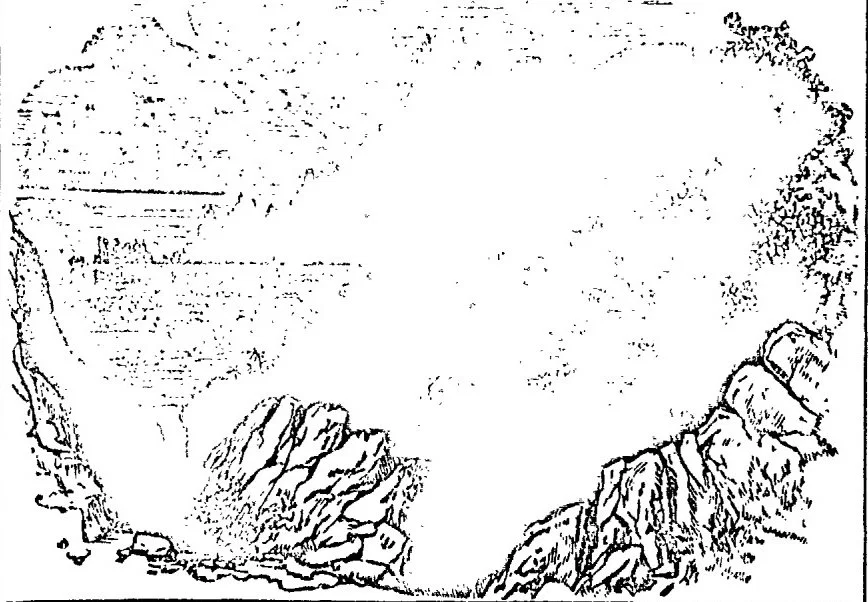
WHILE the saints are seated at the marriage supper of the Lamb, and partaking of the viands of heaven prepared by angelic hands, and served by God’s own Son, the wicked are food for the vultures of heaven. Surely the words of the prophet are true: “Say ye to the righteous, that it shall be well with him: . . . Woe unto the wicked! it shall be ill with him.” Isa. 3:10, 11. Every living thing will at last be destroyed from the earth. “I will utterly consume all things from off the land, saith the Lord. I will consume man and beast; I will consume the fowls of the heavens, and the fishes of the sea, and the stumbling-blocks with the wicked; and I will cut off man from off the land, saith the Lord.” Zeph. 1:2, 3. The birds of heaven will, after feasting on the flesh of the slain, themselves sink into the realms of death forever. The earth will be entirely depopulated.
During this time, while the marks of the curse are resting in such a visible manner upon the earth, it will not remain as it now is. “And the seventh angel poured out his vial into the air; and there came a great voice out of the temple of heaven, from the throne, saying, It is done. And there were voices, and thunders, and lightnings, and there was a great earthquake, such as was not since men were upon earth, so mighty an earthquake, and so great.” Rev. 16:17, 18. Here are depicted the scenes which transpire under the pouring out of the last plague, when human probation is forever ended. There is then no intercessor. Isa. 51:14–17.
Jesus has donned the garments of vengeance. From the threshold of the heavenly Sanctuary are heard the words, “It is done.” As the mighty detonations which accompany this solemn announcement from the lips of the eternal God reverberate through the earth, it becomes convulsed beyond the power of language to portray. Thousands in the past have perished in the ruins caused by earthquakes, but these are no comparison to this coming earthquake.
“And the cities of the nations fell.” Rev. 16:19. The ponderous structures and massive walls of the large cities of earth tumble into ruins as these words roll through the earth. “Every island fled away, and the mountains were not found.” Verse 20. The many islands of the sea are unmoored, swept from their anchorage, and carried into the ocean. Whole mountain ranges that now tower far above the sea, will drop into the great chasms rent in this solid globe as it sinks beneath the wild disorder of sin. The Andes and Himalayas, whose lofty peaks are covered with perpetual snow, will drop into these yawning chasms never more to be seen. Add to this the desolating effects of the last hailstorm, every stone of which will weigh a talent (fifty-seven pounds), and we can perhaps form a faint idea of how exceeding sinful it is to transgress God’s holy law. This final period of earth’s history is just before us. When its vengeance bursts upon us, may it be ours to have a sure dwelling beneath the Lord’s “pavilion.”
Prophets of God have beheld this dark scene, and portrayed it to us in words that attract attention: “Behold, the Lord maketh the earth empty, and maketh it waste, and turneth it upside down, and scattereth abroad the inhabitants thereof.” “The earth shall reel to and fro like a drunkard, and shall be removed like a cottage.” Isa. 24:1, 20. Says Jeremiah, “I beheld the earth, and, lo, it was without form and void; and the heavens, and they had no light. I beheld the mountains, and, lo, they trembled, and all the hills moved lightly. I beheld, and, lo, there was no man, and all the birds of the heavens were fled.” Jer. 4:23–25. When Jesus was dying on the shameful cross, the sun was veiled in darkness. Now when the atonement for mankind is complete, sun, moon, and stars no longer cast their illuminating rays upon this sin-cursed earth. Darkness, as gross as before the Almighty fiat gave birth to light, will surround the globe. The earth is turned back into the chaos from which the Spirit of God molded it into shape.
Having now shown the location of the thousand years, and the condition of the earth during that time, we are prepared to show, if it does not already appear, how, when, and where the binding of Satan occurs. The “bottomless pit” cannot, of course, refer to a pit without a bottom. This would be absurd. The original word signifies an abyss, bottomless, deep, and is used to denote any place of darkness or death. In Rom. 10:7, it applies to the grave. But the passage which specially throws light upon the signification of the word here, is Gen. 1:2, where we read that “darkness was upon the face of the deep.” The word there rendered deep is the same word that is here rendered bottomless pit, so that that might have been translated, “Darkness was upon the face of the abyss, or bottomless pit.” But we all know what is meant by the word “deep” as there used. It applied to the earth in its chaotic state. Precisely this, we believe, is what is meant in Rev. 20:3. What more appropriate words could be chosen to describe the earth, whose foundations God has shaken, and the works of whose inhabitants he has destroyed?
Satan, therefore, is bound by circumstances. In order to work, he must have subjects, but during the thousand years he has none whom he can tempt. The saints are safe within the jasper walls of the New Jerusalem, and the wicked are dead, and, consequently, are beyond his power to deceive. His sphere of action is circumscribed. He can no longer leave this earth to annoy the inhabitants of other planets with his presence. He must wander up and down the broken surface of the earth, and view the ruin which is indirectly the work of his own hands. Here in a state of hopeless inactivity, he can meditate upon his final doom. He is aware that in every conflict against God, he has been vanquished, and that his doom is certain.
The above position is strengthened by a brief reference to the typical service connected with the earthly sanctuary. On the day of atonement, anciently, two goats were taken by the priest, upon which lots were cast, one for the Lord, and the other for the scape-goat. The one upon which the Lord’s lot fell, was then slain, and his blood carried into the sanctuary, to make an atonement for the children of Israel, after which the sins of the people were confessed over the head of the other, or scape-goat, and he was sent away by the hand of a fit man into the wilderness. Now, Christ is the priest of this dispensation. The scape-goat can be readily shown to refer to Satan, as is indicated by its name. Azazel, the Hebrew word for scape-goat in Lev. 16:8, is understood by ancient and modern scholars to refer to Satan. See Jenk’s Comp. Commentary; Chas. Beecher in “Redeemer and Redeemed;” the Arabic, cabalistic, and rabbinical writers, and the learned Fathers of the early Christian church.
After Christ has finished his ministration in the heavenly Sanctuary, and the atonement is complete for all the people of God who have confessed their sins and sent them beforehand to Judgment, he will remove the sins of his people from the Sanctuary, and lay them upon the head of their author, the anti-typical scape-goat, the Devil, and send him away into a land not inhabited; i. e., the earth.
The thousand years at last end. “And when the thousand years are expired, Satan shall be loosed out of his prison.” Rev. 20:7. As we have seen, the wicked are to be raised at this time. The city of God, with all its holy inhabitants, descends to the earth. Rev. 21:1, 2. God prepares for it a location. Zech. 14:4, 5. Then the wicked who lie buried in the bosom of this sin-polluted earth, are summoned forth to receive their merited doom. Then will Satan be loosed. He now, after his long period of confinement, has subjects upon whom to work. He goes out to “deceive the nations which are in the four quarters of the earth, Gog and Magog, to gather them together to battle; the number of whom is as the sand of the sea.” Rev. 20:8. He begins his nefarious work where it was brought to an abrupt end a thousand years before, when war was the all-absorbing theme of life. He now begins to prepare for battle. He shows them the New Jerusalem, tells them that it is a usurper within his dominion, and that the numbers within its walls are small, compared to his own. He instills in their hearts the faint hope of victory. The deception is successful. They catch the spirit of their leader. “And they went up on the breadth of the earth, and compassed the camp of the saints about, and the beloved city.”
Such an army has never been seen since the world began. Their number is as the “sand of the sea.” Kings and princes and mighty men of war are there, at whose approach kingdoms have trembled. Men who fell in battle thirsting for blood and victory, surround the city, animated by the same ferocious disposition. As they stand around the city, they behold the beautiful home of the redeemed, and know that they can never enter. They have been rebels against God, and must now be destroyed. They see Abraham, Isaac, and Jacob, and all the prophets in the kingdom of God, but they themselves forever shut out. An inexpressible sense of their loss seizes hold upon them, and “weeping and gnashing of teeth” are heard. Desperation gets hold upon them. They are now transformed, as it were, to demons. They, together with Satan and his angels, prepare to attack the city and annihilate its holy inhabitants. Then the long-restrained wrath of God breaks forth, and fire comes down “from God out of heaven.” The earth, whose streams have been turned into pitch, and whose dust into brimstone (Isa. 34:9), ignites; and all the wicked are engulfed in the fiery vortex. The earth melts with fervent heat, and the wicked are “devoured” until the arch-fiend and his angels alone remain. But finally these succumb to the terrible power of God’s wrath.
The righteous from within the city see the awful burning, and vividly realize the exceeding sinfulness of sin. But Jesus no longer desires them to witness the terrible spectacle. From his throne “high and lifted up,” he says, “Come, my people, enter thou into thy chambers, and shut thy doors about thee: hide thyself as it were for a little moment, until the indignation be overpast.” Isa. 26:20. They enter into the beautiful mansions prepared for them, and close their doors while the flames of the last great day rage without, ceasing not until all the works of sin are forever devoured. Sin and sinners are no more. The controversy is forever ended.
The saints enter the renewed earth, and know it is their eternal home. Then “every creature which is in heaven, and on the earth, and under the earth, and such as are in the sea, and all that are in them, heard I saying, Blessing, and honor, and glory, and power, be unto him that sitteth upon the throne, and unto the Lamb forever and ever.” Rev. 5:13.
Reader, this glorious time is near, and hastens greatly. If you desire to be among the saved, you must be looking for Jesus’ coming. Heb. 9:28. Trust not in the words of those who cry “peace and safety.” Jesus soon will come! Will you be prepared to meet him?
LITTLE BY LITTLE.
LITTLE by little the time goes by,—
Short if you sing through it, long if you sigh;
Little by little,—an hour, a day,
Gone with the Years that have vanished away;
Little by little the race is run,
Trouble and waiting and toil are done!
Little by little the skies grow clear;
Little by little the sun comes near;
Little by little the days smile out
Gladder and brighter on pain and doubt;
Little by little the seed we sow
Into a beautiful yield will grow.
—Sel.
MY SIXTY-SIX BOOKS.
By Obadiah Oldschool
I see articles in various periodicals, from the pens of well-known authors, with such headings as these: “Books that have Helped Me,” “List of a Hundred Books that Everybody Ought to Read,” etc. It is evident that the reading question is becoming a very serious one. Every sensible man will admit that, from one cause or another, fully two thirds of the books now published are not worth reading. Some of them are really bad, filled with false ideas of life or covert suggestions of evil. Their influence in demoralizing the young is fearful. And, as we cannot have in this free land a legal censorship of the press, each parent and teacher ought to be a self-constituted censor, and know what kind of books his children or his pupils are reading.
Next to the books that are positively immoral, I am old-fashioned enough to put what is called realistic fiction. That it is true to nature—to fallen human nature, I am willing to admit. But because people suffer with the small-pox is no reason why I should visit the pest-house. I never heard of any one whose benevolent and philanthropic impulses were stimulated by such fiction; but I know of many whose imaginations have been corrupted by it, until their hearts have become cages of unclean birds. Even that kind of fiction which is realistic only in style, in which we are amused and amazed, page after page, with Cracker slang and bigger talk, is to me very offensive. How can I hope to teach my children to speak and write pure English when popular story-writers teach them, in the most fascinating way, all the possible corruptions of their native tongue? If we must have fiction, let it be rather of the old romantic school, which exalts our ideals of life. It is better to level up than to level down.
Time and space would fail to tell of the books that are full of platitudes, whose authors have found or stolen a few nuggets of gold, and beaten them out into marvelously thin leaves of foil. There is truth in them, but it is like the grain in a stack. We go to it for bread to appease our hunger, and find that we have to begin by winnowing the straw and the chaff, and the result is not enough wheat to pay for the threshing. And then the “books upon books” written by day-dreamers! They have woven webs as ingenious and as flimsy as the spiders’, all out of their own heads. They have theories in physics, morals, political economy, or theology which, though novel, are entirely satisfactory to themselves, and of course ought to be to everybody else. Oh, how these bantlings, that come out in cloth instead of feathers, do strut and crow as if the world had slept in ignorance till they waked it, as the roosters wake us country folks in the morning! And worse still, if possible, the biographies! How they are coming in like a flood! The earliest biography on record is that of Enoch. God inspired it as a model. Its length is just one line in my Bible: “And Enoch walked with God.” “And” is merely a conjunction. “Enoch” is the title. Hence the biography proper is embraced in three words, “walked with God.” How brief, yet how comprehensive and how satisfactory! But now the life of every second-rate author or politician must be served up in two or three octavo volumes. Our own lives are too short to permit us to read so much about the lives of other people.
But I am forgetting my sixty-six books. I must hasten to them before my column is full. From early childhood I was an omnivorous reader. Too sickly to go regularly to school, I devoured a large family library. I was such a bookworm that they made me librarian at college.
Thirty years in a newspaper office kept me abreast of the new literature of the day. But though I have gone through thousands of volumes, reading sometimes with my eyes and sometimes with my fingers, I have found very few that really helped me. And now I have come to the conclusion, at the end of sixty-six years, that there are just sixty-six books in the world that are really worth reading. Some of the sixty-six are so short that they are rather leaflets than books, and the whole of them I have bound in a single volume that I can put in my pocket. Yet these books form a perfect library. They are a cyclopedia. They compose and comprehend the whole circle of that knowledge which we all need. I have read these sixty-six books over and over a great many times, and yet they charm me with their novelty. They are like my beautiful spring on the hillside yonder. I have gone to it every day for years. The water is never frozen in winter, and never warm in summer. It bubbles up this morning as fresh and as refreshing as when I first visited it. But no, this figure does not tell the whole story. My sixty-six books are like a mine. When I first began prospecting, with a cold and carnal heart, they were to me only a barren hill-slope. I saw no beauty that I should desire them. But when the Holy Spirit opened the eyes of my understanding, I began to find particles of fine gold scattered all over the surface. Gathering these and looking farther, I found pockets of gold that I could work easily. Before exhausting the pockets, I discovered great veins, or lodes, of gold-bearing quartz, hard to mine, but repaying the toil an hundred-fold. And the deeper I have dug, the richer the mine has proved to be. I believe that if I could live as long as Methuselah, and work it every day, I would not be able to exhaust it.
How sad it is that when the world is deluged with literature, the only books in it that have any permanent value are neglected by the majority of readers! To many a voyager on this inky flood, the books of God seem like barren islands. They behold them afar off—perhaps listen to voices from them now and then, but are too busy with the painted novelties amid which they float, to stop and explore them. But there they stand, that cluster of three-score and six, from venerable Genesis to cloud-encompassed Revelation—stand firm and unchanging as the pillars of heaven—stand while thousands of ephemeral books sink beneath the waves. And if the dreamy lover of fiction would only go there, he would find that, instead of being barren, they are covered with trees of life, which bear twelve manner of fruits; that their souls are gold, that their rocks are gems, and that their waters are full of priceless pearls, some waiting for the courage and skill of the diver, but many in such shallows that the little child can wade out and gather them. The Bible is the world’s one perfect library. It ought to be studied an hundred-fold more than it is.—Obadiah Oldschool, in Interior.
THE RELIGION OF "DON'T KNOW."
THE religion of “don't know” is a very poor article for any man to keep on hand. Is there a personal God?—“I don't know.” If there be such a God, what are his attributes and his relation to men?—“I don't know.” Has a man a soul distinct from the body that dies?—“I don't know.” If he has a soul, will that soul survive the event of death, and live forever?—“I don't know.” Is there a heaven and a hell?—“I don't know.” Is the Bible true?—“I don't know.” Was there a Jesus Christ who came into this world to save sinners?—“I don't know.” Did Jesus Christ rise from the dead and ascend into heaven, and does he now exist there as the High Priest of the Christian profession?—“I don't know.”
The man who thus answers these and similar questions, and thus disposes of them all, would do well to see where he stands. He declares his own ignorance upon the most important questions that can be asked or answered. No others are or can be to him of so much importance; and yet he dismisses them all at sight by simply saying, “I don't know.” This is the one saying which he flings at every religious truth, and with which he seeks to relieve himself from its pressure. We more than suspect that he does not want to know. He chooses the religion of “I don't know,” rather than that of “I do know.” When he comes to die, he will, if he has his reason in that solemn moment, want to know something, or believe something, which contains the solution of what death is and is to be to him. He will find it a difficult task to get out of this world on the naked theory of “I don't know.” He is, after all, a man, and has locked up in his nature the wants that are common to men.—Golden Censer.
ENERGY
It is astonishing how much may be accomplished in self-culture by the energetic and persevering, who are careful to avail themselves of opportunities, and use up the fragments of spare time which the idle permit to run to waste. Thus Ferguson learned astronomy from the heavens while wrapped in a sheepskin on the Highland hills; thus Drew studied the highest philosophy in the intervals of cobbling shoes; thus Miller taught himself geology while working as a day laborer in a quarry. By bringing their mind to bear upon knowledge in its various aspects, and carefully using up the very odds and ends of their time, men such as these, in the very humblest circumstances, have reached the highest culture, and acquired honorable distinction among their fellow-men. It was one of the characteristic expressions of Chatterton, that God had sent his creatures into the world with arms long enough to reach anything, if they chose to be at the trouble.—Christian Press.
CAN YOU WAIT?
How long? Till the trials which have vexed you are passed away? Till the men are dead that sought your life? Till those who slandered you come to have all they can do to defend themselves? Till those who have lied about you have proved themselves liars and are recognized as such? Till those who left you to join the strongest side have found their mistakes and want to come back? Till those who stood silently by and saw others wrong you, have had the same cup pressed to their own lips, and found few to take their part? Till the tide turns, and those who were deceived have learned to despise their deceivers? Till men who ride on the hights of power and wealth come down so low that none will do them reverence? Till God-fearing men who have been fooled recover their senses and their judgment? Till rogues fall out, and honest men get a portion of their dues? Till those who abused you for telling the truth find out the truth themselves and tell it far more loudly than you ever did? Till God, whose authority has been rejected, brings forth judgment unto victory, and blesses those who have been scorned and persecuted and cursed?
Can you wait? Time works changes, and eternity confirms them. All things come to those that wait. “Rest in the Lord, and wait patiently for him: fret not thyself because of him who prospereth in his way, because of the man who bringeth wicked devices to pass.”—The Armory.
PRECIOUS PROMISES.
By C. Geikie
Does your spirit faint? They are a dropping honey-comb, better than Jonathan’s. Dip your pilgrim staff into their richness, and put your hand to your mouth, like him, and your faintness shall pass away. Are you thirsty? They are the flowing stream of the water of life, of which you may drink by the way, and lift up your head. Are you overcome by the sultry burden of the day? They are as the shadow of a cloud to bring down the heat; as the cool shadow of a great rock in a weary land. Have your steps well-nigh slipped? They are a staff in your hand on top of which, betimes, like Jacob, you may lean and worship God. Are you sad? There are no such songs to beguile the road, and to bear you on with gladness of heart, as when one goeth with a pipe to come into the mountain of the Lord. Put but a promise under your head by night, and were your pillow a stone like that at Bethel, you shall have Jacob’s vision. The thirstiest wilderness will become an Elim, with palm-trees and wells of water.—C. Geikie, D. D.
THE PACIFIC ISLANDS AS A MISSION FIELD.
By J. O. Corliss
INTERESTING LETTERS FROM PITCAIRN; THE MISSIONARY ZEAL OF ITS PEOPLE, ETC.
The introduction of the Third Angel’s Message produces the same effect wherever it is heartily accepted. It invariably creates in the receiver a thirst for Bible knowledge, and a desire to impart to others the message that has brought joy and peace to his own heart. The islands of the Pacific are no exception to this rule. From letters received from Pitcairn during the year past, the spirit of earnest devotion, and desire of harmony in the work, as also a love and burden for the souls of others, is breathed forth in almost every sentence.
In one letter written last April to Bro. Tay, the writer earnestly pleads for ministerial help to be sent them, and in a closing paragraph tersely states their needs thus:—
I sincerely trust that the Lord will open a way very soon for your people to come to perform his commands of baptism to his people. If you will not be able to come soon, we shall be glad to know just how you conduct your services on Sabbath, and the partaking of the ordinances of the Lord’s supper.
VIEW OF THE VILLAGE OF PITCAIRN.
By this extract will be seen the anxiety that is felt to be in perfect harmony with the great body of Sabbath-keepers; and yet here are true believers denied the privilege of baptism, for many months, though ardently desiring it and pleading for it. Our people generally do not, because they cannot, fully appreciate the situation of these islanders. Could they have our different periodicals regularly, the situation would be somewhat relieved; for then they would have the weekly instruction these afford. But they cannot have even these, because there is no regular way of communicating with them.
When a package of papers or even a letter is directed to them, it goes to Tahiti, and there lies perhaps for months before a vessel touching there expects to pass near to Pitcairn. And then if such package is intrusted to a vessel going in that direction, she may be blown out of her course, and so not sight the island at all. In this case the package is left at the first port reached, to be returned in some round-about way to its destination. Sometimes fortune seems to favor the transmission of intelligence to the island so that it reaches there in four or six months from the time of leaving America.
A paper mail of that kind would seem stale enough to our American brethren. But these people eagerly devour the contents of these old papers as the choicest bits of spiritual meat. None of them are allowed to be wasted either. When they have been read, they are carefully preserved until some vessel comes in sight, when they are taken on board for the benefit of the sailors. In a letter dated Aug. 31, 1887, the writer says:—
I write this in acknowledgment of the Signs, which we have received at different times. I trust you will accept our hearty thanks. The package sent from Tahiti—I made it known in the Sunday night meeting, and requested the people to read them and return them, to be sent on board ships. I have received many encouragements by sending them on board ships, especially English ships; for they are always received most kindly.
One would hardly suppose that with their meager opportunities for doing missionary work, they would feel any burden whatever in that direction. Undoubtedly under similar circumstances many of our brethren would feel that way, judging from the indifference sometimes manifested by those who have infinitely greater privileges than their island brethren. But in the day of reckoning God will call them all to an account of how they have used the talents intrusted to them.
To show the earnestness and zeal with which every opportunity of presenting the truth is improved by this people, we quote again from the letter last referred to:—
On the 5th of May arrived the “Ina” of Tahiti, bringing shells from the islands. The supercargo, Mr. Stuart, (the brother of Stuart with whom you stayed at Tahiti,) came on shore to settle business with my brother. As it happened, the day before “preparation” he was told that no work would be done on the Sabbath. He said, “Mr. Tay has been here.” Being answered in the affirmative, he not very pleasantly said, “But there is much to be said on both sides of the question.” He left the island, I trust, with more serious thoughts. Mr. Young and Ross had some talk with him in the school-room, till he confessed he never read his Bible. I had conversation with him, also, on the Sabbath question. I asked him who wrote the commandments. He answered that he did not know. I referred him to Ex. 31: 18, and Deut. 9: 10. He read them over, and I asked again, Who changed the Sabbath? Said he, “That’s water too deep for me.” I referred him to Dan. 7: 25 and other passages. He said, “I never gave my mind to such things before.” He felt really ashamed. We talked long and earnestly with him before he left.
I have met with a young English doctor who is well acquainted with your books, and said very earnestly, “I believe they are right, both in the soon coming of the Lord, and the keeping of the Sabbath.”
But the religious world has taken much to heart the radical change of faith adopted by these islanders. Before they embraced the Sabbath, probably few knew or cared what their particular views were. But for them to embrace the Sabbath of the Bible, even though all on the island are heartily agreed to the change, and no one in the outside world is inconvenienced by it, is in the minds of many a decided apostasy from Christianity. Hence it is considered that the strongest efforts are necessary to again wrench them from their wretched condition. If the Bible were appealed to by these would-be missionaries, and its truths purely set forth, the more they could do the better. But instead of this, they simply indulge in the grossest falsehoods about the people who keep the Sabbath.
One or two samples will suffice. In a letter to Mary Young (one of the islanders), from one Adam Harper, a missionary of the Church of England, of Birkenhead, near Liverpool, England, the writer says:—
You speak of a visit from a Mr. Tay of the S. D. Ad- ventists. Now, they may be a good people, but those I have met, do not believe in Christ, as we believe in him. They say he was a good man, who came to show us a good example, but, as I told one of them, he was either the Christ or else he was an impostor. A deceiver of the people could not be a good man, as they think proper to call your Saviour and mine, our “Rock of Ages” cleft for us. We believe he was the Son of God, manifest in the flesh, sent to save, to justify, to sanctify, and then to glorify us; and now let me ask, What would be our lives in this world of sin, were it not for the hope we have in Christ? These people tell us that if we keep the law, we shall be saved; but our Saviour says that after we have done all, we are unprofitable servants! No, by the deeds of the law no man can be justified. They put aside the atonement, the substitution, and the intercession of our Saviour. It appears that they have a great deal of Judaism at the same time. I trust you will not think I judge them. I only speak from conversation I have had with them, and all I tell them is, if they are correct in keeping the Sabbath on our Saturday, they are wrong in not acknowledging the Saviour.
The indignation of the average reader may find vent by the expression: “What stuff! Does not every one who knows the Seventh-day Adventists, know that such a statement is a gross falsehood?” But, dear friends, remember this: Here is an accredited missionary of a powerful church establishment, asserting that these things have actually been told him by believers in that faith. A missionary in the commonly accepted sense of the word, is supposed to be a truthful man, because he is looked to as a model of self-abnegation; a man who is entirely given up to do the Master’s bidding. Do you not suppose that words from such will have weight, and will tend to prejudice honest people against the truth? Then how necessary to keep the seeds of truth watered when once they have been planted in any land. But some may contend that the above is an isolated case, and that such sentiments could not come from any other church or part of the world. But in this they are mistaken. We give one more of the same sort, from Des Moines, Iowa:—
I think I must tell you of a movement going on here connected with what are called Seventh-day Adventists—a sect of Judaizers that seems to be growing rapidly in this country. It is only lately that they have been coming into prominence here in Des Moines, but they are now very active, and are doing a great deal of mischief. They keep the seventh day as the Sabbath, hold to the pre-millennial coming of Christ, but in great confusion. . . . Well, there is a growing congregation of them here, and under the direction of the pastor there are nine or ten young women—nice, intelligent-looking persons—who are at work all over the city, holding Bible readings in the afternoons and evenings. They have a regular system of readings, by which the snare is carefully spread, and ere people are aware they are entangled in the meshes of their Satanic system.
My wife, in her visits, has come across several of these female teachers, and has resisted and sought to expose the error of their teaching, effectually closing their mouths on several occasions, and has thus been used to set some of their victims free.
The author then goes on to tell about one of these Bible readings that he attended, and how he exposed the sophistries of the young lady conducting it:—
It was all put in a very subtle and plausible way, and she passed so rapidly from scripture to scripture, that the poor creatures who were listening had not time to think whether it was a right application of scripture or not.
And I suppose among the twenty, or such a number who were listening, there were none besides ourselves—two—who were able to detect the character of the wretched reasoning. In the course of the reading I asked several questions and stated several difficulties, which exposed the false reasoning, and after she saw that she would not answer questions. As soon as the reading was over she left, and then there was an opportunity to show something of the evil teaching.
Two of the women (who were being victimized) came next day to Mrs. Rule’s Sunday-school class, and after the Sunday-school, got pretty well cleared up as to the heresy of these people. These false prophets are doing a great deal of mischief, but I believe, dear brother, God is using it also to open a door for the truth as well. It is awakening inquiry among a good many, and the wrong views held generally as to the law among Christians make it difficult for them to meet and answer this Satanic attack upon the truth.
This was forwarded to the friends of Pitcairn, to show them that although the Bible readings, through which they had received the truth, seemed to them plausible, nevertheless they were only a gloss, and could be easily overthrown by those accustomed to meet such sophisms. And who can tell what influences such craftily worded falsehoods135may secretly work on the minds of those partially instructed islanders! If we as a people could only fully appreciate the worth of one soul, and then realize the jeopardy of that entire community, who are left exposed to all the darts of the wicked one, we could not help being aroused from our lethargy, and would unitedly arise to the work of sending them the relief they need. “How long, O Lord, how long!” J. O. CORLISS.