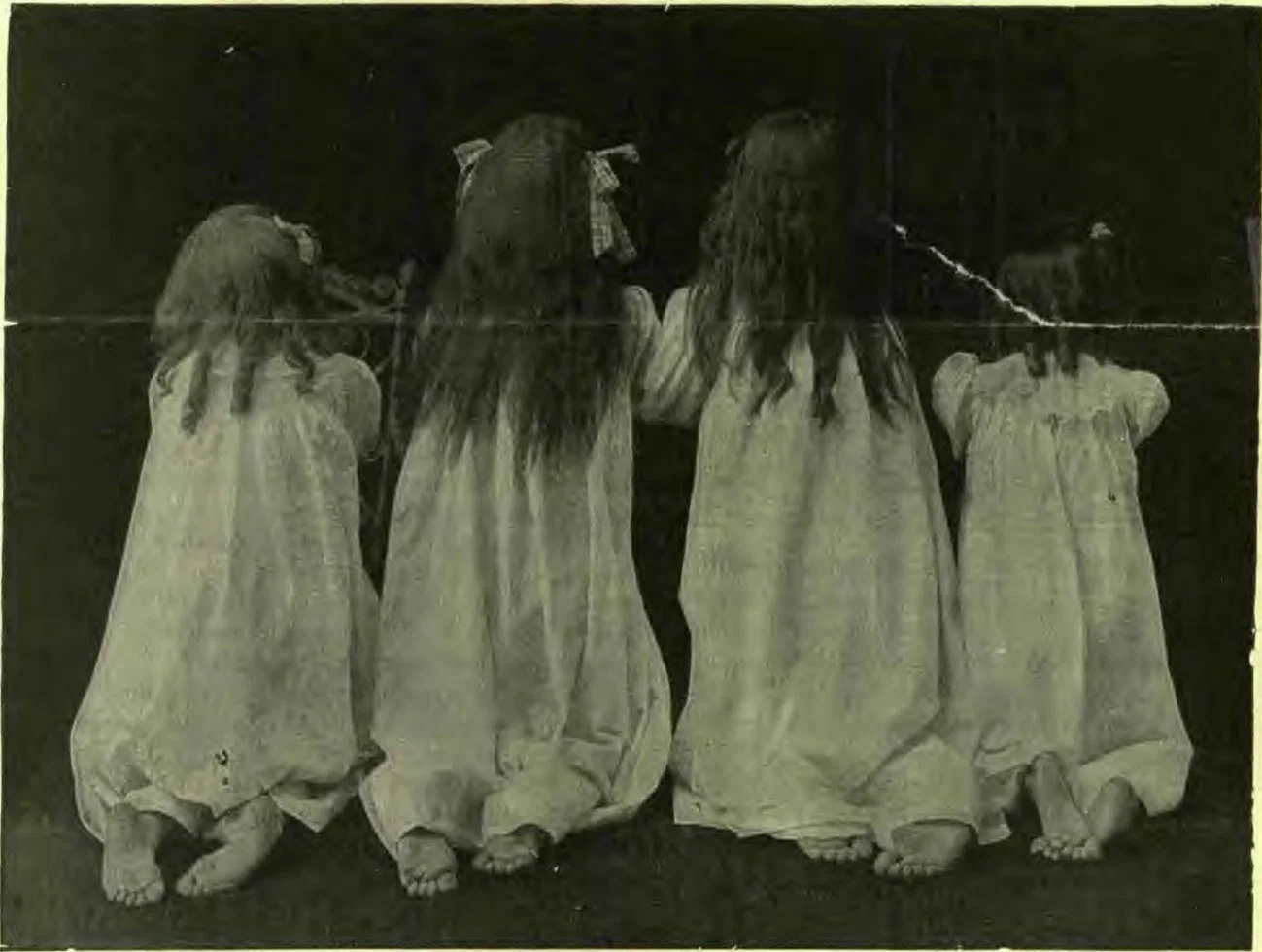
Not even his auntie, who liked his picture taken in every possible way, and who thought him the handsomest boy in the world, would have cared for a photograph taken on this particular morning. It was not often that he looked cross, but this morning he did. His hair was in his eyes more than usual; he had one hand stuffed into his little pocket, where his mother did not like to see it, and he looked as though he did not care. The fact is, he had had a very great disappointment.
He had expected, on this spring morning, to be dressed in his second-best suit, and by this time of day be seated in the cars, whizzing over the country to Aunt Kate’s house. Not that she was his true auntie, but a dear friend of mama’s who had taught Button and him to call her auntie.
Button was Teddy’s baby brother, who was never very far away from “Ted.” Of course Button was not his real name, but he was such a fine roly-poly baby, with such a long name, John, that his father for short had named him Button, and Button I am afraid he will be called—perhaps until his hair begins to turn gray.
“Suffer the Little Children to Come unto Me”
At Aunt Kate’s there was to be a wedding, such as Ted had heard of, but never seen. Her eldest daughter was to be married, and the bridal train from the house to the church was to be preceded by a company of children, scattering flowers, and Ted was to have been one of them. Yet here he was in his everyday dress, with his shirt-waist a little short-waisted, showing a line of white where it shouldn’t, looking forlornly out into the back yard, listening to the whistle of the out-going train, and feeling dismal generally. He had just had a talk with his mother, which, if you are told about it, will explain the situation.
“I don’t see, mama, why you can’t go; you aren’t sick in bed.”
“No, dear; but the doctor says that mama must by no means venture out to-day; the air is not right for her, although it is so sunny. Mama has a sick lung, you know, and has to be very careful; and this cold which I have taken makes matters worse. I am very sorry, dear; it is a great disappointment to me as well as you. Aunt Kate and I were children together, and have loved each other through all these years. It seems so strange that she should have a daughter old enough to be married.”
This mama said to herself, rather than to Ted; for he was staring gloomily out of the window, not seeming to hear all that she said. Presently he broke forth afresh.
“I don’t think it’s right, mama, anyhow. I don’t mean it isn’t right for you not to go; of course you could not go when the doctor said you must not, but—”
“Well, dear?” said mama encouragingly; she wanted to know all her boy’s thoughts. “Who is it that isn’t doing right, then? The doctor couldn’t help my being sick, you know; and if he thought I ought not to go out, he should tell me.” “Of course; but God could have helped it. He could let you be well to-day, just as well as you were last week. I don’t see why, if he loves you and me and all of us, he couldn’t have let you go. We promised to go a long time ago, and he could have helped it just as easy! Wouldn’t you have helped my being disappointed, mama, if you could?”
“Perhaps not, dear; not if I knew as much as God does. I suppose he knows a reason why it is a great deal better for me not to go; better for you, too, Teddy. Can not mother’s little boy trust God?”
Teddy drew a long, discouraged sigh. “I suppose so,” he said, forlornly; “but it would be easier, mama, if God would only show us sometimes why it is better for us not to have our own way, when it’s a nice, good way, and other people want it, too. Aunt Kate will be so sorry that she will almost cry, because we are not there; and the carriage will go to the train to meet us, and it will be just dreadful!”
Whereupon Teddy’s composure forsook him entirely, and he wailed out the last word in the midst of a rush of tears.
“Poor little Ted,” said mama, looking after him as he dashed out of the room; “he is like the rest of us; he wants to know ‘why’?”
The reason why I am telling you this story is because, before the day was done, Ted actually knew “why.” Button had gone in to take his morning nap, and Teddy was trying to amuse himself as best he could, when he heard a clear, ringing voice shout at him from away down the street.
“Hurrah, Teddy! How are you, my man? Where is mama? She’s at home, I hope.”
Ted dropped the bit of board he was trying to whittle, and stared in astonishment. “Uncle Brad!” he managed to gasp out, at last.
“Yes, sir, Uncle Brad at your service. Just in on the mail train. Where is mama, pet? Quicker than a flash of lightning; I haven’t much more time than the lightning has to-day.”
“She is in the house,” said Ted, dropping his knife now, and leading the way quickly enough. The advent of Uncle Brad was a most unexpected luxury. No more delightful uncle lived than this handsome young man, who always had his pockets full of interesting things, and gave Ted and Button leave to rummage to their hearts’ content.
Such a wonderful time as they had in the next few hours! Uncle Brad, though in a great hurry, had forgotten neither his pockets nor Ted’s presents. The pockets were fuller than usual; all sorts of queer and delicious things were to be found there. Ted was so absorbed in them that he almost forgot to be amazed over the shortness of Uncle Brad’s visit. But he did look up once from a strange new toy that he was trying to wind up, to repeat, “You are going on the express? Why, that goes at two o’clock.”6
“Yes, it does, my lad; a very early hour. But there is no help for it; I had exactly four hours to stay, and I resolved to make it. If you had been gone away, Nannie, what should I have done?”
“Nannie” was Uncle Brad’s pet name for Ted’s mama. He had his arm around her as he spoke, and her fair head rested on his shoulder—for, though Uncle Brad was several years younger than his sister Nannie, she was such a frail, pale woman that she always seemed young and small to him.
Ted caught at the sentence, and looked over at them wonderingly. It occurred to him that Uncle Brad was not so jolly as usual, and mama, though her face was in a smile, had what Ted called “tear-eyes.”
“Why, you could have come again,” he said. “It isn’t very far; it didn’t take you but three hours to come, did it, Uncle Brad?”
“No, my boy; but it will take more than three hundred hours to come from where I shall be in a little while. I am going to China, Ted. Don’t you want to go along?”
“To China?” said Ted, and he actually dropped the new toy that would wind up, and came over toward his uncle.
“Yes, sir, to China; going to be gone two whole years; think of that! And I had but four hours to say good-by in. What if you had all been gone away somewhere? It broke my heart to think of it, when I was coming along on the cars.”
A sudden light flashed over Ted’s face. He turned, and he and his mother exchanged significant glances. “I guess God knew all about it,” said Ted, gravely.
“Yes,” said mama, earnestly, “what would poor mama have done if she had gone away on the cars this morning, of all others? I wonder if my little boy will not try to remember that God always knows all about it?”—Selected.
Number One
By Charles R. Talbot
“I TELL you,” said Robbie, eating his peach,
And giving his sister none,
“I believe in the good old saying that each
Should look out for Number One.”
“Why, yes,” answered Katie, wise little elf,
“But the counting should be begun
With the other one instead of yourself,
And he should be Number One.”
— Charles R. Talbot.
An Afternoon on the Panama Canal
By Carlton Claud Kellar
LEAVING the small town of La Boca early in the afternoon of one sultry day in November, our party, consisting of five, started out to see the wreck of the famous enterprise, the Panama Canal. We had heard much of the work on this canal, and therefore were anxious to see something of it. Although it is only about five miles in length — not including numerous branches which were made on either side of the main channel — there is much of interest to be observed in the remains of the great French project.
Having read of the alligators which abound in the swamps and marshes of the tropics, we wanted much to catch a glimpse of them at home. Two of the gentlemen carried firearms, hoping to find one of these interesting friends basking in the sun somewhere along our trip.
After rowing about one mile from the mouth of the bay, we came in sight of a magnificent dredger — one of the finest and best preserved on the Pacific side of the canal, having been made in France, and transported here at great expense. Sun and rain are rapidly doing their work on this structure, decaying the wood, and even penetrating the steel where the absence of paint left it unprotected.
The few Frenchmen who still guard the ruins look upon all strangers with suspicion, and it was only after much deliberation, that one of our number — a prominent gentleman in marine circles — convinced them that our intentions were only good. When satisfied that we entertained friendly feelings toward them, a most cordial reception was tendered us, accompanied by a detailed description of the dredger as we were shown over the wreck.
After looking around for a short time, we rowed about a mile farther up the stream to the end of the main channel, where we ate our lunch. Entering a side cut, we soon found ourselves in one of those mountain streams which come rushing and tumbling over rocky steeps in their mad haste to reach the ocean. A mud bank hindered our progress for a short time, but after loosening the boat and rowing about for a half-hour, we started back to the town. Curious to see a number of wrecks in another side channel a quarter of a mile farther on, we were again enticed away from the main channel, although the tide was falling, and the side cut was very shallow. Here the tide sometimes rises to the height of twenty feet, and low tide leaves some of these channels entirely without water.
We had gone about a quarter of a mile from the main stream, when we suddenly ran aground. Scarcely had persistent effort freed us, until we found ourselves in mud again. This time no amount of exertion would liberate us, as the water had subsided until the bar of the channel was high — but not dry — and an impassable wall of mud about four feet high lay where we had just been rowing. In a few moments we were completely stranded in the center of the cut, with no hope of escape until the tide should come in again, which would not occur until about nine o’clock that evening. The prospect was not very pleasing, as it was only four, and the cloudy sky threatened a tropical “downpour.” A suggestion to go overland was considered, but abandoned on account of the impenetrable thickets. We sat in the boat until it began to rain, when we determined to seek shelter on one of the nearest dredgers. To our consternation we found a strip of soft mud, nearly two hundred yards long and four feet deep, directly in our path. After a hard struggle, and a deal of fun mingled with our arduous efforts, we reached the welcome shelter only to find new enemies in waiting for us. Hordes of small gnats attacked our faces and mud-bespattered limbs, nearly driving us crazy. Tearing the lining out of my coat sleeve, and dipping it in one of the oil cups of the machine, we started a fire, which finally drove the pests away. The hours dragged wearily on until nine, when the water came back as rapidly as it had gone. After another struggle with the elements, we reached our boat, and were soon on our homeward journey, arriving there about one hour later.
During the afternoon we saw five alligators, but secured none, and fortunately for us, they none.
Notwithstanding we experienced more than was anticipated when we started on our trip, we felt glad of the opportunity of seeing the canal that to-day is of interest to so large a part of the civilized world.
CARLTON CLAUD KELLAR.
Mayinza: A Boy Near Victoria Falls
By Mrs. W. H. Anderson
Mayinza
To the northeast of the beautiful Victoria Falls, where bands of the warlike Mashakalumbe raid and plunder either friend or foe, in the summer of 1881 a little baby boy came to gladden the heart of his mother. He was a wee little thing, with big black eyes and coal-black hair. There were no garments ready for him, so his mother wrapped him in skins.
He was called Mayinza, summer, as he was born at the time of the warm season.
When Mayinza was about two weeks old, his mother took him out in the garden with her to dig. He was tied on her back with a skin. If you could have seen him then with the hot sun shining on his bare little head, continually bobbing about as his mother was at her work, you would have thought that his brains would never be of any use. However, he soon grew to be a fine fat boy with shy, laughing eyes.
As he grew older and began to walk, he would play about with other children, just as careless and happy as himself; while his mother was at her work, either digging or cooking, and his father was raiding some neighboring village or fighting the Matabele.
Our next visit to this dirty, untidy village will be in the winter of 1888. Mayinza has grown to be a tall, thin boy of about seven years. We find him herding his father's goats. While doing this he and other little boys, who are also herding, amuse themselves by getting clay and making oxen, sheep, and goats.
Very early one morning a cry of alarm was given. The blood-thirsty Matabele had surrounded the village, and were killing all the men who could not escape, and taking the women and children captives.
Mayinza's mother made her escape, but finding that her son was among the captives, returned, and gave herself up to become a slave that she might be with her child. They now bade farewell to all that was dear to them, and started on the long journey to the south.
Mayinza and his mother were given to a soldier who lived about twenty-five miles from where our mission farm is now located.
They remained here but two or three months, when Mayinza's mother determined to take her son and make their way home if possible. They had gone about eighty miles when they were captured by a band of raiders, and taken to a village, where they were shut up in a hut for several days.
His mother now gave up all hope of ever being able to return home. She gave Mayinza the name of his father, and told him when he grew to be a man, he might be able to return to his home. At this place there were two villages near together, and one day the men took his mother out and whipped her from one to the other. This was done until she was nearly exhausted, when a man came and took her away with him. This was the last that Mayinza ever saw or heard of his mother. He does not know whether the man took her away from pity, or whether he killed her.
Soon after this some people took Mayinza back to his old master. He was here when the English took the country, and when we arrived at the mission station.
His master joined the rebels at the time of the Matabele rebellion in 1897. Their village was plundered by the Makalanas, who were helping the English. Mayinza was again taken captive. This time he was brought nearer to the mission. During the famine of 1897, Mayinza first visited our mission. He was on his way to Buluwayo to find work. It was at the time when our oxen were dying of the rinderpest, and he joined the hungry people in eating the dead carcasses of the animals. He carried a load of fowls to town for Elder Tripp.
When he reached town, he found work with a coolie, where he acquired a taste for gardening. He then worked a short time for an Irish policeman. When not in his usual drunken condition, the policeman would urge Mayinza to go to the missionary and learn about God. He told him, although he himself did not obey God, that it was much better to do so. This made a lasting impression on Mayinza's mind.
From here he spent nearly two years with a prospector, going about the country digging holes, as he expresses it.
It was this prospector that gave him the name Jim, by which he is known at the mission, and by which he has been previously introduced to the INSTRUCTOR readers.
After finishing his work with this prospector, he spent four days with his old master. He then came to the mission and told Mr. Anderson that he wanted to remain with us and learn to read. This was in October of 1898. He remained here until the last of the following May, when he went to town and worked two months. Brother Mead persuaded him to return again to the mission.7
Jim had attended school while in town, so he had not forgotten what he had learned while with us. From this time Jim has been one of our most faithful boys, and has truly grown in grace, and in the knowledge of the truth. He has always seemed to drink in God's Word as the parched earth does the refreshing showers of rain.
On June 25, 1901, Jim was baptized, and has ever since led a consistent Christian life.
Nov. 10, 1902, he was married. He has huts built by a kepje near our homes, and is an example to the people in neatness and order in the home and surroundings.
A few weeks ago a little girl came to gladden his home. She was named after the great grandmother of king David.
In his separation from his home and loved ones, Jim, like Jacob, thought, “All these things are against me.” He did not see the hand of God leading him out of darkness so that the bright rays of the gospel could shine into his heart.
Do we always when passing through trials remember that God is leading us where he can reveal more of himself to us, or do we murmur at the roughness of the way chosen for us?
You will not wonder when I tell you that the greatest desire of Jim's heart is to return to the home of his childhood, and take the gospel to his own people. MRS. W. H. ANDERSON.
MEMORY VERSE: “Fear God, and keep his commandments: for this is the whole duty of man.” Eccl. 12:13.
The reign of Solomon did not end as gloriously as it began. He walked in the good ways of his father David, but he also followed him in one way that was not good, although he knew of the trouble it had brought to David. “King Solomon loved many strange women.” He took a multitude of wives, not from his own people, but from among the heathen, of whom God had said, “Ye shall not go in to them, neither shall they come in unto you: for surely they will turn away your heart after their gods.”
First Solomon married the daughter of Pharaoh, king of Egypt, the dark, idolatrous land from which God had delivered Israel. Then he took women from the Moabites, Ammonites, Edomites, Zidonians, and Hittites, until he had seven hundred wives. Perhaps he trusted to his great wisdom to save him from being influenced by them, and thought through them to spread the knowledge of God to the nations from which he had taken them. But in this thing he was disobeying God, and we must not do evil that good may come. It came to pass just as God had said: instead of his wives being converted to the worship of Jehovah, they turned away his heart from God to the worship of their idols.
The Lord had exalted Solomon in the eyes of all the nations that he might make known to them the power and glory of his own name. When Solomon was led away by his wives to worship their gods, the nations had reason to think that the wise king had found that their gods were as good or better than Jehovah, the God of Israel. So the influence of Solomon’s idolatry was widely felt.
God was grieved and displeased with Solomon, for he had twice appeared to him and told him not to go after other gods, and what would be the consequence if he did. He said that he would rend the kingdom from him, and give it to his servant. But for David’s sake he would not do it in Solomon’s days, but in the days of his son; and he would also leave to the house of David one part, for the sake of Jerusalem which he had chosen. God had given to Solomon a reign of peace, but now he suffered adversaries to rise against him and trouble him.
Among the servants of Solomon was a man named Jeroboam, who was in favor with the king because he was industrious. One day Jeroboam was walking along the way with a new garment on, when the prophet Ahijah met him. The prophet took off Jeroboam’s new mantle and tore it into twelve parts, representing the twelve tribes of Israel. Ten of these pieces he gave to Jeroboam, signifying that God would give him ten of the tribes of Israel, and he should rule over them, according to all that was in his heart. If he should be true to God, God would be with him and establish his house. But if not, he also should be cast off. The other two pieces of the garment represented the two tribes that should be kept for David’s sake for the son of Solomon.
The prophet told Jeroboam that Solomon should reign over Israel all the days of his life. But Jeroboam seems not to have been content to wait, like David, for God’s time to give him the kingdom; for we are told that “he lifted up his hand against the king.” When Solomon sought to kill him because of this, he fled into Egypt.
Although the reign of Solomon ended in gloom, yet we have reason to believe that in his last days he repented of his sin and turned to God. It was then that he wrote the book of Ecclesiastes, telling of his search after wisdom and also after folly. In the last words of this remarkable book, he sums it all up in the following memorable words written especially for the young:—
“Let us hear the conclusion of the whole matter: fear God, and keep his commandments: for this is the whole duty of man. For God shall bring every work into judgment, with every secret thing, whether it be good, or whether it be evil.”
Questions
1. In what evil practise did Solomon follow the example of David? What instruction had God given the Israelites about marriage with the heathen? What did he say would be the result of it?
2. What influence did Solomon’s wives have upon him? What did he do for them? What effect did this have upon the nations?
3. What calamity came upon Solomon as the result of his sin? To whom was the prophet Ahijah sent with a message from God? Tell how he delivered his message.
4. Why did not God take the whole kingdom from Solomon? How much was left to the house of David? What reason have we to think that Jeroboam was not content to wait until Solomon’s death? What did Solomon seek to do to Jeroboam? Where did Jeroboam take refuge?
5. What did Solomon write after his repentance? Of what does he tell in this book? In what words does he sum up our whole duty?
XII—The Standing up of Michael
(March 19)
Questions
1. WHAT is the significance of the last verse of Daniel 11?
2. When this prophecy is fulfilled, what is to occur in the heavenly sanctuary? Dan. 12:1.
3. What does the expression “stand up” mean? Note 1.
5. How will the time of trouble at the standing up of Michael compare with the experiences of the past? Dan. 12:1.
6. Upon whom will it come?—Evidently upon the whole world; for the nation instead of God’s people is mentioned; but out of this trouble the children of God are to be delivered.
7. Since Christ ceases his ministry before the time of trouble, what will be the nature of the wrath of God that is poured out? Rev. 14:10. The wrath of God all through the ages has been mingled with mercy. But when Christ’s ministry ceases in the heavenly sanctuary, mercy will be withdrawn.
8. In what manner will the wrath of God be poured out just before the end? Rev. 15:1.
9. What promise has the Lord given that reaches to that time? Ps. 91:7, 9, 10.
10. What did the angel tell Daniel would be the experience of God’s people? Dan. 12:1.
11. How will it be determined who shall be delivered at this time? Dan. 12:1.
12. Whose names will be retained in the book of life? Rev. 3:5.
13. What is great cause for rejoicing? Luke 10:20.
14. What will be the fate of those whose names shall then have been blotted out of the book of life? Rev. 20:15.
15. To what events then do the first two verses of Daniel 12 bring us? Note 3.
16. What two classes are especially mentioned in this closing time? What promise is made concerning these? Dan. 12:3.
Notes
1. The significance of the expression is furnished in the interpretation of verses two and three in chapter eleven. “There shall stand up yet three kings in Persia.” “A mighty king shall stand up that shall rule with great dominion.” These plainly show that the expression “stand up” in the verse under consideration must mean to take the kingdom, to reign. At that time Michael shall stand up, shall take the kingdom, shall begin his reign.
Christ is reigning now, associated with his Father; but when his work as High Priest closes, he takes his own kingdom.—“Thoughts on Daniel.”
2. Michael is called in Jude the archangel. This means the chief angel, or the head over the angels. There is but one; and he is the one whose voice is heard from heaven when the dead are raised. 1 Thess. 4:16. And that voice is the voice of our Lord Jesus Christ. John 5:28. Then Michael, the great prince, who stands for God’s people, is none other than our Saviour the Lord Jesus. He is the Prince of Life.—“Thoughts on Daniel.”
3. Verse 2 evidently brings us to the resurrection, showing that the standing up of Michael is followed soon after by the deliverance of God’s people from the land of the enemy. The significance of the details brought out in the first three verses of Daniel 12 are presented in an interesting manner in “Thoughts on Daniel.” The vital question in the study of this lesson is the nearness of the end, and our preparation to stand in the time of trouble. But the encouraging thought is that Jesus still stands to plead our cases; and now, even to-day, he is ready to receive us, if we turn to him. “To-day if ye will hear his voice, harden not your hearts.” We can not afford to wait until to-morrow. The richness of knowing Jesus is worth all that apparently would keep any one from seeking him. With him in our hearts, like David, we shall be ready to say to others, “O, taste and see that the Lord is good,” and the promise of Dan. 12:3 will be ours.
A Word Just to the Boys and Girls
I imagine the author of the article “Around the Work-Table” would be pleased to learn how many have constructed the various things he has taken the pains to give you the secret of making; and he would like to know, too, whether you were successful. Elder Thompson, I am sure, would like to know whether you have read carefully his very important and interesting articles on the truths of the third angel’s message; he would like to know, too, what good they have done you; so would we.
The author of the stories on history would be interested to learn whether by reading the articles, you have been inspired to read some good books on history. Dr. Reed, who is anxious to have all understand clearly the invisible things by the visible—the common things with which we daily have to do—would like to know whether his articles have helped any to a clearer view of God’s eternal power and love.
We would be glad to learn that Mrs. Loper’s excellent articles on reading had made some of you choose more carefully your books for reading.
Then, too, there may be some question you would like to have answered, then again the editor may have some question she would like to have you answer; for example, Why is a marble bust of Kosciusko in the Capitol? In what respect does the marble from Tennessee, Maryland, Massachusetts, and Vermont differ? These varieties are all found in the Capitol.
From what I have already written, do you not think it would be a good plan to have a corner in some page of the INSTRUCTOR devoted to questions and answers, and to letters from our readers? If you think so, send in answers at once to the questions I have suggested. Some of the best and most prompt responses we will print in an early number of the INSTRUCTOR. Who will be the first?
I am sure that some of the older readers will feel impressed to learn what secrets are being given to the boys and girls; so I shall now say a word to you. A letter received the other day made more impressive a plan that had already been suggested to those in charge of the work, namely, that of devoting one corner of the paper to personal talks with our readers—a corner in which we shall learn directly from you what lines of thought you have been the most interested in, and what you would like to have appear in the columns of the INSTRUCTOR. It is your paper, you are the ones to be pleased; therefore let us hear suggestions at once. The letter to which we referred, spoke of the pleasure and great good the young people of the Sabbath-school had gotten from carrying out the suggestion relative to “Bible Story Telling” that had been given in the INSTRUCTOR.
Suggestions already received from friends have been appreciated. Now we hope to hear from others.
This Will Interest You
The Correspondence School for Nurses connected with the Sanitarium Medical Missionary Training School will begin a new class the first of April, 1904. Lessons are sent weekly to students who are unable to leave home duties in order to take a regular course at one of our sanitariums. This is the sixth year this work has been in progress, and hundreds are availing themselves of it. One who desires to do Bible or missionary work or canvassing can not afford to miss this opportunity. Studies in eleven subjects are given, among which Christian Help work and the care and treatment of the sick are prominent.
Our lessons have recently been rewritten and enlarged, and are in every way improved.
The tuition fee is six dollars for the entire course. This amount is to cover the cost of sending out lessons, correcting the replies, and returning the reports to the pupils. The few textbooks required for this work are furnished at the actual cost price. We shall organize a new class in April, which will continue one year. By taking double lessons, some students finish in six months. We shall be glad to hear from all who are interested. A descriptive circular giving full particulars, also testimonials from those who have taken the course, will be sent free on application. Address Correspondence Department, Sanitarium Training School, Battle Creek, Michigan.
New Belden Chart: The Dark Ages and the Dark Day
A NEW chart has been published by Brother F. E. Belden, entitled “The Dark Ages and the Dark Day.” It is printed on cloth, size 36 x 48, and is designed to illustrate such subjects as the change of the Sabbath, the 1260 years, the last-day signs, etc. The price is 90 cents, postpaid, including a copy of the booklet “At the Door.” It may be obtained of the publisher, F. E. Belden, Battle Creek, Mich.—Review.
The Baltimore Fire
Fires, wrecks, dreadful casualties of all kinds, wars, and rumors of war, are coming as never before to be an expected part of the daily program. Scarcely had the tones of the funeral knell of the dead at Chicago’s theater died away, before the flames were seen rising from Baltimore’s almost unparalleled fire.
A graphic description of the catastrophe as seen by an eye-witness, was given in the Washington Post. A few paragraphs only from this article can be given here:—
“You can not imagine it; you can not imagine it,” he kept repeating.
“I have seen big fires in New York and Chicago,” he said, “when block after block would fall before the sweep of the flames, but nothing that approached in terrible fury the catastrophe that fell upon Baltimore to-day. The flames swept down the streets with the onward rush and fury of a tidal wave. Great billows of fire two hundred feet in height would fill the space between the buildings, and, sweeping from side to side, would blot out of existence a skyscraper as if it were a box of matches.
“The Union Trust building and the Atlantic Trust building shared this fate. One moment they stood in the stately beauty of stone and marble; a moment later and they were not. The flames would dash against their sides, beat in the massive walls, leap from windows and roofs and—then would come the collapse. The Union Trust building, one of the handsomest in the country, seemed to my mind to vanish almost as I looked.
“The city was a mass of whirling, burning, blinding embers. In the Sun office, where we sat at work over our desks, the copy paper would burn as we wrote. In the streets the embers fell in sheets, and rose and fell again, as the swift wind carried them along. Everywhere were drawn and anguished faces, and the marks of desolation.”
Senator Hanna
A Brief Survey of His Career
MARCUS A. HANNA, Senior Senator from Ohio, died Monday evening, February 15, at Washington, from typhoid fever. Senator Hanna had suffered severely from an attack of grip since the middle of December, but had managed to keep at his work till February 3, when he collapsed. During the next ten days he sank rapidly, and during the last two or three days life was kept in him only by use of the most powerful supporting agencies known to science.
It is a favorite saying with us that here in America a man can mount from the lowest station to the highest. Senator Hanna’s career affords a striking example of the truth of this boast. He was born in 1837 at New Lisbon, Ohio, his father being a country merchant. The family later moved to Cleveland, where the elder Hanna became a groceryman. At fifteen, young Hanna chose to become a clerk in his father’s store. Though his standing at first was exactly the same as that of the other clerks, he soon showed evidence of his remarkable business ability, and in time became the head of the concern, which had developed into the wholesale field. He entered the firm of his father-in-law, who was in the coal and iron trade, as junior partner. Ten years later he was senior partner. Under Mr. Hanna’s business direction the firm had a marvelous growth. It gradually came to own iron and coal mines, steamship lines, docks and furnaces, and Mr. Hanna found himself amassing millions. Mr. Hanna was the head of this firm till the time of his death.
Mr. Hanna entered politics about thirty-five years ago, and gradually became a conspicuous figure in Ohio. He first came into national prominence in 1895, when he undertook the management of McKinley’s candidacy for the presidential nomination of the Republican party. It was largely through Mr. Hanna’s astute generalship that the convention was brought to nominate Mr. McKinley. Mr. Hanna showed such ability in this pre-election campaign that the National Committee made him chairman of the Campaign Executive Committee. The prominence he attained by the successful management of the campaign secured for him the appointment to the United States Senate.
The rest of Senator Hanna’s career is so fresh in mind that it does not need to be told. Since he took his seat in the Senate, he has been, aside from the president and the cabinet officers, the most prominent figure in American politics.
Though on occasions we have criticized Senator Hanna, we do not hesitate to pronounce him one of the ablest and most thoroughly sincere men that have appeared in recent politics. He was deeply interested in the problem of the relation between capital and labor, and his work with the Civic Federation to promote harmony between the two will stand among his most praiseworthy achievements. In Senator Hanna the Republican party has lost a great leader, and the United States a valuable citizen.—Week’s Progress.