The Youth's Instructor, Vol. LII, No. 10

The Capitol

The Youth's Instructor

March 8, 1904

Review and Herald Publishing Assn. · Washington, D. C. · March 8, 1904

The Capitol
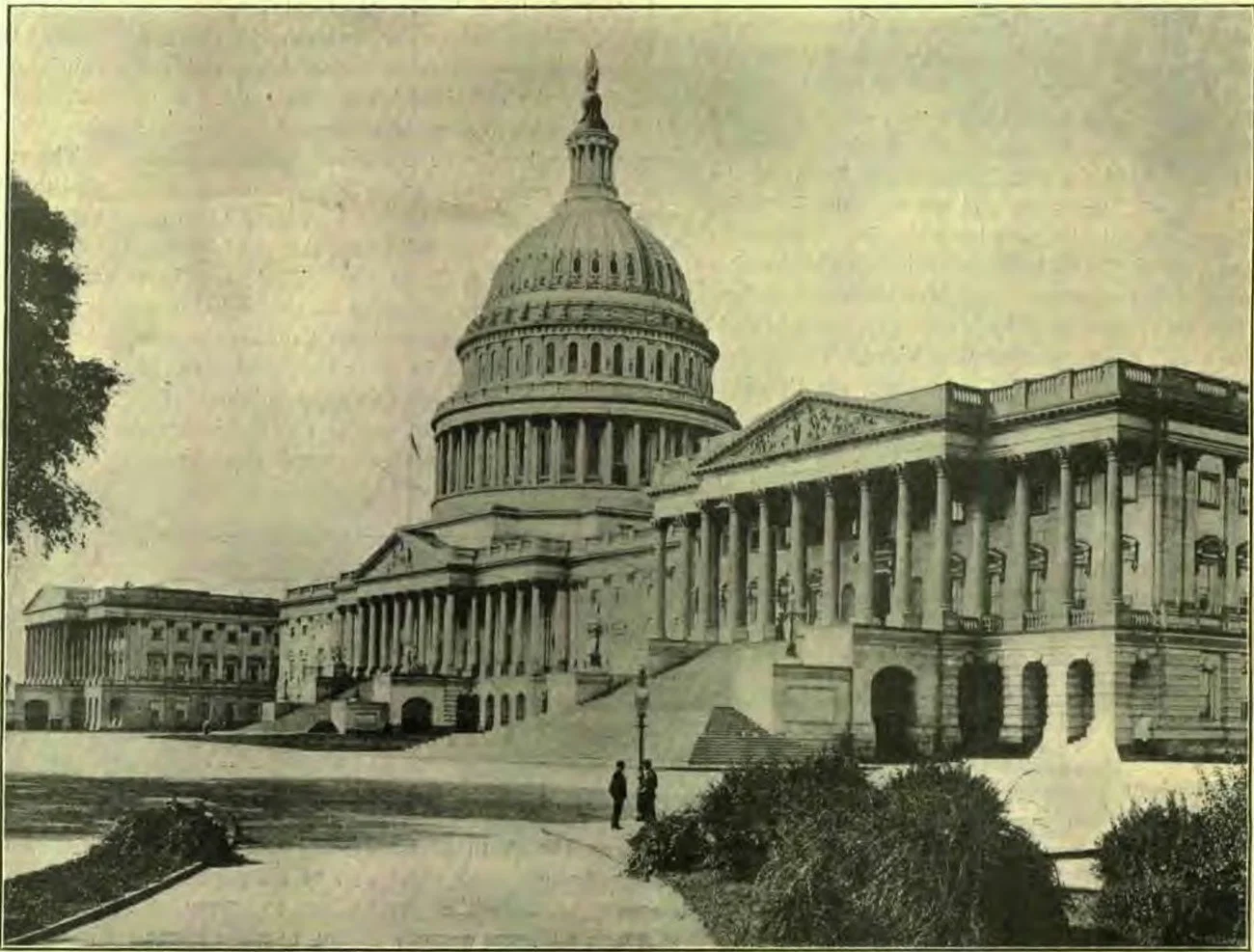
THE interest of all Washington, of all the land, centers on Capitol Hill, the site of the legislative building. “The Capitol is distinguished for its commanding situation and majestic properties; for the dignity, grace, and beauty of design, and the adornments and decorations which beautify it without and within.” As an architectural object it ranks among the noblest in the world, claiming close relationship with the Milan Cathedral, and St. Paul’s, the Houses of Parliament, and Westminster Abbey.
“Come, let me lead thee o’er this second Rome.”—Moore.
The Capitol is seven hundred fifty-one feet long, and three hundred fifty feet in greatest breadth, and measures three hundred seven and one-half feet from the ground to the crest of the Liberty Statue surmounting the dome. The architecture is modified Corinthian upon a rustic base. The cost of the structure is estimated at fifteen million dollars. The building faces the east; for it was expected that the city would extend in that direction; but the development of Washington has been chiefly toward the west. The grounds on the west side of the building therefore have been beautified and ornamented more than those on the east, the real front. Here on the east utility takes the place of beauty, and the large plaza passed over daily by carriages and multitudes of pedestrians is simply cold, bare concrete. Thus the path that leads the representatives, senators, and other official dignitaries to their honored place is not velvet-carpeted by nature, lined with roses, nor perfumed with rich fragrance. The hard pavement is perhaps more suggestive, however, of the difficult path some have had to tread in attaining the goal of their ambition. This large plaza is where the immense crowds gather to witness the inauguration of the president.
There are three flights of broad steps; one leading up to the central entrance, and one to each wing, giving an appearance of breadth and solidity to the building, whose walls are nearly hidden by the three rows of large monolithic fluted marble columns. On either side of the central flight of stairs from the level of the portico extend two great buttresses, each adorned by colossal pieces of marble statuary, which together cost forty-eight thousand dollars. It is unusual to find the entrance to a building attracting the special attention of visitors, yet it is so here; for the famous Roger’s bronze door can but command attention. It is nineteen feet high,—tall enough for any dignitary,—weighs ten tons, and cost enough to build a modest mansion for you or me, twenty-five thousand dollars. The door is so nicely hung that even a child can easily swing the massive leaves back and forth. Each leaf is divided into eight panels, all of which are superbly enriched by scenes portraying the chief events in the life of Columbus and the discovery of America. The key of the arch of the casing is ornamented with the head of Columbus, and on the sides are typical statuettes of the four leading continents, and a running border of ancient armor, banners, and designs. Pizarro, the conqueror of Peru, Ferdinand and Isabella, and the leading historians of the voyages of Columbus, Irving and Prescott, are each given a place on this historic door. As I stood studying the various panels, I heard a lady remark to her friend—they also had been admiring this marvelous work of art—that “the inside of the door is ornamented as beautifully as the outside.” The lady’s appreciation was thus at once doubled; but the fact is, only the outside is adorned. Here was certainly an illustration of the oft-repeated saying, “Where ignorance is bliss, ’tis folly to be wise.”
This door admits one to the Rotunda, the center of the Capitol. It is said that “the crowning glory of the Capitol is the imposing dome, springing from a peristyle of fluted Corinthian columns above the central building, the Rotunda, and terminating in a lantern lighted by electric lights, which is surmounted by the Statue of Liberty.” The dome is of cast iron, and weighs nearly four thousand tons. It is so constructed that with the variations of temperature the iron plates expand and contract, like “the folding and unfolding of a lily.” It is thoroughly protected from the weather by heavy coats of white paint. It cost a million and a quarter of dollars, and required eight years in construction, being completed in 1865. The lantern is fifteen feet in diameter, and fifty feet high. Over the lantern is a globe, and standing on the globe is the bronze Statue of Liberty. This is no pigmy goddess; for she is nineteen and one-half feet high, and weighs seven and one-half tons, and cost twenty-four thousand dollars. Amid the salutes from guns in Washington and surrounding forts, and the cheers of thousands of soldiers, the Goddess of Liberty was raised to her commanding position. It is to be hoped that the principles which the statue represents may never be forgotten nor ignored by those that fill the legislative halls below.

The Rotunda

The visitor willingly tarries long in the Rotunda; for its walls are decorated by costly paintings, frescoes, and statuary. Here are found the four celebrated paintings of John Trumbull, few others, if any, being more highly prized than these. Mr. Trumbull when a young man was aide-de-camp to General Washington. He had a natural taste for drawing; and while in the war conceived the idea of cultivating his talent with the purpose of commemorating by it the great events of the Revolution, preserving faithful portraits of the leading men, and accurate details of scenes, dress, and arms. To this end, after the war Mr. Trumbull studied art in this country and in Europe. In 1816, after thirty years of preparation, he was commissioned by Congress to paint the four great pictures, commemorating the signing of the Declaration of Independence, the surrender of Burgoyne, the surrender of Cornwallis, and the resignation of Washington. Copies of these, doubtless, are familiar to many of our readers. Mr. Trumbull received thirty-two thousand dollars for his work. Four other paintings of equal size and great merit complete the circle adorning the Rotunda walls.
One must remember here as elsewhere that the crown is above; so lift your eyes, for the vaulted canopy of the dome glows with color. This is the artist Brumidi’s masterpiece. Brumidi was born in Rome in 1805, studied art, and at the age of thirteen became a member of the Academy. He painted frescoes in Roman palaces, in the Vatican, and did considerable work in Mexico. He decorated the Public Reception Room of the Capitol, and the walls and dome of the Rotunda. These are said to have been the first frescoes in the United States. His masterpiece, “The Apotheosis of Washington,” cost fifty thousand dollars. The artist died in 1880 from an injury sustained by a fall while painting this frieze. The central figure is Washington. On his right sits Freedom, on his left Victory, and around him float aerial figures representing the thirteen original States of the Union. On their banner is inscribed the motto of the United States—E Pluribus Unum—Out of many, one. Appropriate groups of figures representing the Fall of Tyranny, Mechanics, Commerce, Arts and Sciences, Agriculture, form a part of this wonderful fresco,—all a pleasing conception of the history of our country.

Legislative Hall

Passing to the south from the Rotunda, one comes into Statuary Hall. Every State in the Union has been invited to send statues of two of her noblest sons to adorn this room. A little farther on is the Hall of the Representatives. Its extensive dimensions, the warm colors of its carpets and drapery, the white and gold of its ornamentation, the exquisite paintings on its walls, and the richness of its furniture make it a legislative chamber, it is said, unsurpassed in the world. The Senate Chamber, occupying the north wing of the building, is not so large as the Hall of the Representatives; but the blending of the green of the velvet floor and the rich mahogany doors and desks, and the gilding about the walls and ceilings, make it not inferior in elegance. The Supreme Court Room is a particularly attractive point of interest to the throng of sightseers daily traversing the corridors of the Capitol; for “all seem anxious to get a peep at the room, and the nine intellectual giants upon whose learning and logic too often depend happiness and misery, wealth and poverty, life and death.”
There are many other interesting rooms here and there, some of which you may enter; and some into which the curious eye of the visitor is not even permitted a passing look—unless he can claim relationship with some of the nobility. In one of these small rooms open to all, hang the two famous paintings by Thomas Moran of the canons of the Yellowstone and Colorado Rivers. These two pictures cost the government twenty thousand dollars. So indescribably rich and varied is the coloring of these—and we are assured that it does not equal the real—that it would seem a score of rainbows had dissolved, and their glory had floated down to give a peculiar softness and beauty to the scene. As one stands before such a work of art, he feels impelled to go at once to purchase a ticket that he may revel to his heart’s content in the grandeur and the glory the artist has but pictured. And it is only the peculiar sensation that comes over him as he grasps his pocketbook that brings him to himself. Do you know the feeling?
The east stairway of Tennessee marble is lighted by a richly stained skylight. On the wall of the landing hangs a spirited painting of the Battle of Lake Erie, which occurred on Sept. 13, 1813. It pictures the gallant exploit of Commodore Perry, transferring his colors from the disabled flagship “Lawrence” to the “Niagara” in the face of a terrific cannonading. It was after the victory here that Perry dispatched the famous message, “We have met the enemy, and they are ours.” On the west landing is another painting of equal merit, Emanuel Leutze’s Westward Ho! having for its legend the familiar lines, “Westward the star of empire takes its way.” Such a combination of glory of color, of grandeur of almost impassable heights, of human suffering and privation, of indomitable courage and surpassing endurance, and of hope and joy at sight of the promised land—the Golden Gate of San Francisco—as is expressed on this one canvas, can hardly be conceived. Marvelous is the artist’s power to portray life, but more marvelous is the power of Him who gave the life! Vain is the attempt to tell of the things of interest found within the walls of the Capitol; for there is scarcely an historical event of note relating to our country that has not been handsomely portrayed or suggested by painting, sculpture, or fresco somewhere within this great building. But why go further? All of earth’s rarest things are not to be compared to the eternal glory freely offered to you and to me.

True Worth Wins

It isn’t the thing you are doing, But the way that you do it, my friend; Not the course, but the way of pursuing, On which your successes depend.
There are prizes in every vocation, And he is the fortunate man Who frets not because of his station, But does just the best that he can.
’Tis not the song we call clever, But the rendering well of the notes; The music of nightingales never Ring true from the mocking-birds’ throats.
— Selected.

From Republic to Empire

Upon the death of Cæsar, his trusted friend, Mark Antony, took possession of his papers and money; and, while pretending to carry out Cæsar’s will, was secretly aiming to make himself supreme. For a time he was successful. Those who took the life of Cæsar expected they would be hailed as deliverers of the people; but in the funeral address given by Antony, the people were so stirred that they vowed vengeance upon the conspirators, who had to flee for their lives. This left Antony the chief man in Rome; and Lepidus, who was at the head of the army, supported him. Cicero spoke the truth when he said, “The tyrant is dead, but the tyranny still lives.” To be sure it did, and the people were satisfied to have it live.
In his will, Cæsar had named his nephew, Octavius, as his heir and successor. As soon as Octavius heard the news, though but nineteen years of age, he assumed the name of Cæsar, and set out for Rome. Antony opposed him in every possible way, even refusing him Cæsar’s money; but Octavius gained at every step. By his liberality he won both the people and the Senate to his side; and then there was war, Antony and Lepidus both being against him. After several battles in which neither side gained a decided victory, the three men met on a small island in northern Italy, and divided the world among themselves. Lepidus was to govern Africa; Octavius, the West; and Antony, the East. This is known as the Second Triumvirate, and it was publicly proclaimed Nov. 27, 43 B. C.
Their first work was to sit down with a list of Roman citizens before them, each pricking with a pin the names of those he wished to perish. To satisfy the others, Octavius gave up his friend Cicero; Lepidus, a brother; and Antony, an uncle. The ambitious, horrid work went on until thousands died.
Those who plotted against Cæsar were now in possession of the East, and the next move was to go in pursuit of them. Their army was met by Octavius and Antony on the field of Philippi, and entirely cut to pieces. Soon after the battle, Lepidus was dropped out, and again the world was in the hands of two men,—Octavius in the West, and Antony in the East. The latter now went into Asia to settle affairs there. He ordered the beautiful Egyptian queen, Cleopatra, to appear before him for aiding his enemies. She came in a vessel propelled by silver oars and sails of purple silk. Antony was captured by her charms; and from that time was her willing slave. Twice afterward he did indeed break away from her for a time, but was soon back again, where he gave himself up to his enchantress, and the revels of Eastern court life. Antony and Cleopatra assumed the dress of god and goddess, and he vainly promised her that he would overcome Octavius, and make Alexandria the capital of the world.
The rumors of Antony’s strange acts were carried to Rome, where Octavius was rapidly growing in favor with the people. He made them believe they had everything to fear from Antony, and finally succeeded in causing a declaration of war. The contest was decided by the battle of Actium, 31 A. D. In the midst of the conflict, Cleopatra, becoming alarmed for her safety, fled; and Antony, heedless of all else, sailed after her in a swift galley. They reached Alexandria in safety, but seeing all was lost, put an end to their lives.
This battle marked the close of the Roman republic, and left the world in the hands of one man. Profiting by the fate of Cæsar, Octavius did not choose the title of king. He was proclaimed Imperator (Emperor), and took the name of Augustus, a name that, until then, had been sacred to the gods. In his honor, the eighth month of the year was called Augustus. A kingdom was not established in name, but the government was in reality a monarchy. The chief ruler held all the great offices of state, but, concealing his power, pretended to be the servant of the Senate, at the same time being himself lawmaker and judge. The forms of the republic still continued, and never did a people seem more contented with a mere shadow.
And now began the “Augustan Age,” the golden age of Roman history. “The Iron Monarchy of Rome” filled the world. “And it came to pass in those days, there went out a decree from Cæsar Augustus, that ALL THE WORLD should be taxed.” Luke 2:1. A few years previous, Herod the Great, an Edomite, had been made king of the Jews; and thus the scepter had departed from Judah (Gen. 49:10), which event told that the “fulness of time” had come when Shiloh was to be revealed. And now, in the profound silence of the night, the angels came and sang to the shepherds, “Glory to God in the highest, and on earth peace, good will toward men.” “For unto you is born this day in the city of David a Saviour, which is Christ the Lord.” Roy F. COTTRELL.

A Relic from Eden

TRAVELERS who visit places of renown, explore ancient ruins, stately edifices, and various countries, delight to bring home relics from the different localities as souvenirs of their tours. Often these are cherished highly. There have come down to us two relics from Eden, as memorials of the time before the dark footprints of sin were seen on the earth, and everything stood in primeval innocence as it came from the plastic hand of the Creator. One of these is the marriage institution; the other is the holy Sabbath. These both antedate sin.
The Sabbath is not ceremonial, for it existed before the fall of man; it is not national, for it existed prior to nations. It was made for man.
In Mark 2:27 we read: “The Sabbath was made for man, and not man for the Sabbath.” Being made, it must have a maker; there must also be a time when it was made, and something out of which it was made. The Bible very clearly teaches that Jesus, the Son of God, the same who redeems man from sin, is the one who created all things. He existed before the world was made (John 17:5; Micah 5:2, margin), and was with his Father in the work of creation. “In the beginning was the Word, and the Word was with God, and the Word was God. The same was in the beginning with God. All things were made by him; and without him was not anything made that was made.” “For by him [Christ] were all things created, that are in heaven, and that are in earth, visible and invisible, whether they be thrones, or dominions, or principalities, or powers: all things were created by him, and for him.” Col. 1:16. See Eph. 3:9; Heb. 1:1-3.
These scriptures, and many others which might be quoted, clearly teach that it was the Son of God who made all things. It was a mighty work indeed, occupying six literal days, and when done, “on the seventh day God [the Son] ended his work which he had made; and he rested on the seventh day from all his work which he had made. And God blessed the seventh day, and sanctified it: because that in it he had rested from all his work which God created and made.” Gen. 2:2, 3. The seventh day, therefore, is the rest-day, or Sabbath, of our divine Saviour, for he made it and gave it to man as a memorial of his great creation (Ps. 111:4), which will endure forever. Ps. 135:13. It is in the truest sense the “Lord’s day.”
And it is clear that, being his rest day, it can never be changed. We can never change our birthday, neither can God change his rest day, for God “can not lie” (Titus 1:2), and so can not change a fact: and it will ever remain a fact that God did rest on, and bless, and sanctify the seventh day. All through the endless cycles of eternity it will be true, therefore, that the seventh day is his rest day. This is doubtless the reason that it will be observed in the “new earth.” Isa. 66:22, 23. It is certainly as true to-day that the seventh day is our blessed Lord’s rest day, as at the dawn of creation; it is, therefore, just as true to-day that the seventh day is the Sabbath.
When the Lord handed down his law in such grandeur and awe from the summit of Mount Sinai, he traced with his own finger in the imperishable stone, the fourth precept of the decalogue, thus planting in the bosom of a holy and just law the Sabbath commandment. This precept says that the “seventh day is the Sabbath of the Lord thy God.” Ex. 20:10. It was made twenty-five centuries before the Jews as a nation existed, and is not Jewish; but belongs to the Lord.
He hallowed it, or made it holy. When the Lord appeared to Moses in the burning bush at Horeb, and he turned aside to view the great wonder, the Lord spoke to him and said, “Draw not nigh hither: put off thy shoes from off thy feet, for the place whereon thou standest is holy ground.” Ex. 3:5. It was the same when the Lord appeared to Joshua at Jericho. Joshua 5:15. The ground from which that shrub was growing was the same as all the rest of the ground round about, but the presence of the Lord made it holy.
It is the Lord’s presence in the sinner that makes him holy. So with the Sabbath. Jesus put himself into it, thus making it holy. All time is the same, with this difference: the presence of Jesus is in the Sabbath, or seventh day. We may not be fully able to comprehend how this can be, any more than we can understand how he can place his presence in a sinner and make him holy; but the fact remains nevertheless; and when we trample the holy Sabbath under our feet, we are committing the awful sin of treading underfoot the Son of God. Heb. 10:29. Anciently, the violation of the Sabbath was a sin which called for the penalty of death to be executed upon the offender (Num. 15:32-36), and the Lord has not changed. Mal. 3:6. Sin is the transgression of the law (1 John 3:4), and “the wages of sin is death.” Rom. 6:23.
It is not true, as some affirm, that the Sabbath was given to the Israelites to commemorate their deliverance from Egypt. The passover was for this purpose. Deut. 16:1-3. The Sabbath, as we have seen, was instituted in Eden by the Son of God, and is given to us as a memorial of his creative power. It points back to creation, and in keeping it we keep in mind the One who by a word has power to throw worlds into space and hold them in their orbits: he who created the world is the same One that redeems man from destruction. Salvation from sin is creative power working to redeem a soul (2 Cor. 5:17), and the Sabbath being the sign of God’s power to create, it is also the sign of redemption, for both are wrought by the same power. “Moreover also I gave them my Sabbaths, to be a sign between me and them, that they might know that I am the Lord that sanctify them.” Eze. 20:12.
The Lord blessed Abraham that he might be a blessing. In like manner he blessed the Sabbath that it might be a blessing to all mankind. He blessed the seventh day for all time to come. “I know that, whatsoever God doeth, it shall be forever: nothing can be put to it, nor anything taken from it: and God doeth it, that men should fear before him.” Eccl. 3:14. G. B. Thompson.

Imitation among Animals

IMITATION, instinct, and experience are three factors which play the greatest part in the development of the lower animals. Of these, instinct is the most important. Concerning the part played by imitation, John Burroughs, the well-known naturalist, has the following to say in the February Century:—
“Different, species of animals associated together will imitate each other. It is said that starving pigeons that have been brought up on grain will not eat peas to save their lives, but that if pea-eating pigeons are put with them, they follow their example and eat peas. A lady writes me that she has a rabbit that lives in a cage with a monkey, and that it has caught many of the monkey’s ways. I can well believe it. Dogs reared with cats have been known to acquire the cat habit of licking their paws and then washing the ears and face. Wolves reared with dogs learn to bark, and who has not seen a dog draw its face as if trying to laugh as its master does? When a cat has been taught to sit up for her food, her kittens have been known to imitate the mother. Darwin tells of a cat that used to put her paw into the mouth of a narrow milk-jug and then lick it off, and that her kitten soon learned the same trick.”
“In all such cases hasty observers say the mother taught her young. Certainly the young learned, but there was no effort to teach on the part of the parent. Unconscious imitation did it all. All acts necessary to an animal’s life and to the continuance of the species are instinctive; they do not have to be taught, and are not acquired by imitation. The bird does not have to be taught to build its nest or to fly, or the beaver to build its dam or its house, or the otter or the seal to swim, or the young of mammals to suckle, or the spider to spin its web, or the grub to weave its cocoon. Nature does not trust these things to chance; they are too vital. The things that an animal acquires by imitation are of secondary importance in its life.”

The Best Way

WHEN the world seems dull and dreary, And your heart is sad and lone, When from toil your hands are weary, What’s the best thing to be done?
Go to Him who will receive you, At his mercy-seat bow down. Jesus only can relieve you,— He who wore the thorny crown.
He who died that all his children Might have life and peace and rest, Will forgive all your trespasses, Go to Jesus; be ye blest.
THEN the world will be made brighter, Christ the shining one you’ll see. Though the clouds at times may gather, Go to Christ, there’s liberty.
Then when you have found the Saviour, Tell your friends the peace he’s given; For in helping others upward, It will draw you nearer heaven.
IVA I. NAY.

Looking His Best

A CERTAIN boy whom I know, is very careful about his personal appearance, and yet he is not vain. He is not the least “dudish.” He does not affect startling neckties, nor fancy waistcoats, nor canes with great, bulging heads, nor anything at all striking in appearance, but he sees to it that his clothes are free from dust or soil of any kind. His boots are always carefully polished, his hair neatly combed, his linen clean, his nails in the same condition. Moreover, his mother does not have to beg and implore him to wash the back of his neck and his ears. He always has an appearance of freshness and neatness that is good to look upon.
One day, when he was getting ready to go some place with another boy, this other boy said, “What makes you so fussy, Ted?”
“I don’t think that I’m fussy,” replied Ted. “I simply want to look my best. Every fellow ought to want to look that.”
I think myself that this is a laudible ambition, and one that should meet with the hearty approval of all. A boy can want to “look his best,” and at the same time be free from vanity. He will find that it always pays for him to look his best. Untidiness has often counted against a boy when he has been applying for a position. I once heard a business man say that he would no more hire a slovenly, dirty boy than he would hire one known to be dishonest.—Morning Star.

Lessons from the Life of Daniel

The Fiery Furnace

The golden image set up in the plain of Dura, an image ninety feet in height and nine in breadth, presented an imposing and majestic appearance. Nebuchadnezzar issued a proclamation, calling upon all the officers of the kingdom to assemble at the dedication of this image, and, at the sound of musical instruments, to bow down and worship it. Should any fail of doing this, they were immediately to be cast into the midst of a burning fiery furnace.
The appointed day came, and at the sound of the music the vast company that was assembled at the king’s command, “fell down, and worshiped the golden image.” “At that time certain Chaldeans came near, . . . and said to the king Nebuchadnezzar, O king, live forever. . . . There are certain Jews whom thou hast set over the affairs of the province of Babylon, Shadrach, Meshach, and Abed-nego; these men, O king, have not regarded thee: they serve not thy gods, nor worship the golden image which thou hast set up.”
Filled with rage, the king commanded that the men be brought before him. “Is it true,” he inquired, “do ye not serve my gods, nor worship the golden image which I have set up?” Pointing to the angry furnace, he reminded them of the punishment that would be theirs if they refused to obey his will.
The king decided to give them a second trial. “If ye be ready,” he said, “at what time ye hear the sound of the cornet, flute, harp, sackbut, psaltery, and dulcimer, and all kinds of music, ye fall down and worship the image which I have made; well; but if ye worship not, ye shall be cast the same hour into the midst of a burning fiery furnace.” Then, with hand stretched upward in defiance, he asked, “And who is that God that shall deliver you out of my hands?”
In vain were the king’s threats. He could not turn these noble men from their allegiance to the great Ruler of nations. From the history of their fathers, they had learned that disobedience to God results in dishonor, disaster, and death; that the fear of the Lord is not only the beginning of wisdom, but the foundation of all true prosperity. They knew that they owed to God every faculty they possessed; and while their hearts were full of generous sympathy toward all men, they had a lofty aspiration to prove themselves loyal to God.
When the king was troubled in regard to his dream, these men, with Daniel, had fasted and prayed, that they might understand the dream. The Lord had heard their cries, and he had given to Daniel wisdom to interpret the dream to the king. Thus their own lives and the lives of the astrologers and soothsayers had been saved. Now the very men who had escaped death through the mercy of God to his servants, had been the prime movers in securing the decree in regard to the worship of the golden image. But the three Hebrews made no mention of these things; they knew that a controversy with the king would only increase his fury.
Standing before the angry monarch, with the image in sight, and the sound of the entrancing music in their ears, these young men thought of the promise made to the prophet Isaiah more than one hundred years before: “Fear not: for I have redeemed thee, I have called thee by thy name; thou art mine. When thou passest through the waters, I will be with thee; when thou walkest through the fire, thou shalt not be burned, neither shall the flame kindle upon thee.”
The answer of Shadrach, Meshach, and Abed-nego was respectful, but decided. Looking with calmness upon the fiery furnace and the idolatrous throng, they said: “O Nebuchadnezzar, we are not careful to answer thee in this matter. If it be so [if this be your decision], our God whom we serve will deliver us out of thine hand, O king.” These Hebrew youth had unquestioning faith in God, and they were determined to honor him at any cost. Their faith strengthened with the declaration that God would be glorified by delivering them, and with a triumphant ring of trust in their voices, they added: “But if not, be it known unto thee, O king, that we will not serve thy gods, nor worship the golden image which thou hast set up.” MRS. E. G. WHITE.

THE WEEKLY STUDY

God's Call to William Miller

KEYNOTE OF THIS LESSON:
God's call to me to preach the message of his coming.
SCRIPTURE STUDY:
PARALLEL STUDY:
“Great Controversy,” Chapter Eighteen, from the fourteenth page of the chapter to its close.
OUTLINE OF TOPICS:
William Miller's call to preach.
The results which followed his preaching from the beginning.
The meteoric shower in 1833, and its effect upon the preaching of the advent message.
The exposition of Revelation 9 by Josiah Litch, and the effect upon the advent message of the fulfilment of the prophecy.
Persecution of William Miller and his associates.
Why is not the preaching of the advent message welcomed as “tidings of great joy”? Why is such persistent effort made to cast reproach upon the prophecies of Daniel and Revelation?
The leader may call for many answers to these questions, and thus make them the basis of a brisk ten-minute discussion.
God's call to William Miller was, “Go and tell it to the world; their blood will I require at thy hand.” What is his call to you?
“When the professed people of God are uniting with the world, living as they live, and joining with them in forbidden pleasure; when the luxury of the world becomes the luxury of the church; when the marriage bells are chiming, and all are looking forward to many years of prosperity,—then, suddenly as the lightning flashes from the heavens, will come the end of their bright visions and delusive hopes.” E. R. P.

Word from Columbus, Ohio

SEEING the good report from time to time in the YOUTH'S INSTRUCTOR from other Societies, the young people at Columbus thought it a duty and a privilege to tell how the Lord has been blessing them. We have found that the key to an active Society consists in having each member take part, and thus be made partially responsible for the success of the work. We are using the INSTRUCTOR lessons as the basis of our studies, and find them interesting and profitable. Even the younger members of the Society manifest a good interest. The attendance during the past few weeks shows that the interest is growing. Twenty-five were present last Sabbath.
Our members have been doing practical missionary work. We have made quilts and comforters, and sold our literature, appropriating the proceeds to assist in the church work.
We have paid the remaining ten dollars of the church-school debt, and twenty-five dollars pledged by the Society on the debt that has been resting on our church.
We have now resolved to extend our missionary efforts, helping the foreign as well as home work. The Society expects to answer Brother Watson’s call in the Review for clothing. He is now working in the South, but was at one time connected with the work in our own State and church. We shall help such other fields as may seem the most needy. We trust the Lord will continue to bless our efforts, thus linking us to the truth of God by bands that can not be broken, and developing faithful workers from among our young people.
JENNIE ELLWANGER, FLORA CLYMER.

God Leads His Own

“What matter what the path shall be? The end is clear and bright to view; He knows that we a strength shall see, Whate’er the day shall bring to do; We see the end—the house of God, But not the path to that abode; For God, through ways they have not known, Will lead his own.”

Young People's Work in Oklahoma

THERE are eleven Societies in Oklahoma, some of which have just lately been organized. Their aim is to fully carry out the object of the organization. Although failures and mistakes have been made, we realize in God there still is complete victory. We know there is a work to be accomplished among us individually; there must be a personal growth before we can labor as our Saviour did for others. We have the privilege of being co-workers with the Lord of heaven and earth, and by faithfulness in everything we do, we become efficient workers for the Lord. Let us seek those things which are pure, good, and holy that we may have strong characters for this work. We can only help others to just the extent that our own hearts have been led to drink of the living water, which is Christ our Lord. We are much interested in the young people's work, and the meetings are interesting, and the effort is to make them helpful to all the members and others. Active work is being engaged in by many of the members, and others are uniting their efforts with them also in the work. We have a large number of isolated young people in Oklahoma; so we have formed a Young People's Society for those who are so situated that they can not belong to a local company. In the simple plans of work, we desire all to have a part. The presence of the parents at the meetings, their interest manifested in the work, add much to the general interest. Let all unite in the work, that much good may be accomplished. We are of excellent courage, and we hope to see satisfying results from the efforts our young people are putting forth to help others.
MRS. LAURA FIELD.

Men Wanted

THE world wants men,— large-hearted, manly men,— Men who shall join in chorus and prolong The psalm of labor and of love. The age wants heroes,— heroes who shall dare To struggle in the solid ranks of truth; To clutch the monster, error, by the throat; To bear opinion to a loftier seat; To blot the error of oppression out, And lead a universal freedom in.
— Anon.

The Bliss of Little Things

If any little word of mine May make a life the brighter, If any little song of mine May make a heart the lighter, God help me speak the little word, And take my bit of singing, And drop it in some lonely vale To set the echoes ringing!
If any little love of mine May make a life the sweeter, If any little care of mine May make a friend the fleeter, If any bit of mine may ease The burden of another, God give me love, and care, and strength To help my toiling brother! —Selected.
Continue reading: Teddy’s “Why”